
Key takeaways
- Skimmia likes shade and acid to neutral soil. On chalky soil the leaves turn yellow
- Female plants only berry if a male grows close by
- 'Rubella' is a favourite male, with deep red buds all winter
- Plant in autumn or spring, using ericaceous compost
- It rarely needs pruning, so just tidy it lightly after flowering
- Skimmia japonica subsp. reevesiana berries on its own, so it suits a single pot
Skimmia is a brilliant evergreen shrub for shady UK gardens. It gives you glossy leaves, scented spring flowers and red winter berries, with very little fuss. It’s happy in north-facing borders and woodland corners where many shrubs struggle.
It comes from the cool mountain forests of Japan and China, which is why it’s so at home in a British winter. It’s hardy across the UK and much prefers cool, damp conditions to heat and drought.
Which skimmia should you grow?
First, decide if you want berries. Most skimmias are either male or female. Only females carry the red berries, and they need a male close by to pollinate them. One male can serve several females.
The exception is Skimmia japonica subsp. reevesiana, which has male and female parts in the same flowers. It berries on its own, though it’s a little less hardy and needs acid soil.
| Variety | Male or female | Height | What’s special | Best for |
|---|---|---|---|---|
| ’Rubella’ | Male | About 1m | Deep red buds all winter | Partner for females, winter colour |
| ’Kew Green’ | Male | Just under 1m | Creamy, scented flowers | Scent, smaller spaces |
| ’Nymans’ | Female | 1-1.2m | Big red berries | Berry displays |
| ’Veitchii’ | Female | 1-1.2m | Lots of berries, broad shape | A feature shrub |
| ’Fragrans’ | Male | About 1m | Very fragrant flowers | Next to paths |
| subsp. reevesiana | Both in one | Smaller | Berries without a male | Single pots, small gardens |
| ’Magic Marlot’ | Male | About 50cm | Cream-edged leaves | Winter pots |
What soil does skimmia need?
Skimmia does best in acid to neutral soil. On chalky or alkaline ground, it struggles to take up iron. The leaves turn yellow between the veins while the veins stay green, and the plant slowly goes downhill.
Test your soil before you buy. A cheap kit from a garden centre gives you an answer in minutes. If your soil is chalky, you have two good options:
- Grow it in a pot of ericaceous compost. This is the easiest and most reliable choice
- Build a raised bed filled with ericaceous compost, composted bark and leaf mould
Skimmia likes the same soil as camellias, rhododendrons and pieris. If those do well for you, skimmia will too. Our guide to plants for acid soil has plenty more ideas.
 A female skimmia full of red berries in late autumn. They hang on through winter and feed hungry birds.
Where to plant skimmia
Pick a shady or part-shady spot out of hot afternoon sun.
| Where you live | Best spot | Good to know |
|---|---|---|
| South-east England | North or east-facing | Hot afternoon sun scorches the leaves |
| Midlands | North, east or west-facing | West is fine if a wall or tree shades it |
| Northern England | Any shady spot | Less scorch risk, but avoid very exposed sites |
| Scotland | Sheltered shade | Hardy, but dislikes cold, drying winds |
| Wales and south-west | North or east-facing | The wetter weather suits it well |
Shelter it from cold, drying winds too. In frozen soil, the roots can’t replace water that wind pulls from the leaves. A north-facing wall, the shade of a deciduous tree or a mixed shrub border are all ideal.
Spacing: Plant single shrubs about 1m apart. For a low, informal hedge, go for 60-75cm. Skimmia is slow growing, so a hedge takes a few years to join up.
How to plant skimmia
Autumn (September to November) is the best time to plant. Spring (March to April) works too, but you’ll need to water more through the first summer.
Step 1: Dig the hole. Make it twice as wide as the pot and the same depth.
Step 2: Improve the soil. Mix the soil you dug out half and half with ericaceous compost. On chalky soil, grow skimmia in a pot or raised bed instead.
Step 3: Plant and water. Set the plant in the hole at the same depth it was in its pot, backfill and firm gently. Water well, with rainwater if you can. Hard tap water slowly makes the soil less acid.
Step 4: Mulch. Spread 5-8cm of composted bark, pine needles or bracken around the base, keeping it clear of the stems. It keeps the soil cool, moist and slightly acid, and holds back weeds.
Step 5: Water in the first year. Give it a good drink each week through its first summer. Once it’s settled, usually after a couple of years, skimmia copes with dry shade.
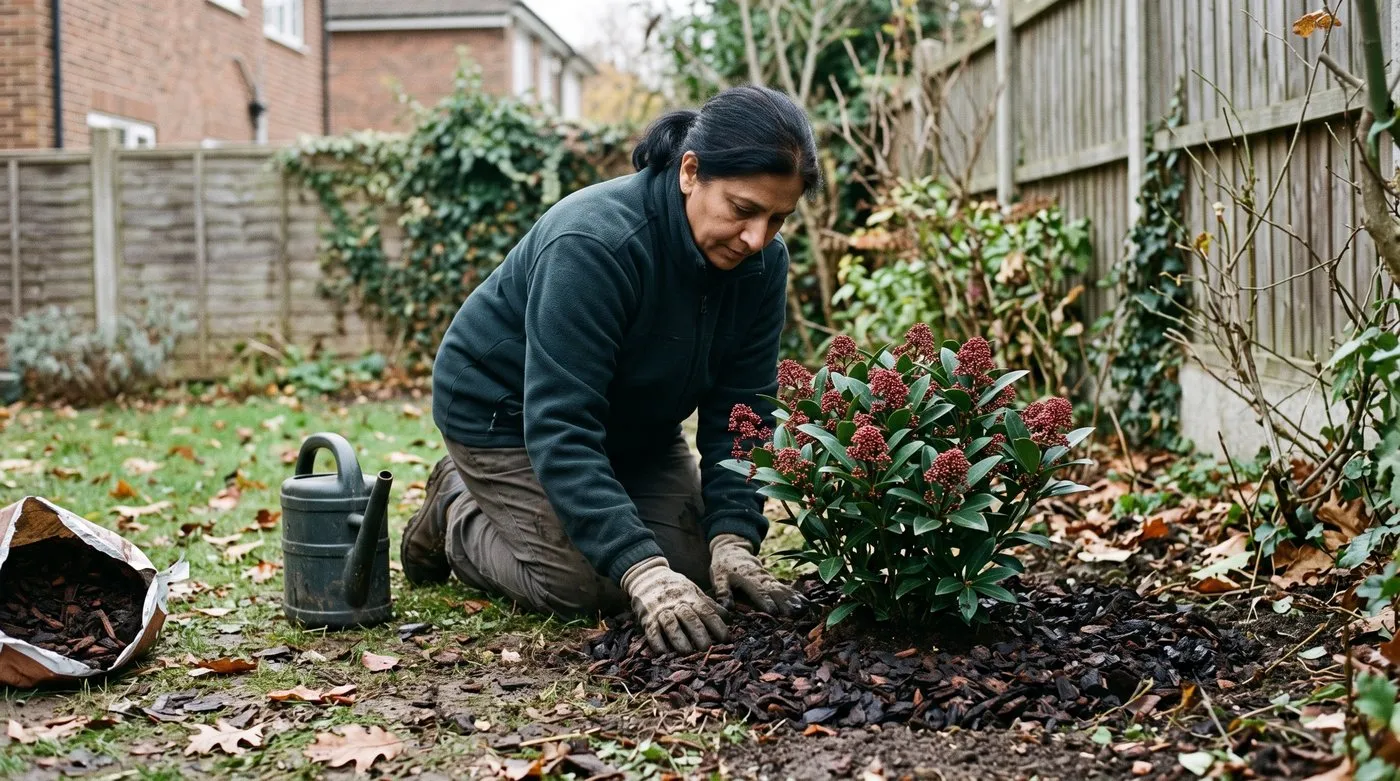
Keep the bark mulch a hand’s width away from the stems. It keeps the roots cool and moist and helps the soil stay slightly acid.
Growing skimmia in pots
Skimmia is one of the best evergreen shrubs for containers and is happy in a pot for years. If your soil is chalky, a pot is the way to go.
 Skimmia is happy in a pot on a shady patio, flowering each spring with no direct sun at all.
What you need:
- Pot: At least 40cm wide and deep. Terracotta or stone helps protect roots from sudden hot and cold
- Compost: Ericaceous compost only. Don’t add garden soil
- Drainage: Make sure there are drainage holes in the bottom
- Spot: North or east-facing, or anywhere shady. Avoid south and west-facing spots with afternoon sun
Feeding pots through the year:
| When | What to feed |
|---|---|
| April to June | Ericaceous liquid feed every couple of weeks |
| July | Stop feeding so new growth firms up before winter |
| September | A sprinkle of slow-release ericaceous granules |
Repot every three or four years into a slightly bigger pot, or trim the roots a little and put it back in the same pot with fresh ericaceous compost. March, just before new growth, is the best time.
How to get berries on your skimmia
You need three things: a female plant, a male plant close by, and insects about when it flowers in April and May.
Most often, the missing piece is the male. Garden centres don’t always label plants clearly, so it’s easy to end up with all males or all females. Check the label, or look at the flowers. Male flowers have obvious yellow stamens dusted with pollen. Female flowers have a small green bump in the middle and no pollen.
Only got room for one plant? Choose S. j. subsp. reevesiana, which berries without a male. The berries are a little smaller and it’s slightly less hardy.
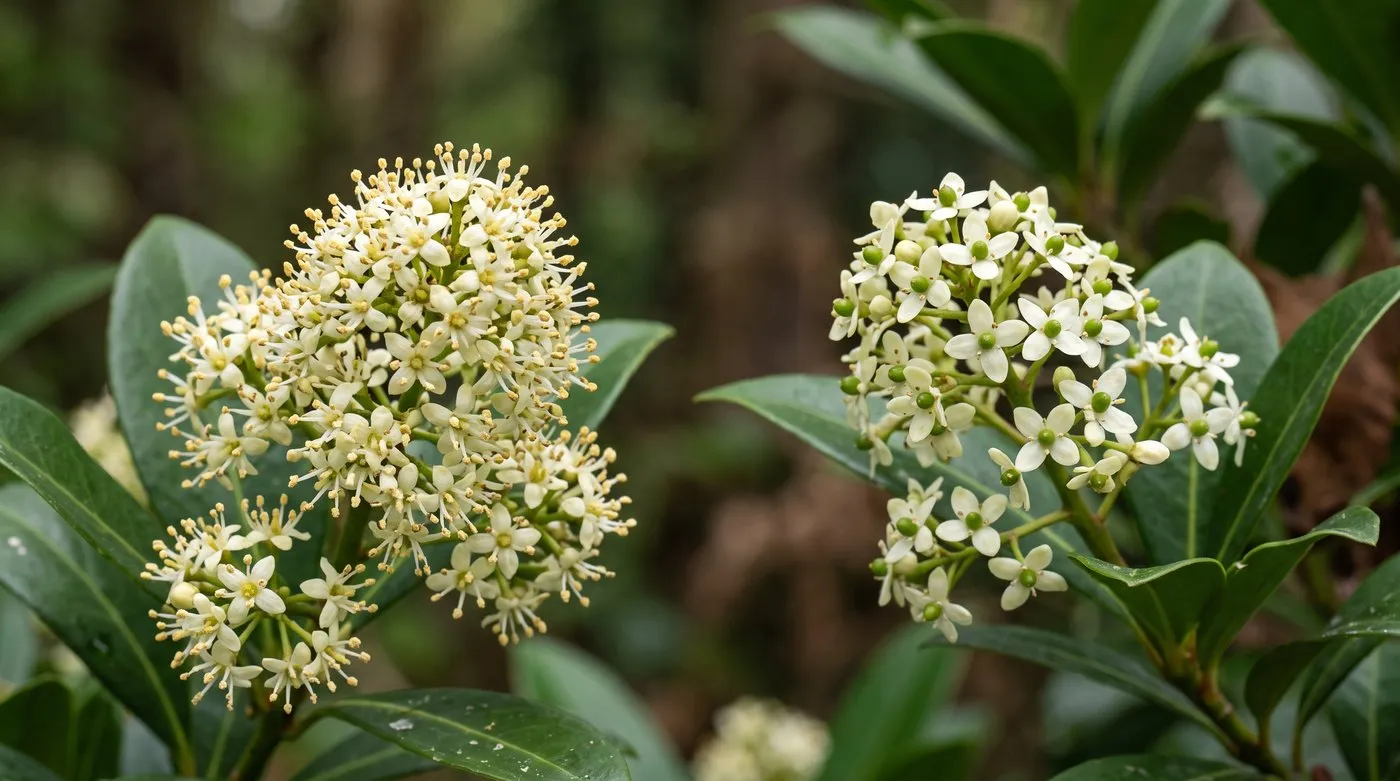
Look closely in April and May. Pollen-dusted yellow stamens mean a male, and a little green bump in the middle means a female that can berry.
Skimmia care through the year
| Month | What to do |
|---|---|
| January | Check new plants haven’t been loosened by wind. Firm the soil around them. |
| February | Spread a 5cm mulch of pine bark or bracken. Check leaves for yellowing. |
| March | Plant new skimmias. Start feeding pots. Repot if needed. |
| April | Flowers open. Make sure a male is nearby. Watch for late frosts on flowers. |
| May | Flowering ends. Trim lightly only if you really need to. |
| June | Water new plants weekly. Feed pots every couple of weeks. |
| July | Stop feeding. Water in long dry spells. Check stems for scale insects. |
| August | Green berries forming on female plants. Keep watering first-year plants. |
| September | Give pots slow-release ericaceous feed. Get ready for autumn planting. |
| October | Berries turn red. Plant new skimmias. Water established plants less. |
| November | ’Rubella’ buds turn deep red. Only water if the soil is very dry. |
| December | Enjoy the berries and buds. Cut a few stems for winter vases. |
Skimmia fits right into a winter garden planting scheme. Pair it with hellebores, winter heathers and sarcococca for colour from October to April.
Common skimmia problems
Yellow leaves. The most common problem, usually because the soil is too chalky. Test your soil. For potted plants, repot into fresh ericaceous compost. In the ground, water with sequestered iron and mulch well with pine bark. That only helps for a season, so if the yellowing comes back, move the plant into a pot.
Brown leaf edges. Too much sun or cold, drying wind. Move pots into deeper shade. In the ground, put up a temporary windbreak or plant another shrub on the exposed side. The damaged leaves won’t recover, but new growth will be fine.
Scale insects. Small brown, limpet-like bumps on stems and under leaves. They suck sap and leave sticky honeydew, which can turn black with sooty mould. Scrape off light attacks by hand. For worse cases, use a fatty acid bug spray from a garden centre in May and July, when the young insects are on the move.
Horse chestnut scale can also turn up on skimmia, especially in towns. Look for white, cottony egg masses on stems in June and scrape them off by hand.
 Skimmia ‘Kew Green’ has creamy, scented flowers in spring that bring in early bees when little else in the shade is flowering.
How to take skimmia cuttings
Skimmia roots best from semi-ripe cuttings taken in August or September.
How to do it:
- Choose healthy side shoots from this year’s growth, without flowers, 8-10cm long
- Cut just below a leaf joint with a clean blade
- Remove the lower two pairs of leaves
- Dip the end in rooting powder
- Push into a half-and-half mix of perlite and ericaceous compost
- Cover with a clear plastic bag or pop in a propagator
- Keep somewhere warm with bright, indirect light
- Roots take a couple of months, and not every cutting will take
Pot rooted cuttings on their own in spring and grow them on for a year before planting out. A cutting from a male plant grows into a male, and from a female into a female, so label them.
Seed is possible but slow. Clean the flesh from ripe berries in autumn and sow straight away in ericaceous compost, then leave the pot outside over winter. Seedlings take several years to flower, and you won’t know if they’re male or female until they do.
Skimmia and wildlife
Its dense evergreen leaves give birds shelter all year, and wrens, dunnocks and robins may nest inside. Early bees and hoverflies visit the spring flowers. The RHS page for Skimmia ‘Rubella’ is a good one to check before you buy.
Blackbirds and thrushes may eat the berries in winter, often later in the season when other food runs out.
Buy healthy plants from a reputable nursery and check them over for pests before planting.
For more shrubs that look good all year, see our guide to evergreen shrubs for UK gardens.
Frequently asked questions
Does skimmia need acid soil?
Yes, it does best in acid to neutral soil. On chalky or alkaline soil, the leaves turn yellow between the veins because the plant can’t take up enough iron. Test your soil with a cheap kit before planting. If it’s chalky, grow skimmia in a pot of ericaceous compost instead.
Why does my skimmia have no berries?
It’s usually missing a male plant. Most skimmias are either male or female. Only females carry berries, and only when a male grows close by to provide pollen. Check the labels: ‘Rubella’ and ‘Kew Green’ are male, while ‘Nymans’ and ‘Veitchii’ are female. Skimmia japonica subsp. reevesiana is the exception and berries on its own.
Can I grow skimmia in full shade?
Yes, skimmia copes with full shade better than most shrubs. It grows a bit slower there, but the leaves stay a deep, glossy green. Keep it out of full sun, especially hot afternoon sun, which scorches the leaves brown at the edges.
When should I plant skimmia in the UK?
Plant from September to November or March to April. Autumn is best, as roots settle in over winter. Avoid summer, when heat and dry soil stress new plants. Water well after planting and mulch with composted bark.
How do I prune skimmia?
Skimmia rarely needs pruning at all. It makes a neat dome shape on its own. If you need to tidy it, do it lightly after flowering, shortening stray stems. Don’t cut back into bare old wood, as it’s slow to regrow. Hard pruning cuts off next year’s flowers and berries.
Can I grow skimmia in a pot?
Yes, it’s one of the best evergreens for pots. Use one at least 40cm wide and deep, filled with ericaceous compost. Keep it somewhere shady. Water with rainwater if you can, as hard tap water makes the compost less acid over time. Repot every three or four years.
Is skimmia poisonous to pets?
Yes, all parts are harmful if eaten. The berries and leaves can upset a pet’s stomach. They taste bitter, so most animals don’t eat much. Still, plant it away from spots where pets like to chew.
Our team produces practical UK gardening guidance from source research, contributor records and established horticultural practice. Editorial standards are overseen by Matt W.


