
Key takeaways
- Autumn and winter kinds together give months of cyclamen flowers
- Plant tubers 2 to 3cm deep in summer under deciduous trees or by a shady wall
- They're fully hardy and happy to be left alone in soil that drains well
- They seed themselves and slowly spread into carpets
- Soggy soil kills more cyclamen than cold does
- All parts are toxic to cats and dogs, especially the tubers
Hardy cyclamen are one of the loveliest ways to brighten shady ground from late summer right through to spring. These aren’t the tender pot plants sold in supermarkets. They’re tough, long-lived plants that are happy under trees, along hedges and in north-facing borders all over Britain.
Two kinds are the stars. Cyclamen hederifolium flowers from August to November, with pink or white swept-back petals above ivy-shaped leaves. Cyclamen coum takes over from January to March with rounded leaves and little magenta flowers. Together they give months of flowers when most gardens are quiet. And they ask for almost nothing in return.
Which cyclamen grow outdoors in the UK?
Two kinds are reliably hardy all over the UK, and both have the RHS Award of Garden Merit.
Cyclamen hederifolium (ivy-leaved cyclamen) is the toughest and most popular. It flowers from August to November, with pink or white flowers on short stems. The leaves come after the flowers and last through winter until about May. Every leaf has its own silver marbling, so the foliage is as pretty as the flowers.
Cyclamen coum flowers from January to March, often through frost and snow. It’s shorter, with rounded flowers in magenta, pink or white and dark, rounded leaves.
| C. hederifolium | C. coum | |
|---|---|---|
| Flowers | August to November | January to March |
| Colours | Pink, white | Magenta, pink, white |
| Height | Short | Very short |
| Leaves | Ivy-shaped, silver marbled | Rounded, dark green, sometimes silvery |
| Spreads by seed | Freely | Steadily |
If you get hooked, Cyclamen purpurascens flowers in summer and is scented. Cyclamen repandum flowers in spring but needs a sheltered garden in the south.
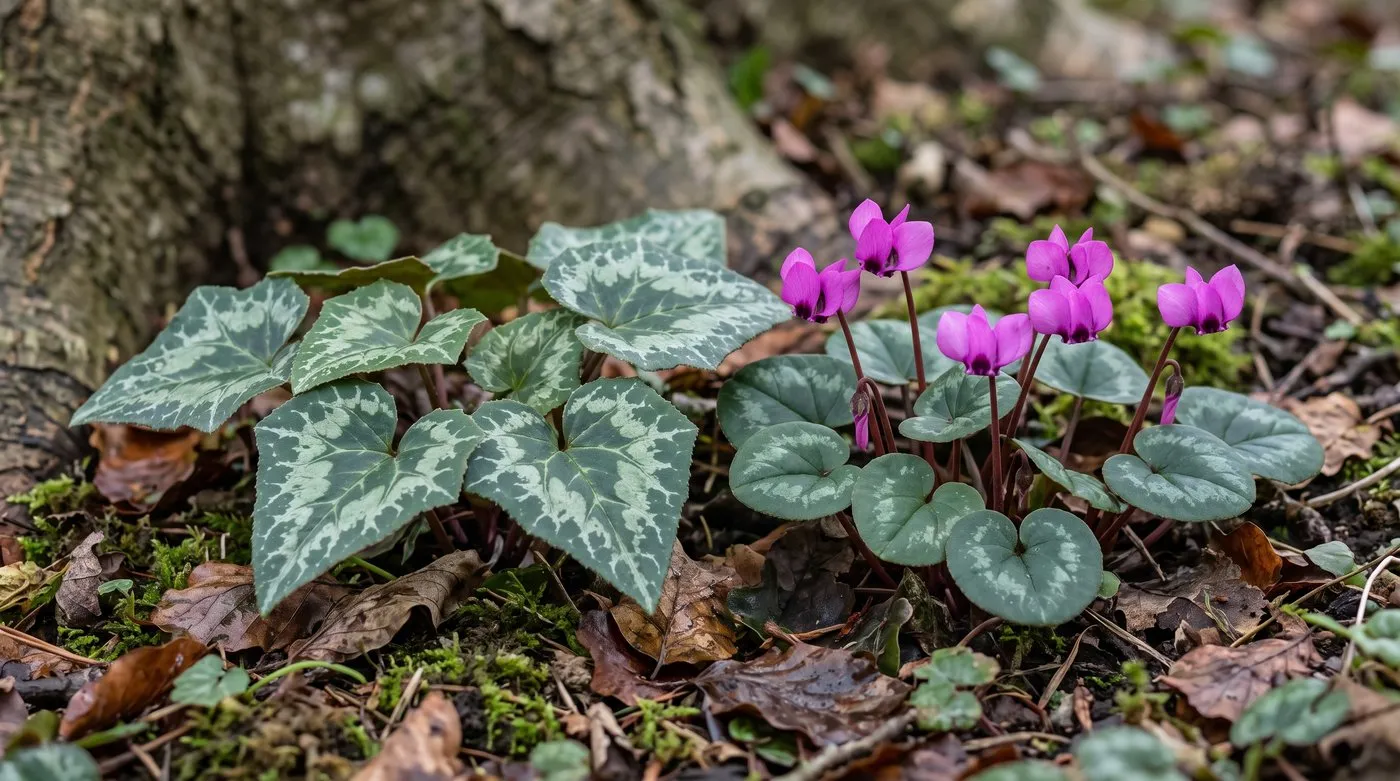
Ivy-leaved cyclamen has pointed, marbled leaves and flowers in autumn, while Cyclamen coum has rounded leaves and flowers from January.
Where is the best place to plant cyclamen?
Under deciduous trees is perfect. The leaves give shade in summer while the tubers rest, and the bare branches let in light in winter when Cyclamen coum is flowering.
The foot of an oak, beech or birch is a classic spot. Cyclamen cope with the dry shade under trees better than most plants. They also do well along the base of north-facing walls and hedges, under big shrubs and in raised beds that drain well.
Avoid:
- Hot, dry, sunny banks, where leaves scorch and flowering is short
- Soggy hollows or heavy clay that hasn’t been improved
- Deep shade under conifers
- Borders you dig over often
How do I plant cyclamen tubers?
Plant resting tubers in summer: July to September for Cyclamen hederifolium, and August to October for Cyclamen coum. They then root in before flowering.
Step by step:
- Dig a shallow hole about 5 to 8cm deep and 15cm wide
- Add a handful of leaf mould and a handful of grit to the bottom
- Set the tuber so its top is 2 to 3cm below the surface. The smooth, rounded side goes down, and the flatter or dipped side with the buds goes up
- Fill in with half soil and half leaf mould
- Top with a thin layer of fine gravel or composted bark
- Water once, then leave it be unless the soil is bone dry
Spacing: Plant 15 to 20cm apart for a good show in a couple of years. Space them 30cm apart if you’re happy to wait a few years for seedlings to fill the gaps.
Pot-grown plants in leaf are easier for beginners, because you can see exactly what you’re getting. Plant them at the same depth they sat in the pot. September to November is best for Cyclamen hederifolium, and February to March for Cyclamen coum.
 Planting tubers in summer under trees, smooth side down and buds facing up.
Looking after cyclamen through the year
Hardy cyclamen love being left alone. Too much water or feed causes more trouble than British weather ever does.
Watering: Once settled, they don’t need watering. Rain is enough in all but the driest years. Water new tubers once at planting. Don’t water while they’re resting in summer unless there’s a long drought.
Feeding: A light sprinkle of leaf mould in autumn is all they need. Skip high-nitrogen fertilisers, which give soft, weak leaves. Our guide to home-made leaf mould shows how to make your own for free.
Mulching: A thin autumn mulch of leaf mould or bark, no more than 1 to 2cm, copies the leaf litter of a woodland floor. A thick layer smothers flower buds and seedlings.
Deadheading: No need. After flowering, the stems coil down like springs and pull the seed pods to the ground, ready to seed.
Cyclamen month by month
| Month | C. hederifolium | C. coum |
|---|---|---|
| January | Leaves looking lovely. Nothing to do. | Flowers start in mild areas. |
| February | Leaves still out. Mulch with leaf mould if bare. | Flowering at its best. Enjoy them! |
| March | Leave the leaves alone. | Still flowering. |
| April | Leaves start to yellow. Let them die back. | Flowers fade and seed pods form. |
| May | Leaves die back and tubers rest. | Leaves yellow and seeds ripen. |
| June | Resting. Mark where they are. | Resting. |
| July | Plant new tubers. Top with grit. | Resting. Plant new tubers from August. |
| August | First flowers. Seedlings pop up. | Plant new tubers now. |
| September | Flowering at its best. Plant pot-grown ones. | Keep planting tubers. |
| October | Still flowering, and leaves appear. | First leaves in mild autumns. |
| November | Last flowers. Leaves spreading. | Leaves appearing, buds forming. |
| December | Leaves at their best. | Buds pushing through. |
How do cyclamen spread?
Cyclamen have a clever trick involving ants. After flowering, the stem coils down and pulls the seed pod to ground level. When the pod opens, each seed has a sticky, sugary coating that ants love.
Ants carry the seeds off, eat the coating and leave the seed in a nice spot to grow. Snowdrops and primroses spread in the same way. That’s how cyclamen pop up a little way from where you planted them.
Seedlings take a few years to flower. They start as a pea-sized tuber with a single leaf and usually flower in their third or fourth year.
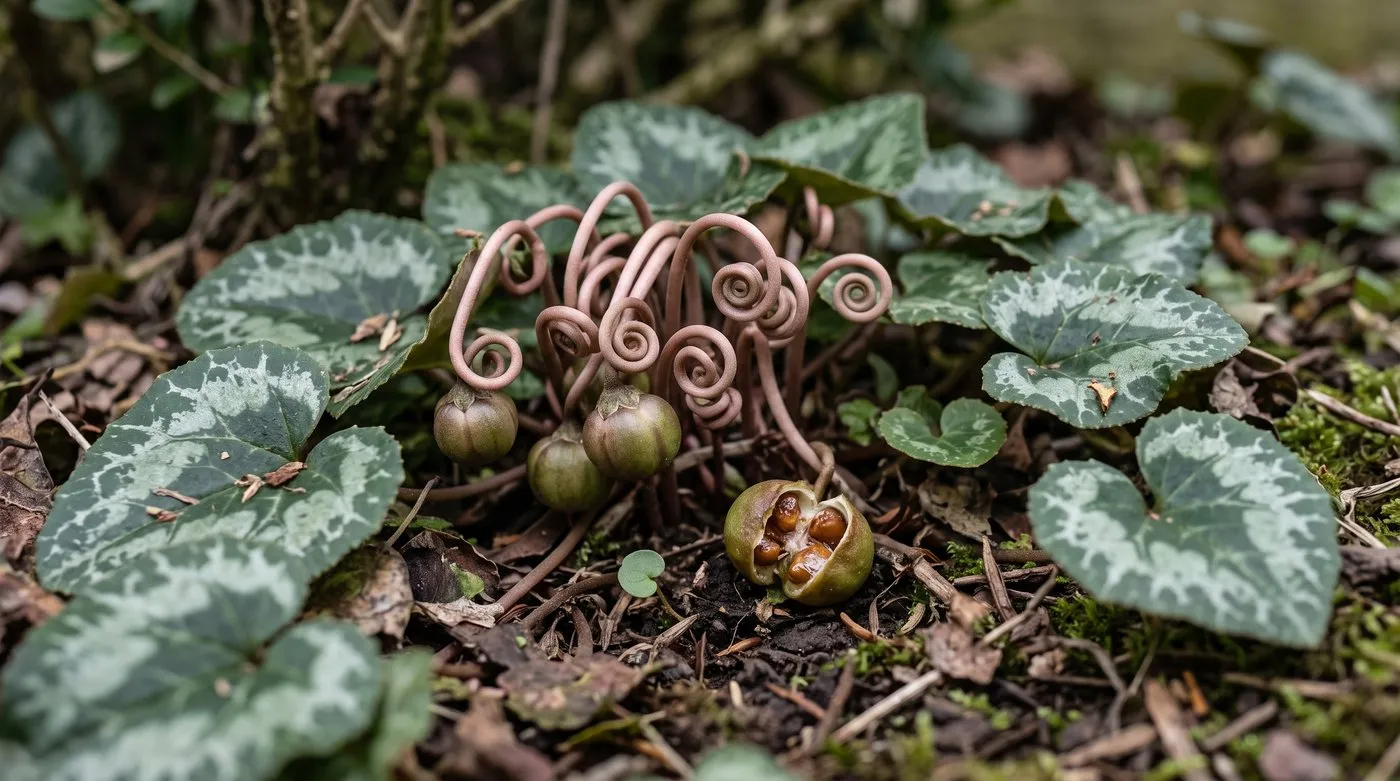
After flowering, the stems coil down like springs to bring the seed pods to the ground. Ants then carry the sticky seeds off to new spots.
What grows well with cyclamen?
Pair them with other shade lovers that won’t smother them or crowd their roots.
Good companions:
- Snowdrops flower in February alongside Cyclamen coum for a pink and white carpet
- Hellebores add taller flowers above the cyclamen from winter into spring
- Hardy ferns unfurl just as cyclamen leaves die back, covering the bare ground
- Epimedium brings dainty spring flowers and evergreen leaves
- Ground cover plants such as lesser periwinkle (Vinca minor) weave between them without taking over
Keep away from:
- Thuggish spreaders like spotted dead-nettle and bugle
- Dense grasses that compete for the shallow root space
- Plants that need regular digging, dividing or feeding
 A carpet of Cyclamen hederifolium under a beech hedge. Pink and white forms seed about to make lovely ground cover.
Can I grow cyclamen in pots?
Yes, hardy cyclamen grow well in pots. Use a wide, shallow pot rather than a deep one. A terracotta pan 25 to 30cm across suits one big tuber or three or four smaller ones.
Compost: Mix John Innes No. 2 with plenty of grit and some composted bark, so it drains freely but holds a little goodness. Our peat-free compost guide covers good options.
Pot care is a little different. Water lightly in the growing season when the top 2cm of compost is dry, as pots dry out faster than the ground. In a long, hard freeze, move pots somewhere sheltered, because compost in a pot stays frozen much longer than garden soil.
Florist’s cyclamen (Cyclamen persicum) is a houseplant and must be indoors before the first frost. Keep it on a cool windowsill, away from radiators. It flowers through winter and rests in summer.
Common cyclamen problems
Vine weevil is the worst pest. The cream grubs eat the roots and tubers from autumn to spring, especially in pots. Water on a nematode treatment in late summer or early autumn. Our biological pest control guide explains how.
Squirrels and mice dig up new tubers. Peg chicken wire flat over newly planted areas for the first season, and take it off once the tubers have rooted.
Grey mould can attack flowers and leaves in damp, still weather, showing as fuzzy grey patches. Thin out crowded patches and clear fallen leaves that trap wet.
Tuber rot from soggy soil is the biggest killer. The tuber goes soft, brown and smelly, and there’s no cure. Good drainage from the start is the answer. Dig out rotten tubers straight away.
Yellow leaves at the wrong time usually mean the plant has been too dry while growing or overfed. The tuber usually survives and makes fresh leaves next season.
Pets: All parts of cyclamen are toxic to cats and dogs, and the tubers most of all. Our guide to plants toxic to dogs has safer choices for pet-friendly borders.
Cyclamen for winter colour
Hardy cyclamen are among the few plants that flower reliably through the coldest months, which makes them a must for winter garden colour. Cyclamen coum usually opens in January. With snowdrops, hellebores and winter aconites, it makes a cheerful winter carpet under trees.
For colour from autumn to spring, try layering with a bulb lasagne approach. Set cyclamen tubers at 2 to 3cm, crocus at about 8cm and small daffodils at 12 to 15cm. Each layer flowers at a different time.
The RHS cyclamen growing guide is a lovely extra read if you want to try more kinds.
Frequently asked questions
Are cyclamen hardy in the UK?
Yes, the two main garden kinds are fully hardy. Cyclamen hederifolium and Cyclamen coum grow outdoors all over the UK, including Scotland and northern England. The florist’s cyclamen sold as a houseplant is different. It’s frost-tender and can’t live outside over winter.
When should I plant cyclamen tubers?
Plant them in summer while they’re resting. July to September suits Cyclamen hederifolium, and August to October suits Cyclamen coum. This gives them time to root before they flower. Pot-grown plants in leaf are even easier, as you can see what you’re buying.
How deep do you plant cyclamen tubers?
Just 2 to 3cm below the surface. Put the smooth, rounded side down and the flatter or dipped side, where the buds are, facing up. Planting too deep can make them rot. Cover them with a mix of leaf mould and grit rather than heavy soil.
Do cyclamen come back every year?
Yes, hardy cyclamen come back year after year. The tubers are very long-lived and get bigger over time. They also seed themselves, with ants carrying the sticky seeds away from the parent plant. Left alone, a patch slowly spreads into a carpet.
Can I grow cyclamen in full sun?
They’re happiest in dappled or partial shade. In hot, full sun on dry soil, the leaves scorch and flowering is shorter. Under deciduous trees is perfect. The leaves give shade in summer, and the bare winter branches let in light for Cyclamen coum to flower.
Why are my cyclamen not flowering?
New tubers often skip flowering in their first year. Planting too deep can also stop them. Soggy soil makes tubers rot before they can flower. If the tubers are healthy and in a good spot, just give them time. Most put on a proper show by their second season.
Are cyclamen poisonous to pets?
Yes, all parts are toxic to cats and dogs. The tubers are the most poisonous part and can cause vomiting, diarrhoea and drooling if eaten. Buried tubers are the main risk, so watch dogs that like to dig. If you think your pet has eaten some, call your vet.
Our team produces practical UK gardening guidance from source research, contributor records and established horticultural practice. Editorial standards are overseen by Matt W.


