Key takeaways
- Vinca minor is the most reliable evergreen ground cover for shade
- Creeping thyme and sedum are best for sunny spots and paving cracks
- Plant 30cm apart, about 9 plants per square metre
- Epimedium and Geranium macrorrhizum cope with dry shade under trees
- Evergreens like vinca and pachysandra keep weeds down all year
- Autumn is the best time to plant
Ground cover plants come in two handy groups. Shade-lovers like vinca and ajuga are happy under trees. Sun-lovers like creeping thyme and sedum spread over gravel, paving cracks and dry banks. Pick the right one for your spot and you’ll get a weed-free carpet instead of a patchy mess.
What makes a good ground cover plant?
A good ground cover plant spreads sideways into a thick mat that shades the soil. No light means weed seeds can’t get going. The best ones grow outwards rather than up, hold their own against other plants, keep their leaves for most of the year and need little care once settled.
How thick it grows matters more than how tall. A low mat of thyme keeps weeds out just as well as a knee-high clump of geranium, as long as there’s no bare soil in between. At 30cm apart, most ground cover knits together in a year or so.
Evergreen ground cover works all year. Ones that die back in winter, like many hardy geraniums, leave gaps for weeds. Mix the two to fix this. Epimedium with ajuga is a good pairing.
Best ground cover plants for shade
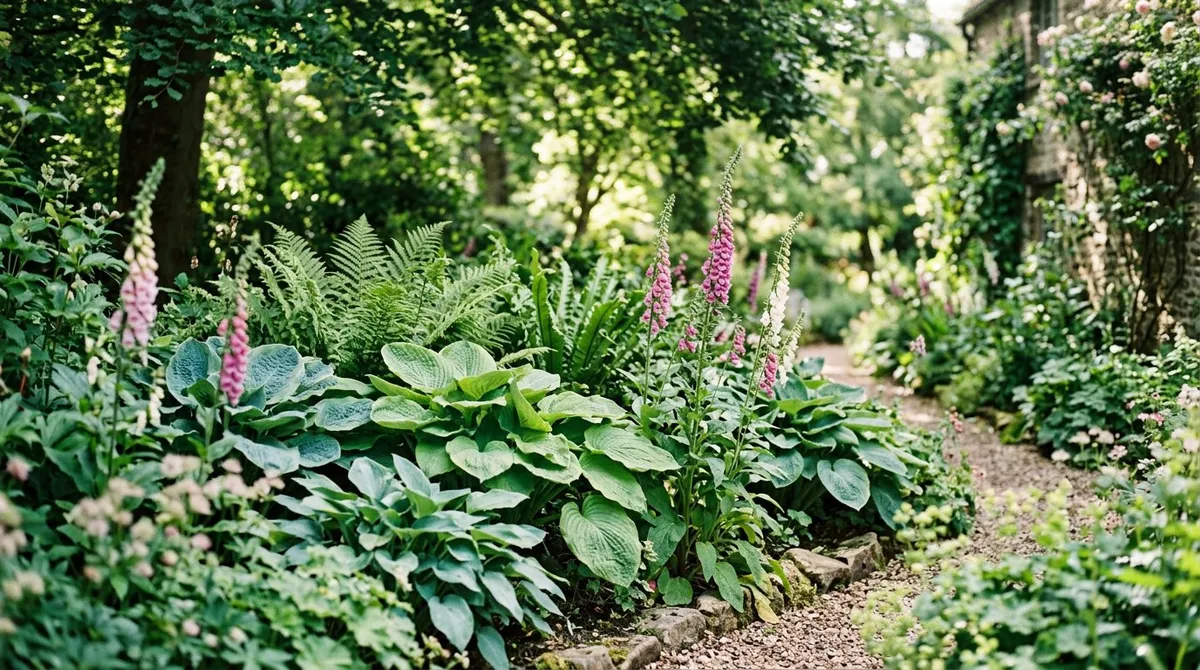
Shade is where ground cover really earns its keep. Grass struggles under trees and by north-facing walls, but these plants don’t mind. They cope with low light, thirsty tree roots and dry soil.
 Vinca minor makes a carpet of blue flowers in a shady corner, and a cosy hideout for hedgehogs.
Vinca minor (lesser periwinkle)
Vinca minor is the most reliable evergreen ground cover for shade. It grows about 15-20cm tall, spreads well and has blue-purple flowers from March to May. It copes with dry shade under trees, north-facing walls and poor soil. Once settled, it makes a mat weeds can’t push through.
Plant 30cm apart in autumn. If you plant in spring, water weekly through the first summer. Every 3-4 years, cut it back hard in March to keep it thick. It holds the RHS Award of Garden Merit. It’s lovely cover for hedgehogs and other wildlife too.
Ajuga reptans (bugle)
Ajuga is one of the fastest spreaders for shade. It sends out runners and can cover 60cm in a season. It grows just 10-15cm tall, with glossy purple-bronze leaves and blue flower spikes from April to June. ‘Atropurpurea’ has deep bronze leaves. ‘Burgundy Glow’ adds cream and pink.
It likes moist soil in part or full shade and struggles in dry, sandy ground. It’s happy on heavy clay. Plant 7-9 per square metre and it should cover the ground in a season. It may die back a little in a hard winter but bounces back in spring.
Epimedium (barrenwort)
Epimedium is the answer for dry shade under big trees. Once settled, it copes with tree roots, drought and deep shade. Most grow 25-35cm tall, with heart-shaped leaves that turn copper in autumn. Dainty flowers appear in April.
Epimedium x versicolor ‘Sulphureum’ is the toughest for dry shade. Epimedium grandiflorum has bigger flowers in pink, white or purple. Cut off the old leaves in February so you can see the spring flowers. Plant 30cm apart. It’s slow in its first year, then spreads steadily.
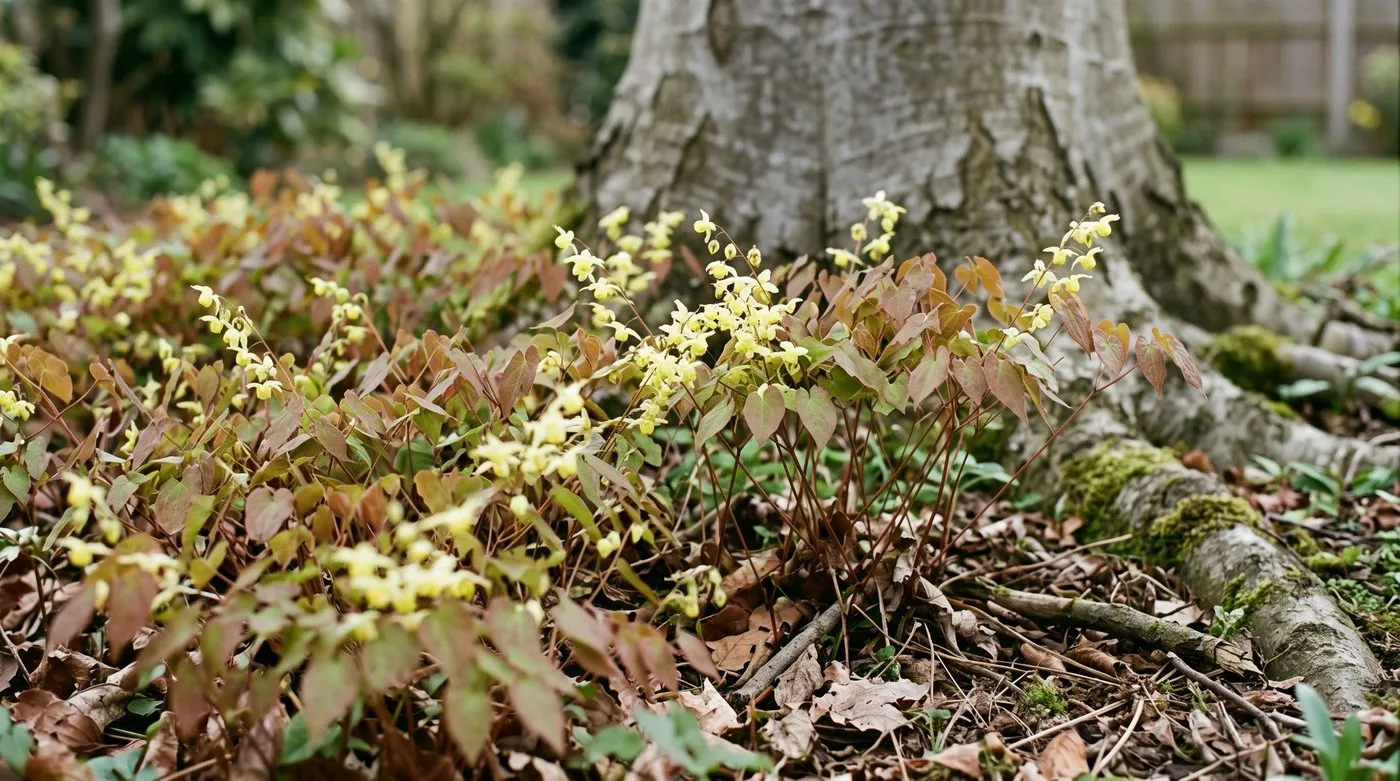
Epimedium copes with dry soil and tree roots where little else will grow. Cut the old leaves off in February so the flowers show.
Pachysandra terminalis (Japanese spurge)
Pachysandra makes a low evergreen carpet in the deepest shade. It spreads by underground runners and copes with north-facing walls, thick tree canopy and poor soil. The glossy leaves stay neat all year, with small white flowers in early spring.
It’s the go-to for spots where nothing else will grow. It’s slow to start, so allow 2-3 years for full cover, but then needs almost no care. It doesn’t like waterlogged soil or full sun. ‘Variegata’ has cream-edged leaves that brighten dark corners. For a faster, scented carpet in moist shade, sweet woodruff spreads quickly under trees and smells of fresh hay when you crush it. For silver-marked leaves and blue spring flowers, see our guide on how to grow brunnera, another good carpet for dappled shade.
Best ground cover plants for sun
Sunny ground cover needs to cope with heat, drought and poor soil. Lots of these plants come from the Mediterranean or the mountains. They tend to be low and tight, and many smell lovely when you step on them.
 Creeping thyme, yellow sedum and white erigeron fill the gaps in a sunny gravel garden. The cat approves.
Creeping thyme (Thymus serpyllum)
Creeping thyme is the best ground cover for sunny paving, gravel and paths. It grows just 5-8cm tall, spreads 30-45cm and is smothered in pink-purple flowers from June to August. Step on it and you get a warm herby scent. Bees adore it.
Plant in well-drained soil or gritty compost. It’s happy in gravel, between stepping stones and on sunny banks. Avoid heavy clay and shade. ‘Coccineus’ has deep crimson flowers and ‘Albus’ has white ones. Give it a light trim after flowering to keep it tidy. It’s one of the best drought-tolerant plants for UK gardens.
Sedum acre (biting stonecrop)
Sedum acre grows on almost nothing: thin soil, gravel, even cracks in walls. It makes a low mat of fleshy green leaves topped with bright yellow starry flowers in June and July. It’s a UK native you’ll spot on cliffs, old walls and railway banks.
It’s the easiest plant here. No watering, no feeding, no pruning. Plant rooted pieces 20cm apart in spring and it fills in within a season on well-drained soil. Rich, damp soil makes it rot. For something a bit taller, Sedum spurium grows to 15cm and comes in pink, red and white.
Erigeron karvinskianus (Mexican fleabane)
Mexican fleabane seeds itself into every gap and crack in a sunny garden. It grows 15-30cm tall and is covered in little daisies from May to November. The flowers open white and fade to pink, so the plant looks two-tone.
Plant it once and it pops up everywhere: gravel paths, wall tops, paving joints and the edges of raised beds. In milder parts of the UK it comes back every year. In colder spots a harsh winter may kill it, but seedlings soon take its place. Cut it back to 5cm in March.
Geranium macrorrhizum (bigroot cranesbill)
Geranium macrorrhizum grows in sun or part shade, so it’s the most adaptable plant here. It grows 30-40cm tall with scented, semi-evergreen leaves that turn red-orange in autumn. Pink, magenta or white flowers appear in May and June.
Best ground cover for slopes and banks
Steep banks are tricky. Soil washes away, mowing is risky and planting is awkward. Ground cover is the easy answer. Look for plants with strong roots to hold the soil and a spreading habit to cover it fast.
Geranium macrorrhizum is top choice for banks. Its thick roots grip the soil and its leaves shield it from heavy rain. Cotoneaster dammeri, evergreen with red berries, is great on bigger banks. Hypericum calycinum (rose of Sharon) spreads fast on dry banks and flowers from June to September.
For a wildlife-friendly bank, mix vinca minor with wild strawberry and bugle. You’ll get flowers through spring and summer, evergreen cover, and food for birds and insects. Our guide to lawn alternatives has more ideas for swapping grass on banks.
Ground cover between paving and paths
 Planting creeping thyme between paving slabs. It smells lovely every time you walk past.
Plants between paving turn a hard path into something living. The right ones cope with footsteps, drought and the heat bouncing off stone. They also mean less weeding between slabs.
Creeping thyme is the top choice. It handles light footsteps and gives off a lovely scent. Chamomile ‘Treneague’ is a non-flowering type made for paths and lawns. Mind-your-own-business (Soleirolia soleirolii) fills shady joints, but it’s invasive, so only use it where you can keep it in check.
To plant between existing paving, scrape out the old mortar or packed soil with a narrow trowel. Fill the gap with half multipurpose compost and half horticultural grit. Press small plug plants in during spring. Water daily for two weeks, then leave them to it.
Evergreen ground cover for year-round interest
Evergreen ground cover still looks good in winter. That matters in front gardens, along paths and in borders where bare soil looks scruffy from November to March.
| Plant | Height | Light | Evergreen | Flowers | Keeps weeds down |
|---|---|---|---|---|---|
| Vinca minor | 15-20cm | Shade or part shade | Yes | Blue, Mar-May | Very well |
| Ajuga reptans | 10-15cm | Shade or part shade | Mostly | Blue, Apr-Jun | Well |
| Epimedium | 25-35cm | Shade, even dry shade | Mostly | Various, Apr | Well |
| Pachysandra | 20cm | Full shade | Yes | White, Mar | Very well |
| Creeping thyme | 5-8cm | Sun | Yes | Pink, Jun-Aug | Very well |
| Sedum acre | 5cm | Sun | Yes | Yellow, Jun-Jul | Well |
| Mexican fleabane | 15-30cm | Sun | Mostly | White and pink, May-Nov | Fairly well |
| Geranium macrorrhizum | 30-40cm | Sun or part shade | Mostly | Pink, May-Jun | Very well |
| Cotoneaster dammeri | 20cm | Sun or part shade | Yes | White, May | Very well |
| Lamium maculatum | 15-20cm | Shade or part shade | Mostly | Pink or white, May-Jun | Well |
The stand-out evergreens are Vinca minor for shade, creeping thyme for sun and Cotoneaster dammeri for bigger areas and banks. All three stay thick through winter and need no cutting back until spring.
How to plant ground cover to keep weeds down
Keeping weeds down comes down to planting close enough and at the right time. Here’s how:
- Clear the ground. Take out all weeds, roots and all. For tough ones like couch grass and bindweed, let them regrow and dig them out again, or smother them with cardboard for 3-6 months first.
- Feed the soil. Dig in about 5cm of garden compost or well-rotted manure. Most ground cover isn’t fussy, but better soil means faster growth.
- Plant 30cm apart. That’s 9 plants per square metre. Stagger them in a zigzag rather than rows. It fills gaps faster and looks more natural.
- Mulch between plants. Spread 5cm of bark or woodchip around (not over) the new plants. This keeps weeds down while the plants knit together.
- Water weekly in the first summer. Even drought-lovers need regular water while their roots settle.
- Weed monthly in year one. Pull weed seedlings by hand before they get going. By year two, the plants should keep weeds down on their own.
Autumn planting, from September to November, gives the best start. The soil is warm, rain does the watering and roots grow through winter. Spring-planted ground cover needs more watering to get going.
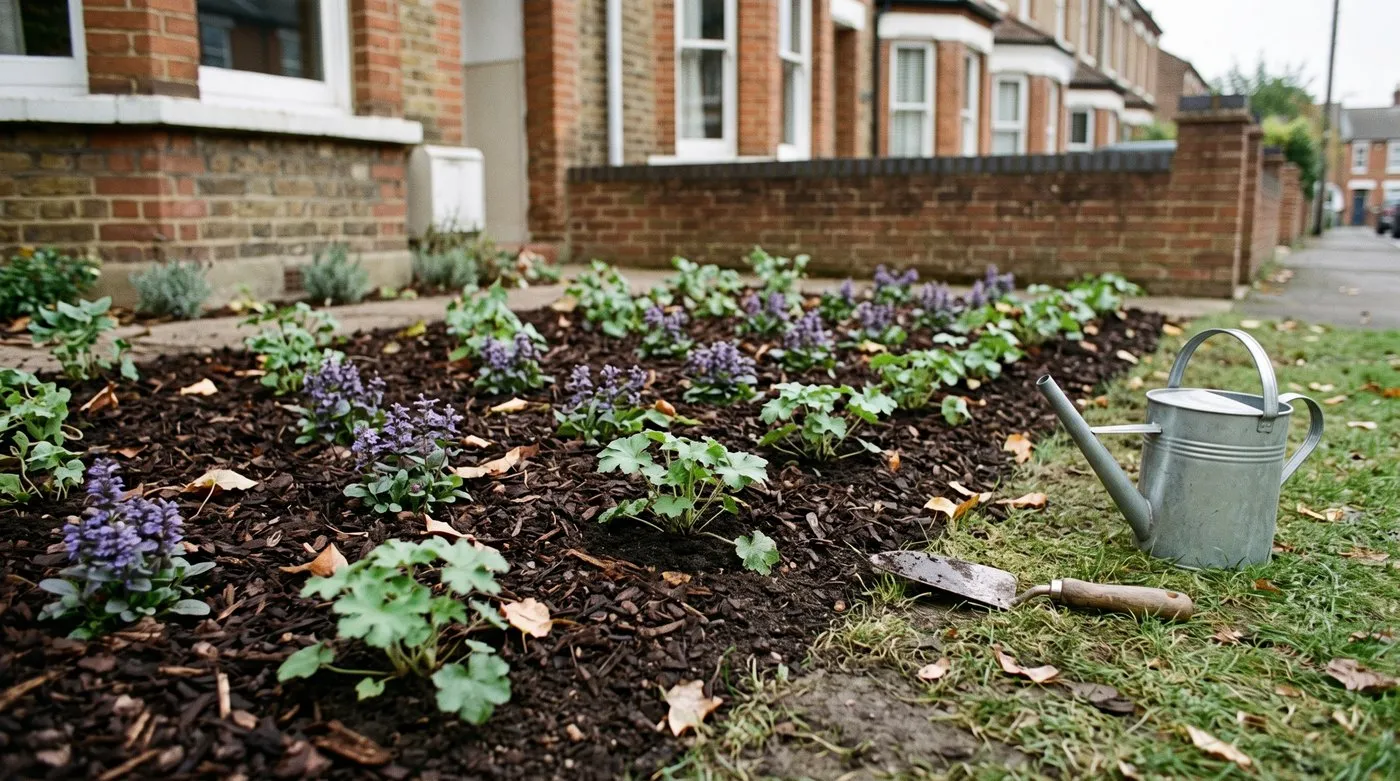
A zigzag at 30cm apart knits together faster than straight rows. The bark mulch holds weeds back until the plants meet.
Choosing ground cover for your garden
Match the plant to the spot, as no single ground cover suits everywhere. A shady north-facing border wants vinca or pachysandra. A sunny gravel path wants thyme or sedum. A steep bank wants Geranium macrorrhizum or cotoneaster.
Think about wildlife too. Ground cover gives shelter to hedgehogs, slow worms, beetles and other helpful creatures. Flowering ones like thyme, ajuga and fleabane feed bees and butterflies from spring to autumn. Thick evergreen cover keeps insects snug in winter.
For more ideas, see our guides to shade plants and perennials that go well with ground cover. Looking for something unusual? Plant Heritage looks after national plant collections and is handy for finding specialist varieties.
Frequently asked questions
What is the best ground cover to stop weeds UK?
Vinca minor is the best ground cover for keeping weeds down. Its thick evergreen mat shades the soil all year. Plant 30cm apart and it should fill in within a year or two. Pachysandra and Geranium macrorrhizum are just as good in shade. In sun, creeping thyme and Sedum acre form tight mats that leave weeds nowhere to grow.
What is the fastest growing ground cover plant UK?
Ajuga reptans is one of the fastest. It spreads by runners and can cover 60cm in a single season. Lamium and Persicaria affinis are quick too. For sunny spots, Mexican fleabane seeds itself about and fills gaps within months.
What ground cover grows in full shade UK?
Vinca minor, pachysandra and ivy all grow in full shade. Vinca minor is the pick, as it flowers in spring and stays neat. Pachysandra is slower to get going but makes a thick carpet. In deep shade, skip anything that needs a few hours of sun.
Can ground cover replace a lawn?
Yes, it’s ideal where lawns struggle. Shady spots under trees, steep banks and narrow side passages all suit ground cover better than turf. Creeping thyme and chamomile cope with light footsteps on paths. See our full guide to lawn alternatives for more options.
When is the best time to plant ground cover UK?
Autumn, from September to November, is best. The soil is still warm, there’s plenty of rain, and roots settle in before winter. Spring planting, March to May, works too, but you’ll need to water through the first summer. Don’t plant into frozen or waterlogged soil.
How many ground cover plants do I need per square metre?
Plant 9 per square metre, 30cm apart. That should give full cover in a year or so. Fast spreaders like ajuga and vinca need fewer, around 5-7. Slow ones like epimedium need the full 9. Planting closer fills in faster but costs more.
Is ground cover low maintenance?
Yes, much less work than a lawn or bare border. Once it’s settled, it keeps weeds down, holds moisture in the soil and never needs mowing. Just trim the edges, pull any weed seedlings in the first year and cut back overgrowth in spring.
Our team produces practical UK gardening guidance from source research, contributor records and established horticultural practice. Editorial standards are overseen by Matt W.