
Key takeaways
- Nothing takes heavy wear like grass, so lay stepping stones on everyday routes
- A grass and clover mix is the most practical swap for a family lawn
- Chamomile and creeping thyme need sun and sharp drainage, and only take light feet
- Moss is the answer for deep, damp shade where grass gives up
- Plant ground cover plugs in spring and water them until they knit together
Think about how many summer Saturdays go on the lawn. Mowing, edging, feeding, weeding, watering it when it browns, then raking the moss out in spring. For all that effort, a closely mown lawn offers bees almost nothing to eat.
Ground cover plants are a gentler way to get a green space. Chamomile, thyme, clover and moss all form living carpets that need a fraction of the work. They’re especially handy in front gardens, where a postage-stamp lawn is more bother to mow than it’s worth. Some take light footsteps, some flower for months and some are happy in the shade where grass goes thin anyway. The RHS page on chamomile lawns and alternatives is a good extra read.
One thing to be honest about from the start: nothing takes a hammering like grass. If children play football on it every evening, keep at least some grass in the mix.
Why replace a lawn?
It makes sense when the lawn is more work than it’s worth, or when grass simply won’t grow well where you are. A standard lawn feeds hardly any wildlife, needs regular attention to stay green and sulks in shade, drought and heavy clay.
The maintenance burden
Weekly mowing from April to October adds up to a lot of weekends. Add in edging, spiking, feeding and weeding, and it’s a part-time job. Most ground cover needs a light trim at most.
Environmental cost
Fewer cuts means less petrol or electricity. No feed means nothing washing into the drains. And lawn weedkillers wipe out the clover and wildflowers that bees depend on. Flowering ground cover, or simply mowing less often, gives pollinators far more to eat.
Where grass fails
Grass struggles under trees, on steep banks, in deep shade and on wet clay. Choosing the right plants for shade is much easier than trying to make grass grow somewhere it clearly doesn’t want to.
Chamomile lawns
Chamaemelum nobile ‘Treneague’ is the classic grass-free lawn. It doesn’t flower, stays low and evergreen, and gives off a lovely smell of apples when you brush across it.
How to plant a chamomile lawn
Start by getting rid of all the grass and every perennial weed. Fork over the top 15cm, then rake it fine and level. Chamomile needs a sunny, open spot and light soil that drains freely. On heavy clay it won’t last.
Buy plug plants rather than seed. Because ‘Treneague’ doesn’t flower, it doesn’t set seed either, so plugs are the only option for this variety. Plant them in mid to late spring, 10-20cm apart depending on how big they are.
Water regularly until they’re established. You’ll need to weed by hand until the chamomile knits together, since lawn weedkillers would kill it too.
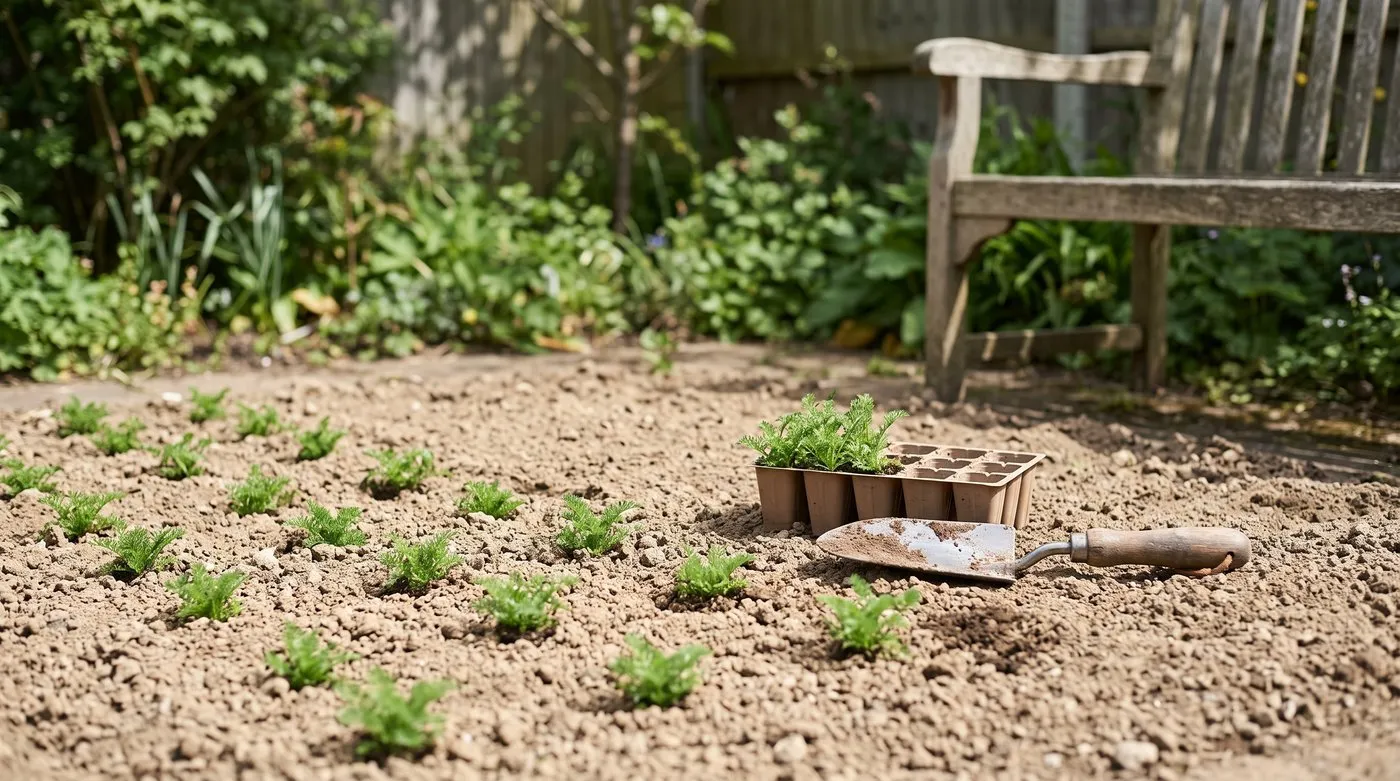
Clear every weed and rake the soil fine before planting. Chamomile needs full sun, light soil and about 12 weeks with no walking.
Maintenance
If it gets straggly, trim it lightly with shears in late summer. Water during long dry spells, and fill any gaps quickly before weeds move in. A very cold or wet winter can leave it patchy, so keep a few spare plugs in pots.
Limitations
Chamomile doesn’t like much foot traffic. A new lawn needs about 12 weeks with no walking at all, and after that it takes the odd gentle footstep. It’s lovely around a bench or as a scented path with stepping stones, but a game of football will wreck it. It also needs full sun, so it’s no use in shade.
Thyme lawns
Creeping thyme (Thymus serpyllum and its varieties) forms a low, flowering mat in pink, purple or white through summer. Bees and other pollinators can’t get enough of it.
It’s the better choice where chamomile would struggle: very free-draining soil, the drier east of England, or anywhere you can’t easily water.
Best varieties for lawns
- ‘Pink Chintz’: soft pink flowers over grey-green leaves
- ‘Snowdrift’: white flowers, lovely dotted among coloured ones
- ‘Coccineus’: deep crimson-pink
- ‘Elfin’: very tight and compact, good for small spaces and cracks in paving
Planting method
Thyme needs full sun and sharp drainage. Poor, sandy or chalky soil suits it perfectly; rich, heavy clay doesn’t. On heavy ground, work plenty of grit into the top 20cm before planting.
Plant plugs about 20cm apart between April and June. Alternating two or three varieties in a chequerboard gives a lovely patchwork effect once they flower.
Maintenance
Trim lightly after flowering to keep it neat. Don’t feed it, because thyme does best on poor soil. Once established it rarely needs watering.
Can you walk on creeping thyme?
Yes, gently. It copes with the occasional footstep and releases a wonderful smell when you do, but it isn’t hard-wearing.
Walk the same line every day and you’ll wear a bald path through it. Set stepping stones in along the route and let the thyme fill the gaps around them. Keep off it when the ground is wet or frosty. And bear in mind that a thyme lawn in full flower is busy with bees, so it isn’t one for bare feet in July.
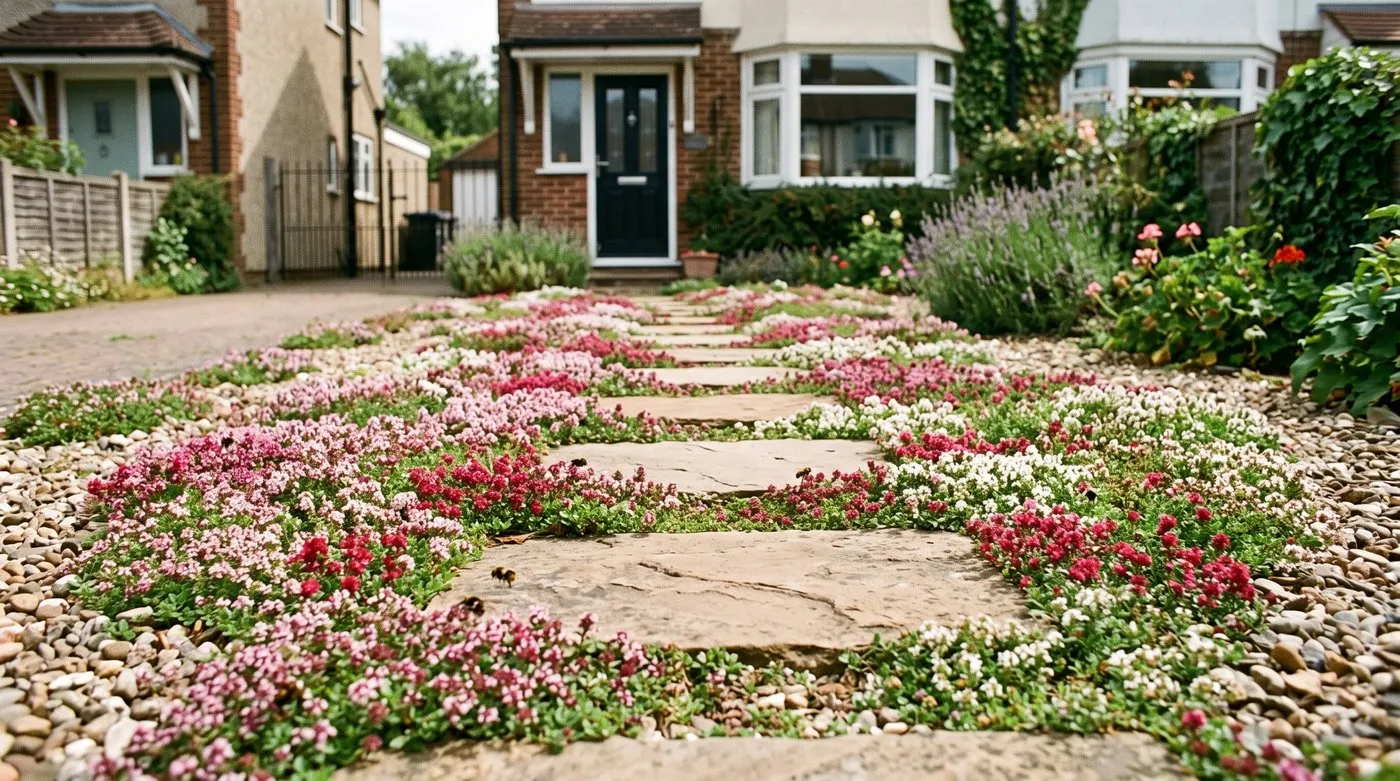
Thyme copes with the odd footstep, but not a daily route. Set stepping stones into it for a path and let the thyme grow round them.
Clover lawns
White clover (Trifolium repens) gives the most practical lawn for a garden that actually gets used. Small-leaved types, sold as micro-clover, are usually sown together with grass.
Why clover works
Clover makes its own nitrogen, so it stays green without any feed. It also has deeper roots than most lawn grasses and stays green in dry spells when grass has gone the colour of straw. And bees love the flowers. The RHS advice on clover in lawns explains more.
On its own, clover takes some foot traffic, but grass takes heavy wear better. That’s why most clover lawns are a mix of the two. It likes sun and doesn’t do well on very acid or waterlogged soil.
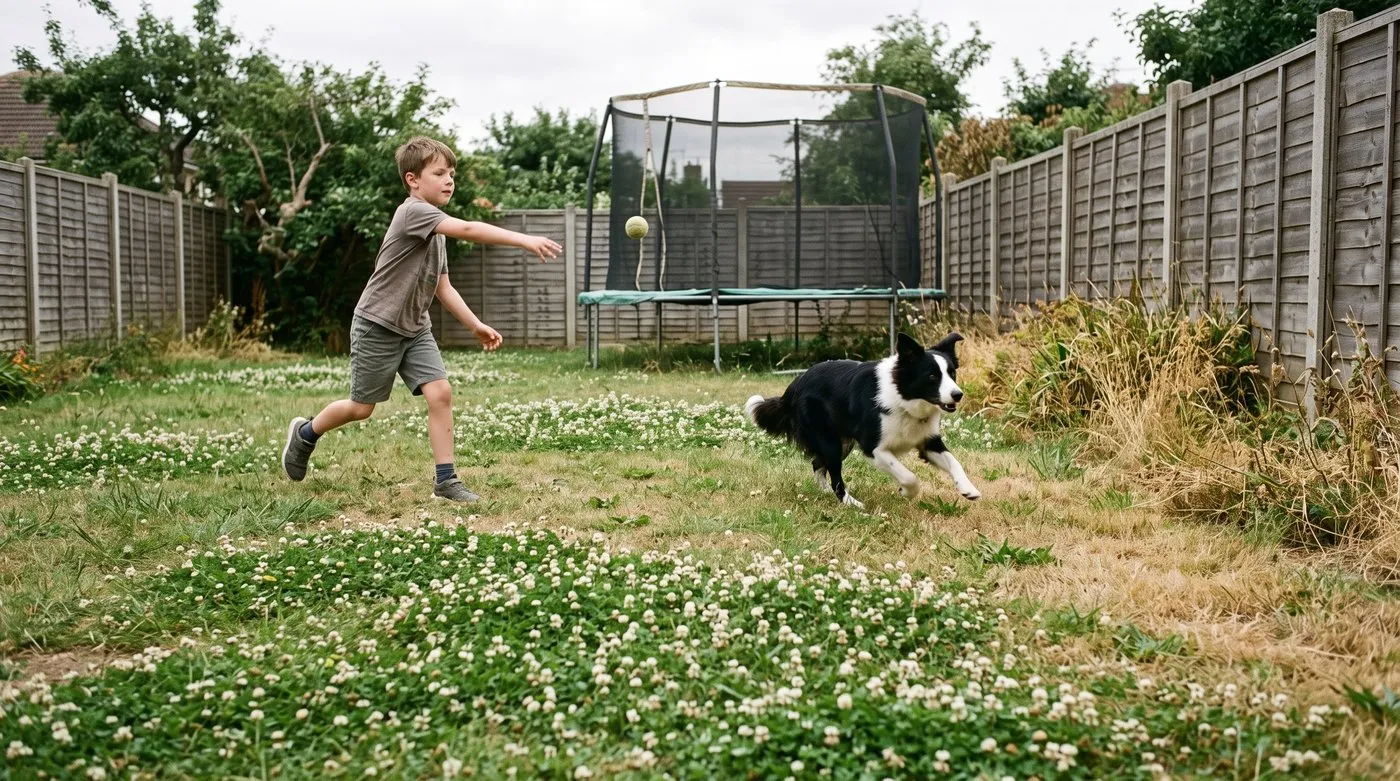
Clover feeds itself and stays green in dry weather. Mixed with grass, it makes a lawn that copes with real family use.
Establishing a clover lawn
Sow micro-clover in spring or early autumn, when the soil is warm and damp. Sowing rates vary between products, so follow the packet.
To add clover to your existing lawn, over-sow in spring. Mow short, rake hard to scratch up some bare soil, scatter the seed and keep it damp until it germinates.
Maintenance
Mow now and then on a high setting, and never scalp it. It needs no feeding at all. Because clover brings in the bees, try to mow after a flush of flowers has finished, or early in the morning when fewer bees are out.
Moss gardens
Moss is the answer for deep shade where nothing else will grow. If you’ve spent years fighting it under a tree or on a north-facing bank, try going with it instead.
Where moss thrives
Moss likes constant damp, shade and acid to neutral soil. It’s quite happy on hard, poorly drained ground, which is exactly where grass gives up. North-facing gardens, the ground under evergreens and shady courtyards all suit it.
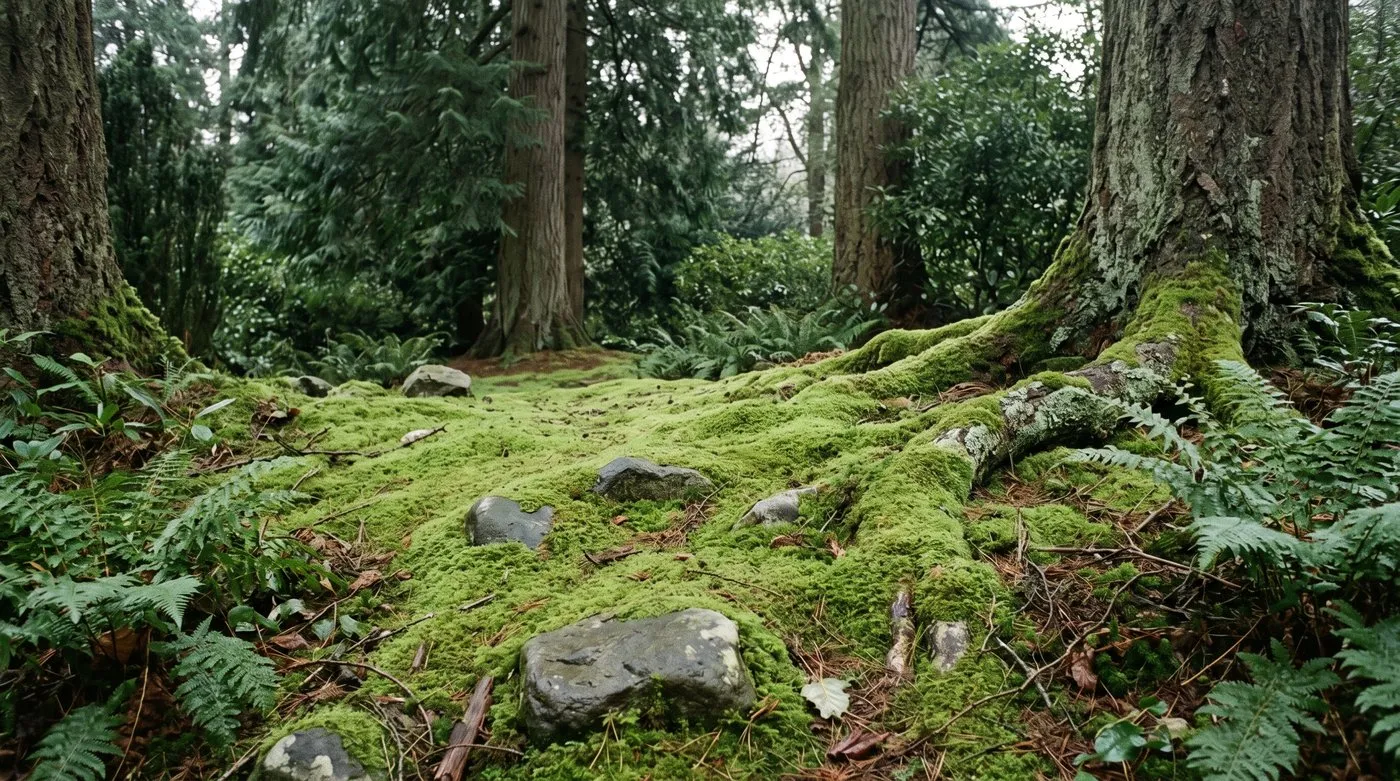
Where grass gives up in deep, damp shade, moss is happy. It needs no mowing or feeding, just clear the leaves off in autumn.
Establishing a moss garden
The easiest start is to encourage the moss you already have. Pull out the struggling grass and keep the area damp. Needless to say, put away the moss killer and lawn sand.
You can also move patches from elsewhere in the garden. Press them firmly onto damp, bare soil and keep them moist for the first month. Moss is slow to settle, but once it has, it lasts for years.
Maintenance
No mowing and no feeding. Water now and then in a long dry spell. In autumn, clear fallen leaves off it so they don’t smother it.
Gravel gardens
A gravel garden swaps the lawn for a hard-wearing, free-draining surface planted with tough, drought-loving plants. Beth Chatto’s famous gravel garden in Essex was planted on an old car park and has never been watered, which shows how well the style suits the drier east of England.
Installation method
- Lift the turf, taking off 5-8cm
- Level the ground and firm it down
- Lay a permeable woven membrane, not plastic sheeting, which traps water
- Spread 4-5cm of gravel on top
- To plant, cut a cross in the membrane and tuck the plant in
Angular gravel locks together and is much easier to walk on than round pebbles, which roll underfoot. Stones of about 10-20mm work well. Local stone is usually cheaper to have delivered, and it tends to look more at home too.
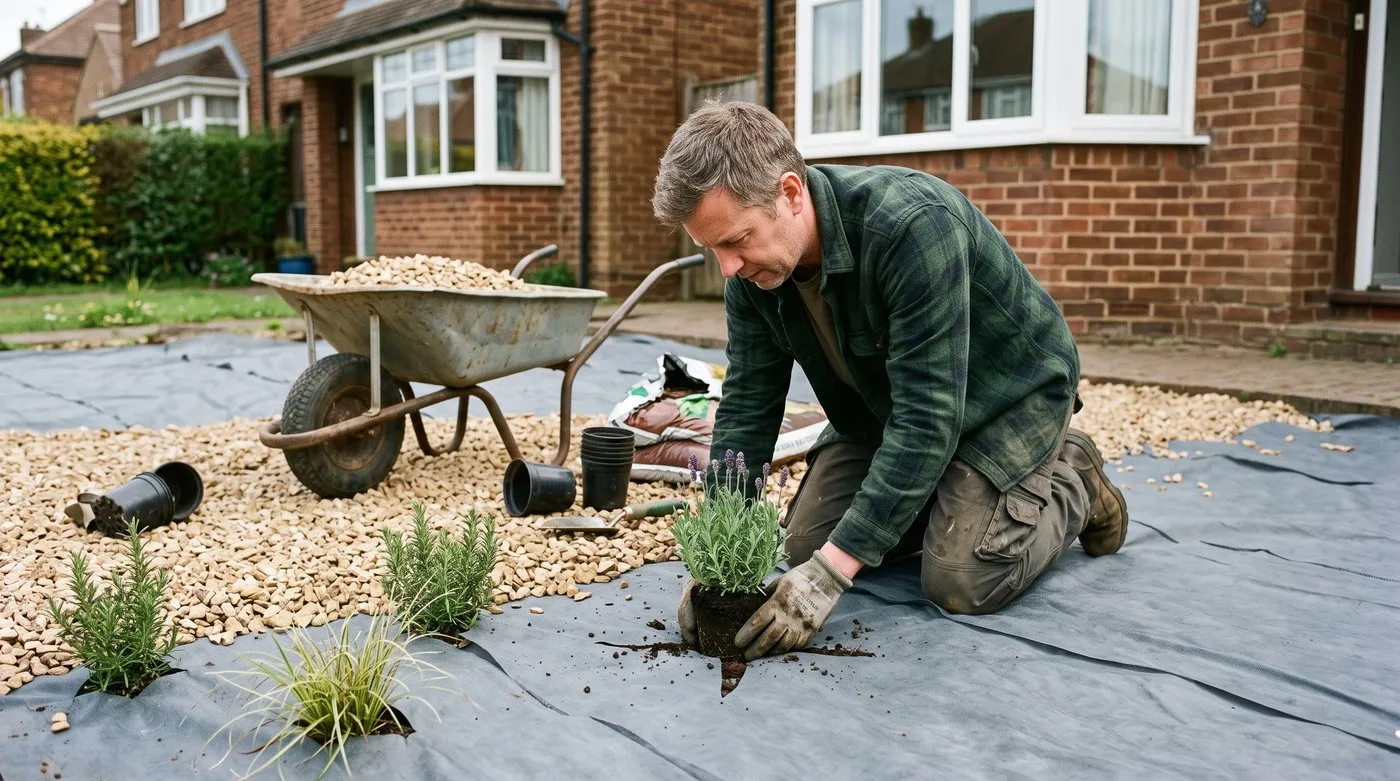
Use a permeable woven membrane, not plastic. Cut a cross to plant through it, then spread 4-5cm of angular gravel on top.
Planting into gravel
Mediterranean plants are made for gravel. Lavender, rosemary, cistus, Verbena bonariensis and ornamental grasses all thrive. These low maintenance plants pretty much look after themselves once they’re settled.
Water new plants through their first summer. From then on the gravel acts as a mulch, keeping the roots cool and the weeds down.
Is artificial grass a good lawn alternative?
It’s low effort, but it does nothing for wildlife or the soil. It’s plastic, with no flowers, no food and no shelter, and the worms and soil life underneath lose out.
There are practical downsides too. It gets surprisingly hot in strong sun, still needs brushing and cleaning, and dog wee can smell unless it’s rinsed off regularly. It’s also hard to recycle when it wears out. Gravel with tough plants, or a clover-rich lawn, gives you a low-effort space with real plants in it. And if the lawn is simply too much work, mowing less often and letting it flower is the easiest fix of all.
Bark mulch areas
Bark mulch makes a soft, natural surface under trees and in play areas. It’s kinder underfoot than gravel and slowly feeds the soil as it breaks down. Woodland-style corners and shady spots suit it well.
Installation
Clear the grass and weeds, then spread bark 8-10cm deep, either straight onto the soil or over a permeable membrane. Top it up every few years. Coarse pine bark lasts longest; softwood chips are cheaper but rot down faster.
Considerations
Loose bark slides about on a slope, so keep it to flat ground. Leave a small gap around plant stems and tree trunks so they don’t stay damp and rot.
Creeping Jenny and ajuga
These two spreaders are ideal for the gaps between stepping stones, under shrubs and along the front of borders.
Creeping Jenny (Lysimachia nummularia)
Creeping Jenny sends out trailing stems of small, round leaves, with yellow flowers in summer. The golden form, ‘Aurea’, glows in a shady corner. It spreads quickly in damp soil and is happy in part shade.
It won’t take being walked on, though. Use it between pavers, around a pond or as edging rather than as a lawn. In damp spots where other ground cover struggles, it’s brilliant.
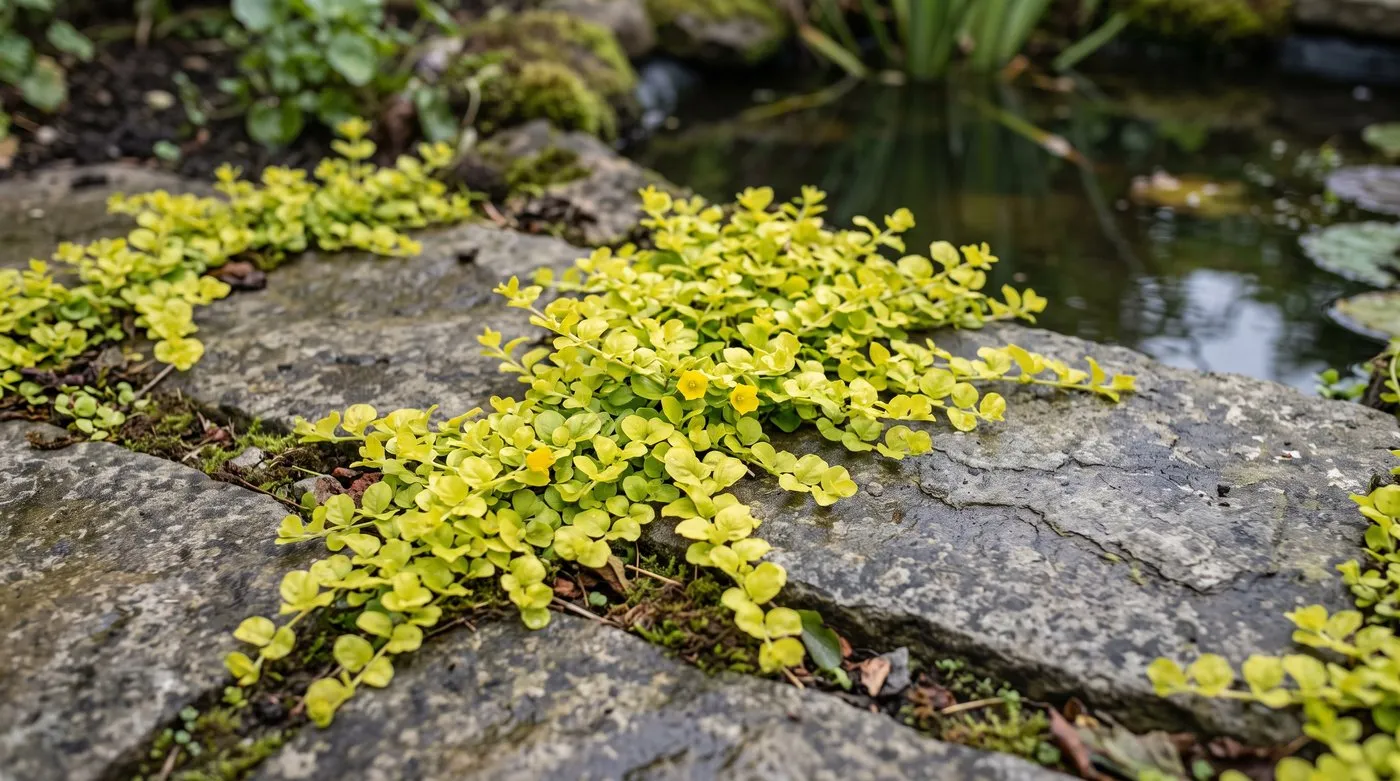
Creeping Jenny brightens damp, shady corners and gaps between pavers. It won’t take being walked on, so keep it off main routes.
Ajuga (Ajuga reptans)
Ajuga, or bugle, forms rosettes of glossy bronze-purple or variegated leaves, with spikes of blue flowers in spring. It spreads by runners into a weed-smothering mat and grows in sun or shade. ‘Atropurpurea’ has particularly lovely dark leaves.
Plant plugs about 15cm apart. Ajuga takes the odd light footstep, so it works in small, quiet areas. It’s especially useful in shade under trees. For a grassier look in the same sort of spot, liriope (lilyturf) makes evergreen, strappy clumps that never need mowing and flower purple in late summer and autumn.
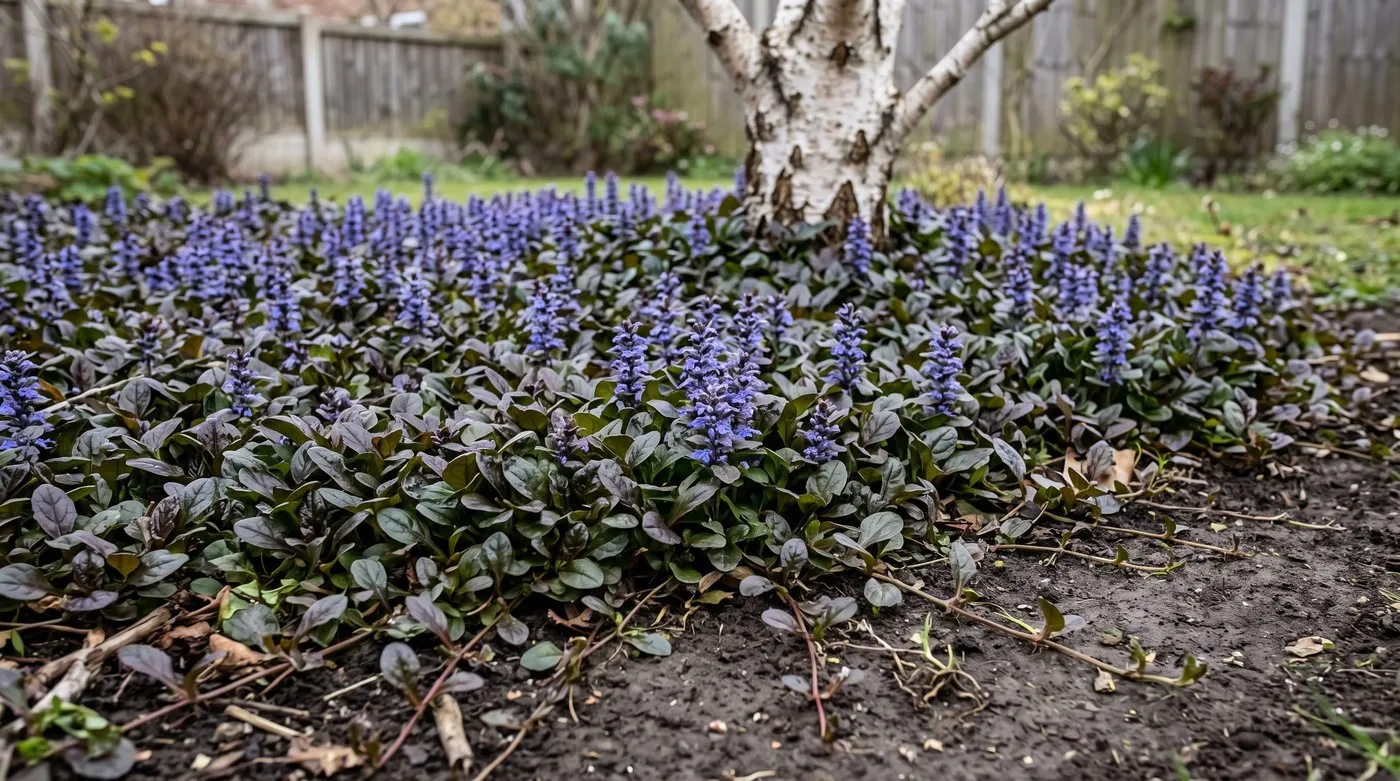
Ajuga spreads by runners into a weed-smothering mat in sun or shade. It’s especially useful under trees where grass goes thin.
Mind-your-own-business
Soleirolia soleirolii, also known as baby’s tears, forms a dense, bright green carpet only a few centimetres high. It looks a bit like a miniature lawn and spreads quickly in damp, sheltered shade.
Where to use it
It’s lovely in courtyards, along sheltered paths and in shady gaps between paving. In mild areas it stays green all year. A hard frost can knock it back, but it usually regrows in spring.
A word of caution
When it’s happy, it’s a thug. It creeps into borders, paving joints and lawns and is very hard to get rid of once it’s there. Keep it in with metal or plastic edging, and don’t plant it next to borders you want to keep tidy.
Ground cover comparison table
Use this to match the right option to your garden.
| Ground cover | Light | Can you walk on it? | Flowers | Spreads | Start from |
|---|---|---|---|---|---|
| Chamomile ‘Treneague’ | Sun | Lightly, now and then | None | Steadily | Plugs |
| Creeping thyme | Sun | Lightly, now and then | Summer | Steadily | Plugs |
| Clover (with grass) | Sun | Yes, some traffic | Summer | Fast | Seed |
| Moss | Shade | Lightly, now and then | None | Slowly | Moved patches |
| Gravel | Any | Yes | N/A | N/A | Membrane and stone |
| Bark mulch | Any | Yes, on flat ground | N/A | N/A | Bark chips |
| Creeping Jenny | Part shade or shade | No | Summer | Fast | Plugs |
| Ajuga | Sun or shade | Lightly, now and then | Spring | Steadily | Plugs |
| Mind-your-own-business | Sheltered shade | Lightly, now and then | Barely noticeable | Very fast | Plugs |
Best options by condition
Full sun, well-drained soil
Creeping thyme is the star here, shrugging off heat, drought and poor soil. Chamomile looks smarter but wants a bit more moisture and can’t cope with clay.
Partial shade
Ajuga does well here, and so does creeping Jenny if the soil stays damp. Clover prefers sun but will grow in light shade when mixed with grass.
Full shade
Moss, every time, as long as it’s damp. In a mild, sheltered spot, mind-your-own-business is a quick alternative.
Heavy foot traffic
Nothing beats grass for this. For a lawn the family plays on, a grass and clover mix is your best bet. Across other ground cover, put stepping stones, gravel or bark along the routes you use most.
Slopes and banks
Ajuga and creeping thyme both cope well on slopes, and their spreading roots help hold the soil together. On a steep bank, plant them through a biodegradable jute membrane while they get going.
Month-by-month planting and establishment calendar
| Month | What to do |
|---|---|
| January-February | Plan and order plug plants. Lift turf in mild, dry spells |
| March | Dig grit into heavy soil. Level and rake the ground |
| April | Plant chamomile, thyme, ajuga and creeping Jenny. Over-sow clover |
| May | Water new plants when dry. Hand-weed around the plugs |
| June | Keep watering new plants in dry spells. Thyme starts to flower |
| July | Water only in long dry spells. Enjoy the bees on the clover |
| August | Trim thyme after flowering. Tidy chamomile if straggly |
| September | Sow clover into thin lawns. Move moss into shady spots |
| October | Lay gravel and bark paths. Clear leaves off moss |
| November | Keep leaves off low ground cover |
| December | Plan the next patch and order materials for spring |
Common mistakes when replacing a lawn
Planting in the wrong season
Plugs planted late in autumn often don’t root in before winter. Spring planting gives them a whole growing season to settle.
Skipping soil preparation
Clearing weeds first matters more than anything else. Perennial weeds left in the ground will push through within weeks, and you can’t use lawn weedkiller on most ground cover. Dig out every scrap of couch grass, bindweed and dandelion root before you plant a thing.
Choosing the wrong plant for the conditions
Chamomile in shade fails. So does moss in full sun. Check your light, drainage and soil, then use the table above to choose.
Expecting instant results
It won’t look finished on day one. For the first few months you’ll see bare soil between the plants. Plant at the right spacing and keep weeding until they meet.
Neglecting watering during establishment
New plugs need regular watering until they root in, especially in a dry spring. Most ground cover is tough once settled, but the first summer decides whether it gets there.
Maintenance comparison: grass vs alternatives
| Job | Grass lawn | Chamomile | Thyme | Clover mix | Moss | Gravel |
|---|---|---|---|---|---|---|
| Mowing | Weekly in summer | Light trim | Trim after flowering | Now and then, high | None | None |
| Feeding | Regular | Rarely | None | None | None | None |
| Watering | To stay green in drought | Long dry spells | Rarely | Rarely | Dry spells | None |
| Weeding | Regular | By hand, often in year one | By hand | Now and then | Now and then | Now and then |
| Raking out thatch | Usually yearly | None | None | None | None | None |
How to transition from grass to ground cover
There’s no need to dig up the whole lawn in one go. Changing it bit by bit is less risky and spreads the cost.
Phase 1: Test a small area
Start with a patch roughly 2m by 2m. Choose the worst bit of lawn, such as a shady corner or the bank that turns brown every August. You’ll see how your chosen ground cover behaves before committing to more.
Phase 2: Expand gradually
Once the test patch is doing well, take on another area each spring. Use different plants in different spots: thyme in the sunny front garden, clover in the main lawn and moss under the trees.
Phase 3: Create a mixed setting
The nicest grass-free gardens mix several types of ground cover with paths, small garden design features and borders. A gravel path through thyme, with moss under an old apple tree, is far more interesting than a flat green rectangle.
Another way to mow less is to read our guide on how to create a wildflower lawn.
Frequently asked questions
What is the best lawn alternative UK?
For most gardens, a lawn with plenty of clover in it. White clover, often the small-leaved micro-clover sown with grass, takes everyday use, feeds itself and stays green when grass browns. Chamomile and thyme suit small, sunny, quiet spots, and moss is the one for deep shade.
Can you walk on a chamomile lawn?
Lightly, and not straight away. A new chamomile lawn needs about 12 weeks with no walking at all, and after that it copes with the odd gentle footstep. ‘Treneague’ is the usual variety. Lay stepping stones along any route you use every day.
How long does ground cover take to establish?
About one growing season from a spring planting. Water through dry spells and the plugs should join up by the end of the year. Planting closer gives faster cover but costs more. Keep weeding by hand until the plants meet.
Will clover take over my garden?
Rarely. Clover creeps, but it can’t outcompete thick, healthy grass, so in a mixed lawn it just fills the gaps. A hard edge such as a brick mowing strip keeps it out of the borders.
What ground cover grows in full shade?
Moss is the best choice for deep, damp shade. It grows where grass won’t and needs no mowing or feeding. Ajuga copes with shade and flowers blue in spring. Mind-your-own-business covers sheltered, damp shade quickly but is hard to keep in bounds.
Is a gravel garden cheaper than a lawn?
It costs more to lay but less to keep. Membrane, edging and stone add up compared with turf or seed. After that there’s no mowing, feeding or watering, just an occasional rake and weed, so you claw the cost back over the years.
Do lawn alternatives attract bees?
The flowering ones do, far more than short grass. Clover flowers are full of nectar and creeping thyme buzzes with bees all summer. Chamomile ‘Treneague’ doesn’t flower, so it does little for pollinators.
Our team produces practical UK gardening guidance from source research, contributor records and established horticultural practice. Editorial standards are overseen by Matt W.


