Key takeaways
- Bedding begonias, busy lizzies, fuchsias and torenia all flower well in shade
- Bedding begonias are the toughest choice for a gloomy spot
- Pick mildew-resistant busy lizzies like SunPatiens over old-style types
- Trailing fuchsias suit baskets, upright ones suit borders
- All are frost-tender, so wait until late May or early June to plant out
Shady corners, north-facing beds and gloomy pots don’t have to stay bare. With the right plants, busy lizzies, begonias, fuchsias and torenia, you can have colour from June until the first frost. Here are the best annuals for shade, when to plant them and how to make them shine in pots and baskets.
Which annuals genuinely tolerate shade in the UK?
Real shade annuals flower with only a few hours of direct sun a day. Watch out for “shade-tolerant” on plant labels. It often means light or partial shade, which is quite different from a north-facing wall or a spot under a big tree.
Not sure how shady your spot is? Count the hours of direct sun it gets on a clear day in June. Under 2 hours is full shade. 2-4 hours is partial shade. For permanent plants that suit shady spots, see our guide to best plants for shade in UK gardens.
| Annual | Shade | Height | Colours | Flowers |
|---|---|---|---|---|
| Busy lizzie (SunPatiens types) | Shade to part shade | 20-40cm | Pink, red, white, salmon, orange, lilac | June to October |
| Bedding begonia (semperflorens) | Shade to part shade | 15-30cm | Red, pink, white | June to first frost |
| Tuberous begonia | Part shade | 25-45cm | Yellow, orange, red, pink, white | June to September |
| Fuchsia (trailing) | Part shade | Trails 30-60cm | Pink, purple, red, white, two-tone | June to October |
| Fuchsia (upright) | Part shade | 45-90cm | Pink, red, purple, white | June to October |
| Torenia | Part shade | 25-35cm | Purple, pink, white, yellow | July to October |
| Lobelia | Part shade | 15-30cm | Blue, white, red | June to September |
| Nicotiana sylvestris | Part shade | 90-150cm | White | July to September |
| Nemesia | Light shade | 20-30cm | Many colours | June to August |
| Mimulus (monkey flower) | Part shade, damp | 15-30cm | Yellow, orange, spotted | June to September |
Busy lizzie: the classic shade annual, and downy mildew
Busy lizzies (Impatiens walleriana) were the go-to shade plant for years. They flower their socks off in low light and come in every shade from white to coral.
Then, around 2011, impatiens downy mildew arrived. It turns leaves yellow, makes them curl and kills plants within weeks. It spread quickly across the UK, and old-style busy lizzies became a gamble as summer bedding.
The answer is a mildew-resistant type. SunPatiens are busy lizzie hybrids bred to resist downy mildew. They stay healthy where old types fail, and they cope with a bit more sun too. Buy them as plug plants in spring.
If you can only find old-style Impatiens walleriana, treat them as a gamble. Plant late, in late May, and pick a spot with good airflow. For the most reliable show, spend a little more on a resistant type. To raise other bedding from seed, see our guide on how to sow seeds indoors.
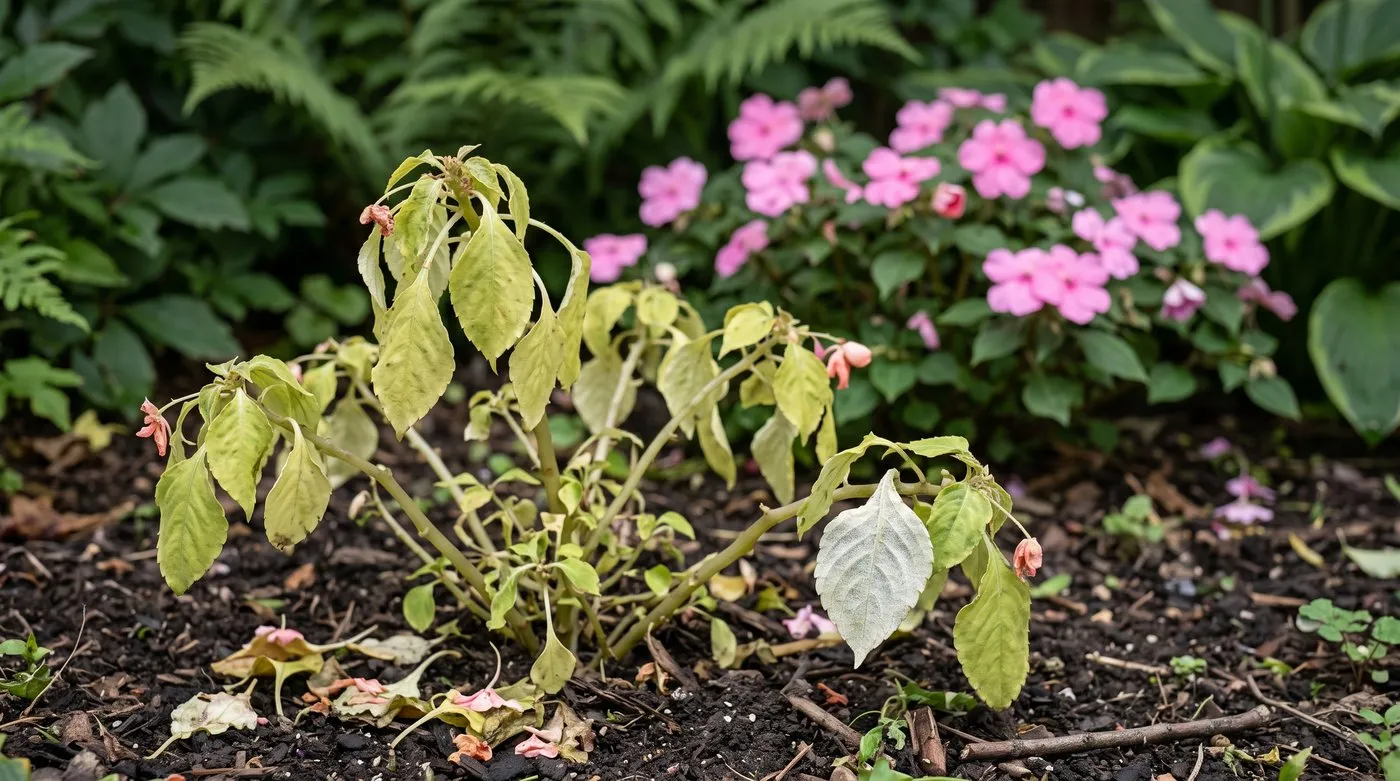
Yellowing, curling leaves with white fuzz underneath mean downy mildew. Pull affected plants and choose a resistant busy lizzie type next time.
Begonia semperflorens: the most shade-proof annual
Bedding begonias are the toughest choice for a shady spot. They flower non-stop from late May until the first frost. All they ask for is moist compost and the odd feed.

Bedding begonias and trailing fuchsias in a north-facing border, flowering away from June to October.
They stay compact, 15-30cm, so they’re great for edging paths or the front of a border. Leaves are green or bronze, and bronze types often do a little better in shade. Flowers come in white, pink and red.
Buy plug plants from late April or trays from mid-May. Keep them under cover until the last frost has passed. Plant 20-25cm apart and water in well. No deadheading needed, as old flowers drop off on their own. Feed every couple of weeks from June with tomato feed to keep them flowering.
Tuberous begonias: dramatic colour in containers
Tuberous begonias are the big, showy cousins, with flowers in rich yellow, orange, red, pink and white. They’re stunning in pots and baskets against a north-facing wall.
Start the tubers indoors in February or March. Set them hollow side up in barely moist compost somewhere warm, around 18-20°C. Shoots appear in a few weeks. Grow them on in bright light, out of direct sun, and harden off before planting out in late May. They’re thirsty, so check pots daily. Too much sun fades the flowers.
In autumn, lift the tubers before the first frost and let them dry off for a couple of weeks. Store them in dry compost somewhere cool and frost-free over winter. Kept well, a tuber gets bigger and flowers better each year.
Fuchsia: trailing for baskets, upright for borders
Fuchsias are a shady wall’s best friend. Their dangling, often two-tone flowers keep coming from June to October. Our guide on how to grow fuchsias covers both hardy and tender types.
Trailing fuchsias such as ‘Swingtime’ and ‘Pink Marshmallow’ are perfect for hanging baskets and window boxes. They spill 40-60cm over the edge. A few in a large basket will flower all summer long.
Upright fuchsias such as ‘Mrs Popple’ and ‘Alice Hoffman’ suit borders and big pots. They grow to 45-90cm and look lovely with begonias and hostas. For more shady planting ideas, see north-facing garden ideas for the UK.
Bedding fuchsias don’t like frost. Plant them out after the last frost in late May, or buy them earlier and keep them under cover. Feed weekly with a high-potash liquid feed from June. If you can keep them in a frost-free greenhouse over winter, they’ll be bigger and better next year.
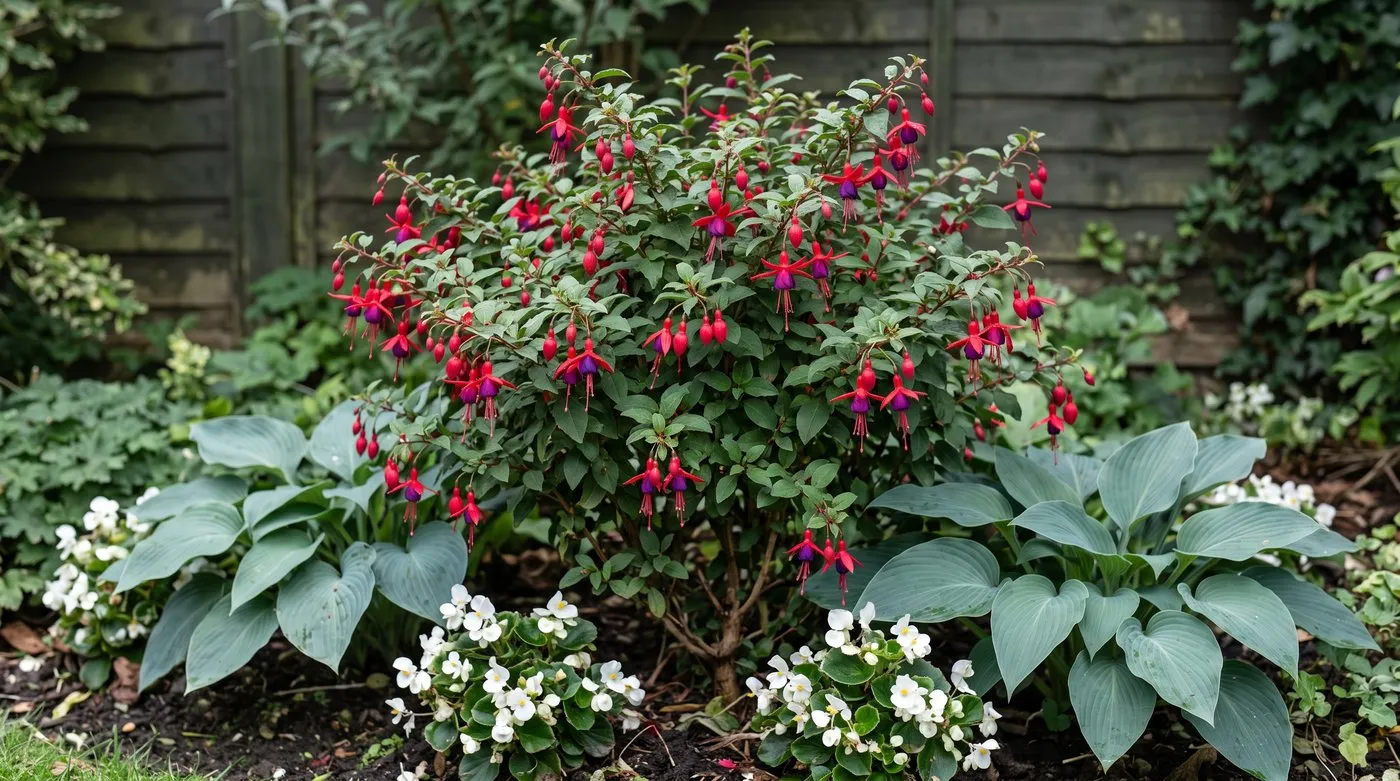
Upright fuchsias flower happily in part shade all summer. A weekly high-potash feed keeps the flowers coming until the frost.
Torenia: the underused shade annual
Torenia, or wishbone flower, deserves to be far more popular. It looks like a tiny snapdragon, with two-tone flowers, usually purple with a yellow splash, and also pink and white. It’s happy in partial shade and lovely in pots.
Sow indoors at 20-22°C in March or April. The seeds are tiny and take a week or two to come up. Prick out into modules, harden off and plant out after the last frost, 20-25cm apart. If you miss the sowing window, buy plug plants in May.
Lobelia, nicotiana, nemesia, viola, and mimulus
Lobelia is lovely trailing over the edges of shady pots and baskets. It’s happy in partial shade but gets thin in deep shade. ‘Sapphire’ is a classic trailing blue, and ‘Crystal Palace’ is a compact dark blue for edging. Sow indoors in February or March at about 20°C. The seed is tiny and needs light, so don’t cover it.
Nicotiana sylvestris (tobacco plant) adds height, 90-150cm, and white flowers that smell gorgeous in the evening. Plant it near a shady seat to enjoy the scent. Sow indoors in March on the surface of moist compost at 18-20°C.
Nemesia likes cool, light shade with a bit of sun, so it’s good in Scotland and the north. It flags in hot summers but bounces back if you cut it back by two-thirds in July. It grows 20-30cm tall in lots of colours.
Violas and pansies are for colour from autumn to spring. Plant them in September or October and they’ll flower on and off until May. They’re brilliant in shady pots in winter when little else is flowering. Our flower planting calendar has the exact timings.
Mimulus (monkey flower) is the one for damp shade. It has bright yellow, orange or spotted flowers from June to September and is happy in wet spots, beside a pond or in a soggy shady corner.
Shade containers and hanging baskets: planting guide
Shady pots reward good plant choice and a little regular care. Here’s how to get them right.

Pots of busy lizzies, begonias and lobelia brighten a north-facing wall.
Compost. Use a good peat-free multipurpose compost with some slow-release fertiliser mixed in. Add a few handfuls of perlite or grit for drainage. Shady pots don’t dry out as fast, so they can get waterlogged in a wet summer.
Timing. All the main shade annuals are frost-tender. Plant out after the last frost, usually late May in the south and early June further north.
Watering. Shady pots need water less often than sunny ones. In June, every 2-3 days is usually enough. In warm spells in July and August, check daily. Push a finger 2cm into the compost and water well if it’s dry. If in doubt, wait, as begonias and fuchsias cope with a little dryness better than soggy compost.
Feeding. Start liquid feeding 6-8 weeks after planting, when the slow-release fertiliser runs low. Use tomato feed at half strength every couple of weeks from late June to September.
For more ideas for tricky spots, see container gardening ideas for UK gardens.
Shade hanging baskets: making them work
Shady baskets are a little trickier because there are fewer plants to choose from, but they’re well worth it. Trailing fuchsia, trailing begonia and trailing lobelia give you everything you need: height, spread and plenty of colour.

A shady hanging basket with trailing fuchsia, lobelia and begonias, perfect for a north-facing porch.
Use a basket at least 35cm wide. Smaller ones dry out too fast. Line it with coir and use a compost that holds moisture. Water-retaining granules mixed in at planting help too.
Aim for about three trailing plants to one or two bushy ones. For a 35cm basket, try three trailing fuchsias with two bedding begonias in the middle. Or go for three trailing fuchsias, one trailing begonia and three trailing lobelias. Water daily in July and August, as even shady baskets dry out in warm weather. Baskets are great on balconies too, so see balcony gardening ideas for the UK for more.
North-facing beds: planting for season-long colour
A north-facing border is a tricky spot, but shade annuals add the summer colour that permanent plants often can’t. Let hostas, ferns and hydrangeas give the shape, and use begonias, fuchsias and torenia for flowers from June to October.
Plant in groups rather than dotting single plants about. Three begonias or five lobelias together make far more impact. Put tall plants like nicotiana and upright fuchsias at the back, begonias and torenia in the middle, and lobelia or violas at the front.
Mix annuals with shade-loving perennials for depth. Hostas and astilbes fill the middle. Ferns add texture. Hellebores flower in spring before the annuals go in. For permanent partners, see best perennial plants for UK gardens and best shrubs for shade in UK gardens.
Give the soil some love first. Beds against north-facing walls are often dry and tired, as the wall keeps much of the rain off. Dig in a 10cm layer of garden compost or well-rotted manure before planting. It helps the soil hold moisture, which shade annuals love.
Combining shade annuals with shade perennials
The best shady borders mix quick summer colour from annuals with the shape of long-lived plants. It gives the border real depth, not just a flat carpet of bedding.
- Bedding begonias at the feet of Hydrangea ‘Annabelle’, filling the gap while the hydrangea builds up its flowers.
- A pot of trailing fuchsia in front of a big Fatsia japonica, whose glossy leaves make the flowers pop.
- Torenia in the gaps between hostas, adding colour where the hostas leave bare soil.
- Nicotiana sylvestris at the back of a fern border, for height and evening scent.
For help planning a shady border, read best plants for shade in UK gardens. For shrubs, best shrubs for shade in UK gardens covers hydrangeas, fatsia and aucuba.
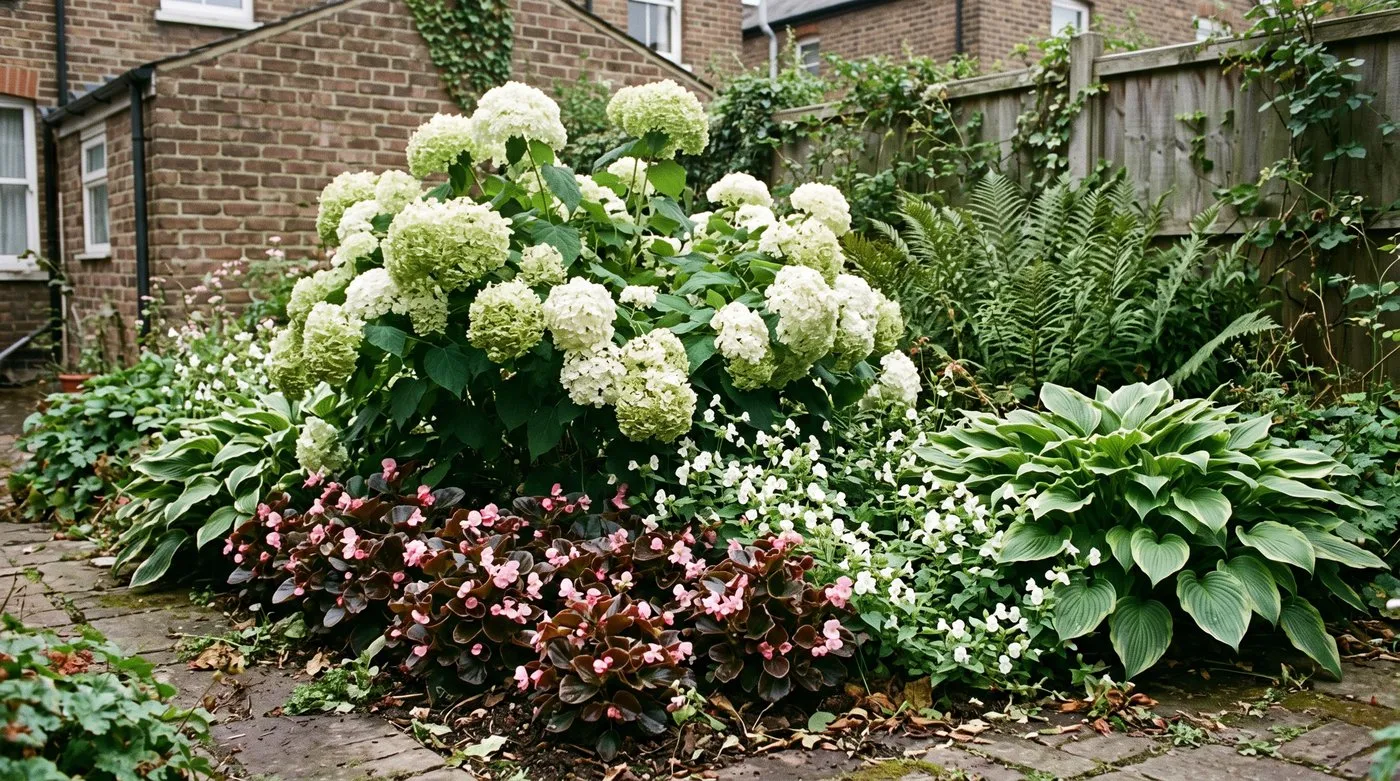
Annuals fill the gaps while long-lived plants give the shape. Begonias at the feet of a hydrangea make a shady border feel full from June.
Where to buy shade annuals in the UK
Garden centres sell trays of shade bedding from May. For mildew-resistant busy lizzies and a wider choice, seed and plug plant suppliers sell rooted plugs in late winter and spring. Grow plugs on in a frost-free greenhouse or on a windowsill and you’ll have big plants by planting time.
The RHS plant finder for shade annuals is handy for more ideas that suit UK gardens.
Frequently asked questions
What annuals grow in full shade in UK gardens?
Bedding begonias and busy lizzies cope best with deep shade. Both flower against a north-facing wall with very little direct sun. Torenia and fuchsias are good in partial shade. Mimulus is the one for damp, shady corners.
Can I grow busy lizzies in shade in the UK?
Yes, busy lizzies love shade. Old-style Impatiens walleriana often get downy mildew, which kills them within weeks. Choose a mildew-resistant type such as SunPatiens instead. Plant after the last frost in moist compost, and don’t let the pots get waterlogged.
Are fuchsias annuals or perennials in the UK?
Most bedding fuchsias are tender perennials. They’re killed by frost, so many people buy new ones each spring. You can keep them over winter in a frost-free greenhouse. Hardy fuchsias such as Fuchsia magellanica stay outside all year in milder areas.
What shade annuals are best for hanging baskets?
Trailing fuchsias, trailing begonias and trailing lobelia are the best trio. The fuchsias and begonias give big flowers, and lobelia fills the gaps. Use a basket at least 35cm wide with moisture-holding compost. Water every day in hot weather.
When do I plant shade annuals outdoors in the UK?
Plant them out once the last frost has passed. That’s usually late May in southern England and early June in Scotland and the north. Busy lizzies, begonias, fuchsias and torenia are all frost-tender. Wait for a settled forecast before planting.
How do I water annuals in shaded north-facing containers?
Check them every day or two from June to September. Shady pots dry out more slowly than sunny ones, but still need water in warm spells. Push a finger into the compost and water well if it feels dry. Let the extra water drain away, and feed every couple of weeks with a high-potash liquid feed.
Do begonias prefer sun or shade?
Begonias prefer partial shade in the UK. Bedding begonias flower well with a few hours of gentle sun but can scorch in hot afternoon sun. Tuberous begonias like shade too and are perfect in pots against a north-facing wall.
Related reading
- Best plants for shade in UK gardens: hostas, ferns and other permanent shade plants
- North-facing garden ideas for the UK: design ideas and plant lists for shady gardens
- Best shrubs for shade in UK gardens: hydrangeas, fatsia and aucuba for year-round shape
- Container gardening ideas for UK gardens: ideas for pots, troughs and planters
- How to plant and maintain hanging baskets in the UK: watering, feeding and plant combinations
Our team produces practical UK gardening guidance from source research, contributor records and established horticultural practice. Editorial standards are overseen by Matt W.