
Key takeaways
- March to May is the busiest sowing time, but always check the seed packet
- Hardy annuals can be sown straight outside in spring or autumn
- Half-hardy annuals only go outside once the frosts are over
- Plant most spring bulbs in September and October, and tulips in October and November
- Sow biennials like foxgloves and wallflowers in summer for flowers next year
Most UK flower seeds are sown between spring and early summer. Hardy annuals have an autumn window too, and bulbs follow their own timings. Sow too early into cold, wet soil and seeds can rot. Sow too late and some plants won’t have time to flower.
There’s something to do in almost every month. Sweet peas can start in winter, and tulips go in as late as November. This calendar covers annuals, perennials, biennials and bulbs, with timings that suit British gardens. For veg, see our separate seed sowing calendar.
 A spring border in full flower. Tulips, daffodils and primroses are at their best in April.
The four types of flower, explained simply
It helps to know the four main types before you start, because each is sown at a different time.
Hardy annuals grow, flower and die in one year, and they don’t mind frost. Sow them straight outside in spring or autumn. Think cornflowers, calendula, nigella and poppies. The RHS guide to sowing seeds outdoors has more on preparing the soil.
Half-hardy annuals also last one year, but frost kills them. Start them indoors in spring and plant them out once the frosts are over. Think cosmos, zinnias, marigolds and nicotiana.
Biennials take two years. Sow them in summer, they sit as a leafy rosette over winter, then flower the next year and die. Think foxgloves, wallflowers, sweet William and honesty. Cottage gardens rely on them, as our cottage garden planting plan shows.
Perennials come back year after year, though many die down in winter. Sowing times vary a lot, so check the packet for delphiniums, lupins, echinacea or lavender.
How to judge the last frost at home
Your own garden’s frost risk decides when tender plants can go out. A national date isn’t much use, because height, wind and nearby buildings all make a difference.
| Your garden | What it means |
|---|---|
| Sheltered town or coastal garden | Frosts may end earlier, but watch the forecast |
| Open country garden | Keep tender plants covered through late cold snaps |
| Northern or hilly garden | Expect to plant out later than in the mild south |
| Frost pocket or valley bottom | Cold air sinks here, so be extra careful |
Get plants used to the outdoors gradually, and keep some fleece handy for cold nights. Jot down your last frost each year. After a few years, your notes will be a better guide than any chart.
Winter: January and February
The garden is quiet, but there’s useful sowing to do indoors. Starting slow growers early gives them a head start.
January
Indoors: Sow sweet peas in deep pots or root trainers if the packet suggests a winter start. Keep them somewhere cool, bright and frost-free.
Outdoors: Nothing to sow yet. Clear beds and dig in some compost ready for spring. Order seeds now while there’s plenty of choice.
February
Indoors: Keep sowing sweet peas if the packet allows. Start slow-growing flowers under cover at the temperature the packet gives.
Outdoors: In mild areas, prepare seed beds. When weed seedlings start popping up, it’s a good sign the soil is warming.
Spring: March to May
This is the main sowing season. More flowers get started in these three months than in the rest of the year put together.
March
March usually kicks off outdoor sowing for hardy annuals. Go by the packet and wait until the soil is crumbly rather than sticky.
Outdoors: Sow cornflowers, calendula, nigella (love-in-a-mist), annual poppies, larkspur and sweet peas where you want them to flower. Rake the soil fine, scatter the seed thinly and cover lightly. They’ll be flowering by early summer.
Indoors: Sow cosmos, marigolds, nicotiana and snapdragons in seed compost, following the packet for warmth and depth. You can also pot up dahlia tubers under cover.
Bulbs: Plant summer-flowering bulbs like gladioli from early spring.
 March sowing. Cornflowers and calendula go straight into the ground.
April
The busiest sowing month. Almost everything can start now, and March sowings are coming on well.
Outdoors: Keep sowing hardy annuals, adding clarkia, godetia, candytuft and Virginian stock. Sow wildflower seed mixes on prepared ground. Sow sunflower seeds outside from mid-April once the soil has warmed up.
Indoors: Sow zinnias, ageratum and annual rudbeckia in a warm spot. Start statice and strawflowers for drying. Move March seedlings into bigger pots. Start getting the earliest ones used to the outdoors by putting them out for a little longer each day.
Perennials from seed: Sow achillea, echinops, echinacea, scabious and salvia now. Some will even flower in their first year.
May
May is the bridge between indoors and out. Tender flowers move outside once the frosts are over.
Outdoors from late May: Plant out half-hardy annuals when the last frost has passed. Cosmos, zinnias, marigolds, nicotiana and bedding dahlias can finally go in. Harden them off for a week or two first. Sow nasturtiums and morning glory straight into the ground.
Sow a second batch: Sow more cornflowers, calendula and nigella outside. It keeps the colour coming later into summer, and it’s the easiest trick for a longer display.
Late May: Plant out dahlias started in pots, and sunflowers raised indoors.
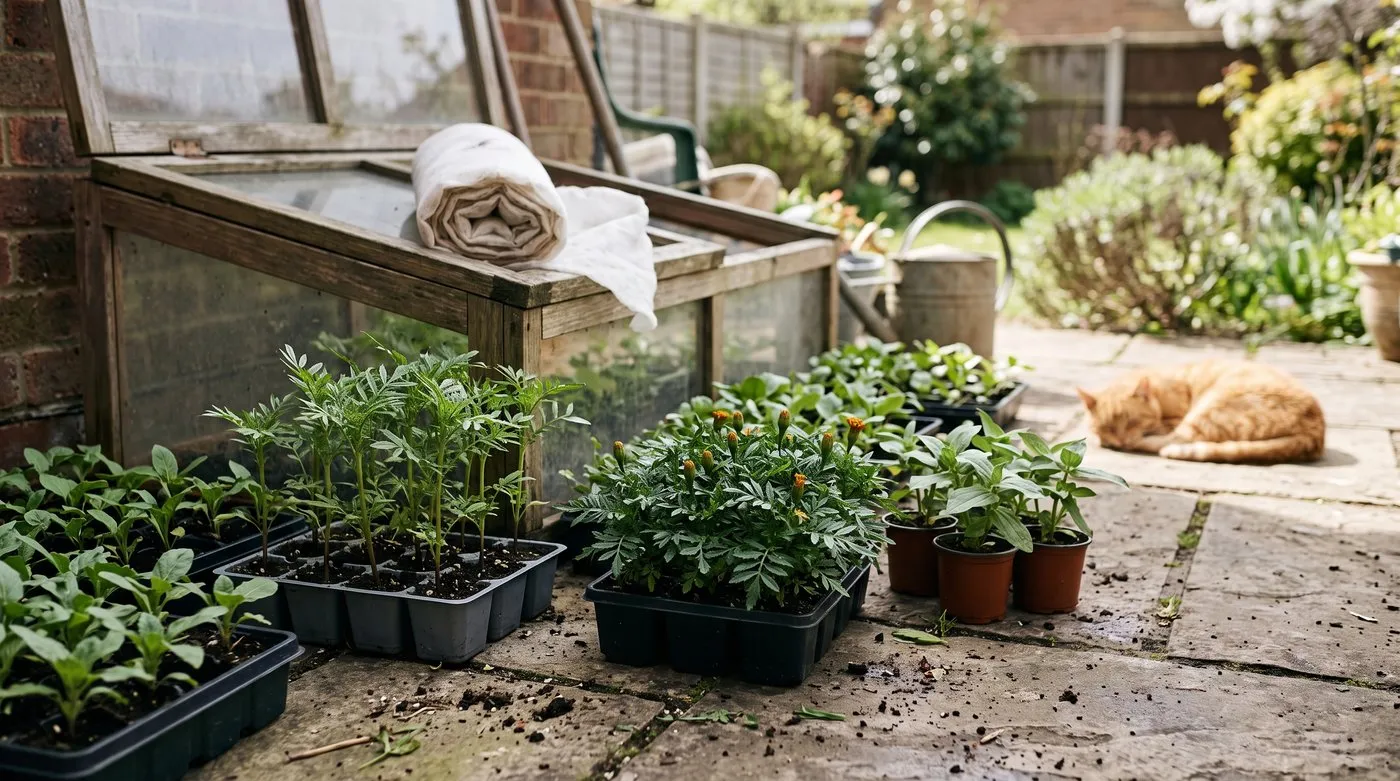
Give half-hardy annuals a week or two outside by day before planting them out. Keep fleece handy in case a late frost is forecast.
Summer: June to August
Summer is more about looking after things than sowing. Deadhead to keep flowers coming, and sow biennials for next year.
June
Biennials to sow now: Sow foxgloves, wallflowers, sweet William and honesty in trays or a spare patch of ground. They grow over summer, sit through winter as rosettes and flower next year.
Outdoors: Last chance to sow hardy annuals like calendula, cornflowers and candytuft for late-summer flowers. Get them in by mid-June. Sow hollyhocks in pots for next year.
Looking after things: Deadhead roses after their first flush to get more flowers. Stake tall plants like delphiniums and dahlias before they flop. Start feeding flowers in pots every two weeks with tomato feed.
 A July border at its best. Dahlias, cosmos and rudbeckia pay back your spring sowing.
July
Time to enjoy it. Keep deadheading, watering and admiring.
Deadhead often. Taking off faded flowers stops the plant setting seed, so it makes more flowers instead. Cosmos, dahlias, sweet peas and roses all respond brilliantly. Pick sweet peas every few days and they’ll keep going for weeks.
Sow for later: Sow winter pansies in pots, and forget-me-nots for next spring.
Water new perennials well in dry spells. Established ones rarely need it if they’re well mulched. For plants that cope with dry weather, see our guide to drought-tolerant plants.
August
The turning point. Summer flowers are at their peak, but it’s time to think about autumn.
Collect seed: Save ripe seed for free plants next year. Calendula, nigella, cosmos and honesty are easy. Dry the seed in paper bags for a couple of weeks, then store somewhere cool and dry.
Prune lavender once it finishes flowering. Trim off the flower stalks and a little of the leafy growth, but don’t cut into old bare wood. It keeps the plant neat and stops it getting leggy.
Look ahead: Make a note of gaps in the border to fill with bulbs next month.
Autumn: September to November
Now it’s all about bulbs and getting ready for next year.
September
Hardy annuals: Sow cornflowers, calendula and nigella outside for earlier flowers next year, where winters are mild. In cold or exposed gardens, wait until March.
Bulb planting begins. September is ideal for daffodils, crocuses, alliums and grape hyacinths. The RHS bulb planting guide has depths and spacing for each kind. As a rule, plant bulbs two to three times their own height deep. Plant in groups rather than rows for a natural look. Get daffodils in by the end of October.
Divide perennials: Split crowded clumps of hardy geraniums, asters and heleniums. Replant the pieces straight away and water well. Leave the old flower heads on hydrangeas over winter, as they help protect the buds below from frost.
October
The main bulb month. Get daffodils, hyacinths, alliums and crocuses in by the end of the month. Tulips are the exception: plant them from late October into November. Planting later helps them avoid a disease called tulip fire.
Lift tender plants: Dig up dahlia tubers, gladioli corms and cannas once the first frost blackens the leaves. Let them dry, then store them in barely damp compost somewhere cool and frost-free.
Plant bare-root perennials and shrubs from now while the soil is still warm. Bare-root roses can go in any time from now until March.
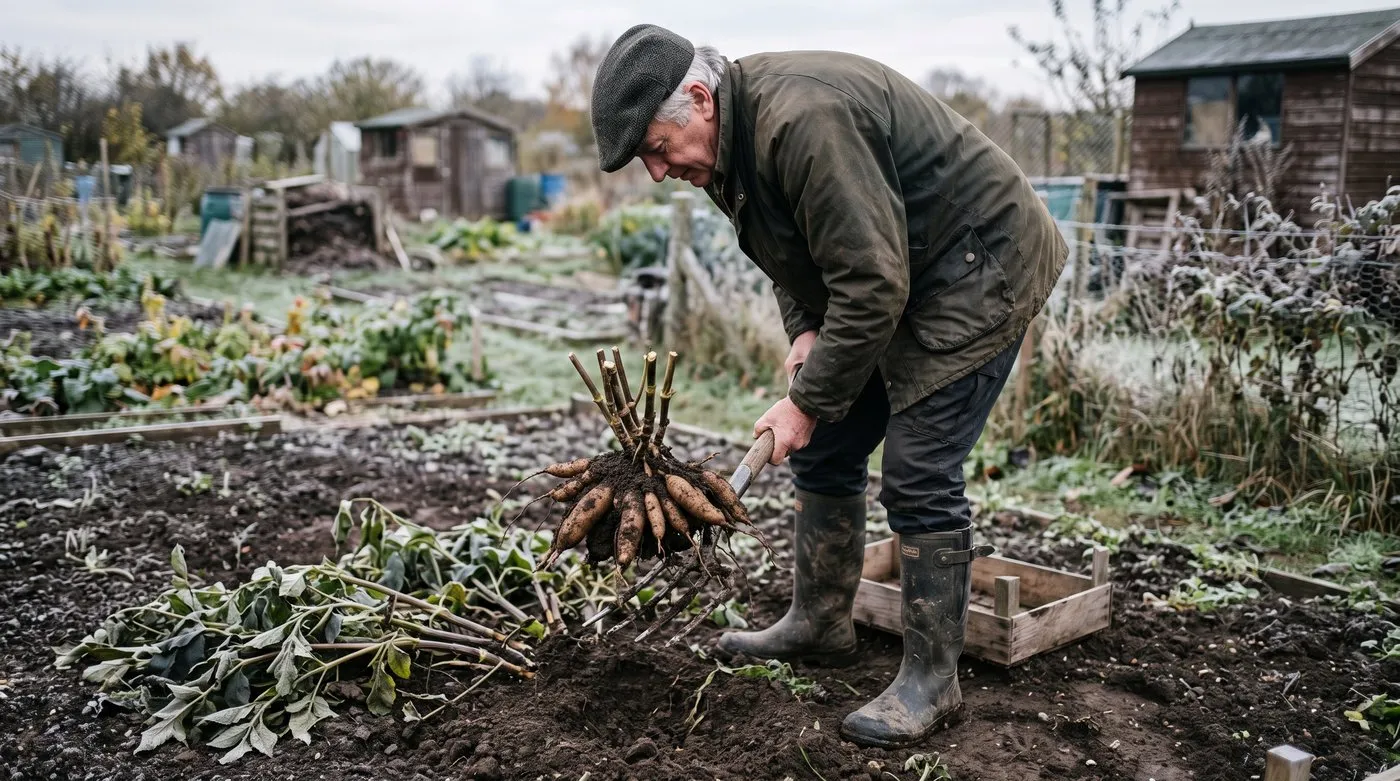
Lift dahlia tubers once the first frost blackens the leaves. Let them dry, then store them in barely damp compost somewhere cool and frost-free.
November
Tulip time. November is a great month for tulips, as the cooler soil suits them. Plant them about 15-20cm deep in well-drained soil.
Sweet peas: If you didn’t sow them in October, you can still sow sweet peas in deep pots in a cold frame or cold greenhouse for strong early plants.
Get beds ready: Clear spent annuals and add compost. Mark where your bulbs are so you don’t dig them up by mistake.
December
Time to plan. There’s no sowing and very little planting. Browse the seed catalogues, order early and sketch out next year’s planting. Wash pots and seed trays. Think about what did well and what you’d change.
If the ground isn’t frozen, you can still plant tulips in early December. They’ll flower, just a little later.
Quick-reference planting table
Here are the main sowing and planting times for the most popular UK flowers. Indoor sowing means a warm windowsill or heated propagator.
| Flower | Type | Sow indoors | Sow or plant outside | Flowers |
|---|---|---|---|---|
| Sweet pea | Hardy annual | Oct-Nov, Jan-Feb | Mar-Apr | Jun-Oct |
| Cornflower | Hardy annual | - | Mar-Apr, Sep | Jun-Aug |
| Calendula | Hardy annual | - | Mar-May, Sep | Jun-Oct |
| Nigella | Hardy annual | - | Mar-Apr, Sep | Jun-Aug |
| Poppy (annual) | Hardy annual | - | Mar-Apr, Sep | Jun-Aug |
| Cosmos | Half-hardy annual | Mar-Apr | Plant out late May | Jul-Oct |
| Zinnia | Half-hardy annual | Apr | Plant out late May | Jul-Oct |
| Marigold | Half-hardy annual | Mar-Apr | Plant out late May | Jun-Oct |
| Sunflower | Hardy annual | Apr | Apr-Jun | Jul-Sep |
| Nasturtium | Half-hardy annual | Apr | May | Jun-Oct |
| Foxglove | Biennial | - | Jun-Jul | May-Jul (next year) |
| Wallflower | Biennial | - | Jun-Jul | Mar-May (next year) |
| Sweet William | Biennial | - | Jun-Jul | Jun-Jul (next year) |
| Dahlia | Tender perennial | Pot up tubers Mar | Plant out late May | Jul-Oct |
| Lupin | Perennial | Feb-Mar | Apr-May | Jun-Jul |
| Delphinium | Perennial | Feb-Mar | Apr-May | Jun-Aug |
| Echinacea | Perennial | Mar-Apr | Apr-May | Jul-Sep |
| Lavender | Perennial | Feb-Mar | - | Jun-Aug |
| Rose | Shrub | - | Plant Nov-Mar | Jun-Oct |
| Tulip | Bulb | - | Plant Oct-Nov | Apr-May |
| Daffodil | Bulb | - | Plant Sep-Oct | Mar-Apr |
| Crocus | Bulb | - | Plant Sep-Oct | Feb-Mar |
| Allium | Bulb | - | Plant Sep-Nov | May-Jun |
| Gladiolus | Corm | - | Plant Mar-May | Jul-Sep |
Flowers for beginners
New to growing flowers from seed? Start with these. They come up reliably, forgive mistakes and flower quickly.
Five easiest flowers from seed:
- Nasturtiums: sow outside in May. Quick to flower, and happy in poor soil.
- Calendula: sow outside March to May. Tough and fast, and it seeds itself for free plants every year.
- Sunflowers: sow April to May. Fast and tall, and children love them. Our guide on when to plant sunflowers has the timings.
- Cornflowers: sow in March or September. Cope with dry spells once settled, and last well in a vase.
- Cosmos: sow indoors in April. Flowers non-stop from July to October if you deadhead. The best cut flower for beginners.
Bees and butterflies love all five. For more bee-friendly plants, see our wildlife section.
Handy tip: Sow a few more than you need, as not every seed comes up. Thin seedlings out once they’re 5-10cm tall. You can often move the thinnings of calendula, nigella and cornflowers somewhere else in the garden.
Extending the flowering season
For flowers from March to November, combine three simple tricks.
Sow little and often: Sow the same flowers every three or four weeks from March to June. You get waves of flowers rather than one big burst. Calendula, cornflowers and nigella are perfect for this.
Deadhead: Snipping off faded flowers before they set seed keeps many plants flowering for longer. Cosmos, dahlias, sweet peas and repeat-flowering roses all respond well.
Sow hardy annuals in autumn: They often flower earlier the next year than spring sowings. It works best in well-drained soil and milder areas.
Add spring bulbs and summer perennials for a long, colourful display. For other spring gardening tasks, our seasonal checklist covers lawns and pruning too.
 Planting tulips in November. Today’s work is next spring’s colour.
Browse the growing guides or carry on with our guide to sowing seeds indoors.
Frequently asked questions
When should I start planting flowers in the UK?
Start sowing hardy annuals outside in spring. Wait until the soil is crumbly rather than cold and sticky. Start half-hardy flowers indoors and move them outside once the frosts are over. Always check the packet, as every plant is a bit different.
What flowers can I plant in March UK?
March is great for hardy annuals and summer bulbs. Sow cornflowers, calendula, poppies and nigella outside once the soil is workable. Plant gladioli from early spring. Start tender annuals like cosmos indoors, following their packets.
What is the difference between hardy and half-hardy annuals?
Hardy annuals cope with frost, but half-hardy annuals don’t. Sow hardy ones straight outside. Keep half-hardy seedlings indoors or under cover until the frosts are over, usually around late May.
When should I plant spring-flowering bulbs?
Plant most spring bulbs in September or October. Plant tulips a bit later, in late October or November. Follow the instructions on the pack for each type.
Can I sow flower seeds in autumn?
Yes, you can sow hardy annuals in autumn. Cornflowers, calendula and nigella are good choices. Choose well-drained soil, and on cold, exposed sites wait until spring instead.
Our team produces practical UK gardening guidance from source research, contributor records and established horticultural practice. Editorial standards are overseen by Matt W.


