
Key takeaways
- Plant bulbs from September to November, and the earlier the better
- Plant them two to three times their own height deep, pointy end up
- Leave the leaves for six weeks after flowering, and never cut, tie or knot them
- Water in a dry spring, as this is the most common reason for no flowers next year
- Divide crowded clumps every three to five years
- All parts are toxic to pets and people if eaten
Daffodils are the flower of a British spring. From early ‘February Gold’ in late winter to the last pheasant’s eye in May, they give months of cheerful colour. They grow well all over the UK in most soils that drain well, in sun or light shade.
Plant the bulbs in autumn and they come back year after year, multiplying with very little help. Below you’ll find planting, growing in grass, dividing and the best varieties. For more on timing, see our guide on when to plant daffodil bulbs.
How do I plant daffodil bulbs?
Plant daffodil bulbs in early autumn, ideally September, pointy end up and two to three times their own height deep. The earlier the better, as bulbs planted after mid-November don’t do as well.
Planting depth and spacing
Plant each bulb two to three times its own height deep, pointy end up. For standard daffodils, that’s 10 to 15cm. Miniature ones like ‘Tete-a-Tete’ go 7 to 10cm deep. Space bulbs 10 to 15cm apart in borders, or closer in pots.
On light, sandy soil, go deeper. On heavy clay, go a little shallower and put a handful of grit under each bulb to help drainage. Our guide to improving clay soil has more tips.
Planting in borders
Make holes with a bulb planter or trowel, or dig out a wider patch and set several bulbs in at once. Pop each bulb in pointy end up, fill in with soil and firm gently. Water if the soil is dry.
For a natural look, toss a handful of bulbs across the area and plant each where it lands. It looks far better than neat rows once the flowers open.

Plant bulbs pointy end up, and scatter them for a natural look.
Do daffodils grow in shade?
Daffodils flower best in sun but cope with light or dappled shade. Avoid deep shade and soggy ground.
Light shade under deciduous trees is fine, because the branches are still bare when daffodils are in leaf. Dense evergreen shade, such as under conifers or a big holly, is a different story. The bulbs can’t build up enough energy, and flowering fades within a few years. ‘Actaea’, ‘Jenny’ and ‘Jack Snipe’ are good choices for light shade. Very dry spots at the foot of hedges and walls don’t suit them either.
Can you plant daffodils in spring?
You can plant potted daffodils in spring, but dry bulbs belong in the ground in autumn. Dry bulbs kept until spring have missed their rooting time.
Garden centres sell pots of daffodils in bud from late winter. Plant these at the same level they sat in the pot, water them in and treat them like any other clump. Let the leaves die down naturally after flowering.
How do I grow daffodils in grass?
Plant varieties that spread well in loose drifts in grass you can leave uncut for six weeks after flowering. They’ll multiply and spread a little more each year.
Choosing the spot
You need grass you can leave long for six weeks after the flowers finish. That rules out a neat lawn, but it’s perfect for rougher grass under trees, on banks, in orchards or in a patch of long grass. Daffodils look lovely with a mini wildflower meadow too. Our naturalising bulbs in grass guide covers other bulbs that do well in turf.
How to plant in grass
Use a bulb planter, a tube that lifts out a plug of turf, to make each hole. Plant each bulb 10 to 15cm deep, put the turf plug back and firm it down. For bigger areas, lift a flap of turf with a spade, loosen the soil, scatter bulbs and lay the turf back.
Scatter the bulbs before you plant, rather than setting them in rows. Aim for loose groups of 10 to 20 with natural gaps in between.
Best varieties for grass
‘February Gold’ is an early, golden-yellow daffodil that’s tough and reliable. ‘Peeping Tom’ and ‘Fortune’ are both good doers in grass. Pheasant’s eye (Narcissus poeticus var. recurvus) flowers late, with white petals and a small red-rimmed cup, and smells wonderful. ‘W.P. Milner’ has pale cream, nodding flowers and looks beautiful under trees.

Daffodils under trees, a classic British spring scene that gets better every year.
What should I do after daffodils have flowered?
Deadhead, leave the leaves for at least six weeks and water in dry weather. This aftercare decides how well they flower next year.
Leave the leaves
After the flowers fade, the leaves keep feeding the bulb for about six weeks. Don’t cut, tie or knot them until they’ve turned yellow and flopped. Cutting too early is a common reason daffodils stop flowering.
Deadhead
Snap off the faded flower and the swollen seed pod behind it, leaving the stem. Making seeds uses up energy the bulb needs. It’s a small job that really helps.
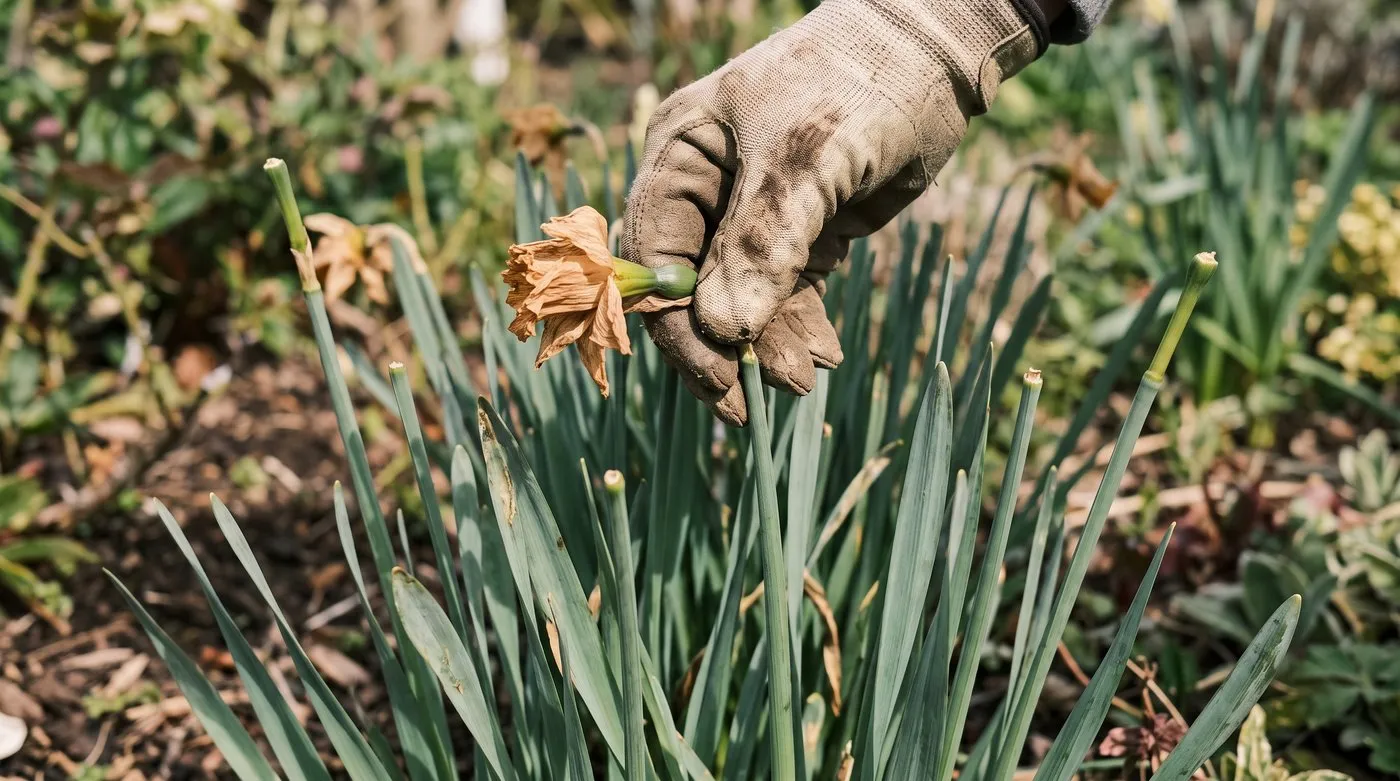
Snap off the faded flower and the swollen pod behind it, but leave the stem and leaves. Seed-making uses energy the bulb needs for next year.
Feeding
Bulbs in reasonable soil rarely need much feeding. On poor soil, scatter a seaweed-based fertiliser in spring as shoots appear. Daffodils in pots like a tomato feed every week or two from when the flowers fade until the leaves yellow.
Do daffodils need watering after flowering?
Yes, in a dry spring. The RHS now names dry weather after flowering as the most common reason daffodils don’t flower the next year.
The leaves need water to keep working while the bulb forms next year’s flower. In a dry April or May, they stop early and the bulb runs short. Give clumps a good soak once a week in dry spells until the leaves die back. A mulch of garden compost in late winter helps hold moisture. Bulbs at the foot of hedges, under conifers or in pots dry out fastest, so check those first.
In lawns
Don’t mow daffodil areas until at least six weeks after the last flowers fade, and set the blade high for the first cut. That usually means late May or early June. Our lawn care calendar helps you plan the grass around your bulbs.
When should I divide daffodils?
Divide crowded clumps every three to five years, or when flowering tails off despite good care. Packed bulbs compete for food and water and flower poorly.
How to divide
Lift the whole clump with a fork in late June or July, once the leaves have died right back. Shake off the soil and gently pull the bulbs apart. Throw away any soft, damaged or tiny ones. Replant the biggest bulbs straight away at the right depth, 10 to 15cm apart, in soil with some garden compost mixed in.
You can also store bulbs dry somewhere cool and dark and replant them in September. Handy if you want to move them.
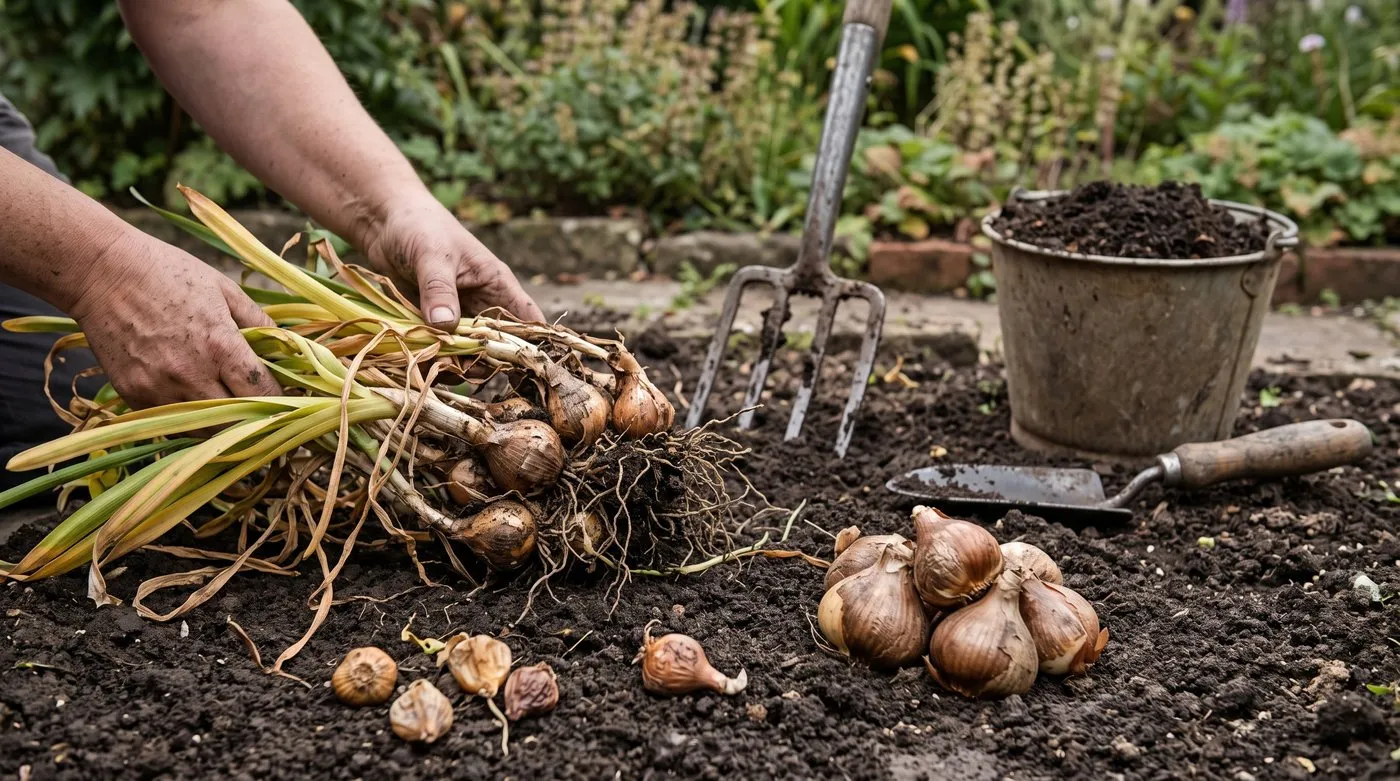
Lift crowded clumps once the leaves have died right back and replant the biggest bulbs 10 to 15cm apart. Flowering soon picks up again.
What are the best daffodils for UK gardens?
Reliable, easy-to-find varieties like ‘Tete-a-Tete’, ‘February Gold’ and ‘Ice Follies’ suit most gardens. Here they are by size and flowering time.
| Type | Variety | Height | Colour | Flowers |
|---|---|---|---|---|
| Miniature | ’Tete-a-Tete’ | Short | Golden yellow | February to March |
| Early | ’February Gold’ | Medium | Deep yellow | February to March |
| Early | ’Jetfire’ | Short to medium | Yellow with orange trumpet | March |
| Standard | ’King Alfred’ (modern selections) | Tall | Classic golden yellow | March to April |
| Standard | ’Ice Follies’ | Tall | White with lemon cup | March to April |
| Standard | ’Carlton’ | Tall | Soft yellow, scented | March to April |
| Multi-headed | ’Cheerfulness’ | Tall | Double white, scented | April |
| Multi-headed | ’Geranium’ | Tall | White with orange cup | April |
| Late | Pheasant’s eye | Tall | White with red-rimmed cup, scented | May |

Pack bulbs close together in pots for a bright patio or doorstep display.
Growing daffodils in pots
Daffodils are great in pots at least 20cm deep with drainage holes. Fill with multi-purpose compost and plant bulbs almost touching, 10cm deep. You can layer different bulbs at different depths, called lasagne planting, for a longer show. Our guide to planting spring bulbs explains how.
Water after planting and leave the pot outside all winter. After flowering, keep watering and give a tomato feed every week or two until the leaves die back. Then plant the bulbs in the garden or store them dry for autumn.
‘Tete-a-Tete’, ‘February Gold’, ‘Minnow’ and ‘Hawera’ are all lovely in pots. Add tulips deeper in the same pot for colour from February to May.
Common daffodil problems
The usual problems are no flowers, narcissus bulb fly and basal rot. Slugs and snails nibble leaves and flowers too.
Blind bulbs (leaves but no flowers)
Caused by dry springs, crowding, shallow or late planting, or cutting leaves too soon. Water in dry spells, divide crowded clumps, replant at the right depth and leave the leaves for six weeks.
Narcissus bulb fly
This fly lays eggs at the neck of the bulb from mid-May to June, and the grub eats out the middle. The RHS narcissus bulb fly advice suggests firming the soil around plants after flowering to make egg-laying harder. Cover special bulbs with insect-proof mesh from mid-May to June. Lift soft or hollow bulbs in spring and put them in the council green waste, not your compost heap.
Basal rot
A brown rot that spreads up from the base of the bulb, worse in warm, wet conditions. Throw out affected bulbs and avoid soggy ground.
Leaf scorch
Brown, scorched-looking leaf tips in spring, caused by a fungus. Remove badly affected leaves. Healthy bulbs usually recover.
Deer, rabbits and squirrels usually leave daffodils alone, which is a real plus over tulips and crocuses in country gardens. They are toxic to dogs and cats, though, so keep an eye on pets around freshly planted bulbs. Our guides to plants toxic to dogs and plants toxic to cats list other common garden plants to watch.
Now you’ve got daffodils sorted, try our guide on growing tulips in the UK next. The RHS daffodil growing guide has even more varieties to explore.
Frequently asked questions
When should I plant daffodil bulbs?
Plant them from September to November, ideally in September or early October. Early planting gives the bulbs the longest time to root before the ground cools. You can plant into December in mild areas, but late bulbs give shorter stems and smaller flowers the first spring.
How deep should I plant daffodils?
Plant each bulb two to three times its own height deep, pointy end up. For standard daffodils, that’s 10 to 15cm. Miniature ones go 7 to 10cm deep. On light, sandy soil, plant a little deeper. On heavy clay, plant a little shallower and put some grit in the bottom of the hole.
Why are my daffodils not flowering (going blind)?
There are a few common reasons. The RHS lists dry spells after flowering, crowded clumps, cutting the leaves too soon, shallow or late planting, and pests like narcissus bulb fly. Water in a dry spring, divide crowded clumps in summer and leave the leaves for six weeks after flowering.
Can I plant daffodils in pots?
Yes, in pots at least 20cm deep. Plant the bulbs almost touching, 10cm deep, in multi-purpose compost. Water them in and leave the pot outside, as they need the winter cold. Give a tomato feed once the flowers fade. When the leaves have died back, plant the bulbs in the garden or store them dry.
When can I cut daffodil leaves?
Wait at least six weeks after the last flower fades. The leaves are busy feeding the bulb for next year’s flowers. Cutting them too soon weakens the bulb and means fewer flowers. Don’t tie or knot them either, as that stops them working properly.
Do daffodils spread on their own?
Yes, they make little new bulbs around the parent bulb. Over a few years, one bulb becomes a clump. They can also seed, though seedlings take several years to flower. In grass, strong growers like ‘February Gold’, ‘Peeping Tom’ and ‘Fortune’ spread steadily.
Are daffodils poisonous to dogs and cats?
Yes, all parts are toxic to dogs, cats and people. The bulbs are the most poisonous part and can cause vomiting, diarrhoea and tummy pain. Call a vet straight away if your pet eats any. The sap can irritate skin too, so wear gloves when handling lots of bulbs.
Our team produces practical UK gardening guidance from source research, contributor records and established horticultural practice. Editorial standards are overseen by Matt W.


