
Key takeaways
- Plant bulbs 8cm deep and 5cm apart from September to November
- Muscari armeniacum is the classic, reliable cobalt-blue grape hyacinth
- They spread by seed and little offset bulbs, so plant where spreading is welcome
- 'Valerie Finnis', white 'Album' and two-tone M. latifolium are better behaved
- They're great in lawns, under trees and in pots
- Let the leaves die back on their own after flowering
Grape hyacinths are some of the easiest spring bulbs you can grow in the UK. They give you dense little spikes of blue, white or pink flowers from March to May. They grow in almost any soil, cope with shade and spread on their own. A bag of bulbs planted in autumn can turn into a carpet of colour within a few years.
They’re also brilliantly timed. They fill the gap between early crocus and the main tulip season, feeding early bees. And they’re happy in awkward spots where little else grows, like under trees, along shady walls and in thin soil over roots.
What types of muscari can I grow in the UK?
There are lots of muscari, and a handful are easy to find in UK garden centres. They grow from small round bulbs and send up narrow, grassy leaves in autumn. From March, the flower spikes appear, covered in tiny bell-shaped flowers that look like mini bunches of grapes. That’s where the name comes from.
All muscari are fully hardy across the UK. They grow 10-25cm tall, depending on type, and like well-drained soil in sun or part shade. The RHS muscari growing guide is a handy extra read.
The flowers last a few weeks and have a sweet, musky scent, strongest on warm afternoons. Bees and hoverflies love them.

Muscari come in deep cobalt blue, soft pale blue and pure white.
Which muscari varieties should I grow?
| Variety | Colour | When | Spreads | Best for |
|---|---|---|---|---|
| M. armeniacum | Cobalt blue | March-April | Fast | Lawns, under trees, big drifts |
| ’Valerie Finnis’ | Pale powder blue | March-April | Medium | Borders, pots |
| M. botryoides ‘Album’ | Pure white | April | Slow | Pots, white gardens, edging |
| M. latifolium | Two-tone, dark and pale blue | April-May | Slow | Borders, rockeries |
| ’Pink Sunrise’ | Soft pink | March-April | Slow | Pots, front of border |
| M. aucheri ‘Ocean Magic’ | Bright blue, white tips | March-April | Medium | Pots, rockeries |
Muscari armeniacum is the classic, sold in big bags in every garden centre from late summer. It has dense cobalt-blue spikes and is almost impossible to kill. The catch is how keen it is to spread. It seeds itself and makes new bulbs, popping up in paths, gravel and next-door beds if you let it.
‘Valerie Finnis’ is the best pick where you want more control. Its pale powder-blue flowers are really pretty, and it spreads more slowly than the classic blue.
Muscari latifolium is the most eye-catching. Each spike is dark indigo at the bottom and pale blue at the top. It flowers a little later and spreads slowly, so it behaves itself in mixed borders.
‘Album’ is a lovely pure white muscari. It looks great on its own or mixed with blue types, and it’s easier to manage than the classic blue.
‘Pink Sunrise’ has soft pink flowers on short stems. It’s best in a pot or near the front of a border where you can enjoy it up close.
How do I plant muscari?
Plant from September to November. October is perfect, as the soil still holds some summer warmth and roots get going quickly.
Planting depth and spacing
Plant each bulb 8cm deep with the pointy end up. Space them 5cm apart for a thick display, or a bit wider for a more natural look. On heavy clay, add a little grit under each bulb. Muscari cope with most soils but rot in waterlogged ground.
Choosing a position
Muscari grow in sun, part shade or even quite deep shade under trees. They flower best in sun. Great spots include under trees that lose their leaves (they get winter sun before the canopy fills in), along the front of borders, in rockeries and beside paths.
Think twice before planting the classic blue in a neat, formal bed. Once it’s settled, it’s hard to get rid of, as every tiny bulb left behind grows back.
Step-by-step planting
- Clear weeds and loosen hard ground with a fork.
- For a natural drift, scatter bulbs by hand and plant each one where it lands.
- Use a narrow trowel or dibber to make holes 8cm deep.
- Drop in a bulb, pointy end up. Not sure which way is up? Plant it on its side and it’ll sort itself out.
- Fill in, firm gently and water if the soil is dry.
- Mark the spot so you don’t dig through them by accident.
For container planting, use pots at least 12cm deep and plant bulbs 5-6cm deep, almost touching.

Plant muscari bulbs 8cm deep and 5cm apart between September and November.
How do I naturalise muscari in a lawn?
Muscari armeniacum loves growing in grass, making drifts of blue that spread a little more each spring. The one thing to accept is that you can’t mow that patch until about six weeks after the flowers finish.
Planting in grass
Use a bulb planter or narrow trowel to lift little plugs of turf. Pop a bulb in 8cm deep, put the plug back and press it down. For a bigger patch, peel back a strip of turf with a spade, loosen the soil, scatter the bulbs, plant them and lay the turf back.
Plant in loose groups of 20-30 with gaps between, rather than straight lines. Under trees, round hedges and along lawn edges are good spots, as late mowing matters less there.
Mowing around naturalised muscari
Leave the leaves until they’ve died back, at least six weeks after the last flowers fade. In most UK gardens, that means the first cut over them is mid to late May. The leaves feed the bulbs for next year, so they need to stay.
If a long patch of unmown lawn isn’t for you, plant muscari only where you can leave the grass: round tree trunks, along boundaries or in a wild strip. Add crocus and daffodils for months of spring colour before mowing starts.

Muscari spreading through a lawn with primroses, making more blue each spring.
Can I grow muscari in containers?
Muscari are perfect for pots, troughs and window boxes. They’re small, flower densely and don’t mind being packed in.
Use a pot at least 12cm deep with drainage holes. Fill with multipurpose compost with some grit mixed in. Plant bulbs 5-6cm deep and almost touching, so a 20cm pot fits a good handful.
Water once after planting and leave the pot outside all winter, as they need the cold to flower well. In spring, water if the compost dries out, but don’t keep it soggy.
Muscari are perfect for the top layer of a bulb lasagne. Put tulip bulbs at the bottom, daffodil bulbs in the middle and muscari on top. You get three waves of flowers from one pot. Our bulb lasagne guide shows you how.
After flowering, plant the bulbs out in the garden, or refresh the compost and replant them in the pot for next year.
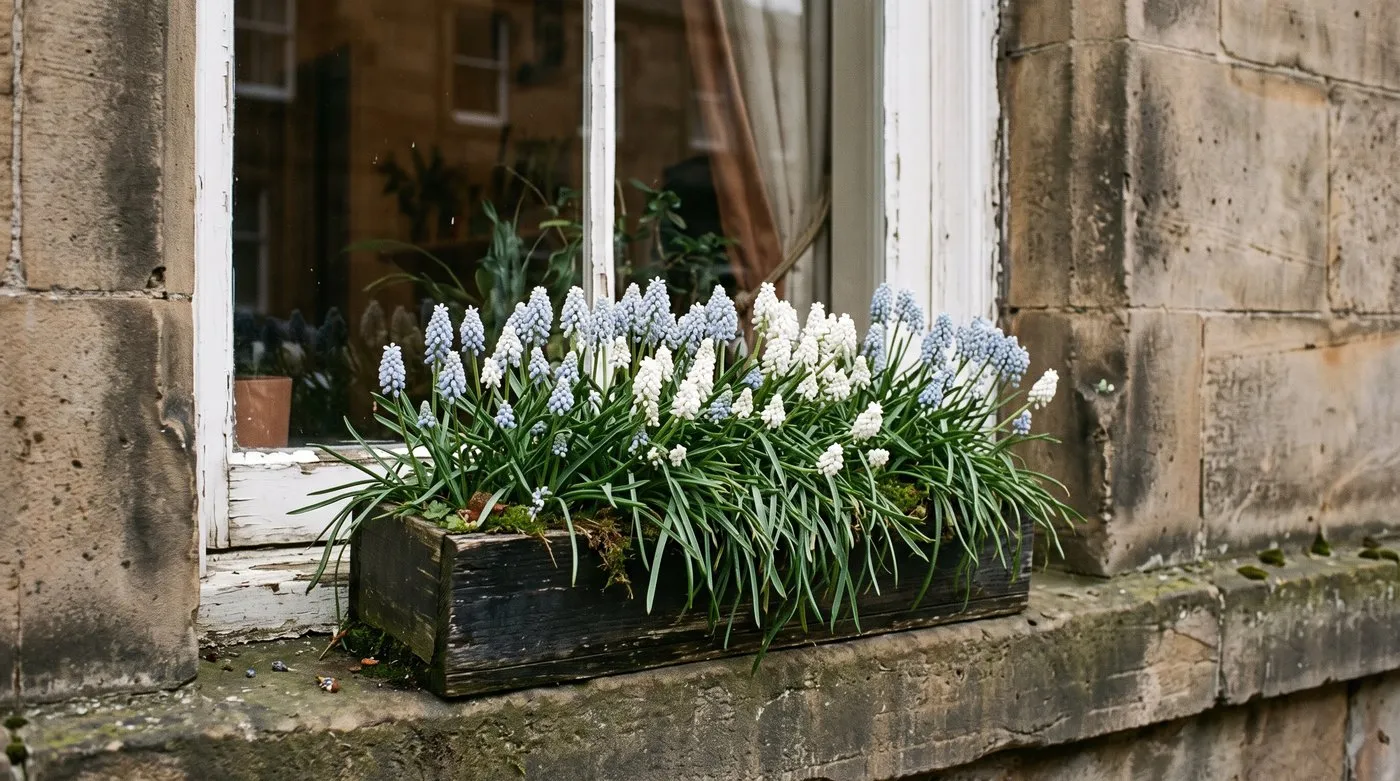
Pack the bulbs in almost touching for a dense show. Leave the box outside all winter, as they need the cold to flower well.
How do muscari spread, and how do I control them?
Muscari armeniacum spreads in two ways: new little bulbs underground and seed. Every flower spike sets seed, and seedlings pop up the next year. Within a few years, a small planting can become a big colony.
That’s great under trees or in wild areas. It’s less fun in neat borders, gravel paths and rock gardens.
Keeping them in check
- Snip off the flower heads as soon as the blue fades, before they set seed. This is the easiest way to slow them down.
- Use a barrier. A strip of plastic lawn edging pushed into the soil stops new bulbs creeping sideways.
- Lift and thin every few years. Dig up crowded clumps in early summer once the leaves have died back, and replant only as many as you want. Give the rest to friends.
- Choose calmer varieties. Muscari latifolium, ‘Album’ and ‘Valerie Finnis’ spread much more slowly.
Year-on-year care for muscari
Once planted, muscari look after themselves.
- Leave the leaves until they turn yellow and die back in early summer. They feed the bulb. Don’t cut, tie or plait them.
- Feed lightly after flowering with a general fertiliser if they’re in pots or borders. In lawns they don’t need it.
- Water pots if the compost dries out in spring. Muscari in the ground rarely need watering.
- Split crowded clumps every few years in early summer and replant straight away, 8cm deep.
- Look out for smut, a fungus that turns the flowers into black, dusty lumps. It’s uncommon, but dig out and bin affected bulbs.
For more seasonal jobs, see our spring gardening jobs checklist and the guide to spring bulb care after flowering.
Best planting partners for muscari
Muscari look great with other spring bulbs and early flowers. They’re short, so they’re perfect at the front of a border or tucked between taller plants. Try them under yellow daffodils, around tulips or with primroses for a cheerful spring picture.
For lots more spring colour ideas, see our guide to best spring flowers for UK gardens.
Frequently asked questions
When should I plant muscari bulbs?
Plant them from September to November for spring flowers. October is ideal, as the soil is still warm enough for roots to get going before winter. You can still plant in December, though the flower spikes may be shorter in the first year.
How deep do I plant muscari?
Plant them 8cm deep with the pointy end up. Space them 5cm apart for a thick display. On heavy clay, put a little grit under the bulbs to stop them sitting wet. In pots, plant them 5-6cm deep and almost touching.
Do muscari spread too much?
Muscari armeniacum can spread a lot within a few years. It makes new little bulbs underground and seeds itself about. That’s lovely under trees or in wild corners, but it can get out of hand in a neat border. For slower spreaders, try ‘Album’ or ‘Valerie Finnis’.
Can I grow muscari in pots?
Yes, they’re brilliant in pots. Use a pot at least 12cm deep with drainage holes, and plant bulbs 5-6cm deep and almost touching. Mix some grit into multipurpose compost. Water once after planting and leave the pot outside over winter. They look great on top of tulips and daffodils in a layered bulb lasagne pot.
Why are my muscari leaves long and floppy?
That’s perfectly normal for muscari. The grassy leaves appear in autumn and stay all winter, feeding the bulb for spring. Don’t cut them. They do look untidy by March, but the flowers pop up through them and steal the show.
Do muscari come back every year?
Yes, muscari come back reliably every spring. They make new little bulbs around the parent each year, so clumps get bigger and fuller over time. Leave them undisturbed and they’ll just keep getting better.
What is the best muscari variety for UK gardens?
Muscari armeniacum is the best all-rounder. It’s tough, reliable and easy to find. For white flowers, choose Muscari botryoides ‘Album’. For a two-tone look, try Muscari latifolium with its dark and pale blue spikes. For pots, the soft pink ‘Pink Sunrise’ is lovely.
Related articles
Our team produces practical UK gardening guidance from source research, contributor records and established horticultural practice. Editorial standards are overseen by Matt W.


