Key takeaways
- Snowdrops and winter aconites are the first to flower, from late January
- Plant most spring bulbs in autumn, and snowdrops in the green in February or March
- Layer bulbs in one pot or hole for weeks of colour from one planting
- Hellebores, primroses and pulmonaria love the shade under trees
- Southern gardens flower a couple of weeks ahead of Scotland
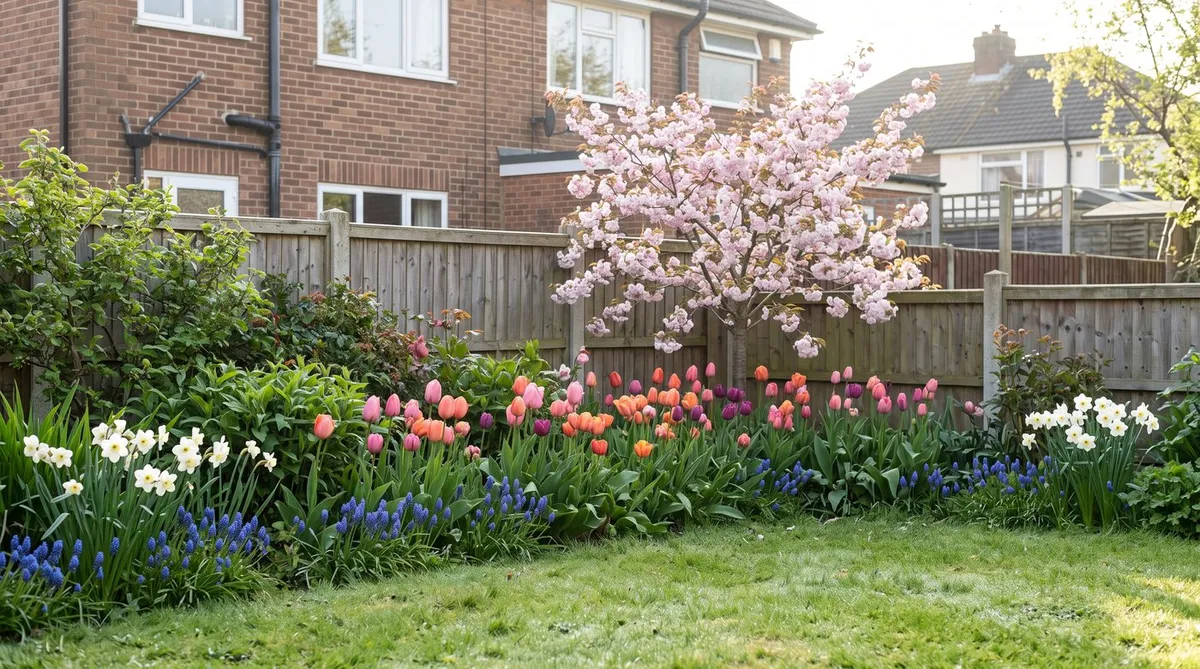
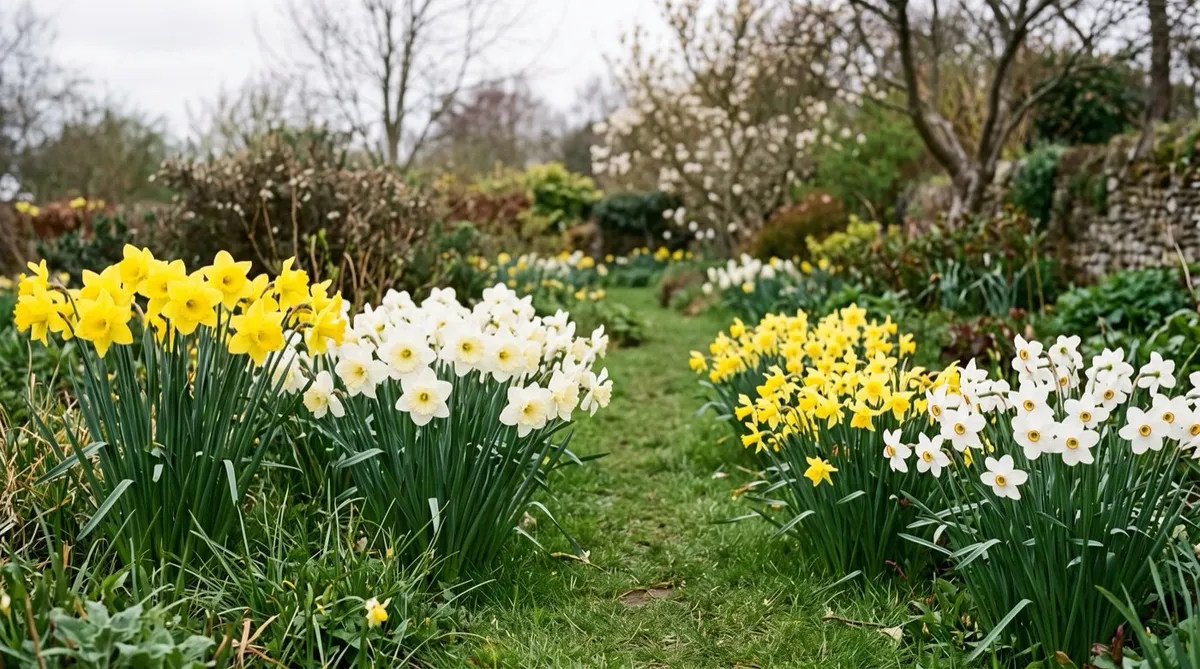
Early spring flowers can light up your garden from late January, long before most plants stir. Plenty of gardens look bare from January to March, but it’s not the weather’s fault. It’s usually just that nothing early was ever planted.
The good news is that it’s an easy fix. The fourteen plants below flower reliably across the UK between late January and late April. They shrug off frost and snow, and many cope with heavy clay. Plant a few together and you’ll have colour all through late winter and spring.
 Crocuses and snowdrops flowering together in a February border.
Why early spring gardens look bare
Usually the bulbs were never planted. Most of us shop for plants in spring when the garden centres are full. By then it’s too late for the autumn bulbs. Crocuses and early daffodils needed to go in the ground the autumn before.
The other reason is planting just one kind of flower. A bed of one bulb flowers for a few weeks and then goes quiet. Mix a few that flower at different times and the show lasts for months. The bulb lasagne method below shows you how.
The science behind early flowering
You don’t need a science lesson, just a few handy basics.
Vernalisation
That’s the fancy word for a simple idea: spring bulbs need a cold winter in the ground before they’ll flower. The UK’s winters are perfect for them. That’s why bulbs go in during autumn, and why bulbs kept somewhere warm indoors often just make leaves.
Soil temperature triggers
Each plant flowers at its own time as the weather warms up. That’s what gives you a natural parade through spring.
| Plant | First flowers (south) | First flowers (north) |
|---|---|---|
| Snowdrops | Late January | Mid-February |
| Winter aconites | Late January | Mid-February |
| Crocuses | Mid-February | Early March |
| Iris reticulata | Late February | Mid-March |
| Early daffodils | Late February | Mid-March |
| Grape hyacinths | Early March | Late March |
| Later daffodils | Mid-March | Early April |
Photoperiod effects
Longer days help too. As the days stretch out after Christmas, hellebores and primroses get going. Mild spells bring everything on, and cold snaps hold it back.
Fourteen early spring flowers for UK gardens
Snowdrops (Galanthus nivalis)
Snowdrops are the first bulbs to flower in most gardens, from late January in sheltered spots. They grow 10-15cm tall and slowly spread into drifts. They cope with most soils, including clay and chalk, and love part shade under trees.
Plant snowdrops in the green, which means while they’re still in leaf, in February or March. They settle in far better that way than as dry bulbs. Set them 5cm deep and 5cm apart. Our guide to growing snowdrops covers dividing and varieties. For a taller lookalike that flowers into March, see our guide to growing leucojum, the spring snowflake.

Snowdrops settle in far better planted while still in leaf than as dry bulbs. Set them about 5cm deep in part shade, and they’ll slowly spread into drifts.
Winter aconites (Eranthis hyemalis)
Winter aconites flower with the snowdrops from late January to mid-March. Their bright yellow, buttercup-like flowers sit on a little green ruff just above the soil. They spread into golden carpets on shady banks and under trees.
Like snowdrops, they do best planted in the green. Dry tubers are hit and miss, so soak them overnight and plant 3-5cm deep in September. They like soil that stays moist in spring, and vanish underground by early summer, so don’t dig around them. Our guide to growing winter aconites has the full story.
Crocuses (Crocus)
Crocuses follow the snowdrops, from mid-February in the south to early March in the north. Plant corms 8-10cm deep in September or October. Crocus tommasinianus is the best spreader and is lovely in a lawn, as long as you hold off mowing for about six weeks after it flowers. Crocus chrysanthus comes in yellow, white and two-tone, and flowers a little earlier.
They spread a little more each year. Crocuses hate soggy ground, so on heavy clay mix some sharp sand or grit into the planting hole.
Hellebores (Helleborus)
Hellebores are the best early perennial for shady gardens. They flower from late winter into April and grow where little else will. The Lenten rose (Helleborus x hybridus) comes in white, pink, plum and almost black. The Christmas rose (Helleborus niger) can flower from December in sheltered spots.
They cope with shade, dry shade and heavy clay. Cut off the old leaves in winter before the flower stems come up. It shows off the flowers and helps stop leaf spot. Mulch with leafmould in autumn. See our hellebore care guide for more.
Primroses (Primula vulgaris)
Primroses are native wildflowers that bloom from late February to May. Their pale yellow flowers sit on short stems in hedgerows, woodland edges and shady borders. They like moist soil in dappled shade, and sulk in hot, dry spots.
They seed themselves around when they’re happy, and big clumps are easy to split in autumn. They look lovely with snowdrops and hellebores. Our primrose growing guide covers the rest.
Pulmonaria (Lungwort)
Pulmonaria flowers from March to May. The flowers open pink and turn blue as they age, and the spotty silver leaves cover the ground for the rest of the year. It loves shade and moist soil. ‘Blue Ensign’ has rich blue flowers, and ‘Mrs Moon’ has lovely spotted leaves.
It’s one of the first flowers queen bumblebees visit in spring. For more pollinator plants, see our guide to bee-friendly garden plants.
 Crocus tommasinianus spreading through a lawn in February.
Cyclamen coum
Cyclamen coum flowers from January to March, with little pink, magenta or white flowers over round leaves often marked with silver. It’s only 5-8cm tall. It’s brilliant in dry shade under trees and shrubs, where little else grows. Plant tubers 3-5cm deep in early autumn, rounded side down and the flatter side, where the shoots come from, facing up.
It spreads by seed, and ants carry the sticky seeds around, so seedlings pop up in surprising places. Once settled, it needs no feeding or watering.
Iris reticulata
Iris reticulata gives vivid blue, purple or yellow flowers in late February and March on short stems. Plant bulbs 8-10cm deep in autumn in full sun and soil that drains well. They’re perfect in gravel gardens, raised beds and troughs.
Watch out for ink disease, which leaves black marks on the bulbs and kills them. Buy firm, healthy bulbs, and plant somewhere fresh if it turns up. ‘Harmony’ (deep blue) and ‘Katharine Hodgkin’ (pale blue and yellow) are popular choices.
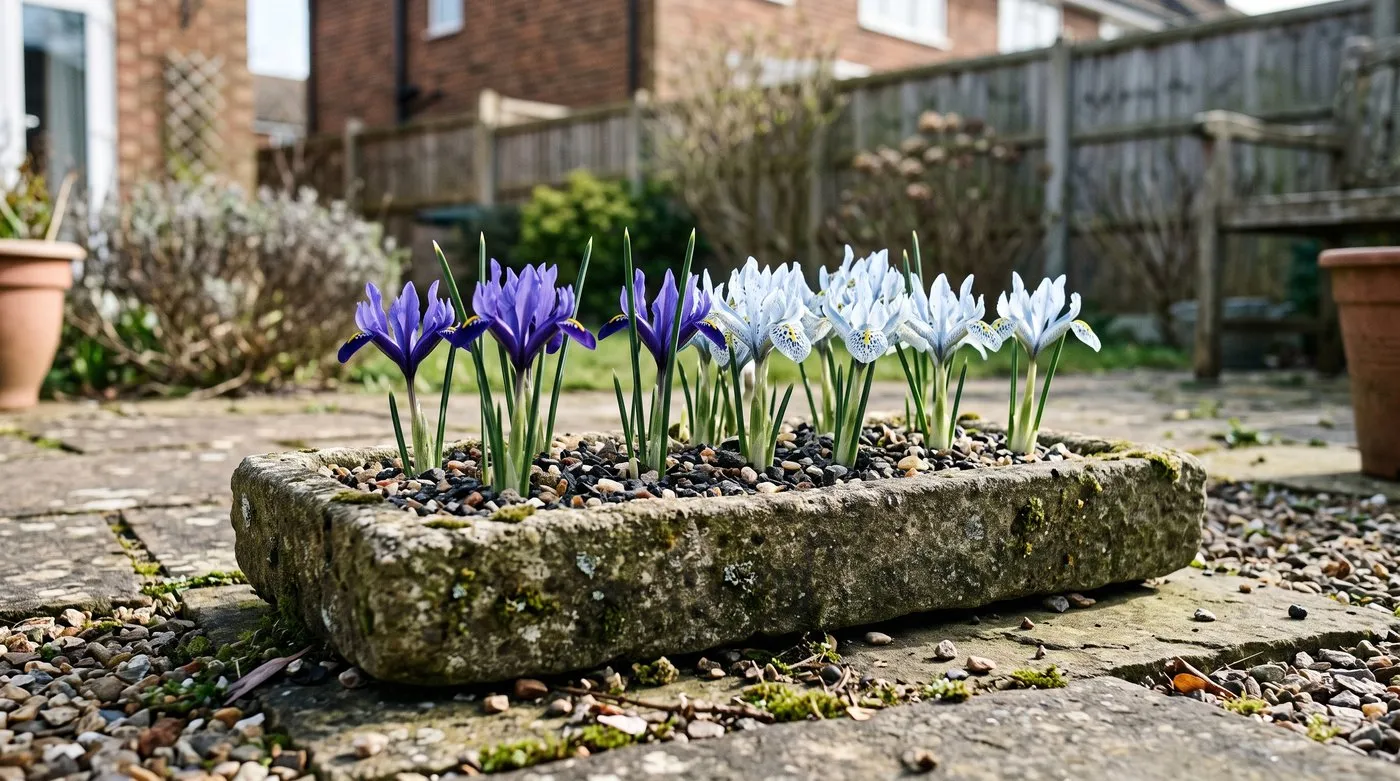
Iris reticulata loves full sun and soil that drains freely, so a gritty trough or raised bed suits it perfectly. Buy firm, healthy bulbs to avoid ink disease.
Muscari (Grape hyacinths)
Grape hyacinths give dense spikes of bright blue flowers in March and April. They spread happily, making blue rivers through borders and under shrubs. Plant bulbs 8cm deep in autumn. They grow in almost any soil, clay and chalk included.
The leaves come up in autumn and look a bit scruffy through winter. Tuck them behind low plants or in grass. They look great with yellow daffodils.
Early daffodils (Narcissus)
Early daffodils flower from late February into March, ahead of the main crowd. ‘February Gold’ is a reliable early one. ‘Tete-a-Tete’ is short and brilliant in pots. ‘Jetfire’ has orange trumpets and peaks in March.
Plant bulbs about 15cm deep in September or October. Deep planting helps keep squirrels off. They spread well in grass if you leave the lawn unmown for about six weeks after the flowers fade. Our daffodil growing guide has more varieties.
Camellia
Camellias flower from February to May, with big white, pink or red blooms on glossy evergreen shrubs. They need acid soil, steady moisture and shelter from early morning sun. ‘Donation’ is a much-loved variety that drops its old flowers cleanly.
They grow well in big pots of ericaceous compost. Avoid east-facing spots, where morning sun thaws frosted buds too quickly and turns the petals brown. Our camellia care guide covers pruning and feeding.
Forsythia
Forsythia is the sunshine shrub of spring, covered in yellow flowers on bare stems in March and April. It grows in any soil. It flowers on last year’s growth, so prune straight after flowering by cutting flowered stems back to a strong bud.
It makes an informal hedge or a standalone shrub. Cut a few stems in late winter and stand them in a vase indoors, and they’ll often burst into flower in a few weeks.
Viburnum (winter-flowering)
Viburnum x bodnantense ‘Dawn’ has clusters of sweetly scented pink flowers on bare stems from late autumn to early spring. It’s a big shrub, eventually about 3m tall, and copes with most soils.
Plant it by a path or door where you’ll catch the scent on winter days. For more ideas, see our guide to winter-flowering shrubs.
 Lenten roses flowering in dappled shade under birch trees.
Winter-flowering cherry (Prunus subhirtella ‘Autumnalis’)
Winter-flowering cherry opens white or pale pink flowers on bare branches in mild spells from November to March. It’s a small, graceful tree and a lovely focal point in a sheltered garden.
It grows in most soils but hates being waterlogged. Plant it where low winter sun catches the flowers. It needs no pruning beyond taking out dead wood.
Month-by-month early spring flowering calendar
When each plant flowers, roughly. Southern gardens run a couple of weeks ahead of northern Scotland.
| Plant | Jan | Feb | Mar | Apr | When to plant |
|---|---|---|---|---|---|
| Snowdrops | Late | Yes | Early | - | Feb-Mar (in the green) |
| Winter aconites | Late | Yes | Early | - | Feb-Mar (in the green) |
| Cyclamen coum | Yes | Yes | Yes | - | Autumn (tubers) |
| Christmas rose | Yes | Yes | Early | - | Autumn (plants) |
| Viburnum ‘Dawn’ | Yes | Yes | Yes | - | Autumn to spring |
| Winter cherry | Mild spells | Yes | Yes | - | Autumn to spring |
| Crocuses | - | Mid-late | Yes | Early | Sep-Oct (corms) |
| Iris reticulata | - | Late | Yes | - | Autumn (bulbs) |
| Lenten rose | - | Yes | Yes | Yes | Autumn (plants) |
| Primroses | - | Late | Yes | Yes | Autumn or March |
| Early daffodils | - | Late | Yes | Early | Sep-Oct (bulbs) |
| Pulmonaria | - | - | Yes | Yes | Autumn or March |
| Grape hyacinths | - | - | Yes | Yes | Autumn (bulbs) |
| Forsythia | - | - | Yes | Early | Autumn to spring |
| Camellia | - | Late | Yes | Yes | Spring (pots) |
The bulb lasagne method for continuous colour
Bulb lasagne means planting layers of different bulbs in the same hole or pot. Each kind flowers at its own time, so one planting gives you weeks of colour. The bigger, deeper bulbs simply grow up past the smaller ones.
How to plant a three-layer lasagne
- Dig a hole about 20cm deep and 30cm wide
- Set 5 early daffodil bulbs at the bottom, about 15cm deep, tips up
- Cover with a little soil
- Add 7 crocus corms at about 8-10cm deep
- Cover with a little more soil
- Add 10 snowdrop bulbs at about 5cm deep
- Top up with soil and firm gently
Snowdrops come first, then crocuses, then the daffodils. On heavy clay, put a layer of sharp sand in the bottom to help drainage.
For a pot, do the same in a 30cm container, using ‘Tete-a-Tete’ for the bottom layer. Use John Innes No. 2 with some perlite mixed in. Keep the pot outside all winter, as the bulbs need the cold.
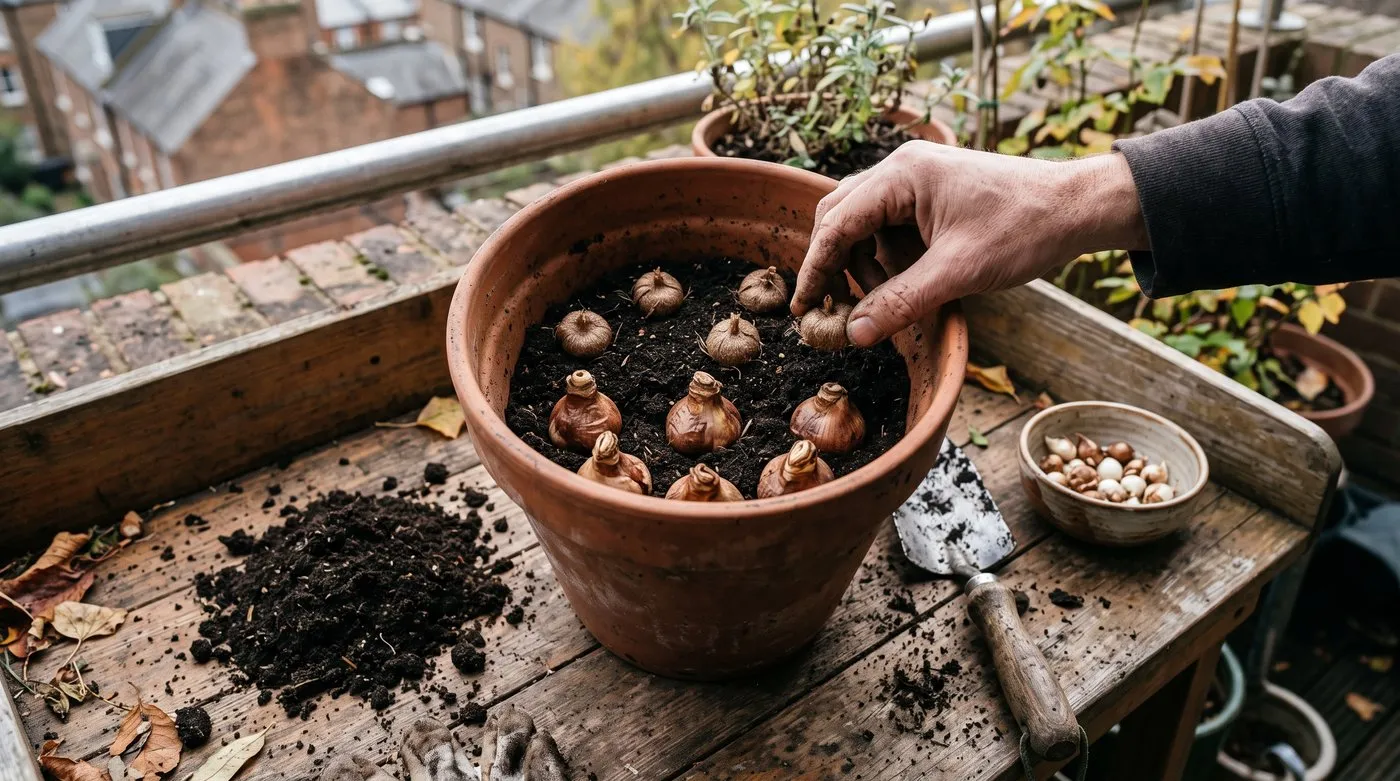
Put the biggest bulbs deepest and the smallest near the top. Each layer flowers at its own time, so one pot gives you snowdrops, then crocuses, then daffodils.
Regional flowering differences across the UK
The further south you are, the earlier things flower. The south coast is usually first, often a couple of weeks ahead of the Midlands, and northern England and Scotland follow a few weeks after that.
Town gardens tend to be a little ahead of country ones nearby. A sheltered, sunny wall brings things on early, and a cold north-facing border holds them back.
Common mistakes with early spring planting
Planting bulbs too late
Aim to have most bulbs in by the end of October. Order them in late summer so you’re ready. Dry snowdrop and aconite bulbs are often disappointing, so buy them in the green in late winter instead.
Removing foliage too early
Leave bulb leaves until they turn yellow on their own. They’re feeding the bulb for next year. Daffodil leaves can take until early summer. Cutting or tying them up early means fewer flowers next spring.
Planting in waterlogged soil
Most spring bulbs rot in soggy ground. Crocuses, iris reticulata and cyclamen mind most. On heavy clay, mix sharp grit into the top layer of soil, or plant in raised beds or pots.
Ignoring shade potential
Lots of people think flowers need full sun. Snowdrops, hellebores, primroses, pulmonaria and Cyclamen coum all prefer some shade. Under trees, they get winter sun through bare branches and shade in summer. It’s a perfect spot that often gets left empty.
Planting single species only
A bed of just crocuses looks wonderful for a few weeks, then nothing. Mix bulbs that flower at different times, and add hellebores, primroses and pulmonaria for leaves after the bulbs have gone over.

Wildlife value of early spring flowers
Early flowers are a lifeline for hungry insects. Queen bumblebees wake up in late winter and early spring needing food fast.
Crocuses are a favourite with early bumblebees. Pulmonaria follows in March, with tube-shaped flowers just right for long-tongued bees. Primroses feed early butterflies like brimstones. Snowdrops give honeybees some of the first pollen of the year on mild days.
Hellebores feed early hoverflies and solitary bees. Winter cherry and Viburnum ‘Dawn’ help insects out on mild winter days. For more plants that feed pollinators through the colder months, see our guide to winter-flowering plants.
Comparison table: fourteen early spring flowers at a glance
| Plant | Flowers | Height | Colour | Light | Best for |
|---|---|---|---|---|---|
| Snowdrops | Jan-Mar | Short | White | Part shade | Drifts under trees |
| Winter aconites | Jan-Mar | Very short | Yellow | Part shade | Woodland carpets |
| Cyclamen coum | Jan-Mar | Very short | Pink or white | Shade | Dry shade under trees |
| Christmas rose | Dec-Feb | Short | White | Part shade | Front of a shady border |
| Lenten rose | Feb-Apr | Medium | Mixed | Part shade | Backbone of a shade garden |
| Crocuses | Feb-Mar | Very short | Purple, yellow, white | Sun | Lawns and gravel |
| Iris reticulata | Feb-Mar | Short | Blue, purple | Sun | Raised beds and troughs |
| Primroses | Feb-May | Short | Pale yellow | Part shade | Hedgerow edges |
| Early daffodils | Feb-Apr | Short | Yellow, orange | Sun | Borders and pots |
| Pulmonaria | Mar-May | Short | Pink then blue | Shade | Shady ground cover |
| Grape hyacinths | Mar-Apr | Short | Blue | Sun | Edging and drifts |
| Camellia | Feb-May | Tall shrub | Pink, red, white | Part shade | Acid soil or pots |
| Forsythia | Mar-Apr | Tall shrub | Yellow | Sun | Hedges and screens |
| Viburnum ‘Dawn’ | Nov-Mar | Tall shrub | Pink | Sun or shade | Scent by a path |
Planting plan for a south-facing spring border
Here’s a simple plan for a border about 3m long and 1m deep, giving flowers from late January to late April.
Back: a Lenten rose or two, planted in early autumn.
Middle: three primroses about 20cm apart and two pulmonarias about 30cm apart, planted in autumn.
Front (bulb lasagne): dig a trench about 20cm deep. Lay 15 ‘February Gold’ daffodils at about 15cm, then 25 Crocus tommasinianus at about 8cm, then 30 snowdrops at about 5cm. Cover and firm.
In the gaps: dot 10 Cyclamen coum tubers between the plants, and 15 winter aconites along the front edge.
The hellebores and primroses give you leaves to look at once the bulbs have gone over. Yearly jobs are simple: cut old hellebore leaves in winter, split crowded snowdrops every few years after flowering, and sprinkle on a general feed like blood, fish and bone in March.
For a planting guide that runs right through the year, see our flower planting calendar. Ready to order bulbs? Our spring bulb planting guide covers timing, depth and varieties.
Frequently asked questions
What flowers bloom earliest in the UK?
Snowdrops and winter aconites, from late January. Snowdrops are at their best in February and early March. Winter aconites open their yellow flowers alongside them and finish by mid-March. In a mild winter in a sheltered southern garden, both can start in early January.
When should I plant spring bulbs for early flowers?
Plant most spring bulbs from September to November. Crocuses, grape hyacinths and early daffodils go in around September and October. Snowdrops and winter aconites do best planted ‘in the green’, while still in leaf, in February or March. As a rule, plant bulbs about three times as deep as they are tall.
Can I get flowers in January in my UK garden?
Yes, quite a few plants flower in January. Try snowdrops, winter aconites, Cyclamen coum, Christmas rose and Viburnum ‘Dawn’. The winter-flowering cherry opens its flowers in mild spells from November to March. Put a few together and you’ll have something to enjoy in the darkest month.
Why do my spring bulbs come up blind with no flowers?
Usually they’re crowded, hungry or planted too shallow. Clumps get congested after a few years, so lift and divide them. Cutting the leaves off too soon after flowering also starves next year’s flower. Let the leaves die back on their own, and give a feed after flowering.
Do crocuses spread on their own in UK gardens?
Yes, they do. They make new little corms each year and some seed themselves too. Crocus tommasinianus is the best spreader and soon forms lovely drifts. They spread fastest in soil that drains well, where they’re left undisturbed in summer.
What early spring flowers grow in shade?
Snowdrops, hellebores, primroses, pulmonaria and Cyclamen coum. They all love the dappled shade under trees. Snowdrops and winter aconites flower under bare branches before the leaves come out. Hellebores cope even with dry shade once settled. Pulmonaria flowers from March and is great for early bumblebees.
How do I plan for continuous spring colour from January to April?
Layer bulbs in the same hole or pot. Put early daffodils deepest, crocuses in the middle and snowdrops near the top. Each kind flowers at its own time, so one planting gives weeks of colour. Add hellebores, primroses and pulmonaria between the bulbs for even longer.
Our team produces practical UK gardening guidance from source research, contributor records and established horticultural practice. Editorial standards are overseen by Matt W.