
Key takeaways
- White flowers are possible from January to October with the right mix of bulbs, shrubs and perennials
- Snowdrops, Christmas rose and sweet box carry white through winter
- Philadelphus, 'Iceberg' roses and white foxgloves are the backbone of a white summer border
- Japanese anemone 'Honorine Jobert' keeps white going from August into October, even in part shade
- White brightens shady corners, and many white flowers are scented in the evening
- Lily of the valley, foxgloves, delphiniums and hydrangeas are toxic to pets, so site them with care
The best white flowers for UK gardens include snowdrops in winter, Narcissus ‘Thalia’ in spring, Philadelphus and ‘Iceberg’ roses in summer, and Japanese anemones in autumn. With a few plants from each season, you can have white in the garden from January to October.
White flowers brighten dull corners and glow at dusk. They also calm down a busy border. This guide picks the best white flowers season by season, with notes on shade, scent and soil. If you’re planning a whole white garden, the guide to a white garden planting scheme covers layout.
White winter flowers: January and February
Winter is when white flowers stand out most, against bare soil and empty borders.
Snowdrops (Galanthus nivalis) are the first white flowers of the year, opening in January or February. They grow about 10cm tall and spread into clumps under trees and in grass. Many gardeners plant them “in the green”, just after flowering with their leaves still on. Dry bulbs planted fresh in early autumn work too. The guide to growing snowdrops explains both methods.
Christmas rose (Helleborus niger) has white, saucer-shaped flowers from midwinter. It grows about 30cm tall and likes part shade and soil that stays moist but not wet. ‘Josef Lemper’ is a reliable variety.
Sweet box (Sarcococca confusa) is an evergreen shrub with tiny white flowers and a big vanilla scent. It grows 1-2m tall, copes with deep shade and is lovely by a door or path. Shiny black berries follow the flowers.

Snowdrops slowly spread into drifts under deciduous trees. They’re the first white flowers of the year.
White spring flowers: March to May
Spring brings the biggest burst of white, from bulbs, blossom and woodland plants.
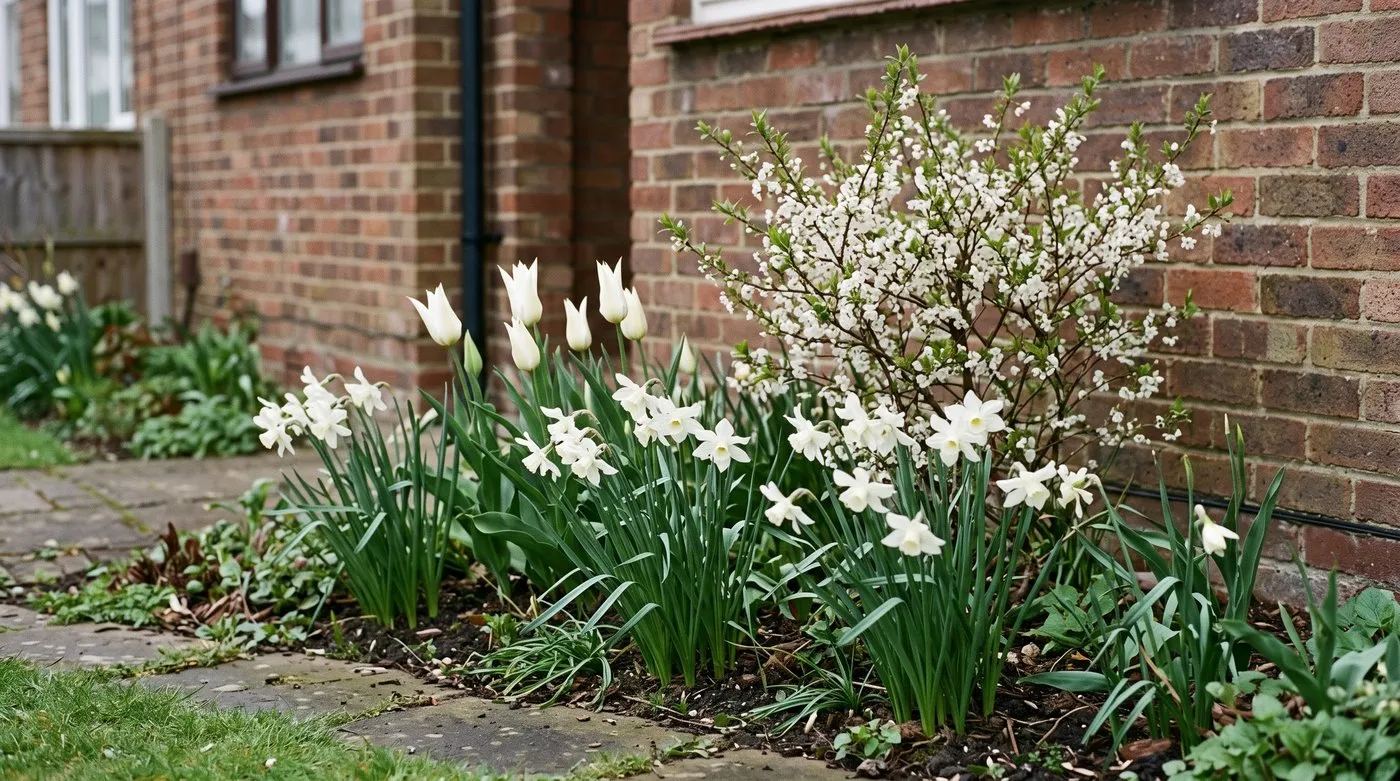
Thalia daffodils and white tulips carry the white theme through April and May.
Narcissus ‘Thalia’ is a graceful white daffodil with two or three nodding flowers per stem. It grows about 35cm tall and flowers in April. Plant the bulbs about 10cm deep in autumn. Leave the leaves to die down naturally for about six weeks after flowering.
Lily of the valley (Convallaria majalis) has tiny, scented white bells in April and May. It spreads to form a carpet in moist, shady spots under trees. Every part of it is poisonous to people and pets, so wear gloves and plant it away from where pets dig.
Tulip ‘White Triumphator’ is a tall, elegant lily-flowered tulip with pointed white petals. It flowers from late April and grows about 60-70cm tall. Plant the bulbs about 15cm deep in November in a sunny, well-drained spot.
Pulmonaria ‘Sissinghurst White’ flowers in March and April, with white flowers over spotted leaves. It is a handy, low plant for shade and clay.
White blossom finishes the season. For a small garden, Prunus incisa ‘The Bride’ is a compact cherry smothered in white in early spring. Prune ornamental cherries in summer, not winter, to lower the risk of silver leaf disease.
White summer flowers: June to August
Summer has the widest choice of white flowers, from climbing roses to annuals.
Rosa ‘Iceberg’ is a well-loved white floribunda rose. It bears clusters of white flowers from June into autumn and grows about 1.2m tall. There is also a climbing form for walls. For something scented, the English shrub rose ‘Claire Austin’ has creamy cupped flowers with a myrrh fragrance.
Philadelphus ‘Belle Etoile’, or mock orange, fills June with an orange-blossom scent. It grows about 1.5m tall, with white flowers marked purple in the centre. Prune straight after flowering, taking a few of the oldest stems to the base.

‘Iceberg’ roses and mock orange flower together in June. It’s one of the easiest white pairings to grow.
Common jasmine (Jasminum officinale) is a vigorous climber with small, starry white flowers from June to September. The scent is strongest on warm evenings. It will cover a fence or pergola in a few years.
White hydrangeas suit sun or part shade. Hydrangea paniculata ‘Limelight’ has big cone-shaped heads that open lime-white and age to pink. Hydrangea arborescens ‘Annabelle’ has round white heads on a compact shrub. White mopheads such as ‘Madame Emile Mouillère’ stay white whatever your soil. The guide to growing hydrangeas explains pruning each type.
White delphiniums such as ‘Galahad’ make tall spires in June and July. They need full sun, rich soil and staking. White foxgloves (Digitalis purpurea f. albiflora) grow 1-1.5m tall in part shade and self-seed freely. Both are poisonous, so keep them away from children and pets that chew plants.
White cosmos ‘Purity’ is the easiest annual filler, flowering from July to the frosts. Gaura ‘Whirling Butterflies’ adds airy white flowers from June to October in a sunny, well-drained spot.
White autumn flowers: September and October
Japanese anemone ‘Honorine Jobert’ is the star of the late white border. It has single white flowers with yellow centres on tall, wiry stems from August to October, reaching about 1-1.2m. It holds an RHS Award of Garden Merit. It copes with clay and part shade, so it suits a north-facing border. It spreads steadily, so give it room. The guide to growing Japanese anemones has more.
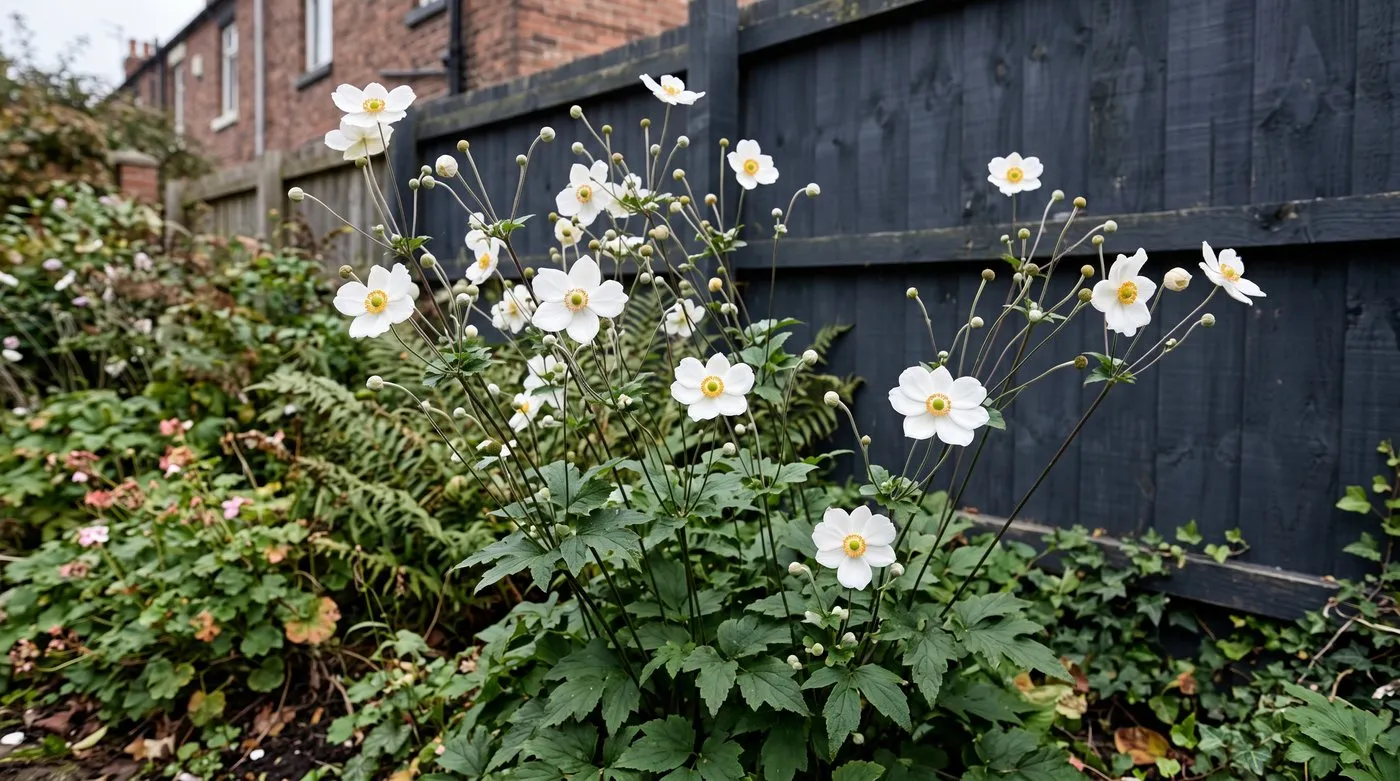
‘Honorine Jobert’ keeps white flowers coming from August into October, even in part shade.
Late cosmos, ‘Iceberg’ roses and Hydrangea paniculata also carry white through September. Together they keep a white scheme going until the first frosts.
White flowers month by month
| Month | White flowers to enjoy |
|---|---|
| January | Snowdrops, sweet box, Christmas rose |
| February | Snowdrops, sweet box, hellebores |
| March | Pulmonaria ‘Sissinghurst White’, early cherry blossom |
| April | Narcissus ‘Thalia’, lily of the valley, blossom |
| May | Tulip ‘White Triumphator’, lily of the valley |
| June | Philadelphus, ‘Iceberg’ roses, foxgloves, delphiniums |
| July | Roses, jasmine, Hydrangea ‘Annabelle’, cosmos |
| August | Hydrangea ‘Limelight’, gaura, Japanese anemones start |
| September | Japanese anemones, cosmos, late roses |
| October | Japanese anemones, cosmos until the frosts |
White flowers for shade
White is the best colour for a shady corner, because pale flowers show up in low light.
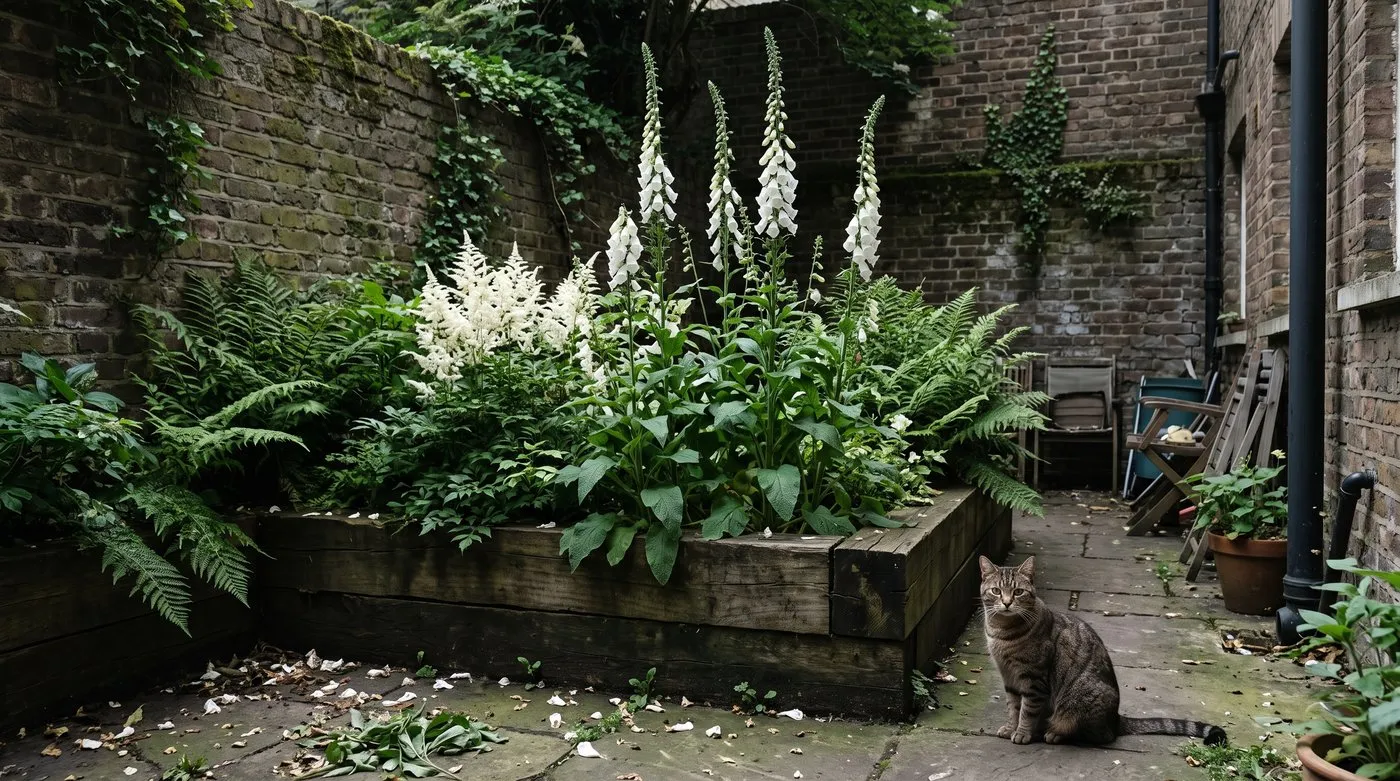
White flowers shine in a shady courtyard. Foxgloves are poisonous, so keep an eye on pets that chew plants.
| Plant | Shade | Flowers | Height |
|---|---|---|---|
| Sweet box | Deep to part | January to February | 1-2m |
| Christmas rose | Part | Winter | 30cm |
| Lily of the valley | Deep to part | April to May | 20cm |
| Astilbe ‘Bridal Veil’ | Part, moist soil | June to August | 60-80cm |
| White foxglove | Part | June to July | 1-1.5m |
| Japanese anemone ‘Honorine Jobert’ | Part | August to October | 1-1.2m |
For more ferns, hostas and ground cover to go with them, see the guide to the best plants for shade.
How to make white flowers stand out
White flowers look their best with good partners. Without them, a white border can look flat.
- Silver leaves, such as lamb’s ears (Stachys byzantina) and Artemisia ‘Powis Castle’, make whites look brighter.
- Dark green backgrounds, such as a yew hedge or a dark fence, make white flowers glow.
- Lime-green Alchemilla mollis gives a fresh, soft edge under white roses.
- Mixed shapes keep it interesting: spires of foxgloves, flat heads of achillea, round hydrangeas and open anemones.
- White-edged leaves, such as Cornus alba ‘Elegantissima’ or Euonymus ‘Emerald Gaiety’, carry the theme through winter.
The famous white garden at Sissinghurst uses all these tricks. The guide to lessons from the Sissinghurst White Garden shows how to scale them down.

White flowers glow long after other colours fade at dusk. They’re perfect for gardens you mostly enjoy in the evening.
If you mainly use the garden after work, a moon garden built around white flowers and evening scent is a lovely idea. Put scented whites such as jasmine and nicotiana near your seat.
Common mistakes with white flowers
- Forgetting foliage. White flowers alone can look washed out. Add silver, lime and dark green leaves.
- Leaving a winter gap. Snowdrops, hellebores and sweet box cost little effort and fill the dull months.
- Dotting single plants about. One of everything looks spotty. Plant your main whites in groups of three or five.
- Putting Mediterranean whites on wet clay. White lavender and cistus rot in soggy soil. Choose anemones or hydrangeas there.
- Planting toxic plants where pets play. Foxgloves, lily of the valley and hydrangeas are poisonous if chewed.
For more ideas, browse the plants hub.
Frequently asked questions
What are the best white flowers for a UK garden?
Philadelphus, ‘Iceberg’ roses and Japanese anemone ‘Honorine Jobert’ are three of the most reliable. Together they cover early summer to autumn and grow in most soils. Add snowdrops for winter and Narcissus ‘Thalia’ for spring.
Do white flowers work in a shady UK garden?
Yes, white flowers brighten shade better than any other colour. Sweet box flowers in winter with a strong scent, and hellebores follow. Lily of the valley flowers in spring, and white foxgloves and astilbe carry on into summer.
What white flower blooms all summer in the UK?
Rosa ‘Iceberg’ flowers from June into autumn in most years. White cosmos, sown each spring, flowers from July until the frosts. Gaura ‘Whirling Butterflies’ also flowers for months in a sunny, well-drained spot.
What white flowers are fragrant?
Philadelphus, common jasmine and sweet box are among the best scented whites. Lily of the valley scents the spring, and white nicotiana is fragrant on summer evenings. Plant them near paths and seats where you’ll notice them.
Which white flowers grow in clay soil?
Japanese anemones, Philadelphus and Hydrangea paniculata all cope well with clay. White foxgloves and astilbe like the moisture too. Avoid Mediterranean plants such as white lavender and cistus on wet clay, as they often rot.
Are white garden flowers safe for pets?
Not all of them. Lily of the valley, foxgloves, delphiniums, hydrangeas and daffodils are toxic to cats and dogs. Lilies are especially dangerous to cats. Keep these away from pets that chew plants.
For a contrasting colour scheme next door, read the guide to the best purple, pink and blue flowers.
Our team produces practical UK gardening guidance from source research, contributor records and established horticultural practice. Editorial standards are overseen by Matt W.


