
Key takeaways
- Japanese anemones flower from August to October, just as summer borders fade
- They're happy in part shade and north-facing borders, unlike most autumn flowers
- Good varieties include Honorine Jobert, September Charm, Pamina, Whirlwind, Queen Charlotte and Wild Swan
- Plant in spring or autumn into moist soil with plenty of compost
- They often skip flowering in their first year, so be patient
- Keep them in check by slicing around the clump with a spade each March
Japanese anemones are the quiet stars of the autumn garden. While dahlias and asters shout for attention, these graceful perennials carry elegant flowers on tall, wiry stems from August right into late October, just when most borders are winding down.
What makes them stand out from other autumn flowers is that they’re happy in shade. Most autumn flowers need full sun, but Japanese anemones do well in part shade, dappled light and even north-facing borders. The RHS growing guide has more background. They’re fully hardy, cope with poor soil once settled and spread to fill gaps on their own. Got a shady corner that looks bare from August? These are your answer.
What are Japanese anemones?
Japanese anemones are hardy perennials related to buttercups, though you’d never guess. Most sold in the UK are Anemone x hybrida, garden hybrids of plants that originally came from China, despite the name.
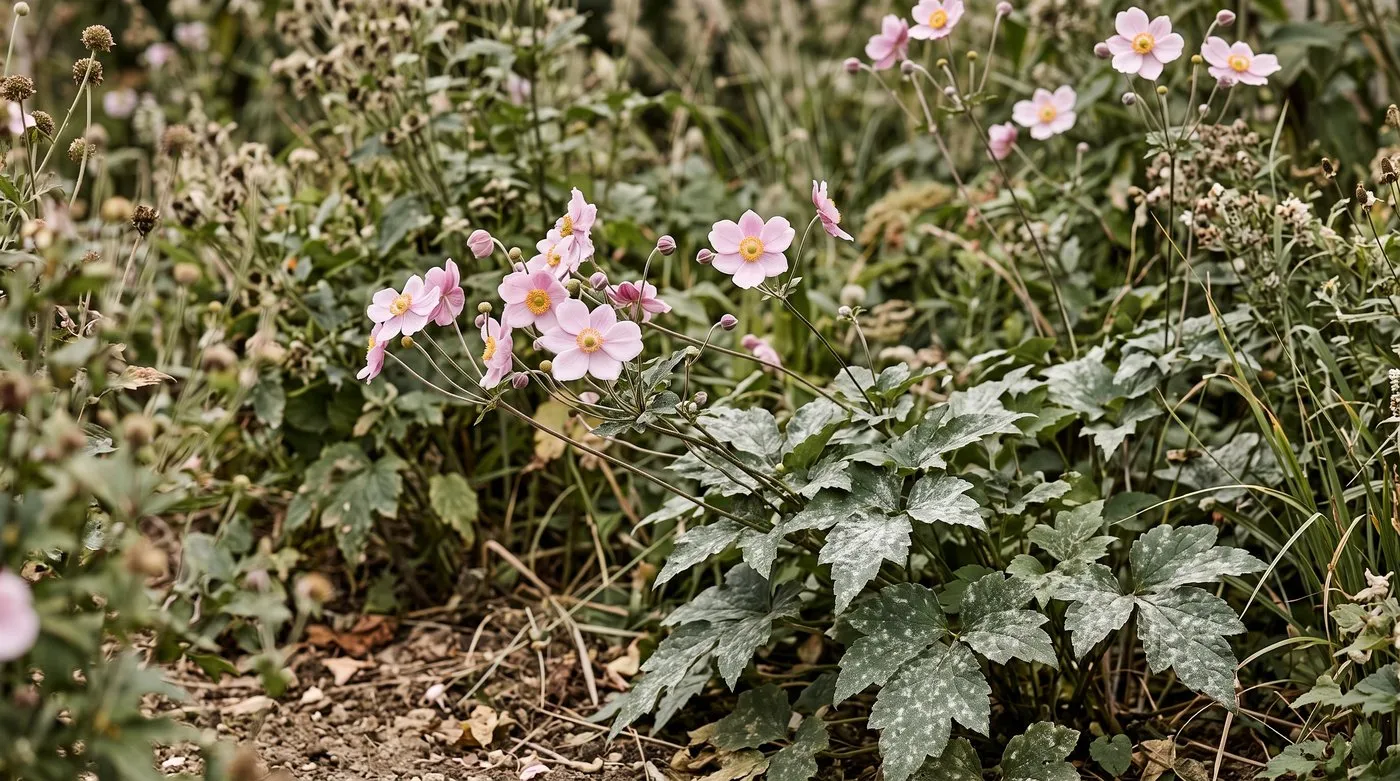
They make clumps of dark green, vine-like leaves. From late summer, tall branching stems rise above the leaves, carrying saucer-shaped flowers with a ring of golden stamens in the middle. The flowers sway in the slightest breeze, bringing the whole border to life. Afterwards, fluffy seed heads form and last into winter.
They die back completely in late autumn and pop up again in spring. Once settled, they’re very long-lived, slowly spreading outwards through underground runners.
Which varieties should I grow?
Honorine Jobert
The classic white Japanese anemone. Single white flowers with golden centres appear from August to October on tall stems. It’s vigorous and spreads well in moist soil, and it’s the best one for lighting up a shady border. It’s a natural pick for a white garden planting scheme.
 Honorine Jobert, the classic white Japanese anemone, glowing in dappled shade.
September Charm
Soft pink single flowers on medium-height stems. Despite the name, it usually starts in mid-August and carries on into October. It’s more compact than Honorine Jobert, so it suits smaller borders. The flowers fade gently from mid-pink to pale blush. Easy to find in garden centres.
Pamina
Semi-double, deep rose-pink flowers on sturdy, shorter stems. One of the darkest pinks around. It spreads more slowly than the others, so it’s good towards the front of a border. Flowers from September to October.
Whirlwind
Semi-double white flowers with a hint of green, on tall stems. The extra petals give a fuller look than the singles. It starts a little later than Honorine Jobert, in early September.
Queen Charlotte
Large, silvery-pink semi-double flowers with slightly cupped petals that catch the light. Flowers from early September to late October. It’s less vigorous than Honorine Jobert, so it’s easier to manage in a small garden.
Wild Swan
A newer, compact variety with white flowers backed in blue-purple, which you see as the flowers nod in the breeze. Its big bonus is a very long season, from early summer right through to October. It’s slower to spread than the others.
| Variety | Flower colour | Height | Flowers | Spread |
|---|---|---|---|---|
| Honorine Jobert | White | Tall | August to October | Fast |
| September Charm | Soft pink | Medium | August to October | Medium |
| Pamina | Deep rose-pink | Medium | September to October | Slow |
| Whirlwind | White, semi-double | Tall | September to October | Medium |
| Queen Charlotte | Silvery pink | Medium | September to October | Slow |
| Wild Swan | White, blue reverse | Short | June to October | Slow |
Where to plant Japanese anemones
The right spot matters more than soil or feeding. Get it right and they’ll flower well and spread at a sensible pace.
Light
Part shade is ideal. Japanese anemones grow naturally at woodland edges in dappled light. In UK gardens they’re happiest with a few hours of sun or bright, filtered light.
They’ll grow in full sun too, as long as the soil stays moist. In a hot, dry, south-facing border, the leaves scorch and the flowers fade fast. Full sun on clay works well, because clay holds moisture. Full sun on sandy soil is the worst combination.
North-facing borders suit them nicely. They get enough light to flower without the stress of hot afternoon sun. Very few autumn-flowering perennials can say that.
 Japanese anemones happily spreading in part shade under a big tree.
Soil
They grow in most soils but love moist soil with plenty of organic matter that doesn’t dry out in summer. Heavy clay is fine, and they’re one of the best perennials for clay.
On light, sandy or chalky soil, dig in lots of garden compost or well-rotted manure before planting to help hold moisture. Mulch around them each spring.
Where in the border
Plant them in the middle to back of a border. Tall types like Honorine Jobert and Whirlwind need something in front to hide their slightly bare lower stems. Shorter ones like Wild Swan and Pamina work nearer the front.
Space them 45-60cm apart. They fill the gaps within a couple of seasons. Plant further apart to slow the spread, or closer for quick cover.
How to plant Japanese anemones
Plant in March to April or September to October. Spring planting gives the roots a whole season to settle before winter. Autumn planting is fine in milder areas.
Planting step by step
- Dig a hole twice as wide as the pot and the same depth.
- Mix a handful of garden compost into the soil you dug out.
- Take the plant out of its pot and tease out any circling roots.
- Plant with the crown at soil level, not buried.
- Fill in and firm gently.
- Water well.
- Mulch with garden compost, keeping it off the stems.
Don’t expect flowers in the first year. Japanese anemones nearly always spend their first season growing roots. Most flower from the second year and really get going from the third. The wait is worth it.

Keep the crown at soil level rather than burying it, then water well and mulch. Don’t worry if nothing flowers in year one, as they spend it growing roots.
Month-by-month care calendar
Japanese anemones need very little looking after, which is one of the best things about them.
| Month | What to do |
|---|---|
| March | Cut old stems down if you left them over winter. Scatter a general fertiliser. Slice around clumps with a spade to stop them spreading. |
| April | Mulch with garden compost. New shoots appear. Divide crowded clumps if needed. |
| May | Water new plants in dry spells. Established plants rarely need it. |
| June | Wild Swan starts flowering. Tall stems begin to grow. |
| July | Buds form. Give a tomato feed if plants look pale. |
| August | Main flowering starts with Honorine Jobert and September Charm. |
| September | Peak flowering. Pamina, Whirlwind and Queen Charlotte join in. |
| October | Flowers carry on until the first hard frost. Leave seed heads for winter. |
| November | Leaves yellow and die back. Cut stems down now or leave until March. |
| December to February | Plants are dormant. Take root cuttings if you’d like more plants. |
How to control the spread
Japanese anemones spread by underground runners. In moist, rich soil and part shade, a single plant can cover quite a patch within a few years.
That’s handy if you want ground cover, but less so when they push into neighbouring plants. Here are three easy ways to keep them in check.
Root barrier
Sink a barrier of rigid plastic, slate or old roof tiles about 30cm deep around the patch. The runners grow sideways near the surface and can’t get past it. This is the most reliable long-term fix.
Yearly edge-slicing
Each March, push a sharp spade straight down around the edge of the clump to cut through any roots heading outwards. Pull out runners that have escaped. It only takes a few minutes per clump.

A few minutes with a spade each March cuts off runners heading where you don’t want them. Pull out any escapees while you’re there.
Drier soil
They spread much more slowly in drier soil, so if you’d like a well-behaved patch, avoid the richest, dampest corner of the garden. Remember they’re not invasive in the wild sense. They don’t seed everywhere, they just make bigger clumps, and any you don’t want fork out easily in spring.
Companion planting for autumn borders
Japanese anemones look best with other late-season plants. Aim for a border that peaks from August to November, after the summer flowers fade.
 Pink Japanese anemones with sedum, asters and Miscanthus grasses in an autumn border.
Best partners
Aster x frikartii ‘Monch’ is perhaps the best partner of all. Its lavender-blue daisies flower from July to October, overlapping nicely and cooling down the pink and white anemones.
Persicaria amplexicaulis has deep red or pink spikes from midsummer into autumn. Their upright shape contrasts with the open anemone flowers. ‘Firetail’ (red) and ‘Rosea’ (pink) are good choices.
Miscanthus sinensis adds height, movement and texture, with feathery plumes in September and October that catch the low autumn sun. ‘Morning Light’ and ‘Kleine Fontane’ work well.
Sedum gives flat heads of pink or mauve flowers from August to October, with fleshy grey-green leaves that contrast with the dark anemone foliage. ‘Autumn Joy’ is the classic.
For spring colour before the anemones wake up, plant snowdrops, hellebores and brunnera around them. Cottage garden planting plans often use this kind of layering.
Border scheme: a 3-metre autumn combination
This plan fills a 3-metre stretch of border with colour from August to November.
| Position | Plant | Colour | Flowers |
|---|---|---|---|
| Back | Miscanthus sinensis ‘Morning Light’ | Silver plumes | September to November |
| Back | Anemone ‘Honorine Jobert’ | White | August to October |
| Middle | Aster x frikartii ‘Monch’ | Lavender-blue | July to October |
| Middle | Anemone ‘September Charm’ | Soft pink | August to October |
| Front | Sedum ‘Autumn Joy’ | Dusky pink | August to October |
| Front | Geranium ‘Rozanne’ | Violet-blue | June to October |
It works in part shade or sun on most soils. A Chelsea chop in late May can hold some late-summer plants back so they flower alongside the anemones.
Propagation
Japanese anemones are easy to make more of by division or root cuttings. The hybrids don’t come true from seed, so skip that.
Division
Divide established clumps in March or April, as new growth appears. Lift the clump with a fork and pull or cut it into pieces, each with a few shoots and healthy roots. Replant straight away at the same depth and water well for the first month.
Divide older clumps rather than young ones. Expect fewer flowers that year, with a full recovery the year after.
Root cuttings
A very easy method, done while the plants are dormant in late autumn or winter.
- Lift part of the clump, or scrape soil away at the edge to find thick roots.
- Cut pencil-thick roots into 5cm lengths.
- Push each one upright (the right way up) into a pot of gritty compost, with the top just below the surface.
- Water lightly and put in a cold frame or unheated greenhouse.
- Shoots appear in spring.
- Pot them on and plant out the following autumn.
Common problems and solutions
Japanese anemones are wonderfully trouble-free, but a few things crop up now and then.
Powdery mildew
A white powdery coating on leaves in late summer, linked to dry soil and poor air flow. It rarely affects flowering. Space plants well and water the soil, not the leaves. Pick off the worst leaves if you like. It’s only cosmetic, so there’s no need to spray.
Mildew looks untidy but rarely spoils the flowers. Water the soil rather than the leaves and give plants a bit more space.
Vine weevil
Adult vine weevils notch the leaf edges, and the C-shaped grubs eat roots. Plants in pots are most at risk. Water in vine weevil nematodes in late summer. In the ground, damage is rarely serious.
Slugs on new shoots
Slugs nibble the new shoots in spring. Use ferric phosphate slug pellets sparingly around the plants as growth appears. Once the leaves toughen up in May, slugs lose interest.
Slow to settle
The most common complaint. New plants often sulk for a season or two. That’s normal. Don’t move them or overfeed them, and don’t assume they’ve died. Keep the soil moist in the first summer and wait. As the old saying goes: “First year they sleep, second year they creep, third year they leap.”
Winter interest from seed heads
 Fluffy anemone seed heads look magical with a coating of frost.
After flowering, fluffy seed heads form on the stems. They look lovely through November and December, catching frost and low winter sun. Many gardeners leave them standing and cut back in March instead.
Five mistakes to avoid
Planting in deep, dry shade. They cope with shade, but not bone-dry shade under thick evergreen trees. Our best plants for shade guide has ideas for the darkest corners.
Moving established plants for no reason. They hate root disturbance and may sulk for a couple of seasons afterwards. Only move them if you really must, and do it in March.
Expecting flowers in the first year. Even big potted plants usually spend their first year on roots. Fill the gap with quick-flowering plants nearby, like dahlias and echinacea.
Too much rich feed. High-nitrogen feeds give lots of leaves and fewer flowers. A balanced feed in spring, or a tomato feed from July, is plenty.
Ignoring the spread. A pretty patch can take over half a border if left alone. Decide where it can go when you plant and slice round the edges each March.
Now you know how to grow Japanese anemones, read our guide on the best shrubs for shade for more ways to fill those shady spots.
Frequently asked questions
Do Japanese anemones grow in shade?
Yes, part shade suits them perfectly. They’re woodland-edge plants, so they flower well with a few hours of sun or dappled light under trees. North-facing borders are fine. In deep shade they flower less, but the leaves still look good.
Are Japanese anemones invasive?
They spread happily, but they’re easy to keep in check. Underground runners make the clump bigger each year, especially in rich, moist soil. Slice around the clump with a spade each March and pull out any runners that have wandered.
When do Japanese anemones flower in the UK?
Most flower from mid-August to late October. September Charm and Honorine Jobert start in August, while Queen Charlotte and Pamina begin in September. Wild Swan starts much earlier, in early summer, and keeps going into October.
Can I move Japanese anemones?
Yes, but do it in March, before new growth starts. Lift the whole clump with a fork, keeping as much root as you can, and replant straight away at the same depth. Water well through its first season. They dislike being moved, so expect fewer flowers for a year or two.
Why are my Japanese anemones not flowering?
New plants often skip flowering in their first year. They’re busy growing roots first. Too much shade, dry soil and recent moving can also mean fewer flowers. Mulch to keep the soil moist and give them time.
Do Japanese anemones come back every year?
Yes, they’re fully hardy perennials. The leaves die back in late autumn and fresh shoots appear in spring. Once settled, they come back every year without any winter protection, and the clumps get better with age.
What goes well with Japanese anemones?
Asters, sedums, ornamental grasses and persicaria are great partners. Aster ‘Monch’ adds a cool blue, and Miscanthus grasses add height and movement. For spring colour, plant snowdrops, hellebores and brunnera around them.
Our team produces practical UK gardening guidance from source research, contributor records and established horticultural practice. Editorial standards are overseen by Matt W.


