
Key takeaways
- Give white flowers a dark backdrop, like a yew hedge or dark-painted fence, so they glow
- Plan four waves of flowers: winter, spring, summer and autumn, so the border never goes blank
- Silver lamb's ears and lime-green lady's mantle are the glue between flowering spells
- Keep creamy whites and pure whites apart, or the cream ones look grubby
- For a moon garden, add scented whites like mock orange, jasmine and nicotiana
A white garden is all about white flowers, silver leaves and fresh greens, set against something dark so they shine. With only one flower colour to play with, shape, foliage and timing do the heavy lifting. Get those right and it’s beautiful. Skip the planning and it can look flat by July.
What made the Sissinghurst White Garden work
Vita Sackville-West planted the famous White Garden at Sissinghurst in Kent around 1950. The National Trust looks after it today, and most white gardens since have borrowed its ideas. The plants matter, but six simple choices matter more.
1. A dark surround. Hedges and walls enclose the garden. Against dark green, white flowers glow. Against a pale fence, they fade away.
2. Enough room. It’s a big garden with several box-edged beds. At home, you need a decent border to get the layered look. A thin strip of white rarely works.
3. Lots of silver foliage. Grey and silver plants like artemisia and lamb’s ears aren’t gap fillers. They’re the backbone, and the flowers sit on top.
4. A mix of plant types. Roses, climbers, shrubs, perennials, bulbs and annuals all play a part. If everything is one type, it all flowers and finishes at once.
5. Height. A white rambling rose on a central frame gives real height. Most home white gardens need more height than people expect.
6. A relay of flowers. No single white plant flowers all year. Each season hands over to the next.
Designing a white border from scratch
Choosing the spot and the backdrop
A south or west-facing spot is best. You get longer flowering, and a west-facing border catches the evening light, which is lovely for a moon garden.
The backdrop matters most. Your main choices:
- Yew hedge. The classic choice. Dark, dense and clips to a crisp edge. It’s slow, though, and takes years to fill out.
- Beech hedge. Quicker than yew. It holds its brown leaves through winter, so the backdrop is warmer rather than dark.
- Low internal edging. Box blight is common in the UK, so Ilex crenata or euonymus make good box alternatives for edging beds.
- Dark-painted fence or wall. Paint a fence deep green and you get the same effect straight away. Not traditional, but it works.
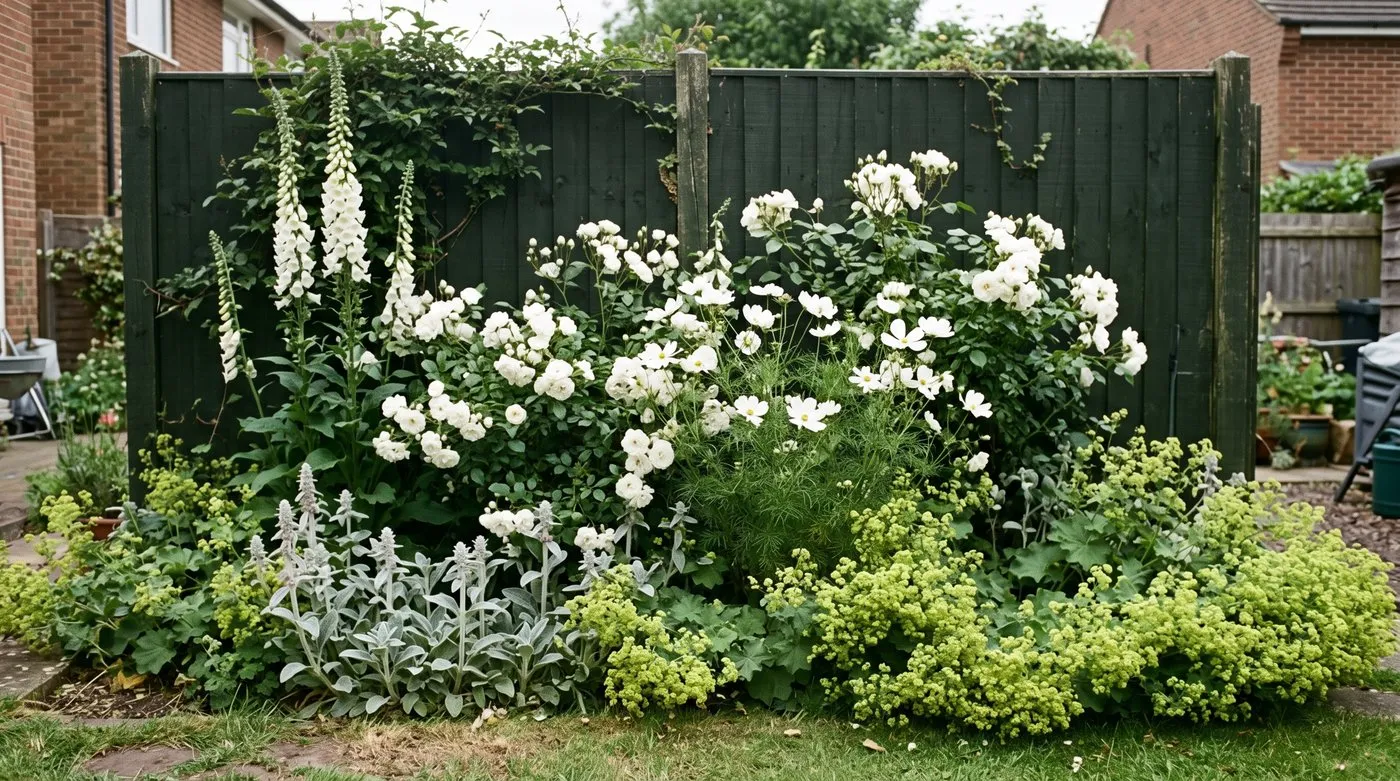
Paint a fence deep green and white flowers glow against it straight away. Against a pale fence, the same plants would fade into the background.
How big should the border be?
Aim for a border about 2m deep. That gives room for three layers: low at the front, medium in the middle, tall at the back.
Go no shallower than 1.5m. Any narrower and it looks like a strip. In a smaller garden, a single border against a dark fence is a great compromise.
Adding a centrepiece
Give the eye something to rest on. A rose arch, a bit of topiary, a birdbath or an obelisk with a climbing rose all work. It also keeps things looking good when one wave of flowers is fading and the next hasn’t started.
A simple arch with Rosa ‘Wedding Day’ gives height without taking over. In a smaller garden, try a climbing ‘Iceberg’ instead.
The four seasons of a white garden
Think of your planting in four waves. If one wave is missing, the border goes blank for weeks.
Winter and early spring (January to March)
The winter wave is about scent and a few cheerful flowers when little else is happening. It doesn’t need to be showy, but it does need to be there.
| Plant | Type | Height | Flowers |
|---|---|---|---|
| Sarcococca confusa (sweet box) | Evergreen shrub | 1-2m | January to February, vanilla scent |
| Helleborus niger ‘Josef Lemper’ | Perennial | 30cm | December to February |
| White Helleborus x hybridus | Perennial | 40cm | February to March |
| Snowdrops (Galanthus nivalis) | Bulb | 10cm | January to February |
Plant sweet box by a door, path or gate so you catch the scent every day. Snowdrops are happiest under deciduous shrubs and trees.
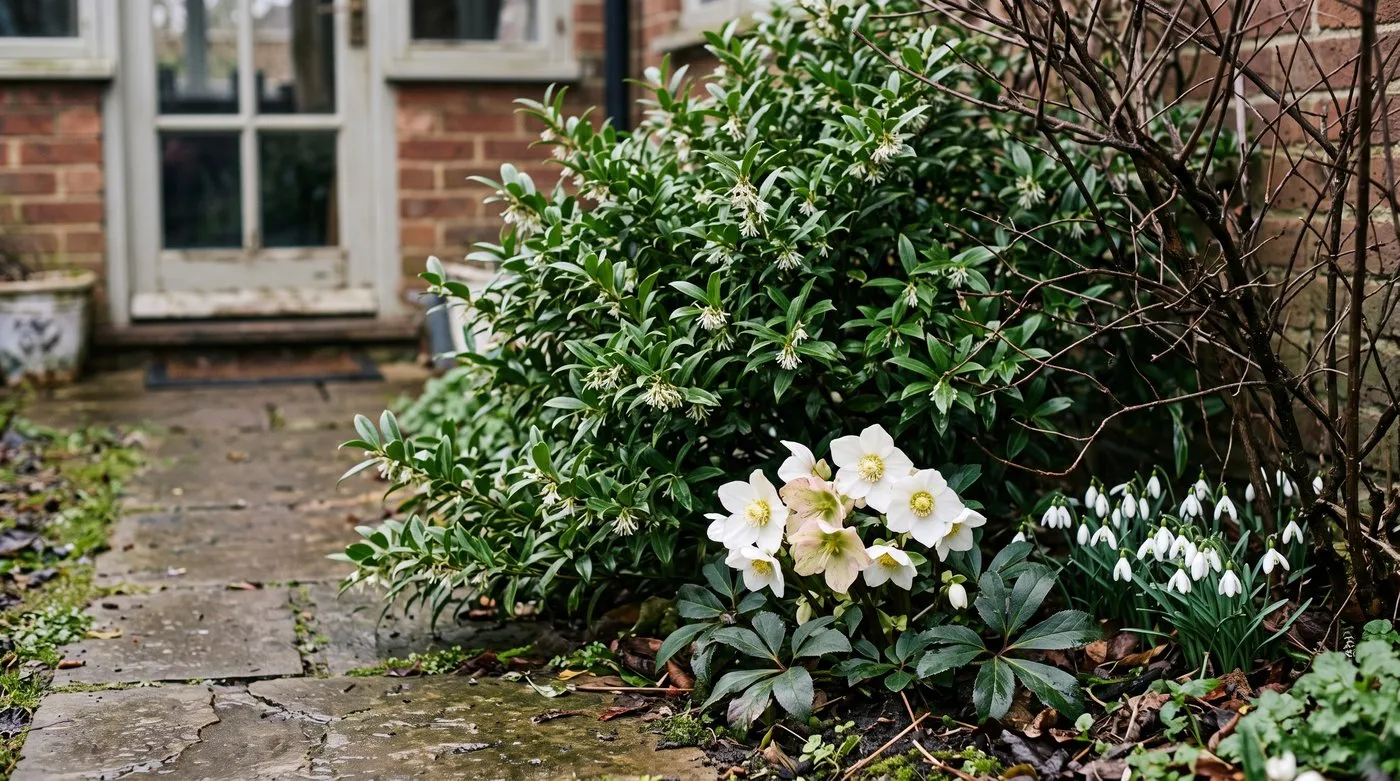
Plant sweet box by a door or path so you catch its vanilla scent every day. White hellebores and snowdrops carry the winter wave.
Late spring (April to June)
Spring is the most generous wave. Bulbs, blossom and early perennials all join in.
 Narcissus ‘Thalia’ and Tulip ‘White Triumphator’ lead the spring show before the summer plants take over.
| Plant | Type | Height | Flowers |
|---|---|---|---|
| Narcissus ‘Thalia’ | Bulb | 35-40cm | April |
| Tulip ‘White Triumphator’ | Bulb | 65-70cm | Late April to May |
| Allium ‘Mount Everest’ | Bulb | 80-90cm | May to June |
| Camassia leichtlinii ‘Alba’ | Bulb | 60-90cm | May to June, likes moist soil |
| White aquilegia | Perennial | 60-90cm | May to June, self-seeds |
| White foxgloves | Biennial | 1.2-1.5m | June, self-seeds |
Dot Narcissus ‘Thalia’ all through the border, about 15cm apart. They’re cheap, take up no room later in the year, and give you the first big flush of white.
Summer (June to August)
Summer is the main event. Roses, mock orange, foxgloves and delphiniums are all in full swing, with the silver foliage holding it together.
| Plant | Type | Height | Flowers |
|---|---|---|---|
| Rosa ‘Iceberg’ | Floribunda rose | 1.2m | June to autumn |
| Rosa ‘Winchester Cathedral’ | Shrub rose | 1.2m | June to autumn, scented |
| Rosa ‘Wedding Day’ | Rambler | Large | June to July |
| Philadelphus ‘Belle Etoile’ (mock orange) | Shrub | 1.5-2m | June to July, scented |
| Philadelphus ‘Virginal’ | Shrub | 2-3m | June to July, double flowers |
| Delphinium ‘Galahad’ | Perennial | 1.5-1.8m | June to July, stake in May |
| Phlox paniculata ‘White Admiral’ | Perennial | 1m | July to September, scented |
| White Nicotiana alata | Annual | 60-90cm | June to October, scented at dusk |
| Cosmos ‘Purity’ | Annual | 90cm | June to October |
Mock orange is big and only flowers for a few weeks, so give it about 2m of space. It’s worth it. That sweet orange-blossom scent on a warm evening is hard to beat.
Late summer and autumn (August to October)
Without this wave, the border goes quiet just when the evenings are nice for sitting out. Japanese anemones are the stars here.
| Plant | Type | Height | Flowers |
|---|---|---|---|
| Anemone x hybrida ‘Honorine Jobert’ | Perennial | 1-1.2m | August to October |
| Hydrangea paniculata ‘Limelight’ | Shrub | 2m | July to September, turns pink |
| Hydrangea arborescens ‘Annabelle’ | Shrub | 1.5m | July to September |
| Anemanthele lessoniana | Grass | 60cm | Foliage all year |
| Gaura ‘Whirling Butterflies’ | Perennial | 60-90cm | June to October |
| White aster ‘White Swan’ | Perennial | 60-80cm | September to October |
Japanese anemones spread by underground roots and can take over in good soil. Give them room at the back of the border. Once settled, they fill the late-season gap beautifully.
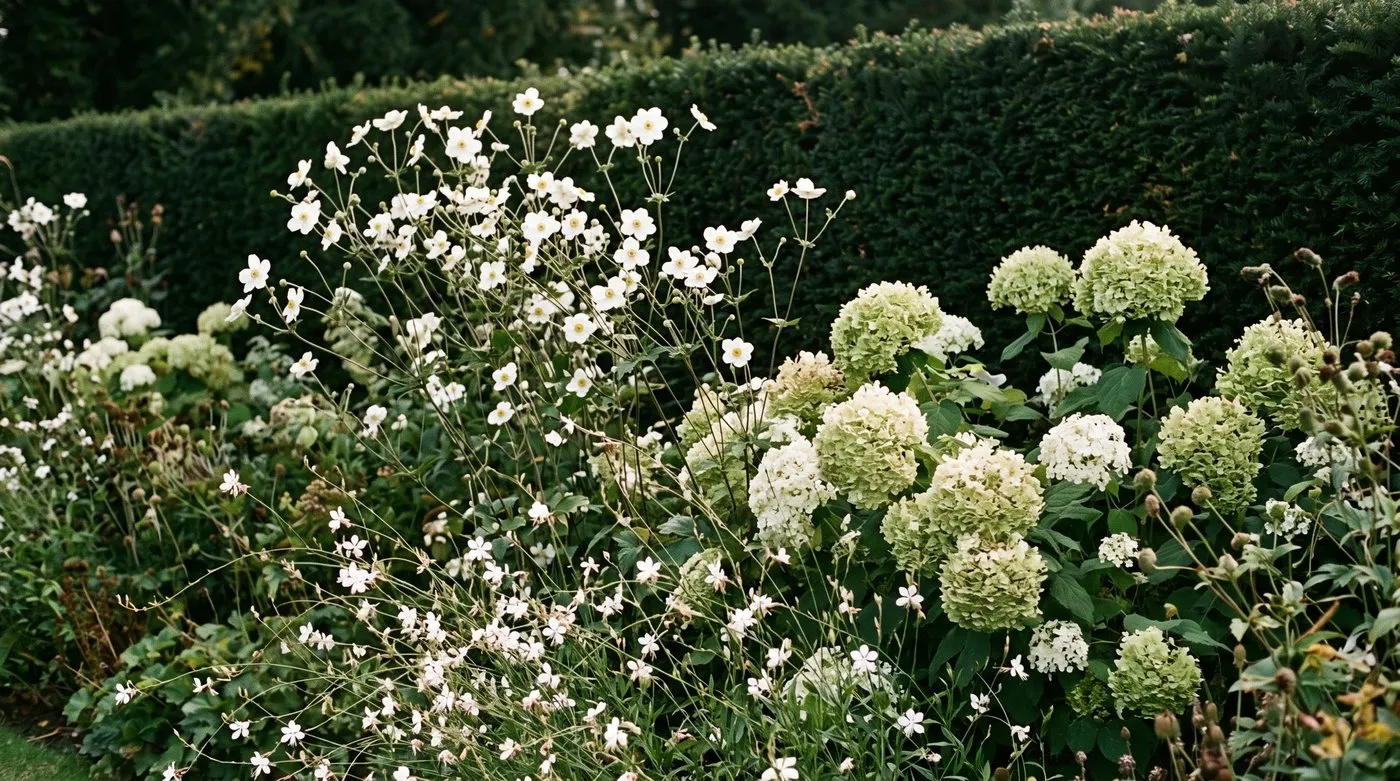
Japanese anemones keep the white border going into autumn. Give them room at the back, as they spread once settled.
Foliage that holds a white garden together
The most common mistake is treating foliage as an afterthought. White flowers without contrasting leaves just disappear. Silver, lime-green and dark green leaves are what make the whole thing work.
 Silver foliage sets off white roses and mock orange. Without it, the border looks patchy.
Silver foliage plants
Lamb’s ears (Stachys byzantina) is the most useful foliage plant in a white garden. Its soft silver leaves make low mats about 30cm high. Plant it along the front, roughly one plant every 50cm. Snip off the pinky-purple flower spikes if you want to keep the silver look.
Artemisia ‘Powis Castle’ gives feathery silver filler in the middle of the border, up to about 80cm. Cut it back in April to stop it going woody.
Convolvulus cneorum is a compact silver shrub with white flowers in late spring. It needs good drainage and a sunny spot at the front.
Lime-green foliage
Lady’s mantle (Alchemilla mollis) is the perfect partner for white flowers. Its frothy lime-green flowers in early summer make nearby whites look crisper. Cut it back after flowering for fresh leaves. It self-seeds, so pull out any extras.
Euphorbia characias subsp. wulfenii brings grey-green leaves and lime-yellow flower heads from March to May. It does the same job as lady’s mantle, but in spring. Wear gloves when cutting it, as the milky sap irritates skin.
Dark green and black foliage
Dark leaves give the strongest contrast with white flowers.
Black mondo grass (Ophiopogon planiscapus ‘Nigrescens’) has near-black, grassy leaves about 20cm tall. Pair it with lamb’s ears at the front for a striking look. White cosmos next to black mondo grass is a real showstopper.
Portuguese laurel (Prunus lusitanica) makes a dark, glossy hedge if you have room. It clips well and makes a lovely backdrop.
Plant combinations for each part of the border
Plan the whole border together, not one bit at a time. This table gives easy pairings by position and season.
| Border position | Spring | Summer | Autumn |
|---|---|---|---|
| Back | White foxgloves + Camassia ‘Alba’ | Delphinium ‘Galahad’ + Rosa ‘Wedding Day’ on an arch | Anemone ‘Honorine Jobert’ + white aster |
| Middle | Allium ‘Mount Everest’ + white aquilegia | Rosa ‘Iceberg’ + Phlox ‘White Admiral’ | Gaura + Hydrangea ‘Annabelle’ |
| Front | Narcissus ‘Thalia’ + lamb’s ears | Lamb’s ears + lady’s mantle + white cosmos | Lamb’s ears + Anemanthele |
| Anchor shrub | Cornus ‘Elegantissima’ | Mock orange ‘Belle Etoile’ | Hydrangea ‘Limelight’ |
| Climbers | None needed | Climbing ‘Iceberg’ on an obelisk | White jasmine |
Two pairings do the most work over the longest season:
- Lamb’s ears with Rosa ‘Iceberg’. Silver leaves and pure white roses, from early summer well into autumn.
- Lady’s mantle with any white rose. The lime-green froth makes white roses look even brighter. And it self-seeds, so you’ll rarely need to buy more.
How to plant a moon garden
A moon garden is a white garden planned for evenings. White flowers and silver leaves catch the last of the light at dusk and stay visible long after darker colours have vanished.
A west-facing spot works best, as it catches the evening sun. Here’s what to choose:
- Evening scent. Many white flowers smell strongest in the evening. Mock orange, white jasmine, white nicotiana and white sweet peas are all lovely. Include at least one.
- Open, flat flowers. Flat or upward-facing flowers catch more light. Rosa ‘Iceberg’, white cosmos and nicotiana all shine at dusk.
- Extra silver. Use more silver foliage than in a daytime border. Lamb’s ears, artemisia, Convolvulus cneorum and white rose campion (Lychnis coronaria ‘Alba’) all glow in low light.
 White nicotiana, Rosa ‘Iceberg’ and lamb’s ears catching the last light on a July evening.
White garden mistakes to avoid
Mixing creamy and pure whites
Put creamy white right next to pure white and the cream looks grubby. It’s the most common slip. Pick one kind of white for each part of the garden, or keep them well apart.
Creamy whites include mock orange, Rosa ‘Gentle Hermione’ and Paeonia ‘Duchesse de Nemours’. Pure whites include Rosa ‘Iceberg’, Delphinium ‘Galahad’, white nicotiana and Cosmos ‘Purity’.
No dark backdrop
A white border against a pale fence or open sky looks flat, because the flowers blend into the background. A dark hedge or painted fence isn’t just decoration. It’s what makes the whites glow.
Too little foliage
With only white flowers and ordinary green leaves, the border loses its magic between flowering spells. Buy your lamb’s ears, artemisia and lady’s mantle first.
Not enough height
Most home white borders are too flat. Add something tall at the back, like delphiniums, foxgloves or a rose on a frame, so the eye has somewhere to go.
Forgetting the planting next door
A white border next to a riot of hot colours can feel cut off. Repeat a white plant or two in nearby borders so the whole garden feels connected.
Using white in the rest of the garden
You don’t need a separate garden room. White can tie a whole garden together.
White as a link. Repeat Rosa ‘Iceberg’ or Japanese anemones through a mixed border. The white gives the eye a rest between colour groups.
White with blue and purple. Put white next to lavender, catmint, delphiniums or agapanthus. The white makes the blues look bluer. For more pairings, see our best plant combinations guide.
Just white, silver and green. The strictest version, with no other colours at all. It takes discipline and great foliage, but the result feels calm and complete. Our hydrangea growing guide covers ‘Limelight’ and ‘Annabelle’, which give white and green flowers from July to October.
White with grasses. Grasses like Stipa gigantea, Anemanthele and Molinia add movement. Lit by low autumn sun, they look wonderful with white flowers. Our guide to ornamental grasses has plenty of ideas.
Frequently asked questions
How do I design a white garden planting scheme?
Start with a dark backdrop and a centrepiece. A yew or beech hedge, or a dark-painted fence, works well. Then plan four waves of flowers: winter (sweet box, hellebores), spring (Narcissus ‘Thalia’, white tulips), summer (roses, mock orange, foxgloves, delphiniums) and autumn (Japanese anemones, white cosmos). Add silver and lime-green foliage throughout to fill the gaps.
What plants did Vita Sackville-West use at Sissinghurst?
Rosa mulliganii, white foxgloves, artemisia, lamb’s ears and mock orange are the classics. White alliums join them too. The big idea was lots of grey and silver foliage, with white flowers dotted through it. Most copies get this the wrong way round and use too little silver.
What is a moon garden and how do I plant one?
It’s a white garden designed to be enjoyed at dusk. White flowers and silver leaves catch the last light. Plant mock orange, Rosa ‘Iceberg’, white nicotiana, white cosmos, lamb’s ears and Artemisia ‘Powis Castle’, ideally in a west-facing spot. Add scented whites like jasmine and mock orange for warm summer evenings.
How many plants do I need for a white garden border?
More than you think, because plants look best in groups. Plant perennials in groups of 3, 5 or 7, about 45-60cm apart for big ones and 30-40cm for smaller ones. Add a few shrubs for structure, a climber or two for height, and plenty of spring bulbs underneath.
What are the best white roses for a planting scheme?
Rosa ‘Iceberg’ is the easiest all-rounder. It flowers from June into autumn. For height, the rambler ‘Wedding Day’ and Rosa mulliganii both give masses of small white flowers in early summer. For scent, try ‘Winchester Cathedral’. Our rose growing guide covers pruning and care.
Can I create a white garden in shade?
Yes, and white flowers really glow in shade. Swap sun-lovers for sweet box (winter scent), white hellebores (February to March), lily of the valley (April to May), white astilbe (summer) and Japanese anemone ‘Honorine Jobert’ (August to October). See our shrubs for shade guide for more white-flowered options.
What foliage plants work best in a white garden scheme?
Silver lamb’s ears and Artemisia ‘Powis Castle’ are the backbone. Lady’s mantle adds lime-green froth that makes whites look crisper. For height, Cornus alba ‘Elegantissima’ has white-edged leaves and red winter stems. Mix in ornamental grasses for movement.
Related reading
- Best white flowers for UK gardens, lots more white flowers sorted by season
- Cottage garden planting plan, a style that suits white planting beautifully
- Best plant combinations for UK borders, how to fit white into a mixed border
- How to design a garden from scratch, getting the layout right before you choose plants
- Garden lighting ideas for outdoor spaces, keep your moon garden glowing after dark
Our team produces practical UK gardening guidance from source research, contributor records and established horticultural practice. Editorial standards are overseen by Matt W.


