Key takeaways
- Plant in three layers: tall at the back, medium in the middle, low at the front
- Mix spring bulbs, summer perennials and autumn grasses for a long show
- Check your soil and sun first, as lavender sulks on clay and shade plants scorch in sun
- Plant in groups of 3-5 of the same plant, not one of everything
- Leave seed heads standing over winter for shape and food for birds
The best plant combinations for UK borders pair plants that like the same soil and sun but look different. A single Salvia ‘Caradonna’ looks fine on its own. Put it with Rosa ‘Boscobel’ and Stipa tenuissima, and you get colour from June to October with contrast in height, shape and colour.
Why many UK borders look flat
A dull border is usually a layout problem, not a plant problem. The good news is that it’s easy to fix. Three things cause most flat borders.
No height variation
Planting everything at the same height is the most common mistake. Lots of medium plants across the whole border looks like a hedge from a distance. Plan for three layers instead: tall plants at the back, medium plants in the middle and low plants at the front. This gives depth and leads your eye into the planting.
Single-season interest
A border that’s gorgeous for six weeks in July and brown the rest of the year has plants that all flower at once. Spread the flowering out. Spring geraniums, summer salvias and autumn Japanese anemones together keep the show going for months.
Wrong aspect matching
Lavender on a shady, north-facing border on heavy soil is a common and costly mistake. The sun and soil decide which combinations will work. Watch how many hours of sun the border gets, and check whether your soil is acid or chalky with a cheap test kit from a garden centre before you buy.
 Three heights in a sunny border: tall delphiniums at the back, salvias in the middle, geraniums at the front.
The thriller-filler-spiller method
Thriller-filler-spiller is a simple planting idea borrowed from pots that works in borders of any size. Every plant gets a job, which sorts out the height problem.
Thrillers (back of the border)
Thrillers are the tall show-offs at the back. Good ones for UK borders include delphiniums (June to August), Verbascum ‘Clementine’ (June to July), foxgloves (June to July) and Miscanthus sinensis ‘Gracillimus’, a tall grass that looks good from September to February. One delphinium per metre is plenty. Give Miscanthus about 80cm of space.
Fillers (middle of the border)
Fillers bulk out the border and hide the bare stems of the taller plants. Good choices are Salvia nemorosa ‘Caradonna’, Nepeta ‘Walker’s Low’, Penstemon ‘Andenken an Friedrich Hahn’ and Achillea ‘Terracotta’. Plant fillers in groups of 3-5 of the same plant. One on its own gets lost, but three together really stand out.
Spillers (front of the border)
Spillers soften the edge where the border meets the path or lawn. Try Alchemilla mollis, Geranium ‘Rozanne’, Mexican fleabane (Erigeron karvinskianus) and lamb’s ears (Stachys byzantina), which has soft silver leaves. Plant them closer together, around 12-15 per square metre, so they cover the ground in a season.
Using colour in a border
Colour is what makes a border look planned rather than random. Three easy approaches work well in UK gardens.
Complementary colours
Complementary colours sit opposite each other on the colour wheel: purple with yellow, orange with blue. They give bold contrast and lots of energy. A classic pairing is Salvia ‘Caradonna’ (deep purple) with Achillea ‘Terracotta’ (burnt orange). It looks striking from across the garden and works well against a dark green hedge.
Harmonious colours
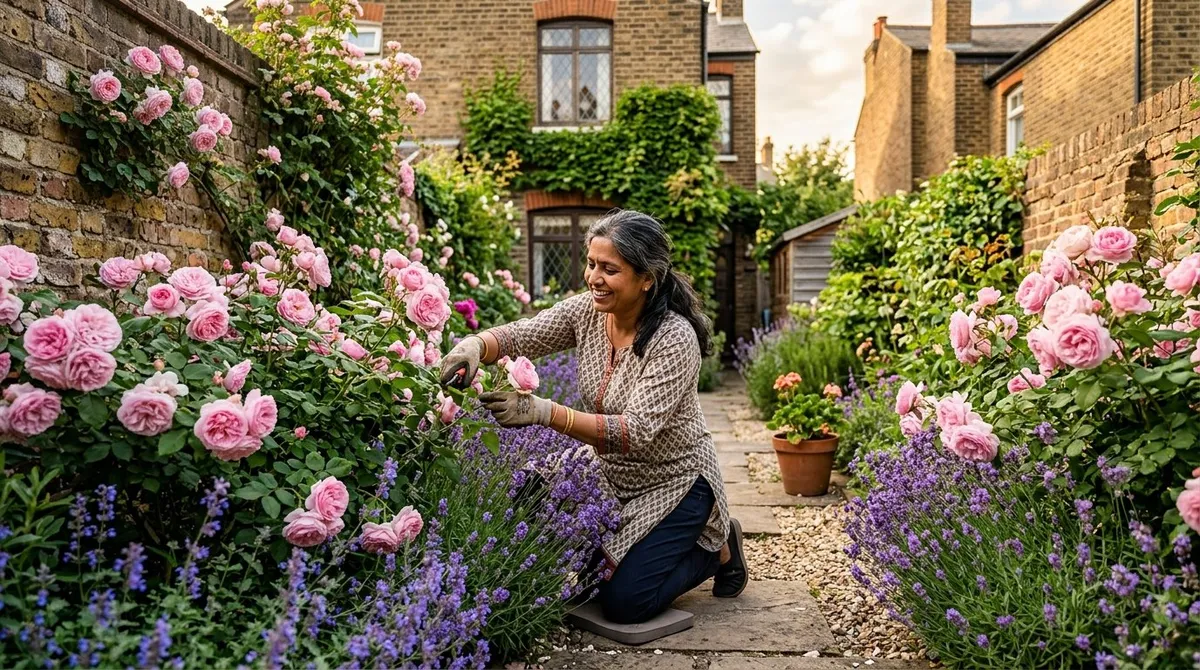
Harmonious schemes use colours that sit next to each other: pinks with purples, or blues with violets. They feel calm and restful. The cottage garden favourite is soft pink roses with lavender ‘Hidcote’ and Nepeta ‘Walker’s Low’. These colours rarely clash, so they’re ideal if you’re new to planning a border.
Tonal planting
Tonal planting uses shades of one colour, from pale pink to deep burgundy, or lemon to amber. The famous white garden at Sissinghurst is the best-known example. For a hot version, put Helenium ‘Moerheim Beauty’ (bronze-red), Crocosmia ‘Lucifer’ (flame red) and Kniphofia ‘Tawny King’ (amber) together. All three flower from July to September.
Great combinations for sunny borders
Summer stunner: Rosa, Salvia, and Stipa
Rosa ‘Boscobel’ (apricot-pink, repeat-flowering) with Salvia nemorosa ‘Caradonna’ (deep purple spires) and Stipa tenuissima (a soft, blonde grass that sways in the breeze) at the front. This trio flowers from June to October. You get warm pink against cool purple, and cup-shaped roses next to upright spires and floaty grass. For each square metre, try 1 rose, 2 salvias and 2 grasses.
Mediterranean heat: Lavender, Perovskia, and Sedum
For dry, sandy borders, this trio needs no watering once settled in. Lavender ‘Hidcote’ (deep purple, June to August), Perovskia ‘Blue Spire’ (lavender-blue haze, August to October) and Sedum ‘Herbstfreude’ (pink fading to copper, August to November). All three want full sun and soil that drains well. It’s a little gravel garden in one bed.
Late-season fire: Helenium, Rudbeckia, and Miscanthus
This trio is at its best just as most borders are fading. Helenium ‘Moerheim Beauty’ (bronze-red, July to September), Rudbeckia fulgida var. deamii (golden yellow, August to October) and Miscanthus sinensis ‘Kleine Fontane’ (pink-flushed plumes). The warm colours glow in low autumn sun. Plant on soil that holds some moisture. The grass plumes keep looking good well into winter.
 Roses, salvias and grasses together in a sunny, south-facing border.
Great combinations for shady borders
Borders that get only a few hours of direct sun need shade-loving plants. These pairings do well where sun-lovers struggle. For more ideas, see our list of the best plants for shade.
Textural trio: Hosta, Dryopteris, and Astilbe
The classic shade trio. Hosta ‘Halcyon’ has blue-green leaves that look great next to the feathery fronds of the fern Dryopteris affinis. Astilbe ‘Fanal’ adds crimson plumes in summer. All three like moist soil, so this one suits a damp, shady spot.
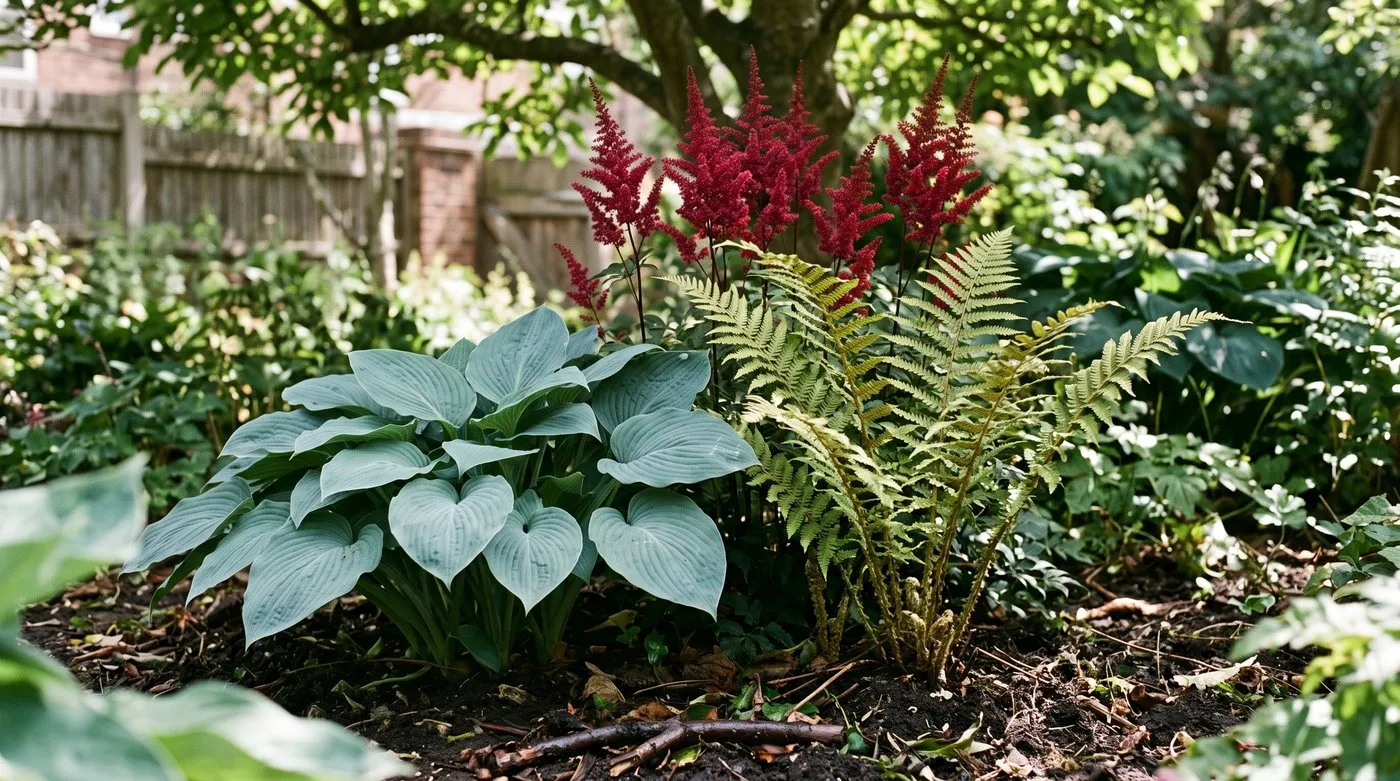
Big, smooth hosta leaves look even better next to lacy fern fronds. The astilbe adds a splash of crimson in summer.
Spring woodland: Brunnera, Epimedium, and Pulmonaria
This trio brings colour early in the year when the rest of the garden is still asleep. Brunnera ‘Jack Frost’ (silver-veined leaves and little blue flowers, April to May), Epimedium ‘Sulphureum’ (pale yellow flowers, March to May) and Pulmonaria ‘Blue Ensign’ (bright blue flowers, March to April). All three cope with dry shade once settled in. They’re perfect under deciduous trees, flowering before the leaves come out.
Structural shade: Hakonechloa, Heuchera, and Tiarella
For a modern look in shade. Hakonechloa macra is a golden-green grass that tumbles like a waterfall. It looks fab next to Heuchera ‘Palace Purple’ with its dark burgundy leaves and Tiarella ‘Spring Symphony’ with frothy pink flowers from April to June. The gold and burgundy contrast shows up even in deep shade.
Combinations for clay soil
Autumn glory: Helenium, Sanguisorba, and Persicaria
All three are happy in damp clay. Helenium ‘Sahin’s Early Flowerer’ (orange-red daisies, July to September), Sanguisorba ‘Tanna’ (little burgundy bobbles, July to September) and Persicaria ‘Firetail’ (crimson spikes, July to October). It’s an easy-going combination that flowers right through late summer. Plant 5-7 per square metre.
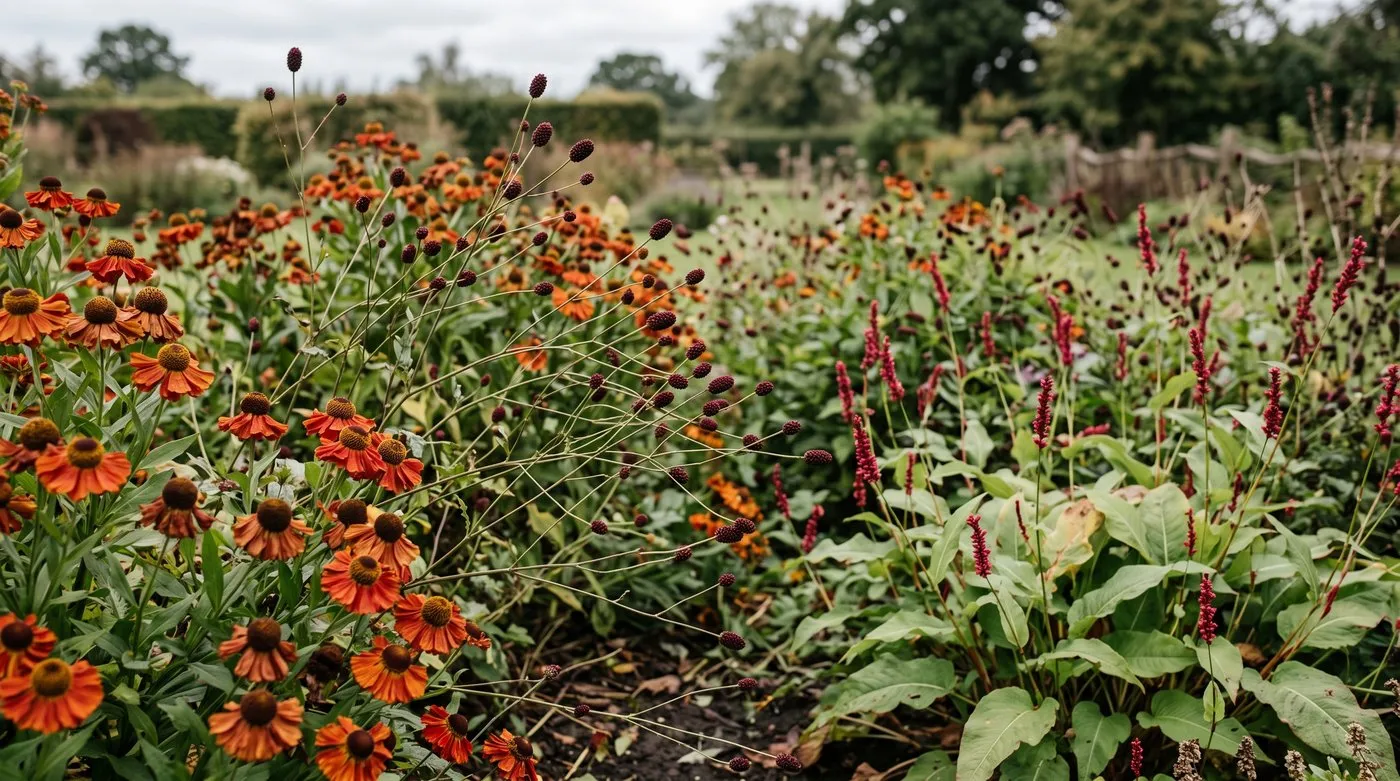
All three love damp clay, so they’ll thrive where Mediterranean plants rot. Plant in drifts of 5-7 per square metre.
Summer meadow on clay: Geranium, Leucanthemum, and Sidalcea
For a softer, cottage look on heavy ground. Geranium ‘Rozanne’ (violet-blue, May to October), Leucanthemum ‘Becky’ (big white daisies, June to August) and Sidalcea ‘Elsie Heugh’ (pale pink mallow flowers, June to August). All three cope with clay in sun or part shade. ‘Rozanne’ is one of the hardest-working perennials you can buy, flowering for months without deadheading.
Combinations for dry and sandy soil
Sandy and gravelly soils dry out fast and lose their goodness quickly. Mediterranean and prairie plants love them. A layer of gravel mulch helps keep moisture in.
Gravel garden: Verbena, Eryngium, and Stipa
Inspired by Beth Chatto’s famous dry garden. Verbena bonariensis (tall purple clusters, July to October), Eryngium ‘Big Blue’ (steel-blue thistles, June to August) and Stipa gigantea (golden oat-like plumes, June to September). All three self-seed happily on gravel. Verbena bonariensis is so see-through that it works at the front despite its height. No watering needed once settled. Our verbena growing guide covers the best varieties.
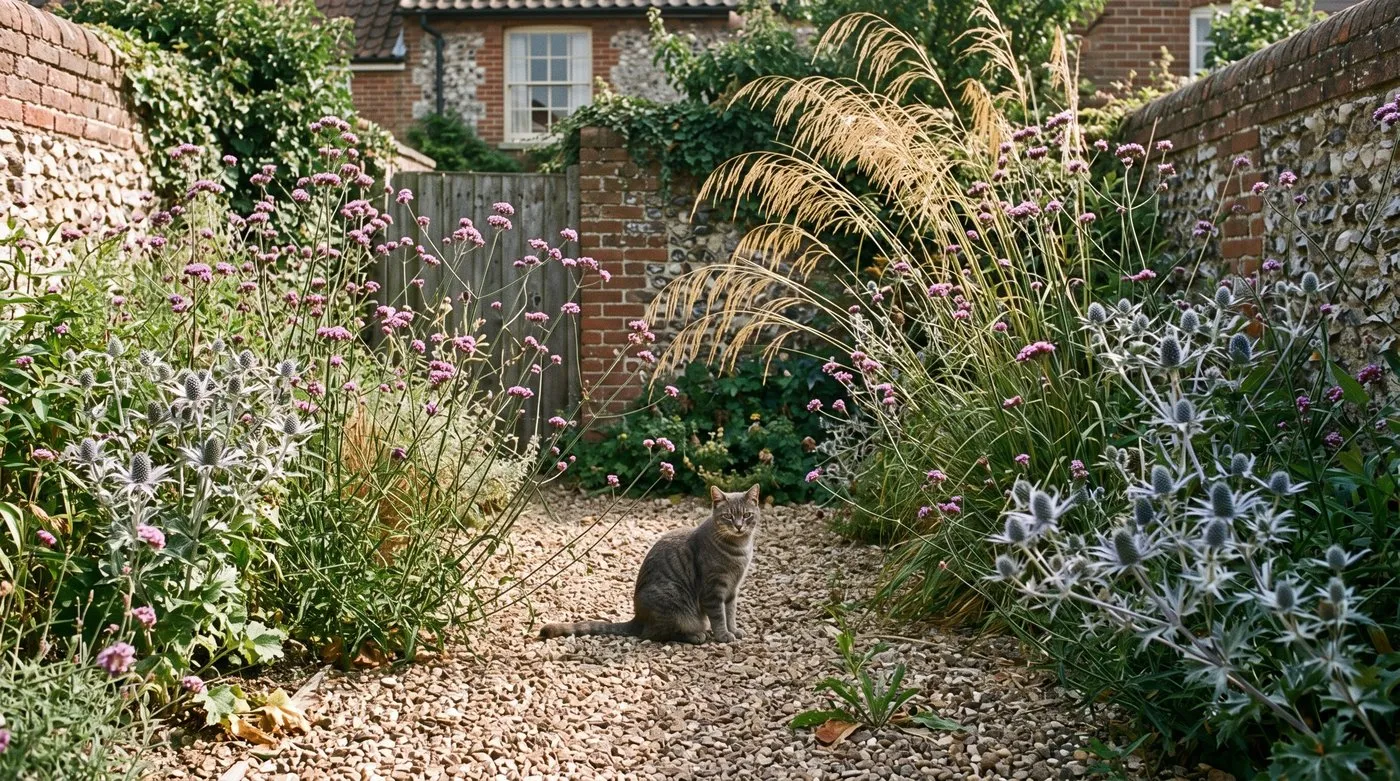
This trio needs no watering once settled and happily seeds into the gravel. The see-through verbena can sit right at the front.
Prairie drift: Echinacea, Perovskia, and Gaura
A prairie-style mix that copes well in UK gardens. Echinacea ‘Magnus’ (pink-purple coneflowers, July to September), Perovskia ‘Blue Spire’ (lavender haze, August to October) and Gaura ‘Whirling Butterflies’ (white and pink, June to October). This trio copes with drought, poor soil and full sun. Echinacea rots in wet winter soil, so on heavy ground plant it in a raised bed or dig in plenty of grit.
Combinations for cottage-style borders
The classic English trio: Rose, Delphinium, and Geranium
The cottage border classic. Rosa ‘Gertrude Jekyll’ (rich pink, beautifully scented, June to October) at the back. Delphinium ‘Black Knight’ (deep violet-blue spires, June to July) rising up through it. Geranium ‘Johnson’s Blue’ (lavender-blue, May to July) along the front. Jekyll herself did far more than plant one rose, and our Gertrude Jekyll border design lessons explain how she used colour and repetition. Stake delphiniums in windy spots. All three like full sun.
Scented cottage: Philadelphus, Paeonia, and Dianthus
This one is all about scent. Philadelphus ‘Belle Etoile’ (mock orange, white flowers smelling of orange blossom, June), Peony ‘Sarah Bernhardt’ (blush pink, scented, May to June) and Dianthus ‘Mrs Sinkins’ (white fringed flowers with a clove scent, June to July). On a warm June evening the smell is wonderful. All three need sun and soil that drains well. Peonies live for decades and hate being moved, so choose their spot carefully.
Combinations for modern and minimalist borders
Modern planting uses fewer types of plant in bigger groups, with a tight colour scheme and strong shapes.
Monochrome: Salvia, Verbena, and Agapanthus
A purple and blue scheme for a contemporary garden. Salvia ‘Amistad’ (deep purple, June to November), Verbena bonariensis (purple, July to October) and Agapanthus ‘Northern Star’ (deep blue, July to August). Plant roughly three salvias for every two verbenas and two agapanthus. All three need full sun and good drainage. ‘Northern Star’ is one of the hardier agapanthus. It looks great against a rendered wall or steel planters.
Textural minimalism: Miscanthus, Sesleria, and Echinacea
Three plants, lots of impact. Miscanthus ‘Morning Light’ (silver-striped grass with September plumes) at the back, Sesleria autumnalis (neat lime-green evergreen mounds) as ground cover and Echinacea ‘White Swan’ (white coneflowers, July to September) in groups of 5-7. Fine grassy leaves next to bold coneflowers gives a clean, sculptural look.
 A modern border: ornamental grasses with echinacea and sedum for shape and texture.
Border combinations at a glance
Use this table to find a combination that suits your border. Match the sun and soil first, then pick the look you like.
| Combination | Season | Sun or shade | Soil | Colours | Style |
|---|---|---|---|---|---|
| Rose, Salvia, Stipa | June to October | Sun | Well-drained | Pink, purple, gold | Summer border |
| Helenium, Rudbeckia, Miscanthus | July to winter | Sun | Moist | Bronze, gold, pink | Late season |
| Lavender, Perovskia, Sedum | June to November | Sun | Dry | Purple, blue, copper | Dry border |
| Hosta, Dryopteris, Astilbe | April to October | Shade | Moist | Blue-green, crimson | Shade |
| Brunnera, Epimedium, Pulmonaria | March to May | Shade | Dry shade | Silver, yellow, blue | Spring woodland |
| Rose, Delphinium, Geranium | May to October | Sun | Well-drained | Pink, violet, blue | Cottage classic |
| Helenium, Sanguisorba, Persicaria | July to October | Sun or part shade | Clay | Orange, burgundy, red | Clay border |
| Verbena, Eryngium, Stipa | June to October | Sun | Dry | Purple, blue, gold | Gravel garden |
| Salvia, Verbena, Agapanthus | June to November | Sun | Well-drained | Purple, blue | Modern |
| Echinacea, Perovskia, Gaura | June to October | Sun | Dry | Pink, blue, white | Prairie |
| Geranium, Leucanthemum, Sidalcea | May to October | Sun or part shade | Clay | Blue, white, pink | Clay cottage |
| Philadelphus, Peony, Dianthus | May to July | Sun | Well-drained | White, pink | Scented |
Month-by-month flowering calendar
Here’s what’s looking good each month. Aim for something happening in most months of the year.
| Month | What’s looking good | Combinations at their best |
|---|---|---|
| January | Seed heads of Miscanthus and Sedum, coloured dogwood stems | Helenium, Rudbeckia, Miscanthus (seed heads) |
| February | Seed heads, snowdrops and early crocus under shrubs | Tuck in bulbs between perennials |
| March | Epimedium, Pulmonaria, spring bulbs | Brunnera, Epimedium, Pulmonaria |
| April | Brunnera, tulips, hosta shoots coming up | Spring woodland trio, shade trio starting |
| May | Geraniums, dianthus, peonies, roses in bud | Cottage classic and scented trio starting |
| June | Roses, delphiniums, salvias, lavender | Peak cottage season |
| July | Helenium, astilbe, echinacea, rudbeckia starting | Shade trio at its best, helenium mixes starting |
| August | Helenium, rudbeckia, perovskia, persicaria | Late-season fire and prairie drift |
| September | Grass plumes, sedum, asters, late salvias | Miscanthus mixes at their best |
| October | Autumn leaves, persicaria, late sedum, grasses turning gold | Clay autumn trio finishing |
| November | Seed heads, grass plumes, evergreens | Leave seed heads standing, cut back only diseased growth |
How to space and plant your combinations
Getting the spacing right matters as much as choosing the plants. Too far apart and the border looks patchy for a couple of years. Too close and plants get crowded and sickly.
How many plants per square metre
For a border that fills out in its first full season, plant roughly:
- Big perennials and shrubs: 1-3 per square metre
- Medium perennials: 5-7 per square metre
- Small perennials and ground cover: 9-12 per square metre
- Bulbs between perennials: 30-50 per square metre
An easy rule is to space plants at half their final spread. A Geranium ‘Rozanne’ that spreads 60cm goes 30cm from its neighbour. That way plants knit together without fighting.
Planting technique on clay
Pick plants that like clay rather than fighting it. Avoid digging when the soil is wet and sticky, as it squashes the soil. Plant at the same depth the plant was in its pot, water well and mulch with compost to slowly improve the soil.
Cost budgeting
Bare-root plants bought in autumn are the cheapest way to fill a border. Pot-grown plants bought in late spring cost quite a bit more. Remember to budget for some grit, compost and mulch as well as the plants. The RHS Plant Finder shows which UK nurseries sell each variety in this guide.
Common mistakes with border combinations
These five mistakes cause most disappointing borders. Avoiding them costs nothing.
Mistake 1: Planting one of everything
One each of 20 different plants looks busy and messy. Groups of 3-5 of the same plant look far better. The exception is big feature plants like a specimen rose or Miscanthus, which look fine on their own.
Mistake 2: Ignoring foliage
Flowers last weeks, but leaves last months. A border that relies only on flowers looks empty for much of the year. Include plenty of plants with good leaves, like ornamental grasses, heucheras, hostas and Alchemilla. They carry the border between flowering peaks.
Mistake 3: Forgetting the front edge
A strip of bare soil between the lawn and the first plants makes a border look unfinished. Spillers like Geranium ‘Rozanne’, Alchemilla mollis or Mexican fleabane should flop over the front edge a little.
Mistake 4: Matching by colour alone
Two plants in the same colour can still look dull together if their flowers are the same shape. Mix up at least two things: colour and texture, or height and shape. Salvia spires look good with round rose flowers because the shapes are different, not just the colours.
Mistake 5: No winter plan
Cutting everything down in November leaves the border bare until April. Leave seed heads standing on sedum, rudbeckia, Miscanthus and eryngium. They look lovely with frost on them, and finches feed on the seeds. Add an evergreen every few metres, such as sweet box (Sarcococca confusa), Euonymus ‘Silver Queen’ or a clipped box ball.
Gardener’s tip: When buying plants for a new border, spend most of your budget on fillers. They’re the workhorses of the border, and gaps between them soon fill with weeds.
 A classic cottage border: roses, delphiniums and hardy geraniums against an old stone wall.
When to plant:
- October: bare-root plants root into warm, moist soil over winter and usually settle in best
- March: bare-root plants do well if you water them through any dry spring spell
- May: pot-grown plants need regular watering through their first summer
Easy, reliable pairings on the right soil: Geranium ‘Rozanne’ with Alchemilla mollis, Helenium ‘Moerheim Beauty’ with Rudbeckia deamii, Hosta ‘Halcyon’ with Dryopteris affinis.
Pairings likely to fail: agapanthus on wet clay, lavender on heavy clay and gaura on waterlogged ground. All tend to rot in winter wet.
Top tip: pair plants that like the same amount of moisture. If one likes it dry and its neighbour likes it damp, one of them will struggle, even when both labels say “any soil”.
Now you’ve got some great combinations to try, read our guide to the best flowering shrubs for UK gardens to add some permanent shape to your border.
Frequently asked questions
What plants look good together in a UK border?
Salvia ‘Caradonna’ with Rosa ‘Boscobel’ is a lovely sunny pairing. The purple salvia spires look great against the soft apricot-pink roses, and both flower from June into autumn. For shade, try Hosta ‘Halcyon’ with Astilbe ‘Fanal’, which gives blue-green leaves and crimson plumes in summer.
How many plants do I need per square metre in a border?
Plan for about 7-9 plants per square metre. That fills the gaps within the first growing season. Use fewer for shrubs and big perennials, around 3-5, and more for small ground cover and front-of-border plants, around 12-15.
What is the thriller filler spiller method?
It’s a simple way to plant in three layers. Thrillers are tall plants at the back, such as delphiniums, verbascum or Miscanthus. Fillers are medium plants that bulk things out, like geraniums, salvias and nepeta. Spillers are low plants that soften the front edge, like Alchemilla mollis and Geranium ‘Rozanne’.
Which plant combinations work on clay soil?
Helenium, rudbeckia and Japanese anemone all cope well with clay. Try Helenium ‘Moerheim Beauty’ with Rudbeckia fulgida var. deamii for bronze and gold from August to October. Add Sanguisorba ‘Tanna’ at the front for little burgundy bobbles.
How do I plan a border for year-round interest?
Think in seasons, not single plants. Use evergreens and grasses for winter shape, bulbs for spring, perennials for summer and late flowers for autumn. Leave seed heads standing over winter. A small border needs about 8-10 different plants to cover the whole year.
What are the best plant combinations for shade?
Hosta, fern and astilbe are the classic shade trio. Hosta ‘Halcyon’ has blue-green leaves that look great next to the feathery fronds of Dryopteris affinis. Add Astilbe ‘Fanal’ for crimson summer flowers and Brunnera ‘Jack Frost’ at the front for silver leaves.
Can I mix shrubs and perennials in the same border?
Yes, and it’s a great way to keep a border interesting all year. Shrubs give shape in winter when perennials have died down. Use an evergreen like Sarcococca (sweet box) as the backbone, then fill the gaps around it with perennials.
Our team produces practical UK gardening guidance from source research, contributor records and established horticultural practice. Editorial standards are overseen by Matt W.