
Key takeaways
- Thalictrum delavayi grows 1.2-1.8m tall with airy lilac-purple flowers in summer
- Part shade and moist soil suit it best; full sun only works if the soil stays damp
- Push twiggy pea sticks in around tall types in April so the stems grow through them
- 'Hewitt's Double' has long-lasting double flowers and is a great first choice
- Divide clumps every 3-4 years in March or October
- Slugs love the young spring shoots, so protect them early
Thalictrum is one of those plants that turns a border from solid to dreamy. Each flower is a tiny fluffy puff on a thread-thin stem, but together they make a haze of purple, lilac or yellow that seems to float above everything else.
Its common name is meadow rue. Our native Thalictrum flavum grows wild in damp meadows and ditches. The garden favourites, though, are mostly T. delavayi from China and its varieties. Here’s how to choose, plant, support and divide them, and what to grow alongside.
Which thalictrum should I grow?
Five types cover most of what you’ll find for sale. Each does a slightly different job in the border.
| Type | Height | Flowers | When | Best for |
|---|---|---|---|---|
| T. delavayi | 1.2-1.8m | Lilac-purple, nodding | July to August | Back of a border, dappled shade |
| T. delavayi ‘Hewitt’s Double’ | 1.2-1.5m | Double lilac pompoms | July to September | Longest flowering |
| T. aquilegiifolium | 60-90cm | Fluffy purple-pink heads | May to June | Middle of a border, early colour |
| T. flavum subsp. glaucum | 1.2-1.5m | Pale yellow | June to July | Blue-grey leaves, sunnier spots |
| T. rochebrunianum | 1.5-2m | Lavender-lilac, dark stems | July to August | Real height and drama |
T. delavayi is the classic. Its nodding flowers have lilac-purple petals around a creamy centre. On a still summer day it looks like a shimmering curtain of colour.
‘Hewitt’s Double’ is the one most people grow, and for good reason. Its flowers are fully double little lilac pompoms, and they last much longer than the single ones. It holds an RHS Award of Garden Merit. It doesn’t set seed, so you increase it by dividing.
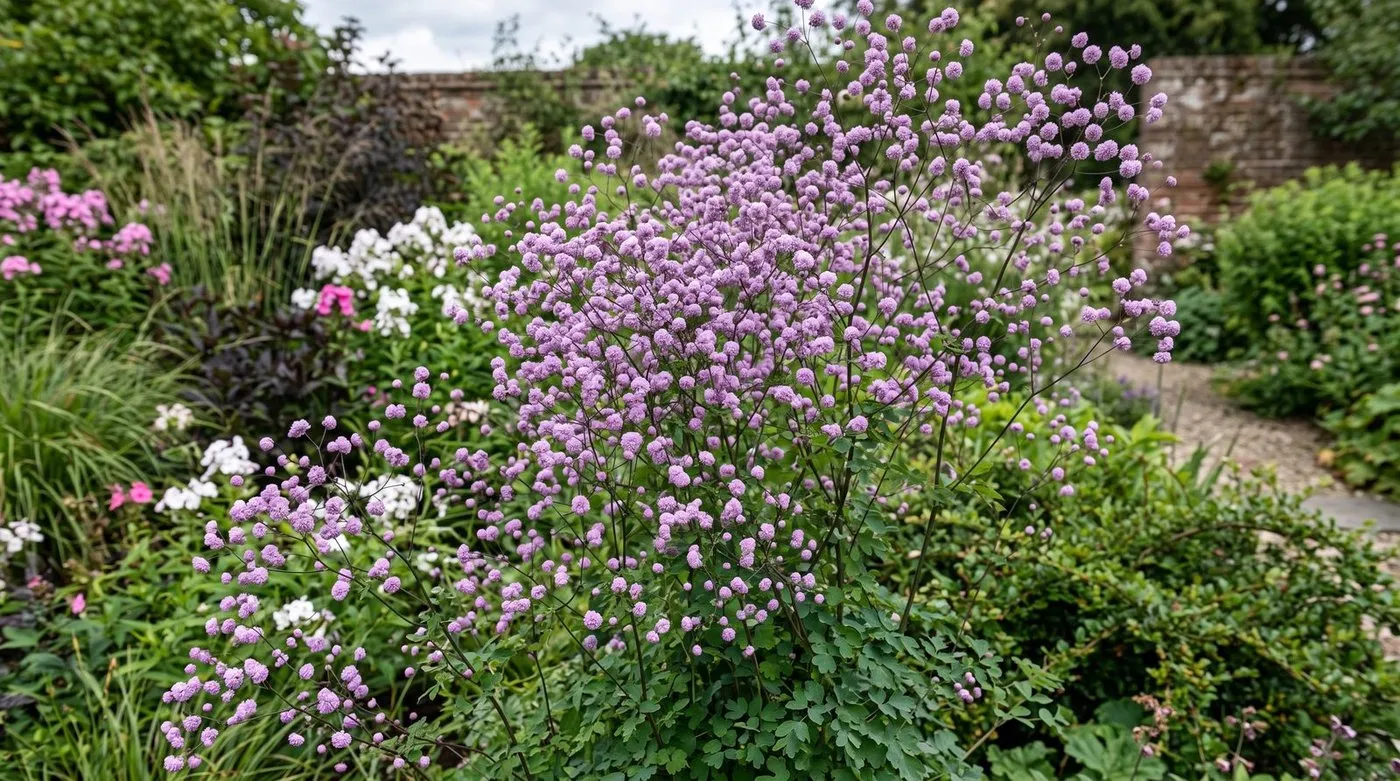
‘Hewitt’s Double’ covers itself in tiny double pompoms from July to September.
T. aquilegiifolium has leaves just like an aquilegia (granny’s bonnet). It’s the shortest and earliest, with fluffy upright flower heads. ‘Thundercloud’ is deep purple and ‘Album’ is white. It usually stands up on its own.
T. flavum subsp. glaucum has lovely blue-grey leaves that look good long before the pale yellow flowers open in June. That foliage earns it a place among the best perennials for UK gardens. It copes with more sun than T. delavayi.
T. rochebrunianum is the tallest, with dark purple-brown stems and small lavender flowers. It needs support in all but the most sheltered spots, but it’s spectacular when it’s happy.
Where to plant thalictrum in the UK
Part shade and moist soil, with some shelter from wind. Get the spot right and the rest is easy.
Part shade is ideal. A few hours of sun with dappled shade the rest of the day is perfect, like a woodland edge. A border on the east or west side of a house, or under trees with light leaves, works well. For more ideas, see our guide to the best plants for shade in UK gardens.
Moist soil really matters. Thalictrum comes from damp places and sulks in dry ground. Before planting, dig in a couple of bucketfuls of garden compost or leaf mould. Mulch 5-7cm deep each March to keep the soil moist through summer. Clay holds moisture well, but can get too wet in winter. Our guide to improving clay soil can help.
Full sun only works if the soil stays damp. In a dry, sunny border the leaves scorch and go brown by July. If you only have sun, grow T. flavum subsp. glaucum and mulch well.
Shelter from strong wind. The tall types have thin, wiry stems. They bend rather than snap, unlike delphiniums, but constant wind leaves them in a tangle.
Soil type isn’t critical. Clay, loam and chalk are all fine. Only very dry sandy soil gives it real trouble.
How and when to plant thalictrum
Plant in spring, from March to May, for the best start. Pot-grown plants can go in any time from March to October, but spring planting lets them settle in before summer.
- Soak the pot in a bucket of water for half an hour.
- Dig a hole twice as wide as the rootball and the same depth.
- Mix a good handful of compost into the soil you dug out.
- Set the plant at the same depth it was in its pot.
- Fill in, firm gently and water well.
- Mulch with 5cm of compost, keeping it off the stems.
Space plants 45-60cm apart. They spread slowly but aren’t invasive. Plant in groups of three or five for the best effect.
Bare-root plants and divisions go in best in March, as growth starts, or in October. On heavy soil, spring is safer, as roots can rot in cold, wet winter ground.
How to stake thalictrum without it looking awkward
Use twiggy sticks the plants can grow through. A single bamboo cane looks wrong next to those delicate stems.
Pea sticks or twiggy hazel are best. Push them in around the clump in April, when shoots are 20-30cm tall. The stems grow up through them and hide them by flowering time. Use sticks about two-thirds of the final height, so about 80-100cm for T. delavayi.
Wire grow-through supports work well for T. aquilegiifolium and shorter types. Put them over the crown in March before growth starts.
T. aquilegiifolium rarely needs support in a sheltered border. On a windy site, loop some twine around three short canes at about 50cm.
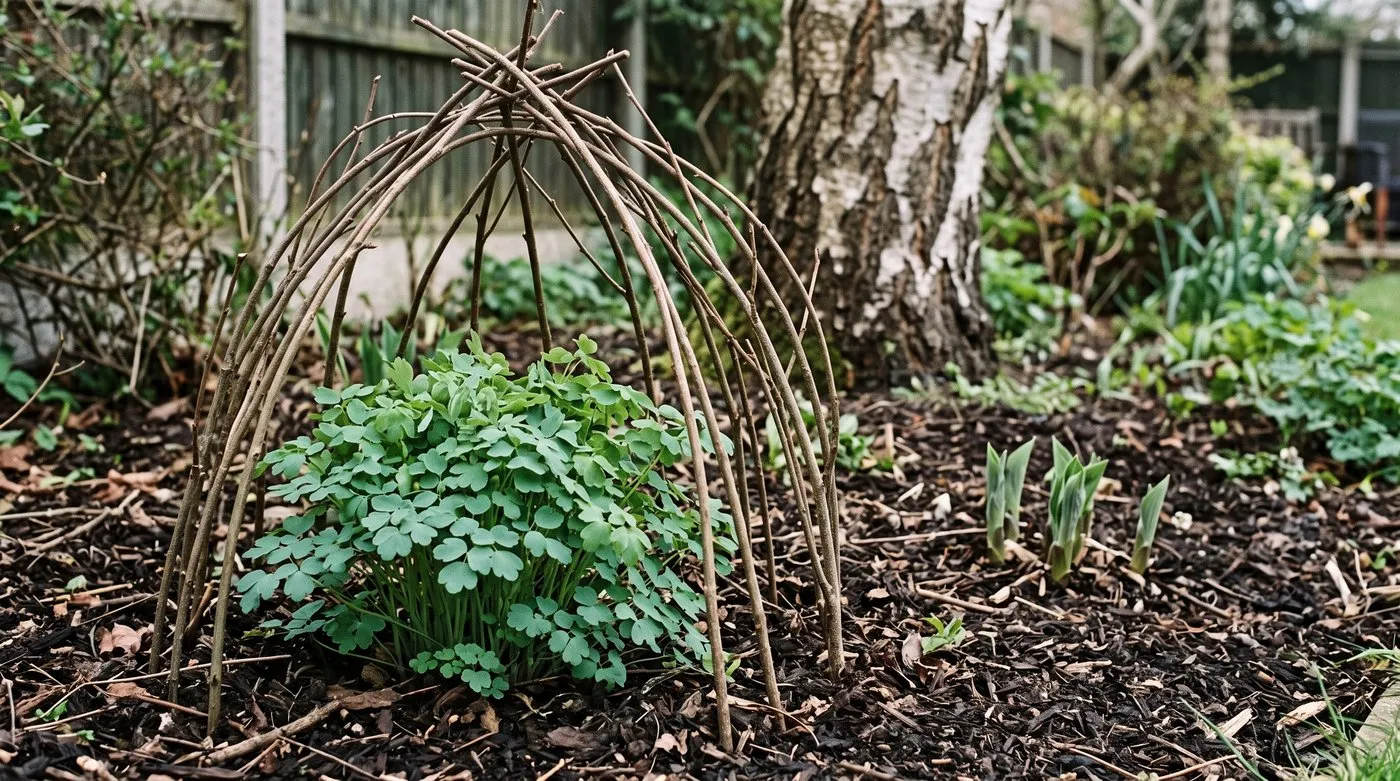
Push twiggy sticks in while the shoots are 20 to 30cm tall. By flowering time the stems have grown through and hidden them.
How to propagate thalictrum by division
Dividing is the easiest way to make more plants. It’s also the only way to increase named varieties like ‘Hewitt’s Double’.
When: March, as red-purple buds appear, or October after cutting back. Spring is more reliable on heavy soil.
- Lift the whole clump with a garden fork.
- Shake off loose soil so you can see the roots.
- Split it with a sharp spade, or two forks back to back. Give each piece several buds and a good chunk of root.
- Replant straight away at the same depth.
- Water well and mulch.
Divide every 3-4 years. Old clumps get crowded in the middle and flower less. Dividing perks them up and gives you plants for elsewhere. Our guide to plant propagation by division, cuttings and layering shows the technique step by step.
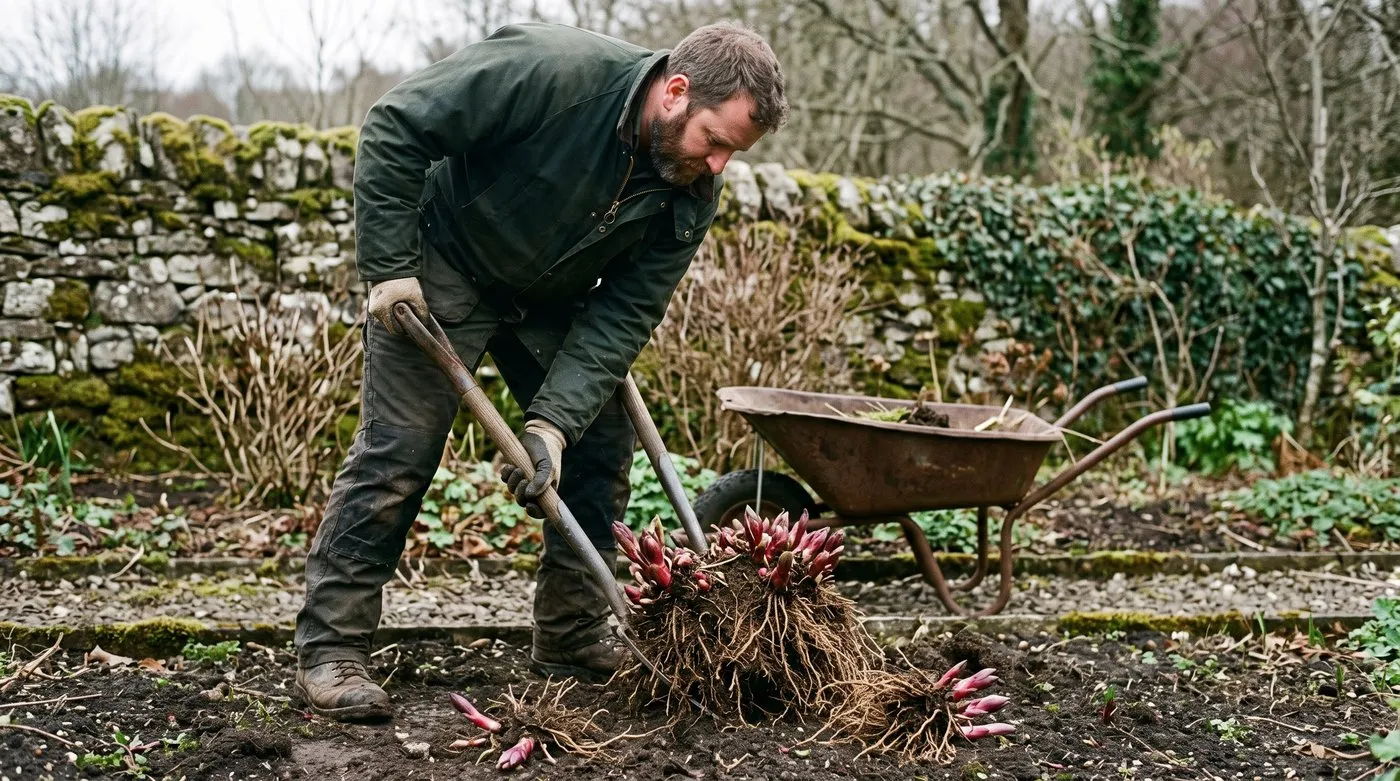
Two forks back to back prise a clump apart without slicing through the buds. Give each piece several buds and plenty of root.
Can I grow thalictrum from seed?
Yes, if you’re patient. The seed is slow and patchy, and it needs a spell of cold before it sprouts.
Sow in autumn:
- Collect seed from ripe heads in September. Pop a paper bag over the heads before they shed.
- Sow straight away into small pots or modules of moist seed compost.
- Cover lightly with vermiculite.
- Leave the pots outside in a shady cold frame over winter. The cold does the work.
- Seedlings come up from March to May.
- Pot them on when they have two true leaves.
Sowing in spring? Mix the seed with damp sand in a sealed bag and keep it in the fridge for 6-8 weeks first. That gives it the cold spell it needs.
Seed-raised plants take 2-3 years to flower. Named varieties won’t come true from seed, so divide those instead.

Thalictrum floating above roses and hardy geraniums. You can see right through the airy stems.
Protecting thalictrum from slugs and mildew
Slugs are the main worry, and only in spring. They go for the soft new shoots in March and April.
- Scatter ferric phosphate slug pellets around the crowns from late February, before shoots appear, following the pack.
- Top them up through March and April.
- In mild, wet winters slugs stay busy, so start earlier if you see damage.
- A nematode biological control works well once the soil warms up in spring.
By mid-May, when stems are about 30cm tall and tougher, slugs lose interest. Foxgloves, delphiniums and other spring-shooting plants need protecting at the same time. For more ideas, see our guide to getting rid of slugs naturally.
Powdery mildew can appear in hot, dry summers. Water at the base, keep up the mulch and give plants space. T. aquilegiifolium is the least prone.
Cutting back and autumn care
Cut all the stems down once flowering is over. That’s usually September for T. delavayi, and earlier for T. aquilegiifolium. It doesn’t flower again, so there’s no rush.

The pretty blue-green leaves look like maidenhair fern or aquilegia, and look good from April until autumn.
- Cut stems to about 5cm once flowers finish and the leaves yellow.
- Clear dead leaves from around the crown so slugs have fewer hiding places.
- Mulch over the crown with 5cm of compost or leaf mould.
- Mark the spot with a label. It vanishes completely in winter and is easy to dig up by mistake.
No winter cover needed. These thalictrums are fully hardy in the UK. Soggy winter soil is a bigger risk than cold. If your soil stays wet, plant slightly raised or add some grit around the crown.
Best companion plants for thalictrum
Pair its airy flowers with bold leaves and solid shapes. It weaves beautifully through a mixed border.
| Companion | Why it works |
|---|---|
| Hardy geraniums | Low mounds below thalictrum’s height, and the same shade and moisture needs |
| Astrantia | Same woodland-edge home, with flowers that look lovely together |
| Hostas | Big bold leaves next to delicate ones, and both love moist shade |
| Japanese anemones | Take over the show as thalictrum finishes |
| Ferns | Matching feathery texture and a woodland feel |
| Astilbe | Same moist soil, with feathery plumes lower down |
| Foxgloves | Spires at different heights give depth in a cottage border |
Lovely plant combinations for UK borders work in three layers. Put a low carpet at the front, such as hardy geraniums or Alchemilla mollis. Add a middle layer of astrantia or persicaria, and let thalictrum float at the back. On heavy or damp ground, persicaria is the most reliable middle layer, flowering from July until the frosts.
In a cottage garden, thalictrum sits happily with foxgloves, delphiniums and roses. For a meadow look, mix it with ornamental grasses such as Molinia caerulea and Deschampsia cespitosa.
Month-by-month thalictrum calendar
| Month | What to do |
|---|---|
| February | Put slug protection around the crowns before shoots appear |
| March | Divide old clumps. Mulch with compost. Watch for new shoots |
| April | Push in pea sticks when shoots reach 20-30cm |
| May | Tie in tall stems if needed. Water in dry spells |
| June | T. aquilegiifolium flowers. Water well in dry weather |
| July | T. delavayi and T. rochebrunianum start flowering |
| August | T. delavayi at its best. Collect seed from T. aquilegiifolium |
| September | Collect seed from T. delavayi and sow straight away |
| October | Cut back once leaves yellow. Divide if needed. Mulch the crowns |
| November to January | Resting. Mark where plants are so you don’t dig them up |
Thalictrum is a joy in any border with some afternoon shade and soil that stays moist. Start with ‘Hewitt’s Double’ for the longest show, add T. aquilegiifolium for early colour, and plant in groups of three or five.
For more varieties to try, the RHS thalictrum growing guide is a handy next stop.
Frequently asked questions
When does thalictrum flower in the UK?
Mostly from June to August, depending on the type. T. aquilegiifolium is earliest, in May and June. T. delavayi and T. rochebrunianum flower in July and August, and ‘Hewitt’s Double’ often carries on into September.
Does thalictrum grow in shade?
Yes, it loves part shade with a few hours of sun. Dappled shade under light trees suits it well. Deep shade means fewer flowers. Full sun is only fine if the soil stays moist all summer, or the leaves scorch.
How tall does thalictrum grow?
Anything from 60cm to 2m, depending on the type. T. aquilegiifolium is the shortest at 60-90cm. T. delavayi reaches 1.2-1.8m, and T. rochebrunianum can hit 2m. Rich, moist soil and a sheltered spot give the tallest plants.
Is thalictrum easy to grow?
Yes, once it has part shade and moist soil. Beyond that it just needs a spring mulch, some support for tall types and dividing every few years. Slugs go for the young spring shoots, but established plants are tough and trouble-free.
Can I grow thalictrum from seed?
Yes, but it’s slow and a bit hit and miss. Sow fresh seed in autumn and leave the pots outside over winter, as the cold helps it sprout. Seedlings appear in spring. Named varieties such as ‘Hewitt’s Double’ don’t come true from seed, so divide those instead.
How do I stop thalictrum falling over?
Push twiggy pea sticks or hazel in around the clump early. Do it when shoots are 20-30cm tall, and the stems will grow up through them and hide them by June. Single bamboo canes look clumsy. T. aquilegiifolium rarely needs support, and a sheltered spot helps all types.
When should I divide thalictrum?
In March as new buds appear, or in October after cutting back. Spring is safer on heavy clay. Give each piece several buds and a good chunk of root, replant at the same depth and water well.
Our team produces practical UK gardening guidance from source research, contributor records and established horticultural practice. Editorial standards are overseen by Matt W.


