Key takeaways
- Hardy geraniums (cranesbills) live outside all year; pelargoniums must come in before the first frost
- 'Rozanne' flowers from late May to the first frosts with almost no deadheading
- Pelargoniums love full sun and are perfect for pots, window boxes and summer bedding
- Cut hardy geraniums back hard after their first flush in June for more flowers later
- Take pelargonium cuttings in August or September to keep them for next year
- Many hardy geraniums cope with part shade and dry soil, even under trees
Two quite different plants get called geraniums in UK gardens. The first is the true hardy geranium, or cranesbill, a tough perennial that comes back every year. The second is the pelargonium, often sold as a geranium, a tender plant from South Africa that needs protecting from frost. Both are brilliant, but they need different care. Our guide to geranium vs pelargonium shows how to tell them apart.
Here we cover both: the hardy perennials for borders, and the tender pelargoniums that bring colour to pots and summer bedding.
What is the difference between geraniums and pelargoniums?
True geraniums are often called cranesbills, after their long, beak-shaped seed pods. They’re hardy perennials that come through winter outside with no help. They flower from May to October, cope with dry spells once settled and grow in most soils, including part shade.
Pelargoniums come from South Africa and can’t survive frost. Here they’re either grown as summer bedding, planted out in late May and thrown away in autumn, or kept alive over winter in a frost-free greenhouse, porch or conservatory. They’re the red, pink and white pot plants you see on patios all over Britain.
The mix-up goes back centuries, when both were grouped together as geraniums. Pelargoniums were later split off, but the name stuck, and garden centres still sell both as geraniums.
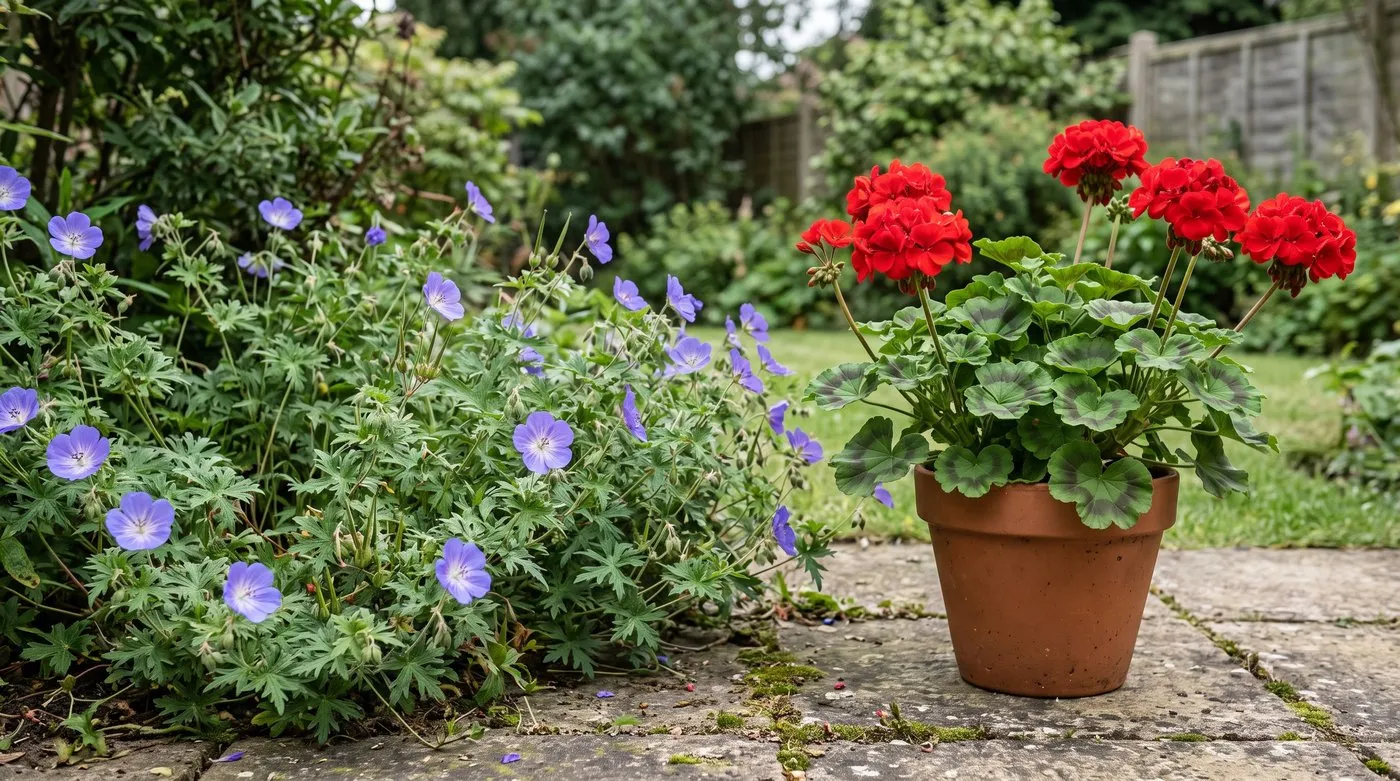
Hardy geraniums have open, saucer-shaped flowers and deeply cut leaves. Pelargoniums have rounder leaves, often with a dark ring, and tight flower clusters.
Best hardy geranium varieties for UK gardens
Hardy geraniums suit almost any spot and need very little care once settled. These are some of the most reliable.
Geranium ‘Rozanne’, RHS Plant of the Centenary
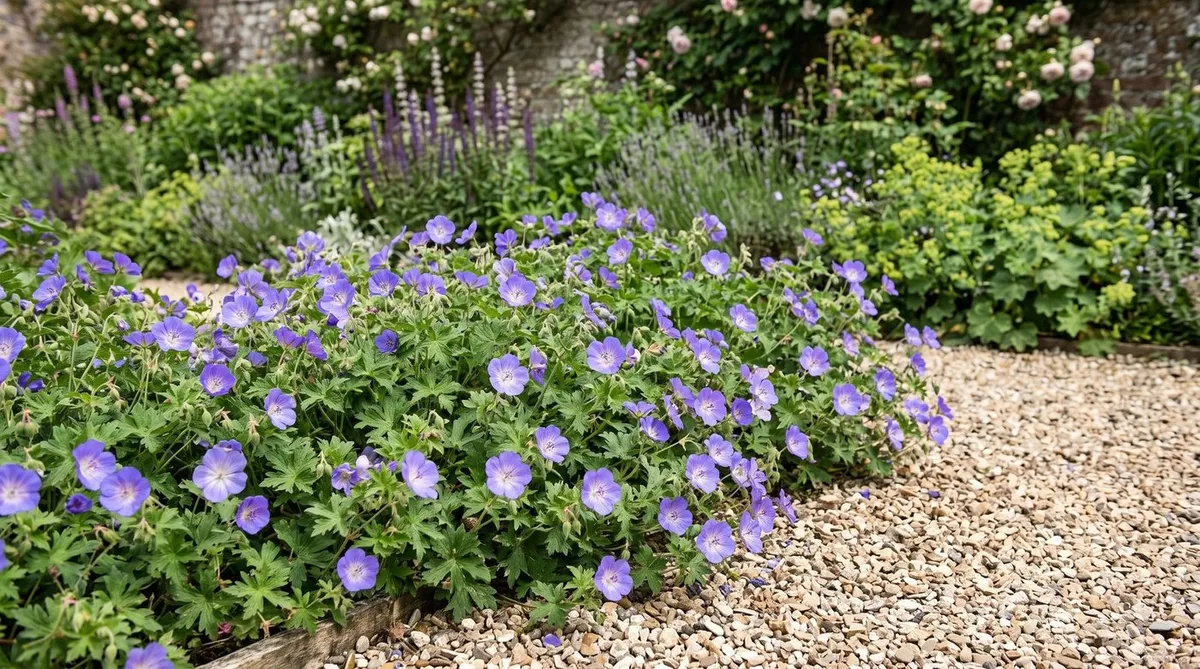
‘Rozanne’ is the hardy geranium everyone talks about. It was voted Chelsea Plant of the Centenary in 2013 and holds the RHS Award of Garden Merit.
It has violet-blue flowers with white centres from late May until the first hard frosts, with almost no deadheading. It grows about 30-40cm tall and spreads 60-90cm. It copes with light shade and dry spells once settled. Let it spill over a path edge or fill gaps between taller plants.
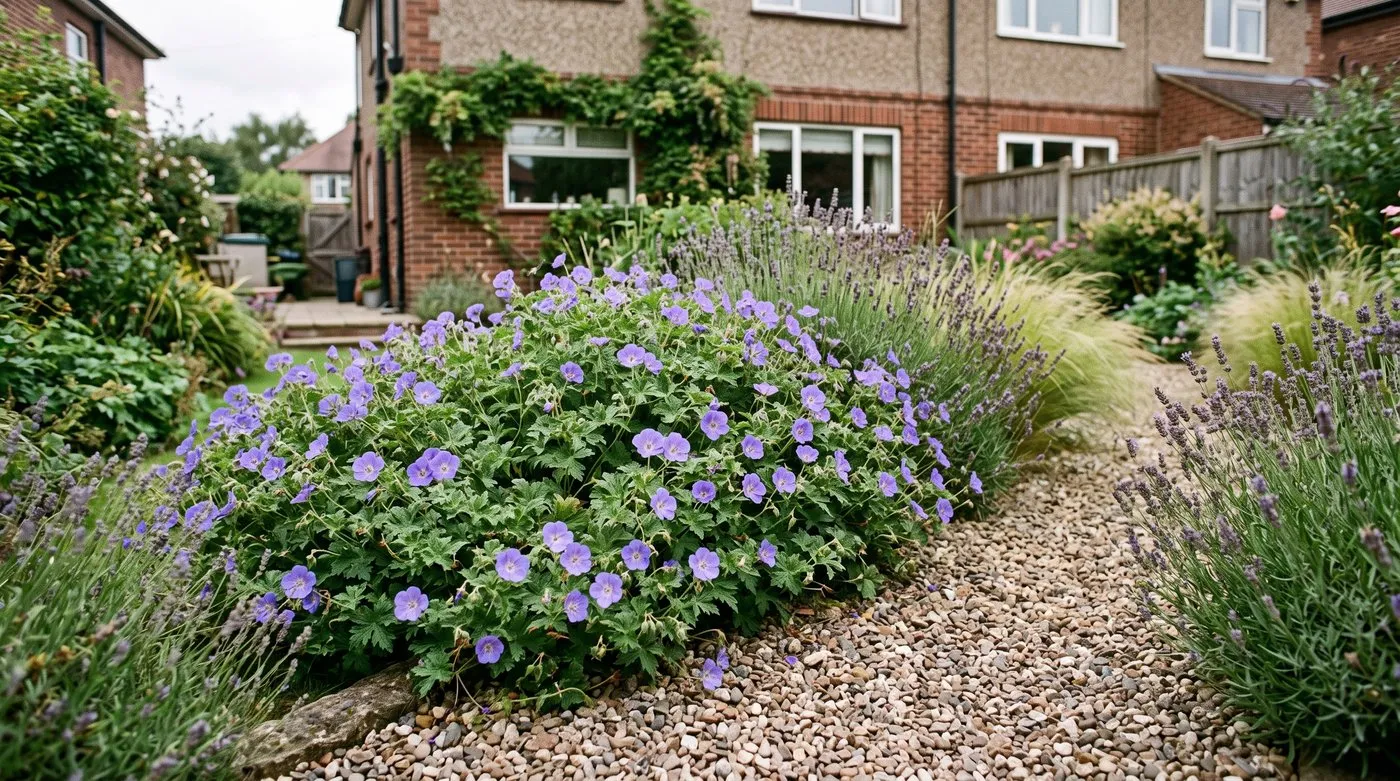
‘Rozanne’ flowers from late May right up to the frosts with hardly any deadheading. Let it tumble over a path edge or fill gaps.
Geranium macrorrhizum
The best choice for dry shade and ground cover. It grows 30-40cm tall and spreads into a thick, weed-smothering mat. The leaves smell lovely when you brush them and colour up in autumn. Pink or white flowers come in May and June. It’s happy under trees and in north-facing borders where little else will grow. ‘Album’ (white) and ‘Ingwersen’s Variety’ (soft pink) are popular. For more ideas, see our guide to best plants for shade.
Geranium sanguineum, Bloody Cranesbill
A native British wildflower with magenta-pink flowers from May to August. It’s compact, about 20-30cm, so great for the front of a border. ‘Album’ is white, and ‘Striatum’ is pale pink with darker veins. Very tough in dry soil once settled, so it’s good on a sunny bank. Our guide to drought-tolerant plants has more options.
Geranium himalayense
Violet-blue flowers from May to July, often with a second round in late summer if you cut it back. It grows 30-45cm tall. ‘Plenum’ has double flowers that look fuller, but the single form is better for bees.
Geranium x oxonianum
Tough and flowers for ages, with pink, darker-veined flowers from May to October. ‘Wargrave Pink’ and ‘A.T. Johnson’ are popular. It grows 45-60cm tall and copes with more shade than most, so it’s handy in the middle of a mixed border.
| Variety | Height | Flower colour | Flowers | Best for |
|---|---|---|---|---|
| ’Rozanne’ | 30-40cm | Violet-blue | May-October | Borders, edging, pots |
| G. macrorrhizum | 30-40cm | Pink or white | May-June | Dry shade, ground cover |
| G. sanguineum | 20-30cm | Magenta or white | May-August | Front of border, dry banks |
| G. himalayense | 30-45cm | Violet-blue | May-July | Mixed borders |
| G. x oxonianum | 45-60cm | Pink | May-October | Shady borders |
Best pelargonium types for UK gardens
There are four main types of pelargonium, each good for different spots.
Zonal pelargoniums are the most common. Their round leaves have a darker ring or “zone”, and they have dense clusters of red, pink, salmon, orange, white or two-tone flowers. They grow 30-60cm tall and are ideal for pots, baskets and bedding.
Ivy-leaved pelargoniums have glossy leaves on trailing stems. They’re perfect for hanging baskets and window boxes on sunny walls, and flower from June to October. Great for small patios and balconies.
Regal pelargoniums have big, showy flowers in deep pinks, purples, reds and whites, often with dark markings. They flower in spring and early summer rather than all season, and don’t love wet summers. They’re best in a conservatory or indoors.
Scented-leaf pelargoniums are grown for their fragrant leaves rather than their flowers. Rose, peppermint and lemon-scented types are popular. The leaves release their scent when touched, so put them where you’ll brush past.
| Type | Shape | Best for | Flowers |
|---|---|---|---|
| Zonal | Upright, 30-60cm | Pots, bedding | Red, pink, white; May-October |
| Ivy-leaved | Trailing | Baskets, window boxes | Pink, red, white; June-October |
| Regal | Upright, 30-45cm | Conservatory, sheltered patios | Big and bold; May-July |
| Scented-leaf | Varies | Herb gardens, patios | Small and simple |
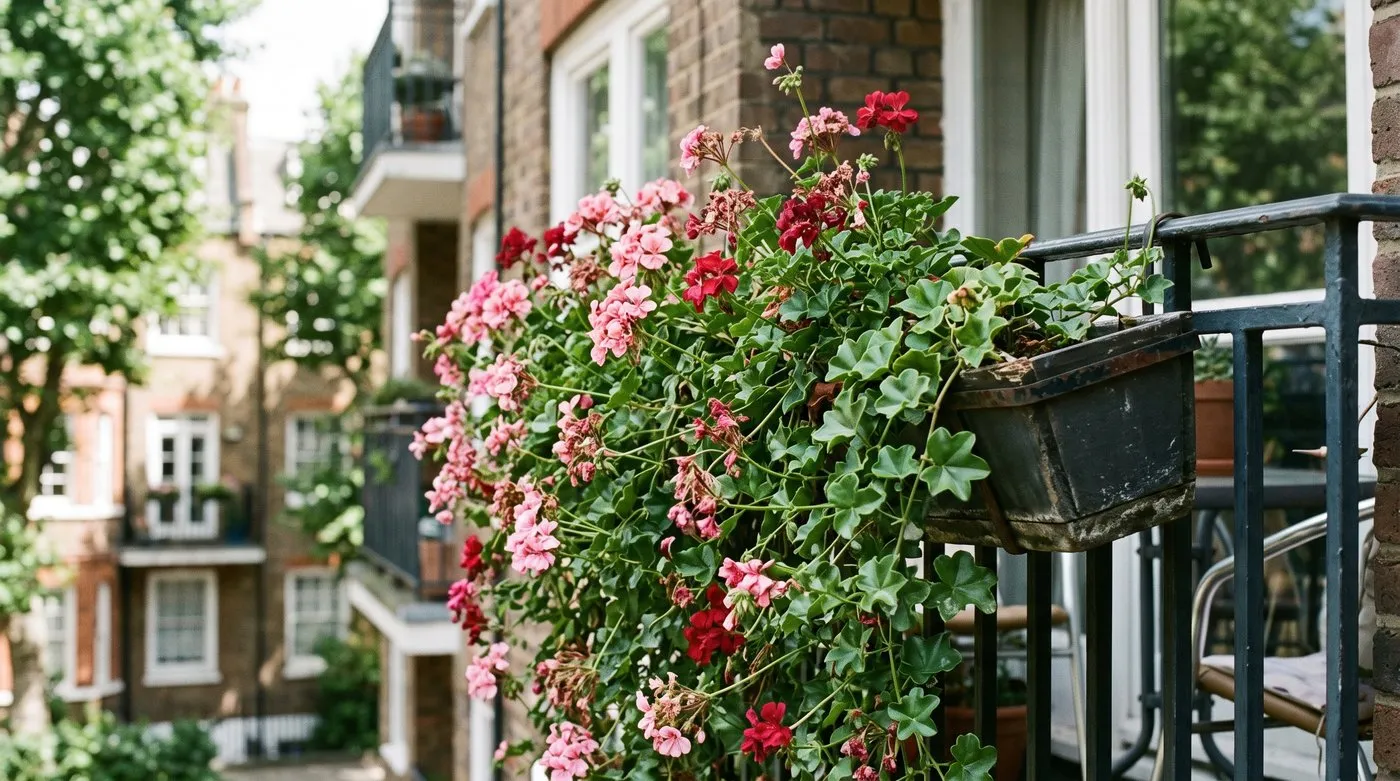
Ivy-leaved pelargoniums trail beautifully from window boxes and baskets on sunny walls. They flower from June to October.
When and how to plant geraniums
Planting hardy geraniums
You can plant hardy geraniums in pots at any time the ground isn’t frozen or waterlogged, but spring and autumn are best. Plant bare-root ones as soon as they arrive.
Clear the weeds and loosen the soil. Hardy geraniums cope with most soils, including clay and chalk, but do best in reasonably rich soil that drains well. Add some compost if your soil is very poor or very sandy. Give ‘Rozanne’ about 60cm and smaller ones like G. sanguineum about 30cm.
Water well after planting, and water in dry spells during the first season. After that, they rarely need it.
Planting pelargoniums outdoors
Don’t plant pelargoniums out until the frosts are over. That’s usually mid-May in southern England, late May in the Midlands and early June further north. A late frost blackens the young growth.
If they’ve come from a heated greenhouse, harden them off first. Put them outside in the day for a week or so before planting out for good.
Plant in full sun in compost or soil that drains freely. In pots, use peat-free multipurpose compost with some grit mixed in for drainage.
How to care for hardy geraniums
Hardy geraniums need hardly any looking after. The one job that really pays is cutting them back after the first flowers.
In June or early July, when the main flowers are over, cut the whole plant back by half to two-thirds with shears. It looks brutal, but you’ll get fresh leaves and a second round of flowers in August and September. Skip it and they look tired and messy for the rest of summer.
Divide clumps every three or four years in spring or autumn to keep them vigorous. Lift with a fork, split into pieces and replant. Spare bits make great presents or gap-fillers.
Give a light sprinkle of general fertiliser in spring. Don’t overdo it, as too much feed gives lots of leaf and fewer flowers.
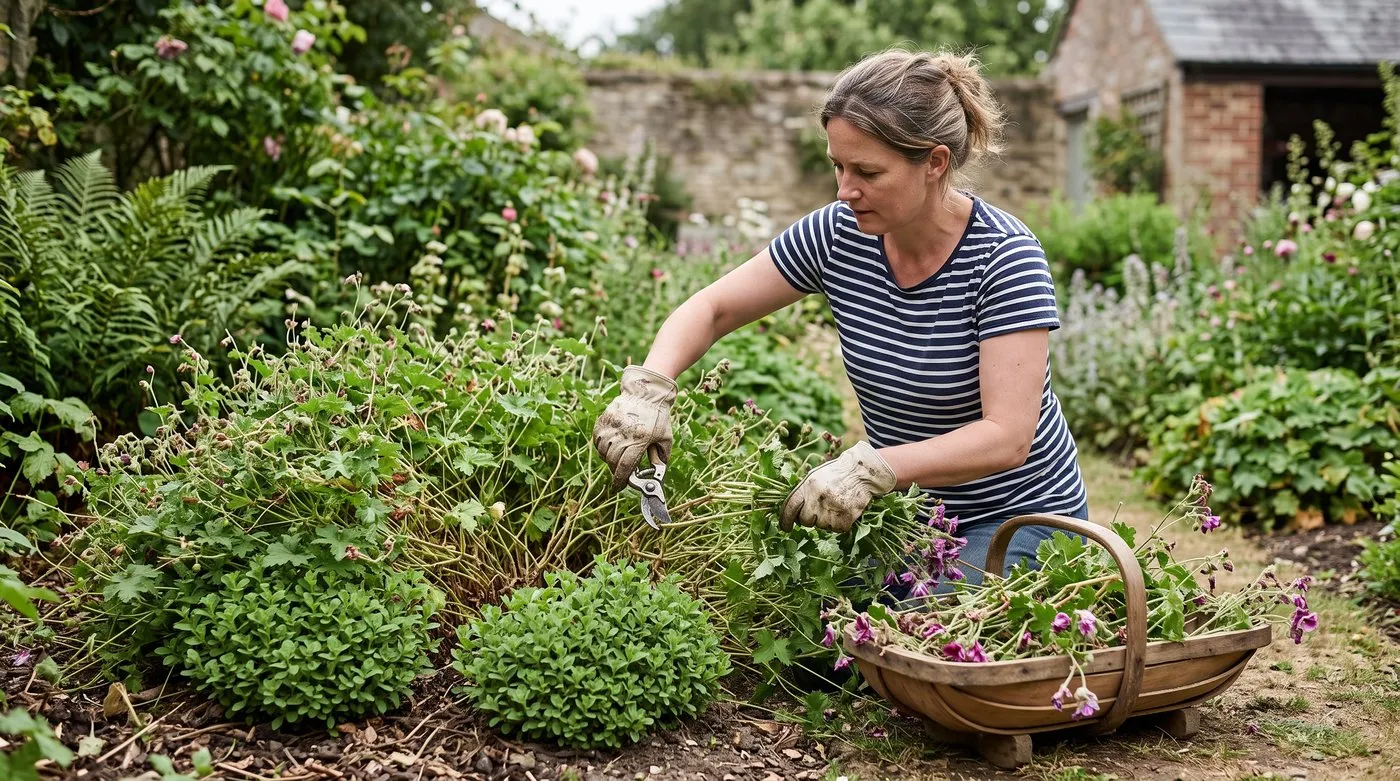
Shear tired plants back by half after the first flush. It looks drastic, but you’ll get fresh leaves and more flowers by late summer.
How to care for pelargoniums
Pelargoniums in pots need a little more attention than hardy geraniums in the ground.
Watering: Water when the top 2cm of compost feels dry. Don’t let pots dry out completely, but never leave them standing in water, as the roots rot quickly. In a heatwave, pots on a sunny patio may need watering every day.
Feeding: Feed every two weeks with tomato feed from June. It encourages flowers rather than leaves. Stop in early September so you don’t push soft growth that frost will damage.
Deadheading: Snap off the whole flower stalk at its base once the flowers fade, not just the petals. It keeps grey mould away and keeps the flowers coming all summer.
Pinching out: Pinch out the tips of young plants once they have 3-4 sets of leaves. You’ll get a bushier plant with more flowers.
Month-by-month geranium calendar
| Month | Hardy geraniums | Pelargoniums |
|---|---|---|
| January | Resting; tidy dead growth if needed | Keep frost-free; water very little |
| February | New growth appears; give a light feed | Check stored plants; remove dead leaves |
| March | Plant bare-root plants; divide clumps | Take cuttings from overwintered plants |
| April | Water new plants in dry spells | Keep frost-free; pot on cuttings |
| May | Flowers start on most varieties | Harden off; plant out after the last frost |
| June | Peak flowers; cut back after the first flush | In full flower; feed every two weeks; deadhead |
| July | Fresh growth after cutting back; water in drought | Deadhead, water and feed regularly |
| August | Second round of flowers | Take cuttings for next year; keep deadheading |
| September | Still flowering (‘Rozanne’, x oxonianum); divide | Cut back by half; bring in before frost |
| October | Cut back untidy plants | Keep in a frost-free greenhouse or porch |
| November | Mulch in colder areas | Keep almost dry and frost-free |
| December | Nothing to do | Watch for grey mould; remove dead bits |
How to propagate geraniums
Propagating hardy geraniums by division
Dividing is the easiest way to get more hardy geraniums. Do it in spring or autumn.
- Lift the clump with a fork, working round the outside so you don’t cut the roots.
- Shake off the loose soil so you can see what you’re doing.
- Split it up. For big, tough clumps, push two forks in back to back and lever them apart. Pull smaller ones apart by hand.
- Make sure each piece has two or three shoots and some roots.
- Replant straight away at the same depth and water well.
Most settle quickly and flower the same year if divided in spring.
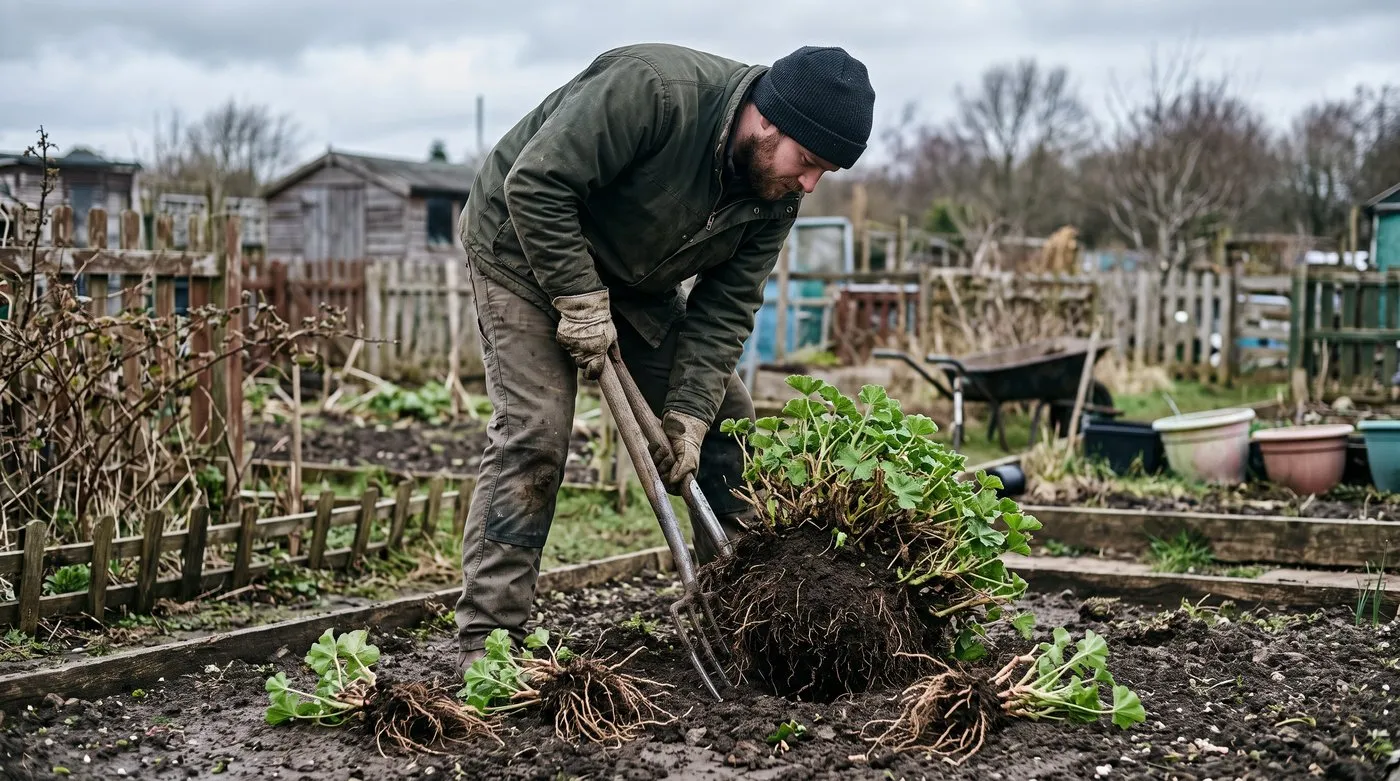
Two forks back to back make light work of a big clump. Check every piece has a couple of shoots and some roots.
Propagating pelargoniums from cuttings
Take cuttings in August or September from shoots without flowers. It’s the cheapest way to keep your plants for next year.
- Choose a healthy shoot without flowers, about 8-10cm long. Cut just below a leaf joint with a sharp, clean knife.
- Remove the lower leaves, leaving two or three at the top, and pinch off any flower buds.
- Let the cut end dry for an hour or two. This helps stop it rotting.
- Push it into a small pot of peat-free compost mixed half and half with perlite or grit. You don’t need rooting powder.
- Stand it on a warm, bright windowsill. Don’t cover it, as pelargoniums rot in damp air.
- Water lightly when the compost is dry. Roots usually form in three to four weeks.
- Pot into 9cm pots once rooted and keep frost-free over winter.
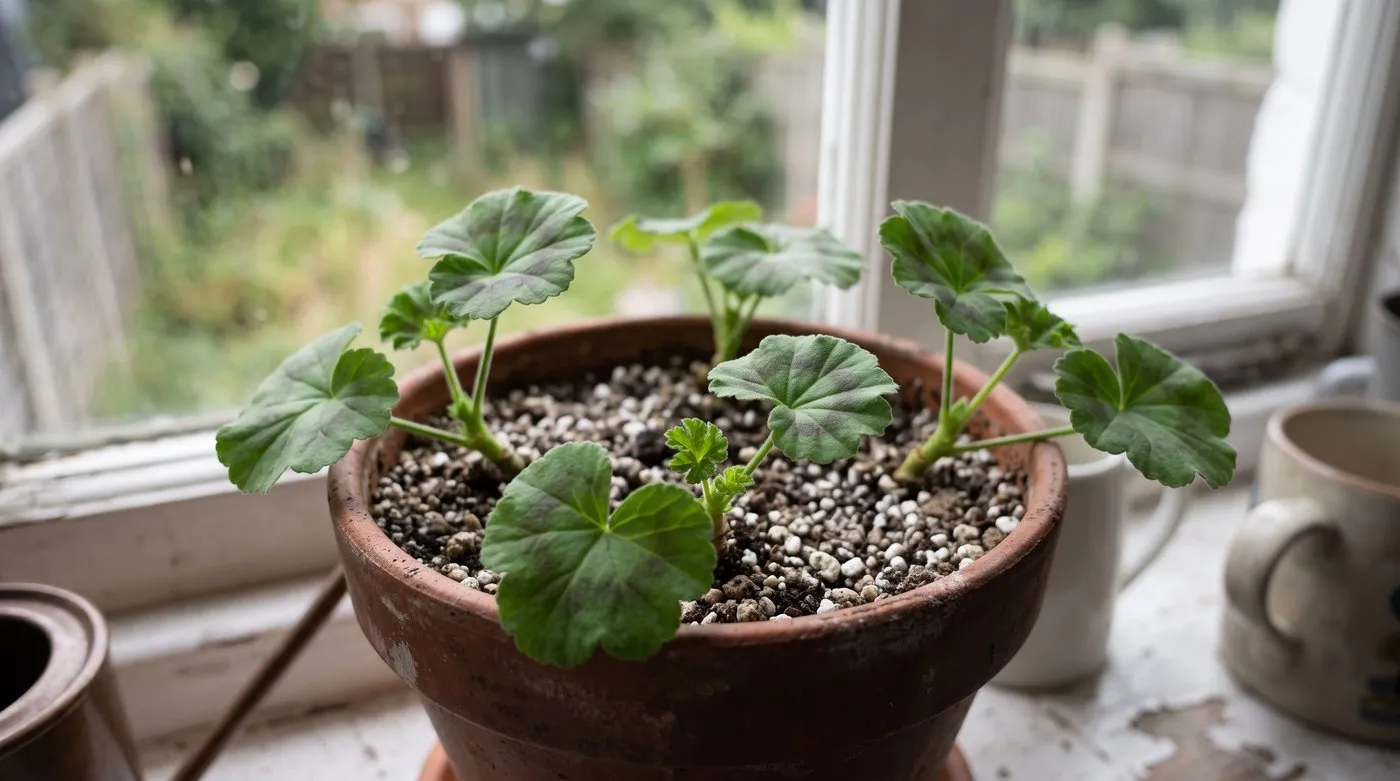
Leave pelargonium cuttings uncovered on a bright windowsill. They rot in damp air, so water lightly only when the compost is dry.
Overwintering pelargoniums
Pelargoniums are killed by frost, so get them somewhere frost-free before it arrives. A cool spot of around 5-10C suits them over winter.
Keeping whole plants: Before the first frost, usually in October in most of England, lift your pelargoniums, shake off the soil, cut them back by half and pot them into pots just big enough for the roots. Keep them in a frost-free greenhouse, conservatory or porch. Water very lightly, every two or three weeks is usually plenty. Water normally again from March.
Keeping cuttings only: Take cuttings in late summer, root them and compost the old plants. Cuttings take up less space and often make bushier plants next year.
In a mild winter, pelargoniums sometimes survive outside against a warm, sheltered wall in the south. Don’t rely on it.
Common geranium problems
Grey mould hits pelargoniums in cold, damp conditions, especially over winter. Fuzzy grey mould appears on stems and leaves. Remove affected bits straight away and let more air in. Don’t mist them, and check stored plants every week.
Rust on hardy geraniums shows as orange spots under the leaves. Pick off affected leaves and improve the airflow. It looks unsightly but rarely kills the plant.
Vine weevil grubs eat the roots of pelargoniums in pots, so plants suddenly wilt even when watered. Tip the pot out and look for creamy, C-shaped grubs. Water with vine weevil nematodes in late summer while the compost is warm, and replace the compost in affected pots.
Leggy pelargoniums usually need more light or pinching out. Move them somewhere brighter and pinch out the tips to make them bushier.
Hardy geraniums are very healthy plants. Their main fault is getting too big and swamping their neighbours, which regular dividing and cutting back sorts out. As they cope with both dry soil and shade, they’re handy next to lavender in sunny borders and in the shadier corners of cottage garden planting schemes.
The RHS plant finder lists hundreds of geranium and pelargonium varieties with growing notes, which is handy when you’re choosing.
Frequently asked questions
What is the difference between geraniums and pelargoniums?
Hardy geraniums live outside all year; pelargoniums can’t take frost. Hardy geraniums, also called cranesbills, are perennials that come back every spring. Pelargoniums come from South Africa and are often sold as geraniums. In the UK they’re grown for summer and either thrown away or kept indoors over winter.
When do geraniums flower in the UK?
Hardy geraniums flower from May to October, depending on the variety. Most have their main show in May and June, then flower again in late summer if you cut them back. ‘Rozanne’ is one of the longest flowering, from late May until the first frosts.
How do I overwinter pelargoniums?
Take cuttings in August or September and root them on a warm windowsill. Or lift the whole plant before the first frost, cut it back by half, pot it up and keep it in a frost-free greenhouse, conservatory or porch. Water very sparingly over winter and water normally again from March.
Can geraniums grow in shade?
Many hardy geraniums are happy in part shade. Geranium macrorrhizum, G. nodosum and G. x oxonianum all do well under trees and in north-facing borders. Pelargoniums need full sun. In shade they flower less and are more likely to get grey mould.
How do I propagate hardy geraniums?
Divide clumps in spring or autumn. Lift the plant, split it into pieces with a spade or by hand, making sure each has roots and shoots, and replant straight away. Most settle in quickly and flower the same year if divided in spring.
Why are my pelargonium leaves turning yellow?
Too much water is the usual cause. Let the compost dry a little between waterings. Hungry plants can also yellow, so feed every two weeks in summer. In cold, damp conditions over winter, grey mould can cause yellowing too.
Which hardy geranium is best for ground cover?
Geranium macrorrhizum is the best one for ground cover. It spreads into a thick mat about 60cm wide, copes with dry shade and keeps much of its scented leaves over winter, with good autumn colour. It flowers in May and June, smothers weeds and needs almost no care.
Further reading
- Patio garden ideas for small spaces: using pelargoniums and hardy geraniums on patios and balconies
- Spring gardening jobs in the UK: when to plant out and divide geraniums
- How to sow seeds indoors: start pelargoniums from seed in February and March
- Container vegetable gardening in the UK: pot-growing tips that work for pelargoniums too
- Companion planting guide: good neighbours for geraniums in the border
Our team produces practical UK gardening guidance from source research, contributor records and established horticultural practice. Editorial standards are overseen by Matt W.


