Key takeaways
- Hardy geraniums (cranesbills) live outside all year and come back every spring
- Pelargoniums are the tender summer pot plants, and frost kills them
- Five matching petals means geranium, two upper and three lower means pelargonium
- Geraniums cope with shade and most soils, pelargoniums want sun and good drainage
- Bring pelargoniums indoors before the first frost, usually in October
- Use geraniums in borders and pelargoniums in pots, baskets and window boxes
Geraniums and pelargoniums are two different plants. They’re in the same family, but they come from different parts of the world, need different care, and only one of them survives a British winter. Mixing them up is one of the oldest muddles in gardening, and every spring it leads to the wrong plant going in the wrong place.
Here’s how to tell them apart at a glance and which one to pick for each spot in your garden. If you already grow one or both, our guides to growing geraniums and growing pelargoniums go into more detail.
Left: a true geranium with five matching petals. Right: a pelargonium with two upper and three lower petals.
Why are geraniums and pelargoniums confused?
Because for a while they had the same name. In 1753 the botanist Linnaeus put both under Geranium, because both have long, beak-shaped seed pods. The name comes from the Greek for crane. In 1789 another botanist split off the South African plants and called them Pelargonium, from the Greek for stork.
Botanists took up the new name. British gardeners didn’t. By then pelargoniums had been sold as geraniums for years, and the old name stuck. Garden centres still label them “geranium” today.
A third cousin, Erodium (storksbill), is sometimes grown in rock gardens too. All three have those beaky seed pods, but their flowers, growth and hardiness are quite different.
How to identify geraniums vs pelargoniums
The flower test
The quickest check is the flower shape. True geraniums have five petals all the same size, spaced evenly like the spokes of a wheel. Pelargoniums have two upper petals that differ in size, shape or markings from the three lower ones.
Look at the flower face-on and ask: are all the petals the same? If yes, it’s a geranium. If the top two look different, it’s a pelargonium.
The leaf test
Geranium leaves are usually cut deeply into five to seven lobes spreading from the middle, a bit like a buttercup or maple leaf. Many turn red, orange or bronze in autumn.
Pelargonium leaves vary a lot depending on the type:
- Zonal pelargoniums have rounded leaves with a dark horseshoe-shaped band
- Ivy-leaved types have thick, pointed leaves like ivy
- Regal pelargoniums have toothed, slightly crinkly leaves
- Scented-leaf types range from finely cut to broad and fuzzy
If the leaf has a horseshoe band or smells strongly when you rub it, it’s almost certainly a pelargonium.
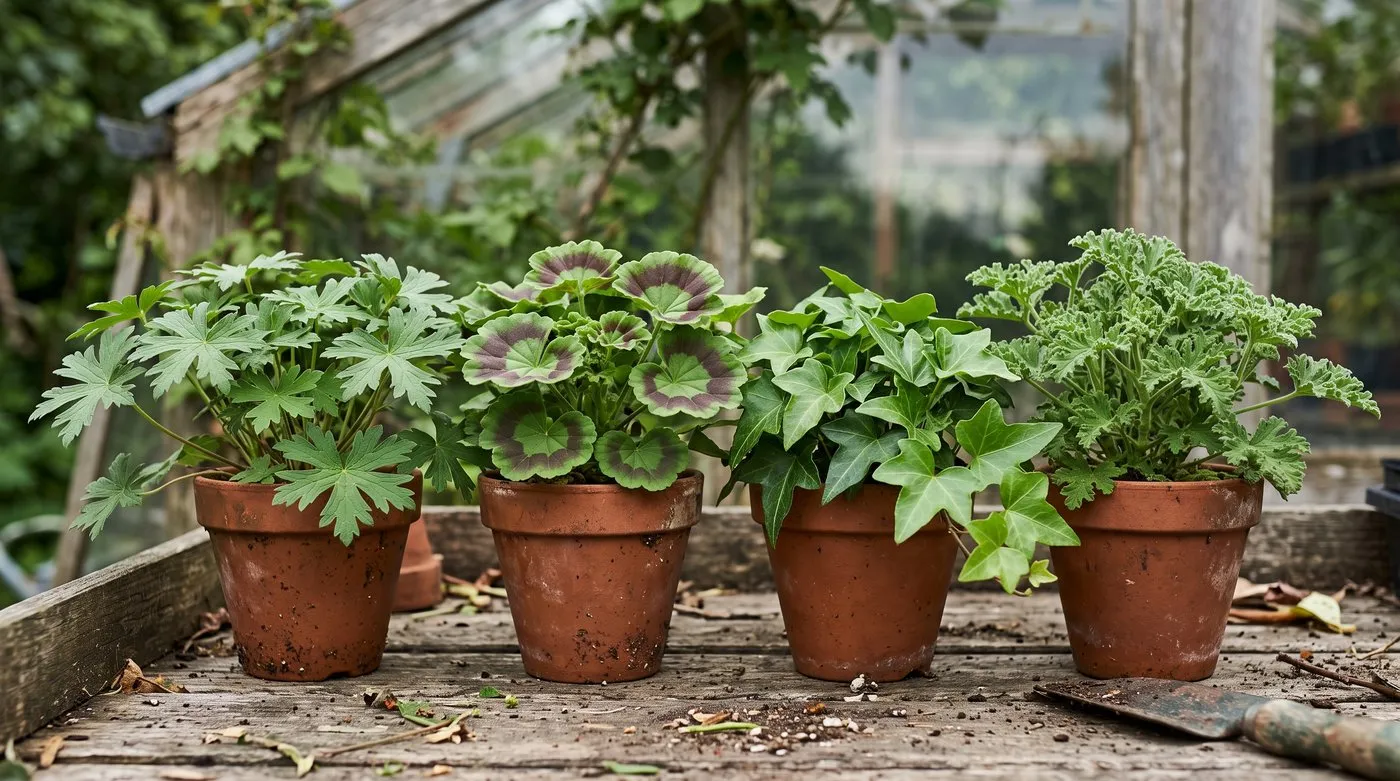
A deeply lobed leaf usually means a true geranium. A dark horseshoe band, thick ivy-like leaves or a strong smell when you rub it points to a pelargonium.
The stamen test
Count the stamens if you fancy a closer look. Geraniums have ten that all carry pollen. Pelargoniums have fewer pollen-bearing stamens, usually five to seven.
Geraniums and pelargoniums side by side
| Feature | Geranium (cranesbill) | Pelargonium |
|---|---|---|
| Comes from | Cooler parts of the world | Southern Africa |
| Flowers | 5 matching petals | 2 upper, 3 lower petals |
| Winter in the UK | Hardy, stays outside | Tender, frost kills it |
| How long it lives | Comes back every year | Kept over winter indoors or grown fresh each year |
| Where to grow | Borders, ground cover, rock gardens | Pots, baskets, window boxes |
| Name in shops | Hardy geranium | Often just “geranium” |
A geranium leaf (left) with deep lobes, and a zonal pelargonium leaf (right) with its dark horseshoe band.
Hardiness and growing conditions compared
Where they survive winter
This is the difference that matters most. True geraniums are hardy all over the UK. They die back in autumn and grow again from the roots in spring. Once planted, they stay put for years.
Pelargoniums can’t take frost. Either treat them as summer bedding, or bring them indoors to a frost-free spot above 5C for the winter. Leave one outside and it won’t see Christmas.
Sun and soil requirements
| Needs | Geranium | Pelargonium |
|---|---|---|
| Sun | Sun or part shade | Full sun |
| Soil | Most soils, including clay and chalk | Free-draining |
| Wet or dry | Copes with both | Hates sitting wet |
| Feeding | An annual mulch is plenty | High-potash feed every fortnight, May to September |
| Watering | Rarely, once settled | Regularly in pots |
Pelargoniums want sun, warmth and free-draining compost. They rot in wet, heavy soil. In pots, mix some perlite into multipurpose compost. In borders, add grit to clay soil before planting. South-facing walls, patios and windowsills suit them well.
Growing habit and maintenance compared
Geraniums: plant and forget
Hardy geraniums are about as easy as perennials get. Plant them in autumn or spring, water them in and leave them to it. They spread into clumps that smother weeds. Divide them every three or four years when the middle of the clump goes bare.
The one job worth doing is a cut-back after the first flush of flowers. When the flowers fade in early summer, cut the whole plant back to about 10cm. Fresh leaves soon follow, and many varieties flower again later in summer. Our guide to the Chelsea chop covers this and other ways of cutting back perennials.
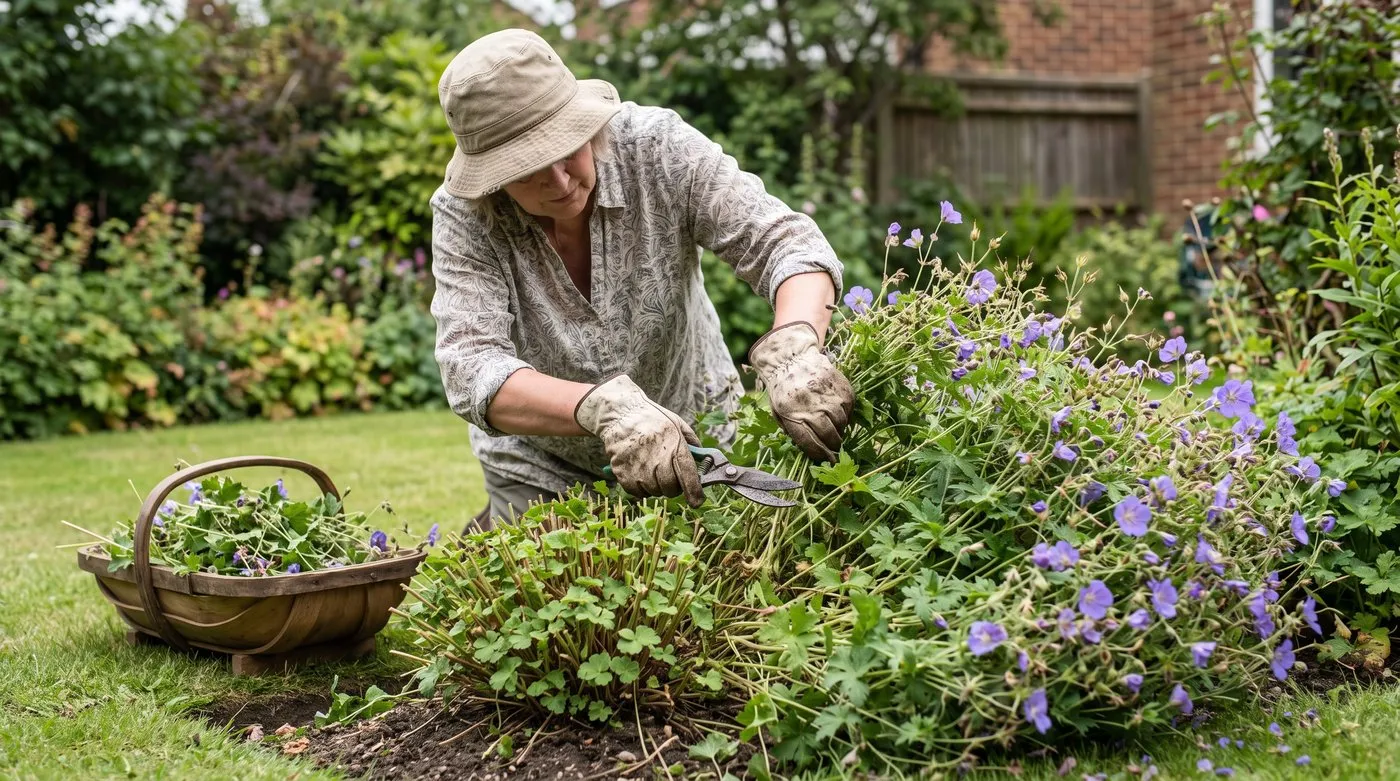
Once the first flush fades, cut a hardy geranium right back to about 10cm. Fresh leaves soon follow, and many varieties flower again later in summer.
Pelargoniums: seasonal care cycle
Pelargoniums like a bit more attention through the year:
- March: Start watering and feeding overwintered plants as new growth appears
- May (after the last frost): Plant outside or move pots onto the patio
- May to September: Feed every fortnight with high-potash feed and pick off faded flowers
- August to September: Take cuttings for next year
- October (before the first frost): Bring indoors, cut back to about 15cm and keep frost-free
- November to February: Water sparingly, once a fortnight at most
If you enjoy pottering with pots, you’ll love them. If you’d rather not, stick with hardy geraniums.
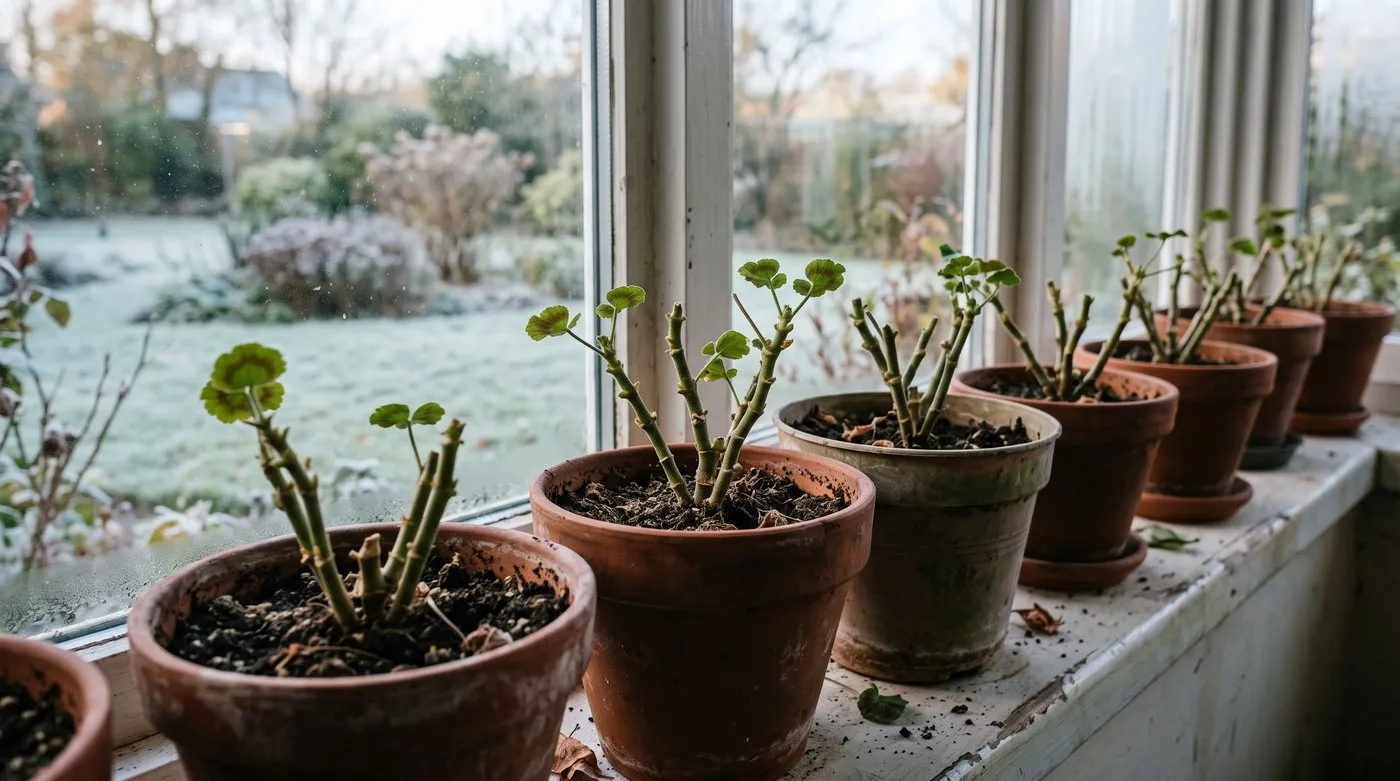
Bring pelargoniums in before the first frost, cut them back to about 15cm and keep them frost-free. Water sparingly, once a fortnight at most, until March.
Best geraniums for UK gardens
For borders and mixed plantings
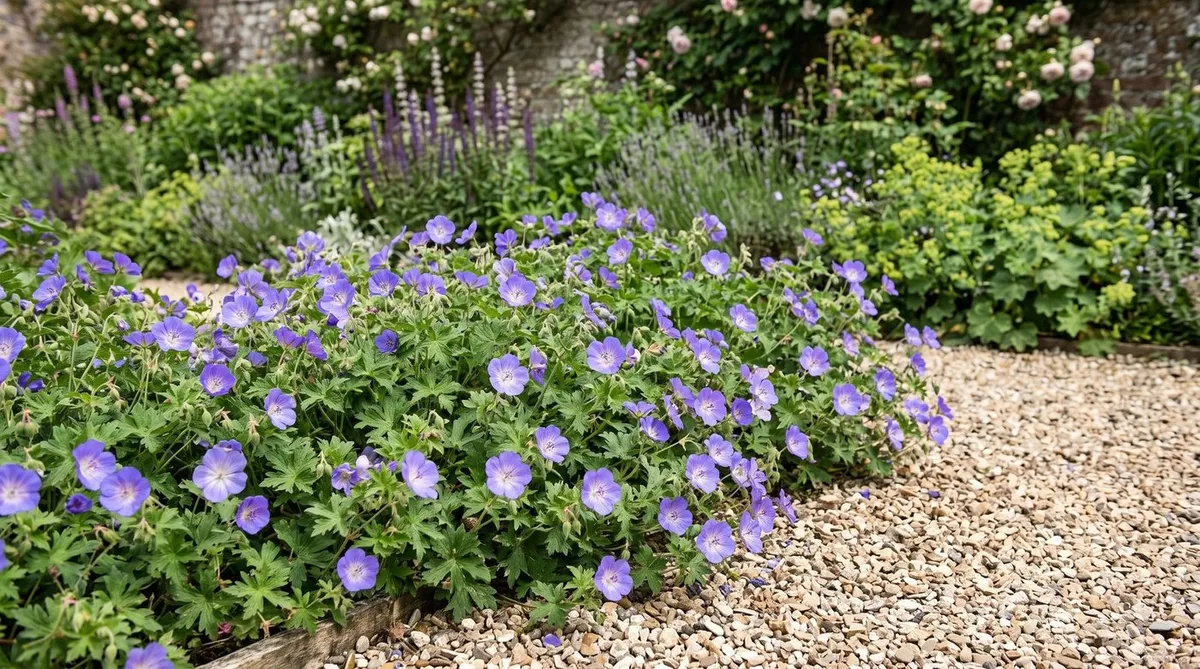
‘Rozanne’ is a favourite, with violet-blue flowers from early summer into autumn. Other good border choices include G. x magnificum (deep violet), G. pratense ‘Mrs Kendall Clark’ (pale pearly blue) and G. psilostemon (magenta with a black eye). All of them look lovely in a cottage garden planting scheme.
For ground cover and shade
Geranium macrorrhizum is brilliant ground cover. It copes with deep shade, dry soil and poor conditions. Its leaves smell lovely when brushed, hang on through much of winter, and spread into thick, weed-proof mats.
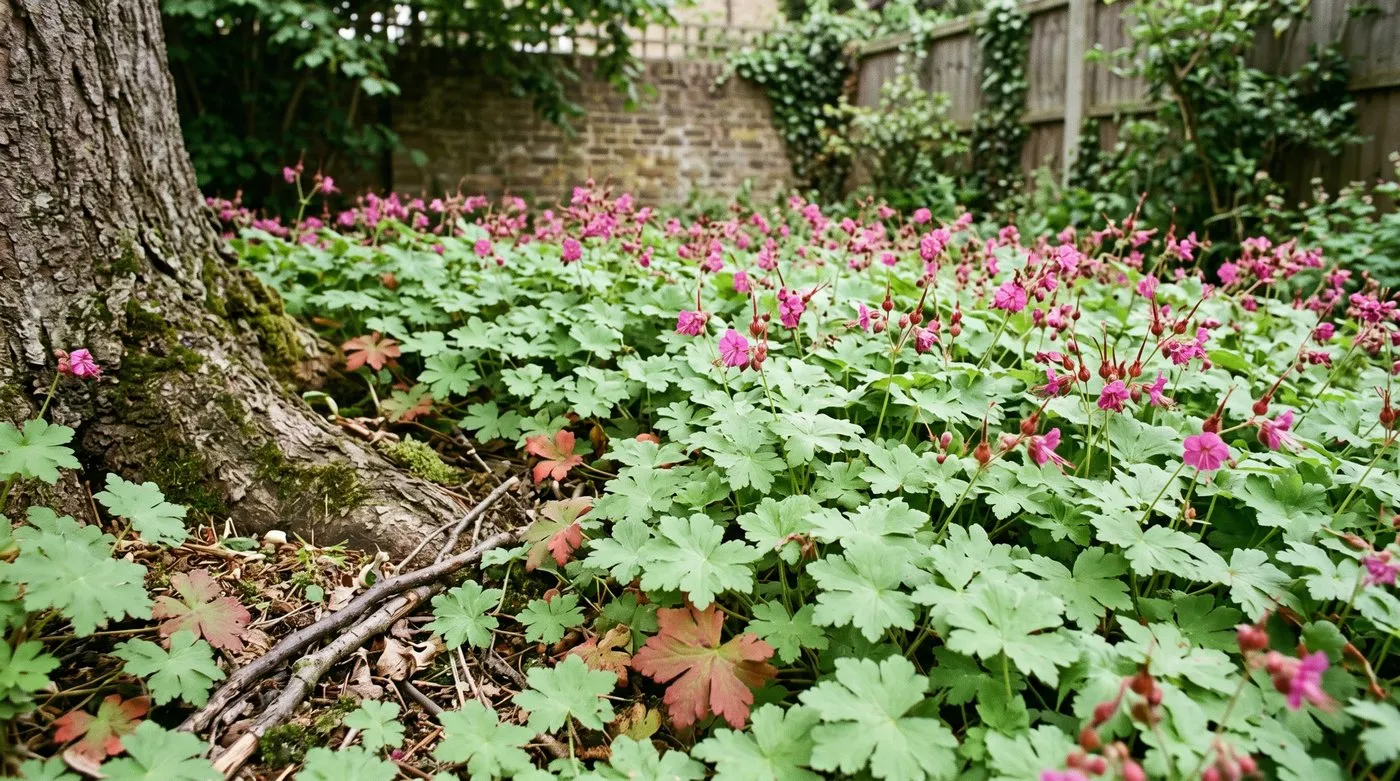
Geranium macrorrhizum copes with deep shade and dry soil under trees, spreading into a thick mat. Its leaves smell lovely when you brush past.
For rock gardens and front of border
Geranium sanguineum (bloody cranesbill) makes low, spreading mounds about 20cm tall, perfect for rock gardens, path edges and raised beds. ‘Album’ has pure white flowers. G. cinereum ‘Ballerina’ has pale pink flowers with dark veins and stays tiny.
Geranium ‘Rozanne’ in full flower in a cottage-style border.
Best pelargoniums for UK gardens
Zonal pelargoniums for bedding
Zonals are the classic bedding plants of a British summer. They’re named after the dark band on each leaf and flower from May to October. Seed-raised series include ‘Maverick’, ‘Horizon’ and ‘Bullseye’.
Plants grown from cuttings, such as ‘Ville de Paris’ and ‘PAC Salmon Princess’, tend to have bigger flowers and more even growth. They cost a bit more but put on a better show.
Ivy-leaved pelargoniums for baskets
Ivy-leaved types trail up to about 60cm, so they’re perfect for hanging baskets, window boxes and tall pots. The ‘Balcon’ types cope well with summer rain. ‘Decora’ types have variegated leaves that look good even before the flowers arrive.
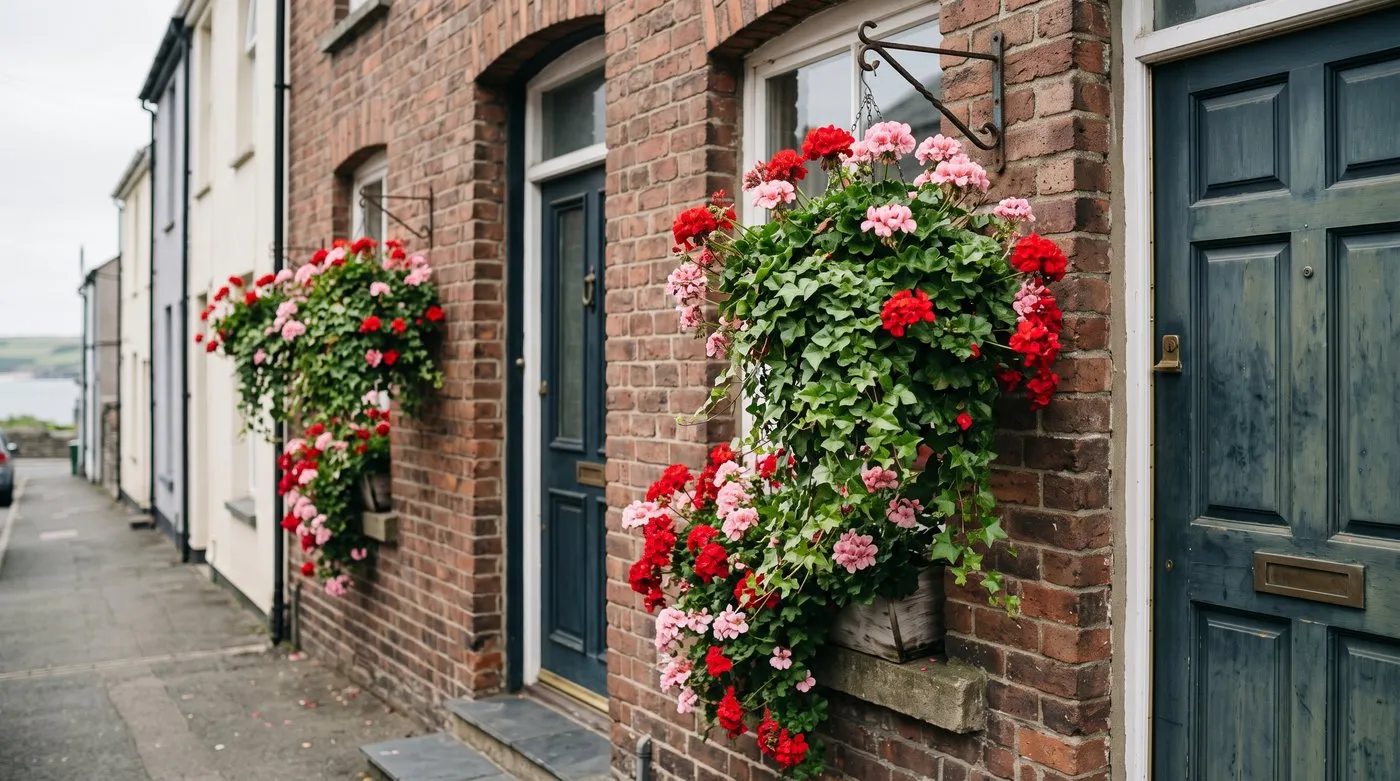
Ivy-leaved pelargoniums trail up to about 60cm, so they’re the ones for baskets and window boxes. Hardy geraniums don’t trail well.
Regal pelargoniums for sheltered spots
Regals have the biggest, fanciest flowers of all, mainly in May and June. They don’t like rain on their blooms, so they’re happiest in a conservatory, porch or very sheltered patio. ‘Lord Bute’ (deep burgundy) and ‘Lavender Grand Slam’ are two beauties.
Scented-leaf pelargoniums
These are grown for their leaves, which smell of lemon, rose, peppermint or even chocolate mint when you brush them. They’re lovely on a windowsill, and the leaves can be used in cooking and baking.
Which should you grow?
It depends what you want from the plant.
| You want | Choose | Why |
|---|---|---|
| Permanent border plants | Geranium | Hardy, comes back, easy |
| Ground cover under trees | Geranium | Copes with shade and dry soil |
| Summer pots and window boxes | Pelargonium | Months of colour, copes with dry pots |
| Hanging baskets | Pelargonium (ivy-leaved) | Trails and flowers for months |
| Rock gardens | Geranium | Low, spreading, hardy |
| Cottage garden borders | Both | Geraniums in the ground, pelargoniums in pots |
| Scented leaves | Pelargonium (scented-leaf) | Lovely range of scents |
| Easy for beginners | Geranium | No winter care |
For most UK gardeners the answer is both. Hardy geraniums are the backbone of a border and come back year after year. Pelargoniums add bright colour in pots from May to October.
If you only want one and you’d like the least work, go for hardy geraniums. If you enjoy summer pots and have a frost-free spot for winter, add pelargoniums too.
Propagation differences
Geranium propagation
Dividing is the easiest way. Lift a clump in spring (March to April) or autumn (September to October). Split it with a spade or pull it apart by hand. Make sure each piece has roots and at least one growing bud. Replant straight away and water well.
Hardy geraniums also grow well from seed. The seed pods flick their seeds out, so tie small paper bags over the ripening heads to catch them. Sow fresh seed in autumn in a cold frame. Plenty of cranesbills self-seed too, and several feature in our list of the easiest flowers to grow from seed.
Pelargonium propagation
Cuttings are the usual way. Take 10cm tip cuttings in August or September. Strip off the lower leaves, cut just below a leaf joint, and push them into free-draining cutting compost. There’s no need for rooting powder. They usually root in a few weeks somewhere warm and bright. Pot them into small pots once rooted and keep them on a bright windowsill over winter. Pelargonium stems tend to rot in a jar, so compost beats water here; our guide to which cuttings root in water lists the plants that do suit that method.
You can also grow pelargoniums from seed, sown in a warm spot from January to March. They take a few months to flower.
Common problems compared
| Problem | Geranium | Pelargonium |
|---|---|---|
| Main pest | Vine weevil grubs eating roots | Whitefly and aphids |
| Main disease | Powdery mildew in dry spells | Pelargonium rust |
| Too much water | Copes with damp soil | Stems rot |
| Frost | No problem | Kills it |
| Slugs | Can nibble young growth | Rarely bothered |
Pelargonium rust shows as rings of brown spots under the leaves, with yellow patches on top. Pick off affected leaves straight away and bin them rather than composting. Give plants more space for air to move and water the compost, not the leaves.
Hardy geraniums are rarely troubled. Vine weevil grubs sometimes eat the roots of plants in pots. Nematodes watered into the compost in spring or autumn deal with them naturally.
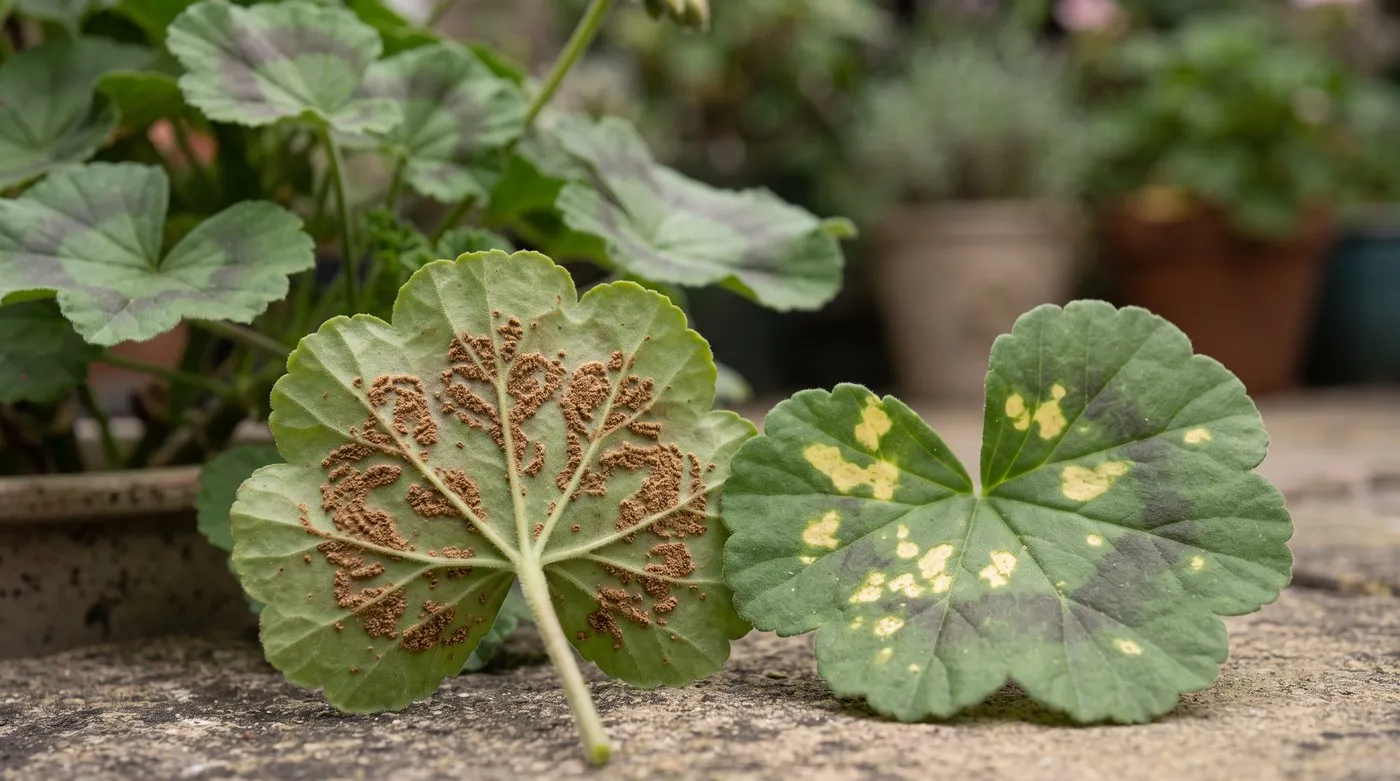
Pelargonium rust shows as rings of brown spots under the leaves, with yellow patches on top. Pick off affected leaves and bin them, and water the compost rather than the leaves.
The naming confusion: a quick reference
When you see “geranium” in the UK:
- “Hardy geranium” or “cranesbill” means a true geranium for the border.
- “Geranium” on a summer bedding tray or basket plant almost always means a pelargonium.
- “Zonal”, “ivy-leaved”, “regal” or “scented geranium” are all pelargoniums.
The RHS geranium page covers true cranesbills, and the RHS pelargonium page covers the tender ones. Both are handy if you grow either plant.
Growing both together in UK gardens
The easy way is to use hardy geraniums as the permanent planting and pelargoniums as the summer show.
Plant hardy geraniums in borders in autumn or spring. Match them to the spot: G. macrorrhizum for shade, ‘Rozanne’ for sun and G. sanguineum for dry places. After their first year they need little more than a cut-back after flowering.
Add pots of pelargoniums from late May. Stand them on patios, windowsills and among border plants for bright summer colour, then bring them in during October.
Both work well with other perennials in UK gardens. In a cottage garden, cranesbills spilling over the path with pots of pelargoniums above give that lovely, overflowing look.
Frequently asked questions
Are geraniums and pelargoniums the same plant?
No, they are related but different plants. True geraniums are hardy perennials from cooler parts of the world. Pelargoniums are tender plants from southern Africa. Botanists split them apart in 1789, but garden centres still sell pelargoniums labelled as geraniums.
How do I tell a geranium from a pelargonium?
Look at the flowers. Geraniums have five matching petals arranged like a wheel. Pelargoniums have two upper petals that look different from the three lower ones. Zonal pelargonium leaves often have a dark horseshoe-shaped band, while geranium leaves are deeply cut into lobes.
Can pelargoniums survive winter outdoors in the UK?
No, frost kills them. Bring them indoors before the first frost, usually in October. Keep them in a bright, frost-free spot at 5 to 10C and water sparingly. Hardy geraniums, on the other hand, stay outside all year without any fuss.
Which is better for hanging baskets, geraniums or pelargoniums?
Pelargoniums are better for hanging baskets. Ivy-leaved pelargoniums trail over the edges and flower from May to October. Hardy geraniums are border plants that don’t trail well, so pelargoniums are the one for pots, window boxes and baskets.
Why are pelargoniums called geraniums in garden centres?
The old name simply stuck. In 1753 both plants were grouped as Geranium. Pelargoniums got their own name in 1789, but everyday gardeners kept calling them geraniums. You’ll often see “zonal geranium” for pelargoniums and “hardy geranium” for true cranesbills.
Do hardy geraniums come back every year?
Yes, hardy geraniums come back every year. They die down in winter and grow again each spring. Most spread slowly into bigger clumps, and they shrug off UK winters without any protection.
Can I grow geraniums and pelargoniums together?
Yes, they look lovely together in summer. Plant hardy geraniums in the border as permanent ground cover. Dot pots of pelargoniums among them for bright colour from May to October. In autumn the pelargoniums come indoors while the geraniums stay put.
Our team produces practical UK gardening guidance from source research, contributor records and established horticultural practice. Editorial standards are overseen by Matt W.