Key takeaways
- Catmint is fully hardy and happy across the UK in well-drained soil
- 'Walker's Low' (60cm) and 'Six Hills Giant' (90cm) both hold the RHS Award of Garden Merit
- Cut plants back to 15cm in mid-July for a second round of flowers
- Bees love it, and the second flush feeds them into autumn
- It's a brilliant partner for roses, hiding their bare lower stems
Catmint (Nepeta) is one of the hardest-working plants in a British border. It flowers for months, buzzes with bees, and softens bare rose stems with a haze of blue-purple. Best of all, it’s happy in poor soil and doesn’t mind being left alone.
There are two secrets to growing it well. It needs soil that drains freely, and it needs a hard chop in mid-July to flower a second time. Get both right and a single ‘Walker’s Low’ will give you colour from late May to autumn. This guide covers choosing varieties, planting, the July chop, rose partners and dividing clumps.
Which catmint varieties are best for UK gardens?
There are lots of catmints, but a handful of named varieties are the ones you’ll see in UK garden centres. These three are the best places to start.
Walker’s Low
‘Walker’s Low’ is the go-to catmint for British borders. Despite its name, it isn’t that low, reaching about 60cm tall and wide. The deep violet-blue flowers sit on arching stems that spill nicely over path edges. It holds the RHS Award of Garden Merit and flowers from late May to July, then again from August after a trim. It suits gardens of any size.
The RHS lists catmints among its plants for pollinators, alongside favourites like lavender and salvia.
Six Hills Giant
‘Six Hills Giant’ is the big show-off. It reaches about 90cm tall and wide, with arching stems of pale lavender-blue flowers from June to August. It’s looser and more vigorous than ‘Walker’s Low’, so it needs more room and maybe a little support in windy spots. Use it in the middle or back of a wide border. It also holds the RHS Award of Garden Merit.
Junior Walker
‘Junior Walker’ is a compact version of ‘Walker’s Low’, only 35-40cm tall. It has slightly richer violet flowers and a tidier, more upright shape. It’s great at the front of a border, in pots, or in small gardens where ‘Six Hills Giant’ would take over.
 ‘Walker’s Low’ in full flower. Its arching stems are perfect for softening a border edge.
Catmint varieties compared
| Variety | Height | Spread | Colour | Flowers |
|---|---|---|---|---|
| ’Walker’s Low’ | 60cm | 60cm | Deep violet-blue | May to Jul, again Aug to Oct |
| ’Six Hills Giant’ | 90cm | 90cm | Pale lavender-blue | Jun to Aug, again Sep to Oct |
| ’Junior Walker’ | 40cm | 45cm | Rich violet | Jun to Aug, again Sep to Oct |
| Nepeta racemosa ‘Superba’ | 30cm | 45cm | Bright blue | May to Jul, again Aug to Sep |
| Nepeta sibirica | 80cm | 50cm | Sky blue | Jun to Aug |
| ’Joanna Reed’ | 50cm | 60cm | Blue-violet | Jun to Sep |
How to plant catmint
Planting catmint is a quick job, but a little care now helps it live longer and flower better.
Picking a spot
Catmint loves sun. A south or west-facing border with a good few hours of direct sun is ideal. It copes with a bit of shade, though it flowers less. Avoid deep shade under trees. A spot with some airflow helps keep powdery mildew away.
Getting the soil right
Good drainage is the big one. Catmint comes from dry, rocky places. On sandy, chalky or well-drained soil, just plant it straight in. On clay or heavy soil, dig a hole about 40cm deep and wide and mix in plenty of grit before refilling. Set the plant a little higher than the soil around it, so water doesn’t sit around the stems.
Catmint is happy on chalky soil, the same ground where roses do well. Once settled, it’s one of the best drought-tolerant plants around. On sandy soil, it feels right at home and settles in fast.
Planting step by step
- Dig a hole twice the width of the pot
- Set the plant so the top of the root ball is level with, or just above, the soil
- Fill in and firm gently
- Water well
- Spread a 3-5cm layer of gravel around the plant to keep weeds down
- Space ‘Walker’s Low’ and ‘Junior Walker’ 45cm apart, and ‘Six Hills Giant’ 60-75cm apart
Skip bark or compost mulch around the base. It holds moisture against the stems and can cause rot in a wet winter. Gravel is the safer choice.
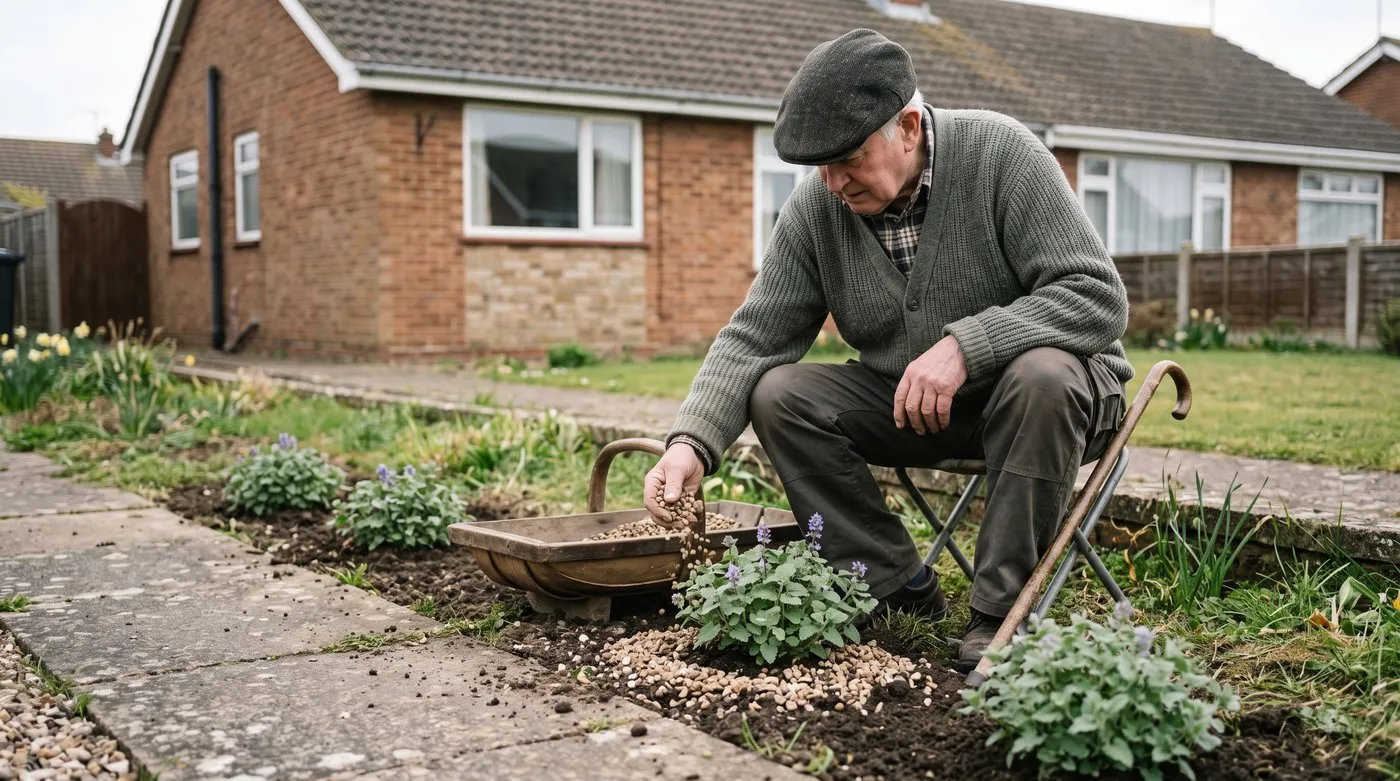
Gravel round the base keeps weeds down without holding damp against the stems the way bark can. Set plants a touch proud of the soil on heavy ground.
When to plant
Potted catmint can go in any time from March to October, as long as the ground isn’t frozen or waterlogged. Spring (March to May) is best, giving roots a whole summer to settle before winter. Divisions can be planted from October to March.
How to prune catmint for a second flush
This is the trick that gets you twice the flowers. Plenty of gardeners only ever see one flush, but with a well-timed chop you’ll get two.
The first flush (May to July)
The main show runs from late May to mid-July and is at its best in June. Just leave the plant alone during this time and let the bees enjoy it.
The mid-July chop
When about half the flowers have faded and the plant starts to look scruffy, usually in mid-July, cut the whole thing back to 15cm. Use sharp shears and do it in one pass. You’re cutting through soft, leafy growth, so the plant bounces back quickly.
Don’t wait until it’s completely over. The later you cut, the later and weaker the second flush. A mid-July chop gives you flowers from August, often into October. For more on cutting back, see our guide to how to prune shrubs in the UK.
Water the plant well afterwards. On poor or sandy soil, give it a liquid feed such as tomato food at half strength. Fresh silvery shoots appear within a few weeks.
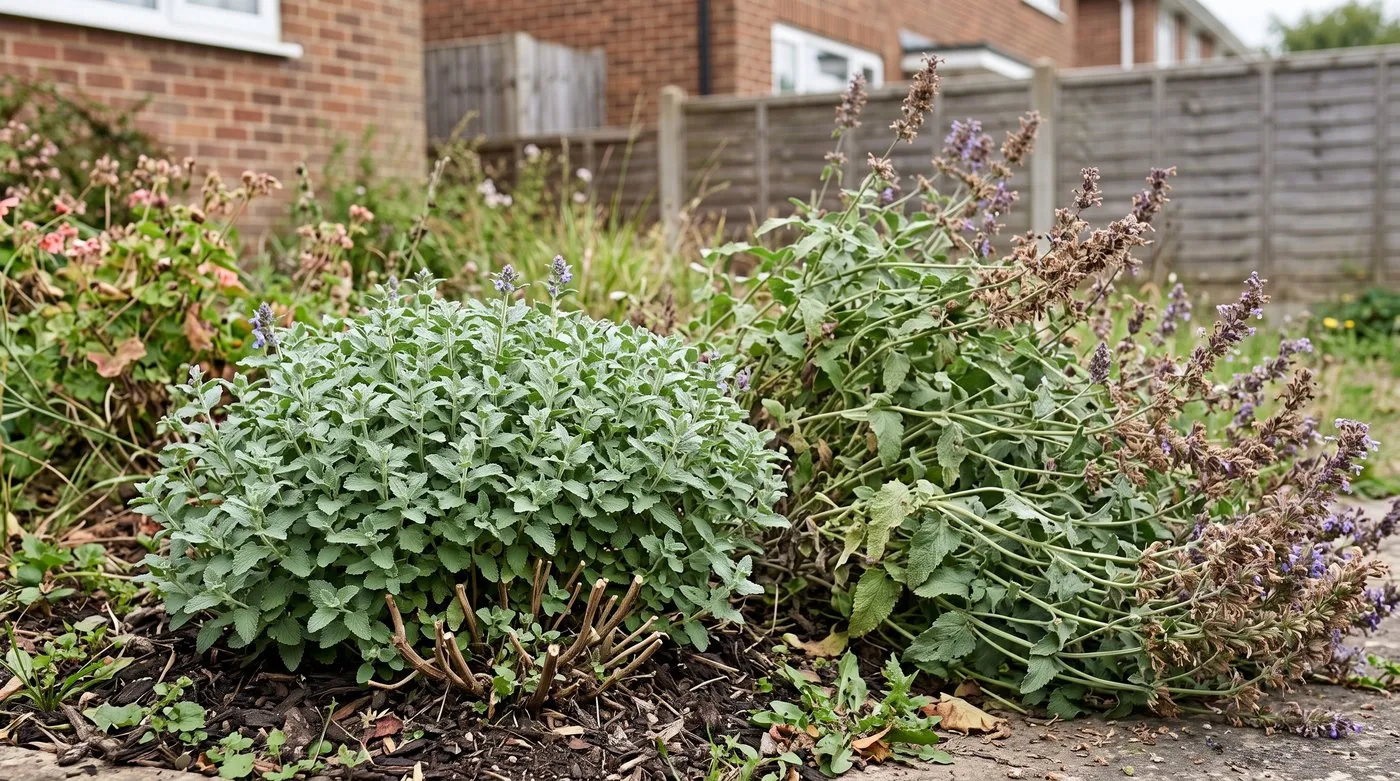
Cut back in mid-July while about half the flowers have faded. Fresh shoots follow in a few weeks, with a second flush into autumn.
The second flush (August to October)
The second flush is often neater than the first, with shorter, more upright stems. It flowers through August and September and, in a mild autumn, into October.
After that, leave the plants standing over winter. The old stems help shelter the crown and give insects somewhere to hide. Cut them back in February or early March, just as new shoots start to appear at the base.
Catmint and roses
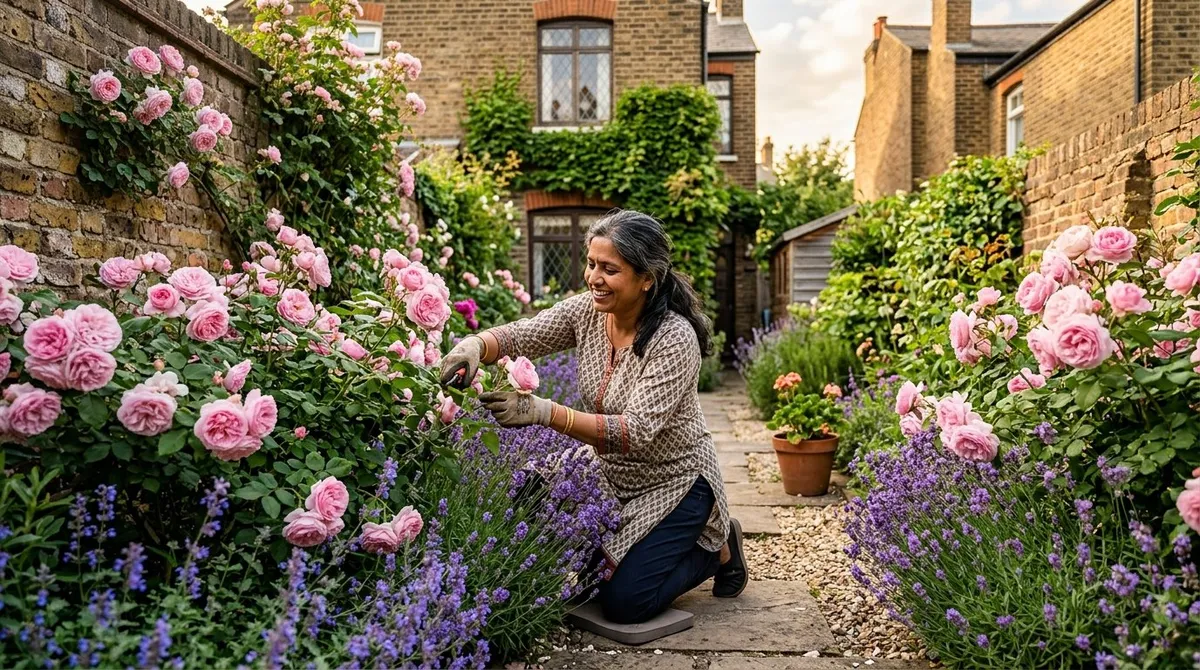
Roses and catmint are one of the oldest and best partnerships in the cottage garden.
 Roses and catmint, a classic pairing. The catmint hides the bare rose stems and brings in the bees.
Why they work so well together
Rose stems are often bare and thorny at the bottom. Catmint fixes that. The soft, arching stems of ‘Walker’s Low’ or ‘Junior Walker’ spill forwards and hide everything below the rose’s lowest leaves. The front of the border goes from a tangle of brown stems to a finished, soft look.
They also like the same things: sun, well-drained soil and not too much feeding. And they flower together. ‘Walker’s Low’ is in full flower just as roses open their first June flush. Blue-purple catmint against red, pink or cream roses looks lovely.
How far apart to plant
Plant ‘Walker’s Low’ or ‘Junior Walker’ 30-35cm from the base of the rose. That gives the catmint room without fighting the rose for water. Along a 1.8m rose border, three ‘Walker’s Low’ 45cm apart make a continuous front edge. Our guide to plant combinations for UK borders has more ideas, and so does our list of the best companion plants for roses.
More life in the border
Catmint along the front of a rose bed brings in lots of bees and hoverflies, and they’ll visit the roses too. If you’d like to pick roses that pollinators enjoy, our how to grow roses in the UK guide covers the best ones.
Good partners for catmint
| Partner | Why it works | Distance from catmint |
|---|---|---|
| Hybrid tea roses | Hides bare stems, lovely colour contrast | 30-35cm |
| Salvia nemorosa ‘Caradonna’ | Flowers at the same time, upright spikes contrast with catmint’s mound | 30cm |
| Achillea ‘Moonshine’ | Yellow flowers set off the blue, and it likes dry soil too | 35cm |
| Allium ‘Purple Sensation’ | Spring flowers before the catmint gets going | Plant bulbs between plants |
| Stipa tenuissima | Soft, swaying grass lightens the look | 40cm |
| Lavender ‘Hidcote’ | Same conditions, matching blue tones | 40cm |
| Geranium ‘Rozanne’ | Flowers for ages and weaves nicely through catmint | 30cm |
For more on planting with perennials, see our guide to the best perennial plants for UK gardens.
Catmint for bees and other pollinators
 Cutting catmint back after its first flush. Fresh growth and a second round of flowers will follow.
Catmint is one of the best border plants for bees. The RHS includes it in its advice on plants for pollinators.
Why bees love it
The small tubular flowers keep the nectar coming all day. Bumblebees, honeybees, solitary bees and hoverflies all visit. On a warm June day a clump can be humming. The second flush in August and September is extra handy, as it keeps the food coming when many other plants have finished.
Getting the most for wildlife
Plant catmint in groups of three or more rather than dotted about. Bees find a big patch easier to work. And let the bees enjoy the first flush before you give the plant its mid-July chop.
Soil, watering and feeding
Once settled, catmint asks for very little. Most of the work happens at planting time.
Soil
Catmint loves well-drained soil that isn’t too rich. It grows on chalk, sand, loam and gravel. It copes with clay if you mix in grit at planting. It may take a little longer to settle, but after its first winter it’s usually fine. Avoid wet, compacted or waterlogged spots. On sandy soils, where lavender thrives, catmint is in its element.
Watering
Water new plants once a week through their first summer. After that, plants in the ground rarely need watering anywhere in the UK. Catmint in pots is the exception: in hot, dry weather, water when the top 3cm of compost feels dry.
Too much water is a bigger danger than too little. Plants may droop in a long dry spell, but they perk up again once it rains.
Feeding
Catmint flowers best on lean soil. Rich feeds give you lots of leaves and fewer flowers. On very poor sandy soil, sprinkle a general fertiliser at planting time. On average soil, it doesn’t need feeding at all.
Common problems
Powdery mildew can show up in dry, still weather. Give plants enough space for air to move. The July chop removes most mildewed leaves anyway. There are no serious pests. Cats may roll in young plants, so protect new ones with a few short canes until they’re bigger.
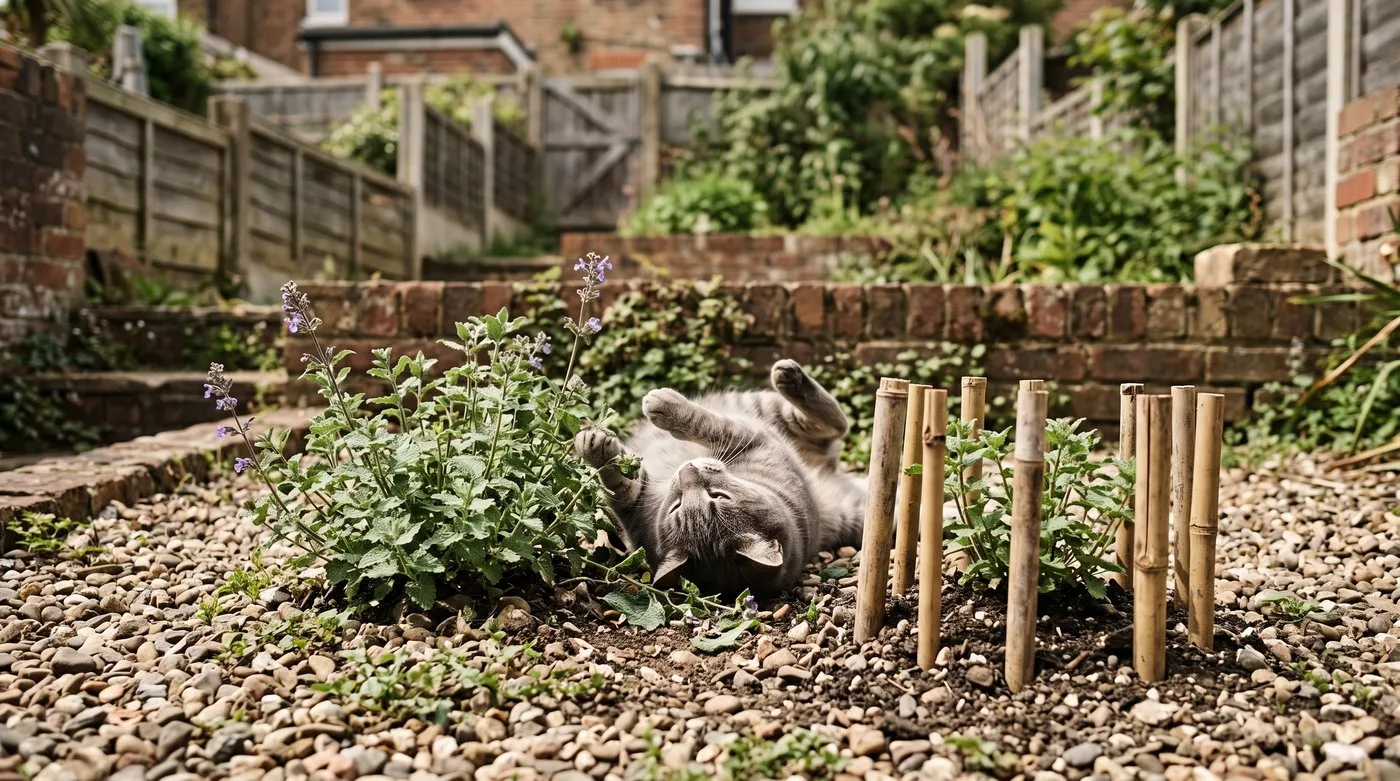
Cats adore catmint and can flatten young plants. A ring of short canes protects new ones until they’re big enough to cope.
Dividing catmint
Dividing is the easiest way to get more catmint, and you get good-sized plants straight away for free.
When to divide
Divide in early spring (March to early April) as new shoots appear, or in early autumn (September). Spring is a little safer on clay, where autumn divisions can sit in wet ground.
How to divide
- Lift the whole clump with a garden fork, working around the outside
- Shake off loose soil
- Pull the clump apart by hand, or push two forks in back to back and lever it apart
- Make sure each piece has a few shoots and some healthy roots
- Replant at the same depth, 45cm apart for ‘Walker’s Low’ or 60cm for ‘Six Hills Giant’
- Water well and keep moist for a few weeks while they settle
‘Walker’s Low’ and ‘Junior Walker’ divide neatly every three or four years. ‘Six Hills Giant’ grows bigger crowns and likes dividing every two or three years. Our guide to plant propagation by cuttings, division and layering has more methods.
From cuttings
You can also take cuttings in May and June. Snip 8-10cm shoot tips without flowers, strip the lower leaves and push them into pots of half perlite, half multipurpose compost. Keep them somewhere bright and sheltered until they root, which takes a few weeks. Handy when a plant is too young to divide.
Design ideas for catmint
Catmint’s soft, arching shape and long flowering make it really useful in all sorts of borders.
Edging a border is the classic use. A row of ‘Walker’s Low’ along the front ties a mixed border together and softens path and paving edges.
Cottage borders use catmint as the blue-purple partner to roses, alliums, salvias and geraniums. Pair it with lavender, which likes the same conditions, for a relaxed, bee-friendly look. Our guide to the best flowering shrubs for UK gardens has shrubs to give the planting some backbone.
Wildlife gardens love its long season. The two flushes fill the late-summer gap when early perennials have finished and autumn ones haven’t started. In a bee-friendly garden, catmint with echinacea, agastache and asters keeps bees fed from May to October.
Dry and gravel gardens suit ‘Six Hills Giant’ well. Its size and toughness make it a good anchor plant alongside grasses, sedums and other drought-tolerant perennials.
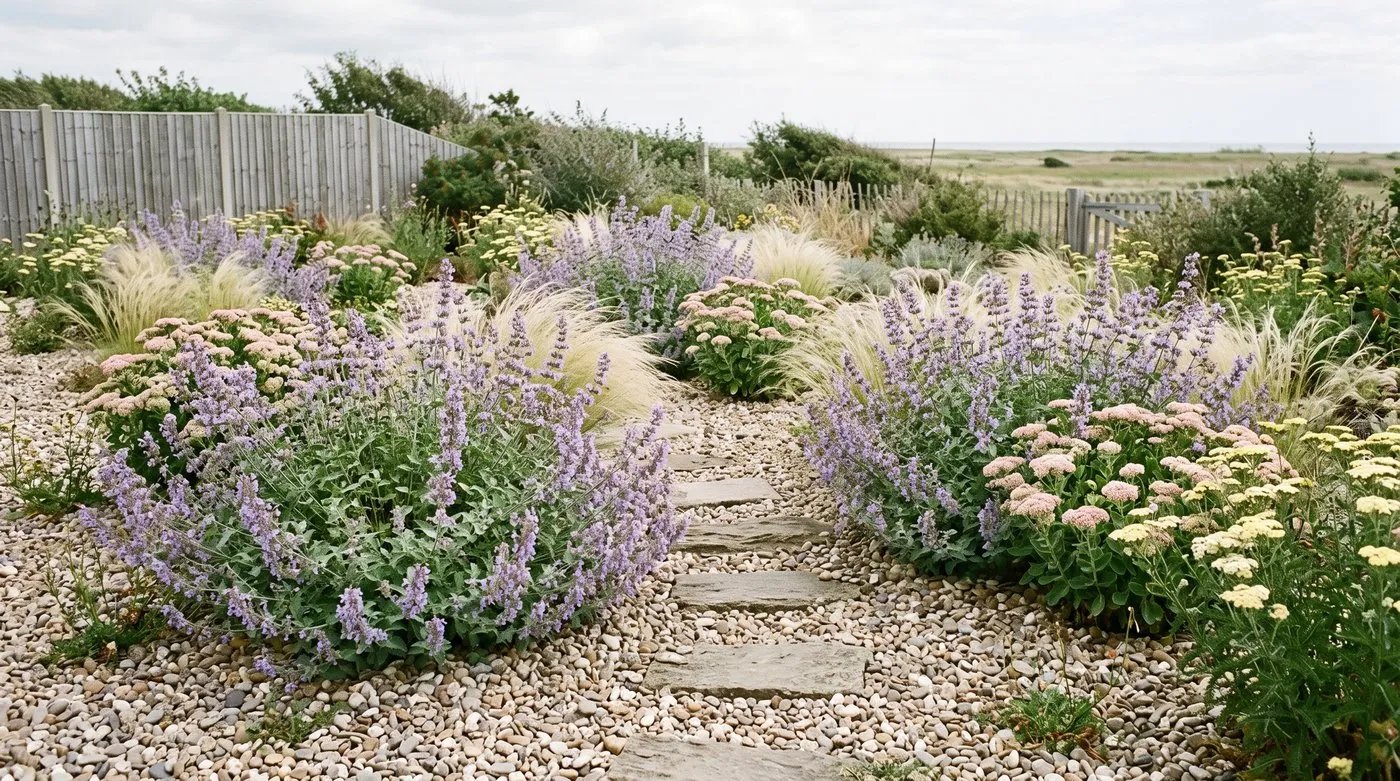
Six Hills Giant is tough enough to anchor a dry gravel garden. Soft grasses and sedums like the same lean, free-draining conditions.
Month-by-month catmint calendar
| Month | What to do |
|---|---|
| January | Nothing. Leave old stems standing for shelter and insects. |
| February | Order new plants for spring. |
| March | Cut back last year’s dead growth to 5cm. Divide clumps. Plant new ones from late March. |
| April | Main planting month. Add grit on clay. Space 45-60cm apart. |
| May | First flowers open late in the month. |
| June | First flush at its best. Bees everywhere. Don’t prune. |
| July | Cut back to 15cm in mid-July. Water, and feed on poor soil. |
| August | New growth comes fast. Second flush starts. |
| September | Second flush at its best. Divide clumps that have outgrown their space. |
| October | Flowers carry on in a mild autumn. Water pots less. |
| November | Nothing. Let the frost take the leaves and leave the stems standing. |
| December | Nothing. |
Related reading
- Bee-friendly garden plants for UK gardens: build a whole pollinator border around your catmint
- How to grow roses in the UK: the perfect catmint partner
- Best perennial plants for UK gardens: more easy border perennials
- Drought-tolerant plants for UK gardens: more plants for dry spots
- Best plant combinations for UK borders: pairing catmint with roses, salvias and grasses
Frequently asked questions
When does catmint flower in the UK?
From late May right through to September. The first flush is at its best in June and July. Cut it back in mid-July and a second flush follows from August, often into October.
How do I get a second flush of flowers from catmint?
Cut the whole plant back to 15cm in mid-July. Use sharp shears and do it in one go. Water well afterwards. New leaves appear in a few weeks and fresh flowers follow, giving you colour into September and October.
Does catmint spread and become invasive?
No, the common varieties are well behaved. ‘Walker’s Low’ and ‘Junior Walker’ make tidy clumps that grow slowly. ‘Six Hills Giant’ is bigger and bolder, so give it more room. Divide clumps every three or four years to keep them neat and get free plants.
What is the difference between Walker’s Low and Six Hills Giant?
Size and colour, mainly. ‘Walker’s Low’ grows about 60cm tall and wide with deep violet-blue flowers. ‘Six Hills Giant’ reaches about 90cm each way, with paler lavender-blue flowers. ‘Walker’s Low’ suits most borders, while ‘Six Hills Giant’ is best at the back of a big bed.
Can catmint grow in clay soil?
Yes, if you help the drainage. Mix plenty of grit into the planting hole and set the plant slightly higher than the soil around it. On really heavy clay, plant on a low mound or grow it in a pot.
Does catmint attract bees?
Yes, bees absolutely love it. It’s one of the best border plants for pollinators. The long flowering season, with its second flush, keeps the nectar coming long after many other plants have finished.
Is catmint toxic to cats?
It’s not a serious worry, but cats can overdo it. Catmint drives many cats wild with rolling and rubbing. Eating a lot can upset a cat’s stomach. The bigger risk is to the plant, so protect young ones with a few short canes until they’re bigger.
Our team produces practical UK gardening guidance from source research, contributor records and established horticultural practice. Editorial standards are overseen by Matt W.