Key takeaways
- Hostas are fully hardy and grow well all over the UK
- Thick-leaved types like 'Sum and Substance' and 'Halcyon' stand up to slugs best
- Blue and white-edged hostas need shade, while gold and green ones cope with some sun
- Pots keep hostas out of reach of many slugs, but need regular watering
- Divide big clumps every few years in March or September
- Hostas are toxic to cats and dogs
Hostas are one of the most reliable plants for a shady UK border. Our cool summers, regular rain and mild winters suit them perfectly. And no other plant gives you such a range of leaf colours, shapes and sizes for the shady bits of the garden.
Why hostas thrive in UK gardens
Hostas come from the cool, damp woodlands of Japan, Korea and China, which aren’t so different from Britain. That’s why they do so well here.
They love steady moisture, which our weather is good at. They don’t like real heat, which we rarely get. And winter cold doesn’t bother them at all, as they’re fully hardy everywhere in the UK. In short, if you’ve got some shade and moist soil, hostas will be happy.
Best hosta varieties for UK gardens
There are thousands of hostas, but you only need to think about three things: how much light the spot gets, how big you want it, and how tough the leaves are against slugs.
Variety comparison table
| Variety | Size | Leaf colour | Slug resistance | Light |
|---|---|---|---|---|
| ’Sum and Substance’ | Large | Lime-gold | Excellent | Shade to some sun |
| ’Halcyon’ | Medium | Powder blue | Very good | Shade |
| ’Empress Wu’ | Giant | Dark green | Excellent | Part shade |
| ’Blue Angel’ | Large | Grey-blue | Very good | Shade |
| ’Patriot’ | Medium | Green, white edge | Fair | Part shade |
| ’Frances Williams’ | Medium | Blue-green, gold edge | Good | Part shade |
| ’Blue Mouse Ears’ | Tiny | Blue-green | Excellent | Shade to part shade |
| ’August Moon’ | Medium | Golden yellow | Good | Shade to some sun |
| ’Krossa Regal’ | Large, upright | Grey-blue | Very good | Part shade |
| ’Fire and Ice’ | Small | White centre, green edge | Fair | Shade |
| ’Great Expectations’ | Medium | Blue-green, cream centre | Good | Part shade |
| ’June’ | Small to medium | Gold centre, blue edge | Good | Part shade |
| ’Sagae’ | Large | Grey-green, cream edge | Very good | Part shade |
| ’Guacamole’ | Medium | Apple green, gold centre | Good | Some sun |
| ’Abiqua Drinking Gourd’ | Medium | Deep blue, cupped | Excellent | Shade |
 Thick, waxy leaves like these are much harder for slugs to chew.
How to plant hostas
Plant hostas in spring (March to May) or autumn (September to October). Spring is slightly better, as the warming soil gets roots growing straight away.
Soil preparation
Hostas grow in most soils but love rich, moist ground that doesn’t get waterlogged. Dig a hole about twice as wide as the root ball and a bit deeper. Mix the soil you dug out with plenty of garden compost or well-rotted manure. That helps both clay and sandy soils. On heavy clay, add some grit too, so the crown doesn’t sit in winter wet.
Planting depth and spacing
Set the crown (where the shoots meet the roots) at soil level. Too deep and it can rot. Firm the soil gently and water well.
Space them according to their final size:
| Size | Examples | Spacing |
|---|---|---|
| Tiny | ’Blue Mouse Ears’, ‘Pandora’s Box’ | 25-30cm |
| Small | ’Fire and Ice’, ‘June’ | 40-50cm |
| Medium | ’Halcyon’, ‘Patriot’, ‘Frances Williams’ | 60-75cm |
| Large | ’Blue Angel’, ‘Sagae’, ‘Krossa Regal’ | 90-120cm |
| Giant | ’Empress Wu’, ‘Sum and Substance’ | 120-150cm |
Planting tip: Start a new shade border with one big hosta as the star, then add medium ones around it and small ones along the front. Something like one ‘Empress Wu’, three ‘Halcyon’ and five ‘Blue Mouse Ears’ makes a lovely little hosta border.
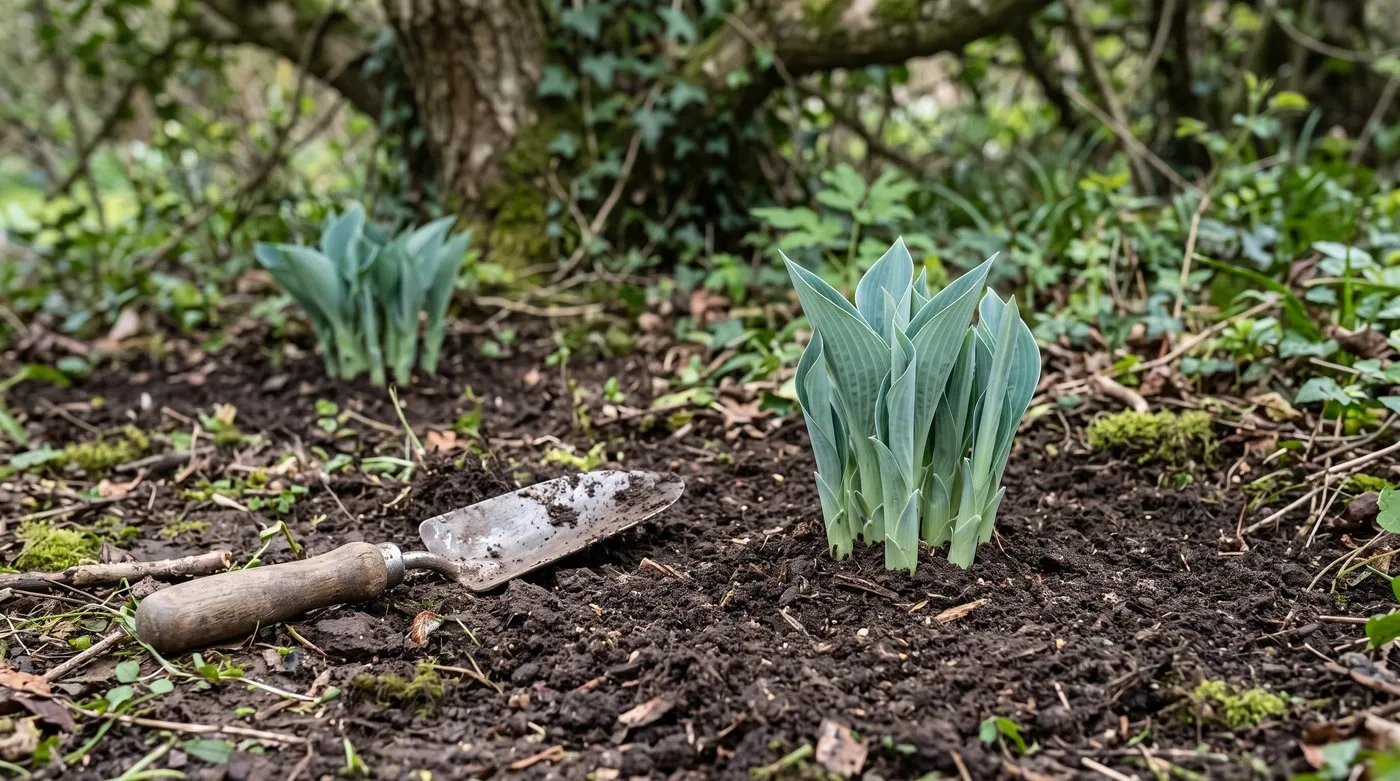
Set the crown right at soil level. Buried too deep, it can rot in a damp British winter.
Growing hostas in pots and containers
Pots are a brilliant way to grow hostas, especially if your soil is poor, space is tight or slugs are a menace. Slugs find raised pots harder to reach, and you control the compost.
Choosing the right pot
Choose a pot a little wider than the hosta’s final spread, and at least 25cm deep. Medium hostas need a good-sized pot, and giants need a really big one.
Use frost-proof pots, as some terracotta can crack in a hard frost when wet. Stand pots on pot feet so water drains away in winter.
Compost mix for container hostas
Use peat-free multipurpose compost with some perlite mixed in, roughly two-thirds compost to one-third perlite. It holds moisture but drains well. Mix in some slow-release fertiliser when you plant.
Watering and feeding
Hostas in pots dry out much faster than those in the ground. Water when the top few centimetres of compost feel dry. In summer that could be every two or three days, and daily in a heatwave. Water less from October and keep the compost just moist in winter.
Give a balanced liquid feed every week from April to August, following the label. Stop after August so the plant can wind down for winter.
 Hostas look great in pots on a shady patio. Just make sure the pots are frost-proof.
The slug problem: protection strategies that work
Slugs are the biggest headache with hostas in the UK. They feed at night, especially on damp evenings, and hostas are a favourite meal.
Why slugs love hostas
Hosta leaves are soft and juicy, and the new shoots in April are the tastiest of all. Once a leaf is holed, it stays holed all season, because hostas grow most of their leaves in one spring flush.
Slug protection, step by step
- Choose thick-leaved varieties. Blue, waxy and crinkly leaves are much tougher for slugs.
- Use nematodes in early spring. More on these below.
- Grow some in pots. Raised pots are harder for slugs to reach.
- Go on a torch patrol. Pick slugs off at dusk on damp spring evenings.
Slug nematodes: how they work
Slug nematodes are tiny worms, too small to see, that infect and kill slugs in the soil. You buy them as a powder (Nemaslug is a common brand), mix with water and water them onto damp soil with a watering can.
They work best on young slugs underground, before they reach your plants. Apply in early spring once the soil has warmed to about 5°C, as they don’t work in cold soil. A second dose in September catches the autumn slugs.
Slug pellets: Metaldehyde pellets are banned outdoors in the UK because they harmed wildlife. Ferric phosphate pellets are still allowed, but nematodes are a kinder first choice.

Water nematodes onto damp soil in early spring, once it has warmed a little. They tackle young slugs before they reach the shoots.
Seasonal care calendar
| Month | What’s happening | What to do |
|---|---|---|
| January | Asleep underground | Order hostas from specialist nurseries. Check pots drain well. |
| February | Still dormant | Mulch borders with composted bark. Check pots for vine weevil grubs. |
| March | Shoots appearing | Apply slug nematodes once soil warms. Plant new hostas. Start dusk slug patrols. |
| April | Leaves unfurling | Cover shoots if a late frost is forecast. Start weekly feeding for pots. |
| May | Leaves filling out | Water pots every two or three days. Snip off flower stems if you prefer just leaves. |
| June | Looking their best | Keep feeding pots. Deadhead faded flowers. Look for notched leaf edges from vine weevil. |
| July | Later types flowering | Water in dry spells. Scented types like ‘Guacamole’ and ‘Royal Standard’ flower now. |
| August | Growth slowing | Stop feeding. Make a note of your favourites. |
| September | Leaves start to yellow | Second dose of slug nematodes. Divide crowded clumps. Plant new hostas. |
| October | Leaves collapsing | Leave the leaves until they’re fully brown, as they feed the crown. |
| November | Died back | Clear dead leaves and compost them. Mulch with composted bark. |
| December | Fully dormant | Plan next year’s hostas. Move exposed pots somewhere sheltered. |
Shade vs sun: which hostas handle light
Not all hostas need deep shade. They’re happy in shade, but some actually prefer a bit of brightness.
Light by leaf colour
Gold and yellow hostas colour up best with a little morning sun and afternoon shade. In deep shade they turn greenish. ‘Sum and Substance’, ‘August Moon’ and ‘Guacamole’ all like some light.
Blue hostas need shade or dappled light. Their blue comes from a waxy coating that sun wears away, leaving the leaves dull green. Keep ‘Halcyon’, ‘Blue Angel’ and ‘Abiqua Drinking Gourd’ in shade.
White-edged hostas are the most sun-sensitive, as the white parts scorch easily. Keep ‘Fire and Ice’, ‘Patriot’ and ‘Great Expectations’ out of afternoon sun.
Green hostas are the most easy-going. Some, like ‘Royal Standard’ and ‘Honeybells’, grow happily in more open spots if the soil stays moist.
| Leaf colour | Light | Good spot | Examples |
|---|---|---|---|
| Gold or yellow | A little morning sun | East-facing or dappled | ’Sum and Substance’, ‘August Moon’ |
| Blue | Shade | North-facing or under trees | ’Halcyon’, ‘Blue Angel’ |
| White-edged | Shade, no direct sun | North-facing wall, woodland | ’Fire and Ice’, ‘Patriot’ |
| Green | Copes with some sun | Anywhere with moist soil | ’Royal Standard’, ‘Honeybells’ |
| Cream-edged | Part shade, no afternoon sun | East or west-facing | ’Frances Williams’, ‘Sagae’ |
 Hostas, ferns and astilbes make a lovely shady border under trees, with interest from spring to autumn.
Division and propagation
Dividing hostas every few years keeps them vigorous and gives you free plants. One hosta can turn into a whole border over time.
When and how to divide
The best time is March, when the new shoots are just poking through but the leaves haven’t opened. September is the next best time. Avoid dividing in summer when the plant is in full leaf.
How to divide:
- Lift the whole clump with a garden fork.
- Shake or wash off some soil so you can see the roots.
- Look for natural gaps between groups of shoots.
- Split it with a sharp spade, a big knife or two forks back to back.
- Give each piece a few shoots and a good fist-sized bit of root.
- Trim off any damaged or dead roots.
- Replant straight away at the same depth.
- Water well.
- Mulch around the crown, but not over it.
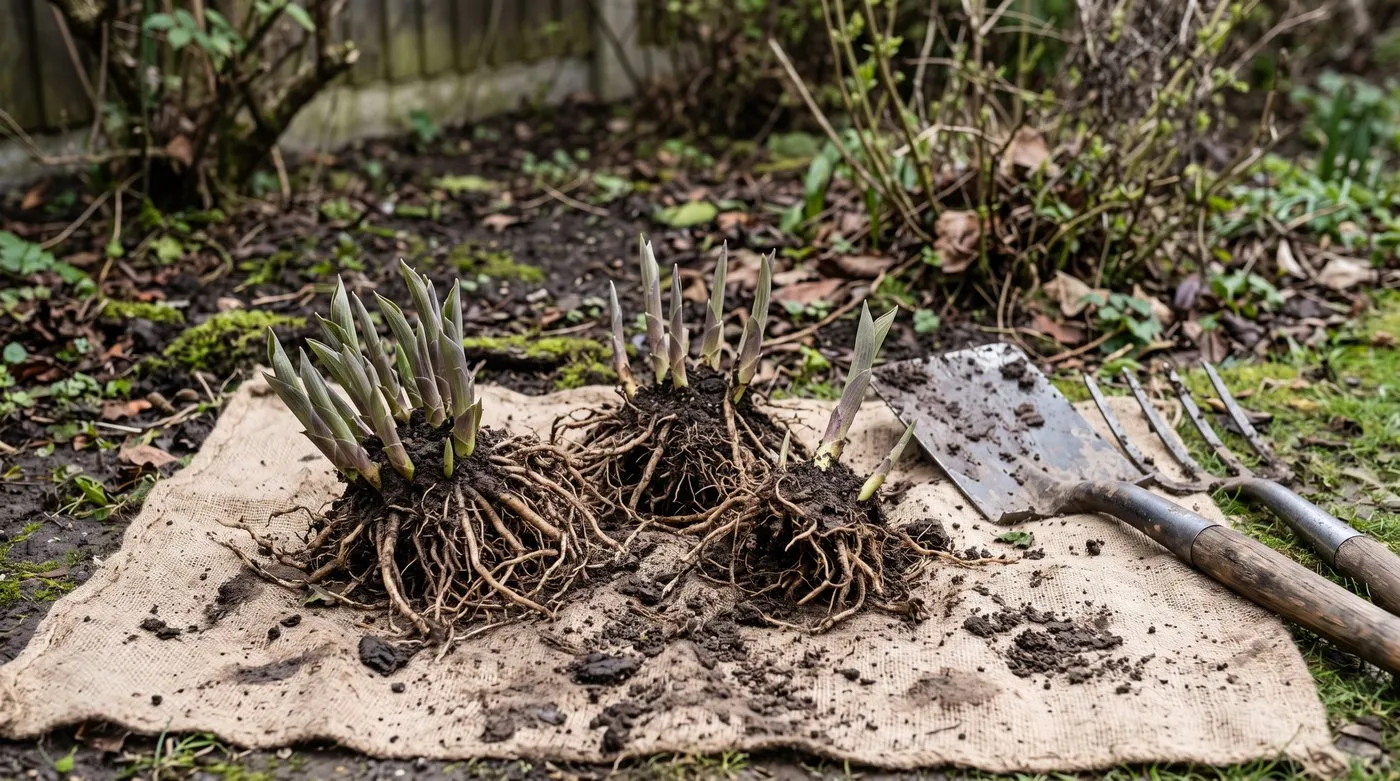
Divide in March, just as the shoots poke through. Give each piece a few shoots and a fist-sized bit of root.
Growing from seed
You can grow hostas from seed, but the babies won’t look like the parent. They’re slow, too, taking a few years to reach a good size. Dividing is much the easiest way to get more of a hosta you love.
Pests and diseases beyond slugs
Slugs get all the attention, but keep an eye out for vine weevil, hosta virus X and leaf nematodes.
Vine weevil
Vine weevil is mainly a problem for hostas in pots. The adults chew neat notches in leaf edges from May to September. The real damage comes from their creamy, C-shaped grubs, which eat the roots over autumn and winter and can kill the plant.
What to do: Water vine weevil nematodes into pots in late summer, when the grubs are small. When you repot in spring, check the roots for grubs and pick them out.
Hosta virus X
Hosta virus X is an incurable disease that causes uneven mottling and blotches on the leaves. It spreads on sap, through cutting tools and by dividing infected plants.
Prevention is the only answer. Buy from good nurseries and check plants before you buy. Mottling that doesn’t match the variety’s normal pattern is a warning sign. Clean your tools between plants when dividing. If a plant has it, dig it up and bin it rather than composting. The British Hosta and Hemerocallis Society has a helpful guide to spotting it.
Leaf nematodes
These tiny worms cause brown streaks between the leaf veins in mid to late summer. They spread in splashing water and are worst in wet summers with crowded plants.
What to do: Remove and bin affected leaves. Water the soil, not the leaves, and give plants space. In bad cases, clear away all the old foliage in autumn.
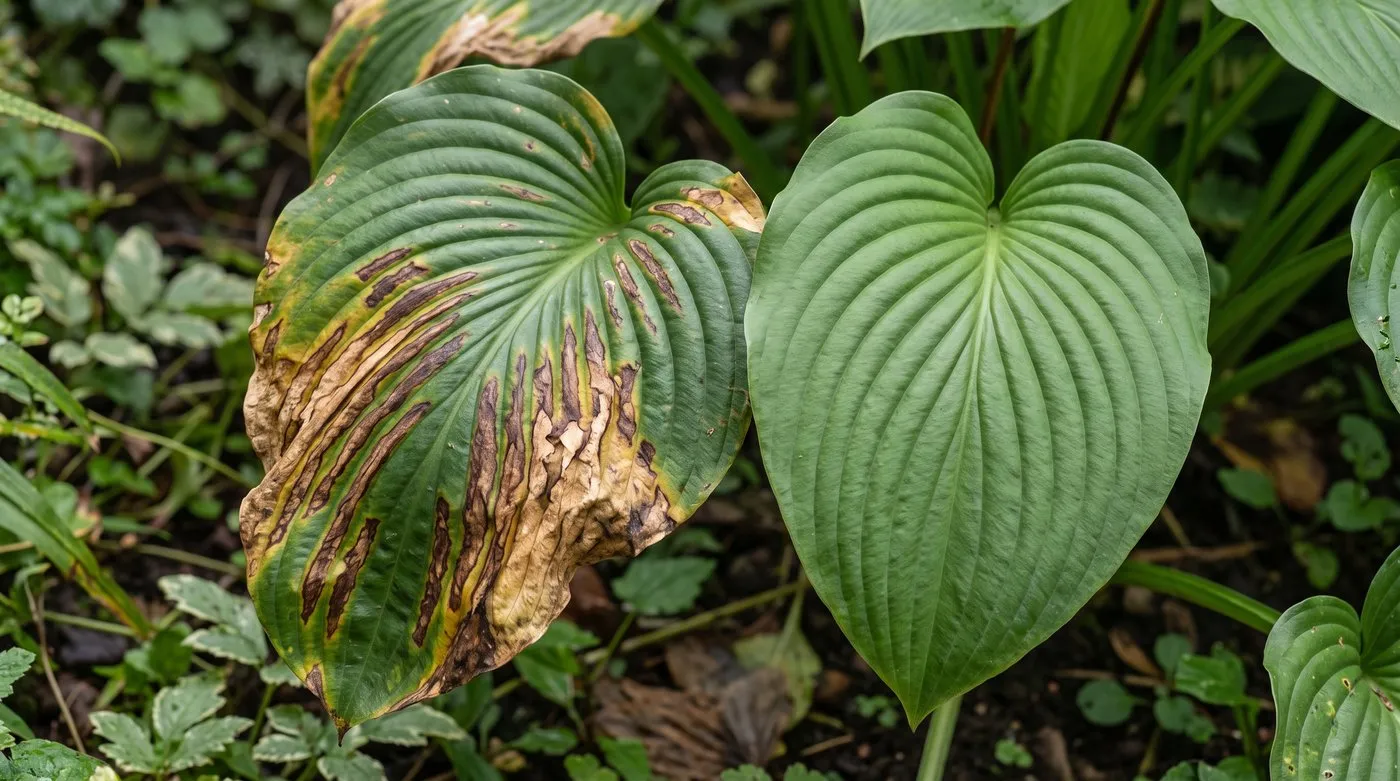
Brown streaks that stop neatly at the veins point to leaf nematodes. Bin affected leaves and water the soil, not the leaves.
Companion planting with hostas
Hostas look great with other shade-lovers that have different leaf shapes and heights. The trick is the same as in a sunny border design: put contrasting plants side by side.
Hosta pairings that work
Hostas and ferns: Big rounded hosta leaves next to feathery fern fronds is a classic combination. Try blue ‘Halcyon’ with the golden-scaled male fern (Dryopteris affinis). Both like moist, shady clay.
Hostas and astilbes: Astilbes add the colour hostas lack. The crimson plumes of Astilbe ‘Fanal’ look stunning above a carpet of ‘Blue Mouse Ears’.
Hostas and heucheras: Heuchera leaves come in lime, purple and silver, so they go with any hosta. Purple ‘Palace Purple’ next to golden ‘Sum and Substance’ really pops. For an evergreen grassy edge, liriope (lilyturf) adds strappy leaves and purple flower spikes as the hostas start to fade.
Hostas and Japanese anemones: For late colour as the hostas wind down, white Japanese anemone ‘Honorine Jobert’ flowers from late summer into autumn and keeps your shade border going.
Hostas and spring bulbs: Hosta shoots come up just as snowdrops, winter aconites and early daffodils are fading, and neatly hide their old leaves. Plant bulbs between your hostas for early spring colour.
Common mistakes when growing hostas
These five slip-ups cause most hosta disappointments. All are easy to avoid.
Mistake 1: Choosing thin-leaved hostas in a sluggy garden
Thin-leaved hostas such as ‘Undulata’ and ‘Stiletto’ can be shredded by slugs in weeks. If slugs are a problem (and in most UK gardens they are), start with thick-leaved types.
Mistake 2: Planting too deep
A buried crown can rot in a damp British winter. Keep it at soil level, or a touch above on heavy clay.
Mistake 3: Forgetting to water pots in summer
Hostas are thirsty, and a big one in a pot can drink a lot on a hot day. Miss a few days and the leaves scorch for the rest of the season. If you’re often away, try an automated drip irrigation system, or grow your hostas in the ground.
Mistake 4: Tidying up too early in autumn
Yellow leaves look scruffy, but they’re sending goodness back to the crown for next year. Leave them until they’re brown and come away with a gentle tug.
Mistake 5: Never dividing
Left alone for years, a clump can go woody and bare in the middle. Dividing every few years freshens it up and gives you new plants for elsewhere.
Now you know how to keep hostas happy, read our guide to the best plants for shade to build a whole shady border around them.
Frequently asked questions
When is the best time to plant hostas in the UK?
Plant hostas from March to May or September to October. Spring planting gives the roots all summer to settle in. Autumn works well too, as the soil is still warm and the rain does the watering for you. Avoid hot summer spells and frozen ground.
Do hostas come back every year in the UK?
Yes, hostas are fully hardy and come back every year. They die down to the ground in autumn and send up new shoots in spring. A happy clump will keep going for many years without any winter protection.
Can hostas grow in full sun in the UK?
Some can, if their soil stays moist. Gold and green types such as ‘Sum and Substance’ and ‘August Moon’ cope with some sun. Blue hostas lose their colour in sun, and white-edged ones scorch, so keep those in shade. In the south, give all hostas some afternoon shade.
How do I stop slugs eating my hostas?
Grow thick-leaved varieties and use slug nematodes in spring. Thick leaves like those of ‘Sum and Substance’ are much tougher for slugs. Water slug nematodes onto the soil in early spring, once it has warmed up a little. Growing hostas in pots helps too.
How big do hostas get in the UK?
From about 15cm to well over a metre tall. Tiny types like ‘Blue Mouse Ears’ suit pots and troughs. ‘Halcyon’ is a medium size, and ‘Empress Wu’ is a real giant. Most garden hostas are knee height and take a few years to reach full size.
When should I divide hostas?
Divide hostas in March or September. Lift the clump with a fork and split it with a sharp spade or knife. Give each piece a few shoots and a good chunk of root. Replant straight away at the same depth and water well.
Are hostas poisonous to dogs or cats?
Yes, hostas are toxic to dogs and cats. Eating the leaves can cause sickness and an upset tummy. Dogs are more likely to nibble them than cats. Call your vet if your pet has eaten hosta leaves.
Our team produces practical UK gardening guidance from source research, contributor records and established horticultural practice. Editorial standards are overseen by Matt W.