
Key takeaways
- There's a bellflower for every spot, from wall crevices to the back of the border
- Campanula persicifolia is the classic cottage bellflower, flowering June to August
- Most cope well with partial shade, so they're handy for north-facing borders
- Trailing types like C. poscharskyana cover walls, paving cracks and bare ground fast
- They're all hardy in UK winters, so no wrapping up needed
- Slugs are the main pest, so guard new shoots in spring
Bellflowers have been brightening British gardens for centuries, and it’s easy to see why. There’s one for every spot, from tiny cushions tucked into a wall to tall spires swaying at the back of a border. The bell-shaped flowers come in blues, violets and white. Most don’t mind shade, and all of them shrug off a British winter.
There are hundreds of campanula species, but only a dozen or so are common in UK gardens. This guide covers the eight most useful, from the cottage favourite C. persicifolia to the wall-hugging C. portenschlagiana. Whether you’re filling a sunny border or planting under trees in dappled shade, at least one will be happy there.
Which campanulas should I grow?
These eight cover just about every spot in a UK garden. Knowing the differences stops you planting a fast spreader where you wanted a well-behaved border plant, or the other way round.
Campanula persicifolia (peach-leaved bellflower)
This is the classic cottage garden bellflower. Slender stems reach 90cm with open, cup-shaped flowers in clear blue or white from June to August. It seeds itself gently into gravel and path edges, but it isn’t a thug and unwanted seedlings pull out easily.
It’s great in mixed borders in sun or partial shade, alongside roses and hardy geraniums. Deadhead old stems for a second round of flowers. Divide every three or four years. It holds an RHS Award of Garden Merit.
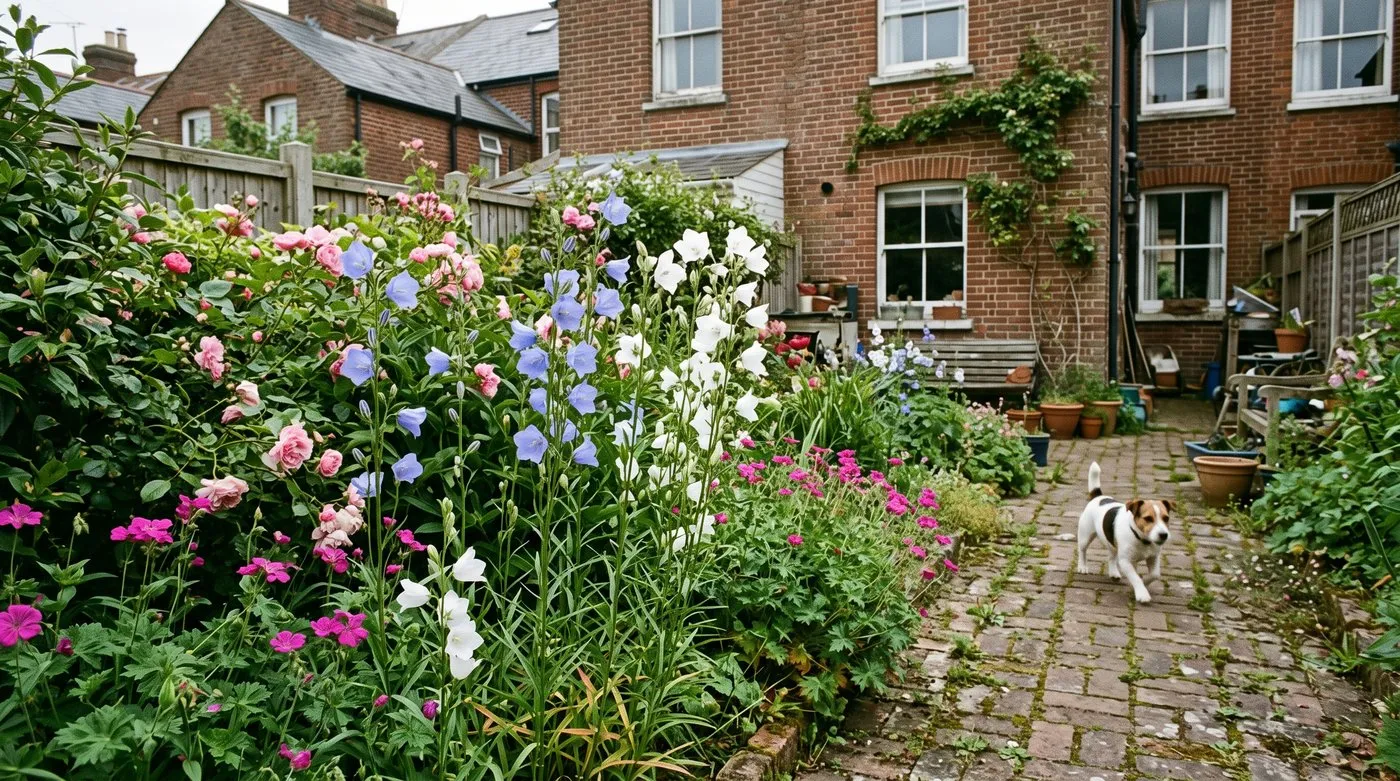
Peach-leaved bellflower threads happily between roses and hardy geraniums. Cut the stems right down after the first flush for more flowers in August.
Campanula lactiflora (milky bellflower)
The tallest common campanula, at 120-150cm. Big, domed heads of lilac-blue, pink or white flowers appear in July and August. The stems get heavy in flower, so stake them in windy gardens. Plant at the back of a border against a wall or hedge.
It grows in sun or partial shade and likes rich soil that stays moist. Cut it back hard after flowering for a smaller second show in September. ‘Prichard’s Variety’ (violet-blue, 90cm) is the most popular. ‘Loddon Anna’ has soft pink flowers.
Campanula poscharskyana (trailing bellflower)
A fast-spreading ground cover plant with masses of starry blue-purple flowers from June to October. It only grows 15-20cm tall but spreads quickly by runners. Lovely for trailing over walls, filling paving cracks and softening raised bed edges.
It grows in sun or shade, even full shade, and copes with dry soil once settled. It’s very hard to kill, but it can take over a small garden. Pull up unwanted runners in spring or autumn. ‘Stella’ is the most common form.
Campanula portenschlagiana (wall bellflower)
Like a tidier version of C. poscharskyana. It makes dense mats of leaves covered in deep violet-blue bells from June to August. It grows 10-15cm tall and spreads steadily, but less wildly.
Perfect for walls, rockeries, pot edges and the front of borders. Happy in sun or partial shade and poor, dry soil. It stays green all winter. One of the best plants for a dry stone wall.
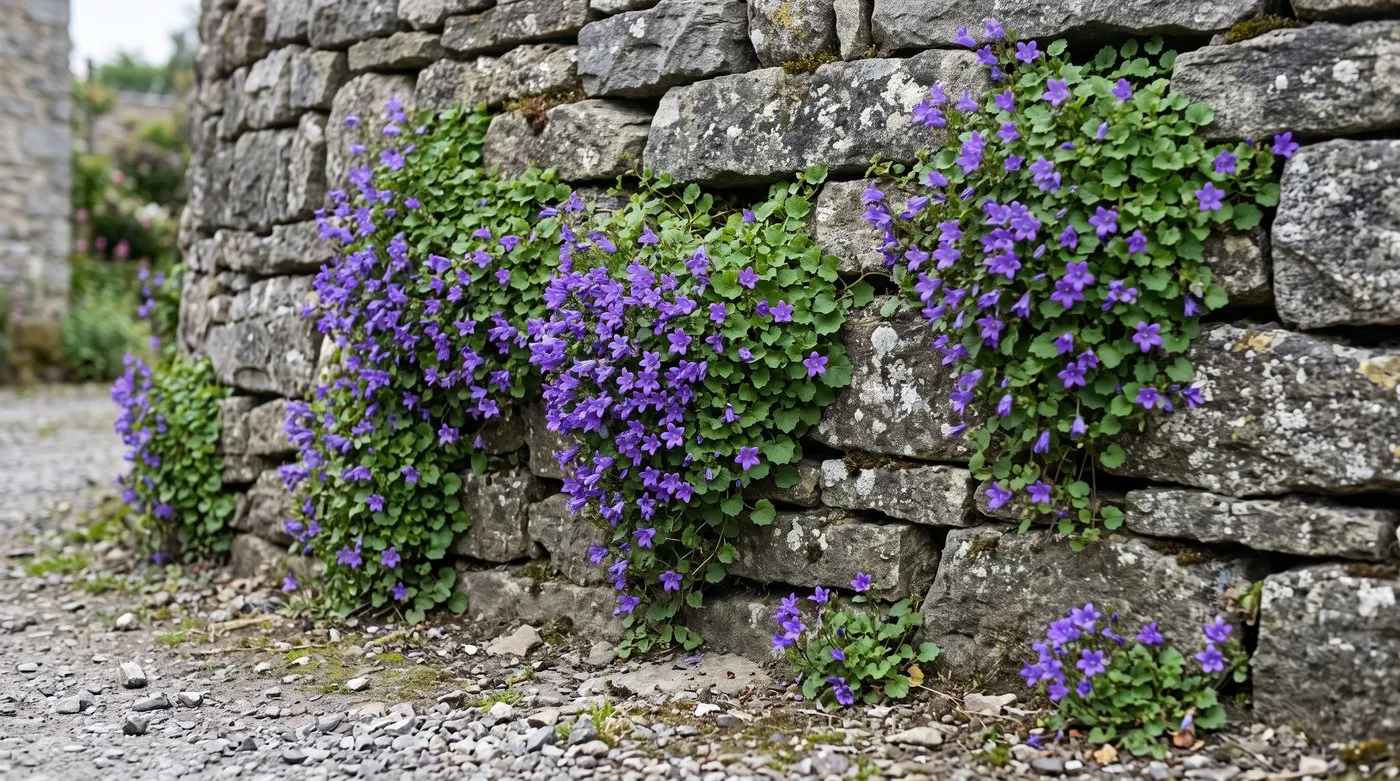
Wall bellflower is happy in poor, dry gaps where little else grows. It stays green all winter and spreads steadily without running riot.
Campanula glomerata (clustered bellflower)
Tight clusters of deep violet flowers sit on top of 40-60cm stems in June and July. It’s a British wildflower of chalk downland, so it’s a natural for wildlife gardens. ‘Superba’ has the richest colour.
It spreads by underground runners and can get busy in rich soil. It loves alkaline or chalky soil in full sun. Cut it back after flowering to stop it seeding everywhere.
Campanula latifolia (giant bellflower)
A British native that grows to 120cm, with large tubular flowers in violet-blue or white. In the wild it grows along woodland edges and hedgerows. It’s a great choice for shady spots and north-facing gardens.
It seeds itself about and can fill a big area in the right conditions. It likes moist soil rich in organic matter. The white form lights up a gloomy corner beautifully.
Campanula medium (Canterbury bells)
This one is a biennial, not a perennial. Sow it in May or June and it flowers the following May and June. Big, showy bells in blue, pink, white or rose sit on 60-75cm stems. The cup-and-saucer forms have a frilly ruff around each bell and are the most eye-catching.
Treat it like a bedding plant and replace it each year. It’s lovely in cottage borders and cutting gardens, and lasts well in a vase.
Campanula carpatica (Carpathian bellflower)
A neat little mound, 15-20cm tall and 30cm wide. Upward-facing blue or white flowers appear from June to August. Ideal for the front of borders, rockeries, pots and path edges.
It needs full sun and good drainage, and hates sitting wet in winter. It does well in gravel and raised alpine beds. ‘Clips Blue’ is the easiest to find. For a close cousin with similar blue bells, try platycodon, the balloon flower, which likes the same sharp drainage.
Campanulas compared
| Plant | Height | Colour | Flowers | Light | Best spot |
|---|---|---|---|---|---|
| C. persicifolia | 90cm | Blue, white | Jun to Aug | Sun or part shade | Middle of border |
| C. lactiflora | 120-150cm | Blue, pink, white | Jul to Aug | Sun or part shade | Back of border |
| C. poscharskyana | 15-20cm | Blue-purple | Jun to Oct | Sun to full shade | Ground cover, walls |
| C. portenschlagiana | 10-15cm | Violet-blue | Jun to Aug | Sun or part shade | Walls, rockery |
| C. glomerata | 40-60cm | Deep violet | Jun to Jul | Sun | Wildflower area |
| C. latifolia | 120cm | Violet, white | Jun to Jul | Part to full shade | Woodland, north-facing |
| C. medium | 60-75cm | Blue, pink, white | May to Jun | Sun | Cottage border |
| C. carpatica | 15-20cm | Blue, white | Jun to Aug | Sun | Rockery, edging |
How to plant campanulas
Most campanulas are sold in pots in spring. Plant them at the same depth they were in the pot, with a handful of garden compost in the hole. Water well, and keep watering in dry spells through their first summer.
Soil: most aren’t fussy. The taller border types (C. persicifolia, C. lactiflora and C. latifolia) like soil that holds some moisture. C. poscharskyana and C. portenschlagiana cope with poor, dry, stony soil. C. glomerata loves chalk. C. carpatica must have good drainage and hates wet winter soil.
Spacing: allow 30-40cm between C. persicifolia plants, 60cm for C. lactiflora and 30cm for the mat-formers. Ground cover types fill gaps fast, so you can space them wider.
Position: match the plant to the light. C. persicifolia, C. lactiflora, C. latifolia and C. poscharskyana are some of the best blue flowers for tricky spots under trees or against north-facing walls. C. glomerata, C. carpatica and Canterbury bells want a sunny spot.
Looking after campanulas through the year
Once settled, campanulas are easy-going. A few jobs each season keep them looking good.
Spring: watch for slug damage on new shoots, especially on the taller types. Start protecting them from March. Spread a light mulch of garden compost around the clumps.
Summer: deadhead faded stems. Cut C. persicifolia stems right down after the first flush for more flowers in August. Stake C. lactiflora before it gets too tall. Water new plants in dry spells.
Autumn: cut back the border types once the leaves die down. Divide crowded clumps. Collect Canterbury bells seed if you want more.
Winter: nothing to do. They’re all fully hardy. Evergreen mat-formers like C. poscharskyana keep their leaves and give shelter to overwintering insects.

Get supports round milky bellflower before it gets too tall. The heavy flower heads can flop in summer wind and rain.
How to propagate campanulas
There are three easy ways to get more plants for free.
Division is the simplest for all the perennial types. Lift clumps in early spring or October, pull or cut them apart into pieces with roots and shoots, and replant straight away. Water well.
Seed works well for C. persicifolia, Canterbury bells and C. carpatica. Sprinkle it on the surface of moist seed compost in spring and don’t cover it, as most need light to sprout. Pop the tray in a cold frame or unheated greenhouse. Seedlings appear in two to four weeks. Prick them out when big enough to handle, grow them on in pots, and plant out the next autumn or spring. The RHS campanula guide has more detail.
Basal cuttings work for C. lactiflora and C. glomerata. In April, take 8cm shoots from the base of the plant and push them into pots of gritty compost. Keep them moist and they’ll root in a few weeks. Pot them on and plant out in autumn.
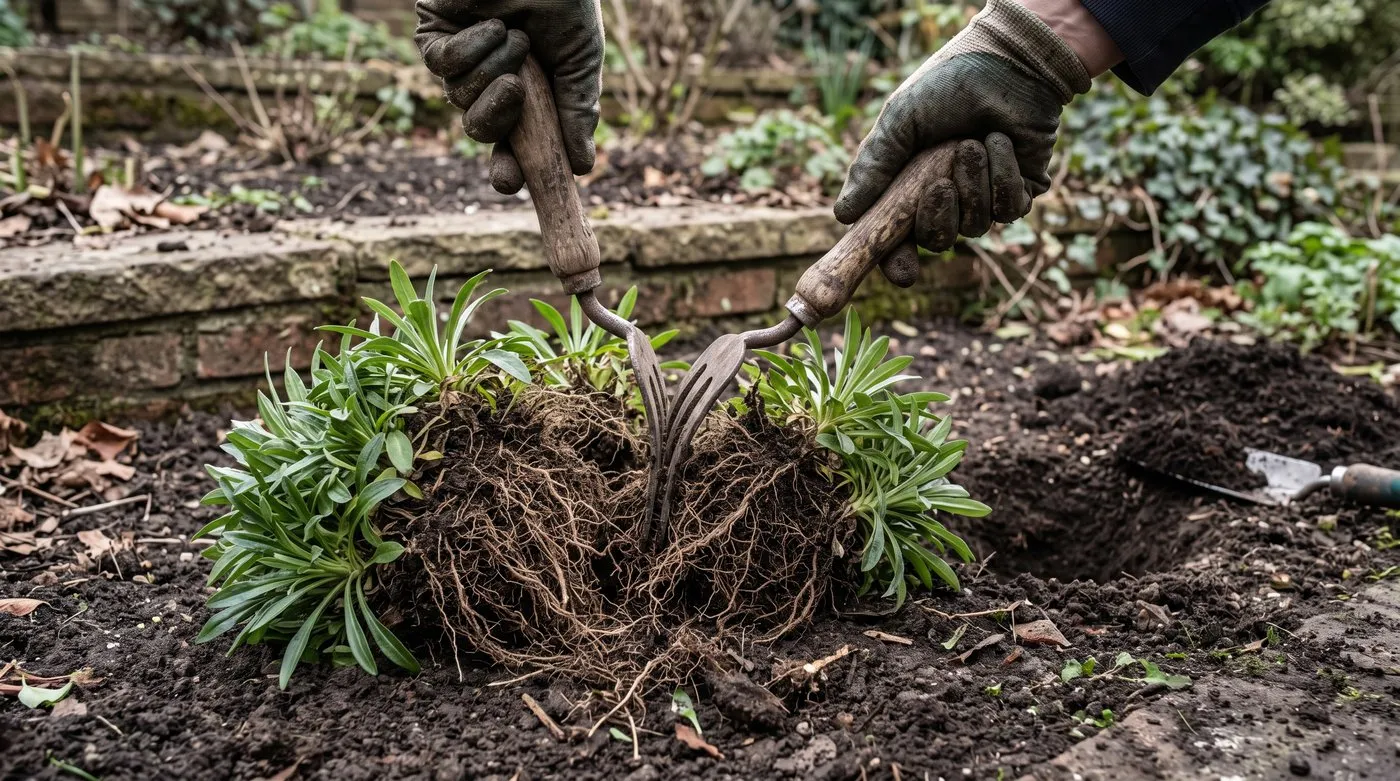
Division is the simplest way to get more plants. Each piece needs roots and shoots, then replant straight away and water well.
Keeping slugs off campanulas
Slugs are the only real pest. They go for the soft new shoots in March and April and can eat a plant to the ground before it gets going.
C. persicifolia and C. lactiflora are the most at risk because their spring shoots are soft and juicy. The low, wiry mats of C. poscharskyana and C. portenschlagiana suffer less.
Start your favourite slug control method from late February. Nematodes watered into the soil in March deal with the small slugs underground. Beer traps sunk level with the soil catch bigger ones. A torch and a bucket on a damp evening is still one of the best ways.
Once stems reach about 20cm, the plants usually grow through any nibbling. So focus your efforts on those first few weeks of spring.
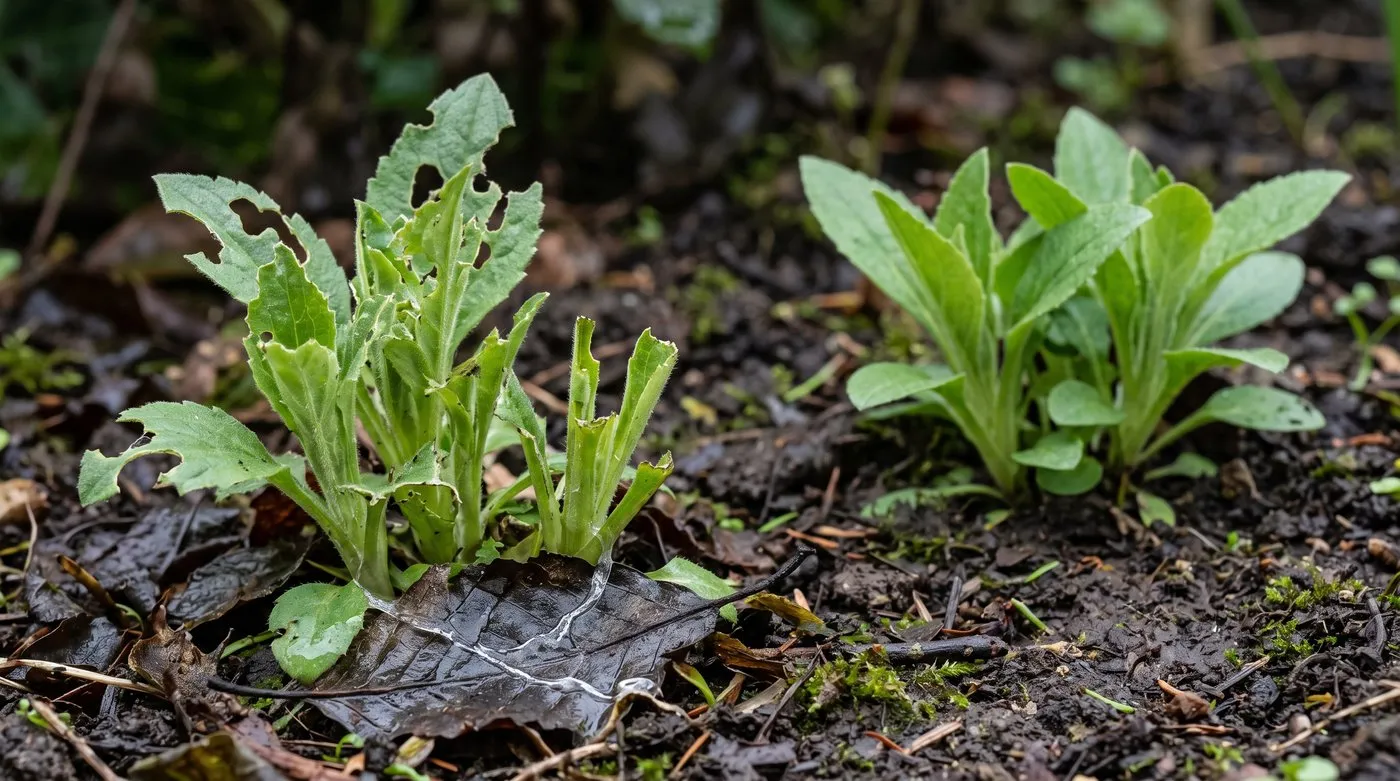
Ragged holes and silvery trails on new shoots mean slugs. Focus on protecting the first few weeks of spring, as bigger stems usually outgrow the nibbling.
Campanulas for cutting
Several campanulas make lovely cut flowers. C. persicifolia is the best, with long, slender stems that look natural in a tall vase. Cut when the lowest flower is open and the top buds are still closed, and they’ll keep opening in the vase. The white form looks especially pretty.
C. lactiflora gives big, full heads for larger displays. Canterbury bells have the showiest flowers of all. Before arranging, cut the stems at an angle, strip the lower leaves and stand them in deep water for a couple of hours.
If you love cutting flowers from the garden, grow a row of C. persicifolia just for the house. That way you can fill vases through June and July without raiding the border. Our guide to conditioning cut flowers has more tips for making them last.
Frequently asked questions
When do campanulas flower in the UK?
Most campanulas flower from June to August. C. persicifolia starts in early June and keeps going for weeks if you deadhead it. C. lactiflora is at its best in July, and C. poscharskyana carries on until October. Canterbury bells flower in May and June.
Do campanulas grow in shade?
Yes, most are happy in partial shade. C. persicifolia, C. lactiflora and C. latifolia all do well in dappled shade and north-facing borders. You’ll get a few less flowers than in full sun. Only the little alpine types really need sun and sharp drainage.
Are campanulas hardy in the UK?
Yes, all the common ones are fully hardy here. They don’t need any winter protection. Border types die back in autumn and pop up again in spring, while mat-formers like C. poscharskyana keep their leaves all winter.
How do I stop slugs eating my campanulas?
Protect the new shoots in March and April. Use beer traps, nematodes or wildlife-friendly slug pellets, or go out with a torch on damp evenings. Once stems are about 20cm tall, the plants usually grow through any damage.
Can I grow campanula from seed?
Yes, the seed is easy to grow. Sprinkle it on the surface of moist compost in spring and don’t cover it, as most need light to sprout. Seedlings usually flower in their second year. C. persicifolia and Canterbury bells often seed themselves around too.
How do I divide campanulas?
Divide clumps in early spring or autumn. Lift the plant with a fork, split it into pieces that each have roots and shoots, and replant at the same depth. Water well. Doing this every three or four years keeps clumps healthy and stops the middle dying out.
Which campanula is best for ground cover?
C. poscharskyana, the trailing bellflower, is the best. It spreads quickly into mats of starry blue-purple flowers from June to October. It grows in sun or shade, copes with dry soil and covers walls and paving cracks. C. portenschlagiana is similar but tidier.
Our team produces practical UK gardening guidance from source research, contributor records and established horticultural practice. Editorial standards are overseen by Matt W.


