Key takeaways
- Make the border at least 1.8m deep so you can fit three layers
- Plant in groups of 3, 5 or 7 and repeat them along the border
- Add about three evergreen shrubs per 3m of border for winter shape
- Stick to two or three main colours plus one accent
- Dig in plenty of compost before planting, especially on clay
- Plant in autumn if you can, or in spring for grasses and tender plants
A mixed border mixes shrubs, perennials, bulbs and grasses in one deep bed that changes through the year. Done well, there’s something to look at every month. Done badly, it looks great for three weeks in July and bare the rest of the time.
The trick is planning. Buying whatever looks nice at the garden centre usually ends in a muddled, gappy border. A simple plan on paper, with layers, a colour scheme and a season-by-season check, gives you a border that keeps going all year. Here’s how to plan one from first sketch to planting day.
How deep should a mixed border be?
Aim for at least 1.8m deep. That gives you room for three layers. Under 1.5m, everything gets squeezed into two rows and looks flat. If you have the space, 2.4-3m is ideal.
For length, think in 3m chunks. Plan one 3m section, then repeat it or vary it along the border. It keeps the design easy to manage and gives it a nice rhythm.
An island bed, seen from all sides, needs to be at least 2.4m wide. Put the tallest plants in the middle and step down to the edges.

A mixed border in summer with clear back, middle and front layers against a stone wall.
What are the three layers of a mixed border?
Every mixed border works the same way: tall at the back, medium in the middle, low at the front. For ideas on what looks good together, see our guide to plant combinations for UK borders.
Back layer (1.2-2.5m)
The back row gives height and screening. Put it against a wall, fence or hedge, or in the middle of an island bed. Tall shrubs like philadelphus, buddleia and viburnum work well. Delphiniums, verbascum and hollyhocks add spikes of summer colour. Miscanthus sinensis brings movement late in the year.
Middle layer (60cm-1.2m)
The middle is where most of your flowers live, so it gets the most plants. Easy middle-row perennials include geranium ‘Rozanne’, Salvia nemorosa, penstemon, achillea, echinacea and rudbeckia. Flowering shrubs like lavender, hebe and potentilla add shape.
Front layer (15-45cm)
The front row softens the edge and hides bare soil. Hardy geraniums, nepeta, alchemilla mollis and sedum are all good here. Low spreaders like aubrieta, ajuga and lamb’s ears (Stachys byzantina) spill over the path for a relaxed look. For spring interest, tuck in crocus, muscari and short tulips.
How to choose a colour scheme for a border
Pick two or three main colours and one accent. A random mix of colours is the main reason borders look chaotic. A clear palette makes the eye travel along the border.
Colour schemes that work well:
- Blue, purple and white with silver leaves: cool and calm
- Pink, mauve and soft yellow: a classic cottage look
- Orange, red and deep yellow with bronze leaves: bold and warm
- White and green with lime: fresh, and bright in shade
Repeat your colours in groups along the border. One salvia here and one echinacea there looks spotty. Plant three salvias together, then another three a couple of metres along. That repetition makes a border look planned.
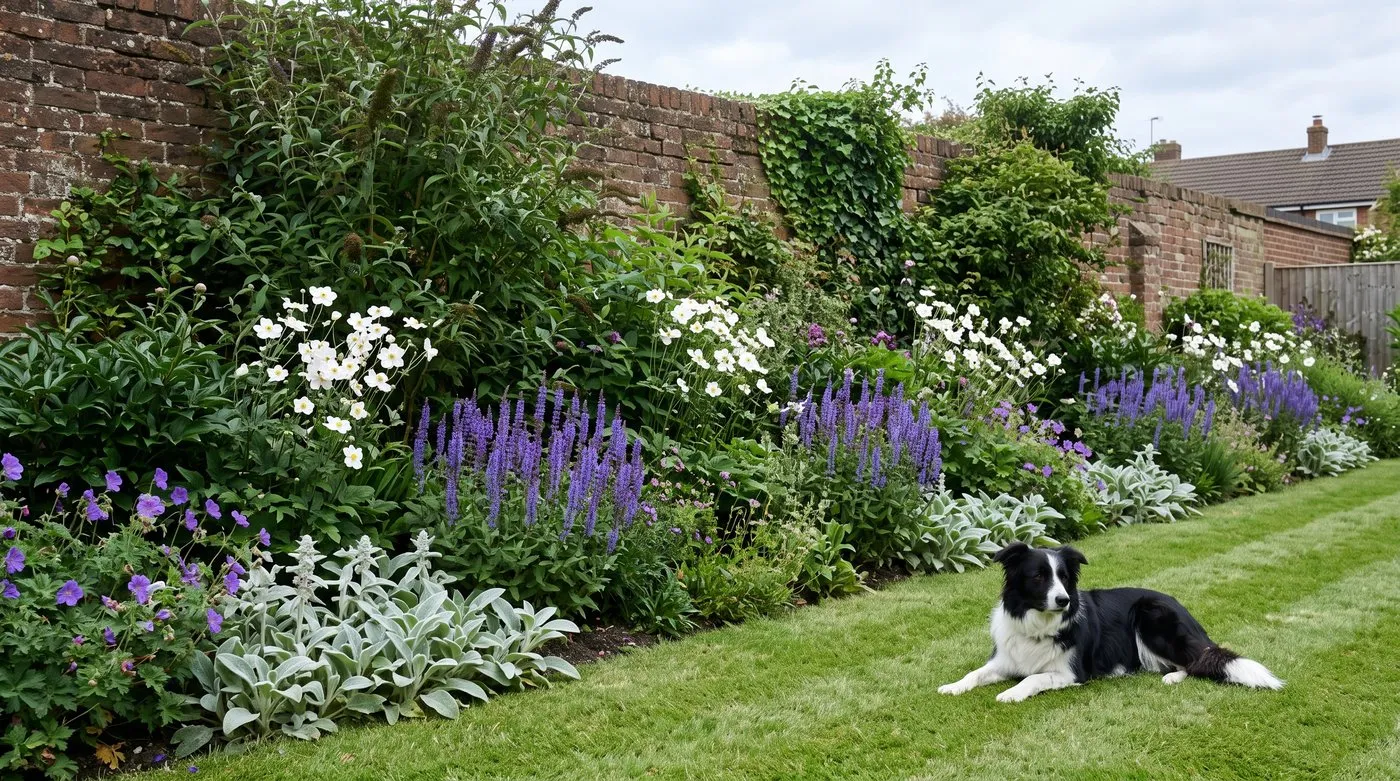
Repeating the same plant groups along the border makes it look planned. Stick to two or three main colours and one accent.
How to plan for year-round interest
A border that’s only good for one month is really a summer border. A proper mixed border earns its place all year.

In winter, evergreens, grasses and seedheads keep the border looking good.
Seasonal planting calendar
| Season | Plants to use | What they bring |
|---|---|---|
| Winter (Dec to Feb) | Sarcococca, mahonia, hellebores, snowdrops, dogwood stems | Shape, scent, low colour |
| Spring (Mar to May) | Tulips, daffodils, brunnera, euphorbia, spiraea | Bulbs, fresh leaves, early shrub flowers |
| Summer (Jun to Aug) | Roses, delphiniums, salvias, achillea, geraniums, grasses | The big show, and plenty for bees |
| Autumn (Sep to Nov) | Sedum, asters, Japanese anemones, rudbeckia, miscanthus | Late colour, seedheads, swaying grasses |
As a rule of thumb, use about three evergreen shrubs per 3m of border. They stop it looking bare from November to March. Yew, pittosporum, sarcococca and box are all good choices.
Ornamental grasses are a secret weapon for autumn and winter. Miscanthus, calamagrostis and Stipa gigantea stand up through frost and wind until you cut them back in February. Leave seedheads of sedum, echinacea and phlomis standing too.
How to prepare soil for a mixed border
Good soil prep pays off for years. Skip it and plants struggle to settle, wilt in dry spells or sit in soggy clay all winter.
On clay soil (most of the Midlands, South East, and parts of the North)
- Mark the shape with a hosepipe or a line of sand
- Strip off turf and dig out perennial weeds like bindweed, couch grass and ground elder. Our guide on how to make a flowerbed in a lawn shows how to lift turf cleanly
- Dig the whole area about 40cm deep, breaking up any hard layers
- Work in plenty of garden compost, well-rotted manure or composted bark
- Add grit to the back if you’re planting lavender, cistus or other Mediterranean shrubs
- Let it settle for two to four weeks before planting
On sandy or chalky soil
Sandy soil drains fast and loses its goodness quickly, so dig in compost to help it hold water. Chalky soil is thin and alkaline. Skip acid-lovers like rhododendrons, camellias and pieris, and choose plants that like lime. Mulch with compost every year to build up the soil.
How to draw a planting plan

A simple hand-drawn plan helps you see spacing and gaps before you buy a single plant.
Draw it to scale on squared paper. One square for 20cm works for borders up to 6m long. Use one square for 30cm for longer ones. Draw the outline, then mark the three layers.
Step-by-step method
- Place evergreens first. Mark about three per 3m section, spaced evenly. They’re the bones of the border
- Add the back row. Fill the back 60cm with tall shrubs and perennials
- Fill the middle. Use groups of 3, 5 or 7 of the same plant. Stagger them so matching groups don’t sit side by side
- Edge the front. Use two or three low plants, repeated along the edge
- Tuck in bulbs. Mark spots between perennials for spring and autumn bulbs
- Check the seasons. Colour each plant by when it flowers and look for long gaps. Self-seeding plants like foxgloves and aquilegia happily fill odd spaces
Groups of 3, 5 or 7 look natural. Singles and even numbers look stiff or spotty. Space plants at about two-thirds of their full spread and the border will fill out in two or three years.
Plants for each layer at a glance
| Plant | Layer | Height | Flowers | Light |
|---|---|---|---|---|
| Delphinium | Back | 1.5-1.8m | June to July | Sun |
| Miscanthus sinensis | Back | 1.5-2m | Plumes Sept to Feb | Sun |
| Buddleia | Back | 2-3m | July to September | Sun |
| Salvia nemorosa | Middle | 60-90cm | June to September | Sun |
| Echinacea purpurea | Middle | 90cm | July to September | Sun |
| Rosa ‘Boscobel’ | Middle | 1m | June to October | Sun |
| Sarcococca confusa | Middle | 1-1.5m | December to February, scented | Shade |
| Nepeta ‘Walker’s Low’ | Front | 30-45cm | May to September | Sun |
| Alchemilla mollis | Front | 30-40cm | June to July | Sun or part shade |
| Geranium ‘Rozanne’ | Front | 30-60cm | June to October | Sun or part shade |
| Sedum ‘Herbstfreude’ | Front | 45cm | August to October | Sun |
| Helleborus orientalis | Front | 40cm | January to March | Part shade |
How to plan a mixed border for shade
Shady borders use the same three layers, with shade-lovers in place of sun-lovers. Leaves, berries and stems do more of the work than flowers.
Back row for shade: Hydrangea paniculata, fatsia, mahonia and evergreen Viburnum tinus.
Middle row for shade: Astilbe, hosta, brunnera, Japanese anemone and ferns like dryopteris.
Front row for shade: Heuchera, pulmonaria, epimedium, Cyclamen hederifolium and ferns like polystichum.
Think about how damp the shade is. Dry shade under trees is the hardest. Epimedium, cyclamen and Geranium macrorrhizum cope best there. Damp shade by a north-facing wall is much easier, and tall thalictrum is a lovely choice for it.
Maintenance calendar for a mixed border
A well-planned border needs a little time each week in summer and very little in winter.
| Month | Jobs |
|---|---|
| February | Cut ornamental grasses back hard to 15cm. Clear old seedheads |
| March | Divide crowded perennials. Mulch the whole border with 5-8cm of compost |
| April | Stake tall perennials like delphiniums. Plant summer bulbs |
| May | Pinch back asters and sedums so they bush out. Start weeding |
| June to August | Deadhead weekly. Water new plants in dry spells |
| September | Plant spring bulbs between perennials. Take cuttings of tender plants |
| October | Plant bare-root shrubs and roses. Move anything in the wrong place |
| November | Mulch with 5cm of bark or compost after the leaves fall |
Every few years, lift, divide and replant tired perennials and dig in fresh compost. The RHS guide to borders has more ideas.
Like a softer, more informal look? Our cottage garden planting plan uses the same ideas in a looser style.
Frequently asked questions
How deep should a mixed border be?
At least 1.8m deep, so you can fit three layers. Around 2.4-3m is even better. Anything under 1.5m squeezes you into two rows and looks a bit flat. Short on space? A border against a wall or fence works at 1.2m with just a back and front row.
What is the best plant ratio for a mixed border?
Go mostly for perennials, with shrubs as the backbone. Add bulbs and grasses to fill the gaps. Perennials bring the flowers, shrubs give shape in winter, bulbs cover spring before perennials wake up, and grasses add movement into winter.
How many plants do I need per square metre?
Roughly 5-7 plants per square metre overall. Big shrubs need about one each. Medium perennials go in at 3-5, about 30-45cm apart. Small front-row plants go in at 7-9, about 20-30cm apart. A 3m by 1.8m border takes around 30-40 plants.
Can I plan a mixed border for shade?
Yes, shady borders can look lovely. Swap sun-lovers for hostas, ferns, astilbe, brunnera and epimedium. Use evergreen shrubs like sarcococca, skimmia and mahonia for shape. Edge it with heuchera, pulmonaria and woodland bulbs. Leaves do more of the work than flowers in shade.
When is the best time to plant a mixed border?
Autumn, in October or November, is best. The soil is still warm, so roots settle in over winter. Spring, in March or April, is next best and right for grasses and tender plants. Pot-grown plants can go in any time if you keep them watered.
How do I stop a mixed border looking messy?
Plant in odd-numbered groups and stick to a few colours. Repeat the same plant two or three times along the border. Dot evergreens along it for shape. Keep a neat front edge with low plants that spill a little over the path.
How do I keep a mixed border looking good in winter?
Use evergreens, grasses and seedheads. Add about three evergreen shrubs per 3m of border. Leave grasses and seedheads of sedum, echinacea and phlomis standing until late February. Plant sarcococca and mahonia for winter scent, with snowdrops and hellebores underneath.
Our team produces practical UK gardening guidance from source research, contributor records and established horticultural practice. Editorial standards are overseen by Matt W.