Key takeaways
- Even a 2m x 3m patch in full sun gives regular bunches all summer
- Grow in straight rows so sowing, weeding and picking are easy
- Cosmos, sweet peas and zinnias are the easiest place to start
- Sow again every 2-3 weeks from March to June for flowers until the frost
- Pick early in the morning and put stems straight into water
A cutting garden is a patch where every plant is grown for picking. In a border, cutting spoils the view. In a cutting garden, picking is the whole point, and the more you cut, the more flowers you get.
Here’s how to choose a spot, lay it out, pick the best flowers, and keep stems coming from spring to the first frost. For a wider look at what to grow, see our guide to types of flowers to grow in the UK.
What size plot do I need for a cutting garden?
About 2m x 3m is enough to start. That fits six to eight kinds of flower and gives a vase for the kitchen table most weeks. Around 3m x 6m lets you grow 20 or more kinds and pick plenty to give away.
| Plot size | Kinds of flower | Good for |
|---|---|---|
| 1m x 2m | 3-4 | Small posies |
| 2m x 3m | 6-8 | A weekly kitchen table vase |
| 3m x 6m | 20 or so | Regular arrangements plus gifts |
| 3m x 10m | 30 or more | Plenty to share |
Choose a spot in full sun, ideally facing south or west. Avoid overhanging trees, which drip on flowers and cast shade. The soil should be fertile and drain well. Heavy clay needs garden compost and grit dug in first. Our composting guide shows how to make your own for free.

Neat rows in a sunny plot give enough choice for a fresh bunch every week.
How should I lay out a cutting garden?
Straight rows are the easiest. Sowing, weeding and picking are all simpler, and narrow beds let you reach every plant from both sides.
Row spacing: Leave 30-45cm between rows of cosmos and zinnias, and 60cm between rows of dahlias and sunflowers. Keep paths at least 30cm wide so you don’t tread on the soil.
Support netting: Stretch flower netting across the bed at about 30cm and 60cm high for tall, floppy stems like snapdragons, larkspur and delphiniums. Tie it to posts at each corner. Plants grow up through it and stay nice and straight.
Which way to face: Run rows north to south so both sides get the sun. Put the tallest plants, like sunflowers and dahlias, at the north end so they don’t shade the rest.
A simple layout for a 3m x 6m plot:
| Row | Width | What to grow | Spacing |
|---|---|---|---|
| 1 (north end) | 60cm | Sunflowers and dahlias | 45-60cm apart |
| 2 | 45cm | Larkspur and snapdragons | 25-30cm apart |
| 3 | 45cm | Cosmos and zinnias | 30-40cm apart |
| 4 | 45cm | Sweet peas on netting | 15cm apart |
| 5 | 30cm | Ammi (bishop’s flower) | 20-25cm apart |
| 6 (south end) | 30cm | Foliage: eucalyptus and rosemary | 30-45cm apart |
What are the best flowers for a UK cutting garden?
Sweet peas, dahlias, cosmos and sunflowers are the backbone of most cutting gardens. For step-by-step growing help, see our guides to sweet peas, dahlias, cosmos and sunflowers.
What foliage fillers should I grow?
A bit of greenery makes any bunch look finished. Without it, a vase of flowers can look sparse. These four are hardy in most of the UK.
Eucalyptus gunnii: The florist’s favourite. Cut it hard back each March and it sends up straight stems of round young leaves, which are the best for arranging.
Pittosporum tenuifolium: Evergreen and compact, with dark stems and small glossy leaves. Trim it often to keep it bushy.
Rosemary: Probably already in your herb patch. Upright kinds like ‘Miss Jessopp’s Upright’ give nice straight stems for small posies, and they smell lovely. See our rosemary growing guide for care tips.
Bronze fennel: Feathery copper foliage from late spring to autumn. It adds lovely airy movement to a vase, needs no staking and seeds itself about.

Eucalyptus, rosemary and bronze fennel give you greenery to pick for most of the year.
Month-by-month cutting garden calendar
What to sow, plant and pick each month, so there’s always something for the vase.
| Month | Sow or plant | Pick |
|---|---|---|
| January | Order seeds and tubers | Hellebores, pussy willow, dried seedheads |
| February | Sow sweet peas and snapdragons indoors | Hellebores, winter jasmine |
| March | Sow cosmos, zinnias and stocks indoors. Sow larkspur, ammi and cornflowers outside | Daffodils, anemones |
| April | Sow sunflowers indoors. Plant ranunculus | Tulips, daffodils, wallflowers |
| May | Plant out dahlias and tender annuals after the last frost | Tulips, ranunculus, sweet williams |
| June | Sow more cosmos and zinnias every 2-3 weeks | Sweet peas, larkspur, ammi, cornflowers |
| July | Last sowing of cosmos | Sweet peas, dahlias, cosmos, zinnias, sunflowers, stocks |
| August | Sow hardy annuals for next spring (larkspur, ammi) | The big month: dahlias, cosmos, zinnias, snapdragons, asters |
| September | Plant spring bulbs (tulips, daffodils, anemones) | Dahlias, cosmos, chrysanthemums, late sweet peas |
| October | Plant ranunculus. Lift dahlias after the first frost | Chrysanthemums, asters, ornamental grasses |
| November | Last chance to plant tulips. Mulch the beds | Late chrysanthemums, dried seedheads |
| December | Plan next year. Clean supports and netting | Hellebores, holly, ivy, dried grasses |
For vegetables and herbs as well as flowers, see our seed sowing calendar.
How does succession sowing extend the cutting season?
Sow a little and often instead of all at once. One sowing of cosmos gives a good flush of flowers. Sow again every few weeks from March to May, and you’ll have flowers right through to the first frost.
These flowers work best for repeat sowing:
| Flower | First sowing | Last sowing | How often |
|---|---|---|---|
| Cosmos | March (indoors) | Early June (outside) | Every 3 weeks |
| Zinnias | April (indoors) | Late May (outside) | Every 2 weeks |
| Sunflowers | April | Mid-June | Every 2 weeks |
| Sweet peas | February | Late March | 2 sowings |
| Cornflowers | March (outside) | May | Every 3 weeks |
| Stocks | February | April | Every 3 weeks |
Our succession planting guide explains the idea in more detail, for vegetables too.

Rows sown a few weeks apart take turns to flower, so the picking never stops.
How do I condition cut flowers for the longest vase life?
A few simple steps keep home-grown flowers fresh for much longer.
When to cut: Early morning is best, when stems are full of water. Avoid the heat of the afternoon. If mornings are tricky, cut in the evening once the sun is low.
How to cut: Use sharp, clean secateurs or a knife and cut at a slant. Blunt scissors squash the stem so it can’t drink.
Strip the leaves: Take off any leaves that would sit under the water. They rot quickly and make the water go off.
Give them a drink: Put stems straight into a bucket of cool water with flower food. Leave them in a cool, shady spot for a couple of hours before you arrange them.
Looking after the vase: Change the water every 2-3 days and trim a little off the stems each time. Keep vases away from sunny windows, radiators and the fruit bowl, as ripening fruit makes flowers fade faster.
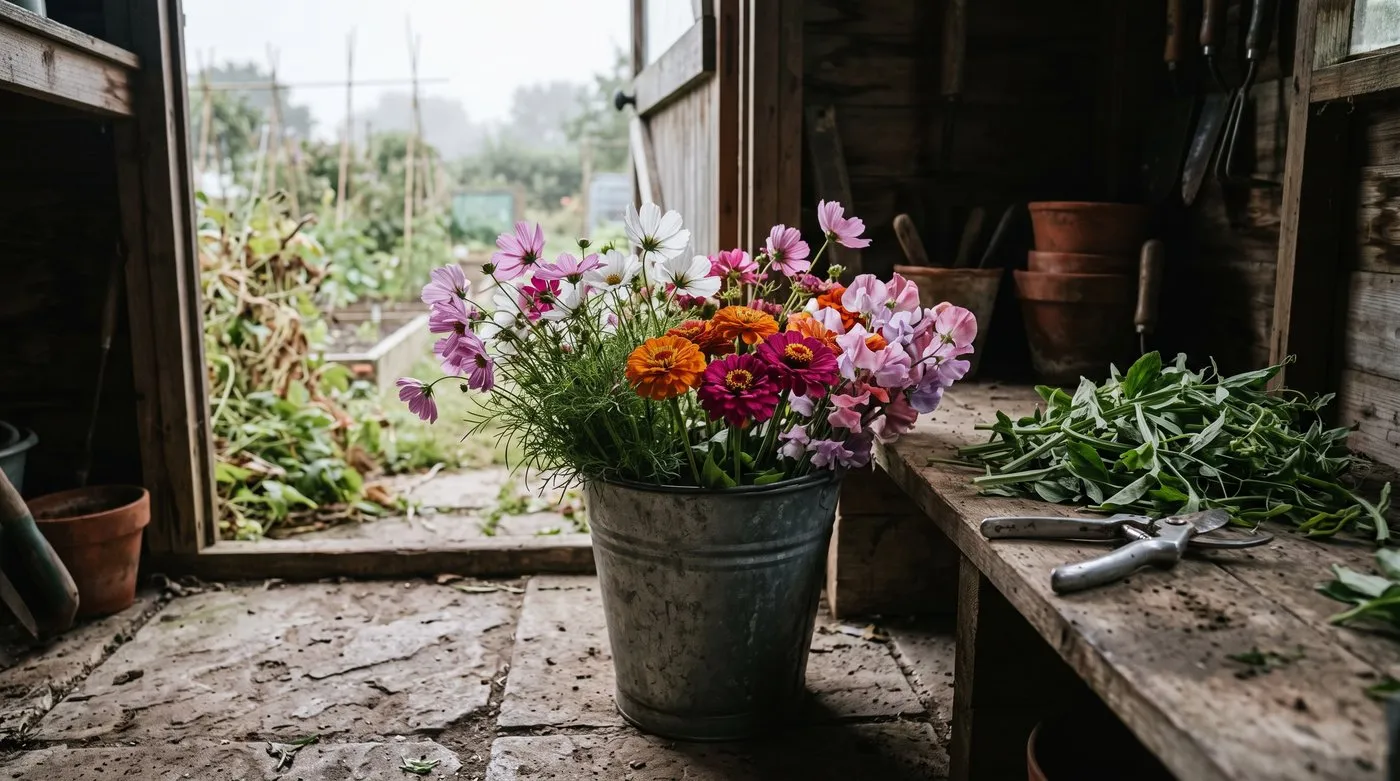
Strip any leaves that would sit underwater and rest the stems in a cool, shady spot for a couple of hours. They’ll last much longer in the vase.
How much does a cutting garden cost to set up?
A cutting garden is one of the cheapest things you can make. Seeds are the best value, as one packet of cosmos gives you plenty of plants.
What you’ll need in the first year:
| Item | Notes |
|---|---|
| Seeds (10-12 packets) | Cosmos, zinnias, sweet peas, sunflowers, larkspur, ammi, snapdragons, cornflowers, stocks, scabious |
| Dahlia tubers | They bulk up each year, giving you free plants later |
| Support netting and canes | Flower netting or string supports |
| Flower food | Sachets or a bottle for the vase |
| Spring bulbs | Tulips, daffodils, ranunculus, anemones |
After the first year: You mainly need fresh annual seeds. Dahlias multiply, perennials come back, and many bulbs flower again.
A bunch of your own flowers costs very little next to a shop bouquet, and they’re fresher too.
Three easy cut flowers for beginners
New to cut flowers? Start with these three. All are easy and give armfuls of stems in their first summer.
Cosmos ‘Sensation Mix’: Sow outside in May and it flowers by July, carrying on until the frost. Keep cutting and it keeps flowering. No feeding or fuss needed.
Sweet peas ‘Spencer Mixed’: Sow indoors in October or February for the strongest plants. The scent alone is worth it. Pick every 2-3 days to keep them flowering from June to September.
Zinnia ‘Benary’s Giant’: Lasts well in a vase. Sow indoors in April and plant out after the last frost. Big double flowers in every colour from lime green to deep burgundy, on long, strong stems.

Cosmos, sweet peas and zinnias together give colour from June to October.
How do I plan a cutting garden for year-round flowers?
Mix bulbs, annuals, perennials and shrubs and you’ll have something to pick in every season.
Spring (March to May): Plant tulips and daffodils in autumn for spring stems. Add ranunculus and anemones in autumn or early spring. Wallflowers fill the gap before summer annuals get going.
Summer (June to September): The busiest time. Sweet peas, dahlias, cosmos, zinnias, sunflowers, larkspur, snapdragons, ammi and scabious give you something to pick almost every day. Our flower planting calendar has the full monthly plan.
Autumn (September to November): Chrysanthemums are the stars of autumn and last ages in a vase. Late dahlias carry on until the first hard frost. Grasses like miscanthus add texture, and asters fill the gap.
Winter (December to March): Hellebores flower from December to April. They last much longer in a vase if you dip the stem ends in just-boiled water for a few seconds first. Winter jasmine adds bright yellow, and pussy willow cut in February lasts for weeks. Dried seedheads from honesty, teasels and ornamental grasses fill the gaps.
For a fun flower that’s great fresh or dried, see our guide to growing Craspedia.
Frequently asked questions
How big does a cutting garden need to be?
As small as about 2m x 3m. That fits six to eight kinds of flower in short rows and gives regular small bunches through summer. A plot of around 3m x 6m gives more choice and bigger bouquets. Even a single row of sweet peas or dahlias is worth it.
What are the easiest flowers to grow for cutting?
Cosmos, sweet peas and zinnias are the easiest. They flower within a few months of sowing and make more stems the more you cut. Cornflowers and calendula are easy to sow straight into the ground. Dahlias, grown from tubers, flower from midsummer until the first frosts.
When should I start sowing seeds for a cutting garden?
Start in late winter. Sow sweet peas under cover from autumn to February. Sow cosmos, zinnias and sunflowers indoors in March and April. Sow hardy annuals like larkspur and ammi outdoors in spring. Plant dahlias out once frosts are over in late May. Sow again every few weeks to keep flowers coming.
How do I make cut flowers last longer in a vase?
Pick in the early morning or evening, when stems are full of water. Use clean, sharp secateurs and put stems straight into a bucket of water. Strip any leaves that would sit under the water. Change the vase water every couple of days and trim the stem ends each time.
Is a cutting garden cheaper than buying flowers?
Usually, yes, once it’s up and running. Seeds and tubers cost little next to shop bouquets, and you can keep dahlia tubers from year to year. You’ll need compost and plant supports at the start. The real cost is your time sowing, staking and picking.
Can I grow cut flowers in a small garden?
Yes, you can. Grow sweet peas up obelisks or trellis. Put dahlias and zinnias in big pots on the patio. Tuck cosmos between vegetables or into borders. Even a 1m x 2m raised bed can give a small posy each week through summer.
Do I need to feed a cutting garden?
Some plants need it, but not all. Hungry plants like dahlias and sweet peas like a regular high-potash liquid feed once they start flowering. Most hardy annuals flower well on ordinary soil. Mulch with garden compost in spring to help the soil hold moisture.
More cutting garden guides
- Cottage garden planting plan, for traditional planting that sits happily beside a cutting garden
- How to grow dahlias in the UK, from planting tubers to winter storage
- How to grow sweet peas from seed, with autumn and spring sowing
- How to grow cosmos from seed, the easiest cut flower of all
- Seed sowing calendar UK, a month-by-month plan for flowers, vegetables and herbs
Our team produces practical UK gardening guidance from source research, contributor records and established horticultural practice. Editorial standards are overseen by Matt W.