
Key takeaways
- Lavender, alliums and salvia are easy purples for sunny, well-drained spots
- Roses, peonies and Japanese anemones give pink from May into autumn
- True blue is rare, and delphiniums, agapanthus and Himalayan poppies need the right soil
- Plant in three heights, tall at the back and low at the front, for a full-looking border
Purple, pink and blue sit on the cool side of the colour wheel, and together they make some of the loveliest borders in British gardens. Plan it well and you’ll have colour from March crocuses right through to late Japanese anemones, with plants from low ground cover to tall delphinium spires.
Best purple flowers for UK gardens
Purple rules British borders from June to September. Here are ten reliable choices.
Purple flowers at a glance
| Plant | Height | Flowers | Sun or shade | Soil | Type |
|---|---|---|---|---|---|
| Lavender ‘Hidcote’ | Low | June to August | Full sun | Well-drained | Shrub |
| Allium ‘Purple Sensation’ | Medium | May to June | Full sun | Well-drained | Bulb |
| Salvia nemorosa ‘Caradonna’ | Medium | June to September | Full sun | Most soils | Perennial |
| Verbena bonariensis | Tall | July to October | Full sun | Well-drained | Perennial |
| Buddleja ‘Black Knight’ | Very tall | July to September | Full sun | Most soils | Shrub |
| Clematis ‘Jackmanii’ | Climber | July to September | Sun, roots in shade | Moist | Climber |
| Bearded iris | Medium | May to June | Full sun | Well-drained | Perennial |
| Globe thistle ‘Veitch’s Blue’ | Medium | July to August | Full sun | Dry | Perennial |
| Eryngium ‘Big Blue’ | Medium | June to August | Full sun | Dry, poor | Perennial |
| Heuchera ‘Palace Purple’ | Low | Leaves all year | Part shade | Moist | Perennial |
Lavender ‘Hidcote’ is the most reliable purple plant for UK gardens. It loves a bit of neglect, needs no feeding, copes with drought and has dense spikes of deep violet flowers from June to August. Plant 45cm apart in full sun on soil that drains well. It’s happy on chalk, sand and light soil. On heavy clay, dig in plenty of grit first. Trim it every year after flowering. Our guide to growing lavender explains when and how.
Salvia nemorosa ‘Caradonna’ has the deepest violet spires of any border perennial, on almost black stems that make the colour pop. It flowers from June to September if you cut it back after the first flush. It’s the perfect height for the middle of a mixed border. Tough, happy on clay and chalk, and no trouble at all. Plant in groups of 3-5 about 40cm apart.
Allium ‘Purple Sensation’ has big round purple heads on tall stems in May and June. Plant the bulbs 15cm deep in October, 15cm apart. They come back each year, and the seed heads look great for weeks after flowering. Plant hardy geraniums around them to hide the scruffy allium leaves in July.
 A purple border with alliums, salvias and Verbena bonariensis at different heights.
Purple combinations that work
Put lavender at the front, Salvia ‘Caradonna’ in the middle and Verbena bonariensis at the back. All three flower from June to September and love sun and good drainage. Add Allium ‘Purple Sensation’ to start the show in May. That gives you months of purple at three heights.
For shade, grow foxgloves rising through Heuchera ‘Palace Purple’, with bugle ‘Atropurpurea’ as ground cover. All three cope with part to full shade and moist soil.
Best pink flowers for UK gardens
Pink is the easiest colour to use in a border. Loads of plants come in pink, and the season runs from spring peonies to autumn Japanese anemones.
Pink flowers at a glance
| Plant | Height | Flowers | Sun or shade | Soil | Type |
|---|---|---|---|---|---|
| Rosa ‘Boscobel’ | Medium | June to October | Full sun | Moist, rich | Shrub |
| Peony ‘Sarah Bernhardt’ | Medium | May to June | Full sun | Rich | Perennial |
| Japanese anemone (pink forms) | Tall | August to November | Sun or part shade | Moist | Perennial |
| Astilbe ‘Fanal’ | Medium | July to August | Part shade | Moist | Perennial |
| Dianthus ‘Mrs Sinkins’ | Low | June to July | Full sun | Well-drained, chalky | Perennial |
| Echinacea ‘Magnus’ | Medium | July to September | Full sun | Well-drained | Perennial |
| Gaura ‘Whirling Butterflies’ | Medium | June to October | Full sun | Well-drained | Perennial |
| Persicaria ‘Firetail’ | Tall | July to October | Sun or part shade | Moist | Perennial |
| Rose campion (Lychnis coronaria) | Medium | June to August | Full sun | Dry, poor | Perennial |
| Geranium ‘Wargrave Pink’ | Low | May to October | Sun or part shade | Most soils | Perennial |
Rosa ‘Boscobel’ is a lovely English rose for mixed borders. It stays compact, repeat-flowers from June to October and has a rich scent. The salmon-pink flowers are packed with petals. Plant bare-root roses in late autumn or early spring. Our roses growing guide covers pruning step by step.
Peony ‘Sarah Bernhardt’ has huge, blush-pink, scented flowers in May and June. Peonies live for decades and hate being moved. Plant the crown so the buds are no more than 2.5cm below the soil. Planting too deep is the number one reason peonies don’t flower.
Japanese anemones fill the late-summer gap most borders suffer from, flowering from August into November on tall stems. They’re happy on heavy clay and in part shade, and they spread steadily once settled. The famous ‘Honorine Jobert’ is white, so pick a pink variety for a pink border. Allow about 60cm between plants.
Gardener’s tip: pink flowers look washed out against a bright white wall or fence. Plant them in front of a dark green hedge, old brick or dark wood and they really glow. A peony against a yew hedge looks fabulous.
 A pink border with roses, peonies and astilbe in soft morning light.
Pink combinations that work
The classic English pink border pairs Rosa ‘Boscobel’ with Peony ‘Sarah Bernhardt’ and Geranium ‘Wargrave Pink’. The peony opens the season, the rose carries the summer and the geranium ties the front edge together. Add a pink Japanese anemone at the back for colour from August to November.
For moist shade, combine Astilbe ‘Fanal’ (crimson-pink plumes) with Persicaria ‘Firetail’ (red-pink spikes) and Geranium macrorrhizum ‘Ingwersen’s Variety’ (soft pink). All three cope with heavy clay and only a few hours of sun. For airy height in the same spot, add thalictrum.
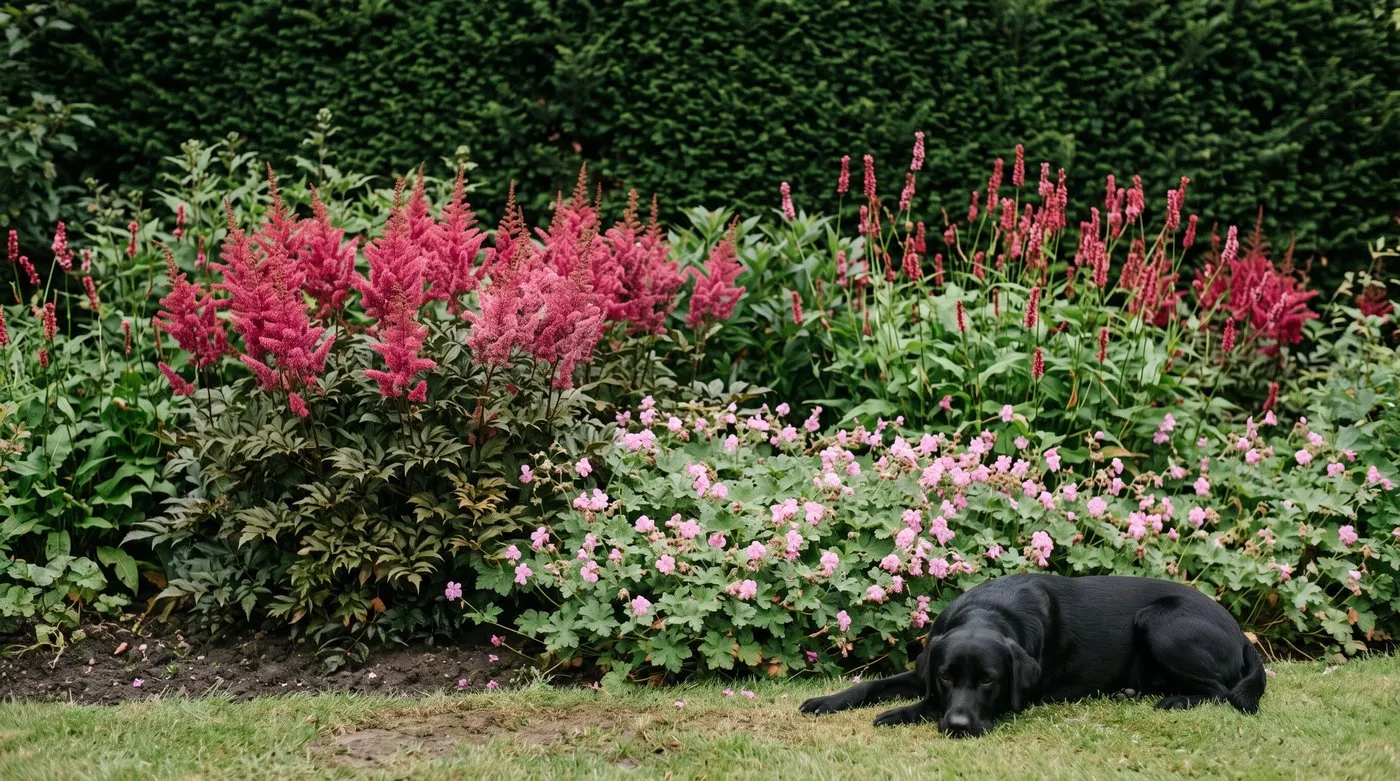
This pink trio copes with heavy clay and only a few hours of sun. A dark hedge behind makes the pinks really glow.
Best blue flowers for UK gardens
True blue is rare in flowers, which makes blue plants extra special. It also means soil matters more for blue flowers than for any other colour.
Blue flowers at a glance
| Plant | Height | Flowers | Sun or shade | Soil | Type |
|---|---|---|---|---|---|
| Delphinium ‘Blue Nile’ | Tall | June to July | Full sun | Rich, moist | Perennial |
| Agapanthus ‘Northern Star’ | Medium | July to August | Full sun | Well-drained | Perennial |
| Hydrangea ‘Nikko Blue’ | Tall | July to September | Part shade | Acid (for blue) | Shrub |
| Ceratostigma willmottianum | Medium | August to October | Full sun | Well-drained | Shrub |
| Catmint ‘Walker’s Low’ | Medium | May to September | Full sun | Well-drained | Perennial |
| Anchusa ‘Loddon Royalist’ | Medium | June to July | Full sun | Well-drained | Perennial |
| Brunnera ‘Jack Frost’ | Low | April to May | Part shade | Moist | Perennial |
| Scabious ‘Clive Greaves’ | Medium | June to September | Full sun | Well-drained, chalky | Perennial |
| Peach-leaved bellflower (Campanula persicifolia) | Medium | June to July | Sun or part shade | Most soils | Perennial |
| Himalayan poppy (Meconopsis) | Medium | June to July | Part shade | Acid, moist | Perennial |
Delphinium ‘Blue Nile’ has some of the most intense blue spires you can grow. Delphiniums want rich, moist, neutral to chalky soil and full sun. Stake them early, when they’re about 30cm tall, especially in windy gardens. Cut the first spikes down after flowering and you’ll often get a second flush in September. Slugs love the young shoots in spring, so protect them with a barrier or biological nematode controls.
Agapanthus ‘Northern Star’ is one of the hardiest blue agapanthus for UK gardens. Deep blue trumpet flowers appear in July and August. It loses its leaves in winter, which helps it cope with the cold. Plant in full sun with really good drainage. On heavy clay, grow it in a big pot of loam-based compost mixed with grit. Feed with a high-potash feed monthly from April to August.
Catmint ‘Walker’s Low’ is one of the longest-flowering blue plants for a UK border, covered in violet-blue flowers from May to September. It spreads wide, so it’s a perfect filler for the front or middle. It copes with drought, poor soil and full sun. Cut it back hard after the first flush in July for a fresh second wave. Bees adore it.
 A blue border with delphiniums, agapanthus and catmint in full summer flower.
Blue combinations that work
Grow Delphinium ‘Blue Nile’ at the back, Campanula persicifolia in the middle and catmint ‘Walker’s Low’ at the front for three layers of blue from June to September. All three like full sun and neutral to chalky soil.
For blue from spring to autumn, plant Brunnera ‘Jack Frost’ (April to May) to open the season, catmint (May to September) for the long middle stretch, and Ceratostigma willmottianum (August to October) to finish. That’s months of blue from just three plants.
How to plan a colour-themed border
Colour borders go wrong when plants are chosen by colour alone. Height, flowering times and soil matter just as much.
The three rules of colour-themed borders
Rule 1: plant at three heights. A purple border of nothing but salvias looks flat. Put tall plants at the back, medium in the middle and low at the front. It gives depth and draws your eye in.
Rule 2: spread out the flowering. A pink border that peaks for three weeks in June and then goes green is a let-down. Choose plants that take over from each other. Peonies (May to June), then roses (June to October), then Japanese anemones (August to November) keep pink going all season.
Rule 3: match the soil before the colour. A blue border of delphiniums, blue hydrangeas and Himalayan poppies sounds lovely, but it won’t work, because delphiniums like chalky soil and the other two need acid. Group plants that like the same soil and drainage.
Mix light and dark shades of one colour
A border of all deep purple looks heavy. Mix three shades of the same colour:
- Pale: catmint (lilac-blue), Geranium ‘Wargrave Pink’ (salmon-pink), scabious (pale blue)
- Mid: Salvia ‘Caradonna’ (violet), Rosa ‘Boscobel’ (salmon-pink), campanula (mid-blue)
- Deep: Clematis ‘Jackmanii’ (dark purple), Persicaria ‘Firetail’ (crimson-pink), Delphinium ‘Black Knight’ (deep violet-blue)
Mixing shades gives a richness that a one-shade border just can’t match.
Seasonal succession: colour from March to October
Colour all season takes a bit of planning. This calendar shows which plants carry each month.
| Month | Purple | Pink | Blue |
|---|---|---|---|
| March | Crocus | Cherry blossom overhead | Grape hyacinths |
| April | Aubrieta | Tulip ‘Angelique’ | Brunnera ‘Jack Frost’ |
| May | Allium ‘Purple Sensation’ | Peony ‘Sarah Bernhardt’ | Catmint starts |
| June | Lavender, salvia, iris | Rosa ‘Boscobel’ starts | Delphinium, anchusa |
| July | Buddleja, globe thistle | Astilbe, echinacea | Agapanthus, scabious |
| August | Verbena bonariensis at its best | Japanese anemones start | Ceratostigma starts |
| September | Clematis, late salvia | Persicaria, late roses | Catmint second flush |
| October | Verbena finishing | Japanese anemones finishing | Ceratostigma finishing |
Top tip: early spring and October are the hardest months to fill with cool colours. Use bulbs like grape hyacinths, crocus and tulips for spring, and late shrubs like ceratostigma and caryopteris for autumn. Without them, your border will have gaps at each end of the season.
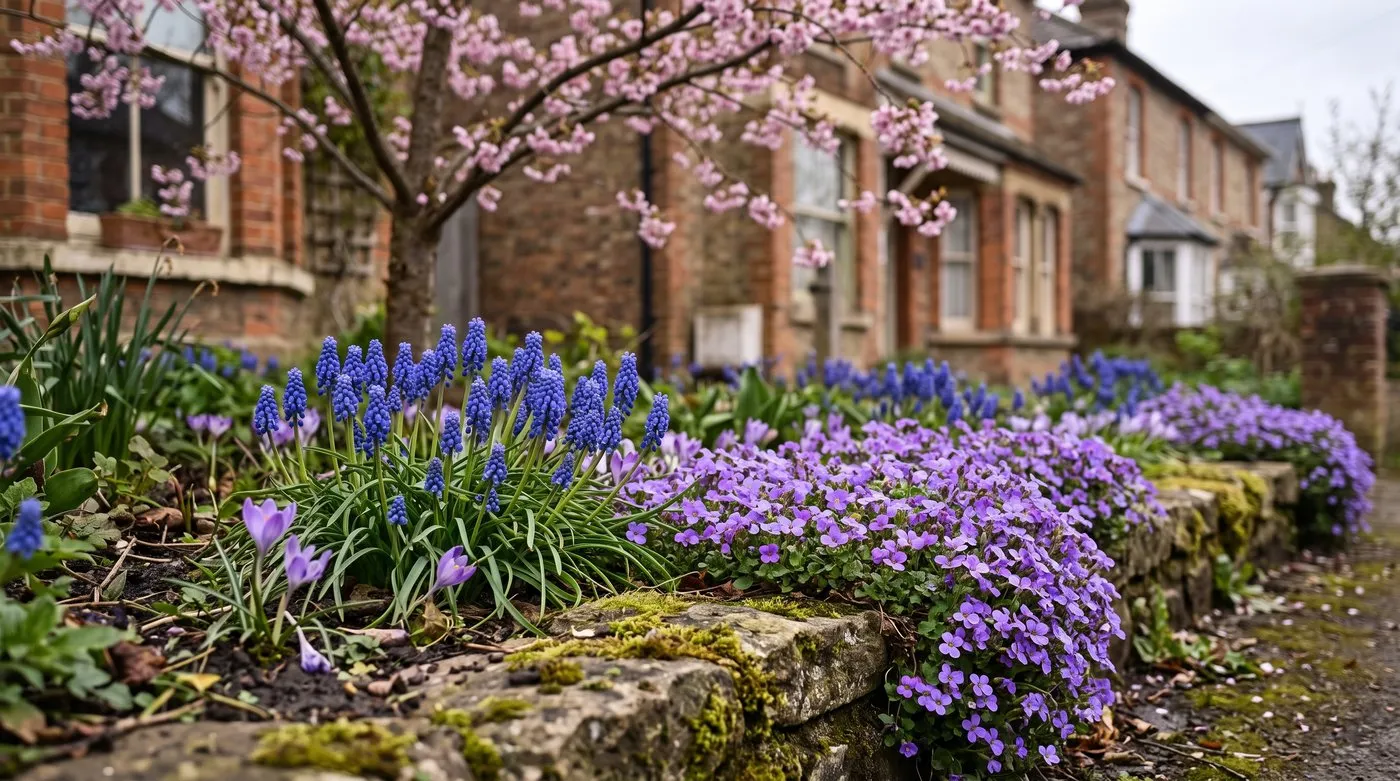
Early spring is the hardest time for cool colours, so bulbs and aubrieta are worth their weight in gold. They fill the gap before the border gets going.
Combining purple, pink and blue together
These three colours sit side by side on the colour wheel, so they always get on. Mixing all three avoids the sameness of a single-colour border while keeping a cool, calm feel.
The best three-colour combination
- Back: Delphinium ‘Blue Nile’ (blue, June to July) and Verbena bonariensis (purple, July to October)
- Middle: Rosa ‘Boscobel’ (pink, June to October) and Salvia ‘Caradonna’ (purple, June to September)
- Front: catmint ‘Walker’s Low’ (blue, May to September) and Geranium ‘Wargrave Pink’ (pink, May to October)
Plant about 7 plants per square metre. The roses and geraniums carry the season from May to October, the delphiniums and verbena add height and drama, and the salvia and catmint fill the middle and front with non-stop flowers.
Soil-specific mixed borders
On clay: swap lavender and agapanthus for persicaria (pink), globe thistle (purple) and campanula (blue). All three cope with heavy clay.
On chalk: lavender, scabious (blue) and dianthus (pink) love thin, chalky soil. Add eryngium (steel blue) and rose campion (magenta-pink) for a Mediterranean feel.
On acid soil: hydrangea macrophylla (blue on acid soil), heathers (pink) and rhododendrons (purple) make a lovely acid-soil scheme. The hydrangea is only blue on acid soil. On neutral or chalky ground, it turns pink.
Common mistakes with colour-themed borders
Five slip-ups cause most disappointing colour borders. All are easy to avoid.
Mistake 1: Ignoring foliage colour
Leaves are on show far longer than flowers, so they matter. Purple and silver leaves, like Heuchera ‘Palace Purple’ and lamb’s ears, make cool colours look richer. A dark green background, like a hedge, helps pinks and blues stand out.
Mistake 2: Planting hydrangeas on the wrong soil
Hydrangea macrophylla only flowers blue on acid soil. On neutral or chalky soil, the same plant turns pink, which surprises lots of people who bought a “blue” one. Test your soil before you buy. On chalky ground, grow blue hydrangeas in pots of ericaceous compost.
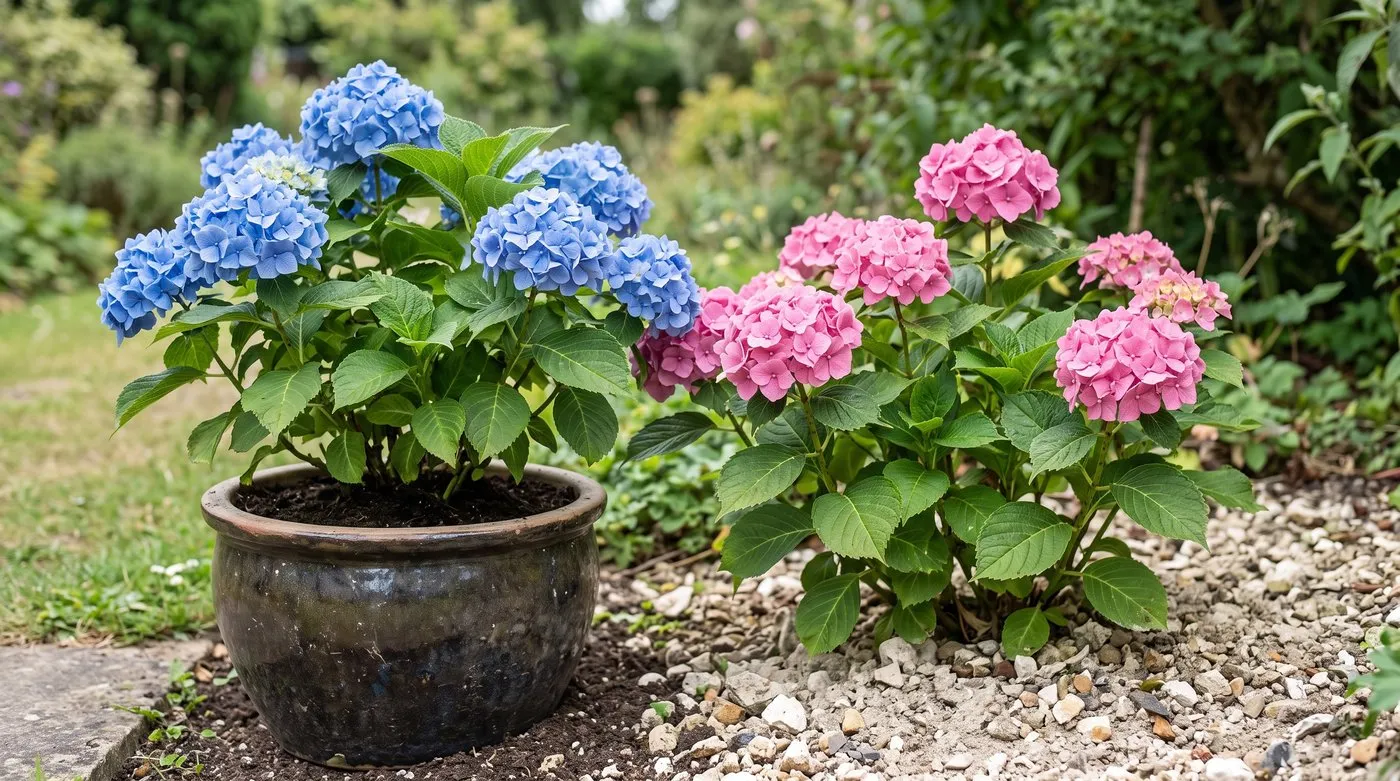
Same plant, different soil. Hydrangeas only stay blue on acid soil, so on chalk grow them in pots of ericaceous compost.
Mistake 3: No late-season plants
Most purple, pink and blue flowers peak in June and July. Without late flowers, the border fades to green by August. Always include at least two plants that flower from August to October, such as Japanese anemones (pink), ceratostigma (blue) and Verbena bonariensis (purple).
Mistake 4: Same height throughout
Salvias, echinacea and campanulas all at a similar height make a flat block with no depth. Always include something tall at the back, like delphiniums, Verbena bonariensis, buddleja or a clematis on an obelisk.
Mistake 5: Not deadheading repeat-flowerers
Salvia, catmint, geraniums and roses all flower again if you deadhead them promptly. Cut Salvia ‘Caradonna’ back after its first flush in July and it’ll have fresh spires by late August. That one habit adds weeks of flowers.
Plants to watch on wet soil: gaura, agapanthus and Himalayan poppies often die over winter on soggy clay. Give them good drainage, or choose clay-loving plants instead.
The Hardy Plant Society runs local plant sales, which are a great place to find named varieties from keen gardeners.
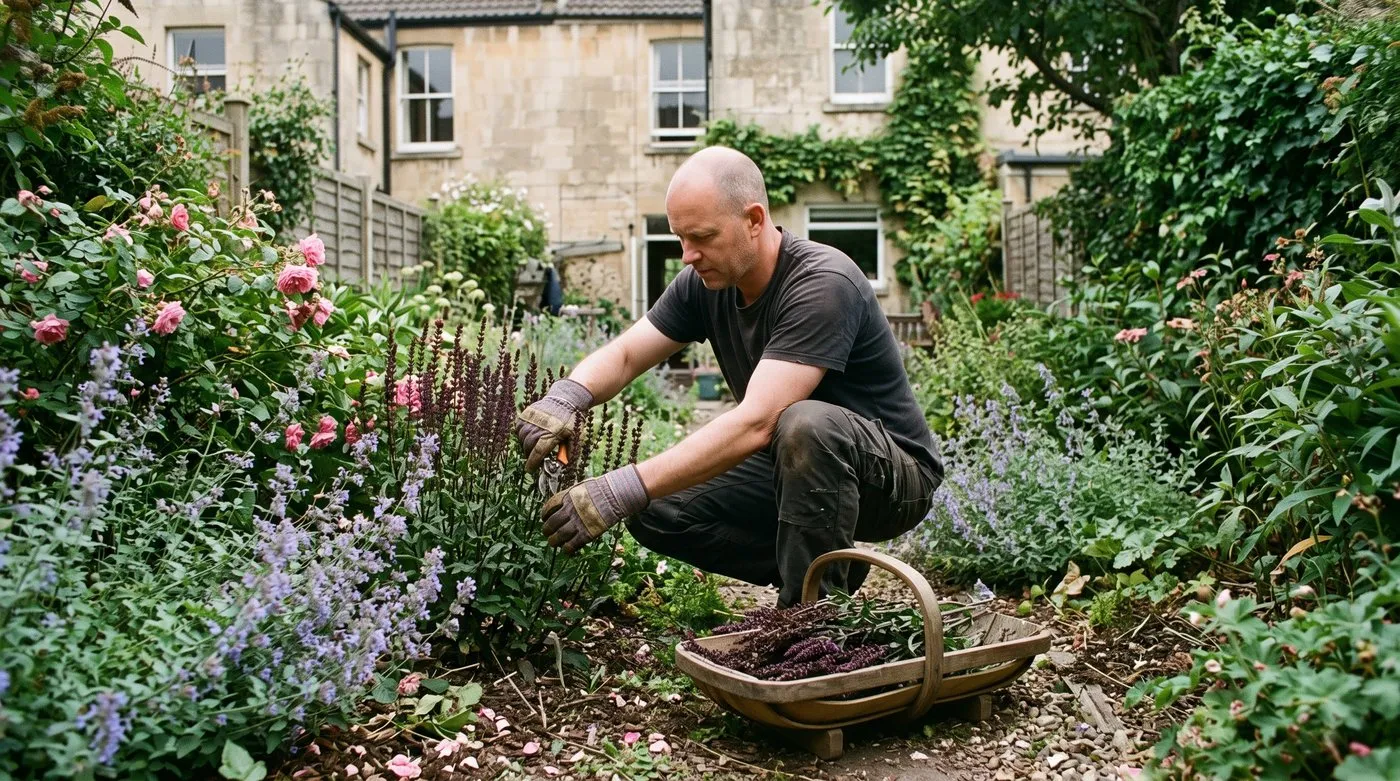
Cut salvia and catmint back after the first flush and they’ll give you a fresh round of flowers by late August.
Month-by-month care calendar
| Month | Jobs |
|---|---|
| January | Order bare-root roses and peonies. The RHS Plant Finder shows which nurseries stock each variety |
| February | Cut back ornamental grasses and dead perennial stems. Mulch borders with 5cm of compost |
| March | Plant bare-root roses and peonies if you didn’t in autumn. Divide big clumps of catmint and geraniums |
| April | Stake delphiniums when they’re about 30cm tall. Feed roses. Protect young shoots from slugs |
| May | Plant out agapanthus and tender plants after the last frost. The first catmint and geraniums open |
| June | Deadhead roses weekly. Cut lavender for drying as the buds start to open |
| July | Cut first-flush salvia and catmint back to 15cm for more flowers. Water new plants in dry spells |
| August | Enjoy the show. Give roses a high-potash feed for autumn flowers. Japanese anemones start |
| September | Take lavender cuttings about 10cm long, strip the lower leaves and push them into gritty compost. Order spring bulbs |
| October | Plant allium and grape hyacinth bulbs. Plant bare-root roses. Cut buddleja back by half so wind doesn’t rock it |
| November | Mulch agapanthus and ceratostigma with a thick layer of bark or straw. Leave seed heads for birds and frosty mornings |
| December | Clean and oil your secateurs. Plan next year’s additions |
For a bold contrast, pair these cool colours with the best orange flowers for UK gardens.
Frequently asked questions
What are the best purple flowers for UK gardens?
Lavender, alliums and Salvia nemorosa are the top three purple flowers. Lavender ‘Hidcote’ flowers from June to August on any well-drained soil. Allium ‘Purple Sensation’ has big drumstick heads in May and June. Salvia ‘Caradonna’ has deep violet spires from June to September.
Which blue flowers grow best in the UK?
Delphiniums are the finest blue flowers for UK borders. ‘Blue Nile’ has tall, pure blue spires in June and July. Agapanthus ‘Northern Star’ gives deep blue flowers in July and August. Catmint ‘Walker’s Low’ flowers from May to September.
What pink flowers bloom longest in UK gardens?
Hardy geraniums and repeat-flowering roses bloom for the longest. Geranium ‘Wargrave Pink’ flowers from May to October. Rosa ‘Boscobel’ repeat-flowers from June to October. Pink Japanese anemones carry on from August into November.
Can I grow blue Himalayan poppies in the UK?
Yes, but only in acid soil that stays cool and moist. Meconopsis likes part shade. It does best in Scotland, northern England and Wales and struggles in the dry south-east. Mulch well with leaf mould and water in dry spells. It’s often short-lived.
How do I combine purple pink and blue flowers in a border?
Plant in three height layers. At the back, grow delphiniums (blue) and Verbena bonariensis (purple). In the middle, grow roses (pink) and Salvia nemorosa (purple). At the front, grow catmint (blue) and hardy geraniums (pink).
Which purple flowers grow in shade in the UK?
Foxgloves are the best purple flowers for shade. They flower in June and July in dappled shade. Heuchera ‘Palace Purple’ gives burgundy-purple leaves all year. Bugle ‘Atropurpurea’ makes low, dark purple ground cover even in full shade.
What soil do blue flowers need in the UK?
It depends on the plant, so match each one to your soil. Blue hydrangeas only stay blue on acid soil. Delphiniums like neutral to chalky soil. Agapanthus needs good drainage and full sun. Himalayan poppies need acid soil that stays moist.
Our team produces practical UK gardening guidance from source research, contributor records and established horticultural practice. Editorial standards are overseen by Matt W.


