Key takeaways
- Hardy fuchsias stay outside all year; 'Mrs Popple' and 'Riccartonii' are the toughest
- Bring tender fuchsias in before the first frost and keep them cool but frost-free
- Prune hardy fuchsias hard in late April or May, never in autumn
- Fuchsia cuttings root easily in spring, so free plants are simple
- Cut out any swollen, twisted shoot tips straight away, as that's fuchsia gall mite
Fuchsias give you masses of dangling flowers from June right up to the first frosts. The one thing to know first is which kind you’ve got. Hardy fuchsias live outside all year as shrubs. Tender fuchsias die in the first frost unless you bring them in. Get that right and they’re among the easiest plants in the garden.
Here’s how to grow both kinds, from choosing varieties to pruning, winter care and cuttings. For more shrub ideas, see our guide to the best flowering shrubs for UK gardens.
‘Mrs Popple’ is one of the most reliable hardy fuchsias, flowering from June until the first frosts.
Hardy vs tender fuchsias: what is the difference?
Hardy fuchsias stay outside all winter in most of the UK. They often die back to the ground and regrow each spring. Tender fuchsias are killed by frost and need a frost-free home over winter.
Hardy fuchsias behave a bit like herbaceous shrubs. After a mild winter they keep some woody stems. After a cold one they die back to the base but shoot up again quickly, often reaching 1-1.5m by summer. Once settled in, after their first couple of years, they’re very tough.
Tender fuchsias have the biggest, showiest flowers: the doubles and fancy two-tones you see in hanging baskets. They’re superb in pots and baskets but need a frost-free spot from October to May.
Some sit in between. ‘Dollar Princess’, ‘Alice Hoffman’ and ‘Army Nurse’ often survive outside in a sheltered spot with a thick mulch over the base. They’re worth a try if your garden isn’t too exposed.
| Type | Winter | Height | Best for | Examples |
|---|---|---|---|---|
| Hardy | Stays outside | 1-1.5m | Borders, hedges | Mrs Popple, Riccartonii |
| Borderline | Outside with shelter and mulch | 60-90cm | Borders, pots | Dollar Princess, Alice Hoffman |
| Tender | Bring in before frost | 30-60cm, trailing | Baskets, pots | Swingtime, Marinka |
Best hardy fuchsia varieties
These hardy fuchsias are tried-and-trusted UK favourites that get bigger and better every year.
‘Mrs Popple’ is the classic. Masses of flowers with scarlet outer petals and violet skirts from June until frost. It makes a lovely shrub or informal hedge, around 1.2m tall and wide. RHS AGM.
‘Riccartonii’ is the famous hedging fuchsia of the west coast, with small, elegant red and purple flowers. It’s one of the toughest of all, growing to about 1.5m in a sheltered spot.
‘Tom Thumb’ is a little one at 30-40cm, covered in small red and violet flowers. Great for the front of a border, a rockery or a pot that lives outside.
‘Lady Thumb’ is even smaller, with semi-double red and white flowers. A neat edging plant. RHS AGM.
‘Hawkshead’ has elegant white flowers tinged with green. It grows to about 90cm and is more upright and narrow than ‘Mrs Popple’.
‘Delta’s Sarah’ has double purple and red flowers on a compact 50cm bush. It gives you bigger flowers on a hardy plant.
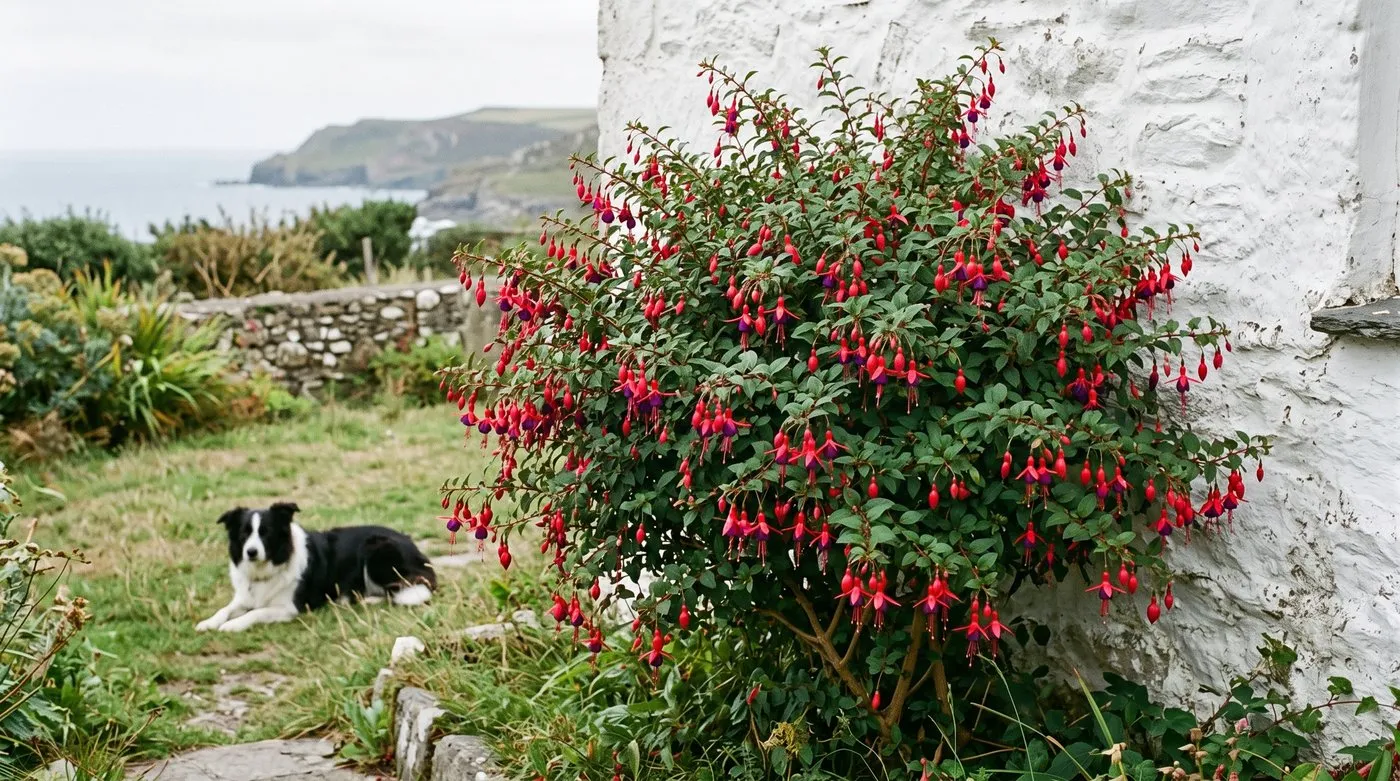
‘Mrs Popple’ stays outside all year and gets bigger and better each summer. It flowers from June right up to the frosts.
Best tender fuchsias for baskets and containers
Tender fuchsias are the stars of the hanging basket, with trailing stems that spill over in a curtain of colour from June to October. They need bringing in for winter, but the display is worth it.
‘Swingtime’ is the classic basket fuchsia, with big double flowers in red and fluffy white on long trailing stems.
‘Marinka’ has masses of single red flowers on long trailing stems. It’s vigorous and fills a basket quickly.
‘Annabel’ has double white flowers flushed with pale pink. Its soft colour looks best in shade and can look washed out in full sun.
‘Dark Eyes’ has double flowers with red outer petals and deep violet-blue skirts. It’s compact and works in baskets and pots.
‘Pink Marshmallow’ has huge double pink and white flowers. Each bloom is a real eye-catcher.
In baskets, fuchsias look great with trailing lobelia, bacopa and silver dichondra. Our guide to bedding plants has more ideas.
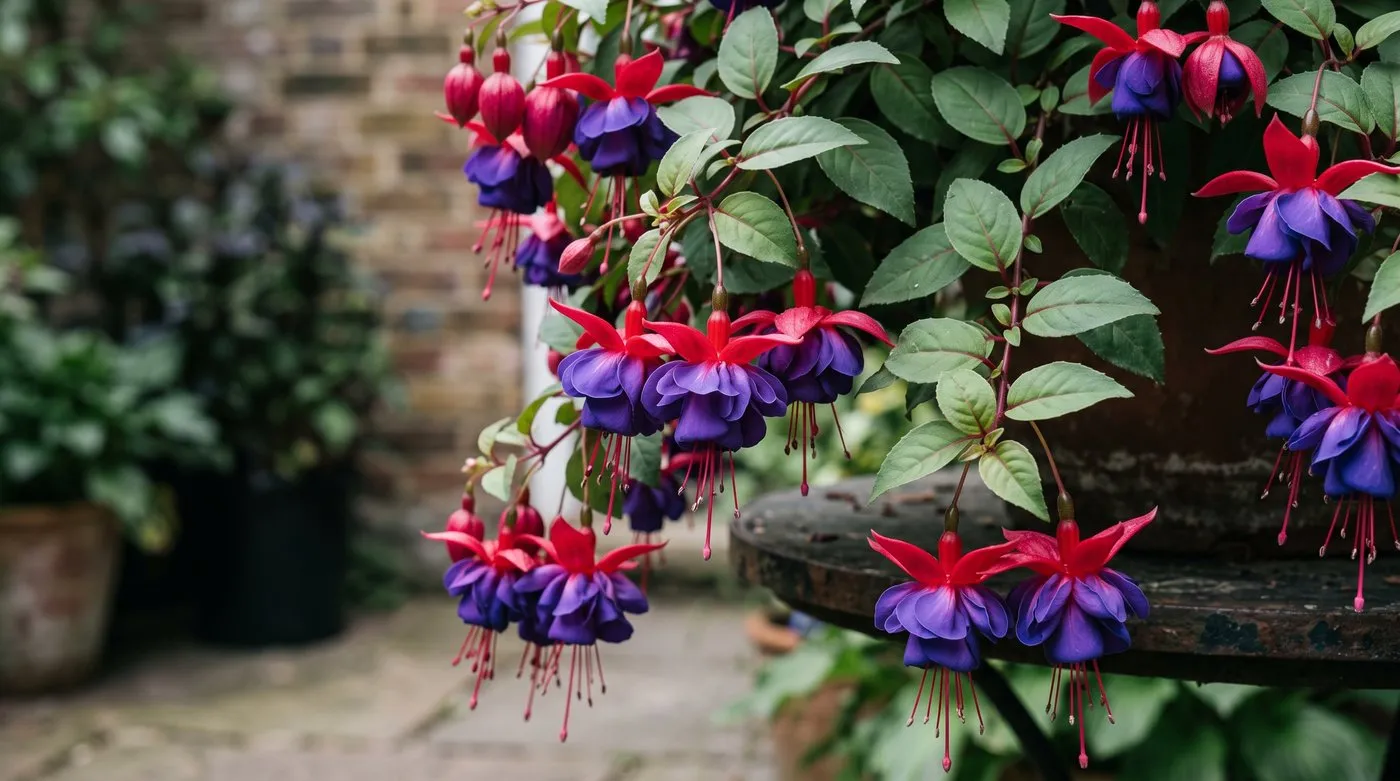
Tender doubles like ‘Dark Eyes’ give the showiest flowers. Just remember to bring them in before the first frost.
How to plant fuchsias
Plant hardy fuchsias in late May or early June, after the last frost, with the base about 5cm deeper than it was in the pot. Planting a little deeper gives the base extra protection in winter.
Choose partial shade or dappled light. East-facing borders are ideal. Full sun is fine in the north of the UK, but in the south some afternoon shade stops the leaves scorching. Fuchsias are one of the best flowering shrubs for shade. Our shade planting guide has more options.
Dig a hole twice the width of the pot and mix plenty of compost into the soil. Fuchsias are hungry and flower best in rich soil that holds moisture. They cope with clay better than most shrubs, but a little grit helps.
Space hardy fuchsias 60-90cm apart in a border. For an informal hedge, plant ‘Riccartonii’ 45cm apart. Water well after planting and mulch with bark or compost.
‘Swingtime’ is the classic trailing basket fuchsia, with big double red and white flowers.
How to plant fuchsia hanging baskets
Plant fuchsia baskets in late May, with three plants in a 35cm basket of multipurpose compost. That gives the stems time to trail before the main show in July and August.
Line a wire basket with moss or a coir liner. Fill with multipurpose compost mixed with water-retaining gel and slow-release fertiliser. Plant three trailing fuchsias evenly around the edge, tilted outwards so they trail from the start.
Water every day in summer, and twice a day in hot weather. Baskets dry out faster than any other pot. A basket with a built-in water reservoir helps a lot.
Feed weekly with tomato feed from June to September. It encourages flowers rather than leaves. Stop in September as growth slows.
Pinch out the tips of young plants twice, once when they have three pairs of leaves and again when the side shoots have two pairs. This makes bushy plants with more flowers. Each pinch delays flowering a little, so start in April.
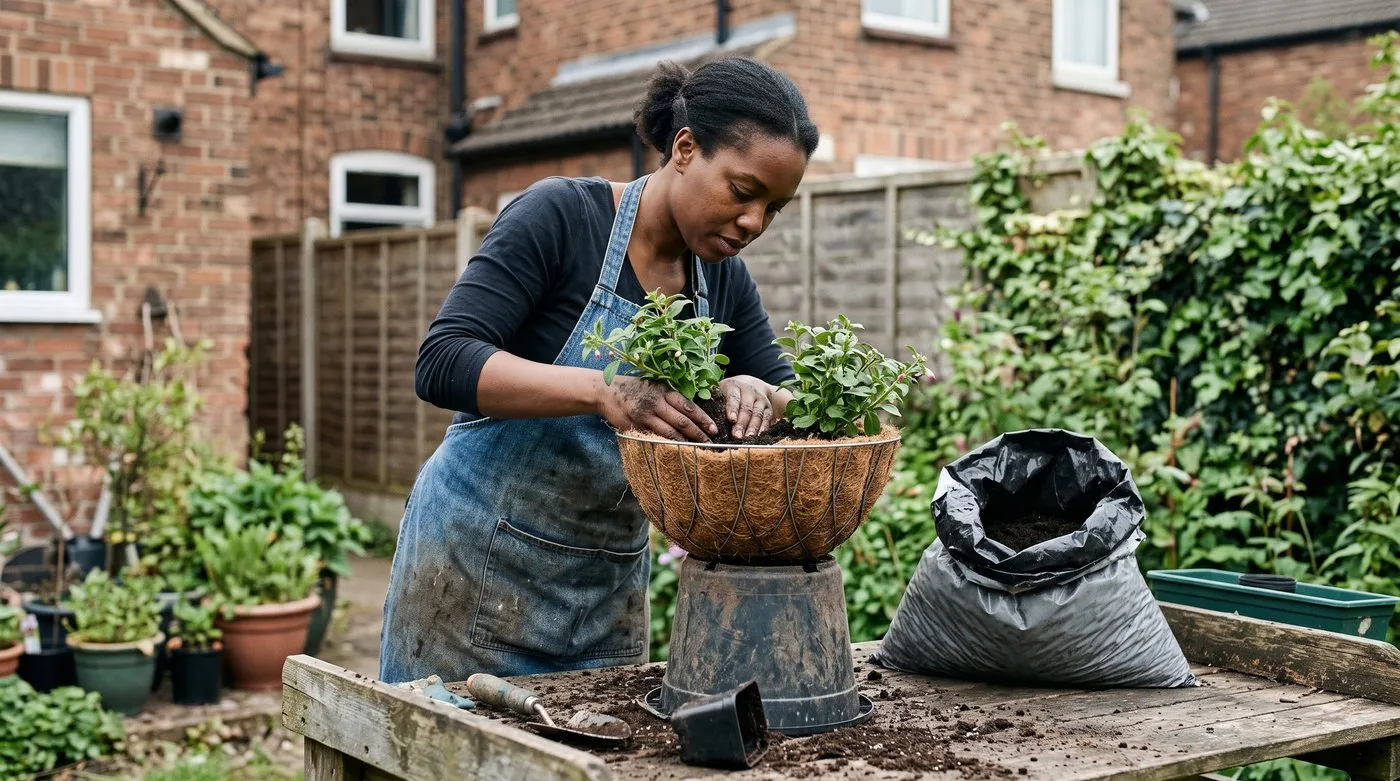
Tilt the plants outwards as you plant so they start trailing straight away. Three is plenty for a 35cm basket.
How to prune fuchsias
Prune hardy fuchsias hard in late spring, not autumn. The old stems help protect the base from frost over winter. This is the most important care tip for hardy fuchsias.
Hardy fuchsias
Wait until late April or early May, when you can see new buds low on the old stems or at the base. Cut all stems back to about 15cm above the ground and remove any dead, blackened ones. After a mild winter, when the stems have come through fine, you can just cut back by a third to strong buds.
The plant looks bare for a few weeks, then shoots away and flowers from late June. Give it a general feed after pruning.
Our spring pruning guide covers roses and other shrubs too.
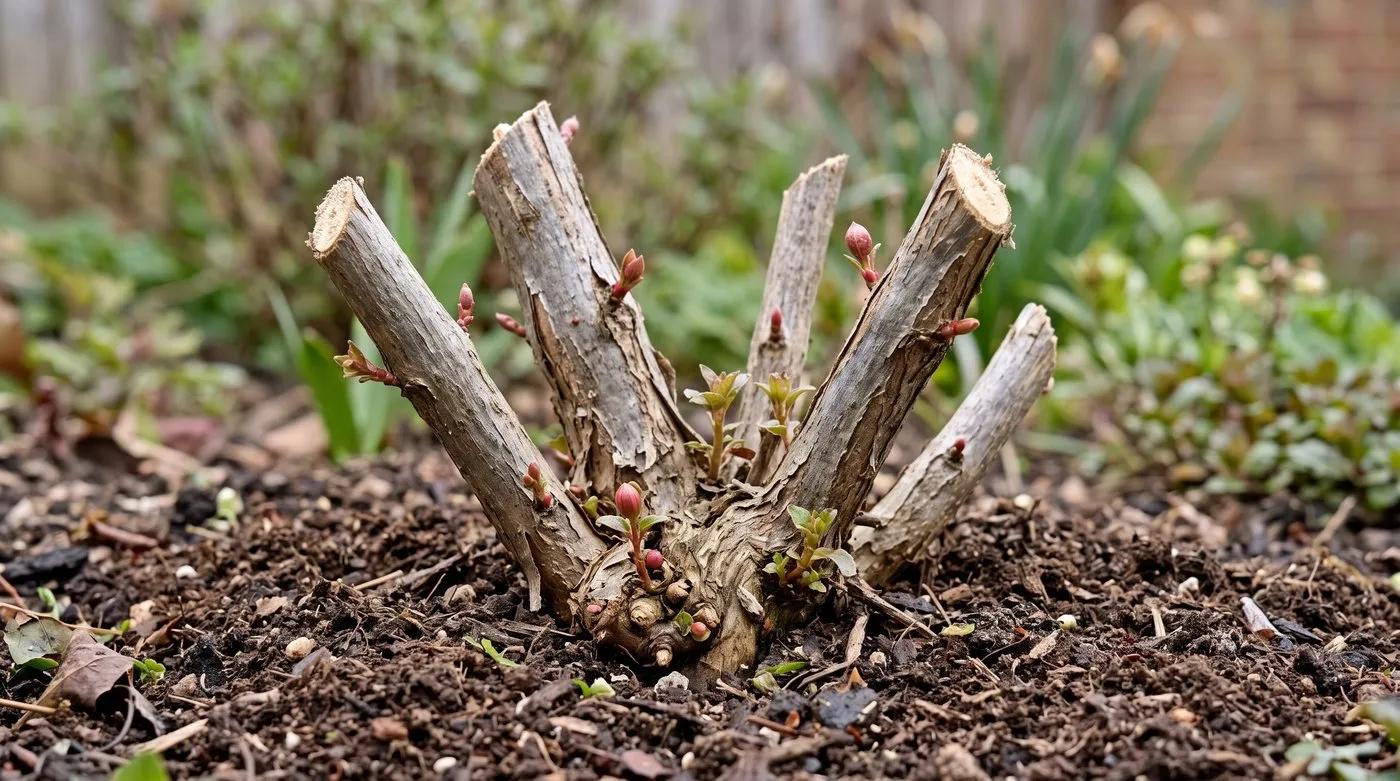
Wait until you see buds low on the stems, then cut back to about 15cm. It looks bare for a few weeks, then shoots away.
Tender fuchsias
Trim tender fuchsias back by a third before bringing them in in October. It makes them easier to store and removes soft growth that can go mouldy. In March, prune harder, back to 2-3 leaf joints on each stem, for fresh, bushy growth. Pinch out the tips twice in April and May.
How to overwinter fuchsias
Tender fuchsias need somewhere cool but frost-free, around 5-7C, from October to May. Without it, they die in the first frost.
Bring pots and baskets in before the first frost, so keep an eye on the forecast from mid-October. An unheated greenhouse, cold conservatory, cool porch or frost-free garage with a window all work. Cool keeps them resting; frost-free keeps them alive.
Keep the compost barely moist over winter. Don’t let it dry out completely, but never keep it wet. Too much water in winter rots the roots, and that kills more fuchsias than the cold.
In February and March, give them more light, warmth and water bit by bit. Prune hard, repot in fresh compost and start feeding when new growth appears. Move them outside after the last frost, usually late May. Harden them off over a week or so first; our hardening off guide shows how.
Hardy fuchsias outdoors: Just leave the old stems standing. In a very cold, exposed garden, cover the base with a thick mulch of bark, straw or bracken in November and remove it in April.

Keep overwintering fuchsias cool, frost-free and only just moist. Too much water in winter kills more than the cold does.
How to take fuchsia cuttings
Fuchsias are one of the easiest plants to grow from cuttings, so you can make lots of new plants for free. April to June is the best time.
Pick shoot tips 7-10cm long with no flowers. Cut just below a leaf joint with a sharp knife. Remove the lower leaves, leaving two or three pairs at the top, and pinch off any flower buds.
Push the cuttings around the edge of a 9cm pot of moist perlite, or perlite mixed half and half with seed compost. Four or five fit in a pot. You don’t need rooting powder.
Cover with a clear plastic bag or pop them in a propagator. Keep them in bright light out of direct sun, and mist if the cover stops misting up.
Roots usually form in 2-3 weeks. Give a gentle tug, and if you feel resistance, they’ve rooted. Pot each one into its own 9cm pot of multipurpose compost. Pinch out the tip when it has three pairs of leaves to make it bushy.
Fancy creating your own varieties? Our guide explains how to hybridise your own fuchsias by hand-pollinating and growing the seedlings.
Training fuchsias as standards
A standard fuchsia is a bare stem with a round head of flowers on top, like a little tree. It takes about 18 months to two years from a cutting and makes a lovely patio centrepiece.
Start with a strong young plant with one straight stem. Push in a cane and tie the stem to it every 10cm as it grows. Remove side shoots, but keep the leaves on the main stem, as they feed the plant while the stem thickens.
When the stem is 15-20cm taller than you want the head, pinch out the tip. Side shoots will grow from the top and form the head. Pinch these after two or three pairs of leaves to make it dense and bushy.
Once the head has filled out, slowly remove the leaves from the stem below. Keep the cane in for good, as fuchsia stems snap easily in the wind.
Hardy varieties like ‘Riccartonii’ and ‘Mrs Popple’ can stay out all year as standards in a sheltered spot. Tender standards need a frost-free home in winter.
A fuchsia standard takes a while to train, but makes a striking centrepiece for a patio or doorway.
Fuchsia gall mite: identification and control
Fuchsia gall mite is the most serious fuchsia pest in the UK, and there’s no reliable spray for it. It’s widespread in southern England and spreading north.
The mite is too tiny to see. Look for the damage instead: swollen, twisted, reddish or yellowish growth at the shoot tips, flowers and buds. It looks lumpy, a bit like cauliflower, and the flowers don’t form properly.
What to do:
- Cut out all affected growth well below the damage, at least 15cm. Bin or burn it, and don’t compost it.
- Check plants regularly from April. The sooner you spot it, the better.
- Keep affected plants away from healthy fuchsias. The mites spread easily on the breeze.
- Some varieties seem to be less affected than others, so ask your nursery if gall mite is a problem locally.
If a plant is badly affected, it’s best to dig it up and bin it, then replace it with something else. For other pests, see our organic pest control guide. Not every visitor is a pest, though. The elephant hawk moth caterpillar nibbles fuchsia leaves in late summer, does little harm and turns into a stunning pink moth.
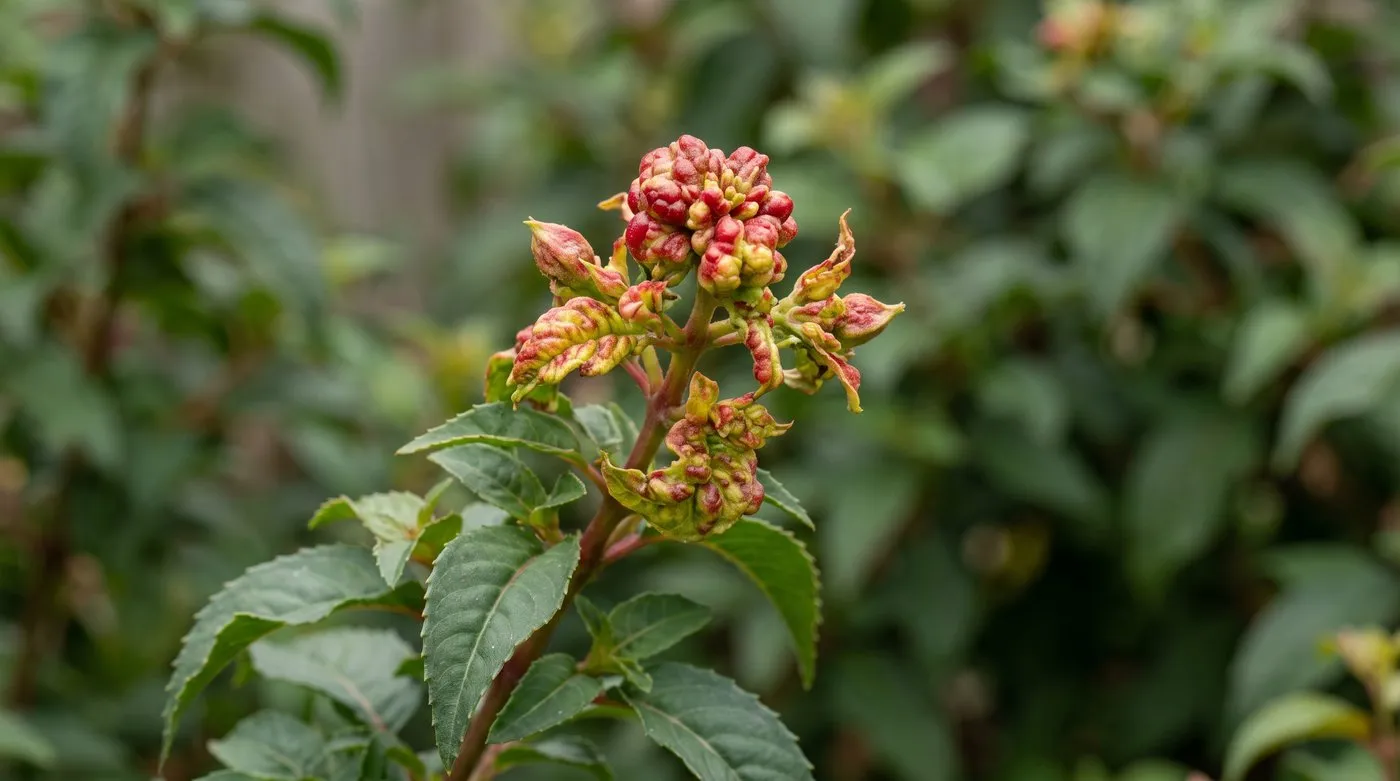
Lumpy, red, cauliflower-like tips are the sign of gall mite. Cut well below the damage and bin it, never compost it.
Common problems with fuchsias
Most other fuchsia problems are easy to sort. Plants that are well watered, well fed and in the right light have far fewer problems.
Capsid bugs: Twisted shoot tips and ragged holes in young leaves in spring. It looks a bit like gall mite, but without the swollen red growth. Pinch off the damaged tips and the plant soon grows out of it.
Vine weevil: The grubs eat roots in pots, so plants suddenly wilt and collapse. Water pots with vine weevil nematodes in spring and late summer.
Grey mould: Fluffy grey mould on dead flowers and leaves, mostly in damp, still air. Pick off faded flowers and keep air moving. It’s most common on plants overwintering in stuffy, damp spots.
Whitefly: Tiny white flies on the undersides of leaves that rise in a cloud when you shake the plant. Annoying but rarely fatal. In a greenhouse, use the Encarsia biological control. Don’t use home-made soap sprays; if you need a spray, use an approved product exactly as the label says.
Rust: Orange spots under the leaves, mostly in wet summers. Pick off affected leaves and improve the airflow. It weakens plants but rarely kills them.
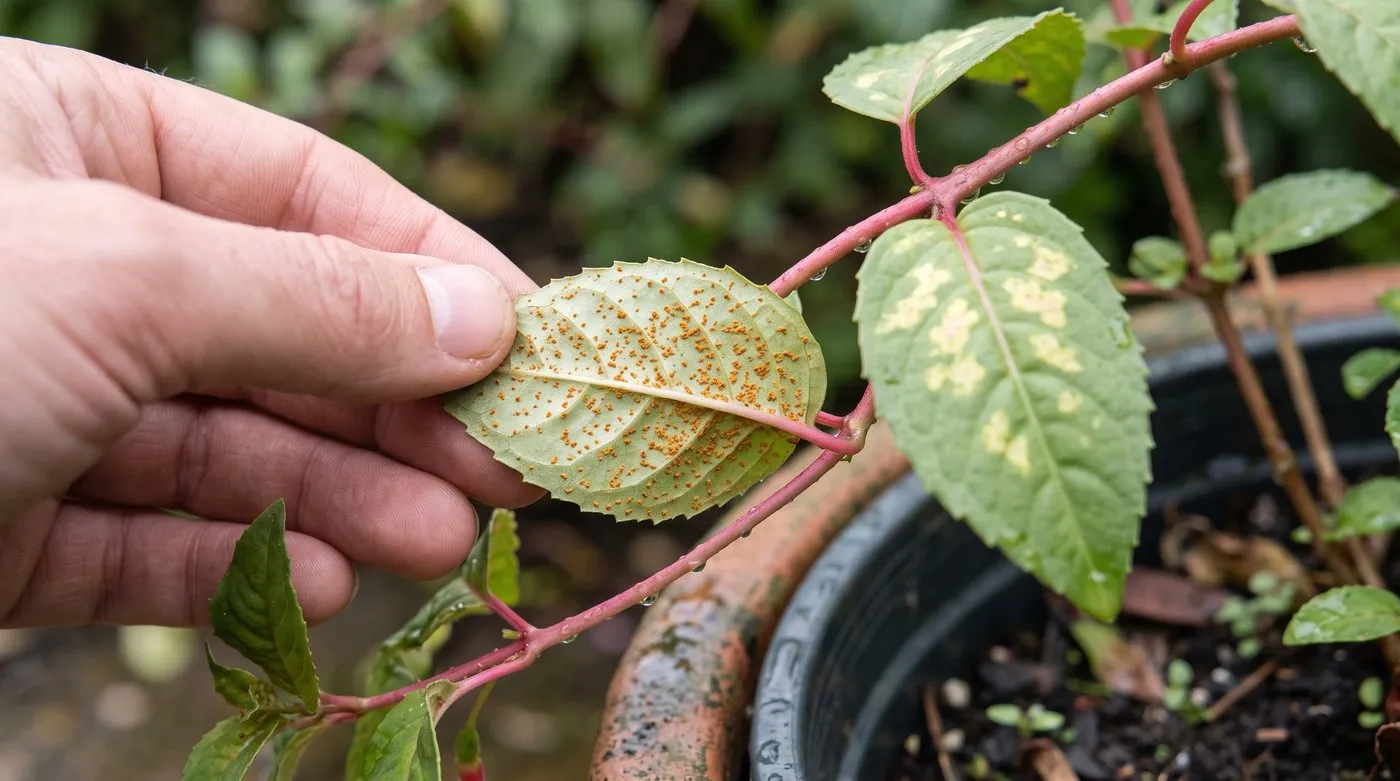
Orange spots under the leaves are fuchsia rust, most common in wet summers. Pick off affected leaves and give the plant more air.
Fuchsias month-by-month calendar
Hardy and tender fuchsias need different jobs at different times.
| Month | Hardy fuchsias | Tender fuchsias |
|---|---|---|
| January | Leave alone | Check stored plants, water a little |
| February | Leave alone | Give them more light |
| March | Watch for buds on old stems | Prune hard, start watering, repot |
| April | Prune hard to 15cm once buds show; remove mulch | Take cuttings, pinch out tips |
| May | Feed and mulch | Plant baskets after the last frost |
| June | Flowers start, feed monthly | Flowers start, feed weekly |
| July-Aug | Deadhead, water in dry spells | Deadhead, water daily, feed weekly |
| September | Enjoy the late flowers | Feed less |
| October | Leave stems standing | Bring in before frost |
| November | Mulch the base in exposed gardens | Keep compost barely moist |
| December | Leave alone | Keep cool and frost-free, check for rot |
Frequently asked questions
When should I prune hardy fuchsias?
Prune them hard in late April or early May. Wait until you can see new buds low on the old stems. Cut everything back to about 15cm above the ground. Don’t prune in autumn, because the old stems help protect the base from frost. After a mild winter, you can just cut back by a third.
How do I overwinter tender fuchsias?
Bring them in before the first frost, usually October. Keep them somewhere cool but frost-free, like an unheated greenhouse, cold porch or garage with a window. Keep the compost barely moist. In March, prune hard, repot and water more. Move them out after the last frost in late May.
Can fuchsias grow in shade?
Yes, they love partial shade and dappled light. They flower well in north and east-facing borders. Full sun is fine in the north of the UK, but in southern England some afternoon shade stops the leaves scorching and wilting. They’re one of the best flowering plants for a shady spot.
How do I take fuchsia cuttings?
Take soft shoot tips about 7-10cm long from April to June. Choose shoots without flowers, cut below a leaf joint and remove the lower leaves. Push them into moist perlite or seed compost and cover with a clear bag. Roots usually form in 2-3 weeks. No rooting powder needed.
What is fuchsia gall mite?
It’s a tiny mite that makes shoot tips swollen and twisted. Affected growth looks lumpy, red and cauliflower-like, and flowers don’t form properly. It’s widespread in southern England. There’s no reliable spray, so cut out affected shoots well below the damage and bin or burn them.
Are fuchsias perennial in the UK?
Hardy fuchsias are, coming back every spring. They often die back to the ground in winter and regrow from the base. Tender fuchsias only last from year to year if you keep them frost-free indoors over winter. In mild coastal parts of south-west England, some tender types survive outside.
Which fuchsia is best for hanging baskets?
‘Marinka’ and ‘Swingtime’ are the classic basket fuchsias. Both have long trailing stems covered in flowers from June to October. Plant three in a 35cm basket of multipurpose compost. Feed weekly with tomato feed and water every day in summer.
Our team produces practical UK gardening guidance from source research, contributor records and established horticultural practice. Editorial standards are overseen by Matt W.