Key takeaways
- Star jasmine is hardy in most of southern and central England against a sheltered wall
- Plant by a south or west-facing wall in soil that drains well
- It flowers from June to August, so prune lightly once flowering is over
- Train stems sideways along wires for lots more flowers
- In pots, use a container at least 40cm wide with John Innes No. 3
- Young plants can take a couple of years to flower well, so be patient
Star jasmine is one of the loveliest evergreen climbers you can grow in a UK garden. It’s covered in white, pinwheel-shaped flowers from June to August, and the sweet scent drifts across the garden on warm summer evenings. Unlike common jasmine, it keeps its glossy dark green leaves all winter, so your wall looks good all year.
Despite the name, it isn’t a true jasmine. It comes from China and Japan and just happens to smell a lot like jasmine. In the UK it needs two things: a sheltered wall and soil that drains well. Get those right and you’ve got a climber that earns its place every month of the year.
Which star jasmine should you grow?
You’ll find a few types in UK nurseries. Pick by how sheltered your garden is and what you’re after.
Trachelospermum jasminoides is the standard star jasmine and the best all-rounder. It has the most flowers and the strongest scent, and holds an RHS Award of Garden Merit. Its glossy leaves often turn bronze-red in cold winters, which looks lovely. Go for this one if scent and flowers are top of your list.
Variegated star jasmine, such as ‘Variegatum’, has cream-edged leaves and the same white flowers. It’s a little slower growing, and great if you want brighter leaves in a sheltered spot.
Trachelospermum asiaticum has smaller, creamy-yellow flowers and a neater, slower habit. It’s often said to be a little tougher, so it’s worth trying in colder or more exposed gardens.
| T. jasminoides | Variegated forms | T. asiaticum | |
|---|---|---|---|
| Flowers | White | White | Creamy yellow |
| Scent | Strong and sweet | Strong and sweet | Sweet, a little lighter |
| Size | Big | A bit smaller | Smaller, neater |
| Growth | Steady | Slower | Slower |
| Leaves | Glossy dark green | Green and cream | Smaller, dark green |
| Best for | Scent and flowers | Pretty leaves | Colder gardens |
Where to plant star jasmine
Star jasmine needs a warm, sheltered spot. A south or west-facing wall is best in most of England. East-facing walls get early sun that thaws frozen leaves too fast and can damage them. North-facing walls are too cool for good flowering.
Soil: It likes fertile soil that drains well and hates sitting wet. On heavy clay, dig a big planting hole and mix plenty of grit into the soil you put back. Wet roots in winter kill more star jasmine than cold air does.
Spacing: Plant about 30-45cm out from the wall and lean the stems in towards it. The soil right at the foot of a wall is often very dry, so this helps the roots get rain. If you’re planting several, space them 2-3m apart.
 Training star jasmine sideways along wires gives you more flowering shoots.
How to train star jasmine on a wall
Training stems sideways is the secret to lots of flowers. Sideways stems send up plenty of flowering side shoots. Stems left to go straight up tend to flower at the top and go bare at the bottom.
Fix galvanised or stainless steel wires to the wall with vine eyes, about 30cm apart, and pull them tight. Start the bottom wire about 45cm off the ground so air can move around the base.
Fan the first stems out from the planting spot, then tie each one to a wire with soft twine or stretchy plant ties. Don’t use wire or cable ties, which cut in as stems thicken. As new growth comes, guide it along the wires and tie it in every month or so from April to September.
Pinch out the tips of sideways stems when they reach the edge of the space. This makes them branch and gives you a thicker cover of flowering stems.
Star jasmine twines, but it can’t stick to a bare wall like Virginia creeper. Without wires or trellis, it just makes a loose mound. For other climbers to cover a wall, see our guide to evergreen climbers for year-round cover.
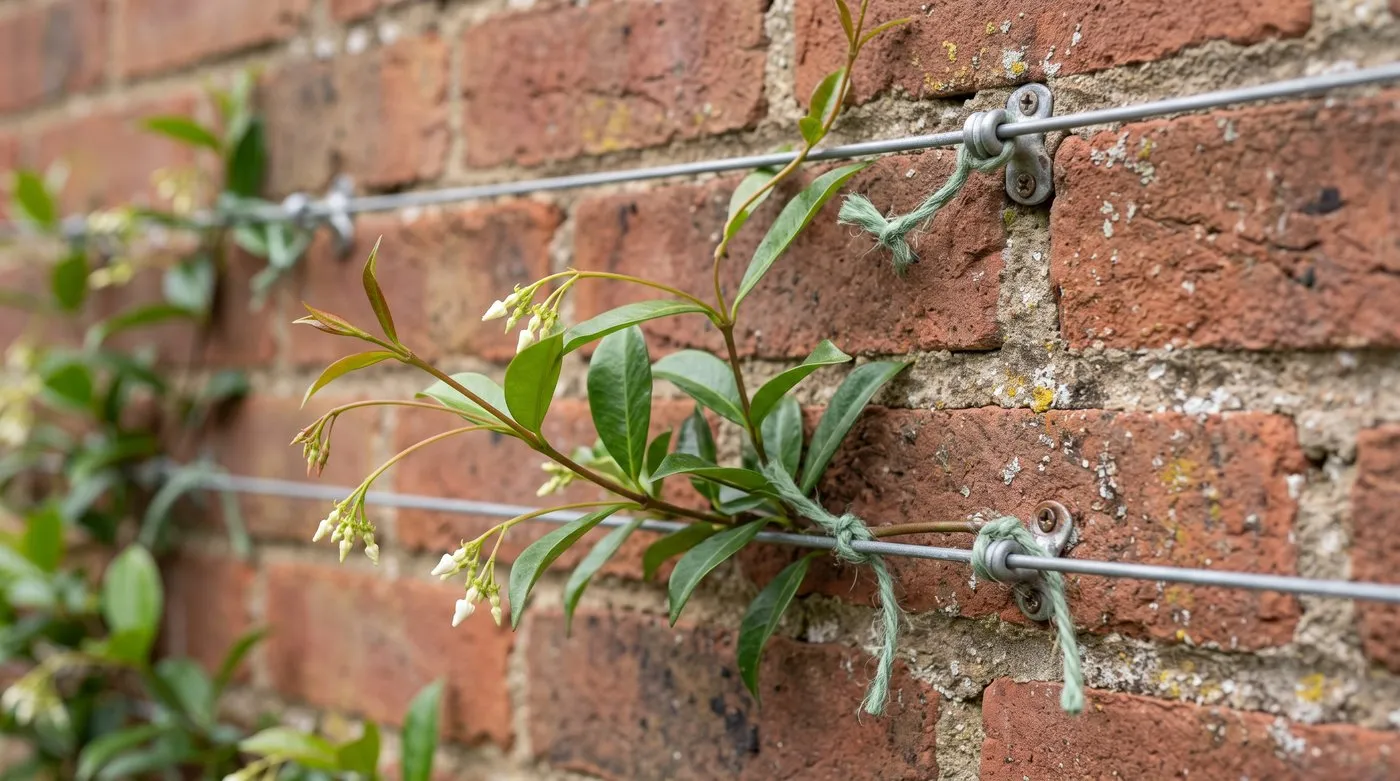
Tie stems loosely with soft twine, never wire or cable ties. Sideways stems send up far more flowering shoots than upright ones.
Growing star jasmine in pots
A pot is the safest way to grow it in colder parts of the UK. You can move it somewhere sheltered in a cold snap, so it’s far less likely to be lost over winter.
Use a pot at least 40cm wide and 40cm deep. Terracotta or stone protects the roots from cold better than plastic. Fill with John Innes No. 3 mixed with some perlite. This soil-based compost holds food and water better than multipurpose, and its weight stops a tall plant toppling over in the wind.
Watering: Keep it evenly moist from April to September, watering when the top few centimetres feel dry. Don’t let the pot stand in a saucer of water. In winter, water just enough to stop the compost drying out completely.
Feeding: Give a tomato feed every two weeks from April to August to help the flowers. Finish with one balanced feed in September.
 Star jasmine on an obelisk in a big pot looks great on a patio and can be moved to shelter in a hard winter.
How to prune star jasmine
Prune lightly once flowering is over in late summer. Star jasmine doesn’t need much cutting. Heavy pruning in spring can remove shoots that would have flowered that summer, which is a common reason for a poor show.
Yearly tidy: Shorten flowered shoots, remove any dead, damaged or crossing stems, and cut back shoots growing away from the wall. This keeps it in its space and encourages fresh growth for next year’s flowers.
Rescuing an overgrown plant: You can cut a neglected plant back hard, close to the main stems, in April. You’ll lose a year of flowers, but new shoots soon appear and it comes back fuller. For more on timing, see our spring pruning guide.
After winter: In March, snip off any frost-damaged shoots back to healthy green growth just above a leaf. Don’t cut more than you need to.
Good to know: Cut stems ooze a milky sap that can irritate skin and stain clothes. Wear gloves when pruning and wipe your tools afterwards.
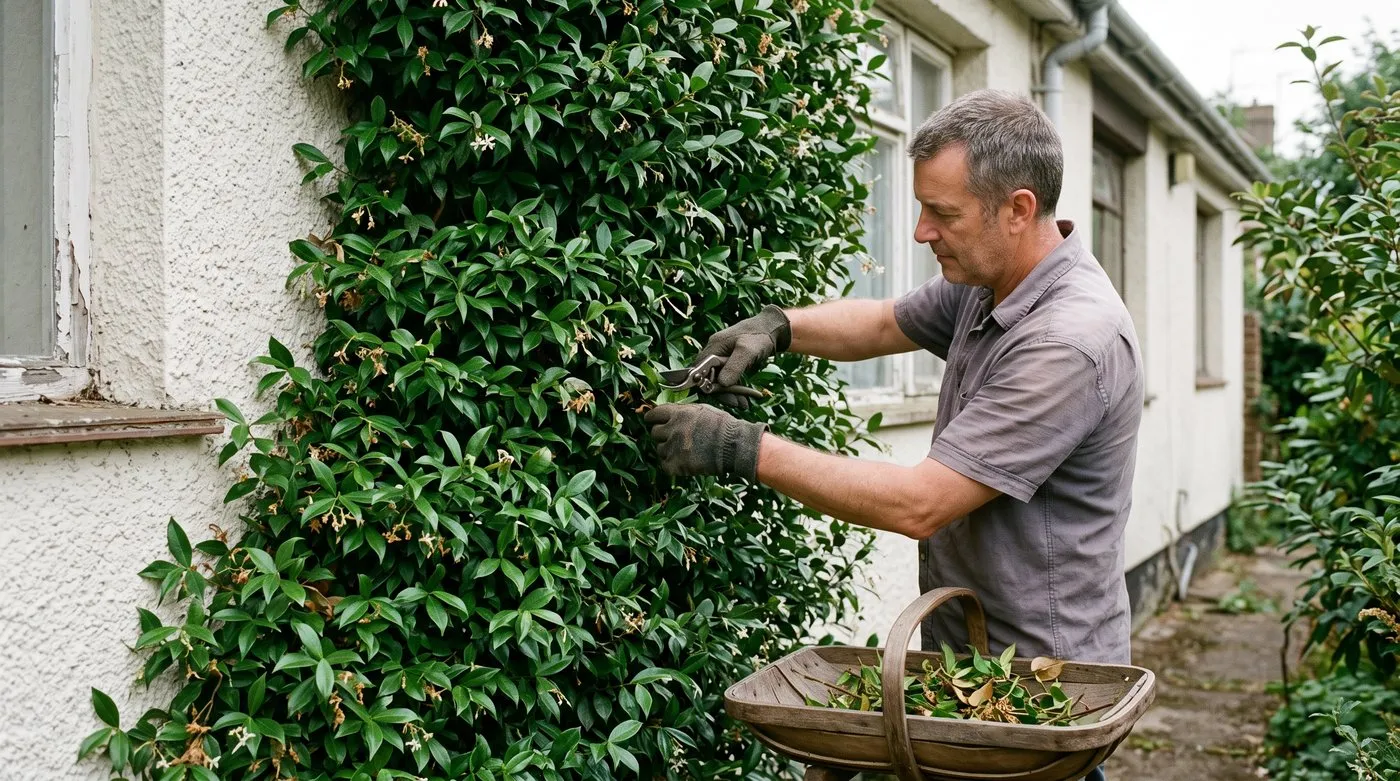
A light trim after flowering is all it needs. Wear gloves, as the milky sap can irritate skin.
Winter care
With the right spot, star jasmine gets through most winters in England and Wales. But it’s about more than just how cold it gets.
Three things that keep it alive in winter:
- Good drainage matters most. Cold, waterlogged soil kills roots. Plants on heavy clay with no grit added are most at risk.
- A warm wall gives shelter and keeps a little warmth after dark. In the Midlands and the north, it’s a must.
- A thick bark mulch over the roots evens out the cold. Spread it in October, keeping it a little away from the stem.
Pots in winter: Move them against your warmest wall. Wrap the pot (not the plant) in bubble wrap or hessian to protect the roots. Throw fleece over the leaves in hard frosts and take it off again in mild spells so the plant doesn’t go mouldy. Our guide on how to protect plants from frost has more tips.
Where you live:
| Region | In the ground | In a pot |
|---|---|---|
| South-east England | Reliable in a sheltered spot | Little protection needed |
| South-west England | Reliable, likes the milder weather | Little protection needed |
| Midlands | South or west walls only, with good drainage | Move to a sheltered wall in winter |
| Northern England | South walls only, a bit risky | Fleece in hard frosts |
| Scotland | Not a good idea | Grow in a pot and bring under cover in hard frost |
| Coast | Sheltered spots, copes with a little salt spray | Great in sheltered seaside gardens |
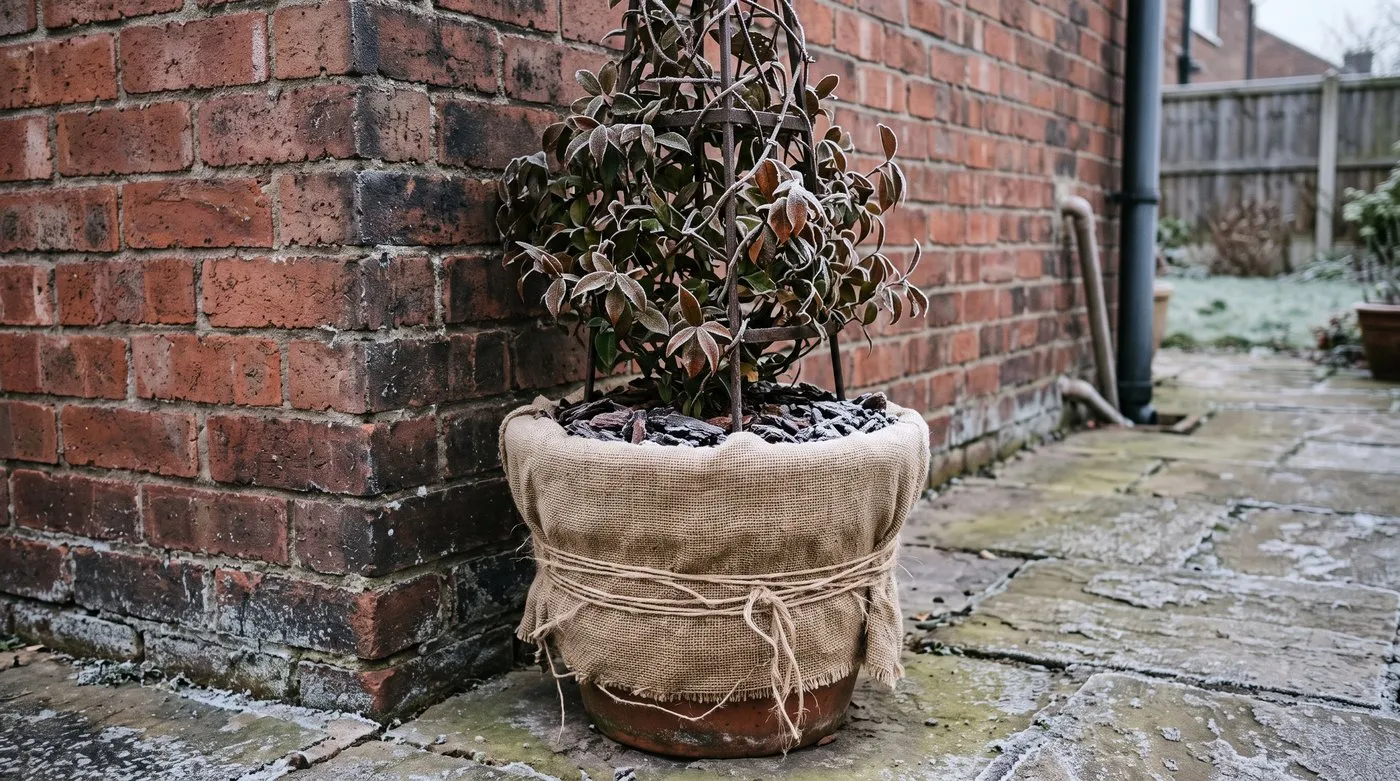
Wrap the pot, not the plant, and push it against your warmest wall. Bronze-red winter leaves are normal and turn green again in spring.
Star jasmine care month by month
| Month | What to do |
|---|---|
| January | Check for wind damage. Water pots lightly if bone dry. |
| February | Order plants. Improve drainage where you’ll plant. |
| March | Snip off frost-damaged shoots back to healthy growth. |
| April | Plant new star jasmine. Fix wires. Start tying in new growth. |
| May | Start feeding. Water pots more as growth speeds up. |
| June | First flowers. Tie in new shoots. Keep feeding pots. |
| July | Peak flowering. Enjoy the evening scent. Keep pots watered. |
| August | Flowers fade. Prune lightly once they’re done. |
| September | Give a last balanced feed. Take cuttings. |
| October | Mulch the base with bark. Move pots to sheltered spots. |
| November | Wrap pots. Check wall ties before winter storms. |
| December | Enjoy the evergreen leaves. Water pots only if very dry. |
How to get more star jasmine
Semi-ripe cuttings in August and September are the easiest way for home gardeners.
Pick healthy shoots from this year’s growth without flowers. Cut 10-15cm lengths just below a leaf joint and strip the lower two pairs of leaves. Dip the end in rooting powder and push it into a small pot of half perlite, half peat-free compost.
Cover with a clear plastic bag and keep it somewhere warm and bright, out of direct sun. Roots usually form in a couple of months. Pot up into John Innes No. 2 once you see roots at the bottom. Keep young plants frost-free over winter and plant out the next spring after the last frost. Expect flowers in a few years.
Layering is even easier. In spring, peg a low stem down to the ground with a bent wire, cover that part with compost and leave it for a year. The next spring, cut it free from the parent and plant it on. It’s very reliable, as the stem stays fed by the parent while it roots.
 Star jasmine’s pretty pinwheel flowers, each with five twisted white petals.
Common star jasmine mistakes
Planting somewhere exposed. In most of the UK, star jasmine isn’t one for an open fence or freestanding pergola. Without a wall behind it, it suffers in cold winds and flowers poorly. Sheltered coastal gardens in Devon, Cornwall and the Channel Islands are the exception.
Pruning hard in spring. Heavy spring pruning can cut off the shoots that would flower that summer. Keep pruning light, and do it after flowering.
Watering too much in winter. Star jasmine is barely growing from November to March, so wet soil just sits around the roots and can rot them. On clay, don’t water wall plants in the ground at all in winter.
Expecting instant results. Young plants grow slowly for the first couple of years while they build roots. Then they speed up. Most don’t flower reliably until their third or fourth year. Patience pays off.
Using the wrong compost in pots. Multipurpose compost is light and dries out fast in summer. Once bone dry, water just runs down the sides. John Innes No. 3 is the one for long-term pots, and the RHS guide to growing climbers has more advice on climbers in containers.
Star jasmine or another scented climber?
Star jasmine is one of several scented plants that make lovely wall climbers. Here’s how it stacks up against other favourites.
| Star jasmine | Common jasmine | Honeysuckle | Wisteria | |
|---|---|---|---|---|
| Evergreen | Yes | No | Some are semi-evergreen | No |
| Size | Medium to big | Big | Medium | Very big |
| Scent | Sweet and strong | Sweet | Sweet, musky | Sweet |
| Flowers | Jun-Aug | Jun-Sep | Jun-Sep | May-Jun |
| Growth | Steady | Fast | Fast | Fast |
| Support | Wires | Wires or trellis | Wires or trellis | Strong wires |
| Looks good in winter | Yes, evergreen | No, bare stems | Sometimes | Bare stems |
Star jasmine wins for year-round looks, as it keeps its leaves through winter. Common jasmine grows faster but is bare by November. Honeysuckle is tough but can get messy without regular trimming. Wisteria is the showiest in flower but bare for much of the year.
For more ideas, see our guide to the best climbing plants for UK gardens.
For more ways to cover fences and walls, see our guide to fast-growing climbers for fences and walls.
Frequently asked questions
Is star jasmine hardy in the UK?
Yes, in most of England and Wales, given a sheltered south or west-facing wall. Cold, soggy soil around the roots is a bigger danger than cold air. Add grit when planting and mulch the base with bark before November. In Scotland and exposed northern spots, grow it in a pot you can move to shelter.
Does star jasmine grow well in pots in the UK?
Yes, it’s very happy in a pot. Use one at least 40cm wide and deep, filled with John Innes No. 3 with some perlite mixed in. Train it up an obelisk or trellis. Water when the top few centimetres are dry and give tomato feed every two weeks from April to August. In winter, move it against a sheltered wall and fleece it in hard frosts.
When does star jasmine flower in the UK?
It flowers from June to August, at its best in July. The scent is strongest on warm evenings. Young plants may only flower a little for the first couple of years, so be patient. Once settled, a mature plant is covered in flowers each summer.
How do I train star jasmine on a wall?
Fix horizontal wires to the wall about 30cm apart using vine eyes. Tie stems to the wires with soft twine, fanning them out. Train shoots sideways rather than straight up, as sideways stems give more flowering shoots. Tie in new growth every month or so in the growing season.
What is the difference between star jasmine and common jasmine?
Star jasmine keeps its leaves in winter, while common jasmine drops them. Despite the name, star jasmine isn’t a true jasmine at all. It has glossy, leathery leaves and a similar sweet scent. Common jasmine (Jasminum officinale) grows faster and bigger but has bare stems all winter.
Why is my star jasmine not flowering?
Usually it’s not getting enough sun. Star jasmine needs plenty of direct sun to flower well. Other causes are heavy pruning in spring, too much high-nitrogen feed, or a plant that’s still young. Most take a couple of years after planting to flower reliably.
Can star jasmine survive a UK winter outdoors?
Yes, in most of southern and central England once it’s settled. The keys are a sheltered wall, soil that drains well and a thick bark mulch over the roots. In the Midlands and the north, a warm wall is a must. Out in the open with no wall behind it, it’s much less likely to survive a hard winter.
Our team produces practical UK gardening guidance from source research, contributor records and established horticultural practice. Editorial standards are overseen by Matt W.