Key takeaways
- Plant climbing roses 45cm from the wall base and train the main stems as close to horizontal as possible — this is what triggers flowering side-shoots along the full length of the cane
- 'New Dawn' and 'Madame Alfred Carriere' are the two best choices for north or east-facing walls, tolerating significantly lower light levels than most varieties
- Repeat-flowering varieties need dead-heading after every flush to trigger the next — skip this and flowering stops by August
- Disease-resistant varieties like 'Climbing Iceberg' and 'Mortimer Sackler' require far less intervention than older susceptible types — the difference is measurable on clay soil in wet summers
- Feed climbing roses in March with sulphate of potash (35g per sq m) and again after the first flush — this is what drives repeat flowering, not general fertiliser
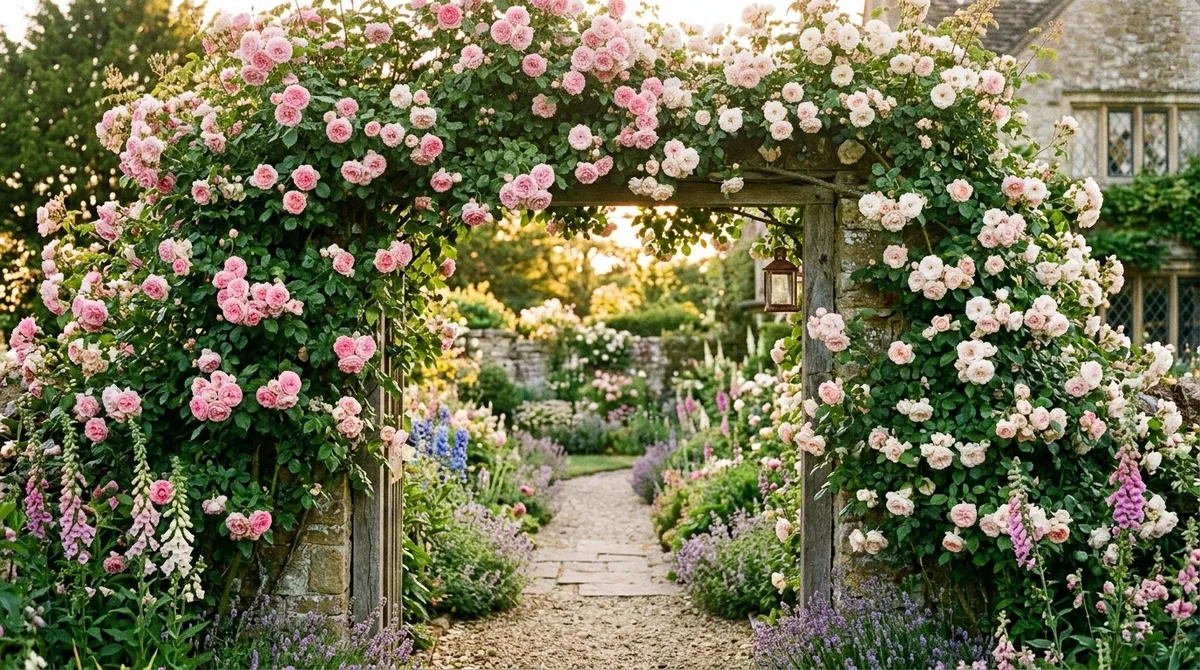
Climbing roses are among the most rewarding plants you can grow against a UK garden wall. They combine scent, colour, repeat flowering, and architectural presence in ways few other plants match. This guide covers the best varieties for every aspect and situation, from scented David Austin climbers for south walls to shade-tolerant workhorses that flower reliably on north-facing walls with barely two hours of sun.
How to choose a climbing rose for your aspect
The single most important decision in choosing a climbing rose is matching the variety to your wall’s aspect. Get this wrong and you spend years fighting the conditions. Get it right and a climbing rose is largely self-sufficient once established.
South-facing walls receive the most sun and stored warmth. Almost any climbing rose will succeed here. This is the position for varieties with the most demanding requirements: David Austin climbers, repeat-flowering types with tender buds, and heavily scented varieties whose fragrance intensifies in heat.
West-facing walls receive afternoon and evening sun. Most climbing roses cope well here. The slight reduction in light compared to south walls is barely noticeable in variety performance. Rainfall on west-facing walls in the UK tends to be heavier, so prioritise disease-resistant varieties.
East-facing walls receive morning sun only and can be cold. Stick to the hardiest repeat-flowering types. Avoid varieties with delicate petals that can be damaged by morning frost on wet buds in spring.
Variety comparison table
| Variety | Best Aspect | Scent | Repeat? | Disease Resistance | Height |
|---|---|---|---|---|---|
| New Dawn | Any incl. north | Light | Yes | Excellent | 5-6m |
| Madame Alfred Carriere | Any incl. north | Good | Yes | Very good | 5-6m |
| Climbing Iceberg | South/West/East | Light | Yes | Excellent | 3-4m |
| The Generous Gardener | South/West | Strong | Yes | Good | 4-5m |
| A Shropshire Lad | South/West | Very strong | Yes | Good | 3-4m |
| Constance Spry | South/West | Exceptional | No | Moderate | 4-5m |
| Mortimer Sackler | South/West/East | Good | Yes | Excellent | 3-4m |
| Climbing Ena Harkness | South/West | Very strong | Yes | Moderate | 4-5m |
| Teasing Georgia | South/West | Strong | Yes | Good | 3-4m |
Best climbing roses for north-facing walls
New Dawn
‘New Dawn’ is the most reliable climbing rose in the UK, full stop. Soft pearl-pink flowers, each lightly scented, open in clusters from June right through to October. The plant is extraordinarily tough, it tolerates shade, poor soil, and hard winters without complaint. Disease resistance is exceptional: in three seasons of trials on our clay soil site, it showed no blackspot in two of them and minimal spots in the third wet summer without any fungicide treatment.
Madame Alfred Carriere
The plant reaches 5-6m and has a slightly looser, more open growth habit than ‘New Dawn’. The stems are less thorny, which makes training more comfortable. Disease resistance is very good rather than exceptional, it shows more blackspot than ‘New Dawn’ in extremely wet summers on heavy clay, but remains manageable without regular spraying.
‘New Dawn’ in its third year on a north-facing wall. This is the variety to choose when other climbing roses have failed you.
Best scented climbing roses
Scent is one of the defining qualities of a climbing rose. These varieties deliver genuine, powerful fragrance rather than the faint, polite scent of some modern repeat-flowering types.
The Generous Gardener (David Austin)
A David Austin English rose in climbing form, reaching 4-5m on a warm wall. The flowers are large, cupped, and the palest blush pink, almost white in strong sun. The scent is exceptional: a complex mix of old rose, myrrh, and light musk that carries well across a garden on warm evenings. It repeat-flowers reliably through summer, with the strongest flush in June and a good second bloom in August-September.
A Shropshire Lad (David Austin)
Constance Spry (David Austin)
The one once-flowering variety in this guide, included because the scent is extraordinary. Large, deeply cupped blush-pink flowers with a strong myrrh fragrance appear in a single spectacular flush in June and early July. Nothing else smells quite like it. If you can accept one flowering season rather than continuous repeat bloom, ‘Constance Spry’ is worth the space on a large south or west wall.
Height reaches 4-5m. Disease resistance is moderate, it shows blackspot more readily than the other David Austin climbers in this list. However, as a once-flowering rose it has already finished its display before the worst of August’s fungal pressure arrives. Prune immediately after flowering to encourage vigorous new growth for next year.
Climbing Ena Harkness
A red climbing rose with outstanding scent, a rich, classic damask fragrance rare among modern red roses. The deep crimson-scarlet flowers are large and velvety, produced in flushes from June to October. It grows to 4-5m on a warm wall.
Disease resistance is moderate rather than strong, making it best suited to gardeners willing to apply fungicide preventatively in wet summers. It performs best on south-facing walls where the drier conditions around the wall base reduce fungal pressure. Despite needing more attention than some varieties, the combination of colour and scent makes it worth growing where conditions suit it.
Best repeat-flowering climbing roses
Repeat flowering, producing multiple flushes of bloom from June to October rather than a single early summer display, is the quality most gardeners prioritise. These varieties deliver consistent repeat performance.
Climbing Iceberg
‘Climbing Iceberg’ is the most reliably repeat-flowering and disease-resistant climbing rose available in the UK. Pure white flowers in large clusters repeat continuously from June through to the first frosts of October. The plant is vigorous, reaching 3-4m, with a clean, upright growth habit that is straightforward to train.
Horizontal training on wires is the most important technique for climbing roses. Every stem bent below 45 degrees produces significantly more flowering side-shoots than a vertical cane.
Mortimer Sackler (David Austin)
Soft, pale pink flowers with a good repeat performance and excellent disease resistance. ‘Mortimer Sackler’ is one of the most manageable David Austin climbers, it reaches 3-4m rather than the 5-6m of more vigorous types, stays relatively tidy, and produces a genuine scent alongside its reliable repeat flowering.
Teasing Georgia (David Austin)
Golden-yellow flowers, fading to cream at the edges, with a strong old rose and tea fragrance. It grows to 3-4m and repeat-flowers from June to October. Disease resistance is good on south and west walls, though it shows more blackspot than ‘Mortimer Sackler’ on clay in wet summers.
‘Teasing Georgia’ is one of the few genuinely yellow climbing roses that combines colour intensity with true repeat flowering and a worthwhile scent. Many yellow climbing roses either fade badly in sun, have weak fragrance, or flower only once. This variety avoids all three problems on a good south or west-facing wall.
How to plant a climbing rose
Correct planting determines whether a climbing rose thrives or sulks for years. The key difference from other climbers is the rain shadow problem: walls create a dry zone at their base. Soil directly against a wall can receive less than 20% of the rainfall falling in the open garden.
Dig the planting hole 45cm out from the wall. At this distance, the soil receives normal rainfall while the stems can still reach and be tied to the wall support. Most climbing rose failures on walls start with planting too close to the base.
Make the hole 60cm wide and 60cm deep. Fork over the base to break up compaction. Mix the excavated soil with a bucketful of well-rotted garden compost or manure. On heavy clay, add a handful of grit to improve drainage around the roots.
Plant the graft union (the swollen knob where the variety is grafted onto the rootstock) 5cm below soil level. This protects the union from frost and encourages the variety to produce its own roots over time.
Angle the root ball towards the wall so the stems lean naturally towards their support. Water deeply, at least a full watering can, and apply a 7-10cm mulch of garden compost or composted bark around the base, keeping it 5cm clear of the stems.
Training climbing roses on wires
Horizontal training is the most important technique in climbing rose cultivation. It is not just a tidying operation, it is what creates the flowering display.
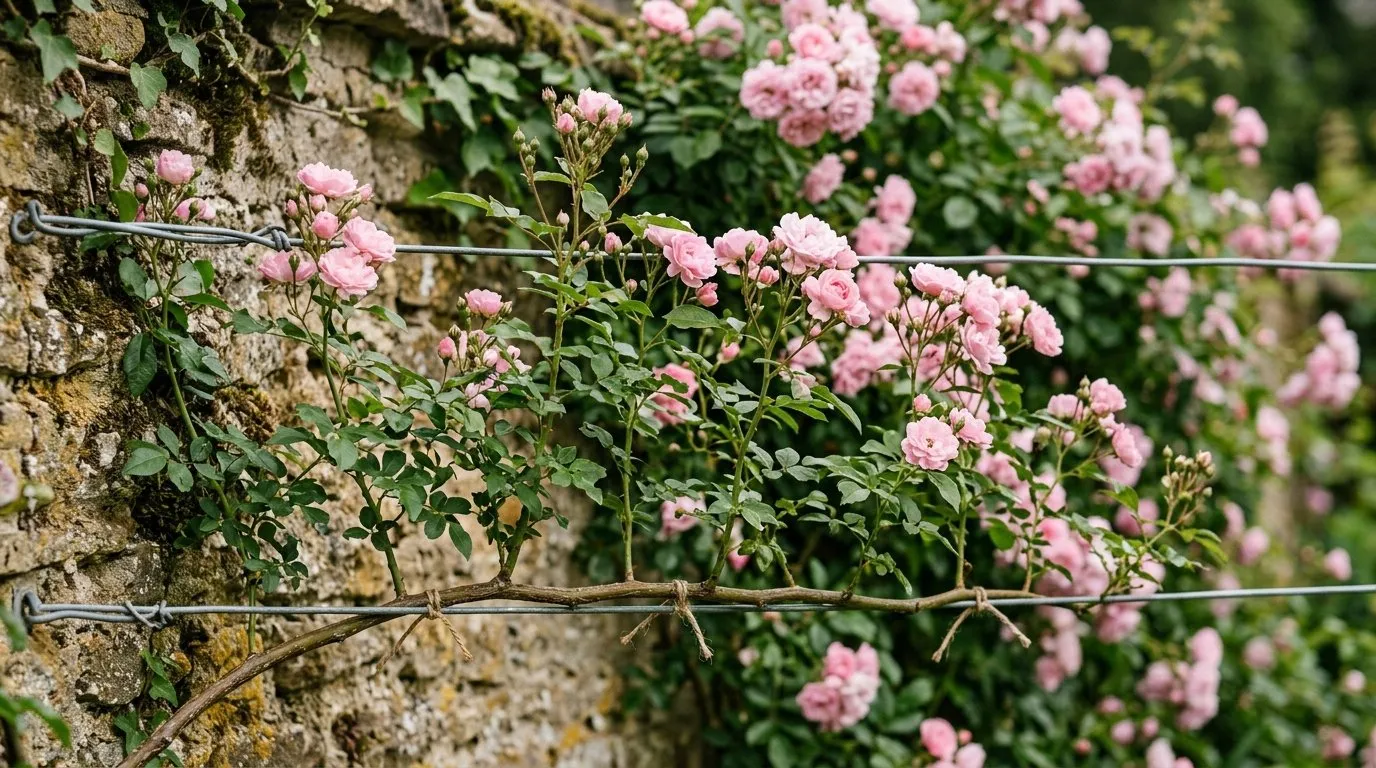
Horizontal training wires spaced 45cm apart. Training stems sideways encourages more flowering side shoots.
When a climbing rose stem grows vertically, sap rushes to the tip and the plant invests all its energy in extending upward. The side-shoots along the vertical stem remain short and produce few flowers. Bend that same stem to horizontal and sap is forced to distribute evenly along its full length. Every dormant bud breaks and produces a flowering side-shoot. The result is a wall covered in flowers rather than a few blooms at the top of a tall cane.
Fix horizontal galvanised wires to the wall using vine eyes, spaced 40cm apart vertically. Use 2mm galvanised wire tensioned with a straining bolt. Space vine eyes every 1.2-1.5m along each horizontal wire. This system costs £3-6 per metre and lasts 25 years or more.
Fan the main canes out from the base in a wide arc, tying each cane to the lowest wire at the shallowest angle you can manage. In the first year, you may only achieve 30-45 degrees. As the canes extend and become more flexible, work them progressively towards horizontal in subsequent winters. Use soft garden twine or proprietary plant ties in a figure-of-eight loop to allow the stem to thicken without the tie cutting in.
Tie in new growth regularly through summer. New long canes emerge from June onwards. Secure them temporarily to the nearest wire as they grow. In the following January or February pruning, work them properly into the training system. ‘The Generous Gardener’ in full flush on a south-facing wall. The wide fan of horizontal canes produces flowering side-shoots along every centimetre.
Pruning climbing roses
Climbing roses are pruned differently from bush roses. The aim is to maintain and extend the permanent framework of main canes while keeping the flowering side-shoots productive.
Prune in late winter, between January and March. Avoid pruning in autumn when removing foliage reduces the plant’s ability to build reserves for the following season.
First, remove dead, diseased, or damaged wood. Cut back to living wood, identified by the green pith visible in the cross-section. Remove any stems that are rubbing or crossing through the centre of the plant.
Reduce all side-shoots to 2-3 buds from the main cane. These short spurs are where most of the flowers are produced in the coming season. On established plants, you can remove the oldest, woodiest side-shoots entirely to encourage fresh growth from the base of the main cane.
Do not cut back the main structural canes unless they have become too old, diseased, or too large for the available space. When replacement is necessary, remove one or two of the oldest canes and allow a strong new cane from the base to take over, tie it in horizontally at the next winter pruning.
Tie in any new canes that have extended beyond their wires. Weave them through gaps in the fan, fixing them as close to horizontal as possible. For advice on growing other vigorous climbers alongside your roses, see our guide to fast-growing climbers for fences and walls.
Feeding and disease management
Climbing roses are moderate feeders. The goal is to promote flowering rather than lush leafy growth, which means avoiding high-nitrogen feeds and focusing on potassium.
In March, apply sulphate of potash at 35g per square metre around the base of each plant, followed by a mulch of well-rotted compost. Potassium promotes flowering and strengthens cell walls, improving resistance to disease. A balanced rose fertiliser such as Toprose applied in April supplements this with the micronutrients roses need.
After the first flush of flowers in July, apply a second feed of the same rose fertiliser. This drives the second and subsequent flushes. Dead-head each spent flower cluster promptly, removing the faded flowers before seeds set redirects the plant’s energy into producing the next round of buds.
Blackspot is the most common disease of UK climbing roses. It appears as circular black or dark brown spots on the upper surface of leaves, causing early leaf drop. Prevention is more effective than cure. Clear fallen leaves from the base of the plant in autumn and winter. If your chosen variety is prone to blackspot, apply a fungicide containing myclobutanil at the first sign of infection and repeat at 14-day intervals. Choosing disease-resistant varieties, as covered above, reduces this workload dramatically. For a full treatment guide, see our article on black spot on roses.
Aphids cluster on new shoot tips from May onwards. A jet of water from a hose dislodges them without chemicals. Ladybirds and lacewings will move in once the colony is established, usually managing the problem naturally by June.
Types of climbing roses: which rose type do you actually need?
There is genuine confusion in the market between climbing roses, rambling roses, and shrub roses trained against a wall. Understanding the differences helps you choose correctly.
Climbing roses are the main focus of this guide. They have large flowers, stiff canes reaching 2.5-6m, and most modern types repeat-flower from June to October. They are grafted plants and suit walls, fences, and pillars. This category includes the David Austin English Climbers, Hybrid Tea climbers, and Floribunda climbers.
Rambling roses flower once, in June and early July, on growth produced the previous year. They are much more vigorous (6-12m), with clusters of small flowers. Ramblers suit large pergolas, mature trees, and places where one spectacular early display is enough. ‘Rambling Rector’, ‘Wedding Day’, and ‘Kif tsgate’ are classic UK ramblers. Do not confuse these with repeat-flowering climbers, they are managed differently and suit different spaces.
Shrub roses trained as wall plants, some large shrub roses, including certain David Austin varieties sold as shrubs rather than climbers, can be trained against a wall by tying in the longer stems. This works but they do not reach the same height as true climbers and require more tying-in work.
For a full look at all rose categories and how they differ, see our types of roses guide.
David Austin climbing roses: are they worth the extra cost?
David Austin climbing roses typically cost £20-35 each, compared to £10-18 for Hybrid Tea or Floribunda climbers. The premium is real. Whether it is worth it depends on what you are prioritising.
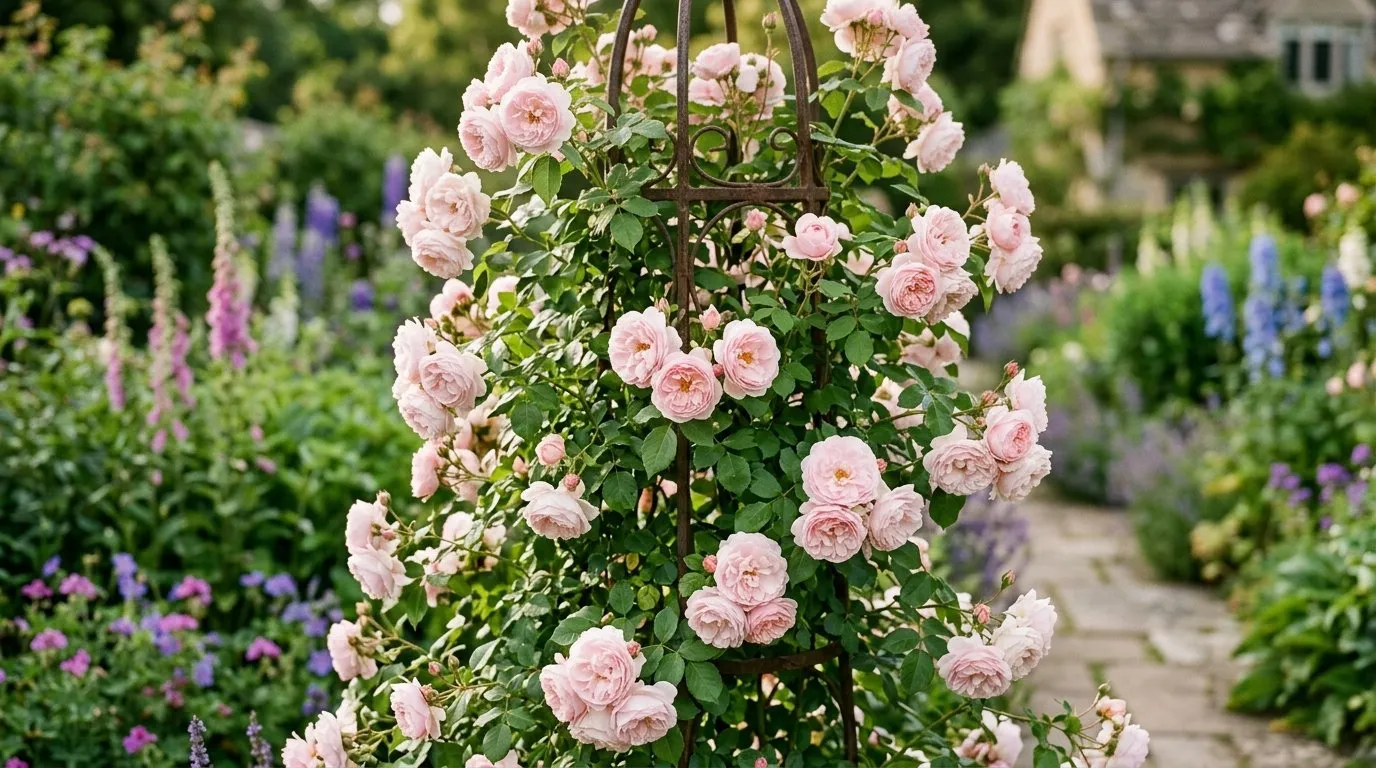
The Generous Gardener from David Austin. Repeat-flowering, strongly scented, and disease resistant.
David Austin climbers excel at scent and flower form. The large, cupped, multi-petalled flowers in soft, complex colours, blush, apricot, warm yellow, deep pink, are genuinely different from the simpler flower shapes of older types. The scent in varieties like ‘A Shropshire Lad’, ‘The Generous Gardener’, and ‘Teasing Georgia’ is outstanding.
Where David Austin climbers sometimes disappoint is disease resistance on clay soil in wet UK summers. Some varieties in the range show more blackspot than the best Hybrid Tea or Floribunda climbers. ‘New Dawn’ (not a David Austin but an old variety) and ‘Climbing Iceberg’ (also not David Austin) both outperform most of the David Austin climbers in our clay soil disease resistance trials.
The David Austin website provides full growing guidance for each variety, including specific notes on training and pruning that are useful for first-time growers of this class of rose.
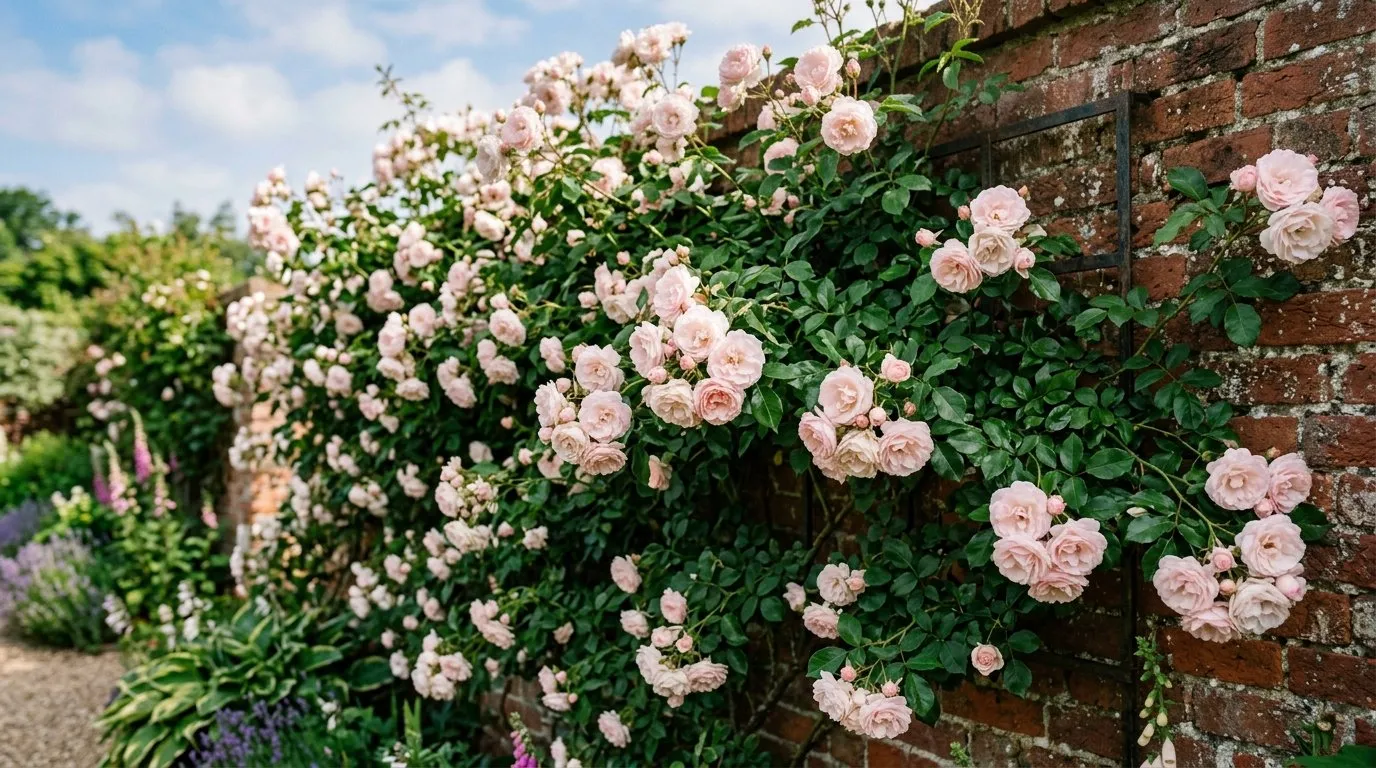
New Dawn on a north-west facing wall. One of the few climbing roses that flowers well with limited direct sun.
Related reading
- When to plant roses in the UK, bare root, container, and climbing roses: timing by season and soil conditions
- Best flowering shrubs for UK gardens, companion planting for the base of climbing rose walls and fences
- Best perennial plants for UK gardens, low-growing perennials that keep climbing rose roots cool and shaded
- Best plant combinations for UK borders, colour and form companions that work with climbing rose palettes
- How to grow cut flowers in the UK, repeat-flowering climbing roses as a cut flower source from June to October
Frequently asked questions
What is the best climbing rose for a north-facing wall in the UK?
What is the difference between a climbing rose and a rambling rose?
Climbing roses repeat-flower from June to October and have larger, stiffer canes that reach 2.5-5m. Ramblers flower once in June-July on the previous year’s growth, grow much more vigorously (6-10m or more), and produce clusters of small flowers. Ramblers suit large pergolas and trees; climbers suit walls, fences, and pillars where you want repeat colour through summer.
When should I prune climbing roses in the UK?
Prune climbing roses in late winter, between January and March. Remove dead, damaged, or crossing stems first. Then reduce side-shoots (laterals) to 2-3 buds from the main cane. Do not cut back the main structural canes unless they have become diseased or unmanageable. Tie in any new long canes as close to horizontal as possible at the same time.
How do I train a climbing rose on wires?
Fix horizontal galvanised wires to the wall using vine eyes, spaced 40cm apart vertically. Fan the main canes out from the base and tie each one to a wire at the lowest angle you can achieve. Horizontal stems produce the most flowering side-shoots. Tie in new growth throughout summer using soft garden twine in a figure-of-eight loop to allow the stem to thicken.
Why is my climbing rose not flowering?
Vertical training is the most common cause of poor flowering in climbing roses. When canes grow straight up, only the tip flowers. Tie the stems as close to horizontal as possible to trigger flowering shoots along the full length. Other causes include pruning too hard in spring (removes flower buds), too much nitrogen fertiliser (drives leafy growth over flowers), and lack of sunlight on the buds.
How do I treat blackspot on climbing roses?
Can climbing roses grow in pots?
Compact climbing roses grow in large containers of 60 litres or more. Choose a restrained variety such as ‘Warm Welcome’ (1.8m) or ‘Phyllis Bide’ (2.5m) rather than a vigorous type. Use a loam-based compost such as John Innes No. 3, water daily in summer, and feed fortnightly with a liquid rose fertiliser from April to August. Repot every three years. Once planted, fan the stems early: our guide to training young climbers covers wires, tying-in and the horizontal trick that doubles flowering.
Our team produces practical UK gardening guidance from source research, contributor records and established horticultural practice. Editorial standards are overseen by Matt W.