Key takeaways
- There are eight main types, from little patio roses to giant ramblers
- Hybrid teas give one big bloom per stem, while floribundas give clusters of colour
- Climbers repeat-flower on walls and arches, while ramblers usually flower once but grow huge
- Floribundas and tough shrub roses are the easiest for beginners
- Most roses want at least four hours of direct sun a day
- Plant bare-root roses from November to March
There are eight main types of rose for UK gardens, and each has its own size, flowering habit and favourite job. Whether you’ve got a tiny balcony or a long country boundary, there’s a rose that will fit.
Roses have been a favourite in British gardens for centuries. This guide walks you through each type, compares them, and helps you pick the right one for your garden and your time.
What are the 8 main types of roses grown in UK gardens?
The eight types are sorted by how they grow and how they flower. They run from small patio roses to giant ramblers, and each suits a different spot, from neat beds to wildlife hedges.
Getting the type right is the first step. A hybrid tea in the wrong place will disappoint as much as a rambler on a short fence. The table below sums them all up, with more on each one after it.

Hybrid teas, floribundas and shrub roses are the three types you’ll see most in UK gardens.
Rose type comparison table
| Type | Size | Flowers | Repeat flowering | Disease resistance | Best for |
|---|---|---|---|---|---|
| Hybrid tea | Medium | One big bloom per stem | Yes | Fair | Cutting, formal beds |
| Floribunda | Small to medium | Clusters | Yes | Good | Borders, low hedges |
| Climbing | Tall | Clusters on long stems | Mostly | Fair to good | Walls, fences, arches |
| Rambling | Very tall | Big sprays of small flowers | Usually once | Good | Pergolas, trees |
| Shrub | Medium to large | Single to very full | Varies | Good | Mixed borders, hedges |
| Ground cover | Low and wide | Small clusters | Yes | Very good | Banks, edges |
| Patio | Small | Small flowers | Yes | Good | Pots, patios |
| Species (wild) | Medium to large | Simple, five petals, then hips | Once | Very good | Hedges, wildlife |
What are hybrid tea roses?
Hybrid teas give you the classic rose: one big, elegant bloom on a long, straight stem. They’re perfect for cutting and flower again and again from June to autumn.
They need a firm prune in late winter, from late February to March, to keep them strong and shapely.
Good hybrid teas for UK gardens:
- ‘Peace’, yellow flushed pink, one of the most famous roses of all
- ‘Mister Lincoln’, deep velvety red with a rich scent
- ‘Elina’, creamy ivory
- ‘Silver Jubilee’, salmon pink
- ‘Just Joey’, coppery orange with a lovely scent
Hybrid teas need the most care of any type. They can suffer from black spot and like a feed in spring and again in summer.
What are floribunda roses?
Floribundas carry clusters of smaller flowers on each stem, so one plant gives a big splash of colour. They flower on and off from June well into autumn. The name means “lots of flowers”, and they live up to it.
They forgive rough pruning and usually shrug off disease better than hybrid teas. That makes them the best type for beginners.
Good floribundas for UK gardens:
- ‘Iceberg’, white, a much-loved classic
- ‘Arthur Bell’, yellow fading to cream, with a strong scent
- ‘Trumpeter’, scarlet, great for a low hedge
- ‘Absolutely Fabulous’, golden yellow
- ‘Bonica’, soft pink and very tough
Prune floribundas in late February to March, but more lightly than hybrid teas. Our guide to pruning roses shows you how.
How tall do climbing roses grow in the UK?
Most climbers reach around 3 to 5m on a wall, fence, arch or obelisk. Many modern ones flower again and again through summer, giving months of colour. Our guide to climbing roses has lots more ideas.
The secret to loads of flowers is training. Fan the main stems out sideways, or at an angle, along the support. This makes lots of side shoots, and each side shoot flowers. A climber trained straight up only flowers at the top. For more ideas, see our guide to climbing plants.
Good climbers for UK gardens:
- ‘New Dawn’, blush pink and very reliable
- ‘Compassion’, salmon pink and scented, copes with a shadier wall
- ‘Gertrude Jekyll’ (climbing form), rich pink with a strong old-rose scent
- ‘The Generous Gardener’, pale pink and healthy
- ‘Madame Alfred Carrière’, white, happy on a shady wall
Climbers need something to hold on to. Fix horizontal wires to a wall about 45cm apart with vine eyes, or use an obelisk or arch.
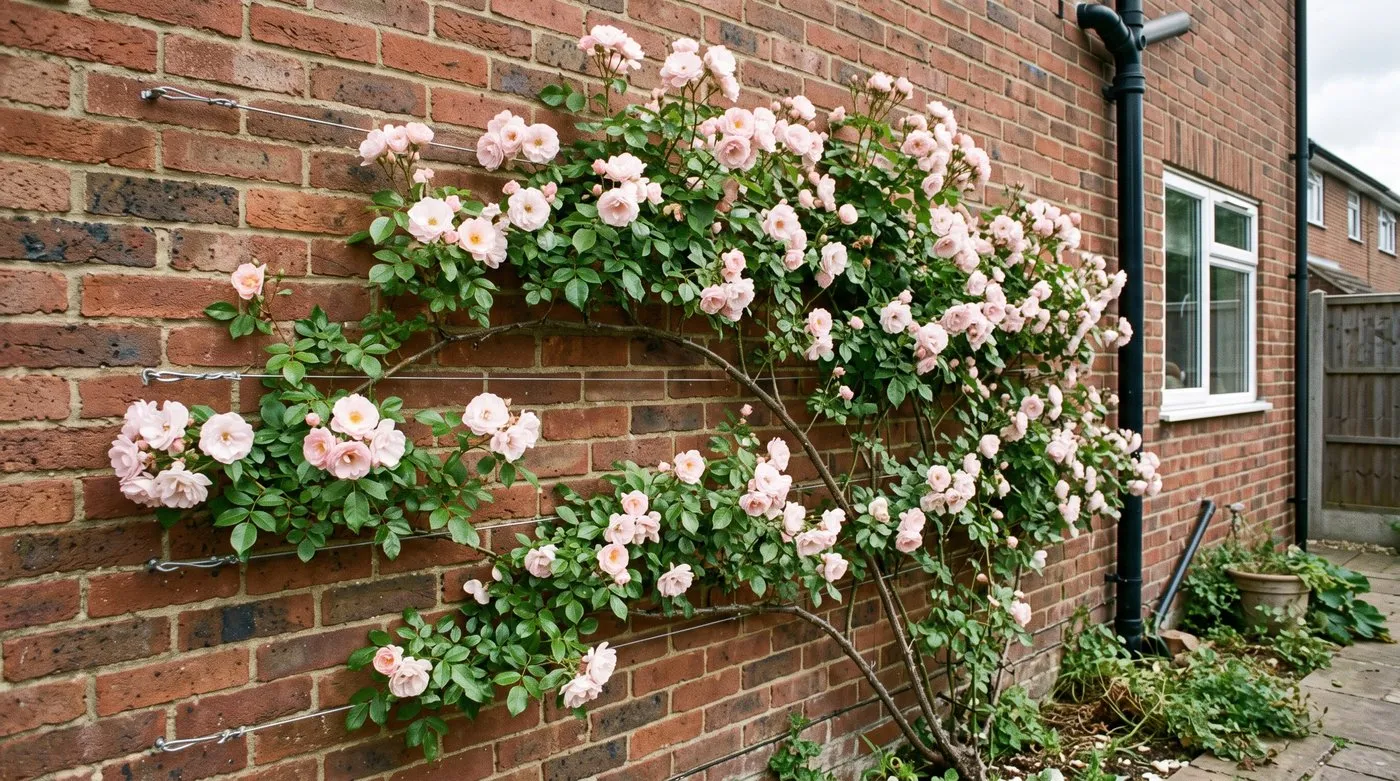
Fanning the main stems sideways makes lots of side shoots, and every side shoot flowers. Trained straight up, a climber only blooms at the top.
What is the difference between climbing and rambling roses?
Ramblers are the giants. Their long, bendy stems weave through trees, smother pergolas and scramble over big structures. Most flower once, in a fabulous early summer show of big sprays of small flowers.
Most ramblers flower on last year’s stems. So prune them straight after flowering in summer. Cut out a few of the oldest stems at the base and tie in the new, bendy ones, which will flower next year.
Good ramblers for UK gardens:
- ‘Rambling Rector’, white, with lots of hips afterwards
- ‘Paul’s Himalayan Musk’, lilac pink and very vigorous
- ‘Albertine’, salmon pink and beautifully scented
- ‘Bobbie James’, white, can climb right up a tree
- ‘Kiftsgate’, white and enormous
Ramblers need space. They’re too much for a small wall, fence or arch, where a climber is a better choice.
| Climbing roses | Rambling roses | |
|---|---|---|
| Size | Tall | Very tall |
| Stems | Stiffer | Long and bendy |
| Flowering | Mostly repeat | Usually once |
| When to prune | Autumn or early spring | Straight after flowering |
| Best for | Walls, arches, obelisks | Trees, pergolas, big structures |
What are shrub roses and why are they good for UK gardens?
Shrub roses are a big, friendly group that includes old garden roses, modern shrub roses and David Austin English roses. They make bushy, arching plants that mix nicely with perennials and grasses. Our guide to companion plants for roses suggests some good partners.
Many have the best scent of any rose. They’re usually healthier than hybrid teas and need less fussy pruning, so they suit anyone who wants roses without the work.
Good shrub roses for UK gardens:
- ‘Gertrude Jekyll’, rich pink with a famous old-rose scent
- ‘Lady of Shalott’, salmon orange and very tough
- ‘Olivia Rose Austin’, soft pink and very healthy
- ‘Charles de Mills’, crimson purple old garden rose with a rich scent
- Rosa rugosa ‘Roseraie de l’Haÿ’, crimson purple and very tough
Rugosa roses are worth a special mention. They cope with salty wind and poor, sandy soil, and their big hips feed birds in autumn. They make a great informal hedge in exposed, windy gardens. Rugosa has escaped onto some coastal sand dunes, so keep it in your garden and don’t let it spread into the wild.
Which roses work as ground cover?
Ground cover roses stay low but spread wide, making a carpet of leaves and flowers that helps smother weeds. They’re the easiest roses of all and only need a quick trim with shears in spring. Most are very healthy.
They’re brilliant on banks, along path edges, at the front of a border and tumbling over low walls. They flower from early summer into autumn.
Good ground cover roses for UK gardens:
- ‘Flower Carpet Pink’, tough and healthy
- ‘Kent’, white, neat and compact
- ‘Surrey’, soft pink and keeps on flowering
- ‘Nozomi’, pearly pink single flowers, lovely trailing over a wall
- ‘Snow Carpet’, white and very small, good in pots
Like all roses, they want sun and well-drained soil.
Are miniature and patio roses good for containers?
Yes, they’re made for pots, window boxes, patios and edging. They have small flowers, usually in clusters, and most flower from early summer into autumn. They’re hardy all over the UK.
Miniature and patio roses overlap a lot. Miniatures are a little smaller, but garden centres sell both as “patio roses”.
Good patio roses for UK gardens:
- ‘Sweet Dream’, apricot peach
- ‘Top Marks’, bright orange red
- ‘Pretty Polly’, soft pink and scented
- ‘Stars ‘n’ Stripes’, red and white stripes, a real talking point
- ‘Baby Love’, bright yellow single flowers

Patio roses like ‘Sweet Dream’ are happy in good-sized pots with plenty of drainage.
Use a pot at least 40cm wide with drainage holes, filled with John Innes No. 3 compost. Feed every couple of weeks from April to August. In summer, check pots daily, as they dry out much faster than borders.
Which wild and species roses grow best in the UK?
Species roses are the wild roses that all the others come from. They have simple five-petal flowers, then colourful hips in autumn and winter. Most flower once, in early summer. They’re the toughest roses of all.
The dog rose (Rosa canina) grows wild in hedgerows all over Britain and has bright red hips. Burnet rose (Rosa spinosissima) is another native.
Good species roses for UK gardens:
- Rosa canina (dog rose), UK native, pinky white, great for hedges
- Rosa rugosa, magenta or white, with big tomato-red hips
- Rosa glauca, grown for its blue-grey leaves and small pink flowers
- Rosa moyesii, blood red flowers and striking bottle-shaped hips
- Rosa spinosissima (burnet rose), UK native, creamy white, one of the first to flower
Wild roses are fantastic for wildlife. Bees visit the flowers in summer, and birds such as blackbirds and redwings feast on the hips. They’re a lovely part of a wildlife-friendly garden.
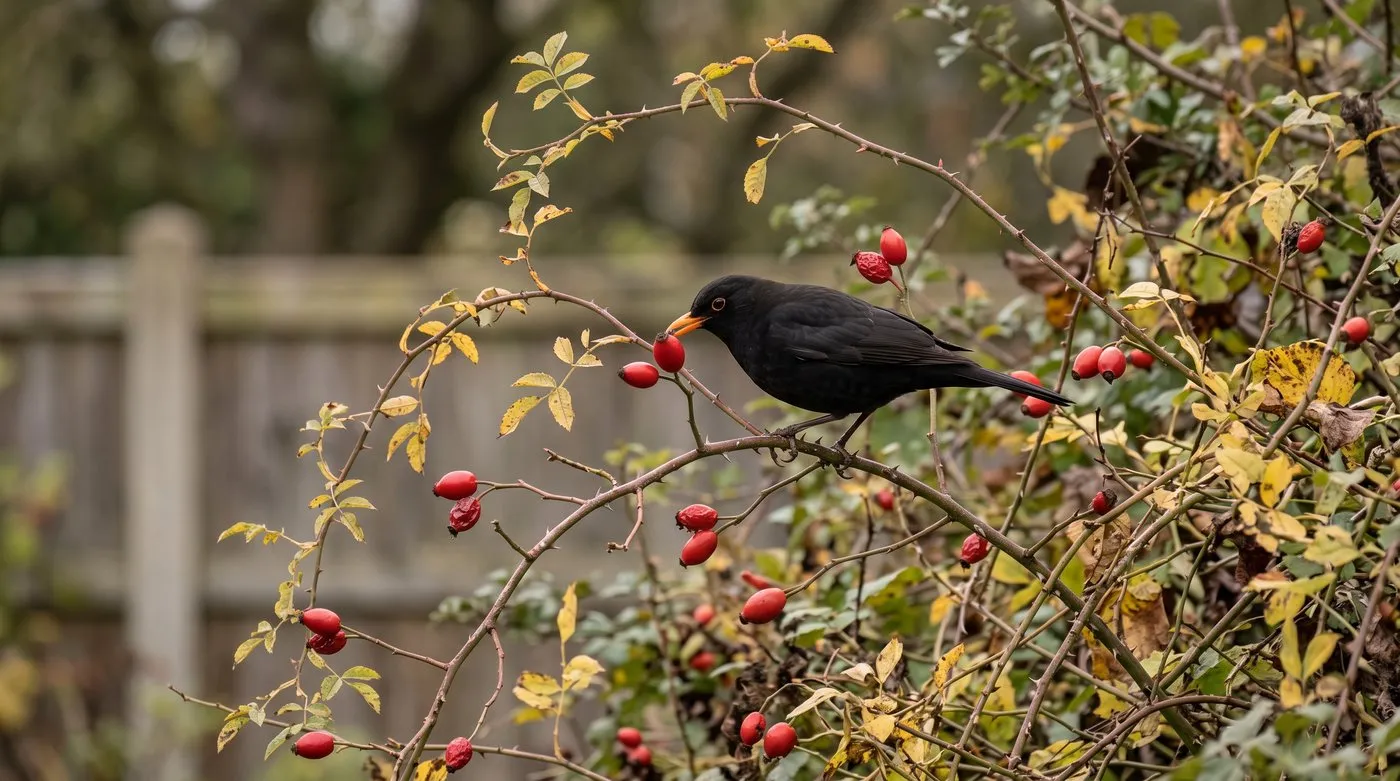
Leave the flowers on wild roses and you get a crop of hips that birds feast on through autumn and winter.
How do I choose the right type of rose for my garden?
Think about your space, what you want the rose for, how much sun you get, and your soil. These four steps make it easy.
Step 1: How much space have you got?
- A small spot or a pot: patio rose or ground cover
- A border: hybrid tea, floribunda or a compact shrub rose
- A wall, fence or arch: climbing rose
- A big tree or pergola: rambling rose
Step 2: What do you want it for?
- Cut flowers: hybrid tea for long stems, or a David Austin rose for scent
- Lots of colour: floribunda or ground cover
- Covering a wall or arch: climber or rambler
- Low effort: shrub rose, ground cover or wild rose
- Wildlife and hips: wild roses or rugosa
- Pots: patio rose
Step 3: How much sun does the spot get?
Most roses want at least four hours of direct sun a day. A few cope with a little less, including ‘Compassion’ and ‘Madame Alfred Carrière’ (both climbers) and many Alba roses. For really shady spots, see our guide to plants for shade.
Step 4: What’s your soil like?
Roses grow in most UK soils, from sandy to heavy clay. On heavy clay, dig in plenty of organic matter before planting. Alba roses cope well with chalky soil.
What are the best roses for beginners in the UK?
These five are tough, healthy and forgiving:
- ‘Iceberg’ (floribunda), white
- ‘Bonica’ (floribunda), soft pink
- ‘Olivia Rose Austin’ (shrub), soft pink
- ‘Lady of Shalott’ (shrub), salmon orange
- ‘Flower Carpet Pink’ (ground cover)
All are easy to find at UK nurseries and garden centres. Our guide to planting roses walks you through planting step by step.
Which roses have the best scent?
Scent is what makes a rose special, and it varies a lot from one variety to the next. Old garden roses and David Austin roses tend to have the strongest perfume.
Five lovely scented roses:
- ‘Gertrude Jekyll’ (shrub), a rich old-rose scent
- ‘Munstead Wood’ (shrub), deep crimson with a fruity old-rose scent
- ‘Mister Lincoln’ (hybrid tea), the classic red rose perfume
- ‘Compassion’ (climber), salmon pink and sweetly scented
- ‘Charles de Mills’ (old garden rose), crimson purple with a rich perfume
Plant scented roses near a seat, beside a path or by the door, where you’ll pass them every day. A warm, sunny wall brings out the scent.
Which roses grow in shade?
No rose is happy in deep shade, but a few cope with part shade or a north wall.
| Variety | Type | Copes with | Flowers |
|---|---|---|---|
| ’Madame Alfred Carrière’ | Climber | North wall | White blushed pink |
| ’Compassion’ | Climber | Shadier walls | Salmon pink, scented |
| ’The Generous Gardener’ | Climber | Part shade | Pale pink |
| ’Gertrude Jekyll’ | Shrub | Part shade | Rich pink, scented |
| Rosa glauca | Species | Part shade | Small pink, grown for its leaves |
| ’Iceberg’ | Floribunda | Part shade | White |
For more plants that like shade, see our guide to the best plants for shade.
Which roses are best for cutting and flower arranging?
Hybrid teas are the classic cutting rose, with long, straight stems and one big bloom. David Austin roses give fuller, more scented flowers on shorter stems.
Five good roses for cutting:
- ‘Peace’ (hybrid tea), huge blooms on long stems
- ‘Elina’ (hybrid tea), creamy flowers on long stems
- ‘Gertrude Jekyll’ (shrub), rich pink and beautifully scented
- ‘Olivia Rose Austin’ (shrub), soft pink rosettes, lovely in a vase
- ‘Just Joey’ (hybrid tea), coppery orange
Cut roses early in the morning, when the stems are full of water. Pop them straight into water, then re-cut the stems at an angle before arranging.
Which roses grow well in containers?
Roses in pots mean you can grow them on a balcony, courtyard or doorstep. Choose a compact variety and a good-sized pot.
| Variety | Type | Pot size |
|---|---|---|
| ’Sweet Dream’ | Patio | Medium |
| ’Top Marks’ | Patio | Medium |
| ’Baby Love’ | Patio | Medium |
| ’Boscobel’ | Shrub | Large |
| ’Harlow Carr’ | Shrub | Large |
| ’Iceberg’ | Floribunda | Large |
Roses are hungry, so feed pot-grown ones every couple of weeks from April to August with a rose feed. Water often in summer. Replace the top few centimetres of compost each spring, and move them to a bigger pot every few years.
Why are David Austin English roses so popular?
David Austin started breeding his English roses in Shropshire in the early 1960s. He crossed old garden roses with modern ones to get the best of both: old-fashioned cupped flowers and strong scent, plus repeat flowering, more colours and better health.
There are now well over a hundred varieties, and they’re among the most popular roses in British gardens. You’ll find them at David Austin’s own nursery and at most garden centres.

David Austin roses mix old-fashioned charm with modern toughness.
Popular David Austin roses:
| Variety | Colour | Scent | Good for |
|---|---|---|---|
| ’Gertrude Jekyll’ | Rich pink | Strong | Scent, borders, cutting |
| ’Lady of Shalott’ | Salmon orange | Warm tea | Beginners |
| ’Olivia Rose Austin’ | Soft pink | Fruity | Healthy plants |
| ’Boscobel’ | Salmon pink | Myrrh | Small gardens, pots |
| ’The Generous Gardener’ | Pale pink | Strong | Climbing, arches |
| ’Munstead Wood’ | Deep crimson | Old rose | Scent, dark colour |
| ’The Lark Ascending’ | Apricot pink | Light | Healthy plants |
| ’Darcey Bussell’ | Deep crimson | Fruity | Compact borders |
Should I plant bare-root or container-grown roses?
Both make healthy, long-lived plants. Bare-root roses are cheaper and come in more varieties, but you can only plant them in the dormant season.
| Bare-root | In a pot | |
|---|---|---|
| Price | Cheaper | Dearer |
| When to plant | November to March | Any time the ground isn’t frozen or bone dry |
| Choice | Biggest range | What’s in stock |
| Delivery | Light, easy to post | Heavy |
Bare-root roses arrive dormant, with bare roots wrapped in something damp. Plant them within a few days. If the ground is frozen, bury the roots in a spare patch of soil or a pot of compost until it thaws.
For full planting steps, see our guide to when and how to plant roses.
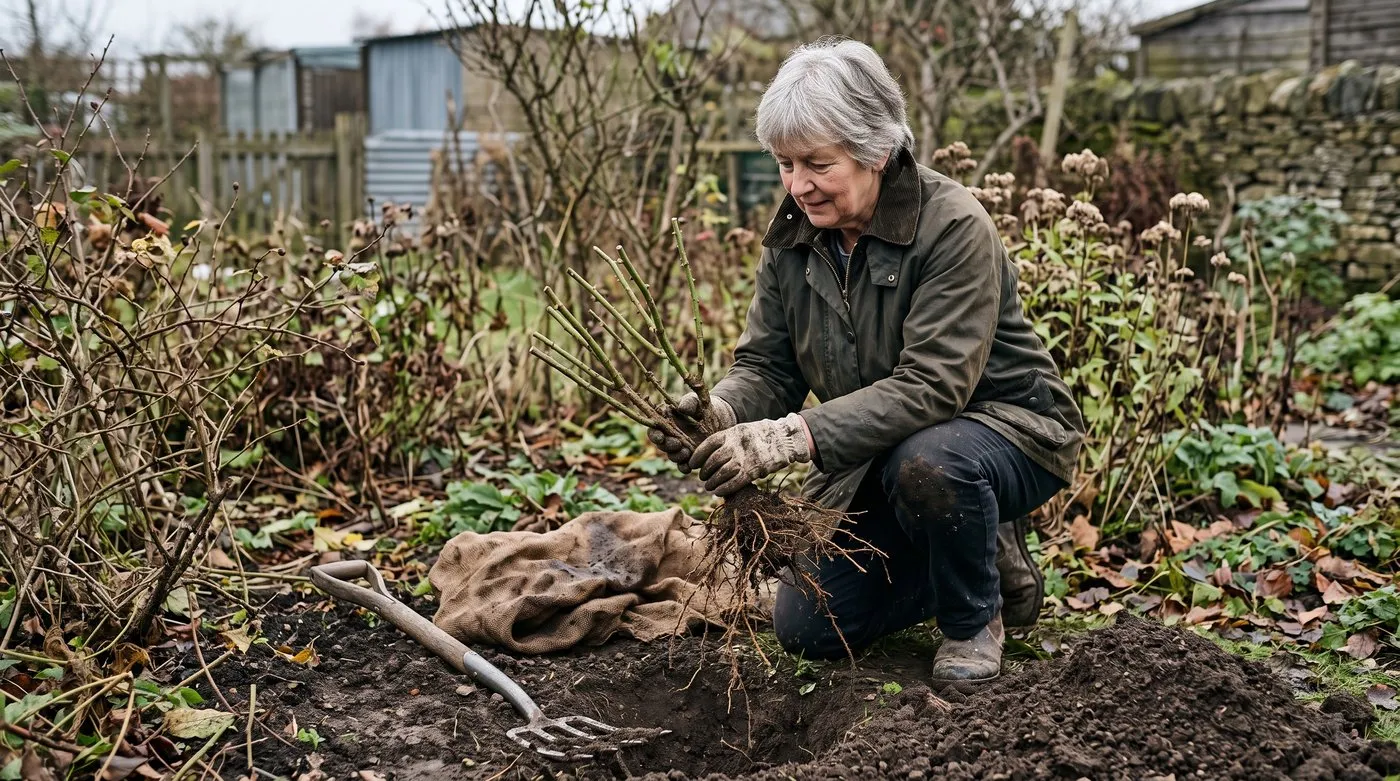
Bare-root roses arrive dormant and want planting within a few days. November is a great month for it while the soil is still workable.
How do I prune different types of roses?
Each type has its own pruning needs. Getting it wrong rarely kills a rose, but it can mean fewer flowers.
| Rose type | When | How |
|---|---|---|
| Hybrid tea | Late Feb to mid March | Firm prune, quite low |
| Floribunda | Late Feb to mid March | Medium prune |
| Climbing | Autumn or early spring | Light prune, tie stems in sideways |
| Rambling | Straight after flowering | Cut out a few of the oldest stems |
| Shrub | Spring | Light shaping |
| Ground cover | Spring | Quick trim with shears |
| Patio | Spring | Light tidy |
| Species (wild) | Rarely | Remove dead wood only |
Use sharp, clean secateurs and cut just above an outward-facing bud with a slight slope. Our rose pruning guide has the full step-by-step.
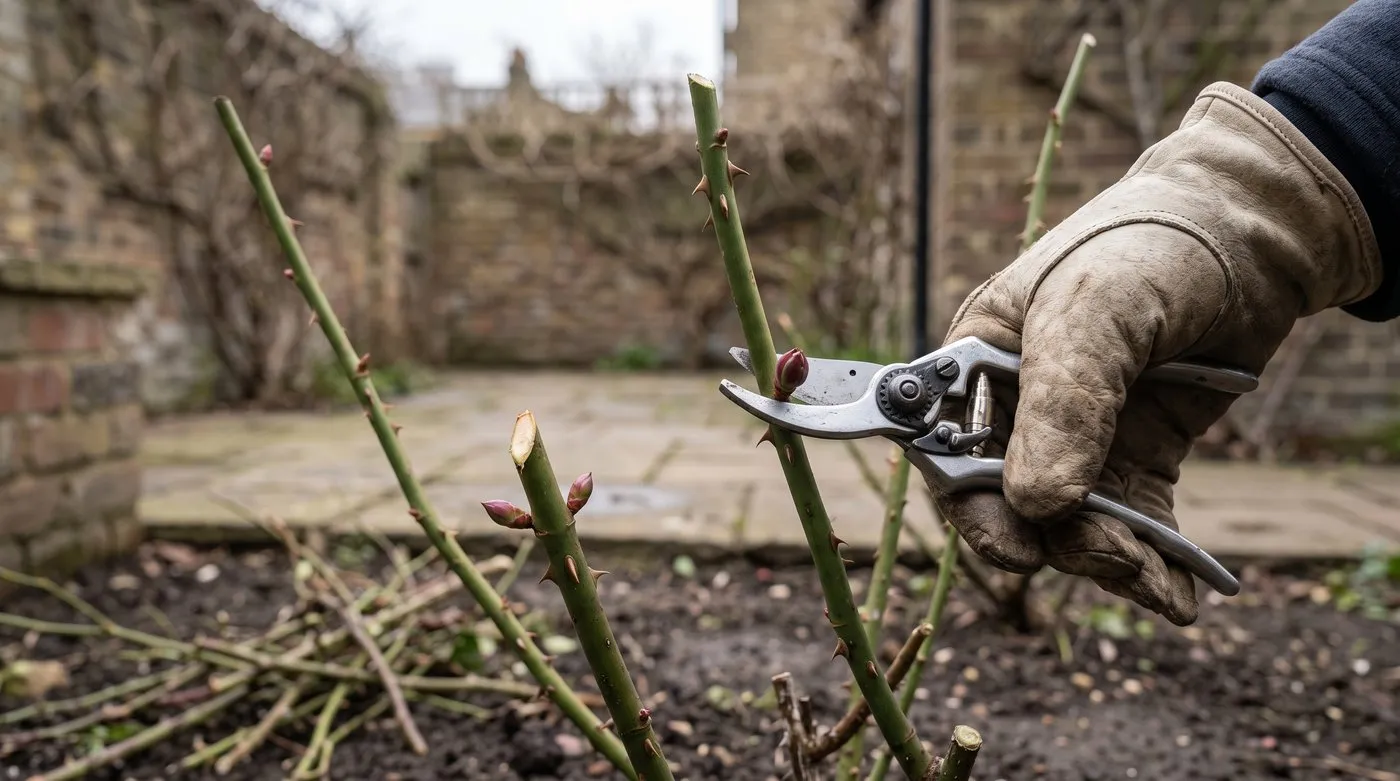
Cut just above an outward-facing bud with a slight slope. It sends new growth outwards and keeps the middle of the bush open.
Which roses have the best disease resistance?
Choosing a healthy variety is the easiest way to enjoy roses with less work. Damp British summers are perfect for black spot, which hits many hybrid teas hard in a wet year.
The RHS guide to roses is a good place to read more about choosing healthy varieties.
| Variety | Type | Health |
|---|---|---|
| Rugosa roses | Species | Very tough |
| ’Flower Carpet’ range | Ground cover | Very good |
| ’Olivia Rose Austin’ | Shrub | Very good |
| ’The Lark Ascending’ | Shrub | Very good |
| ’Bonica’ | Floribunda | Good |
| ’New Dawn’ | Climber | Good |
| ’Iceberg’ | Floribunda | Fair to good |
| ’Peace’ | Hybrid tea | Can get black spot |
If your roses already have black spot, our black spot treatment guide can help. Good airflow, watering the soil rather than the leaves, and a spring mulch all help keep it at bay.
Rose planting and care calendar for UK gardens
| Month | Task |
|---|---|
| January | Plant bare-root roses if the ground isn’t frozen. Browse the catalogues. |
| February | Finish bare-root planting. Start pruning hybrid teas and floribundas late in the month in milder areas. |
| March | Finish pruning. Mulch, and give the first rose feed. |
| April | Look out for greenfly. Tie in new climber stems. |
| May | Water in dry spells. Pick off any spotty leaves. |
| June | Feed again after the first flush. Deadhead to keep flowers coming. |
| July | Prune ramblers once they’ve finished flowering. Keep deadheading. |
| August | Keep deadheading for an autumn show. |
| September | Stop deadheading wild roses so they make hips. Stop feeding. |
| October | Get planting holes ready for bare-root roses. Plant roses in pots. |
| November | Plant bare-root roses. A great month for it. |
| December | Keep planting bare-root roses. Shorten tall stems to stop them rocking in the wind. |
For a month-by-month list of other flowers, see our flower planting calendar.
Roses for every garden situation
| Situation | Type to choose | Good picks |
|---|---|---|
| Small garden | Patio, compact shrub | ’Sweet Dream’, ‘Boscobel’, ‘Harlow Carr’ |
| North-facing wall | Shade-tolerant climber | ’Madame Alfred Carrière’, ‘Compassion’ |
| Windy or coastal | Rugosa, species | Rosa rugosa, ‘Roseraie de l’Haÿ’ |
| Clay soil | Most roses, with good soil prep | ’Iceberg’, ‘Gertrude Jekyll’, ‘New Dawn’ |
| Wildlife garden | Species, rugosa | Rosa canina, Rosa rugosa, ‘Rambling Rector’ |
| Formal beds | Hybrid tea, floribunda | ’Peace’, ‘Trumpeter’, ‘Absolutely Fabulous’ |
| Cottage garden | Shrub, old garden, climber | ’Gertrude Jekyll’, ‘Charles de Mills’, ‘New Dawn’ |
| Pots only | Patio | ’Sweet Dream’, ‘Top Marks’, ‘Baby Love’ |
| Cut flowers | Hybrid tea, David Austin | ’Peace’, ‘Elina’, ‘Gertrude Jekyll’ |
| Low effort | Ground cover, rugosa | ’Flower Carpet’, ‘Kent’, Rosa rugosa |
Roses are one of the most adaptable flowers to grow in UK gardens. They also look great with flowering shrubs like lavender, philadelphus and buddleja.
Frequently asked questions
What are the main types of roses in the UK?
There are eight main types of rose for UK gardens. They are hybrid tea, floribunda, climbing, rambling, shrub, ground cover, patio and species (wild) roses. Each grows and flowers differently and needs slightly different pruning. Pick one to suit your space, whether you want flowers for cutting, and how much time you have.
Which type of rose is best for beginners?
Floribundas are the best place to start. They flower for months, forgive a bit of rough pruning and tend to shrug off disease better than hybrid teas. ‘Iceberg’ and ‘Bonica’ are reliable choices. Tough shrub roses such as ‘Olivia Rose Austin’ and ‘Lady of Shalott’ are great for beginners too.
What is the difference between climbing and rambling roses?
Climbers repeat-flower, while most ramblers flower once but grow much bigger. Climbers have stiffer stems and suit walls, fences and arches. Ramblers have long, bendy stems that scramble through trees and over pergolas. Prune ramblers straight after flowering in summer.
Can I grow roses in pots and containers?
Yes, patio roses are perfect for pots. Use a pot at least 40cm wide with drainage holes and fill it with John Innes No. 3 compost. Feed every couple of weeks from April to August and water often in summer. Compact shrub roses such as ‘Boscobel’ also do well in a bigger pot.
Which roses are most disease-resistant in the UK?
Rugosa roses and many modern shrub and ground cover roses. Rugosas are very tough. Among modern roses, ‘Olivia Rose Austin’, ‘Boscobel’ and ‘The Lark Ascending’ are known for good disease resistance. Ground cover roses such as the ‘Flower Carpet’ range are tough too.
When should I prune different types of roses?
Most roses are pruned in late winter or early spring. Prune hybrid teas and floribundas from late February to mid-March. Prune climbers in autumn or early spring, tying stems in sideways. Prune ramblers straight after flowering in summer. Shrub roses need a light tidy in spring, and wild roses rarely need anything.
What are David Austin English roses?
They’re shrub roses bred in Shropshire, mixing old-fashioned looks with modern habits. They cross old garden roses with modern ones. You get full, cupped flowers and lovely scent, plus repeat flowering and better disease resistance. Popular choices include ‘Gertrude Jekyll’, ‘Lady of Shalott’ and ‘The Generous Gardener’.
Our team produces practical UK gardening guidance from source research, contributor records and established horticultural practice. Editorial standards are overseen by Matt W.