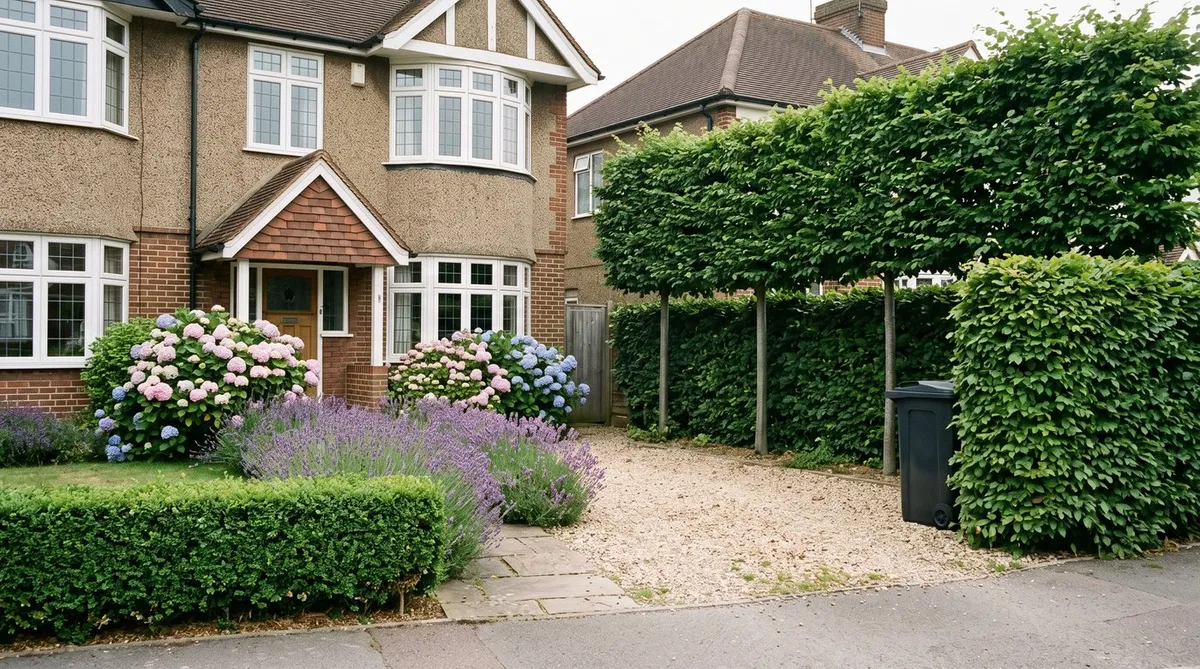
Key takeaways
- A windbreak that lets about half the wind through works far better than a solid fence
- A mixed native hedge of hawthorn, blackthorn, field maple and hornbeam is the best long-term shelter
- Woven hurdles or windbreak netting protect young hedges while they grow
- Stake new trees low down for their first year or two
- Low, small-leaved plants and ornamental grasses cope best with wind
A garden on a hillside, ridge or open plain gets battered by wind. It dries the soil, snaps plants and makes sitting outside miserable. The natural urge is to put up a solid fence. Surprisingly, that’s the worst thing you can do.
The answer is a windbreak that slows the wind down rather than trying to stop it. The RHS guide to windbreaks explains why a filtering barrier works better than a solid one.
Why do solid fences fail in windy gardens?
A solid fence doesn’t stop the wind. It just sends it over the top. The wind rises over the fence, then tumbles down the other side in swirling gusts. Those gusts can do more damage than the wind you started with.
A solid fence only gives calm air for a short distance behind it. Further back, plants can be worse off than if there were no fence at all.
A windbreak that lets about half the wind through works much better. It slows the wind gently and gives shelter for a long way behind it, roughly ten times its height. That’s the “50% rule”, and it works for hedges, woven hurdles and slatted windbreak fencing.
What are the best windbreak options for exposed UK gardens?
Here are the six most practical choices, side by side.
| Windbreak | How well it shelters | How long it lasts | Upkeep |
|---|---|---|---|
| Mixed native hedge | Very well | A lifetime | Trim once a year |
| Hornbeam hedge | Very well, even in winter | A lifetime | Trim once a year |
| Woven hazel hurdle | Well | A few years | Replace as they rot |
| Woven willow screen | Well | Shorter than hazel | Replace as they rot |
| Slatted fence panels | Well | Many years | Stain every few years |
| Solid close-board fence | Poorly, causes gusts | Many years | Often damaged in storms |
A mixed native hedge is the best value by far. It’s cheap to plant as bare-root whips, lasts for generations, gets better with age and is great for wildlife. The only downside is waiting a few years for it to grow.
Woven hazel hurdles are the best stopgap while a hedge grows. They let some wind through naturally, look lovely, and by the time they rot, the hedge behind has taken over.
 A woven hazel hurdle shelters a young hawthorn hedge. The gaps in the weave slow the wind gently instead of causing gusts.
Which hedge species work best as windbreaks?
For a permanent windbreak, native hedging plants beat fancy ornamental ones. They’re cheaper, tougher and settle in faster on poor, windy sites.
Hawthorn (Crataegus monogyna)
Hawthorn is the best windbreak hedge for exposed gardens. It copes with any soil, any aspect and any amount of wind, from heavy clay to chalk, sand and thin upland soil. Plant bare-root whips 5-6 per metre for a thick single row. Its May blossom feeds pollinators and its autumn berries feed birds. Our hedge planting guide takes you through planting bare-root whips step by step.
Hornbeam (Carpinus betulus)
Hornbeam holds on to its dead brown leaves through winter, so it keeps filtering the wind even though it’s deciduous. That’s a big plus when winter winds are at their worst. It copes with heavy clay better than beech, which hates wet ground. Plant 4-5 per metre.

Hornbeam keeps its dead brown leaves through winter, so it goes on filtering the wind when gales are at their worst. It copes with heavy clay better than beech.
Field maple (Acer campestre)
Field maple is one of the quicker native hedging plants to fill out. It’s tough, copes with most soils including chalk and clay, and gives lovely butter-yellow autumn colour. Mix it in with hawthorn to bulk up a new hedge.
Blackthorn (Prunus spinosa)
Blackthorn is the toughest choice for the very windiest spots. Its thick, thorny growth makes a barrier nothing can get through. White blossom in March is the first hedgerow show of spring, followed by sloes in autumn. It’s slower than hawthorn, and the thorns make trimming a prickly job. It’s best mixed with hawthorn rather than grown on its own.
Mixed native hedge formula
A mix makes a better windbreak than a single plant. This blend works well on exposed sites:
- About half hawthorn, the backbone of the hedge
- A fifth blackthorn, for thickness and toughness
- Some field maple, for quick growth and autumn colour
- Some hornbeam, for winter leaves
- A few dog roses, for flowers and hips
Plant 5-6 whips per metre, so a 10-metre run needs 50-60 plants. That’s far cheaper over the years than a run of hurdles you’ll need to replace.
 A newly planted native hedge. Give it a few years and it will filter the wind far better than a solid fence.
How do I protect plants while a windbreak hedge establishes?
A new hedge takes a few years to get to a useful height. Until then, both the hedge and the plants behind it need a bit of help.
Temporary windbreak options
Woven hazel hurdles on the windy side of the hedge shelter it while it grows up through and past them. Fix them firmly to sturdy treated posts. By the time they rot, the hedge has taken over.
Windbreak netting stretched between posts is a cheaper option. It’s less pretty than hazel but works just as well. Buy proper UV-stabilised windbreak netting, as ordinary garden netting soon shreds in strong wind.
Spiral guards around each young whip protect against rabbits and wind. Take them off once the hedge is well established so they don’t rub or constrict the stems.
Staking young trees in exposed gardens
Stake every tree you plant in a windy garden for its first year or two. Without one, the wind rocks the roots loose before they can grip.
Use a short stake, angled into the prevailing wind, with a rubber tree tie. This holds the root ball still but lets the trunk bend and grow stronger. Tall stakes that hold the whole trunk rigid make weaker trees that can snap once the stake comes off.
Check ties a few times a year and loosen them as the trunk thickens. A tight tie cuts into the bark.
Low ground cover copes with wind even without shelter. Anything taller than about 30cm will need staking, temporary shelter or a grown-up windbreak to get through its first couple of winters, so don’t skip the temporary protection.
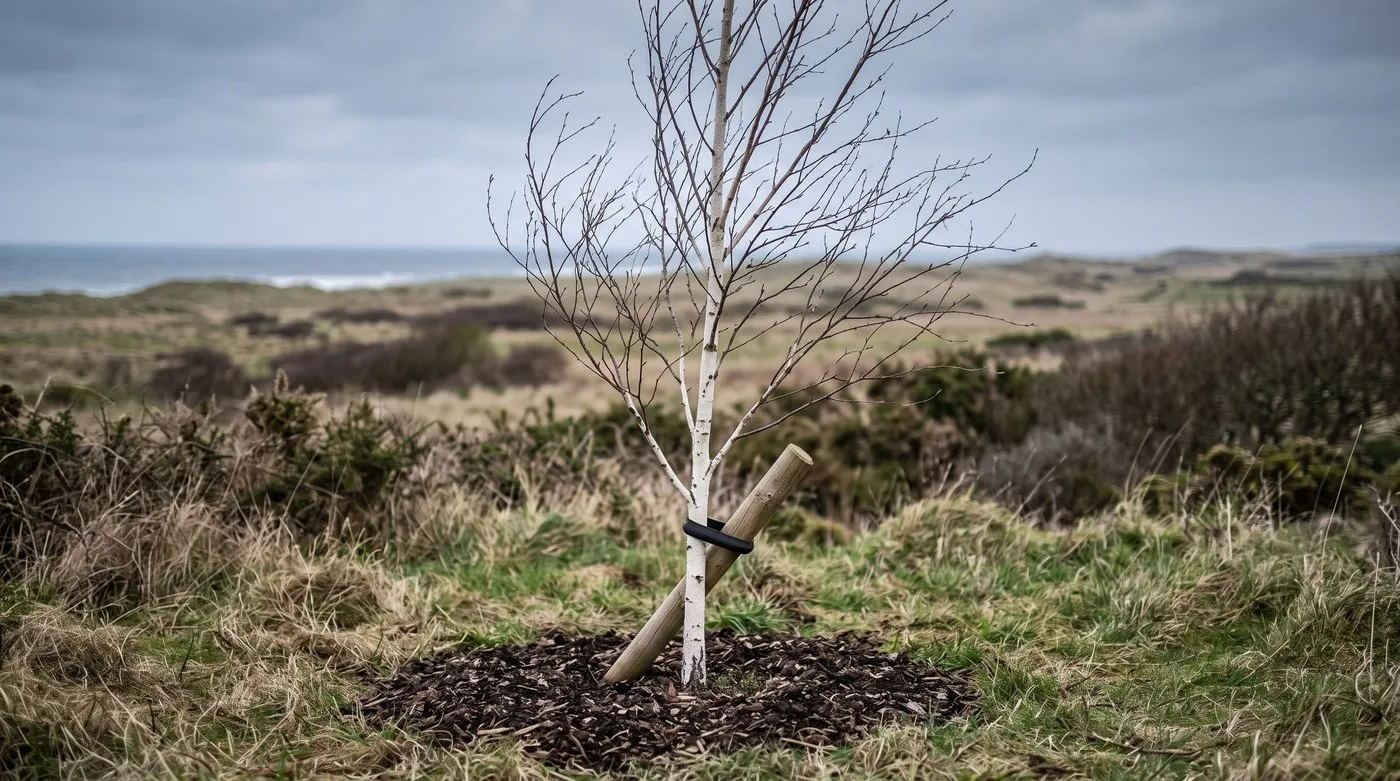
A short stake angled into the wind holds the root ball still while the trunk bends and grows stronger. Loosen the tie as the trunk thickens.
What plants survive in very windy UK gardens?
Look for three things: small leaves, a low habit and deep roots. Big leaves dry out and tear. Tall plants catch more wind. Shallow roots get rocked loose. The same tough, compact plants also suit roof terrace planting, where pots sit fully exposed to every gust.
Wind-tolerant perennials
| Plant | Height | How it copes with wind | Flowers |
|---|---|---|---|
| Crocosmia ‘Lucifer’ | 60-90cm | Very well | Red, Jul-Aug |
| Japanese anemone | 60-120cm | Well | Pink or white, Aug-Oct |
| Hardy geranium | 30-60cm | Very well | Blue or pink, Jun-Sep |
| Bergenia | 30-45cm | Very well | Pink, Mar-Apr |
| Eryngium (sea holly) | 40-80cm | Brilliantly | Blue, Jul-Sep |
| Stipa tenuissima | 40-60cm | Brilliantly | Golden, Jun-Oct |
| Miscanthus sinensis | 120-200cm | Very well | Silver plumes, Sep-Nov |
| Pennisetum alopecuroides | 60-90cm | Well | Fluffy plumes, Aug-Oct |
| Sedum spectabile | 30-50cm | Very well | Pink, Aug-Oct |
| Astrantia | 45-60cm | Well | Pink or white, Jun-Aug |
Ornamental grasses are made for wind. Their narrow leaves let it slip past, and their stems bend rather than break. They look their best swaying in a breeze. Stipa tenuissima and miscanthus are brilliant on windy sites. Many drought-tolerant plants also cope well with wind, as both are good at holding on to water.

Narrow leaves let the wind slip past and the stems bend rather than break. Ornamental grasses, crocosmia and sea holly are all happy on blowy sites.
Wind-tolerant ground cover
Plants under about 30cm dodge the worst of the wind. Use them to cover bare soil in the most exposed spots:
- Ajuga reptans (bugle): 10-15cm, spreading, blue flowers April-May
- Vinca minor (lesser periwinkle): 15-20cm, evergreen, blue flowers March-June
- Geranium macrorrhizum: 30cm, scented leaves, pink flowers May-June
- Persicaria affinis: 20-25cm, spreading, pink spikes July-October
- Thymus serpyllum (creeping thyme): 5-10cm, scented, purple flowers June-August
Ground cover also stops wind blowing away light topsoil, and helps keep moisture in.
Wind-tolerant shrubs
These shrubs fill the gap between the hedge and the lower planting.
Cotoneaster makes dense, wind-proof growth with autumn berries. Low ones like C. horizontalis cover banks, and upright ones like C. lacteus (2-3m) fill gaps in the border. Our privacy screening guide covers taller types for boundaries.
Berberis is thorny, dense and shrugs off wind. Evergreen B. darwinii gives year-round structure, and deciduous B. thunbergii has brilliant autumn colour. Both grow in any soil.
Viburnum tinus flowers through winter when little else does. It’s evergreen, dense and grows to 2-3m. Great for structure in a sheltered pocket of a windy garden.
How do I design planting in an exposed garden?
Think in layers. Start with the windbreak on the boundary and step the planting down in height towards the house.
The shelter gradient
- Windbreak hedge on the windy boundary
- Tall shrubs a couple of metres inside the hedge: viburnum, cotoneaster, berberis
- Medium perennials in the middle: crocosmia, miscanthus, Japanese anemone
- Low plants and ground cover nearest your seating area: geranium, bergenia, thyme
Each layer calms the wind a little more. By the time it reaches where you sit, it has lost most of its bite.
Raised beds as micro-windbreaks
Raised beds give a little shelter on their downwind side, where more delicate plants can grow. On clay soil they also help drainage, which matters because wind-rocked roots sitting in wet clay soon rot. Build them across the path of the prevailing wind for the most shelter.
Sunken seating areas
Setting a patio or seating area a little below the rest of the garden gives instant shelter. Add low walls or planting round the edges and you get a calm pocket, even in a very open garden. You’ll use it far more often.

Setting a patio a little below the rest of the garden gives instant shelter. Low walls and planting around the edges make a calm pocket you’ll use far more often.
Shelter belts for larger exposed gardens
In a big, deep garden you can plant a shelter belt instead of a single hedge. It uses three rows at different heights to slow the wind over a wider area.
| Row | Where | What to plant | Spacing | Grows to |
|---|---|---|---|---|
| Outer | On the windy boundary | Scots pine or alder | 2m | Tall trees |
| Middle | 2m inside the outer row | Hawthorn or hornbeam | 1m | 2-4m |
| Inner | 2m inside the middle row | Viburnum or cotoneaster | 1.2m | 1.5-2.5m |
If your garden is open on several sides, start with the sides facing the prevailing wind, usually south-west and west in the UK. For the calmer sides, see our garden fence ideas.
Plants that look better in wind
Some plants don’t just cope with wind, they look better for it.
Stipa tenuissima ripples like water in every breath of wind, and glows in low evening light.
Miscanthus sinensis ‘Gracillimus’ has silver autumn plumes that catch the light as they move. Its gentle rustle is soothing in a garden that can otherwise sound harsh in wind.
Silver birch (Betula pendula) has the most graceful movement of any native tree. Its hanging branches sway in the lightest breeze, and the white bark brightens winter. It copes with full exposure.
Hakonechloa macra is a soft grass that spills over raised beds and walls like water. Give it a sheltered corner, where it makes a calm contrast to the tougher plants out in the open.
Common mistakes in exposed gardens
Choosing ornamental over functional
Photinia and laurel hedges look great in a catalogue but struggle on a really exposed site. Their big leaves scorch and drop in cold wind. Native hedging isn’t as glamorous, but it survives, and that’s what counts.
Planting too close to the windbreak
Plants squashed against a hedge fight it for water, light and root space. Leave about a metre between the hedge and your first row of border plants. It also gives you room to trim.
Ignoring the wind funnel effect
Gaps between buildings, fences or hedges squeeze the wind and make it faster. A narrow gap between the house and a fence can be the windiest spot in the garden. Block it with planting or extend the hedge or fence. Climate-resilient plants that cope with wind and changeable weather suit these tricky spots.
Forgetting winter exposure
Deciduous hedges filter less wind in winter, just when it’s strongest. Hornbeam keeps its dead leaves, and a few evergreens like holly or yew in the mix help a lot. Adding some holly to a hawthorn hedge gives much better winter shelter.
Frequently asked questions
What is the best windbreak for an exposed garden?
A mixed native hedge is the best permanent windbreak. Hawthorn, field maple and hornbeam planted 5-6 per metre make a thick barrier that filters the wind rather than blocking it. Bare-root whips are cheap, and the hedge lasts a lifetime. Use hurdles or netting for shelter while it grows.
Why do solid fences fail in windy gardens?
Solid fences push the wind over the top, causing gusts behind. The wind rises over the fence and tumbles down the other side in swirls that can be worse than the original wind. A solid fence only shelters a short distance behind it. A windbreak that lets about half the wind through slows it gently and shelters a much bigger area.
What plants survive in very windy gardens UK?
Hawthorn, blackthorn, field maple, hornbeam, birch and Scots pine all cope with full exposure. For flowers, try crocosmia, Japanese anemone, hardy geranium, bergenia and ornamental grasses. Low ground cover under 30cm, like ajuga, vinca and creeping thyme, survives even without a windbreak.
How far apart should I plant a windbreak hedge?
Plant a single row at 5-6 plants per metre for a thick hedge. For a denser hedge, plant a zigzag double row with 4 plants per metre in each row and 40-50cm between the rows. A double row fills out faster but uses twice as many plants and takes up more space.
How long does a windbreak hedge take to grow?
Most native hedges give useful shelter within three or four years. Field maple is one of the quicker ones, and hornbeam gives the bonus of winter leaves. Use woven hurdles or windbreak netting to shelter the garden while the hedge grows.
Do I need planning permission for a garden windbreak?
No, hedges don’t need planning permission. Councils can act on complaints about tall evergreen hedges, over 2m, that block a neighbour’s light. Fences and walls over 2m high, or over 1m next to a road, usually need permission. Check who owns the boundary before you plant.
What is the 50% permeability rule for windbreaks?
It means a windbreak should let about half the wind through. Slowed gently like this, the wind stays calmer for a long way behind the windbreak. A solid barrier causes gusts and swirls that can harm plants more than the open wind.
Our team produces practical UK gardening guidance from source research, contributor records and established horticultural practice. Editorial standards are overseen by Matt W.