Key takeaways
- Salt spray is worst close to the shore, so tamarisk, escallonia and griselinia go in the front line
- A shelter belt that lets some wind through works better than a solid wall or fence
- Give your windbreak two or three years to grow before planting the main garden behind it
- Seaside gardens are often milder in winter, so agapanthus and other borderline plants can thrive
- Plant in October or November and skip January and February, when storms are at their worst
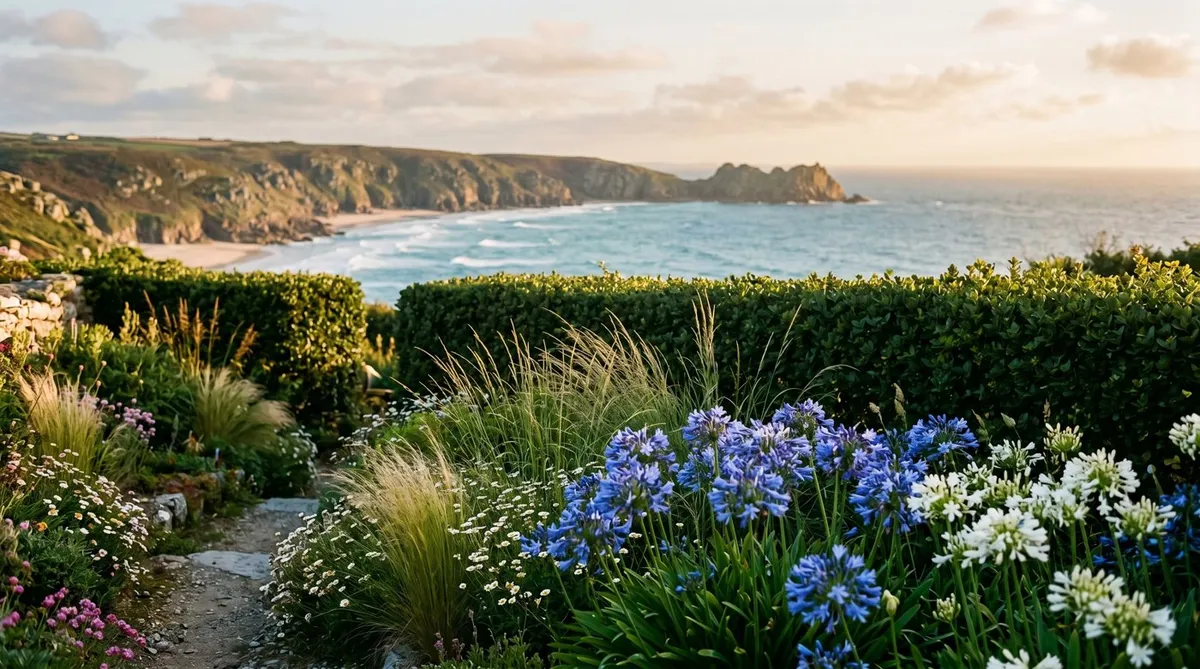
Gardening by the sea isn’t about fighting the weather. It’s about working with it. The same wind that flattens ordinary plants also keeps frost away, and the salty air comes with some of the mildest winters in the UK. Pick the right plants, give them shelter, and a seaside garden can be wonderful.
The RHS coastal gardening guide is a handy extra read if you want more ideas.
Below you’ll find how salt and wind affect plants, how to plant a shelter belt, the best plants for each spot, and a month-by-month plan.
Why coastal gardens fail
Most seaside planting problems come down to three things.
Salt spray damage
Waves throw salty spray into the air, and the wind carries it inland onto your plants. It’s worst right by the shore. That’s what kills most ordinary garden plants on an exposed coast.
Salt dries out leaves, leaving them brown and scorched. Over time it can also build up in the soil and make it harder for roots to take up water. The further back from the sea you go, the less of a problem it is.
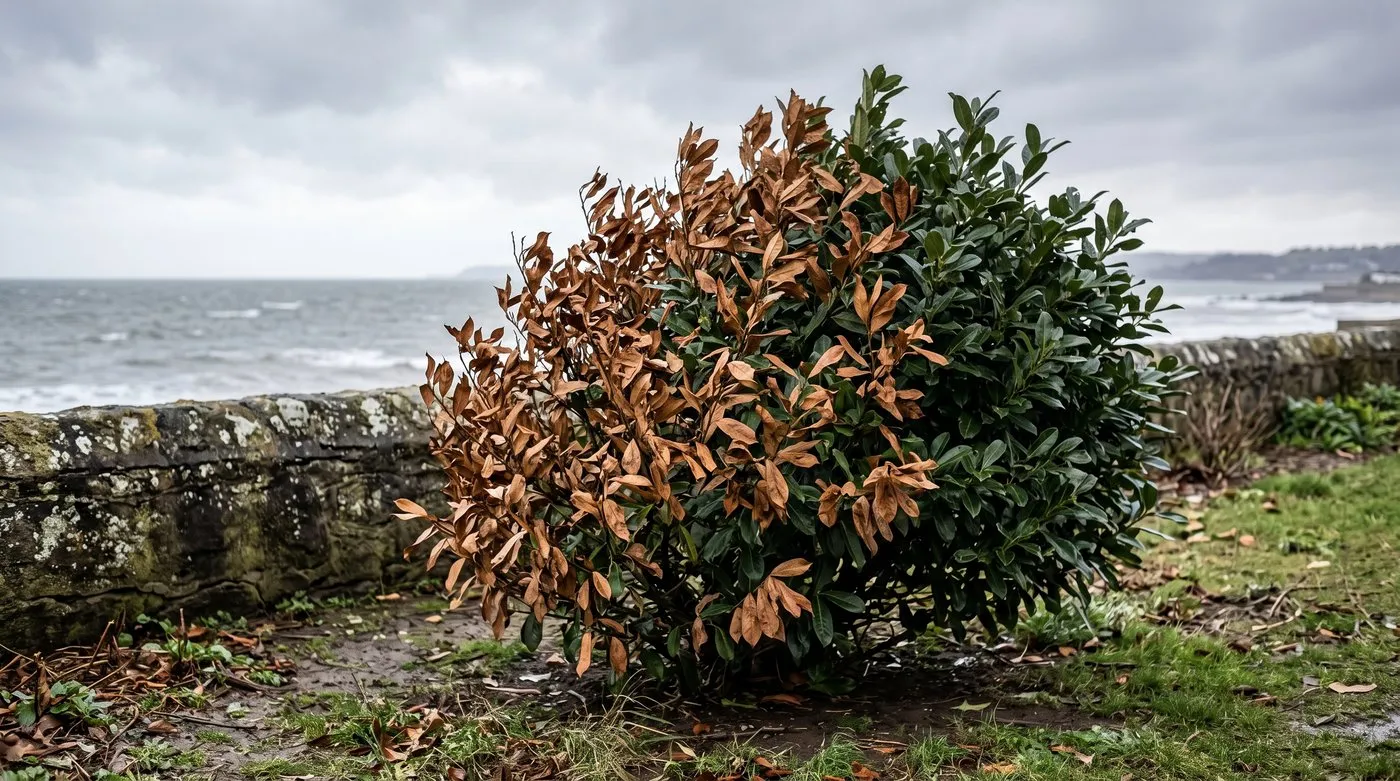
Salt spray burns the side of a plant that faces the sea. Soft, broad leaves like these suffer most, which is why tougher shrubs go on the front line.
Drying wind
Even without salt, sea wind dries plants out fast. The roots can’t keep up, so leaves wilt, then scorch.
Small, narrow or waxy leaves lose less water. That’s why so many seaside plants look that way.
Thin, fast-draining soil
Coastal soil is often thin sand over rock. It dries out quickly in summer. On the plus side, it drains well in winter, which Mediterranean plants love. Digging in plenty of compost makes a big difference within a season.
How salt and wind damage plants
You don’t need the chemistry, just the basics. Salt on leaves breaks down their waxy coat, so they lose water faster. A sunny spell straight after a salty storm often does more harm than the storm itself, because the damaged leaves dry out quickly.
Plants with thick, leathery leaves, silver or waxy coatings, or fine hairs handle this best. Escallonia, hebe, griselinia and tamarisk all have this kind of protection. Most soft, broad-leaved garden shrubs don’t.
The upside: milder winters
The sea stays warmer than the land through winter, so frosts by the coast are fewer and gentler, especially in the south-west.
That’s why agapanthus grows outside all year on the Cornish coast, and why Echium pininana self-seeds on the Isles of Scilly.
Wind chill can still damage buds and soft stems, though. Shelter matters for frost as much as for salt.
 Sea thrift and sea kale are happy close to the shore, salt and all.
Shelter belt design
How shelter belts slow the wind
A shelter belt is a row or two of tough shrubs and trees on the windy side of your garden. It should let some wind through. A solid wall or fence makes the wind tumble over the top and swirl down the other side, which can be worse than no barrier at all.
As a rough guide, a shelter belt protects a strip behind it about ten times its height. So a 3 metre belt shelters around 30 metres of garden.
The three-row shelter belt
| Row | Plants | Spacing | Grows to | Job |
|---|---|---|---|---|
| Outer (sea side) | Tamarisk or Monterey pine | 1.5m | 3-5m | Takes the worst salt and wind |
| Middle | Escallonia or griselinia | 1.2m | 2-3m | Catches more salt |
| Inner | Hebe or sea buckthorn | 1m | 1-1.5m | Low shelter and a neat edge |
Plant the outer row first and let it reach about 2 metres before the rows behind can get going. Close to the shore, be patient and plant the main garden last.
Trim the belt each year in late August to keep it bushy. Never take off more than a third in one go.
Windbreaks for smaller gardens
No room for three rows? A single dense hedge of escallonia or griselinia still gives useful shelter. While new plants settle in, stretch windbreak netting between stakes to protect them for the first two or three years.
Our hedge planting guide explains spacing and planting step by step.
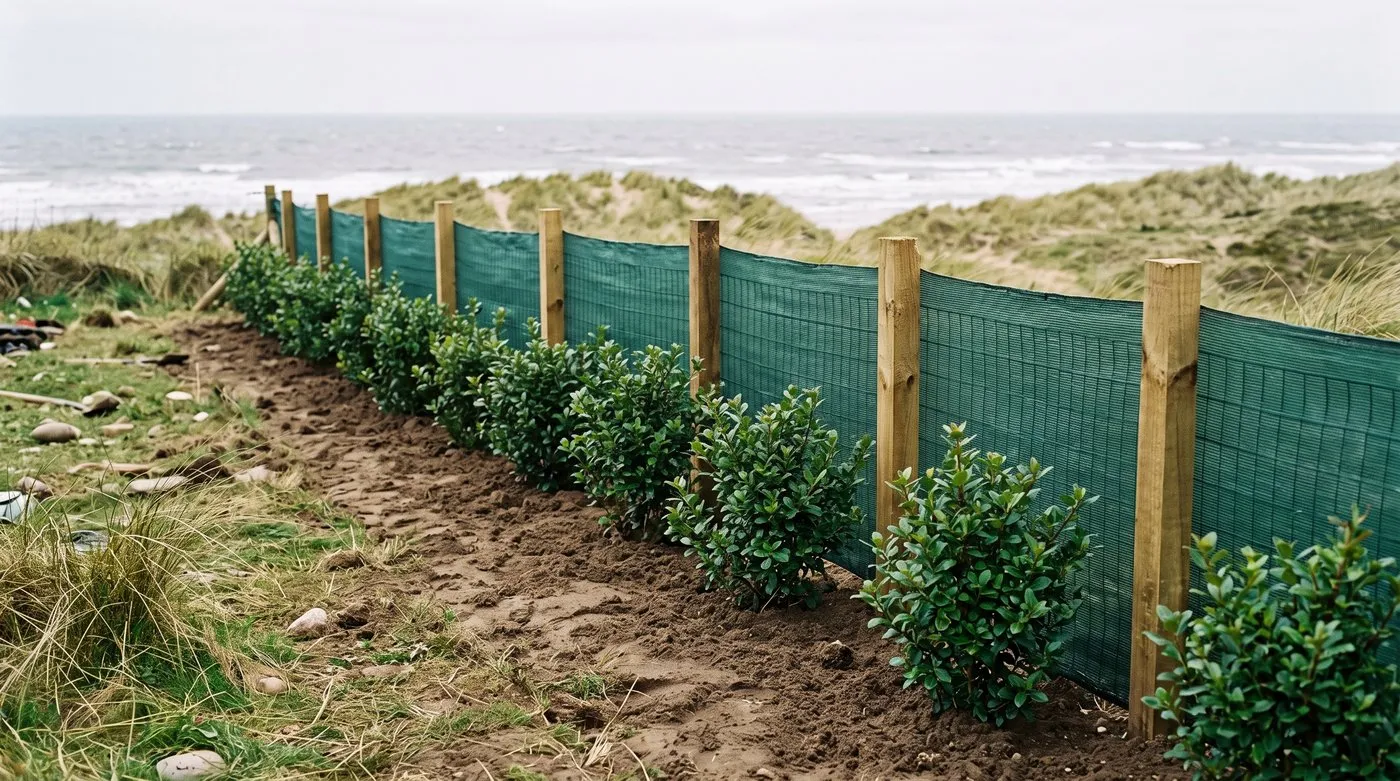
Windbreak netting filters the wind rather than blocking it. Leave it up for two or three years while the young hedge gets going.
What to plant where by the sea
| Spot | How close to the sea | What it’s like | Good plants |
|---|---|---|---|
| Front line | Right by the shore | Salt spray and strong wind | Tamarisk, escallonia, sea thrift, Monterey pine |
| Close | A short walk back | Some salt, strong wind | Griselinia, hebe, agapanthus, Stipa, olearia |
| Further back | Well back from the beach | Less salt, some wind | Most Mediterranean plants, eryngium, crocosmia |
| Sheltered | Far back or well sheltered | Little salt | Most garden plants, with a windbreak |
The 15 best coastal plants
Use this table to match plants to your spot.
| Plant | Salt | Wind | Height | Where | Looks good |
|---|---|---|---|---|---|
| Tamarisk (Tamarix) | Very tough | Very tough | 3-5m | Front line, close | Pink flowers May-Jun |
| Escallonia ‘Crimson Spire’ | Very tough | Very tough | 2-3m | Front line, close | Red flowers Jun-Sep |
| Griselinia littoralis | Very tough | Very tough | 2-4m | Front line, close | Evergreen leaves |
| Sea thrift (Armeria maritima) | Very tough | Tough | 15-25cm | Front line to further back | Pink flowers May-Jul |
| Hebe ‘Autumn Glory’ | Tough | Very tough | 60-90cm | Close, further back | Purple flowers Jul-Oct |
| Olearia x haastii | Very tough | Very tough | 1.5-2m | Close, further back | White daisies Jun-Aug |
| Holm oak (Quercus ilex) | Tough | Very tough | 15-20m | Close to sheltered | Evergreen |
| Agapanthus | Tough | Fair | 60-90cm | Close to sheltered | Blue flowers Jul-Aug |
| Eryngium x tripartitum | Tough | Tough | 60-90cm | Close to sheltered | Blue-silver Jul-Sep |
| Crocosmia ‘Lucifer’ | Fair | Tough | 90-120cm | Close to sheltered | Red flowers Jul-Aug |
| Stipa tenuissima | Tough | Very tough | 40-60cm | Close to sheltered | Golden leaves May-Oct |
| Pennisetum villosum | Fair | Tough | 60-90cm | Further back, sheltered | Fluffy plumes Aug-Oct |
| Phormium tenax | Tough | Very tough | 1-2m | Close to sheltered | Bold leaves all year |
| Sea buckthorn (Hippophae) | Very tough | Very tough | 2-4m | Front line to further back | Orange berries in autumn |
| Ceanothus | Fair | Tough | 1-4m | Further back, sheltered | Blue flowers Apr-Jun |
Trees for coastal gardens
Monterey pine (Pinus radiata)
Monterey pine grows fast once it gets through its first couple of years. It comes from the California coast, where the weather is a lot like south-west England. It gets big, so it suits larger gardens as a windbreak tree.
Holm oak (Quercus ilex)
An evergreen oak that copes with salt and dry spells once settled. It grows slowly but makes a handsome, solid tree. You can also clip it as a tall hedge.
Scots pine (Pinus sylvestris)
Easy to find and very wind-tolerant. It’s the classic seaside pine in Scotland and northern England, and grows into a lovely twisted shape in exposed spots.
Tamarisk (Tamarix)
At 3-5 metres, tamarisk is the most useful coastal tree for ordinary gardens. It shrugs off salt, has feathery pink flowers in May and June, and bends in the wind instead of breaking. It’s one of the quickest windbreaks to get going.
 Tamarisk on the outside and escallonia behind make a shelter belt that keeps tender plants safe from the sea wind.
Shrubs that form the backbone
Escallonia
Escallonia is the UK’s favourite seaside hedge. It takes salt spray, doesn’t mind clipping and flowers from June to September. ‘Crimson Spire’ is a good upright hedge. ‘Apple Blossom’ has pink and white flowers and a softer, spreading shape for borders.
After a very hard frost it may drop some leaves or lose its tips. Cut back to healthy wood in April and it soon recovers.
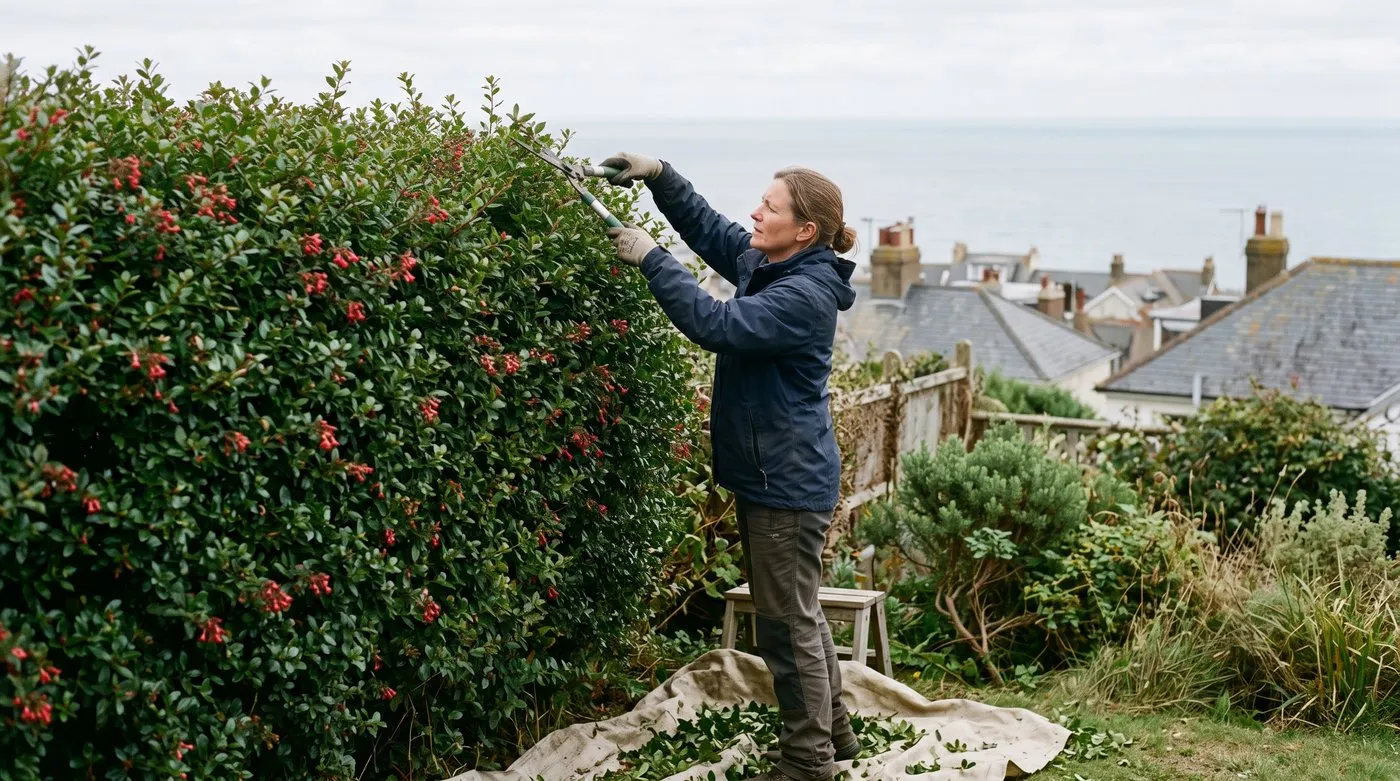
Clip escallonia after flowering in late August, taking off no more than a third. A yearly trim keeps it thick right down to the ground.
Hebe
There are loads of hebes, from low mats to 2 metre shrubs. For the windiest spots, choose tough types like Hebe salicifolia or Hebe rakaiensis. For colour, try ‘Autumn Glory’ (purple, July to October) or ‘Great Orme’ (pink, June to September).
Hebes mind hard frost more than salt. A really cold winter can knock some back, but seaside gardens are usually mild enough.
Olearia (daisy bush)
Olearia x haastii covers itself in white daisies from June to August. It’s one of the best flowering shrubs for salty wind and stays tidy without clipping. Olearia macrodonta is bigger, with silver-green leaves. Our flowering shrubs guide has more ideas to plant alongside.
Griselinia littoralis
Griselinia has glossy, apple-green leaves and grows into a thick hedge that filters salt and wind well. It isn’t flashy on its own, but it’s a superb shelter plant.
It’s not the hardiest, so in cold northern and Scottish coastal gardens, choose something tougher.
Coastal perennials and grasses
Sea thrift (Armeria maritima)
Sea thrift grows wild on British cliffs. It makes tight green cushions with pink pompom flowers from May to July. It likes poor, well-drained soil. In rich soil it gets floppy and flowers less, so tuck it into gravel or a dry wall.
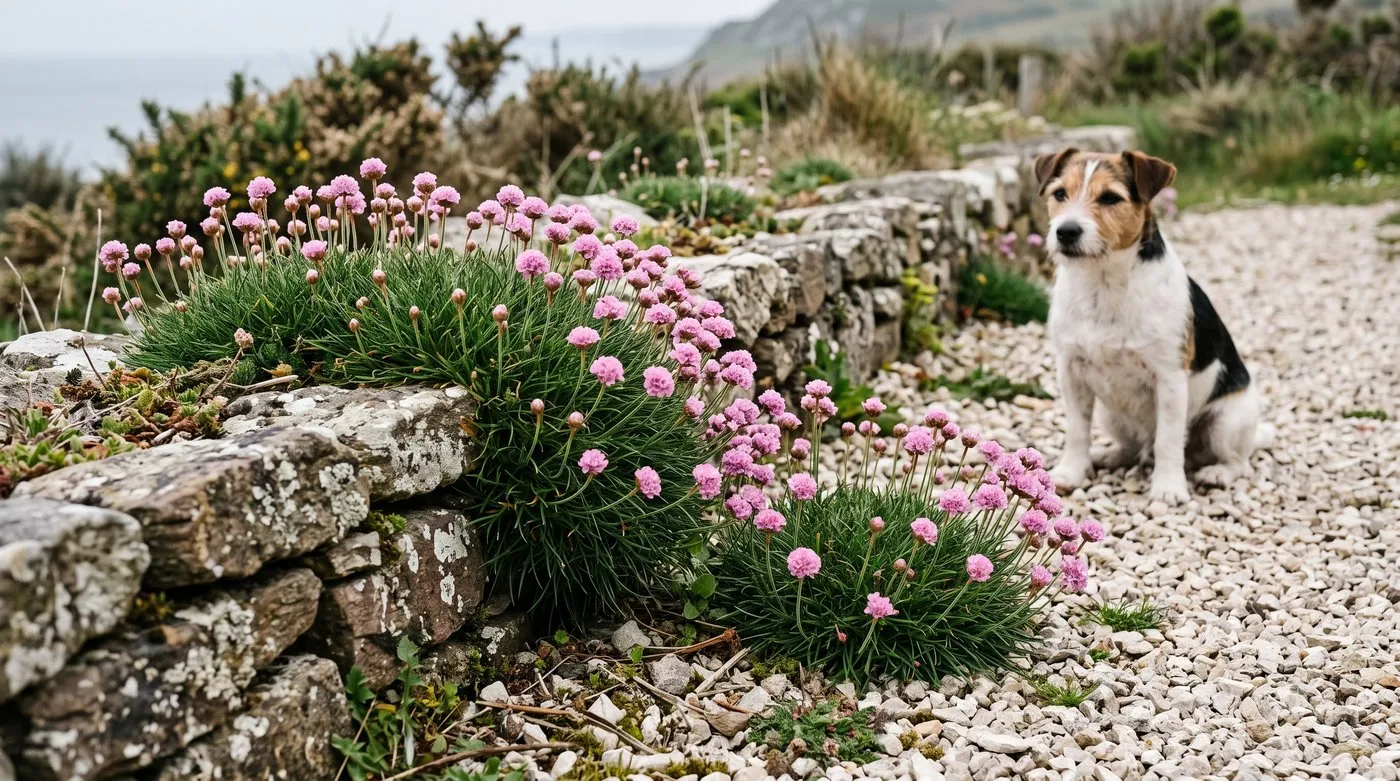
Sea thrift flowers best in poor, sharp-draining spots. Tuck it into gravel or wall crevices rather than rich border soil.
Agapanthus
Agapanthus gives big blue or white flower heads in July and August. Evergreen types like the mild coast best, which is why they’re so common in Cornwall and south Devon. Deciduous types are hardier and can be grown further north. Mild seaside gardens also suit dierama, or angel’s fishing rod, with its arching summer flowers.
Agapanthus flowers best with its roots a bit squashed, so pots work really well.
Eryngium (sea holly)
Sea holly has spiky blue-silver flower heads that look brilliant by the sea. Garden types like Eryngium x tripartitum and Eryngium bourgatii are easy to grow, and our guide to growing eryngium covers sowing and dividing. Give it full sun and sharp drainage. Poor soil brings out the best blue. For more plants that like the same conditions, see our drought-tolerant plants.
Ornamental grasses for coastal conditions
Grasses are naturals by the sea. Their narrow leaves lose little water and sway in the wind instead of snapping.
Stipa tenuissima (Mexican feather grass) has fine, blonde leaves that catch the light. It grows 40-60cm tall and self-seeds into gravel.
Pennisetum villosum has soft, feathery plumes from August to October. It can struggle in cold inland gardens but does well by the mild coast.
Phormium tenax (New Zealand flax) has bold, sword-like leaves up to 2 metres and takes salt in its stride. It makes a great centrepiece.
 Raised beds behind a shelter belt, filled with lavender, agapanthus and other sun-lovers.
Month-by-month coastal garden calendar
| Month | Jobs to do |
|---|---|
| January | Check the shelter belt for storm damage and clear blown debris. Look for broken tamarisk stems. |
| February | Hold off planting, as storms are at their peak. Trim wind-damaged escallonia tips. |
| March | Mulch beds thickly with composted bark before spring winds dry the soil. Plant pot-grown griselinia and hebe. |
| April | Cut frost-damaged escallonia back to healthy wood. Plant agapanthus once frosts are over. |
| May | Tamarisk flowers. Sow calendula and California poppies in sheltered spots. |
| June | Escallonia starts flowering. Plant summer bedding in sheltered spots. Lightly trim the outer row of the shelter belt. |
| July | Agapanthus and sea holly are at their best. Feed agapanthus in pots. |
| August | Clip escallonia after flowering. Take escallonia and griselinia cuttings. |
| September | Sea buckthorn berries turn orange. Add to the shelter belt. Start dividing sea thrift. |
| October | The best month for planting new shrubs and perennials. |
| November | Plant bare-root shelter trees like tamarisk and holm oak. Put a gravel mulch around agapanthus. |
| December | Check windbreak posts and ties before storms. Fleece borderline plants if a hard frost is forecast. |
Common mistakes in coastal gardens
Planting before the shelter has grown
This is the most expensive mistake. Without shelter, even tough plants get battered by salt and wind from day one. Wait until the windbreak is about 2 metres tall before planting behind it.
Buying plants for looks, not toughness
Garden centres fill up with lavender, cistus and grasses each spring. Many do fine well back from the sea, but right by the shore most won’t last. Check the table above before you buy.
Forgetting to trim the shelter belt
An unclipped escallonia or griselinia hedge goes bare at the bottom after a few years. Wind then rushes through the gaps at ground level. Trim it each August, up to a third, to keep it thick. Our guide to climbing plants covers training plants on walls and fences too.
Forgetting the cold side of the garden
The side of your garden facing away from the sea, behind the house or a cliff, can be surprisingly frosty. It may behave more like a north-facing garden than a mild seaside one. Check which way each part of your garden faces and plant to suit.
Watering too much in summer
Most seaside plants are drought-tolerant once settled. Too much water causes root rot and soft growth that salt damages easily. Water new plants in their first year, then let them get on with it.
Related reading
For shelter, our hedge planting guide covers spacing, soil and watering for all the hedging plants used in coastal shelter belts.
Behind the shelter, drought-tolerant plants are great partners, as they like the same sunny, well-drained spots.
For walls and fences, see climbing plants. Several climbers cope with a bit of salt.
For the main garden, our flowering shrubs guide has plenty of shrubs that do well near the coast.
Frequently asked questions
What plants grow well in coastal gardens UK?
Escallonia, griselinia, hebe, tamarisk and sea thrift cope closest to the sea. Further back you can add agapanthus, eryngium, crocosmia, Stipa tenuissima and most Mediterranean plants.
How do I protect a coastal garden from salt spray?
Plant a shelter belt of tamarisk, escallonia or griselinia on the seaward side. Give it two or three years to reach about 2 metres before you plant the main garden behind. A layered windbreak slows the wind and catches salt before it reaches your borders.
What soil problems do coastal gardens have?
Sandy soil and thin soil over rock are the usual problems. Sandy soil dries out fast after rain. Spread a thick layer of composted bark or garden compost on beds each autumn to help it hold water.
Can I grow vegetables in a coastal garden?
Yes, as long as they’re well sheltered. Put the veg plot well back from the shore, or behind a dense hedge or fence. Salt spray scorches cabbages and lettuce. Root crops like carrots, parsnips and beetroot cope better than leafy ones.
Are coastal gardens warmer than inland gardens?
Usually, yes, especially in winter. The sea holds on to its warmth and releases it slowly. That’s why agapanthus, echium and tree ferns grow outdoors on the Cornish coast. Watch out for cold wind, though, which can still damage buds.
How do I create a shelter belt for a coastal garden?
Plant three rows. Put tamarisk or Monterey pine 1.5m apart on the outside, escallonia or griselinia 1.2m apart in the middle, and hebe 1m apart on the inside. Cut the outer row back hard in year two so it bushes out from the base.
What trees survive coastal exposure UK?
Monterey pine, holm oak and Scots pine handle wind best. For smaller gardens, tamarisk grows to 3-4 metres and makes a great first line of shelter. Sycamore is often used in windbreaks but spreads easily, so keep an eye on seedlings.
When should I plant a coastal garden?
October and November are the best months. The soil is still warm and the worst storms haven’t arrived. Pot-grown plants settle in better than bare-root ones in salty spots. March and April are your next best choice.
Our team produces practical UK gardening guidance from source research, contributor records and established horticultural practice. Editorial standards are overseen by Matt W.