Key takeaways
- Full sun and sharp drainage are non-negotiable; on clay add 30% grit and plant on a low mound
- Tap-rooted types (E. bourgatii, E. planum, 'Big Blue') hate being moved, so buy young and never divide
- Propagate from root cuttings taken in December to February, not by division
- Rich or wet soil kills them; root rot and powdery mildew are the only real problems
- The steel-blue bracts swarm with bees and hoverflies and dry perfectly for everlasting arrangements
- Evergreen rosette types like E. agavifolium are bolder and taller but only half-hardy
Sea holly is one of those plants that stops people mid-path. The steel-blue, almost metallic flower heads sit above a stiff ruff of spiny bracts, all on branching stems washed the same silvery blue. It looks exotic and difficult. It is neither, as long as you give it the two things it cannot live without.
Those two things are full sun and sharp drainage. Get them right and eryngium is close to unkillable, shrugging off drought, salt wind and poor stony ground that defeats softer perennials. Get them wrong, especially on wet clay, and the plant sulks, rots and vanishes over its first winter. This guide covers both halves of the story.
What sea holly is and why gardeners grow it
Sea holly is the common name for Eryngium, a genus of around 250 spiny perennials in the carrot family, Apiaceae. Despite the name and the holly-like bracts, it is no relation to true holly. The genus splits into two very different camps, and knowing which you have changes how you grow it.
The first camp is the Old World tap-rooted group. These are the classic steel-blue sea hollies of British borders: E. bourgatii, E. planum, E. alpinum and hybrids like ‘Big Blue’. They send down a deep, fleshy tap root, die back to a resting crown in winter, and resent both rich soil and any attempt to move them. The second camp is the New World evergreen rosette group, chiefly E. agavifolium and E. pandanifolium from South America. These form bold, spiny, sword-leaved rosettes, keep their leaves through winter, and are taller but less hardy.
Both share the same needs: sun, grit and lean living. They sit naturally among other architectural plants that carry a border on form rather than fuss. What sets eryngium apart is that metallic colour, which no other hardy perennial quite matches.
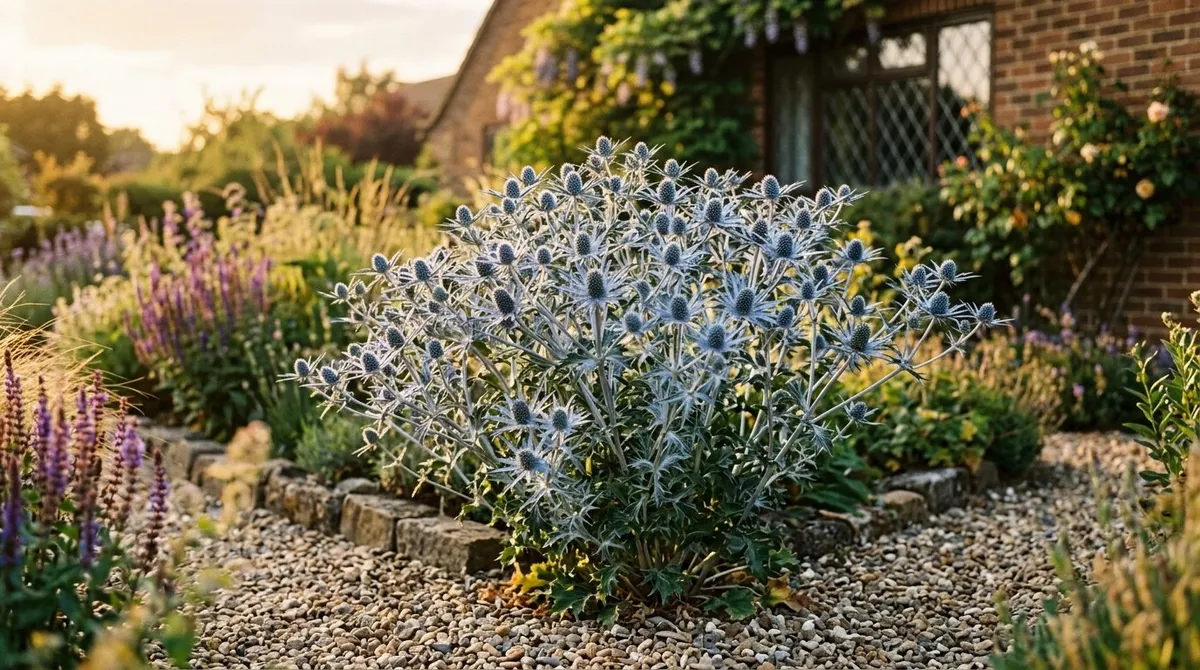
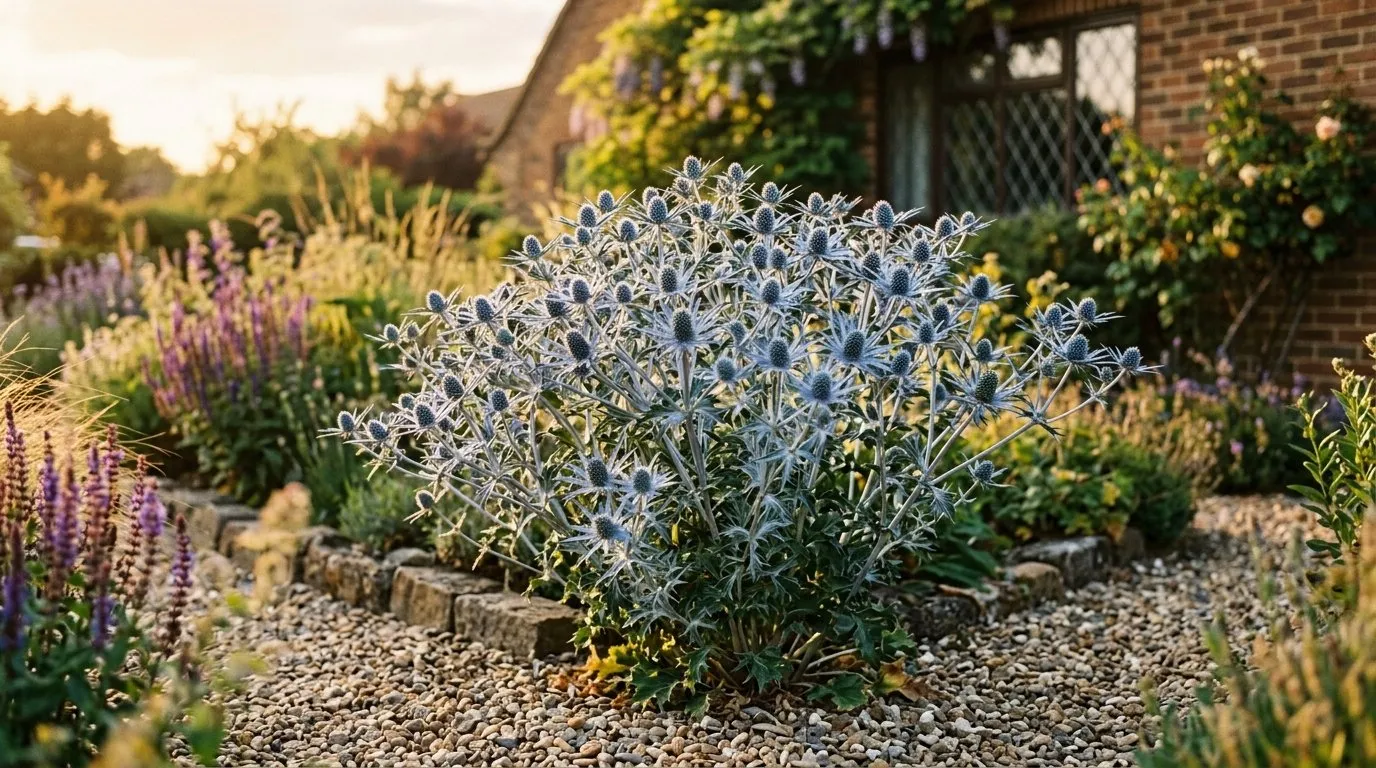 A mature sea holly clump in full flower, the metallic steel-blue heads that stop people mid-path.
Tap-rooted versus evergreen rosette sea hollies
The single most useful thing to know is which of the two groups you are buying, because they behave differently in almost every way. Tap-rooted types are herbaceous, hardier and hate disturbance. Evergreen rosette types are bolder, greener in flower and more tender.
Tap-rooted sea hollies die back each autumn to a woody crown and a long tap root. That root is why you must buy young, plant once, and never divide. The New World rosette types, by contrast, hold a fountain of evergreen strap leaves all year and can be raised more easily from seed. They read as a completely different plant in the border, more agave than thistle.
Comparison: the two types of sea holly
| Feature | Tap-rooted (Old World) | Evergreen rosette (New World) |
|---|---|---|
| Example species | E. bourgatii, E. planum, E. alpinum, ‘Big Blue’ | E. agavifolium, E. pandanifolium |
| Root system | Deep fleshy tap root | Fibrous, shallower |
| Foliage | Herbaceous, dies back in winter | Evergreen sword-shaped rosette |
| Flower colour | Steel-blue to violet bracts | Greenish-white to silver |
| Height | 45-90cm | 1.2-2.5m |
| Hardiness | H5, to around -15C | H4, to around -10C, wants shelter |
| Best propagation | Root cuttings in winter | Seed, or offsets |
| Dislikes | Being moved, rich soil, wet | Hard frost, waterlogging |
The practical upshot: treat a tap-rooted E. bourgatii as a permanent resident and never lift it on a whim. Treat an E. agavifolium as a slightly tender feature plant that you might fleece in a cold spell but can happily raise from seed.
Choosing the best eryngium varieties for UK gardens
For height and a longer, airier display, E. planum gives clouds of small blue cones on branching 75-90cm stems, and it is the best of the lot for cutting. E. alpinum, the alpine sea holly, has the softest, most feathery bract collar of any, though it wants slightly less baking conditions. The hybrid E. x zabelii ‘Big Blue’ pushes the colour further still, with large violet-blue heads on 90cm stems, and E. x oliverianum is a reliable, long-flowering middle ground.
If you want drama over colour, turn to the evergreen types. E. agavifolium throws greenish-white flower spikes to 1.5m above a rosette of toothed, sword-like leaves. E. pandanifolium is the giant, topping 2.5m in a warm, sheltered plot, though it is only borderline hardy and best kept for milder gardens. These bold forms belong with the gravel garden planting they suit so well.
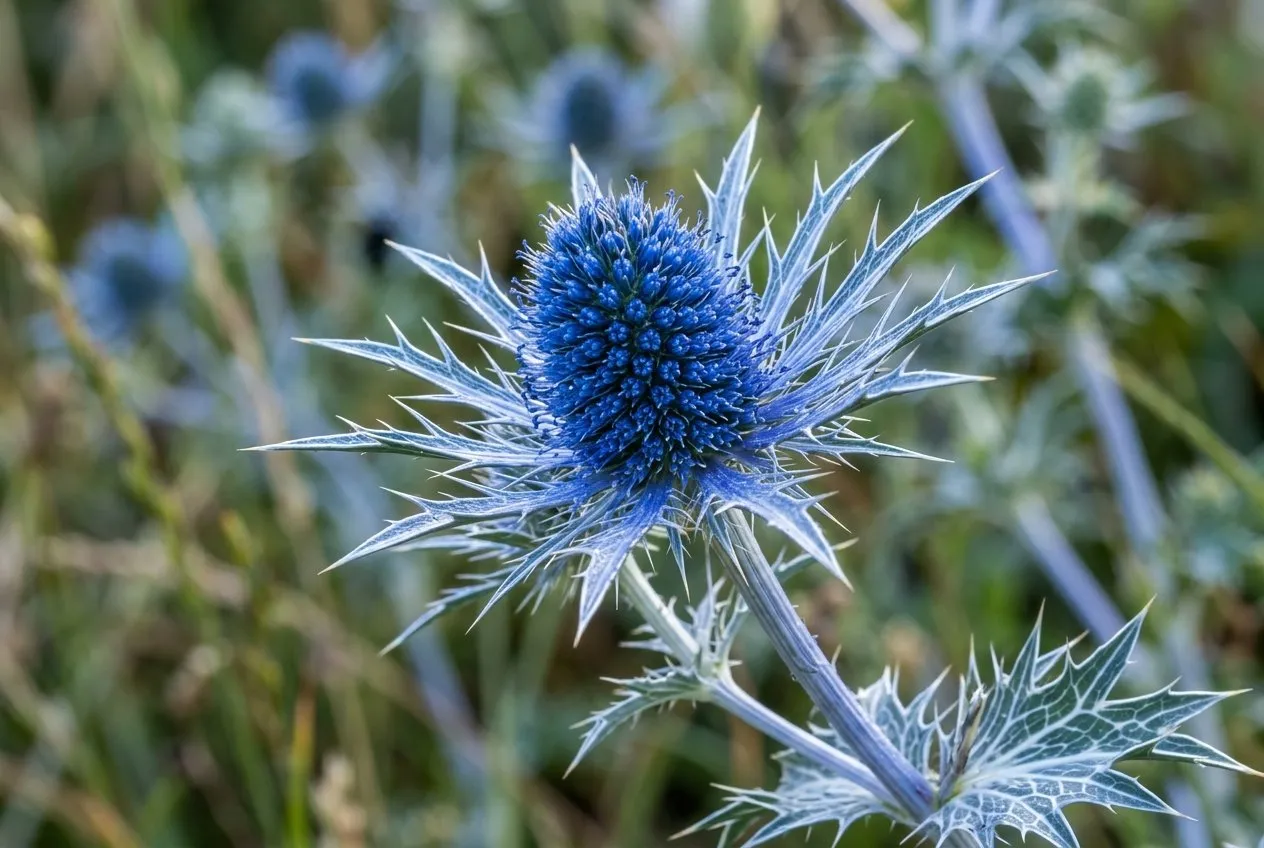 Eryngium bourgatii ‘Picos Blue’: the metallic colour deepens on lean, dry, sunny ground.
Why sea holly fails on wet clay, and how to fix it
Sea holly fails on wet clay because its fleshy tap root rots in cold, saturated soil. This is the single commonest reason eryngium dies in UK gardens, and it has nothing to do with cold hardiness. The plant evolved on dry, stony, free-draining ground with lean nutrition. Our wet winters keep clay waterlogged for months, and the root simply turns soft and brown from the base up.
Do not feed and do not enrich. Rich, manured ground gives soft, floppy, over-green growth with washed-out flower colour and a root more prone to rot. The same lean discipline that suits a gravel bed suits sea holly, which is why it sits so happily with other drought-tolerant plants in a low-water scheme. If your soil is solid clay and nothing else will grow, a raised bed or a deep pot of gritty compost lets you control the medium completely.
Warning: Never plant a bare-root or newly bought sea holly into a low spot, a heavy-clay hollow, or ground that stays wet after rain. The tap root will rot over its first winter and the plant will collapse in spring with no warning. On clay, the mound is not optional, it is the difference between life and death.
How to plant sea holly the right way
Plant sea holly young, in spring, and only once. Because the tap root resents disturbance, the goal is to get a small, pot-grown plant into its final position before that root has any chance to circle or check. Large, pot-bound specimens establish far worse than a modest young plant, so buy small and be patient.
Spring, from April to early June, is the best planting window. The soil is warming, and the plant has the whole season to drive its root down before winter. Dig a hole no deeper than the rootball but twice as wide. On clay, mound grit and topsoil under and around it so the crown sits slightly proud. Firm gently, water in once to settle the soil, then leave it alone. Overwatering a young sea holly is as risky as drought.
Space compact E. bourgatii at 30-40cm, taller E. planum and ‘Big Blue’ at 45-60cm, and the giant rosette types at 75cm or more. Good spacing keeps air moving, which cuts the powdery mildew that can appear on crowded, dry-stressed plants in late summer. If you inherit a sea holly in the wrong place, resist moving it. Better to take root cuttings and start fresh plants where you want them, because a lifted tap-rooted eryngium rarely survives the shift.
 Planting young on a grit mound: the crown sits proud so winter water drains away from the tap root.
Watering, feeding and year-round care
Sea holly needs almost no feeding and very little water once established. This is a plant that performs best on neglect. A young plant wants a weekly soak through its first summer while the tap root establishes, but from the second year on it is genuinely drought-proof and rarely needs watering at all.
Skip the fertiliser entirely on decent soil. If your ground is truly starved, a single light spring dressing is plenty, but rich feeding is counterproductive: it gives lax growth, poorer blue, and floppier stems that need staking. Do not mulch with rich compost or manure over the crown, as that traps moisture exactly where you do not want it. A thin gravel mulch is the only top-dressing sea holly wants, and it doubles as a dry collar around the crown.
Leave the flower stems standing into winter. The dried steel-blue heads hold their shape for months, catch frost beautifully, and feed seed-eating birds. Cut the old growth back to the base in late winter, in February or March, just before the new rosette pushes. The evergreen rosette types need their tatty outer leaves pulled off in spring but no cutting back. Sea holly also self-seeds gently, so leave a few heads if you want free plants, or clear them if you want to keep it tidy. It sits well with other self-seeding plants that fill gaps for nothing.
Month-by-month sea holly calendar
| Month | Task |
|---|---|
| January | Enjoy the frosted seedheads; check crowns are not sitting in water |
| February | Cut old stems to the base before new growth starts |
| March | Pull tatty leaves off evergreen rosette types; top up gravel mulch |
| April | Plant new young pot-grown stock on a grit mound |
| May | Water new plants weekly; stake only if grown too rich |
| June | Buds form; hoverflies begin to arrive on early heads |
| July | Peak flowering and peak pollinator traffic; cut stems for drying |
| August | Continue cutting for the vase; watch for powdery mildew in dry spells |
| September | Colour fades to silver; leave heads for seed and structure |
| October | Collect ripe seed if wanted; sow fresh in a gritty tray |
| November | Leave stems standing; ensure no water pools around crowns |
| December | Lift a mature plant if needed and take root cuttings |
Propagating sea holly from root cuttings
Root cuttings are the reliable way to make more tap-rooted sea holly, because these plants resent division and are slow from bought plants. The tap root that makes them hate being moved is also the source of every new plant you will ever want. Take cuttings in the dormant season, from December to February.
Lift a healthy, established plant of three years or more, or expose one side of the root without lifting the whole crown. Choose roots about pencil thickness. Cut them into sections roughly 5cm long. Keep track of which way is up: cut the top of each piece straight across and the base at a slant, so you plant them the right way round. Insert the sections upright into pots or a tray of gritty, free-draining compost, straight cut level with the surface, or lay thinner roots flat and cover with 1cm of grit.
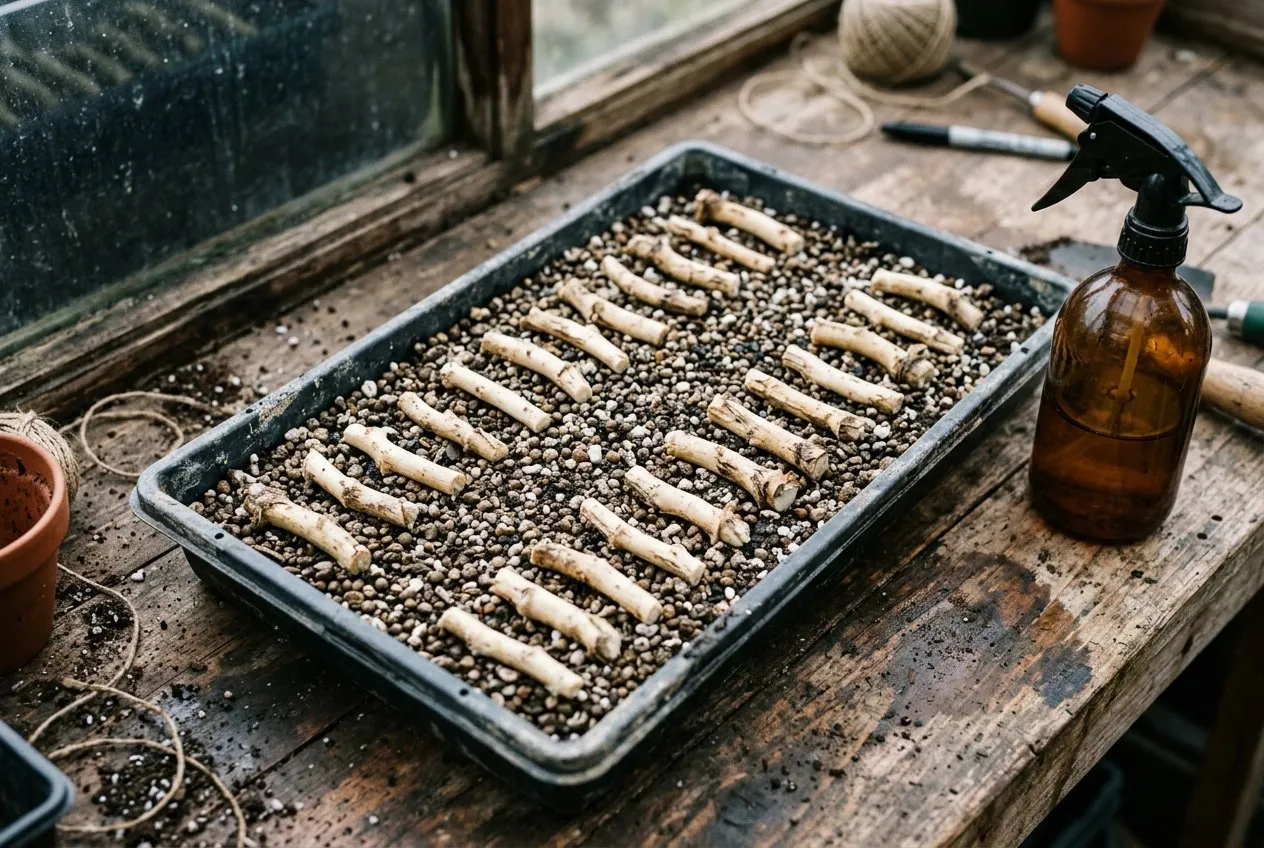 Pencil-thick root sections in gritty compost: cut straight at the top, slanted at the base, kept frost-free.
Cutting and drying sea holly for everlasting arrangements
Sea holly is one of the best perennials for both fresh and dried flower work. The stiff stems, spiny bracts and metallic colour give arrangements a structure few other blooms manage, and the colour holds for months once dried. E. planum, with its many small heads on branching stems, is the top choice for cutting.
For fresh use, cut stems when the bracts are fully coloured but before any florets brown. Cut in the cool of the morning, strip the lower leaves, and stand the stems in deep water for a few hours before arranging. Fresh sea holly lasts a good week to ten days in a vase. For drying, cut at the same stage, tie small bunches of five or six stems, and hang them upside down in a dark, dry, airy room. Two to three weeks gives you everlasting stems that keep their steel-blue for a season or more.
Grow a short cutting row of E. planum if you arrange often, spaced 40cm apart in a sunny, free-draining bed. It earns its place alongside the other best flowers for cutting and, unlike many, gives you two products from one plant: fresh stems in July and dried ones for winter.
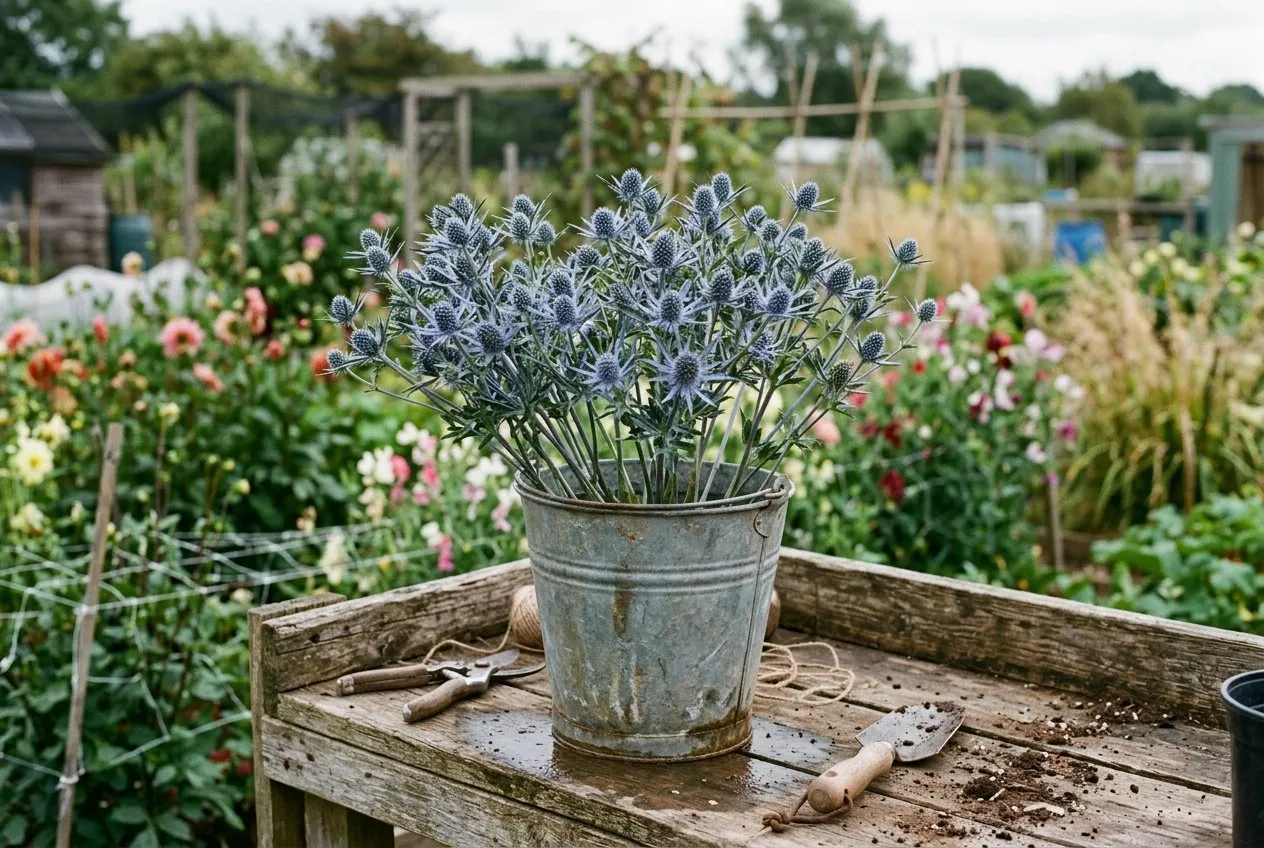 E. planum is the best sea holly for cutting: many small heads on branching stems, cut in the cool of the morning.
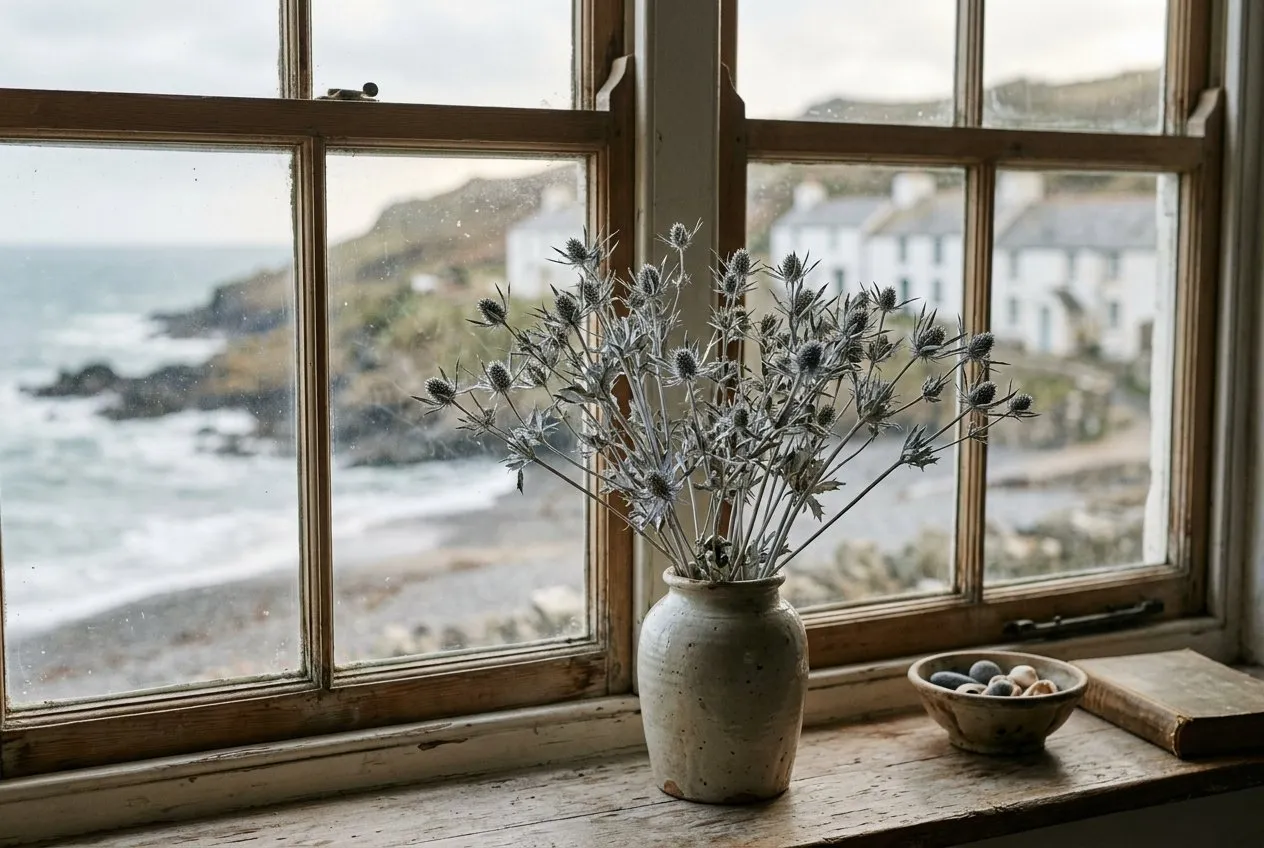 Dried sea holly holds its steel-blue for months, cut when fully coloured and hung upside down to dry.
Sea holly for pollinators and coastal gardens
That accessibility makes eryngium especially valuable in mid-summer, when it fills a nectar gap between the early border and the late-season flush. The Royal Horticultural Society lists sea holly among its plants for pollinators, and the Bumblebee Conservation Trust rates open, nectar-rich flowers like these for supporting bees through the summer months. If you are planting for wildlife, a group of E. planum will do more work than almost anything else of its size (bumblebeeconservation.org).
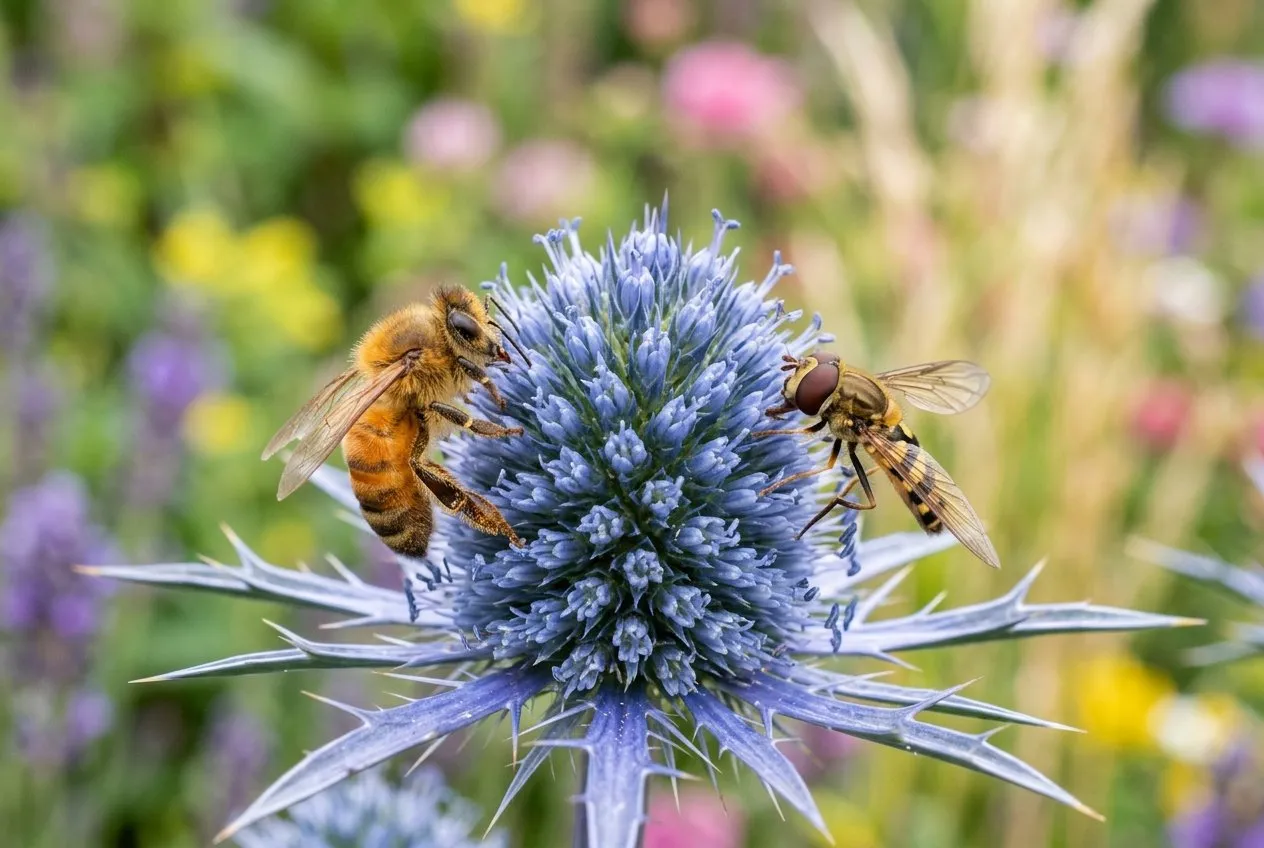 Open florets make sea holly easy nectar: bees, hoverflies and solitary wasps all work the heads.
The evergreen rosette types up close
Evergreen rosette sea hollies are a different plant to grow, bolder in leaf and less hardy at the root. E. agavifolium and E. pandanifolium keep their spiny, sword-shaped leaves all year, so they give structure in winter when the tap-rooted types have vanished underground. Their flowers are greenish-white or silver rather than blue, carried on tall branching stems.
These bold forms raise easily from seed, which is the main way to increase them, and they self-sow where happy. Use them as a full stop at the end of a gravel bed or a spiny centrepiece in a dry, sunny courtyard. Their agave-like silhouette earns its keep for the eleven months of the year they are not in flower.
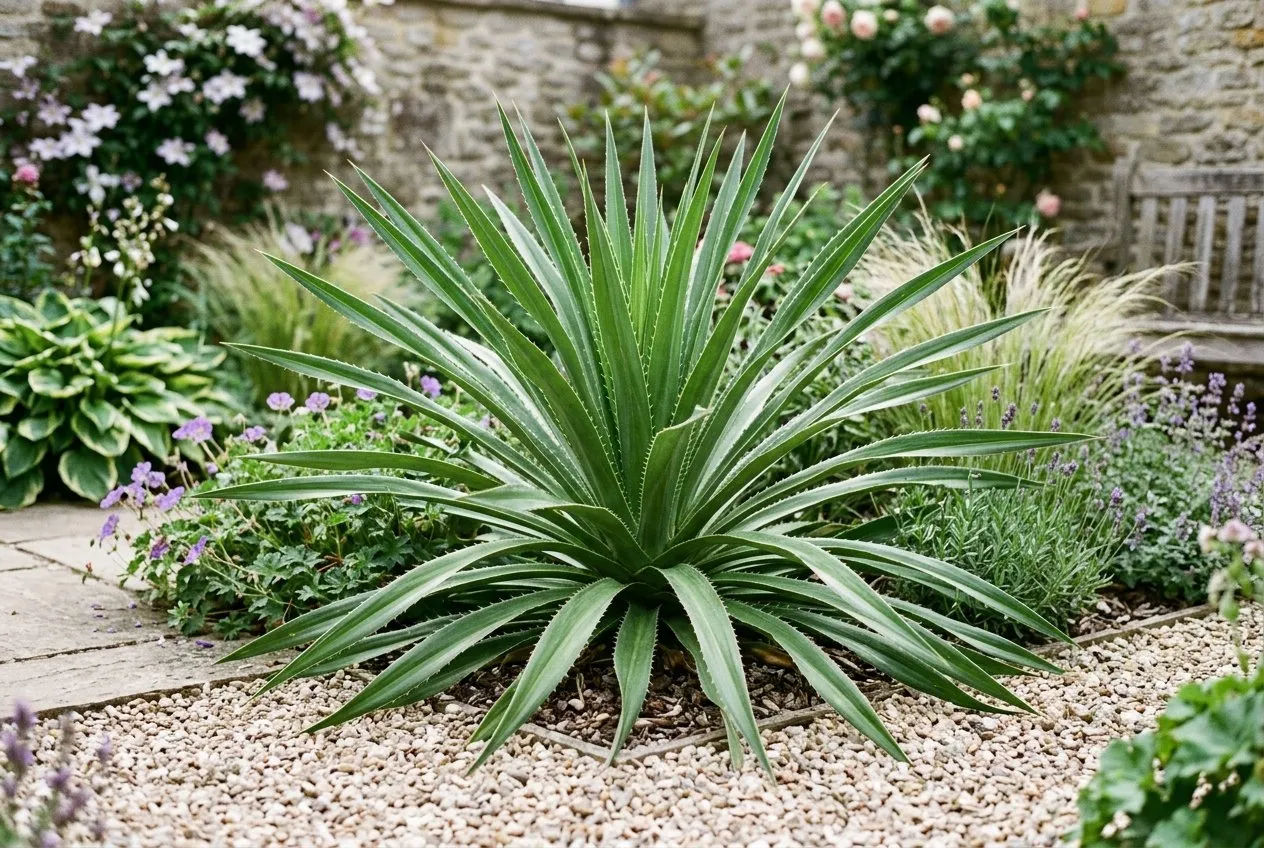 Eryngium agavifolium: an evergreen, agave-like rosette that holds structure through winter but needs shelter from hard frost.
Common mistakes when growing sea holly
Most sea holly failures trace back to a handful of avoidable errors, and nearly all of them are about giving the plant too much rather than too little.
Planting into wet, unimproved clay
The number one killer. A tap-rooted sea holly set into cold, wet clay rots at the root over winter. Always dig in 30% grit and plant on a raised mound, or grow it in a deep pot of gritty compost instead.
Feeding and enriching the soil
Rich ground gives soft, floppy growth and washed-out colour. Sea holly wants lean, stony living. Skip the fertiliser, skip the manure mulch, and let the plant go hungry for the best blue and the strongest stems.
Trying to move or divide it
Tap-rooted eryngiums rarely survive being lifted or split. Buy young, plant in the final spot, and make more plants by root cuttings, not division. If a plant is in the wrong place, take cuttings and start again rather than digging it up.
Buying a big, pot-bound specimen
A large, root-bound sea holly establishes far worse than a small young one. The circling tap root never settles. Choose the smallest healthy plant on the bench and let it drive its root down undisturbed.
Growing it in shade
Shade gives leggy growth, dull colour and more mildew. Sea holly needs six hours of direct sun minimum. A hot, dry, open spot that scorches other plants is exactly where eryngium shines. The hotter and leaner the position, the bluer the flower heads.
Frequently asked questions
Where should I plant sea holly?
In full sun on free-draining, poor soil. Sea holly needs at least six hours of direct sun and sharp drainage to thrive. It suits gravel gardens, sunny banks and coastal plots. Avoid shade and any spot where water sits in winter, because the fleshy tap root rots in cold, wet ground.
Why is my eryngium dying or rotting?
Almost always winter wet at the root. Sea holly evolved on dry, stony ground and cannot cope with saturated soil. On clay the tap root rots from November onwards. Dig in 30% grit, plant on a raised mound, and never feed or overwater. Root rot, not cold, is the usual killer.
Can you divide sea holly?
No, dividing usually kills it. Tap-rooted eryngiums resent any root disturbance and rarely recover from being split. Propagate instead from root cuttings taken in winter, or collect and sow the self-set seed. Buy young, pot-grown plants so the tap root establishes without a check.
How do you take sea holly root cuttings?
Lift a plant in December to February and cut pencil-thick root sections. Cut each root into 5cm lengths, straight at the top and slanted at the base. Lay them flat or set them upright in gritty compost, cover lightly, and keep frost-free. Most root by mid-spring.
Is sea holly good for bees?
Yes, it is one of the best pollinator plants you can grow. The domed flower heads carry hundreds of tiny nectar-rich florets that bees, hoverflies and solitary wasps work all day. It flowers in July and August, filling the mid-summer nectar gap in a sunny border.
Can you dry sea holly for arrangements?
Yes, sea holly dries beautifully for everlasting arrangements. Cut stems when the bracts are fully coloured but before the florets brown. Strip the lower leaves and hang small bunches upside down in a dark, airy room for two to three weeks. The steel-blue colour holds for months.
How tall does eryngium grow?
From 45cm to over 2m, depending on the type. Compact E. bourgatii reaches 45-60cm, E. planum and ‘Big Blue’ around 75-90cm, while the evergreen E. agavifolium throws flower spikes to 1.5m. The giant E. pandanifolium can top 2.5m in a warm, sheltered spot.
Our team produces practical UK gardening guidance from source research, contributor records and established horticultural practice. Editorial standards are overseen by Matt W.