Key takeaways
- Right plant, right place: choose plants for the spot you have, not the other way round
- Beth Chatto's gravel garden in Essex is built on an old car park and is never watered
- Spread 50-75mm of gravel, with no membrane, and dig grit into clay first
- Water new plants weekly in their first summer only, then let them fend for themselves
- Under trees, try epimedium, Geranium macrorrhizum and Cyclamen hederifolium
- Leave seed heads standing all winter and cut back in late February
A Beth Chatto dry garden is simple: put plants where they’re happy and they’ll look after themselves. No watering, no feeding and very little fuss. Her famous gravel garden in Essex was made on an old car park in one of the driest parts of England, and it’s never watered.
The trick is to stop fighting your garden. Baked gravel in full sun, dry shade under big trees, heavy clay that cracks in summer: each one has plants that love it. Find them, and the hard work is done.
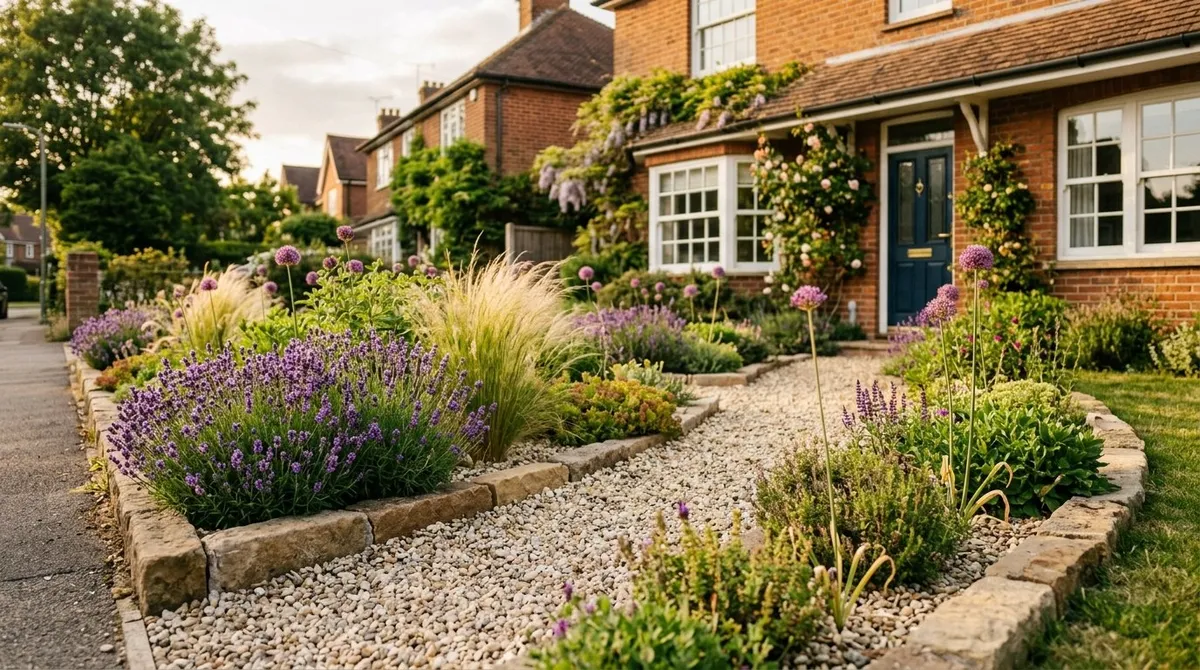
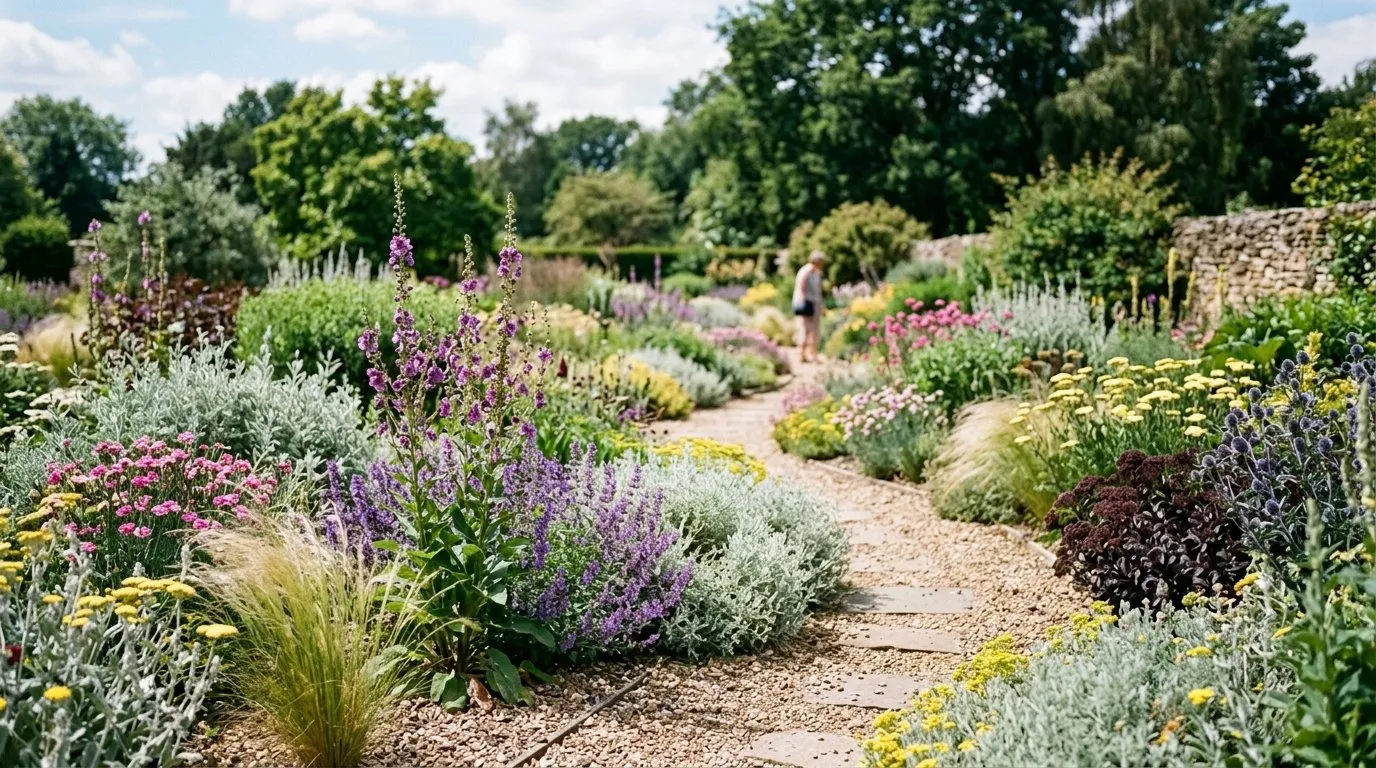 A Beth Chatto style dry garden, with stipa, eryngium and verbascum growing through pale gravel.
What is the Beth Chatto way of gardening?
It all comes down to one idea: right plant, right place. Lavender sulks in wet shade. Hostas fry in hot gravel. Swap them round and both are happy.
Beth Chatto showed this at her nursery at Elmstead Market in Essex. She had a dry, stony car park, a boggy ditch and dry shade under old oaks. Rather than level and water everything, she planted each area with plants that suited it. Those gardens are still going strong.
Her books The Dry Garden and Beth Chatto’s Gravel Garden explain it in more depth. The idea is easy to borrow: think about where a plant grows in the wild, then find the spot in your garden that’s most like it.
How to check what your garden is like
Before you buy a single plant, walk round the garden and take notes. It only takes an afternoon.
Light: Note which spots get full sun (6 hours or more), part shade (3-6 hours) or shade (under 3 hours). A spot under a tree may be shady in July but sunny from November to April.
Soil: Dig up a handful. Clay is sticky and holds its shape when squeezed. Sandy soil is gritty and falls apart. Chalky soil is pale and stony. A cheap pH kit from a garden centre tells you if it’s acid or alkaline. Most dry garden plants like neutral to alkaline soil.
Drainage: After heavy rain, see how long puddles hang about. If they’re still there after 2-3 hours, the drainage needs help. If water vanishes in minutes, you’ve already got dry garden conditions. Our guide to improving sandy soil has tips for very fast-draining ground.
Thirsty neighbours: Big trees and hedges suck a lot of water out of the soil in summer. Anything planted within about 3 metres of a large tree will be competing for every drop.
Which plants thrive in a dry gravel garden?
A sunny gravel bed suits the biggest range of drought-loving plants. Many come from hot, stony hillsides where summer rain is rare.
| Plant | Height | Flowers | Good to know |
|---|---|---|---|
| Stipa tenuissima | 60cm | June to September, buff | Wafts in the breeze, seeds itself about |
| Verbascum bombyciferum | 180cm | June to July, yellow | Woolly silver rosettes, flowers in its second year |
| Eryngium bourgatii | 45cm | June to August, steely blue | Spiky and striking, hates being moved |
| Allium hollandicum | 90cm | May to June, purple | Seed heads last for months |
| Cistus x purpureus | 100cm | June to July, pink | Papery flowers, scented leaves |
| Lavender | 60cm | June to August, purple | Loves chalk and sun |
| Pennisetum villosum | 60cm | August to October, white | Fluffy heads, not fully hardy |
| Euphorbia characias | 120cm | March to May, lime green | Evergreen and bold |
| Salvia nemorosa | 50cm | June to September, violet | Flowers again if you deadhead it |
Stipa feather grass is the star of Beth Chatto’s gravel garden. Its fine, hair-like leaves catch every breeze and glow in low sun. Plant it in groups of five or more.
Cistus, or rock rose, is another must. Each flower lasts a day, but dozens open every morning through June and July. It needs no pruning and no feeding.
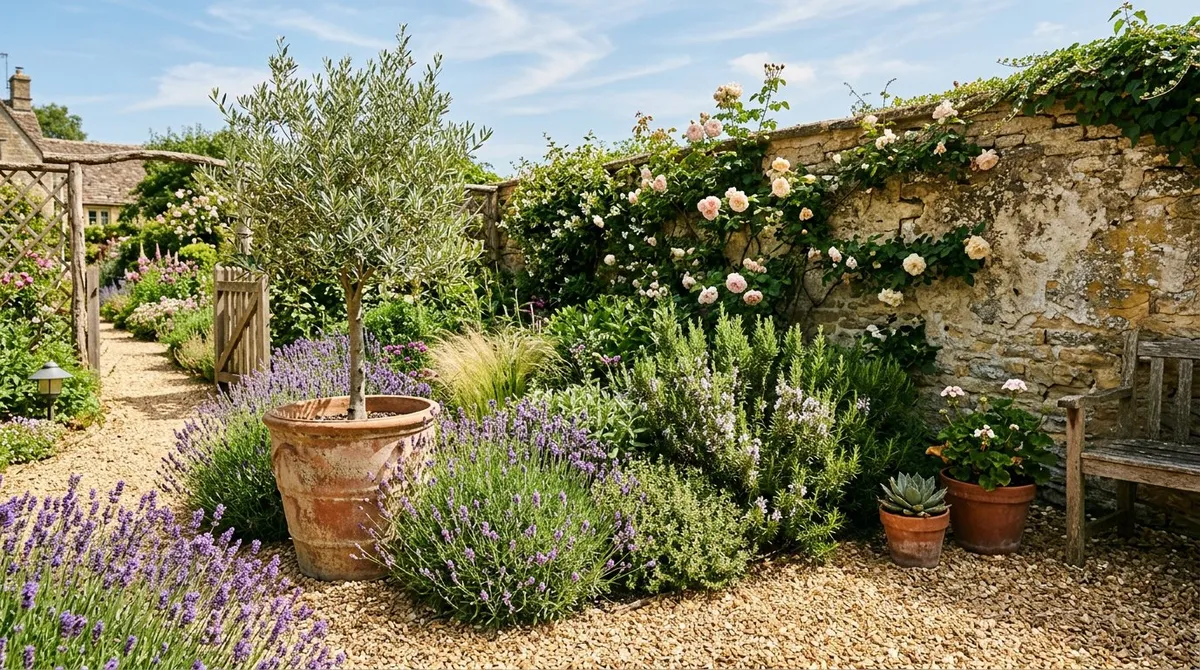
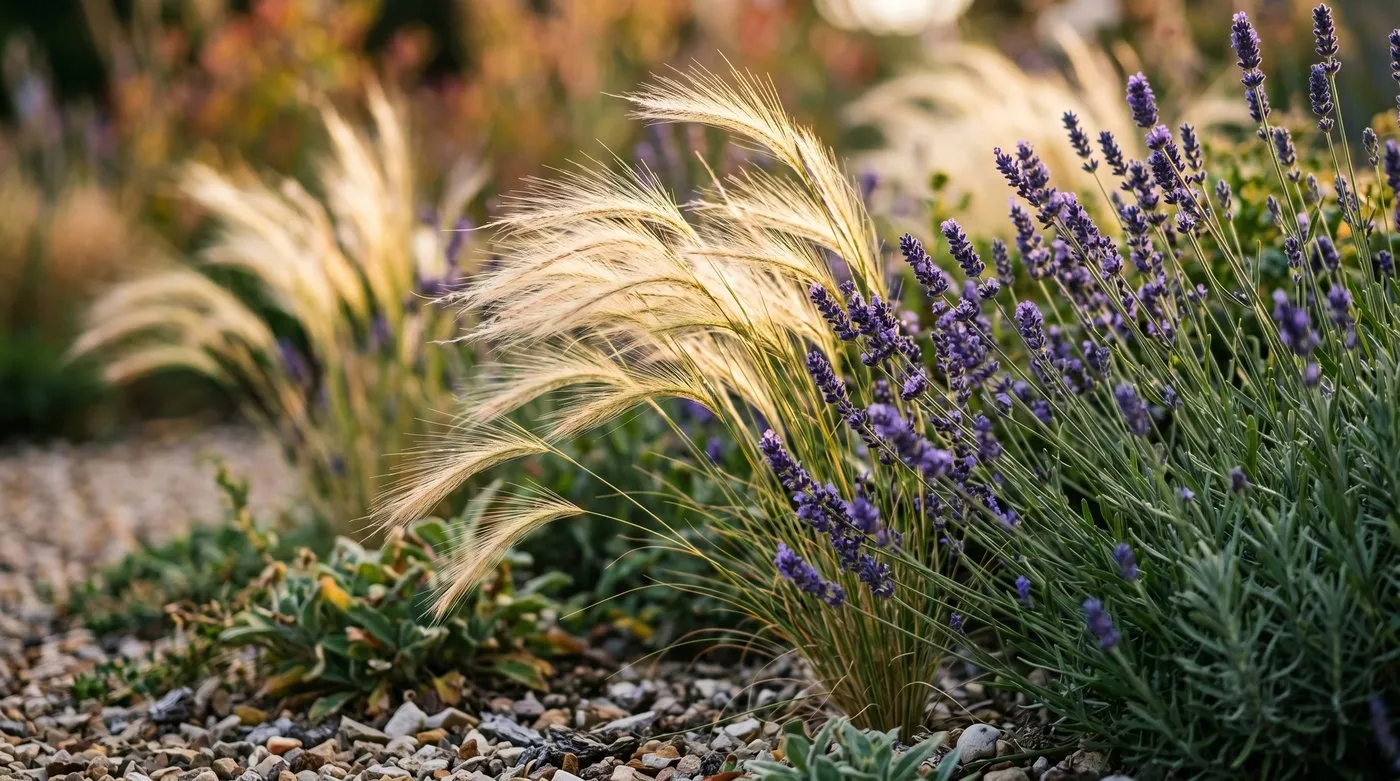 Stipa tenuissima and lavender make a soft, natural looking border in gravel.
Best plants for dry shade in the UK
Dry shade under big trees is the hardest spot in any garden. Tree roots take nearly all the water from May to October, and the leaves stop rain getting through.
Beth Chatto planted hers under an old oak. Her rule was simple: only use plants from woodland floors, where life is just as dry and shady.
Good choices for dry shade:
- Epimedium x versicolor ‘Sulphureum’: 30cm, heart-shaped leaves and yellow spring flowers. Very tough once settled. Cut the old leaves off in February so you can see the flowers.
- Geranium macrorrhizum: 40cm, scented leaves and pink or white flowers in May and June. Spreads into thick ground cover that smothers weeds.
- Cyclamen hederifolium: 12cm, pink flowers in September before the leaves appear. Spreads happily under trees and hedges.
- Stinking iris (Iris foetidissima): 50cm, evergreen leaves and bright orange berries in autumn. Copes with deep shade and roots.
- Male fern (Dryopteris filix-mas): 90cm, a native fern with a shuttlecock shape.
- Brunnera macrophylla: 40cm, forget-me-not flowers in April and big heart-shaped leaves. ‘Jack Frost’ has silvery leaves.
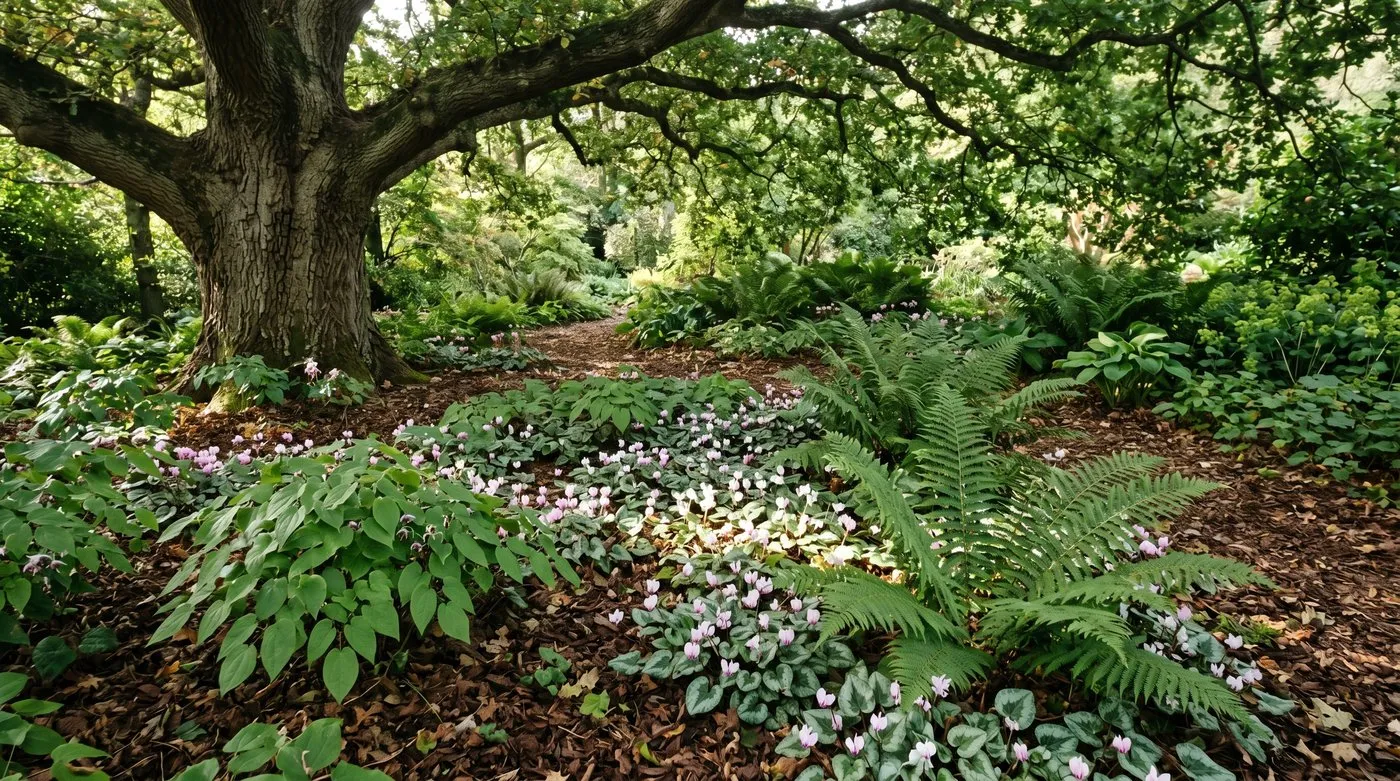 Epimedium, ferns and cyclamen are happy in dry shade under an old oak.
How to prepare soil for a dry garden
What you do depends on your soil. The aim is always the same: winter wet must drain away from the roots.
On clay: Dig 10-15cm of sharp grit into the top 30cm before you plant. Or build beds 15-20cm high with a gritty mix. Without this, sun lovers rot in wet winters.
On sandy soil: There’s hardly anything to do, as it already drains fast. Grasses like stipa and pennisetum are happy without any changes.
On chalk: The best natural base for a dry garden. It drains freely and suits lavender, cistus, eryngium and verbascum. Our list of plants for chalky soil has plenty more.
On thin, stony ground: This is what Beth Chatto started with. If your soil is poor, stony and dry, lucky you. Clear the weeds, spread the gravel and plant straight in.
How to make a gravel garden you don’t need to water
Beth Chatto kept it simple: no membrane, no fancy edging and no watering system.
Step 1: Clear the ground. Lift turf, weeds and rubbish. Fork out bindweed and couch grass roots. Wait three weeks and fork out anything that regrows.
Step 2: Fix drainage if needed. On clay, dig in grit as above. On free-draining soil, skip this step.
Step 3: Spread the gravel. Lay 50-75mm of 20mm gravel or angular flint straight onto the soil. Leave out the membrane, as it stops plants seeding themselves, and that’s half the charm of a gravel garden.
Step 4: Plant through the gravel. Scrape the gravel aside and dig a hole twice the width of the pot. Water the hole, then plant at the same depth as it sat in the pot. Backfill with soil mixed with grit, then pull the gravel back around the plant.
Step 5: Water the first summer only. Water new plants weekly from April to September in their first year, then stop. That makes the roots go deep to find water for themselves.
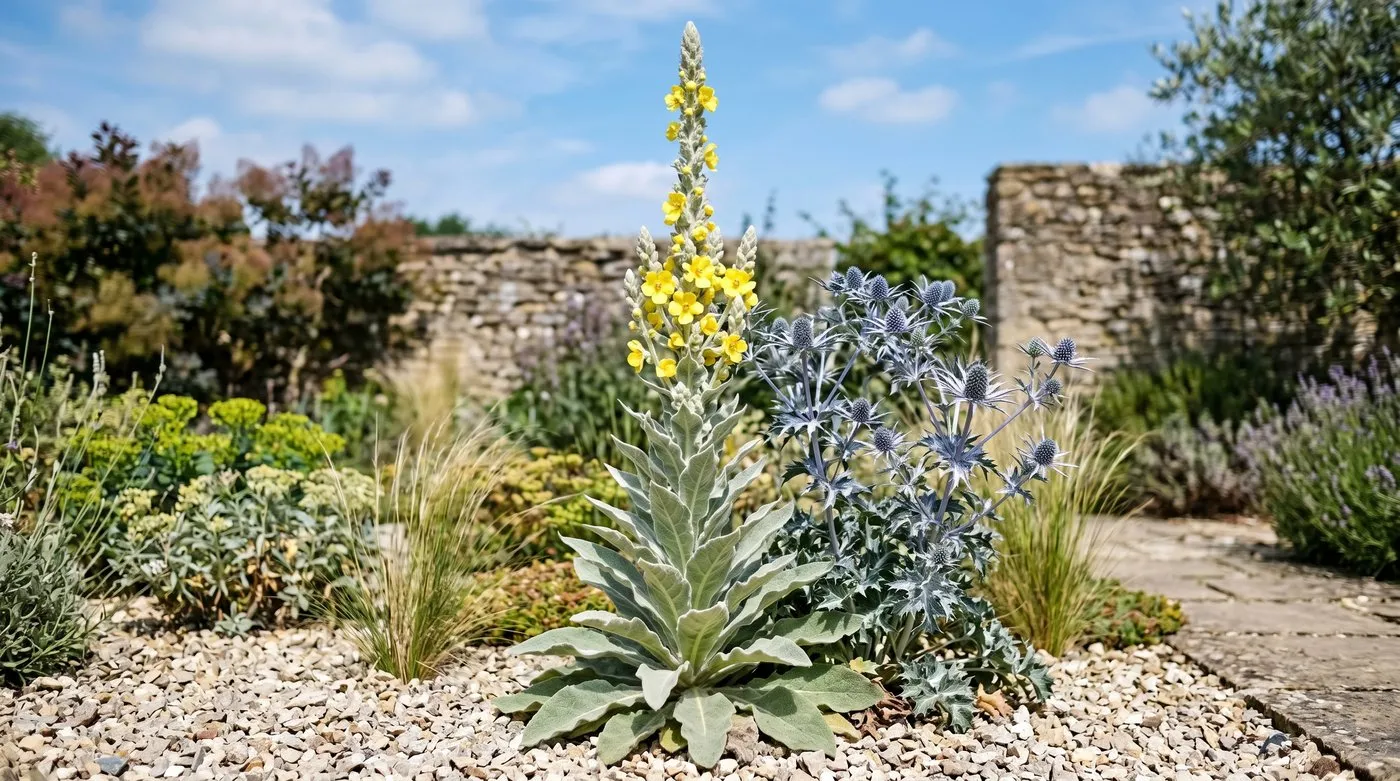 Verbascum and eryngium in gravel. Neither lives very long, but both seed themselves about freely.
What does right plant, right place mean in practice?
It means matching each plant to the conditions it grows in naturally. It’s the opposite of buying whatever looks nice and then working hard to keep it alive.
One word of warning: a spot described as “alpine” doesn’t tell you its soil or pH, so check before you plant. Our Church Gill planting-zone article shows how to check conditions zone by zone.
The easy way to use it is to split your garden into zones:
| Zone | What it’s like | Plants to try | Where you’ll find it |
|---|---|---|---|
| Dry sun | Full sun, drains fast, poor soil | Stipa, lavender, verbascum, eryngium | South-facing gravel bed, edge of a drive |
| Dry shade | Under trees, lots of roots | Epimedium, cyclamen, stinking iris, ferns | Foot of big trees, north side of a hedge |
| Damp shade | Sheltered, rich, moist soil | Hosta, astilbe, ligularia, rodgersia | Shady border with plenty of mulch |
| Damp sun | Full sun, soil that stays moist | Siberian iris, trollius, marsh marigold | Pond edge, low clay border |
Put every plant in its happy place and it looks its best with no extra water, feed or replacing. Beth Chatto’s own garden has run this way for over 30 years.
Dry garden care through the year
A dry garden needs far less time than a traditional border. Here’s what to do and when.
| Month | Job |
|---|---|
| February | Cut old epimedium leaves to the ground. Cut grasses back to 10cm. |
| March to April | Pull weed seedlings out of the gravel. Thin out self-sown stipa and verbascum. |
| May | Deadhead alliums if you’d rather not keep the seed heads. |
| June to July | Trim lavender after its first flush. Pull off spent cistus flowers. |
| August to September | Collect verbascum and eryngium seed. Plant cyclamen. |
| October | Spread 50mm of leaf mould on dry shade beds. Leave gravel beds bare. |
| November to January | Leave seed heads standing. Nothing to cut. |
The most common mistake is tidying too early. Seed heads protect plant crowns over winter, feed birds and look lovely in a frost. Cut back in late February, just before new growth starts.
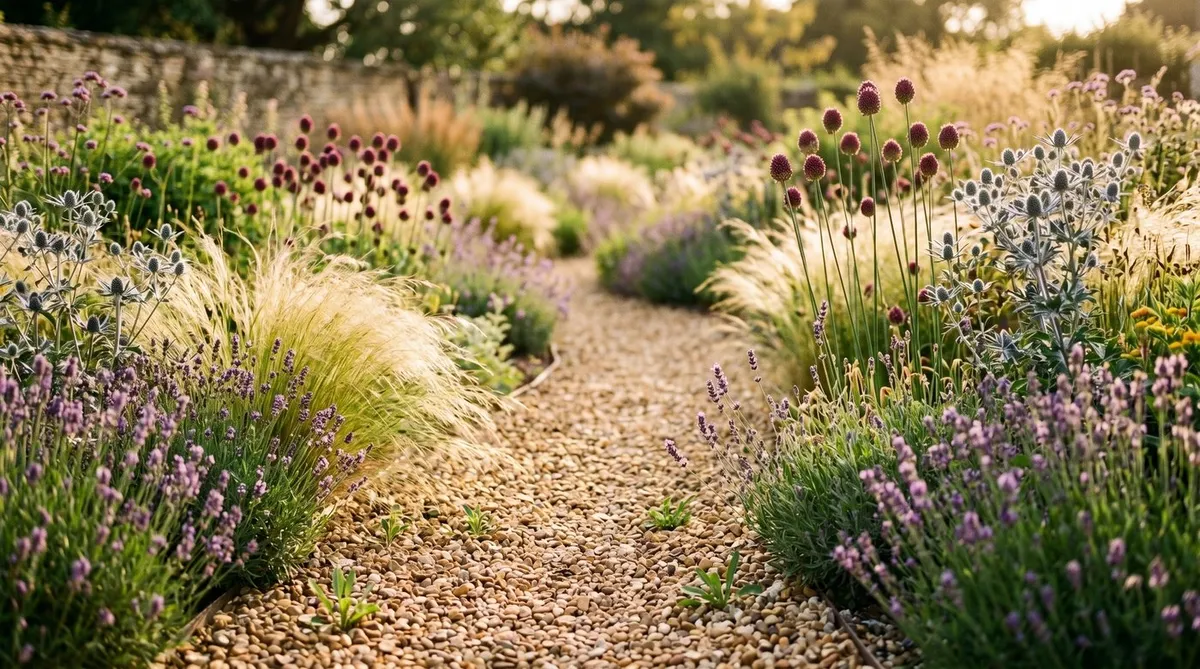
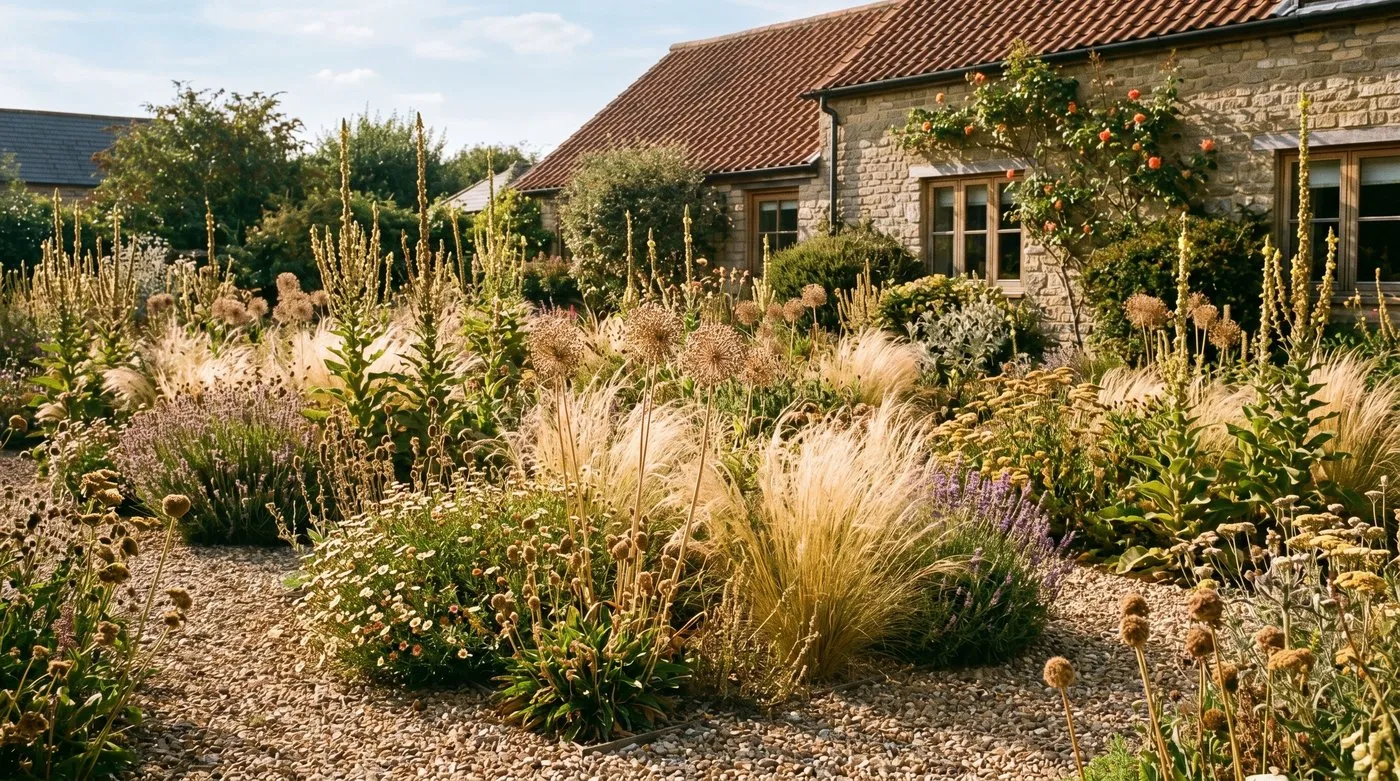 A settled dry garden in late summer. Self-sown verbascum and allium seed heads give it shape, with no watering at all.
Making a Beth Chatto border on a budget
You don’t need a big garden or a big budget. The same ideas work on a 2-metre strip by the drive or a single raised bed.
A starter border, about 2m x 4m:
- 1 tonne of 20mm gravel
- Half a tonne of sharp grit, if you’re on clay
- 5 stipa tenuissima in 9cm pots
- 3 lavender in 9cm pots
- 5 allium bulbs
- 3 sedum in 9cm pots
- 1 eryngium and 1 verbascum in 2-litre pots
Buy small plants. Nine-centimetre pots cost far less than big ones and settle into lean, gravelly soil quickly. Within a couple of seasons, self-sown seedlings fill the gaps. Beth Chatto was a fan of small plants and patience.
For more ideas, see our list of drought-tolerant plants. Many of the same plants suit a Mediterranean garden style in a sunny, sheltered border.
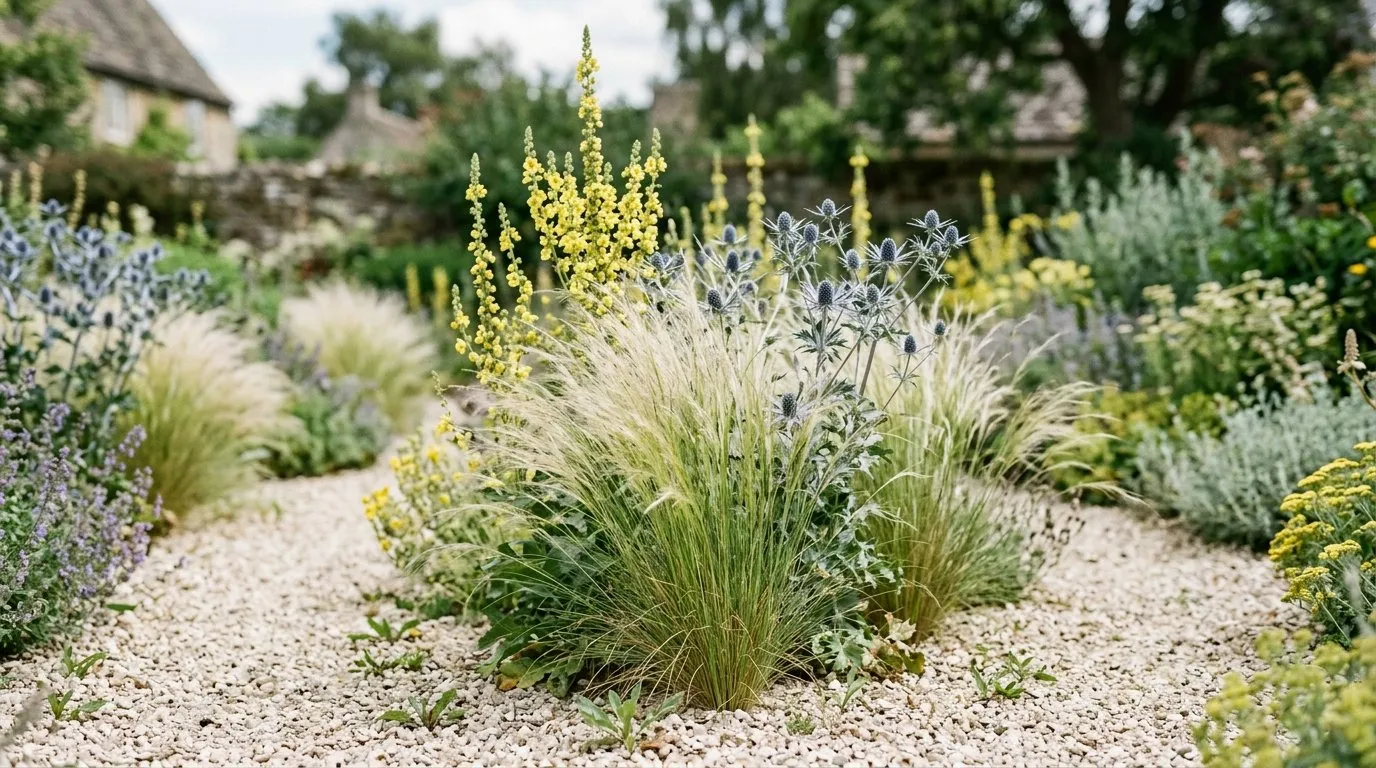 After a few seasons, stipa, verbascum and eryngium seed themselves into natural drifts.
For more ideas to borrow from a famous garden, see our notes from RHS Wisley. The RHS guide to drought-resistant gardening is handy too.
Frequently asked questions
What is the right plant right place principle?
It means choosing plants that suit the spot you already have. Look at the soil, how wet or dry it is and how much sun it gets, then pick plants that like exactly that. Lavender in wet clay soon dies. The same lavender in gravel and full sun carries on for years without watering.
Can you visit the Beth Chatto dry garden?
Yes, it’s part of Beth Chatto’s Gardens near Colchester. The gardens are at Elmstead Market in Essex. Check their website for opening times and prices before you go. Late spring and early summer give the best show, but there’s something to see in every season.
Does a dry garden work on clay soil?
Yes, as long as you sort out the drainage first. Dig 10-15cm of sharp grit into the top 30cm of clay before planting, or build beds 15-20cm high with a gritty mix. Without that, Mediterranean plants rot in soggy winter clay.
What plants grow in dry shade UK?
Epimedium, Geranium macrorrhizum and Cyclamen hederifolium are the most reliable. Tree roots drink almost everything, so only tough woodland plants cope. Stinking iris, male fern and brunnera are good backups. Spread leaf mould over the bed each autumn to help the thin soil.
How much does a dry garden cost to create?
Allow roughly 15-30 pounds per square metre. That covers gravel, grit, small plants and edging. After the first year it costs almost nothing to run, because there’s no watering, no feeding and little weeding.
Do dry gardens need watering?
Only in the first summer after planting. Water new plants weekly from April to September in their first year. Once the roots go down, normal UK rain is enough, even in a dry summer.
What gravel is best for a Beth Chatto style garden?
Use 20mm gravel or angular flint, spread 50-75mm deep. Warm honey or buff shades suit most UK gardens and set off silver leaves nicely. Skip bright white stone, which looks harsh, and anything under 10mm, which sticks to your shoes.
Our team produces practical UK gardening guidance from source research, contributor records and established horticultural practice. Editorial standards are overseen by Matt W.