Key takeaways
- Repeat one plant at regular intervals along a border for an instant sense of design
- Buy fewer varieties in bigger groups rather than one of everything
- Thread spring bulbs between perennials so the border performs from April
- A crevice trough gives you a rock garden in a space the size of a doorstep
- Step-over apples turn a path edge into a crop, trained on a single low wire
- Put scented plants within arm's reach of where you actually sit
RHS Wisley is the Royal Horticultural Society’s flagship garden, near Woking in Surrey. It’s huge, but many of its best ideas shrink beautifully to fit an ordinary back garden. Here are eleven you can copy at home, from a simple border trick that costs nothing to a still water bowl that needs no pump.
Take a notebook and your phone when you go. Photograph plant labels and the planting around them, as you can’t take cuttings. Check opening times and tickets on the RHS Wisley page before you set off.
Ideas to copy from Wisley’s mixed borders
The long mixed borders are one of the most useful parts of Wisley for home gardeners. They run either side of a grass walk, and three of their tricks work in any border of about 5m or more.
1. Repeat one signature plant down the border
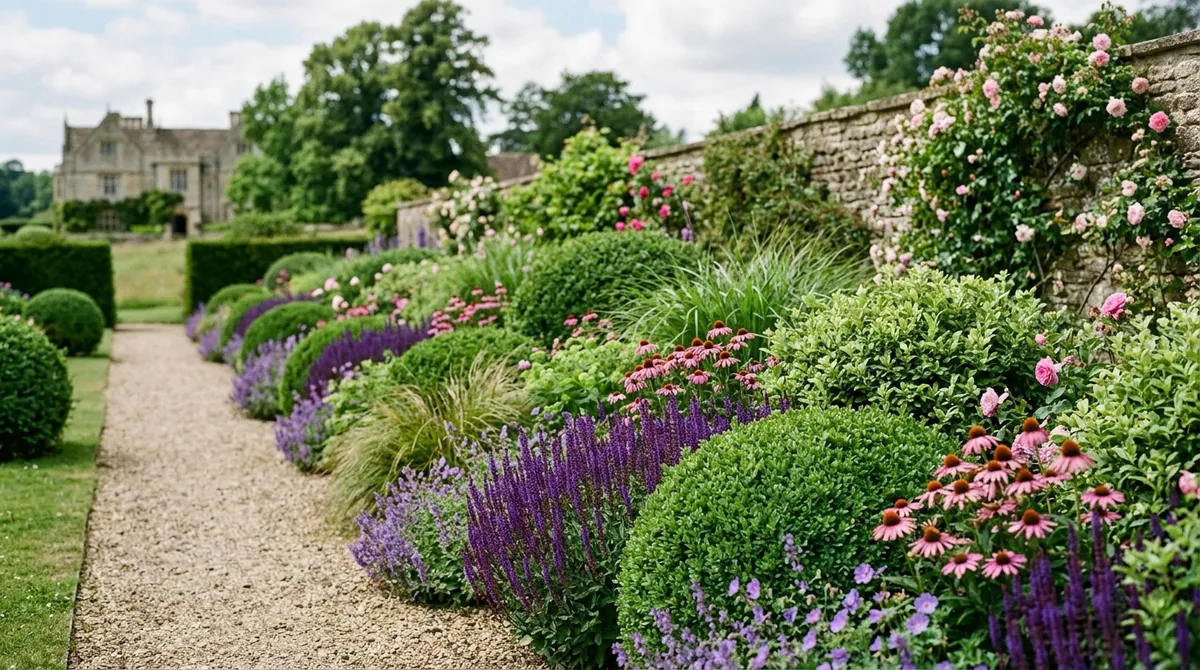
Pick one strong plant, such as a salvia, nepeta or a grass, and plant it at regular intervals every few metres. The eye picks up the pattern and the whole border looks designed, even if the rest is a mix. Dividing a clump you already have makes this free.
2. Plant in groups, not one of everything
Big groups read clearly from across the garden. Single plants get lost. Buy fewer varieties in bigger numbers, in threes, fives or sevens. Five varieties in groups of seven looks far calmer than thirty-five different plants, and costs about the same.
3. Thread bulbs through the border
In spring, the borders rely on tulips and daffodils planted between the perennials, weeks before the perennials wake up. Plant bulbs in the gaps in autumn and you’ll have colour from April. For pots, the same idea becomes a bulb lasagne with layers of flowers from one container.

Three groups of purple salvia spaced along a border. Repeating one plant is the quickest way to make a bed look planned.
Ideas from the Glasshouse borders and Exotic Garden
The borders around the Glasshouse were designed by Piet Oudolf in his naturalistic style. Nearby, the Exotic Garden shows what big leaves can do.
4. Weave grasses and perennials together
Instead of separate blocks, grasses and flowering perennials are planted through each other. Grasses like molinia and deschampsia hold the scheme together from summer to late winter, with echinacea and salvias rising through them. The guide to prairie planting explains how to build one at home.
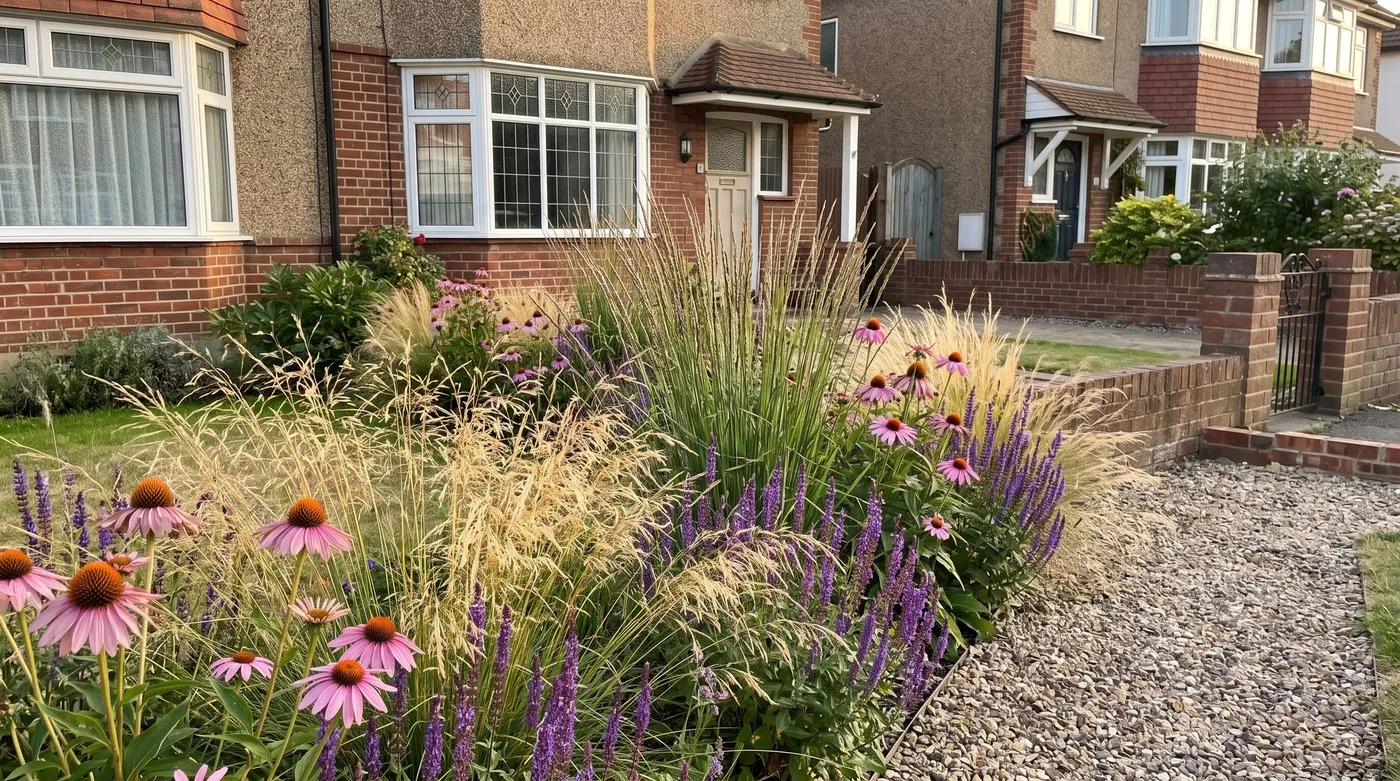
Grasses and perennials planted through each other look natural and hold their shape well into winter.
5. Give one corner to big leaves
A small dose of oversized foliage changes the feel of a whole space. You don’t need a jungle, just one sheltered corner. Fatsia is tough and evergreen, and hardy bananas and tetrapanax add drama in milder or sheltered gardens. The bigger the leaf, the fewer plants you need.
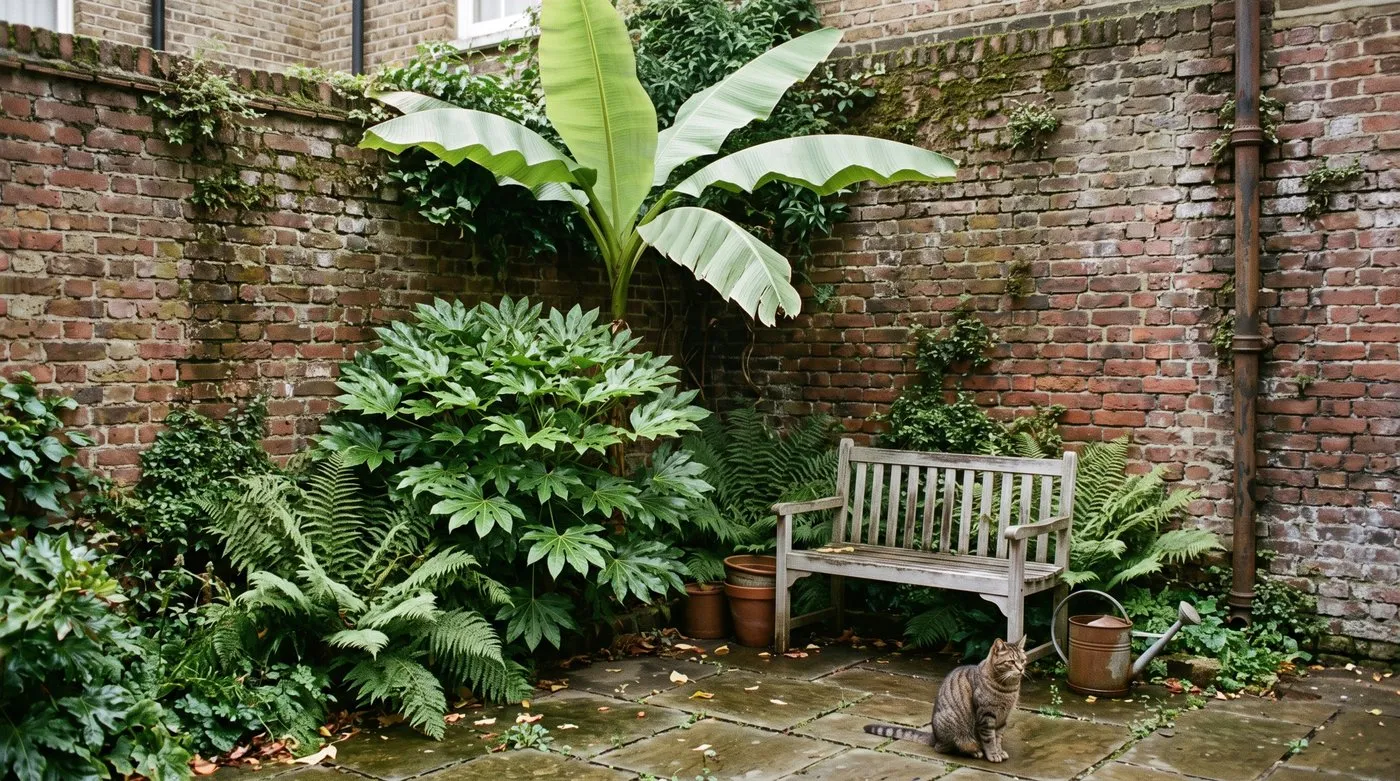
A fatsia and a hardy banana are enough to make one corner feel lush. The bigger the leaf, the fewer plants you need.
Can a small garden copy Wisley’s rock and gravel planting?
Yes, and the small versions are some of the cheapest ideas here. Wisley’s Rock Garden is more than a century old and enormous, but the principles work in a trough.
6. Plant a crevice trough instead of a rockery
Stand thin pieces of slate or stone on edge in a trough of gritty compost. Plant small alpines such as saxifrages and sempervivums into the gaps. The roots run deep and cool between the stones, which alpines love. The guide to building a crevice garden has step-by-step instructions.
7. Use gravel as mulch and growing surface
A layer of gravel keeps the necks of drought-loving plants dry, stops weeds and lets plants self-seed. It suits sunny, free-draining spots best. The guide to creating a gravel garden shows how to lay one.

Slate on edge and gritty compost turn an old trough into a tiny rock garden. Alpines love the sharp drainage.
Edible ideas from the fruit and food gardens
Wisley shows that fruit and veg can look as good as flowers. Two ideas scale down well.
8. Edge a path with step-over apples
A step-over apple is trained along a single low wire, about 45cm high, so you can literally step over it. It makes a pretty, productive edge for a veg bed or path. Plant bare-root trees between November and March. The guide to training fruit trees as espaliers covers the pruning.
9. Run your own mini trial
Wisley trials plants side by side to decide which earn the RHS Award of Garden Merit. Do the same on a small scale. Before filling a whole bed with one variety, grow two or three side by side for a season and note which does best in your conditions.

A step-over apple trained along a low wire makes a path edge that gives you fruit too.
Finishing touches: still water and scent
Two quieter ideas add a lot of atmosphere for very little space.
10. Use a still water bowl as a focal point
Wisley’s formal canal, designed by Geoffrey Jellicoe, shows how calm water reflects the sky. At home, a sealed water bowl does the same on a patio, with no pump or liner. Keep it level and topped up, and tip it out and refill it now and then. The guide to water feature ideas has more options.
11. Plant scent within reach of the seat
The Wellbeing Garden at Hilltop is made for sitting quietly among plants. Bring that feeling home by planting something scented within arm’s reach of wherever you sit. Try sarcococca for winter, daphne for spring or night-scented stock for summer evenings. The guide to the best scented plants has plenty more.

A still water bowl reflects the sky like a mini canal. No pump, no liner, just keep it topped up.
The 11 Wisley ideas at a glance
| Idea | Space needed | Best for |
|---|---|---|
| Repeat planting | Any border | Making a mixed border look planned |
| Plant in groups | Any border | A calmer, bolder look |
| Bulbs through the border | Any border | Spring colour |
| Grass and perennial matrix | A sunny bed | Movement and winter structure |
| Big-leaf corner | One sheltered corner | A lush, jungly feel |
| Crevice trough | A doorstep or patio | Alpines in a small space |
| Gravel planting | A sunny, dry spot | Low watering, self-seeding |
| Step-over apples | A path or bed edge | Fruit in a tiny space |
| Mini trial | A spare row | Finding varieties that suit you |
| Still water bowl | A patio | A calm focal point |
| Scent by the seat | Beside a bench | Fragrance where you’ll notice it |
Common mistakes when copying a big garden
- Copying the plant list, not the layout. The repeat rhythm and the groups matter more than the exact varieties.
- Buying one of everything. A single of each plant makes a collection, not a design.
- Ignoring your own soil. Wisley’s ground is light, sandy and acidic. Plants that thrive there may sulk on cold, wet clay. Match the idea to your conditions.
- Scaling up instead of down. A formal canal needs engineering. A sealed bowl gives you the reflection on a patio.
- Visiting once. A spring visit tells you nothing about August. Go again in another season.
Now you’ve borrowed ideas from Wisley, read the guide to the best new ideas from RHS Chelsea for more inspiration. For more projects, browse our garden design guides.
Frequently asked questions
Is RHS Wisley worth visiting for garden design ideas?
Yes, it’s one of the best gardens in the UK for ideas. It covers borders, rock and alpine planting, a glasshouse, fruit, veg and plant trials, so most garden styles are shown somewhere. Take a notebook and photograph plant labels as you go.
When is the best time to visit RHS Wisley?
Spring and late summer show the most variety. April and May bring tulips, magnolias and alpines. From July to October the naturalistic borders by the Glasshouse are at their best. Winter visits are good for structure, scent and the glasshouse itself.
Do RHS members get into Wisley free?
Yes, RHS members get free entry to Wisley and the other RHS gardens. Check the RHS website for current opening times, ticket prices and any booking you need to do before you go.
What is the easiest Wisley idea to copy at home?
Repeat planting is the easiest and can cost nothing. Lift a strong clump of a perennial you already grow in autumn or spring. Split it into three or five pieces and plant them at even spacings along the border.
Can you take cuttings or seeds at RHS Wisley?
No, you can’t take plant material from RHS gardens. Photograph the label and the planting around it instead. Many of the plants are sold in the plant centre, so take your photos there and ask the staff.
How do I copy Wisley’s mixed borders in a small garden?
Copy the rhythm, not the size. Pick one or two signature plants and repeat them every few metres. Plant in groups of three, five or seven, and fill gaps with bulbs for spring. Even a 5m border looks planned this way.
Our team produces practical UK gardening guidance from source research, contributor records and established horticultural practice. Editorial standards are overseen by Matt W.