Key takeaways
- Plant roughly 70% structure and foliage to 30% seasonal flowers, measured by area not plant count
- The 70% backbone of evergreens, grasses, and shrubs keeps a border full for all 12 months
- Repeat 3 to 5 key plants in drifts down a border to create rhythm and stop a spotty look
- Plant in odd numbers, layering tallest at the back and lowest at the front
- The 30% flower highlights are placed in drifts, not dotted singly through the border
- A single focal point such as a statue or sundial anchors the whole scheme
A great border looks good in February, not just July. Most do not. They peak for a few summer weeks, then fall apart into bare soil and gaps. The fix is a simple ratio that professional designers lean on, often without naming it. The 70-30 planting rule sets the balance between the plants that hold a border together and the flowers that light it up. Get the split right and the border earns its place for all 12 months.
What the 70-30 planting rule is
The 70-30 planting rule divides a border by purpose. Around 70% of the planting is structure and foliage: evergreen shrubs, grasses, and reliable plants that look good with or without flowers. The other 30% is seasonal colour: the perennials, bulbs, and bedding that flower hard then fade.
The 70% is the backbone. It carries the border through autumn and winter, when flowering plants have died back to nothing. Evergreens hold their shape under frost. Grasses catch low winter light and stand until spring. This group does the heavy lifting that most amateur planting skips.
The 30% is the reward. These are the echinacea, salvia, dahlia, and roses that pull the eye and mark the season. They matter, but they cannot run a border alone. Built mostly from flowers, a border looks glorious for a month and threadbare for the rest of the year.
The split is not a strict measurement. It is a target you aim at by eye. Think of it as roughly two thirds structure, one third colour, and you will not go far wrong.
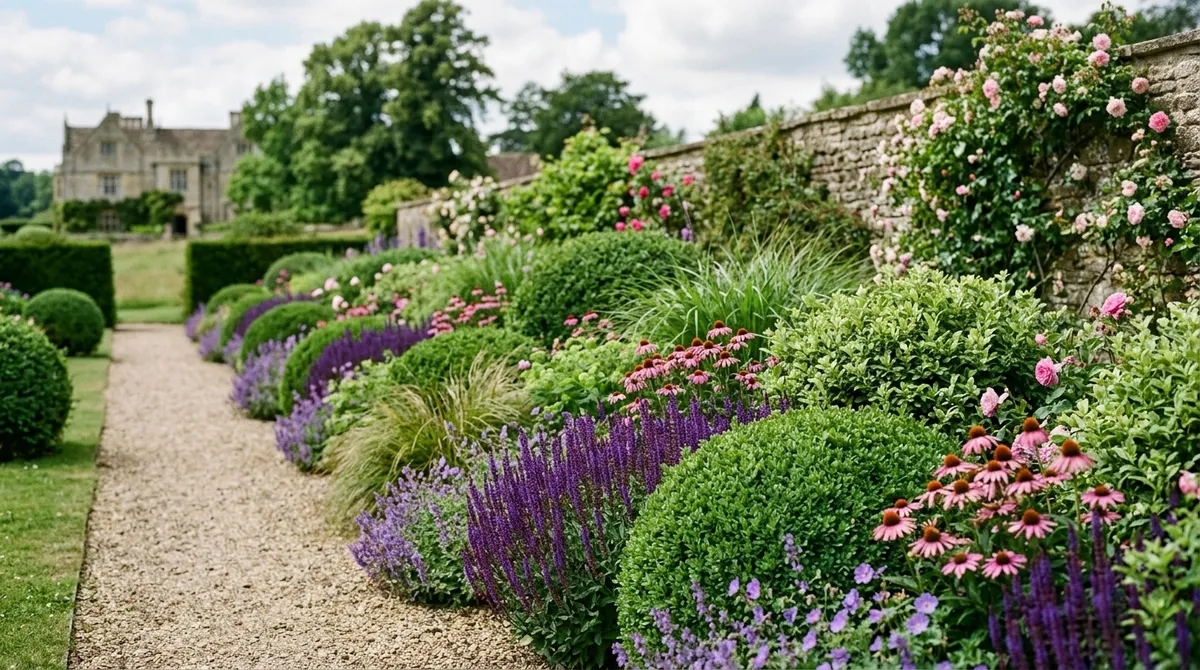
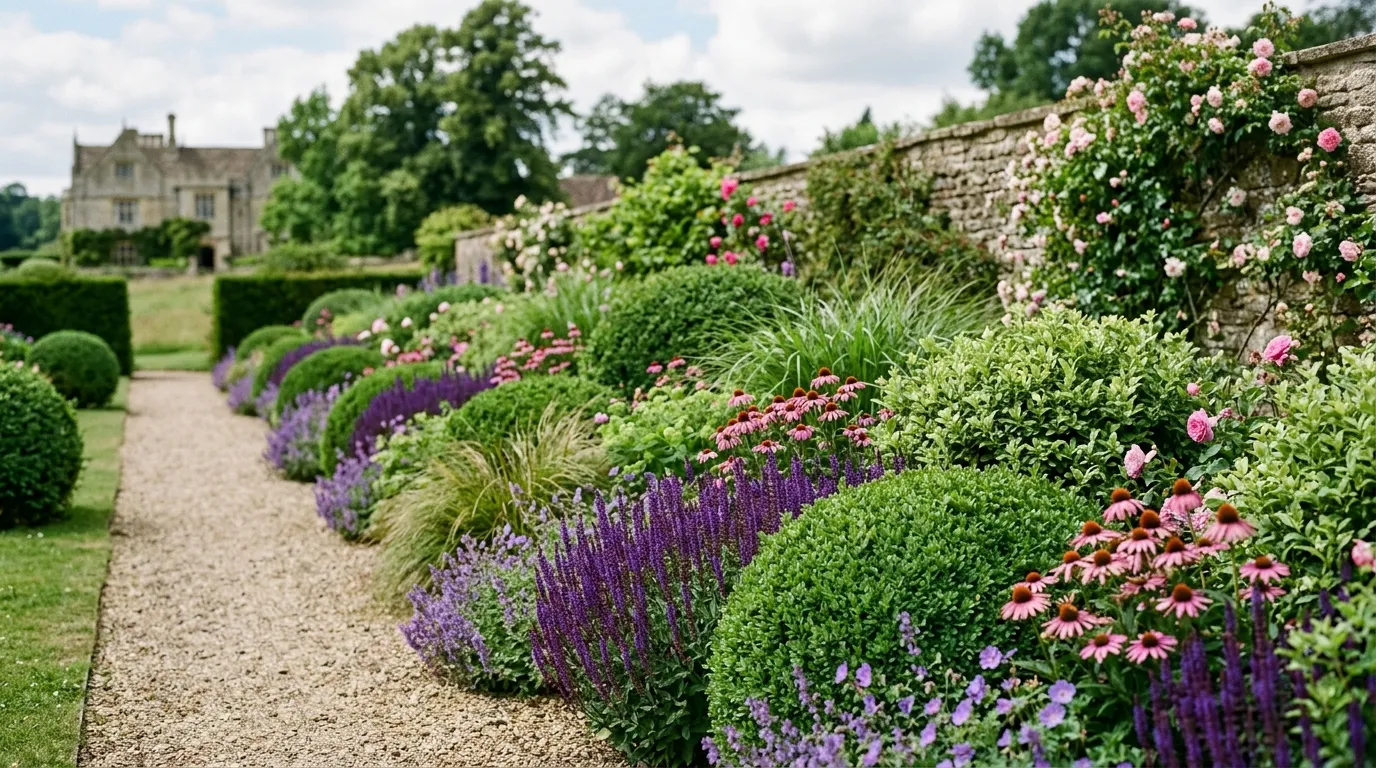 A border built on the 70-30 rule. Structure and foliage carry the scheme, with flower colour layered through it.
Why the 70-30 rule works
The rule works because most of the gardening year has no flowers in it. A UK border flowers from roughly May to September. That leaves seven months where structure is all you have. Plant for the flowers alone and you design for a quarter of the year.
A strong 70% backbone solves the most common border failure: patchiness. Flower-heavy borders bloom in waves, so something is always going over while the next thing is not yet out. The gaps between show as bare soil. Fill those gaps with foliage and evergreens and the border reads as full even mid-changeover.
Structure also gives the flowers somewhere to sit. A dahlia against bare fence looks lost. The same dahlia rising out of a clipped box mound or a haze of grass looks deliberate. Foliage is the frame that makes colour read as design rather than accident.
Gardener’s tip: Test any border in winter. Stand at the window in January and look. If you see mostly soil and a few sticks, you are short on structure. A good 70% backbone still looks furnished with every flower gone.
Choosing the 70% backbone
The backbone is where you spend most of your plants and most of your thought. Pick plants that earn their space for more than a fortnight. You want strong foliage, good shape, and ideally evergreen cover.
Three plant types build a reliable 70%. Evergreen shrubs give year-round bulk and clipped form: box, yew, pittosporum, hebe, choisya, and euonymus. Ornamental grasses add movement and winter structure: Stipa, Calamagrostis, Miscanthus, and Hakonechloa. Hardy foliage perennials and shrubs bridge the two: hardy geraniums, euphorbia, viburnum, and heuchera.
Aim for a mix of textures within the 70%. Set fine grass against broad-leaved shrub. Place glossy evergreen next to matt, soft foliage. The contrast is what keeps a green framework from reading as a flat green wall.
| Plant | Type | Role in the 70% | Hardiness |
|---|---|---|---|
| Box (Buxus) | Evergreen shrub | Clipped structure and edging | Hardy to -20C |
| Yew (Taxus) | Evergreen shrub | Dark backdrop, clipped forms | Hardy to -20C |
| Stipa tenuissima | Grass | Fine movement, front of border | Hardy to -15C |
| Calamagrostis ‘Karl Foerster’ | Grass | Upright vertical accent | Hardy to -20C |
| Euphorbia characias | Foliage perennial | Evergreen lime structure | Hardy to -10C |
| Hakonechloa macra | Grass | Soft mound, shade or sun edge | Hardy to -18C |
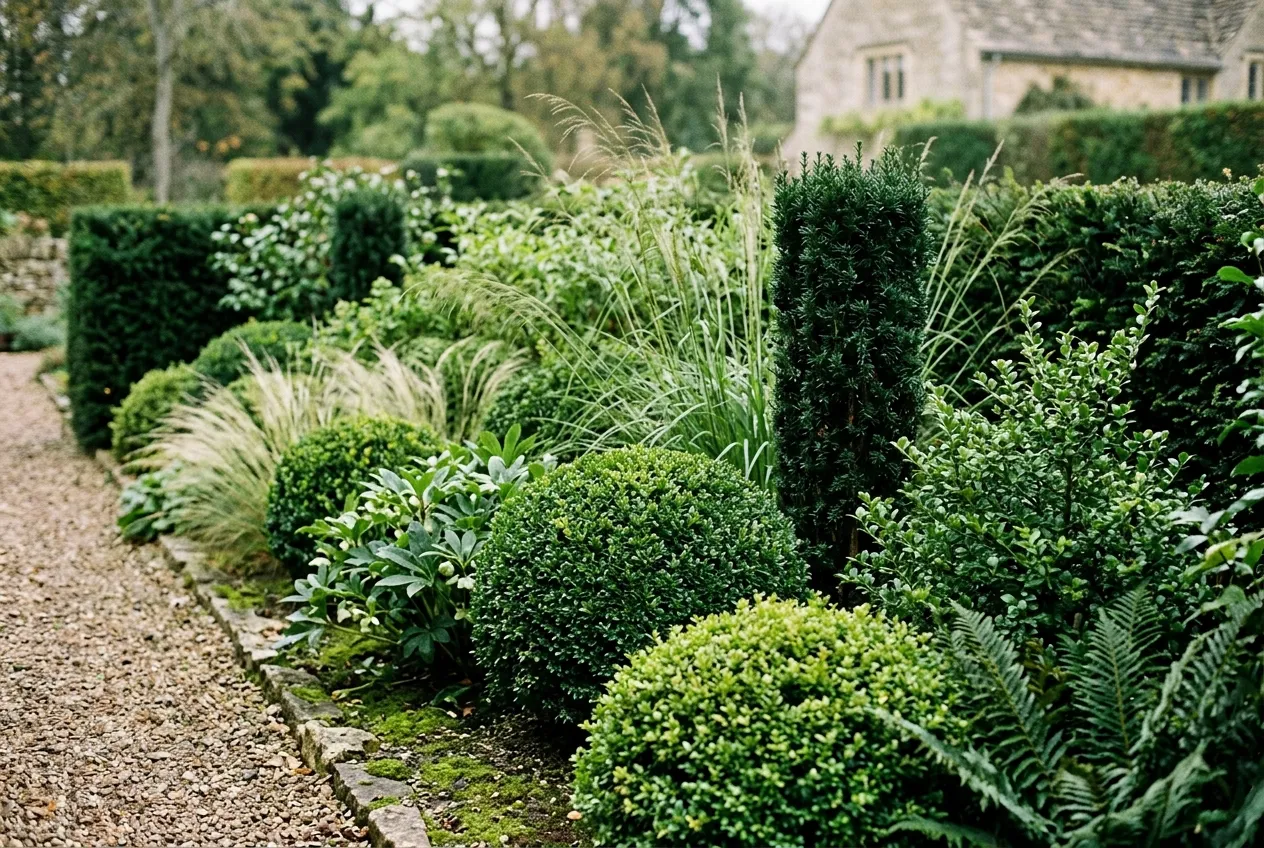 The structural 70%: evergreen shrubs, clipped box, and grasses. This framework carries the border through winter.
Choosing the 30% flower highlights
The 30% highlights are the plants people notice and remember. Because they fill less space, each one has to count. Choose flowers with a long season, a strong colour, or a good seedhead, and ideally all three.
Reliable UK performers for the 30% include Salvia nemorosa, Echinacea purpurea, Rudbeckia, Achillea, dahlias, roses, and Verbena bonariensis. These flower for weeks, not days. Many leave seedheads that read as structure once the colour has gone, blurring the line between the 70% and the 30% in a good way.
Place the flowers in drifts, not dotted singly through the border. A single salvia reads as a spot. Seven salvias planted as a drift read as a deliberate river of colour. Repeating the same drift in two or three places along the border ties the whole scheme together.
Match flower colour to a plan rather than buying one of everything in flower at the garden centre. This is where the 60-30-10 colour rule helps, covered further down. A border that holds to two or three colours always looks calmer and more designed than a rainbow.
Warning: Resist filling a new border entirely with flowering perennials because they look best at the nursery in June. A border bought in full bloom is almost always over the 30% flower share and will look bare by November. Buy structure first.
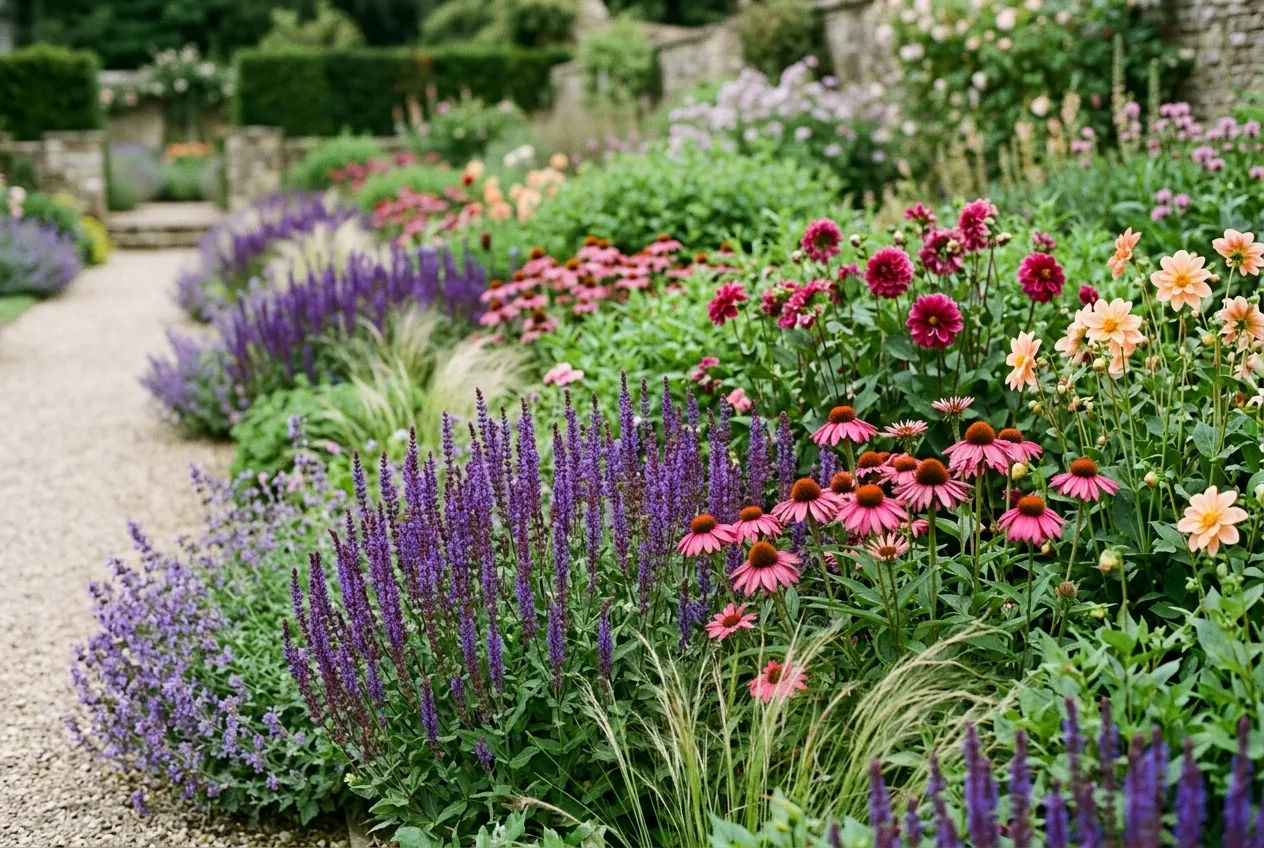 The flowering 30%: drifts of salvia, echinacea, and dahlia. Colour planted in groups, never dotted about singly.
Ratio by area, not plant count
The single most misread part of the rule is the maths. The 70-30 split is measured by area covered, not by the number of plants. This catches people out and leads to flower-heavy borders that still look bare in winter.
One mature viburnum can fill as much border as fifteen salvias. Count by plant and three shrubs against thirty perennials looks like a flower-dominated border. Measured by area, those three shrubs might cover 70% of the ground and visual space. The shrubs win on bulk even though the perennials win on count.
Judge the ratio by standing back and squinting. Look at how much of the border each group fills, both across the soil and up through the air. Grasses and shrubs claim vertical space that low perennials never reach. A 1.5m Miscanthus occupies far more visual volume than its small footprint suggests.
A practical check: in winter, with the flowers gone, the border should still look about 70% furnished. If it drops to mostly bare soil, you planted by count, not by area. Shift the balance towards more and larger structural plants next season.
Repetition, drifts and the rule of odd numbers
Repetition is what turns a collection of plants into a designed border. Repeating the same plant down the length of a border creates rhythm and leads the eye along. Without it, a mixed border reads as a jumble.
Pick three to five key plants and repeat each one several times along the border. A grass such as Stipa, an evergreen mound such as box, and a flower such as salvia, each repeated three times, gives a coherent scheme from very few varieties. The repeats need not be evenly spaced. Slightly irregular spacing looks more natural.
Plant each repeat as a drift: a group rather than a single specimen. Drifts overlap and merge, knitting the border into a whole. Single plants dotted about read as a spotty muddle, the classic look of an unplanned garden.
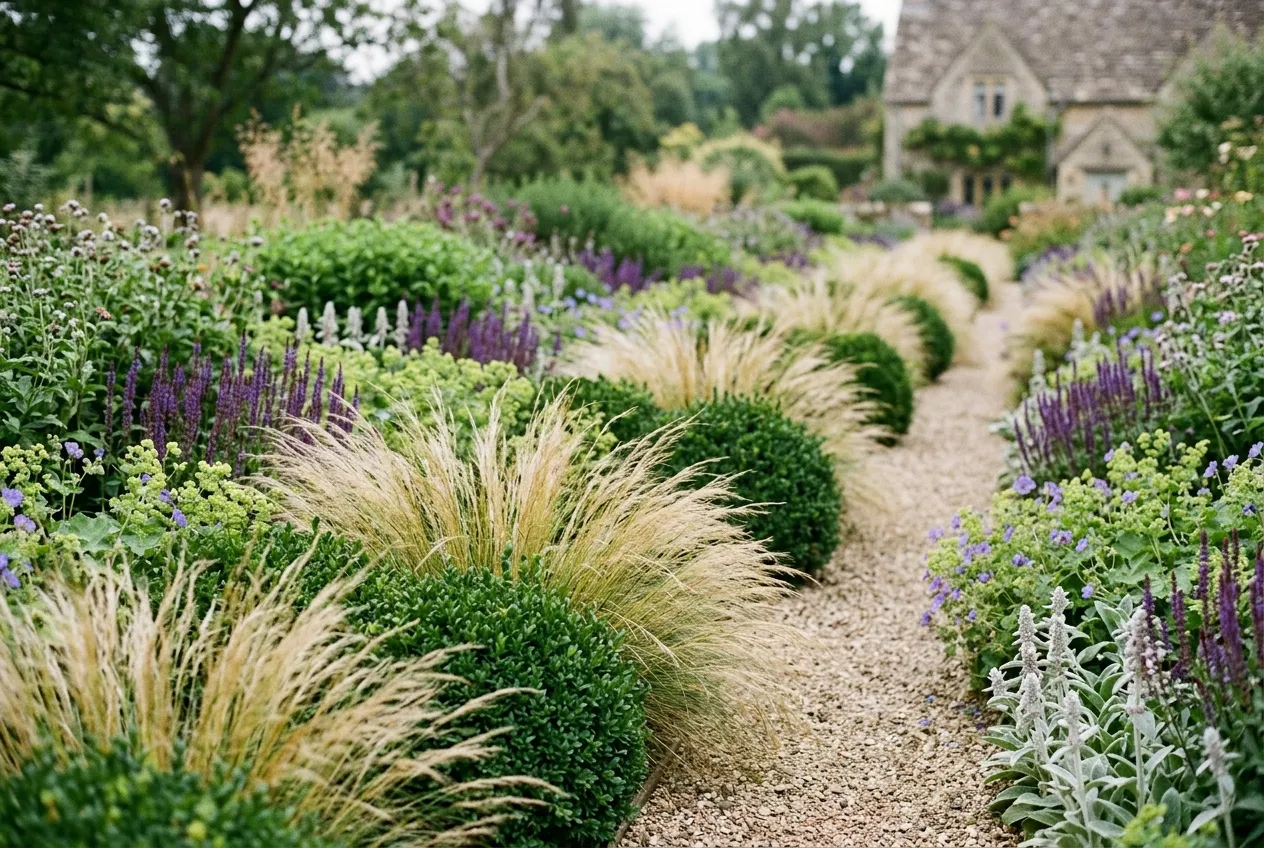 Repeated drifts of a single grass create rhythm. Three to five repeated plants give a coherent border from few varieties.
Layering by height, front to back
A border is a stage, and plants need arranging so every one is seen. The basic rule is tallest at the back, lowest at the front, with mid-height plants between. This sounds obvious yet gets ignored constantly.
For a border seen from one side, work in three rough layers. The back layer holds tall structure: Miscanthus, viburnum, climbers on the fence, and tall flowers like Verbena bonariensis. The middle layer carries the bulk of both backbone and flowers: salvias, grasses, hardy geraniums, and medium shrubs. The front layer runs low: Stipa, heuchera, hardy geraniums, and edging box.
Break the rule deliberately here and there. Bringing one tall, see-through plant like Verbena bonariensis or a tall grass forward to the front edge adds depth and stops the layering looking like a staircase. You see through it to the planting behind.
For a border viewed from both sides, such as an island bed, put the tallest plants in the centre and grade down to low planting on every edge. The same height logic applies, just mirrored. In a small garden design, tighter layering keeps even a narrow border feeling full.
A worked sun border and shade border
The rule applies the same way in sun and shade. Only the plant list changes. Both examples below hold to roughly 70% structure and 30% flower.
A sunny border might use box and Stipa for evergreen and grass structure, with Calamagrostis as vertical accents, making up the 70%. The 30% comes from salvias, echinacea, and a few dahlias for late colour. All of these thrive in full sun and free-draining soil.
A shady border leans harder on foliage, because shade has fewer flowers to offer. Ferns, hostas, box, and evergreen euonymus build the 70% from leaf shape alone. The 30% colour comes from foxgloves, astrantia, hellebores, and Japanese anemones, all of which flower happily in shade. Our guide to the best plants for shade covers more options.
| Element | Sun border (70-30) | Shade border (70-30) |
|---|---|---|
| Evergreen structure | Box, hebe, pittosporum | Box, euonymus, ferns |
| Grasses / foliage | Stipa, Calamagrostis | Hakonechloa, hostas |
| 70% backbone share | Two thirds of the bed | Two thirds, foliage-led |
| Flower highlights (30%) | Salvia, echinacea, dahlia | Foxglove, astrantia, anemone |
| Peak season | June to September | May to August |
| Winter interest | Grass seedheads, clipped box | Evergreen ferns, box, hellebore |
Notice the shade border carries even more foliage weight. Where colour is scarce, leaf shape and texture become the main event, not a supporting one.
The role of a focal point
A border needs somewhere for the eye to land. A focal point gives the planting an anchor and a sense of purpose. Without one, even well-balanced planting can feel like it drifts on with no end in sight.
A focal point can be a piece of garden ornament, a large pot, a clipped specimen, or a bench. Stone ornaments work especially well because they read clearly against soft planting and hold the eye in every season, including bare winter. A statue such as the Endless Love Garden Statue set at the end of a border gives the whole scheme a clear destination.
Place the focal point at a natural stopping point: the end of a border, a path junction, a turn in the lawn, or the centre of an island bed. The planting then builds towards it. A sundial like the Swirl Stone Sundial in Granite suits a junction where two borders or paths meet, marking the corner and drawing you round it.
Use only one strong focal point per view. Two competing features cancel each other out and the eye does not know where to settle. One clear anchor, framed by the 70% structure, is all a border needs.
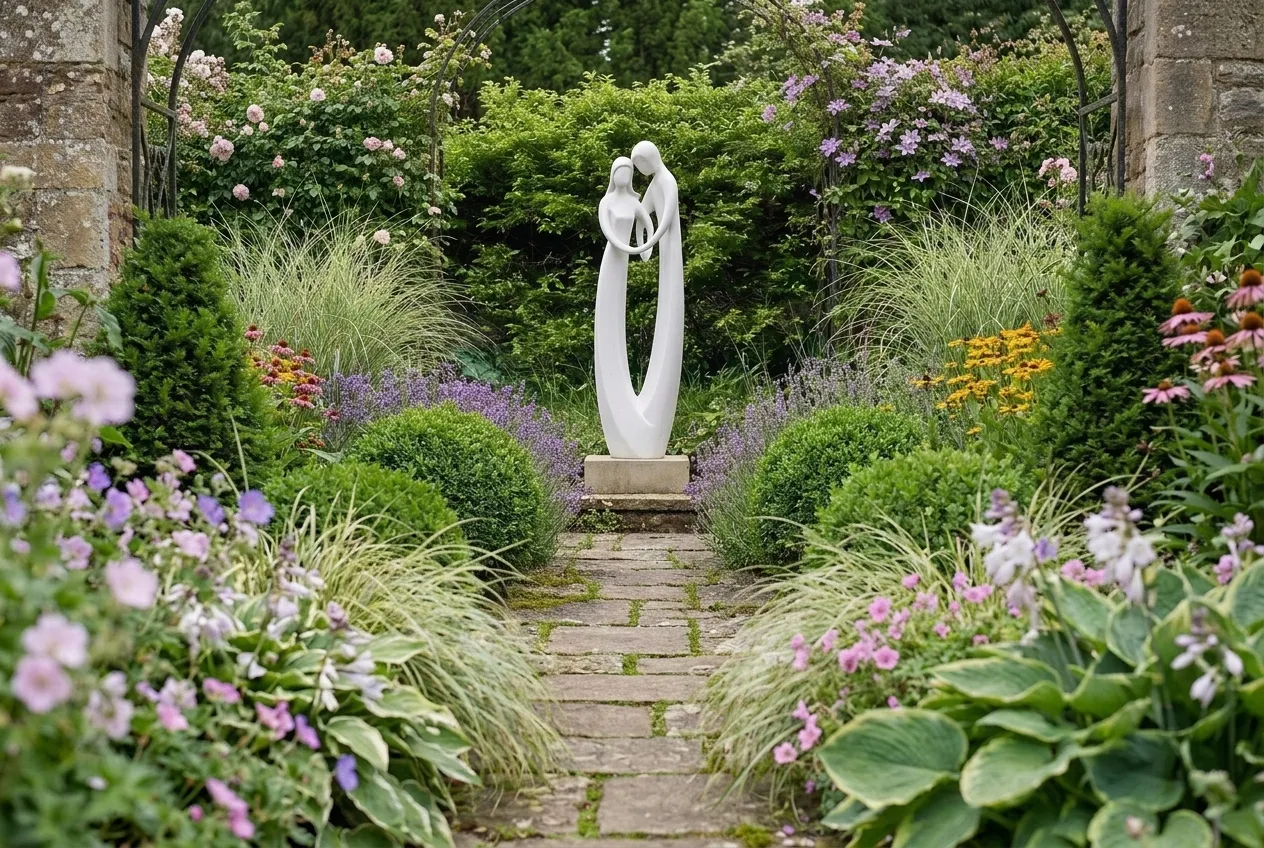 The Endless Love Garden Statue anchors the end of a border. One clear focal point gives planting a destination.
The 60-30-10 colour rule
The 70-30 rule sets the structure. The 60-30-10 rule sets the colour. The two are separate tools that work together, and confusing them is common. Use 70-30 for the framework, then 60-30-10 to plan the flower palette within the 30%.
The 60-30-10 rule borrows from interior design. Choose a dominant colour for 60% of the flowers, a secondary colour for 30%, and an accent colour for 10%. A border might run 60% soft purple from salvia and Verbena, 30% pink from echinacea and roses, and 10% hot orange from a single dahlia. The accent lifts the whole scheme.
Holding to three colours stops a border looking busy. The mistake most beginners make is buying one plant of every colour, which gives a restless, spotty result. A limited palette always reads as calmer and more deliberate.
Green counts as a colour too. The foliage of your 70% backbone is the quiet background that lets the 60-30-10 flower colours sing. A scheme of purple, pink, and orange flowers works precisely because it sits against a large field of green.
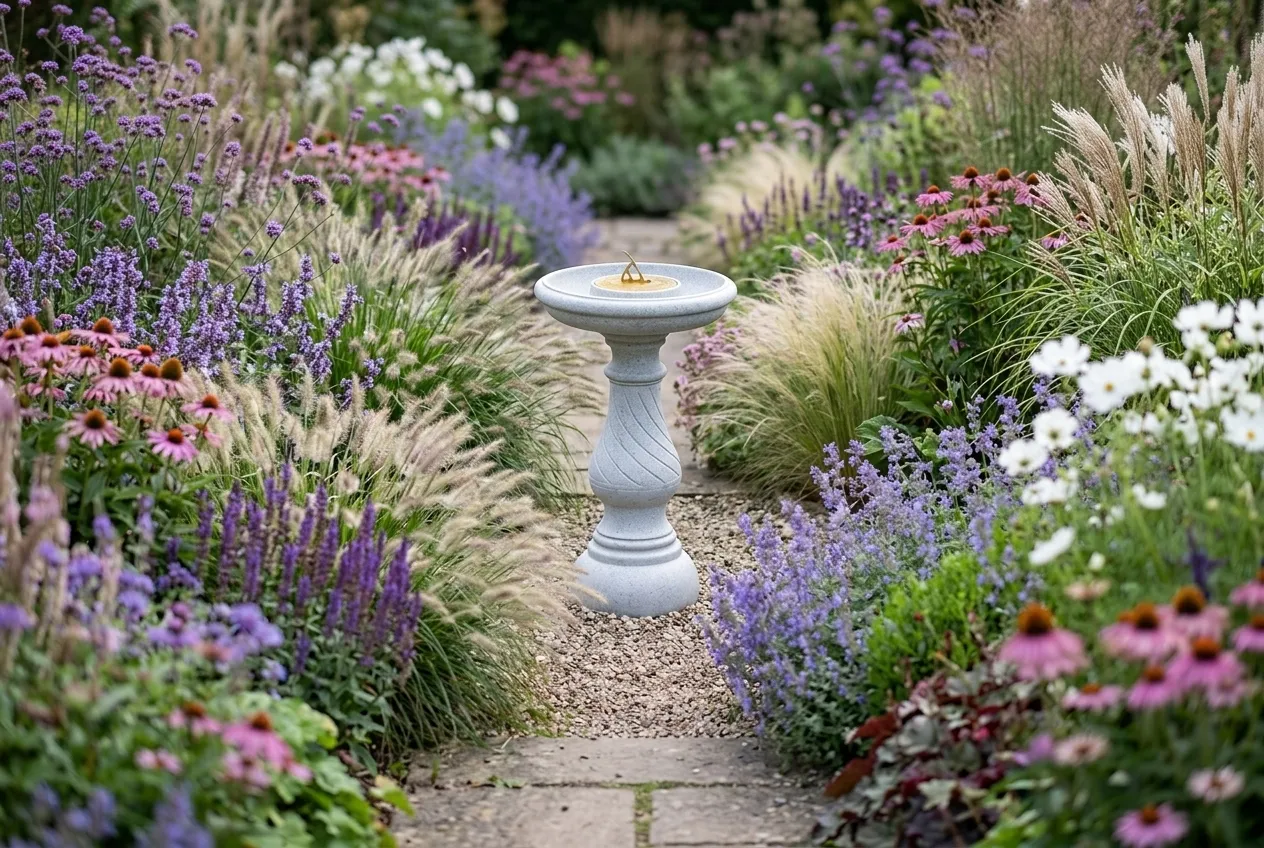 The Swirl Stone Sundial in Granite marks a border junction. Stone focal points hold the eye even in bare winter.
Planning your border on paper
The fastest way to hit the 70-30 split is to plan before you plant. Sketch the border to scale and block in the structure first. Draw the evergreen shrubs and grasses as rough circles at their mature spread, then check they cover about 70% of the area.
Only once the backbone fills the plan do you add the 30% flowers into the gaps between and in front. Working in this order stops the usual mistake of buying flowers first and squeezing structure in as an afterthought. Structure leads, colour follows.
Stand back often during planting. Set the pots out on the soil, still in their containers, and walk to the far end of the garden to judge the balance. It is far easier to shuffle pots than to dig up planted shrubs. Photograph the layout on your phone, which flattens the scene and shows the balance more honestly than the eye.
Leave proper spacing for growth. A backbone shrub planted at its mature spread looks sparse for a season or two, then fills out. Resist overplanting to cover bare soil now. Fill short-term gaps with annuals while the structure matures.
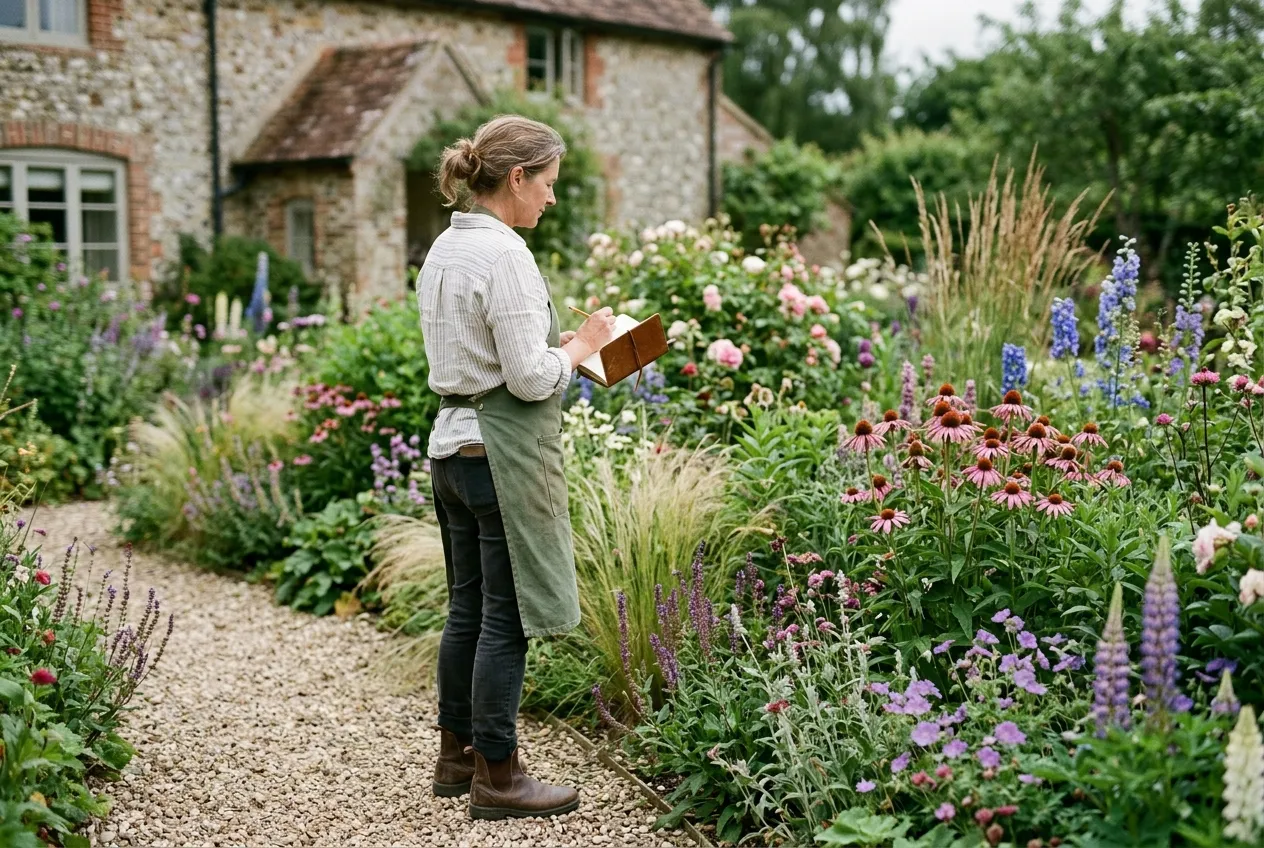 Planning on paper and setting pots out before planting makes the 70-30 balance far easier to judge and adjust.
Common mistakes
Too many flowers, not enough structure
The most common error is a flower-dominated border. It looks magnificent in June and bare by November. Beginners buy what is flowering at the garden centre, which pushes the flower share well over 30%. Buy structure first, flowers second, and check the winter look holds.
Dotting single plants about
Planting one of everything spreads colour and texture too thinly. The result reads as a spotty muddle with no rhythm. Plant in drifts of odd numbers and repeat three to five key plants along the border instead. Fewer varieties, planted in groups, always looks more designed.
Counting plants instead of area
Judging the 70-30 split by the number of pots leads to bare borders. A handful of large shrubs can fill the 70% backbone while many small perennials make up the 30%. Measure by ground and visual space each group covers, not by plant count.
Ignoring winter
A border planned only for summer fails for more than half the year. Always ask what each part of the border looks like in January. Evergreen shrubs, grasses with standing seedheads, and clipped forms keep the bones visible through the cold months.
No focal point
Without an anchor, even balanced planting can feel aimless. Add one clear focal point at a natural stopping place: a statue, sundial, pot, or bench. One per view is enough. More than one and the eye does not know where to rest.
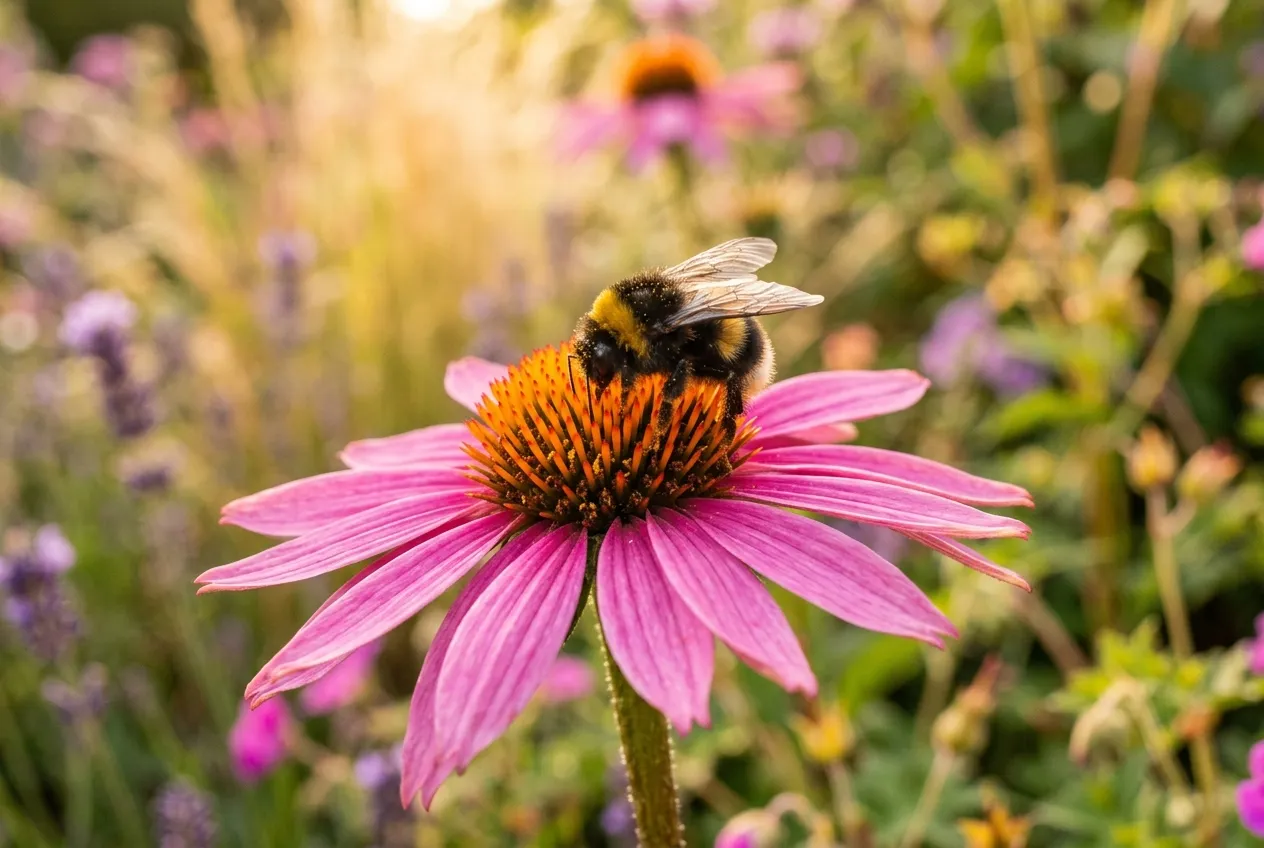 The 30% flowers feed pollinators through summer. A bee works an echinacea, one of the most reliable border perennials.
Frequently asked questions
What is the 70-30 planting rule?
Plant 70% structure and foliage, 30% seasonal flowers. The structural 70% covers evergreen shrubs, grasses, and reliable repeat plants that hold a border together all year. The flowering 30% adds seasonal colour. Measuring by area rather than plant number keeps a border full and stops it looking patchy through the winter months.
Is the 70-30 rule measured by plant count or area?
By area covered, not the number of plants. A few large shrubs can fill the 70% backbone, while many small perennials make up the 30% of flower colour. Judge the split by standing back and looking at how much ground and visual space each group fills, not by counting pots on the bench.
What plants make good backbone structure in a UK border?
Evergreens, grasses, and shrubs with strong foliage. Box, yew, pittosporum, and hebe give evergreen bulk. Ornamental grasses like Stipa and Calamagrostis add movement and winter form. Hardy shrubs such as viburnum and choisya hold their shape. These plants stay good through a British winter and frame the seasonal flowers in front.
How do I use the 70-30 rule in a shady border?
Build the 70% from shade-tolerant foliage. Ferns, hostas, box, and evergreen euonymus give structure in low light. Add the 30% colour with foxgloves, astrantia, hellebores, and Japanese anemones. Shade borders rely even more on leaf shape and texture, so make foliage contrast the main event rather than a backdrop.
What is the rule of odd numbers in planting?
Plant in groups of 3, 5, or 7 rather than even numbers. Odd-numbered groups read as natural drifts and knit together visually. Even numbers tend to look paired and rigid. The rule matters most for perennials and grasses planted in repeating clumps, and less for large single shrubs that stand alone.
How is the 60-30-10 rule different from 70-30?
The 60-30-10 rule applies to colour, not structure. It uses 60% a dominant colour, 30% a secondary colour, and 10% an accent. The 70-30 rule governs the balance of structure to flowers. The two work together: use 70-30 for the framework, then 60-30-10 to plan the flower palette within the 30%.
Where should the focal point go in a 70-30 border?
Place one focal point at a natural stopping point. The end of a border, a path junction, or a turn in the lawn all work well. A statue, sundial, or large pot draws the eye and gives the planting a clear anchor. Use only one strong focal point per view to avoid a cluttered, restless look.
Our team produces practical UK gardening guidance from source research, contributor records and established horticultural practice. Editorial standards are overseen by Matt W.