
Key takeaways
- Prune most roses between late February and mid-March, when the forsythia flowers
- Cut on a slope about 5mm above an outward-facing bud
- Hybrid teas like a hard prune, floribundas a bit less, shrub roses just a trim
- Prune ramblers in summer, straight after they flower
- Take out dead, diseased and crossing stems first, then shape the rest
- Wipe your secateurs clean between plants so you don't spread disease
Pruning roses worries new gardeners far more than it should. Roses are tough and forgiving. Cut too hard and they bounce back. Cut too little and you get a slightly leggy bush. The only real mistake is never pruning at all, which leaves a tangled plant with fewer flowers each year.
Here’s how to prune every common rose in a UK garden, from a neat hybrid tea to a wild old rambler. For planting and general care, see our rose growing guide. For other jobs to fit in at the same time, have a look at what to plant in March.
When to prune roses in the UK
Prune most roses in late winter or early spring, when the forsythia comes into flower. Go too early and a late frost can nip the new shoots. Go too late and the plant wastes effort on growth you then cut off.
Roughly, that means:
- Southern England and Wales: late February to early March
- Midlands and northern England: early to mid-March
- Scotland and higher ground: mid to late March
Go by the weather, not the calendar. If a cold snap is on the way, wait a week. The RHS rose pruning guide is a good place to check if you want a second opinion.
Tip: If the buds are swelling and turning red, you’ve got the timing right. If new shoots are already 5cm long you’re a little late, but pruning now still beats skipping it.
Autumn tidying
In November, shorten very tall stems by about a third. This stops winter winds rocking the plant and loosening its roots. It’s just a tidy, not the main prune.
The tools you need
Bypass secateurs, loppers, a pruning saw and good gloves will cover it. Keep them sharp and clean.
- Bypass secateurs for stems up to 15mm thick. They cut cleanly, while anvil secateurs tend to crush. Our guide on how to sharpen garden tools shows you how to keep the blades keen.
- Loppers for stems 15-30mm thick. The long handles give you extra leverage.
- Pruning saw for anything thicker, usually on old climbers and overgrown shrub roses.
- Thornproof gauntlets that reach your elbows. Rose thorns can cause nasty scratches that get infected.
- Disinfectant (diluted Dettol or a garden cleaner) to wipe blades between plants, so you don’t spread black spot or canker.
How to make a good pruning cut

Every rose gets the same basic cut. Once you’ve got it, the rest is just deciding where and how much.
- Find an outward-facing bud. These are small red or green bumps on the stem. A bud facing outwards sends its shoot away from the middle, keeping the bush open.
- Cut on a slope angled away from the bud, so rain runs off.
- Cut about 5mm above the bud. Any closer and you can damage it. Any further and the stub dies back.
- Do it in one clean snip. Ragged cuts from blunt blades are slow to heal.
How do you prune a newly planted rose?
Cut newly planted bush roses hard, but leave new climbers and shrub roses mostly alone. A hard first prune pushes out strong shoots low down, giving a bushy base.
- Bare-root hybrid teas and floribundas planted between November and March: cut every stem to about 10-15cm, just above an outward-facing bud. Do it at planting or in early spring.
- Potted roses planted in spring or summer: let them flower, then prune normally the next February or March.
- Climbers and ramblers: just take off any dead or damaged tips. Climbing forms of bush roses, such as ‘Climbing Iceberg’, can go back to being bushes if cut hard in their first two years.
- Shrub and English roses: trim off broken or weak stems and leave the rest.
Pruning by rose type
Each kind of rose grows a little differently, and that decides how you prune it. Here’s the quick version before the details.
| Rose type | When to prune | How hard | Main job |
|---|---|---|---|
| Hybrid tea | Late Feb to mid Mar | Hard (15-20cm) | Open the centre, cut to outward buds |
| Floribunda | Late Feb to mid Mar | Medium (25-30cm) | Mix the heights for a longer show |
| Climbing | Late Feb to mid Mar | Light | Shorten side shoots, tie stems sideways |
| Rambler | After flowering (Jul to Aug) | Remove flowered stems | Cut old canes to the base |
| Shrub or English | Late Feb to mid Mar | Light (about a third) | Reduce and shape |
| Ground cover | Early spring | Light trim | Trim to shape |
Hybrid tea roses
These are the classic big-flowered roses of formal beds. They flower on this year’s new growth, so a hard spring prune gives you strong flowering stems.
- Cut out anything dead, diseased or damaged, back to healthy white pith.
- Remove stems crossing through the middle. You’re after a goblet shape, open in the centre so air can move through.
- Cut the remaining stems to 15-20cm from the base, each to an outward-facing bud.
- If the plant is weak, go harder, to 10-15cm. Strong plants can take a lighter cut.
Don’t be shy. Hybrid teas love a hard prune, and those short stumps will be tall and flowering by midsummer.
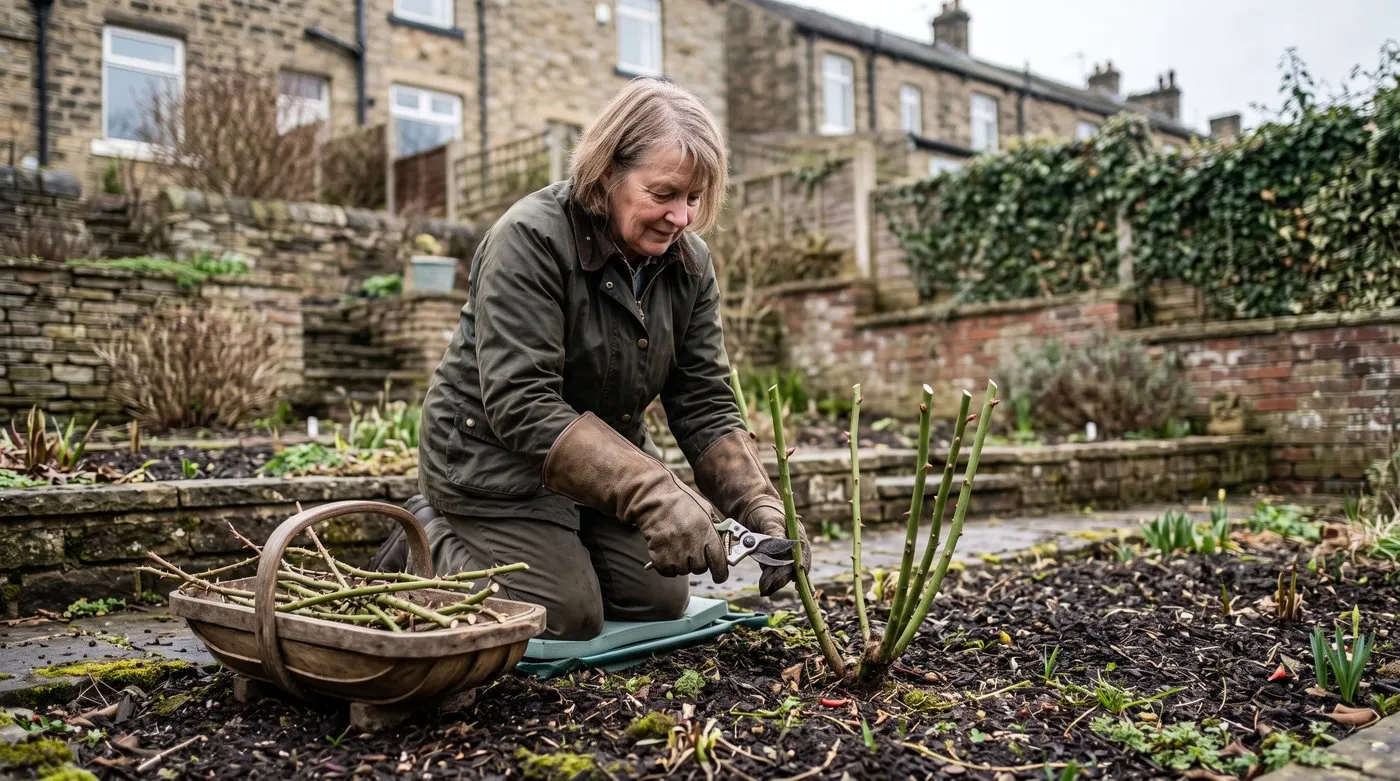
Hybrid teas love a hard prune. Those short stumps cut to outward-facing buds will be tall and flowering by midsummer.
Floribunda roses
Floribundas carry clusters of smaller flowers. Prune them a bit more gently than hybrid teas.
- Take out dead, diseased and crossing stems as before.
- Cut the strongest stems to about 25-30cm.
- Cut weaker or older stems harder, to about 15-20cm.
- Mixing the heights like this gives flowers at different levels and a longer show.
If you grow floribundas as a hedge, you can simply trim them with hedge shears to save time.
Climbing roses

Tie climbing rose stems out sideways along wires and you’ll get flowers all the way along, not just at the top.
Climbers have a permanent set of main stems with shorter side shoots that carry the flowers. Keep the main stems and prune the side shoots.
- Loosen the main stems from their support so you can work.
- Remove any dead or diseased wood completely.
- Cut the side shoots back to 2-3 buds from the main stem. These short stubs will carry this year’s flowers.
- If a main stem is very old and tired, cut it to the base so a new one can grow from low down.
- Tie the main stems back in, as close to flat as you can.
Stems trained sideways flower all along their length, while upright ones tend to flower only at the top. Climbers trained along walls and fences look lovely in a cottage garden planting plan.
Rambler roses
Ramblers are different from climbers. They flower once, in early to midsummer, on stems that grew the year before. Prune them in spring and you cut off the flowers.
- Prune straight after flowering, usually in July or August.
- Cut the stems that have just flowered back to the base, or to a strong new shoot lower down.
- Tie in this year’s long, bendy new stems. They’ll carry next year’s flowers.
- If the plant is very crowded, take up to a third of the oldest stems out at ground level.
Ramblers can scramble right through trees. If yours has got out of hand, cut it hard to 30cm in late winter. You’ll lose a year of flowers, but it usually grows back well.
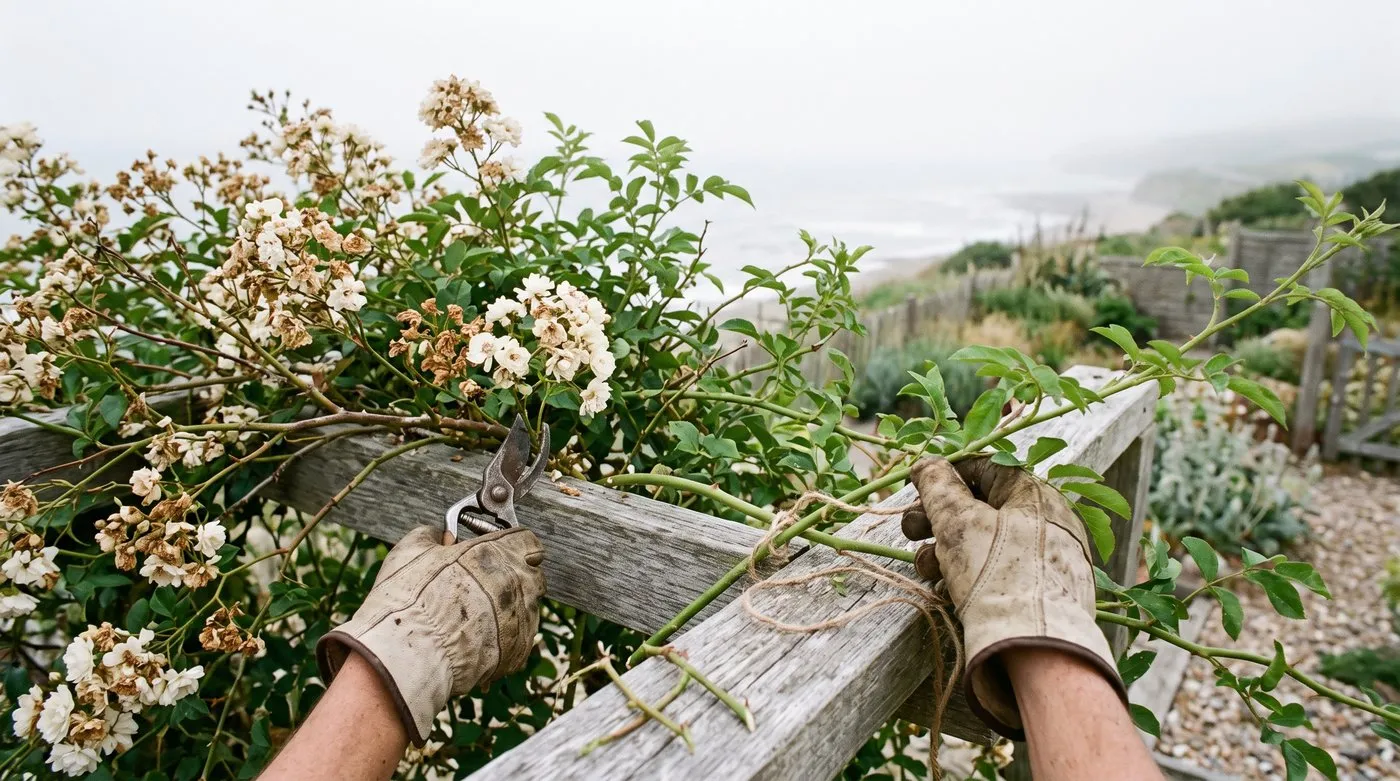
Ramblers flower on last year’s stems, so prune them straight after flowering. The long new stems you tie in carry next summer’s show.
Shrub and English roses
David Austin English roses and other shrub roses need a lighter touch. Their big, arching shape is part of the charm.
- Remove dead, diseased and thin, twiggy growth.
- Cut the whole plant back by about a third, to outward-facing buds.
- Take one or two of the oldest, woodiest stems out at the base each year, to make room for fresh shoots.
- Aim for a rounded, slightly open shape rather than a goblet.
Many shrub roses carry hips in autumn, which birds love. Grown alongside bee-friendly plants, they feed pollinators in summer and birds in winter.
How do you prune a standard rose?
Treat the head like a small bush rose and keep the trunk clear. Prune at the same time as bush roses, late February to mid-March.
- Shorten the main stems in the head to about 15-20cm, cutting to outward-facing buds.
- Remove crossing, dead and weak twiggy growth so the head stays open and even all round.
- Rub off any shoots on the bare trunk, and pull off suckers coming from below ground.
- Check the stake and ties. A heavy head on a loose tie can snap in a winter gale.
Weeping standards are usually ramblers grown on a tall stem. Prune those after flowering in summer, like a rambler, and let the new stems hang down.
Fixing common problems while you prune
Pruning time is a good chance to deal with black spot, dieback, blind shoots and suckers.
Rose black spot
Black spot hides over winter on fallen leaves and infected stems. Cutting out infected wood and opening up the bush helps keep it in check.
- Cut out any stems with dark purple or black patches.
- Clear all fallen leaves from under the bush and bin them, or add them to a really hot compost heap. Our composting guide explains what’s safe to add.
- Water at the base rather than over the leaves, so you don’t splash spores about.
Dieback
If stem tips are brown and the dead patch is creeping down, that’s dieback. It often starts from a stub left too long or frost after pruning. Cut back until you see healthy white pith. If it’s still brown, keep going.
Blind shoots
A strong shoot with no flower bud is called a blind shoot. Cut it back by half to a good outward-facing bud, and it will usually send out a flowering shoot.
Suckers
Shoots coming from below the graft (the knobbly joint at the base) belong to the rootstock, not your rose. They often have seven leaflets instead of five and look a lighter green. Pull them off where they start rather than cutting them, as cutting tends to bring more.
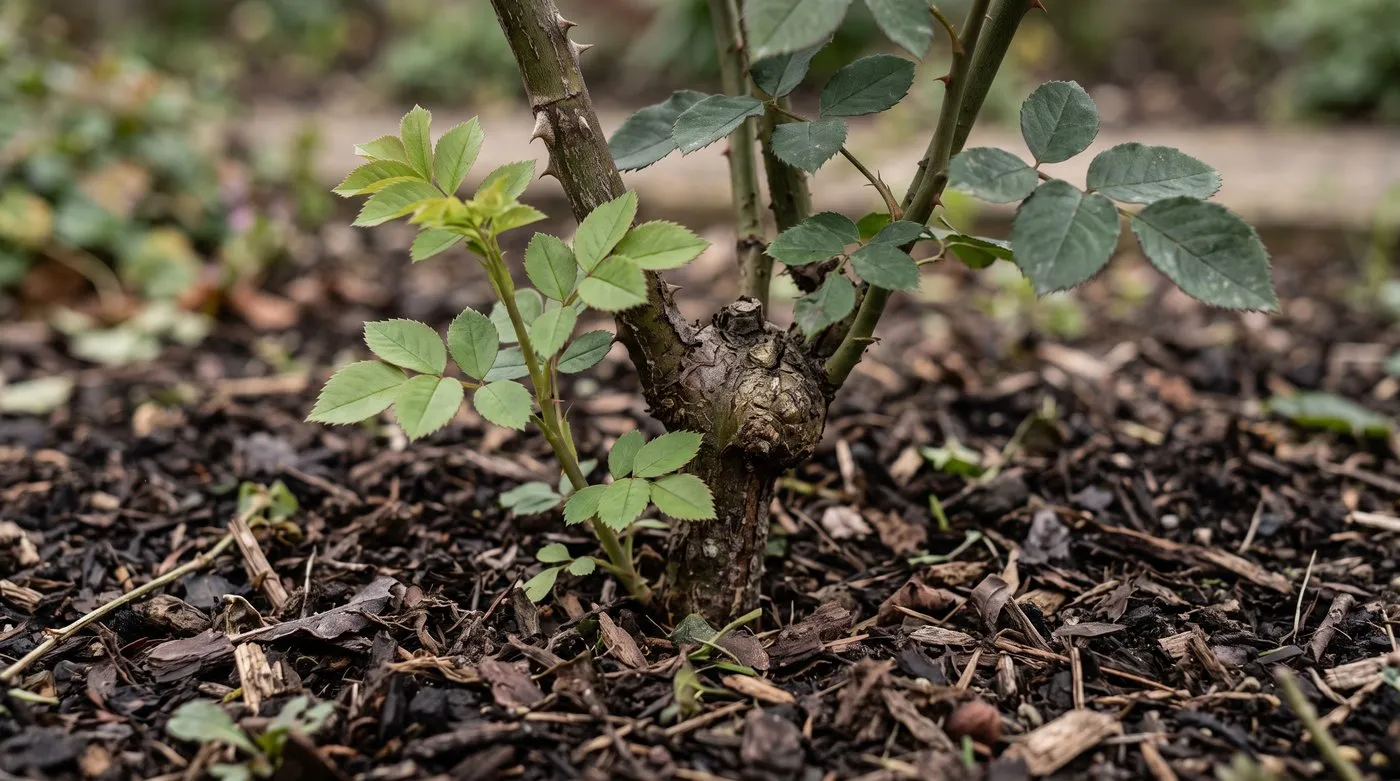
Suckers often have seven leaflets and look lighter green. Pull them off where they start, as cutting tends to bring more back.
Bringing an old rose back to life
An old, unpruned rose gets woody and leggy and flowers poorly. Before you dig it out, try a gentle three-year makeover.
Year one: Cut a third of the oldest, thickest stems out at the base. Prune the rest normally.
Year two: Take out another third of the old stems. Strong new shoots should be coming from the base by now.
Year three: Remove the last of the old wood. You now have a younger, happier bush.
Going step by step means you still get some flowers each year. In a small garden, this is well worth doing, as one healthy rose earns its space far better than a tired one.
After pruning: feeding and mulching

A thick mulch after pruning keeps the soil moist and the weeds down.
Once you’ve pruned, give your rose a feed, a mulch and a drink to set it up for the new growth.
- Feed with a rose fertiliser (such as Toprose or David Austin’s own feed) in mid-March. Give a second feed in mid-June, after the first flush of flowers.
- Mulch with a 5-8cm layer of garden compost, well-rotted manure or bark. Keep it a few centimetres away from the stems.
- Water newly pruned roses in dry spring spells. Established roses cope with dry weather, but steady moisture gives better flowers.
Mulch also keeps weeds down around the base. If slugs are munching your underplanting, see our guide on how to get rid of slugs.
How do you deadhead roses in summer?
Snip each faded flower back to the first strong leaf or outward-facing bud below it. This stops the plant making seed and encourages more flowers.
- Single-flowered roses such as hybrid teas: cut the faded bloom back to just above a healthy leaf, usually 10-15cm down the stem.
- Cluster-flowered roses such as floribundas: pinch off faded flowers as they go over, then remove the whole cluster when it’s finished.
- Roses grown for their hips, such as Rosa rugosa and Rosa moyesii: don’t deadhead, or you’ll lose the hips.
Deadhead from June to early September. Stop in late September so the plant can slow down before the frosts.
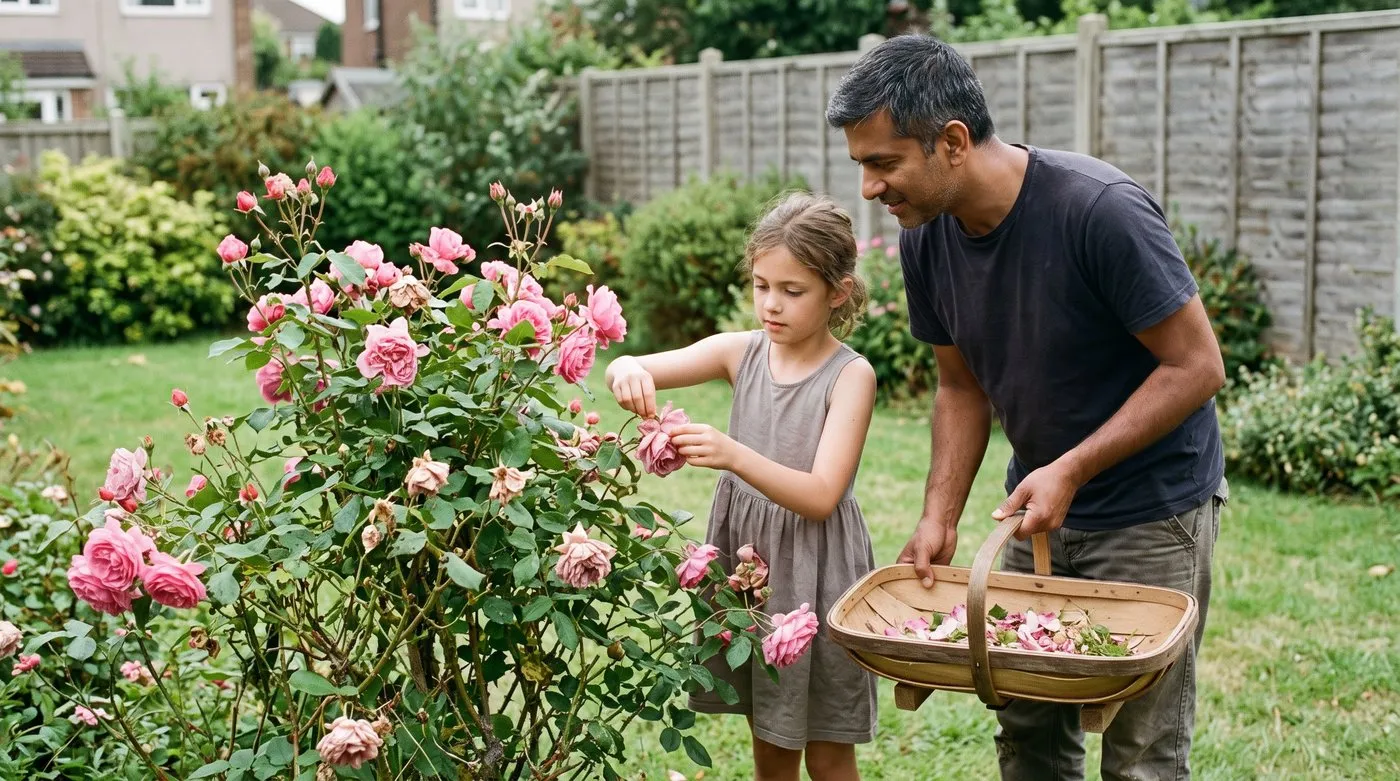
Pinch off faded floribunda flowers as they go over, then remove the whole cluster when it’s done. Stop in late September so hips can form.
Month-by-month rose care calendar
Roses like a little attention most of the year, not just at pruning time.
- January to February: Order bare-root roses. Plan where new ones will go.
- March: Main pruning time. Feed and mulch afterwards.
- April to May: Keep an eye out for aphids. Let ladybirds and other helpers do their job.
- June: Deadhead repeat-flowering roses. Give the second feed.
- July to August: Prune ramblers after flowering. Keep deadheading the rest.
- September: Stop deadheading so hips can form. Ease off feeding.
- October: Take hardwood cuttings of your favourites.
- November: Autumn tidy. Shorten tall stems by a third. Clear fallen leaves.
- December: Plant bare-root roses in mild spells when the soil isn’t frozen or soggy.
Hardy geraniums, lavender and nepeta make lovely low-maintenance companion plants, filling the gaps at the base of your roses.
For the rest of the border, see our guide on how to prune shrubs in the UK.
Not sure where to start?
You really can’t get this badly wrong. A rose will forgive a clumsy prune and try again next year. Get the timing right for your type, use clean, sharp tools and cut to an outward-facing bud.
Start with the dead, diseased and crossing stems. Once they’re gone, the shape you want usually jumps out at you. If you’d like to see it done, look out for a pruning demonstration at a gardening club or local garden. Ten minutes watching someone prune a real bush is worth a lot of reading.
Planning a few veg beds this spring as well? Our guide to starting a vegetable garden covers the basics. For roses in containers, see growing patio roses in pots.
Frequently asked questions
When should I prune roses in the UK?
Between late February and mid-March for most roses. A handy sign is the forsythia coming into flower. In southern England you can start in late February. In Scotland and northern England, wait until mid to late March. Don’t prune in a hard frost.
Can I prune roses in autumn?
Just a light tidy in November. Cut very long stems back by about a third so the wind can’t rock the plant and loosen its roots. Save the main prune for late winter or early spring, when you can see the shape clearly.
How hard should I prune roses?
It depends on the type. Cut hybrid teas hard, to 15-20cm. Take floribundas to 25-30cm. Shrub roses only need light shaping. For an old, neglected rose, take out a third of the oldest stems at the base each year for three years.
Should I seal pruning cuts on roses?
No, there’s no need. The RHS no longer recommends wound sealants. A clean cut heals on its own, and sealant can trap damp and invite disease. Just make a neat, sloping cut with sharp secateurs.
Why are my roses not flowering after pruning?
You may have pruned at the wrong time. Ramblers and some old garden roses flower on last year’s stems, so a spring prune cuts the flowers off. Prune those just after they flower in summer. A very hard prune can also hold flowering back for a season.
What tools do I need to prune roses?
Bypass secateurs, loppers and a small pruning saw. Use secateurs for stems up to 15mm, loppers up to 30mm and the saw for anything thicker. Skip anvil secateurs, which crush stems. Wear thornproof gloves that reach your elbows, and keep blades sharp and clean.
Our team produces practical UK gardening guidance from source research, contributor records and established horticultural practice. Editorial standards are overseen by Matt W.


