Key takeaways
- Check leaves, flower shape, habitat and season, not just colour
- Spring starts with lesser celandine and primroses, then bluebells in April and May
- Meadows and verges are at their best in June and July
- Knapweed, field scabious and cowslips are brilliant for bees and butterflies
- Picking a few common flowers is usually fine, but never dig up wild plants without permission
Learning UK wildflowers is easier than it looks. Britain has a huge number of wild plants, but a few dozen common ones make up most of what you’ll see on a walk between March and October. This guide covers those favourites, sorted by season and habitat, with simple tips for telling similar flowers apart.
Don’t rely on colour alone. Lots of unrelated flowers are white or yellow. Instead, look at four things: the leaves, the flower shape, where it’s growing and the time of year. Together they usually narrow it down to one or two plants.
How to identify wildflowers on a walk
Look at the leaves, count the petals, notice where it’s growing, and check the month. Colour helps, but it’s the last clue, not the first.
Start with the leaves. Do they grow in pairs opposite each other, or one at a time up the stem? Are they one simple blade, or divided into smaller leaflets? Toothed edges, hairy surfaces and a strong smell when crushed all help.
Next, look at the flower. Buttercups have five shiny petals. Daisy-family flowers have a middle disc with a ring of petals around it. Ragwort is in this family, and its yellow heads and ragged leaves are worth learning. Pea-family flowers look a bit like a little butterfly. Dead-nettles have hooded flowers with two lips.
Then think about where you are. Primroses like shady banks and hedges, not open meadows. Yellow rattle grows in grassland, never woodland. Just noting the habitat rules out lots of options.
Spring wildflowers: February to May
Spring flowers turn up in a fairly reliable order, which helps you guess. A yellow flower in a hedge bottom in February is very likely lesser celandine. By April, that same spot might hold primroses or cowslips.
Primrose (Primula vulgaris)
Pale yellow flowers, 2-3cm across, each on its own short stalk. They rise from a rosette of crinkly, tongue-shaped leaves. Look for them from February to May on shady banks, hedges and in wildlife-friendly woodland corners. The name comes from “first rose” of spring.
Bluebell (Hyacinthoides non-scripta)

A carpet of native bluebells. Notice how the flower stems arch over, with the bells mostly on one side.
The native bluebell has narrow, tubular bells hanging from one side of an arching stem. The pollen is creamy white and the scent is sweet. It carpets old woodland in April and May. The UK is home to a big share of the world’s bluebells, so these woods really matter.
Wood anemone (Anemone nemorosa)
White flowers, sometimes tinged pink, 2-4cm across. Each flower sits alone on a slim stem about 15-25cm tall, above deeply cut, three-lobed leaves. It flowers from March to May in old woods and hedges. It spreads very slowly, so a big patch is a sign of long-undisturbed woodland.
Lesser celandine (Ficaria verna)
Glossy, bright yellow, starry flowers with lots of narrow petals. Dark green, heart-shaped leaves. It stays low, around 5-15cm. One of the first spring flowers, it shows up from February to April on damp banks and woodland floors, then vanishes completely by early summer.
Cowslip (Primula veris)
Clusters of deep yellow, nodding flowers on a single stem, 10-20cm tall. Each flower has small orange spots inside. Look for them in April and May in grassland, especially on chalky soil. They’re a great early food source for bees, especially long-tongued bumblebees.
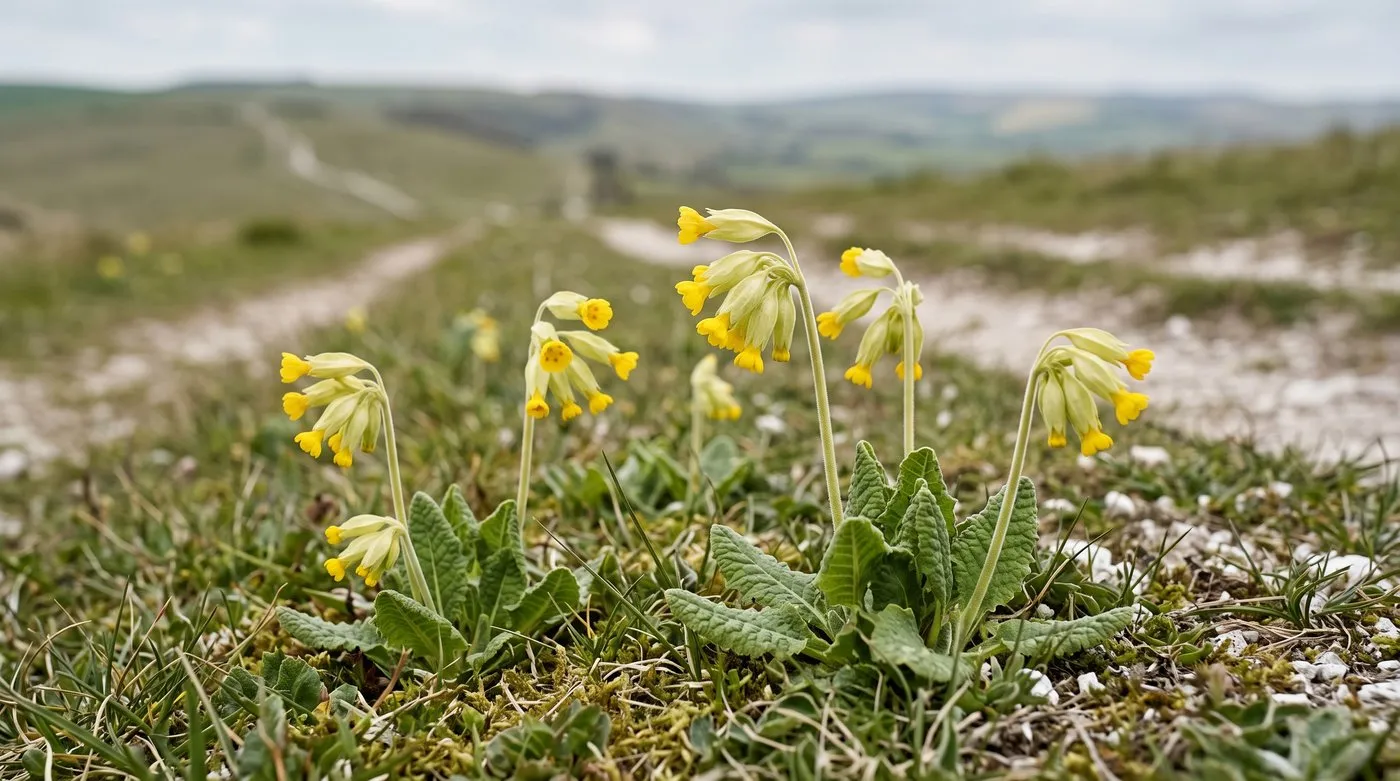
Cowslips carry a cluster of nodding yellow flowers on one stem, unlike primroses, which have one flower per stalk. Look for them on chalky grassland.
Wild garlic (Allium ursinum)
Broad, bright green leaves that smell strongly of garlic when you crush them. White, starry flowers sit in a round cluster on a single stalk. It flowers from April to June in damp woods and shady hedges, often in big patches along streams.
Summer wildflowers: June to August
Summer is the busiest time. Meadows, verges and hedges are at their best in June and July, and many of these flowers are top plants for butterflies.
Ox-eye daisy (Leucanthemum vulgare)

Ox-eye daisies and red campion in a summer hedgerow, two of the easiest flowers to recognise.
Big white daisies, 3-6cm across, with a yellow middle, on stems 30-60cm tall. The leaves are narrow and toothed. It flowers from June to August in meadows and on verges. It’s a must for any mini meadow wildflower area.
Red campion (Silene dioica)
Pink-red flowers, 2-3cm across, with five deeply notched petals. The stems and leaves are hairy, and the plant grows 30-60cm tall. It flowers from May right through to October along hedges and woodland edges. Male and female flowers grow on separate plants. Our red campion growing guide shows how to grow it from seed for a shady corner.
Foxglove (Digitalis purpurea)
Tall spikes, up to 1.5m, of pink-purple tubular flowers with dark spots inside. Big, soft, downy leaves sit in a rosette at the base. It makes leaves in its first year and flowers in its second. Look for it from June to August in woodland clearings, hedges and heaths. All parts are poisonous, so look but don’t nibble.
Common knapweed (Centaurea nigra)
Purple, thistle-like flowers, 2-3cm across, on wiry stems 30-60cm tall. The giveaway is the hard, round, dark brown bud under the flower. It flowers from June to September and is one of the very best wildflowers for bees and butterflies.
Field scabious (Knautia arvensis)
Lilac-blue pincushion flowers, 3-4cm across, on tall stems around 50-80cm. The lower leaves are deeply divided, the upper ones simpler. It flowers from June to October in meadows and dry grassland. Butterflies and bees love it.
Yarrow (Achillea millefolium)
Flat-topped clusters of tiny white or pale pink flowers. The leaves are feathery and finely divided, with a strong herby smell. It grows 20-60cm tall and flowers from June to September on grassland and verges. It’s tough, copes with drought and is happy in poor soil.
Autumn wildflowers: August to October
Fewer flowers bloom in autumn, but the ones that do are a lifeline for late insects.
Devil’s-bit scabious (Succisa pratensis)
Dark purple, round flower heads on stems 30-60cm tall. The leaves come in opposite pairs. It flowers from July to October in damp meadows and woodland rides. The name comes from its short, stubby root, which looks bitten off. It’s a key food plant for the rare marsh fritillary butterfly.
Harebell (Campanula rotundifolia)
Delicate, nodding blue bells on thin, wiry stems, 15-40cm tall. The round leaves at the base often wither before it flowers, leaving narrow, grassy leaves on the stem. It flowers from July to October on dry grassland, heaths and dunes. In Scotland it’s often called the bluebell.
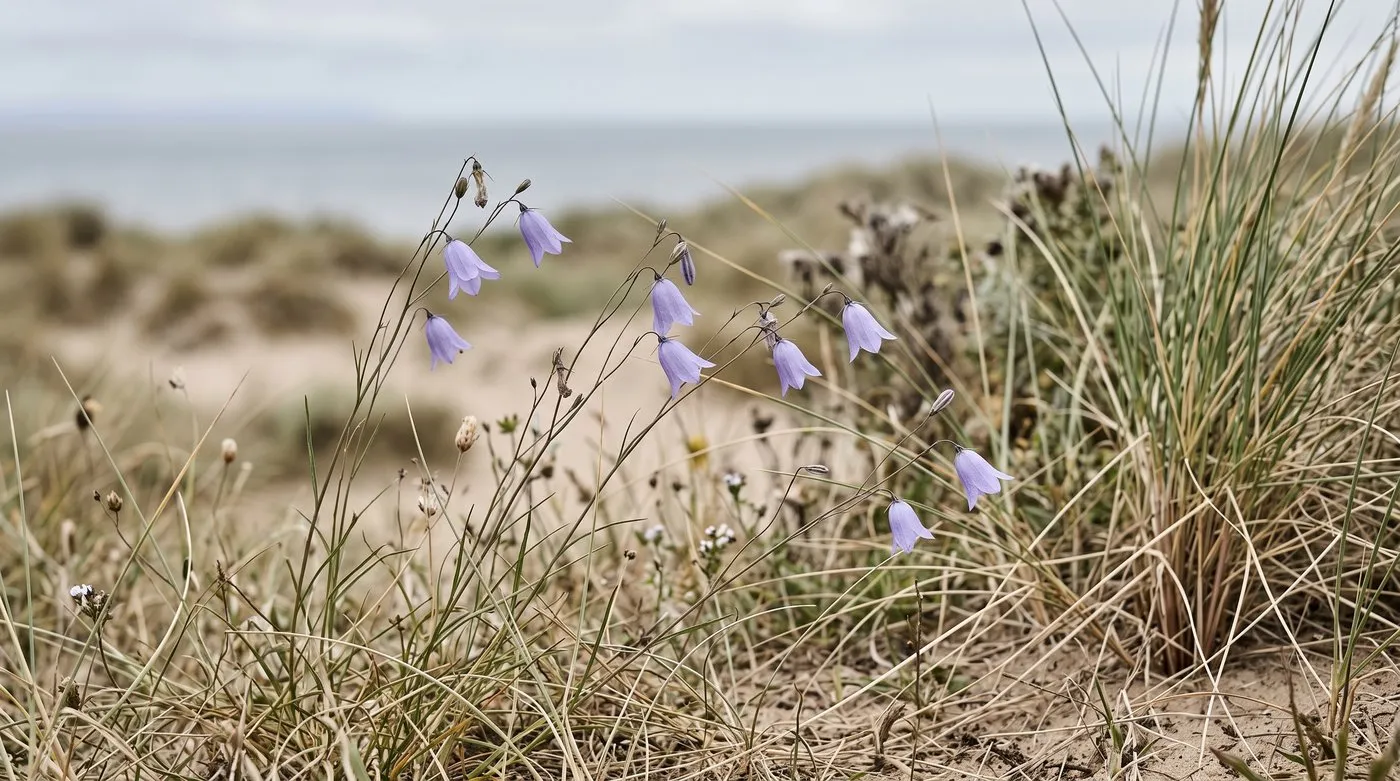
Harebells nod on thin, wiry stems in dry grassland and dunes from July. In Scotland, this is the flower many people call the bluebell.
Meadow saffron (Colchicum autumnale)
Pale purple, crocus-like flowers in September and October. The flowers come up with no leaves, which appear in spring instead. It grows in damp meadows, mostly in central and western England. All parts are very poisonous. Despite the name, it isn’t related to the saffron crocus.
Hedgerow and woodland wildflowers
Hedges and woodland edges have their own set of plants. Many climb or scramble, or are happy in shade.
Dog rose (Rosa canina)
Pink or white five-petalled flowers, 3-5cm across, in June and July. Long, arching, thorny stems scramble through hedges. Bright red hips follow in autumn. It’s the most common wild rose in Britain.
Honeysuckle (Lonicera periclymenum)
Clusters of cream and pink tubular flowers with a lovely sweet scent, strongest at dusk. It twines up through hedges and trees and flowers from June to September. Bumblebees and moths visit it, and red berries follow in autumn.
Wild clematis (Clematis vitalba)
Also called old man’s beard or traveller’s joy. A vigorous climber with small, creamy-green flowers in July and August. Fluffy, silvery seed heads follow and last all winter. It loves chalky and limestone soils, and can smother a hedge if left alone.
Herb Robert (Geranium robertianum)
Small pink flowers with five rounded petals. The leaves are finely cut and fern-like, turning red in autumn, and smell musty when crushed. It grows 10-30cm tall in hedges, walls, woods and gardens. It flowers from April to November, one of the longest seasons of any wildflower.
Growing wildflowers in your garden

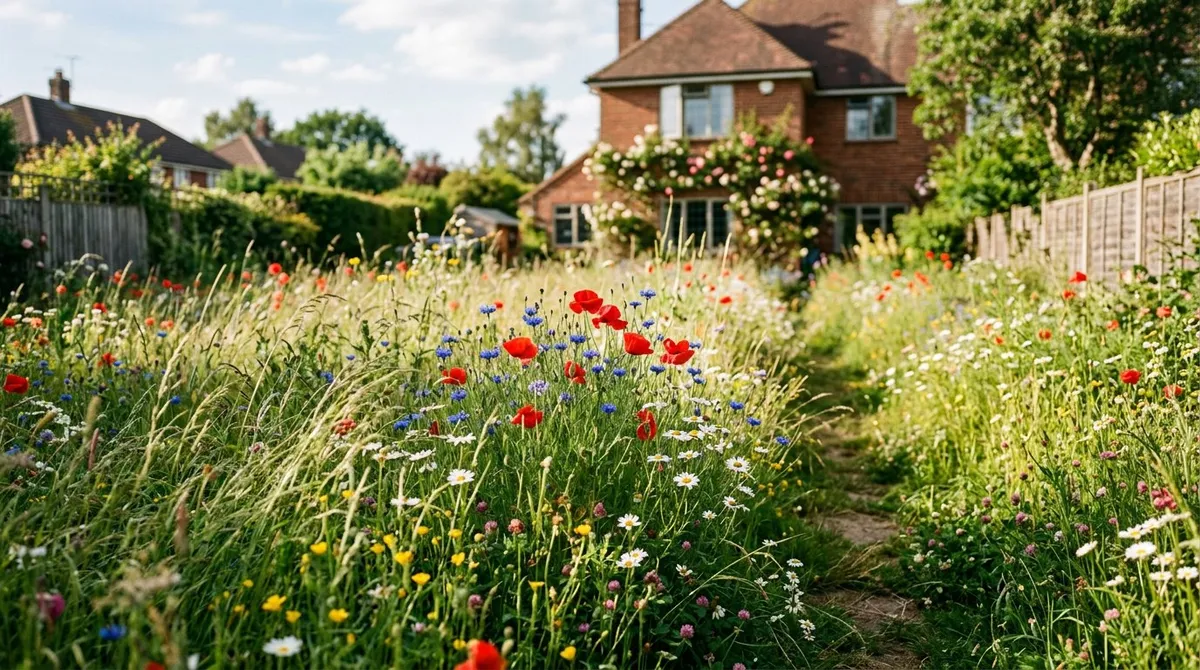
A small garden patch of knapweed, scabious and yarrow. Even a suburban plot can be buzzing.
You don’t need a meadow to grow native wildflowers in a UK garden. A small patch will do. The secret is poor soil. Wildflowers are used to thin ground, and on rich soil the grass muscles them out. On thin, chalky soil, wild carrot is one of the easiest natives to get going, and insects love its flat flower heads.
Add yellow rattle (Rhinanthus minor) to your seed mix. It feeds off grass roots and weakens the grass, which gives the wildflowers room.
Autumn sowing, in September or October, works best. Rake the ground back to bare soil, scatter the seed thinly, and firm it in by walking over it. Don’t add fertiliser. Cut once in late August after the seeds have dropped, and take the cuttings away to keep the soil poor. Our guide on when to sow wildflower seeds has more on timing.
Picking wildflowers and protecting them
Picking a few common flowers is usually fine. Digging up any wild plant without the landowner’s permission is against the law. A small number of rare plants, such as some wild orchids, are specially protected and must not be picked at all.
Wildflower meadows have shrunk enormously in the last century. Plantlife and the Wildlife Trusts work to protect what’s left.
You can help by logging what you see on walks, using apps like iNaturalist or the BSBI’s recording schemes. Your sightings help map where plants are doing well and where they need help.
Quick wildflower comparison table
| Wildflower | Season | Habitat | Colour | Height | Good for |
|---|---|---|---|---|---|
| Primrose | Feb-May | Hedgerow, bank | Pale yellow | 10-15cm | Early bees |
| Bluebell | Apr-May | Woodland | Violet-blue | 20-40cm | Bumblebees, hoverflies |
| Wood anemone | Mar-May | Woodland | White/pink | 15-25cm | Early bees, beetles |
| Cowslip | Apr-May | Meadow, chalk | Deep yellow | 10-20cm | Long-tongued bumblebees |
| Wild garlic | Apr-Jun | Damp woodland | White | 25-40cm | Hoverflies, beetles |
| Ox-eye daisy | Jun-Aug | Meadow, verge | White/yellow | 30-60cm | Bees, hoverflies, butterflies |
| Red campion | May-Oct | Hedgerow, wood edge | Pink-red | 30-60cm | Long-tongued bees, moths |
| Foxglove | Jun-Aug | Woodland, heath | Pink-purple | 60-150cm | Bumblebees |
| Knapweed | Jun-Sep | Meadow, verge | Purple | 30-60cm | Bees and butterflies |
| Field scabious | Jun-Oct | Meadow, dry grass | Lilac-blue | 50-80cm | Butterflies, bumblebees |
| Yarrow | Jun-Sep | Grassland, verge | White/pink | 20-60cm | Hoverflies, beetles |
| Devil’s-bit scabious | Jul-Oct | Damp meadow | Dark purple | 30-60cm | Marsh fritillary, bees |
| Harebell | Jul-Oct | Dry grassland | Blue | 15-40cm | Bees, hoverflies |
| Dog rose | Jun-Jul | Hedgerow | Pink/white | 1-3m | Bees, beetles |
| Honeysuckle | Jun-Sep | Hedgerow, wood | Cream/pink | Climber | Moths, bumblebees |
| Herb Robert | Apr-Nov | Hedgerow, walls | Pink | 10-30cm | Hoverflies, small bees |
Frequently asked questions
What is the easiest UK wildflower to identify?
The bluebell is one of the easiest to spot. Its violet-blue bells carpet woodlands in April and May. Native bluebells have narrow bells with curled-back tips, mostly on one side of an arching stem. Spanish bluebells are paler and more upright, with bells all round the stem.
When is the best time to see wildflowers in the UK?
Late May to mid-July is the peak. Spring starts in late winter with snowdrops and primroses, then bluebells and cow parsley. Meadows are at their best in June and July with ox-eye daisies, knapweed and field scabious. Harebells and devil’s-bit scabious carry on into September.
Is it illegal to pick wildflowers in the UK?
Picking a few common wildflowers is usually fine. Digging up any wild plant without the landowner’s permission is against the law, though. Some rare plants are specially protected and must not be picked at all. Nature reserves may have their own rules too.
How can I identify wildflowers by their leaves?
Leaves are a great clue, especially before flowers appear. Check whether they sit in opposite pairs or one at a time up the stem. See if they’re simple or divided, toothed or smooth. Herb Robert has finely cut leaves with a musty smell. Wild garlic has broad leaves that smell of garlic when crushed.
What wildflowers can I grow in my garden?
Most common meadow flowers grow happily in gardens. Ox-eye daisy, field scabious, knapweed, yarrow and red campion all do well in ordinary soil. Sow yellow rattle into grassy areas to weaken the grass. Perennial wildflowers can take a year or two to get going, but annual cornfield flowers bloom in their first summer.
What is the difference between native and non-native bluebells?
Native bluebells droop to one side and smell sweet. Their narrow bells hang from one side of an arching stem, and the pollen is creamy white. Spanish bluebells have wider bells all round an upright stem, little scent and often blue pollen. Hybrids are common and show a bit of both.
How do wildflower meadows help pollinators?
They give bees, butterflies and hoverflies food from spring to autumn. Different flowers bloom at different times, so there’s always something on the menu. Knapweed and bird’s-foot trefoil are real favourites. Leave some dead stems standing over winter, as insects shelter inside them.
Further reading
Our team produces practical UK gardening guidance from source research, contributor records and established horticultural practice. Editorial standards are overseen by Matt W.