
Key takeaways
- Plant bare-root vines from November to March against a sunny, south-facing wall
- Boskoop Glory, Seyval Blanc and Regent are reliable outdoor choices
- Prune in December or January, as later cuts bleed sap
- Pinch back shoots every week or so in summer so the sun reaches the grapes
- Thin bunches in June for bigger, sweeter grapes
- One vine is enough, as they're self-fertile
A grape vine is one of the most rewarding fruit plants you can grow in a UK garden. Plant one against a warm wall this winter and you could be picking sweet grapes within three years. Prune it well and it will keep cropping for decades. Our warmer summers make garden grapes more reliable than ever.
Here’s how to choose a variety, plant it, train it and prune it. If you already grow fruit, our guides to fig trees and apple trees cover other long-lived crops that love a south-facing wall.
What type of grapes can I grow in the UK?
There are two main groups. Outdoor varieties are bred to cope with British weather. Greenhouse varieties need the extra warmth of glass to ripen. Outdoor grapes split again into dessert grapes for eating and wine grapes for pressing.
Outdoor dessert grapes
Dessert grapes are sweet, juicy and thin-skinned, made for eating straight off the vine. Outdoors, they need a warm, sheltered spot. Outside the south-east, a south-facing wall or fence is almost a must.
Boskoop Glory is the most reliable outdoor eating grape. It gives big bunches of sweet blue-black grapes in September, even in an ordinary summer. It’s vigorous and tough, so it’s a great first vine.
Muscat Bleu has deep blue grapes with a lovely muscat flavour. It ripens in early October and copes with cooler weather better than many eating grapes.
Outdoor wine grapes
English wine is thriving, which tells you our climate can ripen wine grapes. Seyval Blanc is a classic for crisp white wine. It ripens early, shrugs off disease and crops heavily, so it’s the safe choice for a first wine vine.
Regent makes a good red wine for a cool climate and resists mildew well. Solaris and Phoenix are white wine grapes bred for cool climates. Both ripen early and resist disease.
Greenhouse varieties
Under glass you can grow the classic eating grapes that won’t ripen outside. Black Hamburg is the traditional greenhouse grape, with big bunches of sweet black grapes, and it’s happy in an unheated greenhouse. Muscat of Alexandria has superb white grapes but needs more warmth, usually a heated greenhouse.
Best grape vine varieties for UK gardens
The right variety is the difference between ripe grapes and hard green bullets. Here are the most reliable picks.
 A mature vine trained along wires, with its permanent rod-and-spur framework.
| Variety | Where | Use | Colour | Ripens | Best for |
|---|---|---|---|---|---|
| Boskoop Glory | Outdoor | Eating | Blue-black | September | Beginners |
| Muscat Bleu | Outdoor | Eating | Deep blue | Early October | Flavour |
| Seyval Blanc | Outdoor | Wine | Green-gold | Late September | White wine |
| Regent | Outdoor | Wine | Dark blue | October | Red wine |
| Solaris | Outdoor | Wine | Golden | Early September | Northern gardens |
| Phoenix | Outdoor | Wine | Green-yellow | Late September | Fragrant white wine |
| Black Hamburg | Greenhouse | Eating | Black | Late summer | Big sweet grapes |
| Muscat of Alexandria | Heated greenhouse | Eating | Amber | Autumn | Best flavour |
Gardener’s tip: For one vine on a garden wall, pick Boskoop Glory. It copes with an average British summer and gives grapes sweet enough to eat fresh. For a second vine, add Seyval Blanc for white wine grapes that ripen a little later.
Where to plant a grape vine
Position matters more than anything else. Grapes need sun and warmth to ripen. That means a south-facing wall, fence or open spot that gets direct sun for most of the day. West-facing walls work in the south but may not be warm enough further north.
Wall and fence planting
 A bare-root vine planted at the foot of a wall, with wires ready for training.
Most garden vines grow on walls and fences. A wall soaks up heat in the day and gives it back at night, which helps the fruit ripen. Brick and stone are best, but fences work too. A warm wall with wires also suits kiwi fruit.
Fix horizontal wires to the wall with vine eyes, about 30cm apart, starting 40cm off the ground. Use strong galvanised wire and pull it tight, as it will hold a lot of leaves and fruit by summer. Keep the wires 10-15cm off the wall so air can move behind the leaves. Good air flow helps keep powdery mildew away.
Open-ground planting
Wine grapes can grow in the open, like in a vineyard. Run rows north to south so both sides get sun. Use sturdy posts and wires, with the end posts braced. This suits people with more room who want several vines for wine.
Soil requirements
Vines cope with most soils as long as they drain well. Sandy or chalky soil suits them, but heavy clay that stays wet in winter doesn’t. Don’t make the soil too rich, or you’ll get lots of leaves and few grapes. If your soil is heavy, try growing in containers instead.
How to plant a grape vine
Plant bare-root vines from November to March, while they’re dormant. Potted vines can go in any time, but planting in the dormant season gives the best start.
Planting steps
- Dig a hole 45cm wide and 30cm deep, about 30-40cm out from the wall
- Fork some garden compost into the bottom
- Set the vine at the same depth it was growing before
- Lean the stem towards the wall if planting against one
- Fill in with soil and firm gently
- Water well and mulch around the base with bark or compost
- Cut the main stem back to three strong buds
That last cut feels brutal, but it matters. It makes the vine send up one strong shoot instead of several weak ones. That shoot becomes the permanent trunk, called the rod.
Greenhouse planting
For greenhouse grapes, plant the vine outside the greenhouse and feed the stem in through a hole low in the wall. The roots get rain and don’t dry out in a baking greenhouse border. Train the rod up inside, where the fruit gets the warmth.
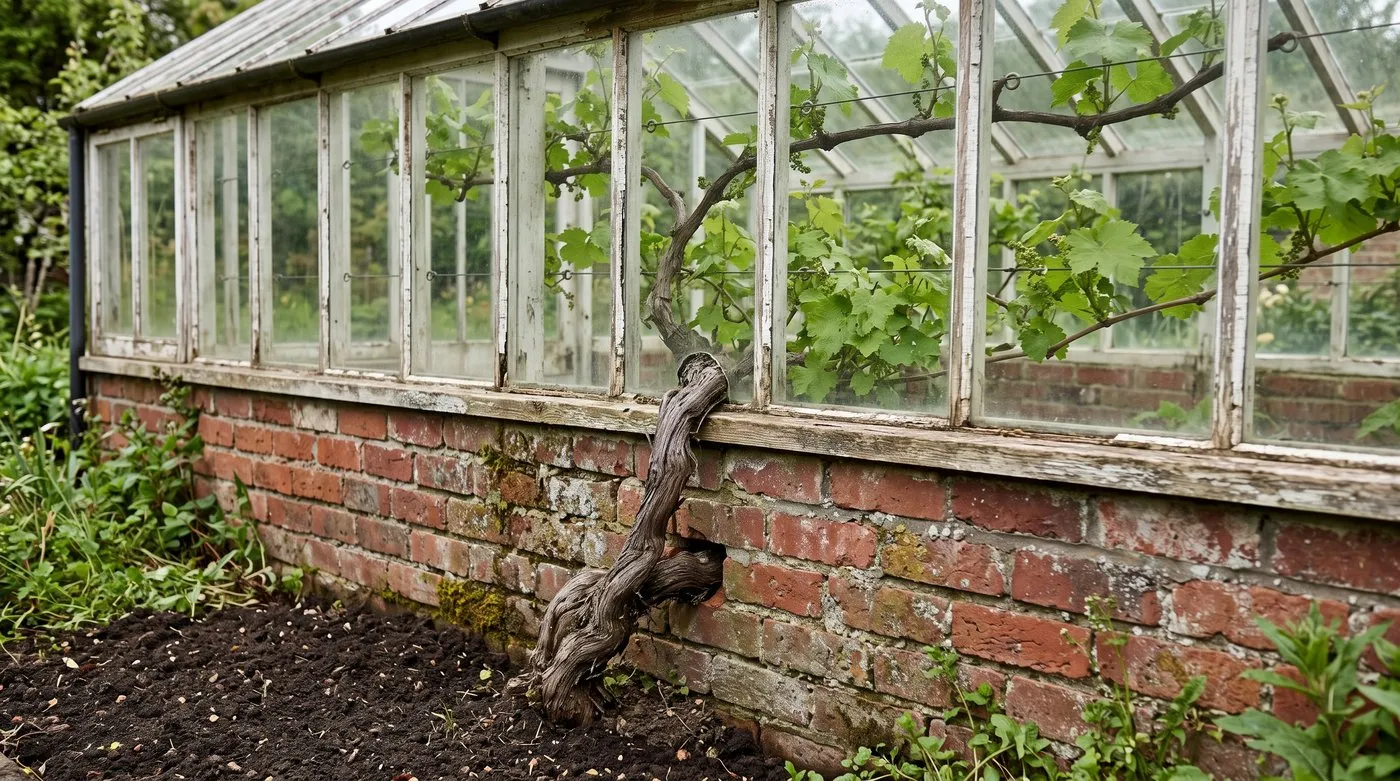
Plant the vine outside and lead it in through a low hole. The roots get the rain and the grapes get the warmth.
How to train a grape vine
Training builds a permanent framework that carries fruit for years. The method depends on whether you’re growing eating or wine grapes. Our guide to training fruit trees as espaliers uses the same idea of a permanent framework.
Rod-and-spur system (dessert grapes)
This is the usual method for eating grapes on a wall. One permanent upright rod carries short spurs along its length. Each spur sends out one or two fruiting shoots a year.
Year one: Let the strongest shoot grow straight up as the rod. Tie it in as it grows and remove other shoots.
Year two: In December or January, cut the rod back by half. In summer, side shoots grow from the rod. Tie them along the wires. Pinch off any flowers this year so the vine builds roots and framework.
Year three onwards: Fruiting begins. Each winter, cut side shoots back to one or two buds. In spring these buds grow into fruiting shoots. Leave one bunch per shoot on a young vine, and a little more as it matures.
Guyot system (wine grapes)
Here, the fruiting canes are replaced every year. In winter, choose one cane (single Guyot) or two canes (double Guyot) from last summer’s growth. Tie them along the lowest wire, and they’ll send up fruiting shoots in spring. At the same time, let a new cane grow up from the base for next year. After harvest, cut out the old canes and tie in the new ones.
It gives more fruit than rod-and-spur but takes a bit more know-how. It’s the method most vineyards use.
How to prune a grape vine
Pruning is the key skill. Without it, a vine becomes a tangle of leaves that shades its own fruit. Vines need pruning twice a year: in winter and in summer.
Winter pruning (December to January)
 Winter spur pruning. Each side shoot is cut back to one or two buds.
Prune in December or January, while the vine is fully dormant. Timing really matters. Once the sap starts rising in late winter, cuts bleed sap for weeks and weaken the vine.
For rod-and-spur, cut every side shoot back to one or two buds. The stubs become the spurs, which get knobbly and gnarled over the years. Remove any dead or weak wood.
For Guyot, keep your chosen replacement canes and remove the rest. The RHS grape vine guide has clear illustrations.
Summer pruning (June to August)
Summer pruning keeps the vine in check and lets sun reach the grapes. Skip it and you get a thick canopy that traps damp air and invites grey mould.
- Pinch fruiting shoots to 5-6 leaves past the last bunch
- Pinch side shoots growing off those shoots to one leaf
- Remove tendrils that wrap around bunches
- Take off leaves shading the fruit in late August
Do this every week or so through summer. Vines grow fast in warm weather, so little and often is easiest.
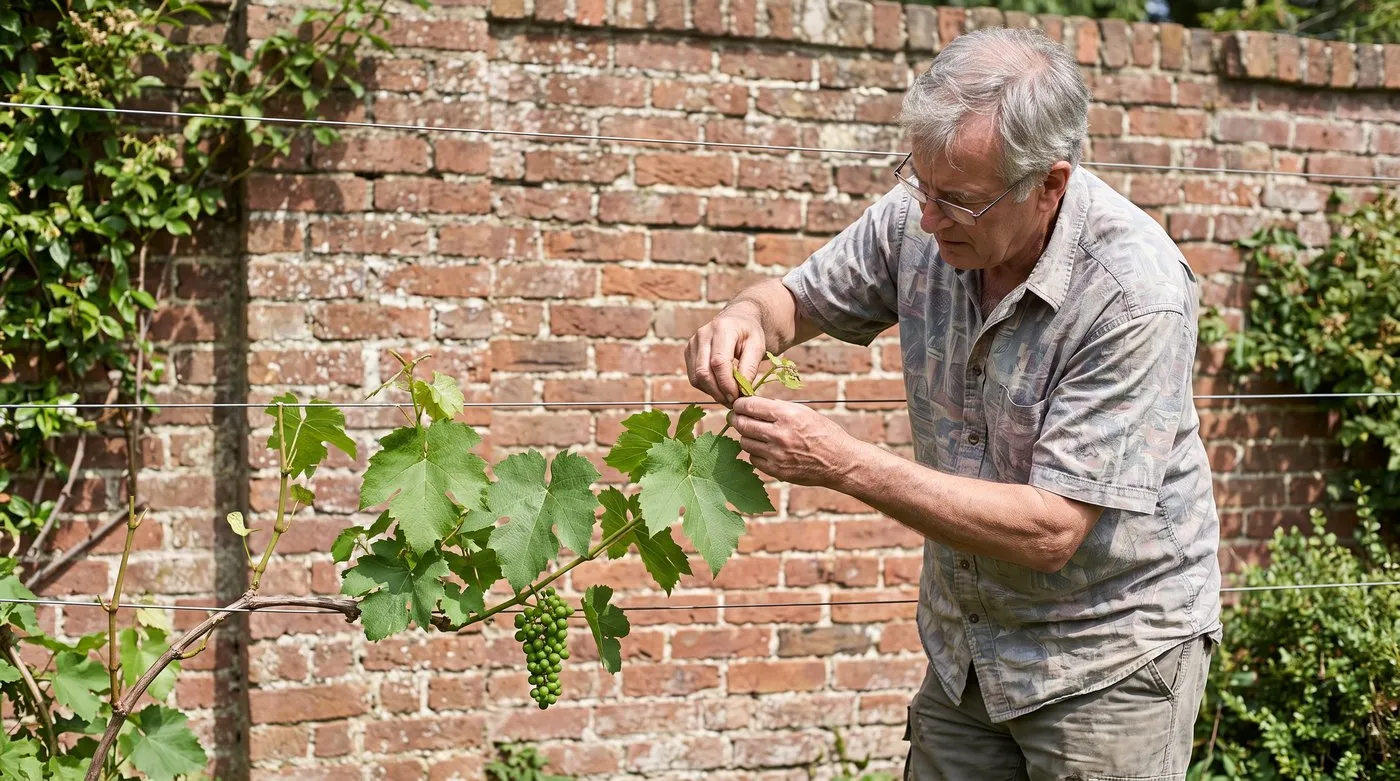
Pinch fruiting shoots five or six leaves past the last bunch, little and often through summer. It lets sun reach the grapes and keeps damp air away.
How to thin grapes for larger fruit
Thinning turns ordinary eating grapes into great ones. Unthinned bunches are packed too tight. The vine can’t sweeten every berry, and the crowding traps damp.
Bunch thinning
In June, once bunches have formed but the berries are still small and hard, remove the weakest bunches. On a young vine, keep one bunch per shoot. An established vine can carry two in a good year.
Berry thinning
For the best eating grapes, use small pointed scissors to snip out some berries from the middle of each bunch. Leave the rest room to swell without touching. Taking out about a third makes a real difference to size and sweetness. Wine growers usually skip this step.
Grape vine month-by-month calendar
Here’s the vine year at a glance.
| Month | What to do |
|---|---|
| December to January | Winter prune. Plant bare-root vines. Check wires and ties. |
| February to March | Finish planting. Mulch around the base. |
| April to May | New shoots grow. Tie them in. Rub off unwanted shoots. |
| June | Summer pinching begins. Thin bunches. |
| July | Keep pinching. Thin berries on eating grapes. Water in dry spells. |
| August | Keep pinching. Take off leaves shading fruit. Net against birds and wasps. |
| September to October | Pick grapes when sweet. Watch for grey mould. |
| November | Leaves fall. Plant new vines. |
Common pests and diseases
A sunny spot and regular summer pruning prevent most problems. Good air flow is the best defence against disease.
Powdery mildew
 Ripe Boskoop Glory grapes in September. Pick them when they’re sweet and slightly soft.
Powdery mildew shows as a white, dusty coating on leaves, shoots and fruit. It loves warm, dry, still weather. Seyval Blanc and Regent resist it well. Keep the leaves open by summer pruning, water in dry spells and pick off badly affected leaves.
Grey mould (botrytis)
Grey mould rots grapes in damp autumns, turning them brown and fuzzy. Thinning bunches and removing shading leaves help a lot. Snip out any mouldy grapes straight away so it doesn’t spread.
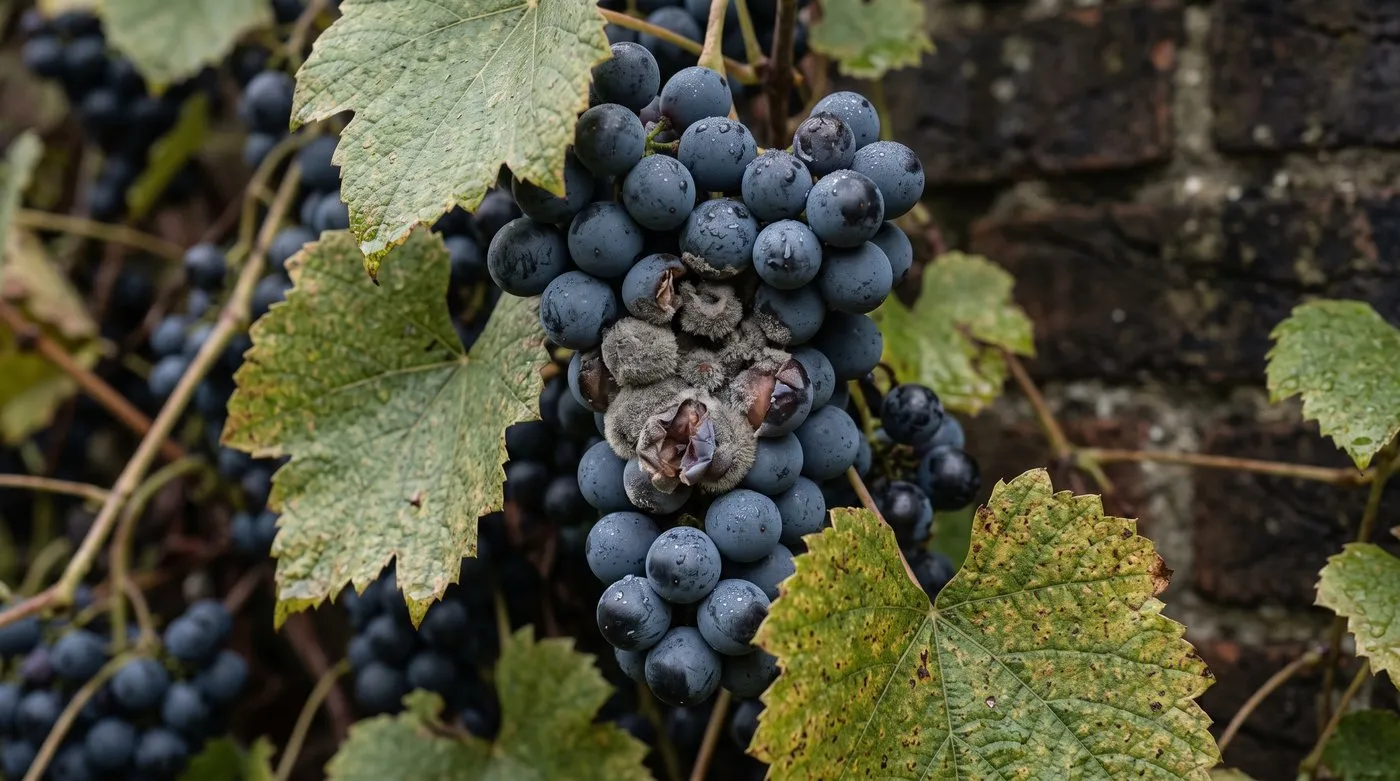
Grey mould starts in tight, crowded bunches in damp autumns. Snip out any furry grapes straight away so it doesn’t spread.
Birds and wasps
Birds go for grapes from August as they colour, and wasps follow as they sweeten. Cover the vine with fine mesh before the fruit softens, or bag individual bunches. Netting is the only reliable fix.
Five common mistakes when growing grape vines
1. Pruning too late in spring
Cuts made after January bleed sap for weeks and weaken the vine. Finish winter pruning by the end of January. If you miss it, leave the vine until next December rather than cutting in spring.
2. Skipping summer pruning
An unpinched vine grows a thick canopy that shades the fruit. Grapes ripen slowly, and the damp inside invites mildew and mould. A few minutes per vine every week or so from June to August makes all the difference.
3. Planting on a north-facing wall
A north-facing wall gets almost no direct sun, so the grapes never ripen. East-facing is only a little better. Go for south or south-west. If you only have shade, try blueberries, which cope with part shade much better.
4. Not thinning fruit
Leaving every bunch gives you lots of small, sour grapes. Thin bunches in June and berries in July for fewer, bigger, sweeter ones.
5. Forgetting to net against birds
Birds can strip a vine in days once the fruit colours. Net in early August, before the grapes soften, and tuck the edges in well.
Growing grape vines in containers
One vine grows happily in a big pot on a sunny patio. Use a pot at least 45cm wide and 40cm deep, filled with loam-based compost (John Innes No. 3). It holds water better than multi-purpose and is heavy enough to stop the pot blowing over.
Train the vine up a fan of canes or onto a sunny wall behind the pot. Prune and pinch just as you would in the ground. Water regularly in summer and give a tomato feed every two weeks from flowering to harvest.
Potted vines give smaller crops than those in the ground, but they’re perfect for patios and courtyards. Boskoop Glory and Seyval Blanc both do well in pots.
Why grow grapes in a UK garden?
A grape vine gets better with age. Once it settles in, a well-pruned vine keeps cropping year after year, much like a fig.
A bare-root vine is cheap, and a sunny wall costs nothing to use. Sun-warmed grapes picked from your own garden taste nothing like chilled supermarket ones. Warmer summers and longer autumns are helping garden grapes ripen better too.
So plant a vine this winter. Go for Boskoop Glory for eating, Seyval Blanc for wine, or both. Cut it back hard, train it along wires and prune it every winter and summer. In three years you’ll be picking your own grapes.
Now you’ve got the hang of grape vines, read our guide on growing fruit trees in the UK to plan a garden with fruit from cherries in June to late apples in October.
Frequently asked questions
Can I grow grapes outdoors in the UK?
Yes, plenty of varieties fruit well outdoors, especially in the south. Hardy choices like ‘Boskoop Glory’, ‘Seyval Blanc’, ‘Regent’ and ‘Solaris’ ripen on a sunny, south-facing wall or fence. In colder northern gardens, pick the earliest varieties or grow under glass.
When should I plant a grape vine?
Plant bare-root vines between November and March, while they’re dormant. This gives the roots time to settle before spring. Potted vines can go in any time, but autumn or winter is still best. Avoid frozen or waterlogged ground and water in dry spells.
Do grape vines need another vine for pollination?
No, grape vines are self-fertile and fruit on their own. One vine on a wall will give you a good crop. Growing more than one variety just gives you more kinds of grape or a longer harvest.
How do I prune a grape vine in winter?
Prune in December or early January, while the vine is fully dormant. For dessert grapes, use the rod-and-spur method and cut each side shoot back to one or two buds. For wine grapes, the Guyot system swaps in one or two new fruiting canes each year. Don’t prune in late winter, as the cuts bleed sap.
Why are my grapes small and sour?
Usually the vine is carrying too much fruit to ripen. Thin the bunches in early summer, leaving about one bunch per side shoot. For dessert grapes, also snip out some berries inside each bunch. Too little sun, skipped summer pruning and dry roots also make grapes small and sour.
What pests and diseases affect grape vines in the UK?
Powdery mildew is the most common problem. It shows as white powder on leaves and fruit, especially in warm, still or dry weather. Good air flow and regular watering help. Grey mould rots fruit in wet autumns, and birds and wasps go for ripening grapes, so net or bag bunches as they colour.
How long does a grape vine take to produce fruit?
Expect a first small crop around the third year. Bigger crops usually start in year four or five, once the framework is built. Pinch off flowers for the first couple of years so the vine puts its energy into roots. With yearly pruning, vines keep going for decades.
Can I grow grapes in a greenhouse in the UK?
Yes, and a greenhouse lets you grow more varieties. ‘Black Hamburg’ and ‘Muscat of Alexandria’ give big, sweet dessert grapes under glass. A popular trick is to plant the vine outside and feed the stem through a hole in the greenhouse wall. The roots get rain and the fruit gets the warmth.
Our team produces practical UK gardening guidance from source research, contributor records and established horticultural practice. Editorial standards are overseen by Matt W.


