
Key takeaways
- Fuzzy kiwi wants a warm south-facing wall. Kiwi berries are tougher and easier
- Most kiwis need a male and a female plant to fruit
- Jenny and Issai fruit on their own, so they're ideal for small gardens
- Expect your first fruit 3-5 years after planting
- Late spring frost kills the flowers, so keep fleece handy in May
- Pick fuzzy kiwis in October before hard frost and ripen them indoors
Kiwi fruit is one of the most fun exotic crops you can grow in a British garden. The fuzzy brown fruits you buy in the shops come from big climbing vines, and they’ll grow against a warm south-facing wall here. Hardy kiwi berries, their small grape-sized cousins, are even easier and fruit across most of England and Wales with no special fuss.
Here’s how to choose between the two, then train, prune and pick them. If you already grow fruit on a sunny wall, our guides to grape vines and fig trees cover two more great choices.
What types of kiwi can I grow in the UK?
There are two main kinds: fuzzy kiwi (Actinidia deliciosa) and hardy kiwi berry (Actinidia arguta). They look and taste different and suit different gardens, so this is your first decision.
Fuzzy kiwi (Actinidia deliciosa)
This is the familiar brown, hairy kiwi from the shops. The vines are big, leafy climbers that can reach 9-10 metres if you let them. Their large heart-shaped leaves look almost tropical. The fruit needs a long, warm season, so it does best in southern and central England.
Fuzzy kiwi needs a sheltered south-facing wall or fence to fruit here. The wall soaks up warmth by day and gives it back at night, which stretches the season. Hayward is the classic shop-sized kiwi and the most widely grown.
Hardy kiwi berry (Actinidia arguta)
 Kiwi berries are grape-sized and smooth-skinned, and sweeter than fuzzy kiwis.
Kiwi berries are smaller, smoother and much easier to grow here. They’re grape-sized with smooth green or red skin, and you eat them whole. They taste sweeter and stronger than fuzzy kiwi.
The vines are very cold-hardy, so they suit far more UK gardens. They’re a bit less rampant than fuzzy kiwi but still need sturdy support. Issai fruits on its own, so it’s the one to choose if you only have room for one vine.
There’s also Actinidia kolomikta, grown mainly for its pretty pink-and-white splashed leaves. It does give tiny edible fruit, but it’s really a decorative climber.
Best kiwi varieties for UK gardens
Choosing well matters. Pick the wrong one and you could wait years for a vine that never fruits. These four are the most reliable here.
| Variety | Type | Fruits on its own? | Fruit size | How tough | Best for |
|---|---|---|---|---|---|
| Hayward | Fuzzy kiwi | No, needs a male such as Atlas | Large | Needs a warm wall | Big sunny walls |
| Jenny | Fuzzy kiwi | Yes | Medium | Needs a warm wall | Small gardens, one vine |
| Issai | Kiwi berry | Yes | Small | Very hardy | Colder gardens, pots, beginners |
| Ken’s Red | Kiwi berry | No, needs a kiwi berry male | Small | Very hardy | Red fruit, great flavour |
Gardener’s tip: Room for only one vine? Choose Jenny. It fruits on its own, gives proper-sized kiwis and starts cropping sooner than Hayward. For a big pergola or fence, plant one Atlas male with two or three Hayward females.
Do kiwi plants need a male and female vine?
Most kiwis carry male and female flowers on separate plants. Without a male nearby, a female vine flowers but never fruits. This is the number one reason UK kiwi growers end up with no crop.
How pollination works
Male vines make pollen but no fruit. Female vines make fruit but need that pollen. Bees carry it between them while the vines flower in late May and June. One male can pollinate several females growing nearby.
The male and female must be the same kind. A fuzzy kiwi male (such as Atlas or Tomuri) pollinates Hayward and other fuzzy kiwis. A kiwi berry male pollinates kiwi berries like Ken’s Red. They can’t swap.
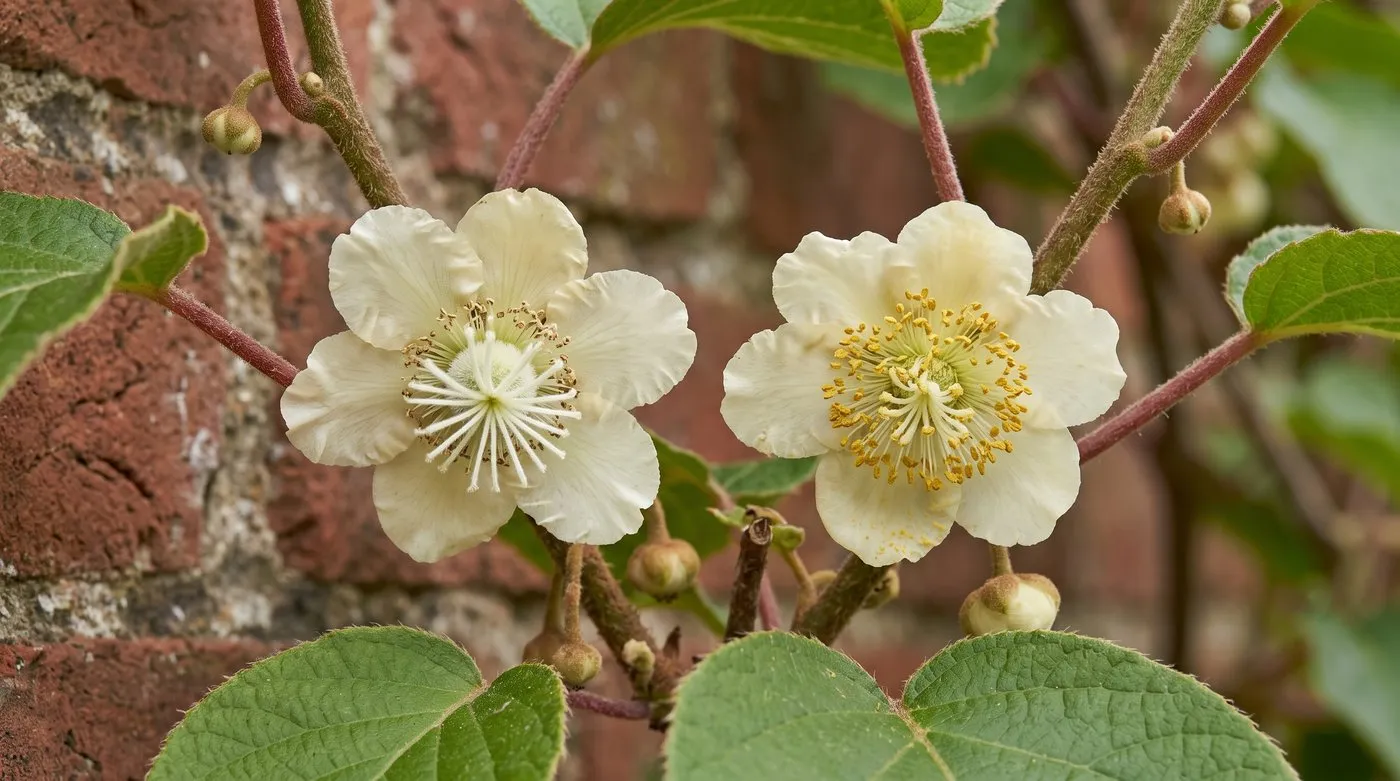
Female flowers have a fuzzy baby fruit and white stigmas in the middle, while males just have stamens. Without a male nearby, most females won’t fruit.
Self-fertile alternatives
Jenny (fuzzy kiwi) and Issai (kiwi berry) fruit on their own. Both crop well alone, though a male nearby can help. For small gardens and patios, they save you planting a second vine.
Solissimo is another fuzzy kiwi that fruits on its own. It’s harder to find in UK nurseries and needs the same warm, sheltered spot as Hayward.
Where to plant a kiwi vine
Where you plant decides whether you get fruit or just leaves. Kiwi vines grow happily in most gardens, but they need warmth and shelter to fruit.
 A kiwi trained on wires against a warm south-facing brick wall, the perfect spot for fuzzy kiwi.
South-facing walls
A south-facing brick or stone wall is the best spot for fuzzy kiwi. It stores the day’s heat and keeps the vine a little warmer at night. That helps the fruit ripen and gives the flowers some protection from frost. A wall also shelters young growth from cold spring winds.
Fix galvanised wires along the wall 45cm apart, starting 45cm from the ground. Use vine eyes to hold them about 10cm off the wall so air can move behind the leaves. One vine needs a wall at least 4 metres wide and 2.5 metres tall.
Pergolas, arches, and fences
Kiwi vines look fantastic on a pergola, but the flowers are more exposed to frost up there. A pergola against a south-facing house wall works well. Freestanding pergolas in open gardens suit kiwi berries better, as they cope with more cold.
For a fence, choose a south or south-west facing one at least 1.8 metres tall, with wires 45cm apart. Wooden fences don’t hold heat like brick, so fruit ripens a little later. Grown-up vines are heavy, so make sure any support is really sturdy.
Soil requirements
Kiwis like well-drained, slightly acid soil. They hate soggy ground and heavy chalky clay. On heavy soil, dig in plenty of compost and grit before planting. On chalk, grow them in a big container (50 litres or more) of ericaceous compost.
The RHS guide to growing kiwi fruit agrees that a warm wall gives the most reliable crops in southern and central England.
How to plant a kiwi vine
Plant bare-root vines from November to March, or pot-grown ones at any time of year. Autumn is best, as the roots settle in before spring.
- Dig a hole twice as wide as the root ball and just as deep
- Mix the dug-out soil half and half with garden compost
- Plant 30cm out from the wall, away from the dry patch at its base
- Keep the top of the root ball level with the soil
- Water well and mulch with 8-10cm of bark or compost
- Tie the main stem loosely to the nearest wire with soft twine
Space vines 4-5 metres apart along a wall, with the male in the middle and females either side. Males are less vigorous, so they need less room. Kiwi berries need 3-4 metres between plants.
How to train a kiwi vine
Training builds a permanent framework of branches that carries fruit for years. Untrained vines turn into a tangle with little fruit. It’s a lot like training grape vines or espalier fruit trees.
Establishing the framework (years 1-3)
Year one: Let the strongest shoot grow straight up as the main stem and tie it to the wires as it goes. Remove side shoots below the first wire. When it reaches the top wire, pinch out the tip.
Year two: At each wire, pick two strong side shoots and train them along the wire in opposite directions. These are your permanent arms. Remove the rest. By late summer you’ll have a trunk with pairs of arms along each wire.
Year three: The framework is done. Short side shoots grow from the arms, and these carry the flowers and fruit. Let them grow to fill the gaps.
Ongoing training
From now on, new growth comes from the arms. Tie it in as it grows, and remove anything growing straight into or away from the wall. Aim for an open, airy vine where light reaches everywhere.
How to protect kiwi flowers from frost
Late spring frost is the biggest threat to a UK kiwi crop. The vines themselves are tough. But the flowers open in late May and early June, and one frosty night can wipe out that year’s fruit.
Frost protection methods
Fleece is the easy answer. Drape a double layer over the vine when frost is forecast. Take it off by day so bees can get to the flowers. A south-facing wall helps, but it isn’t always enough in a May cold snap.
Temporary covers work on a pergola. A clear sheet of polythene held above the vine traps warm air rising from the ground. Leave the edges loose so air can move during the day.
In frosty gardens, try kiwi berries, which handle cold better. A south-facing house wall is also a little warmer than a garden wall.
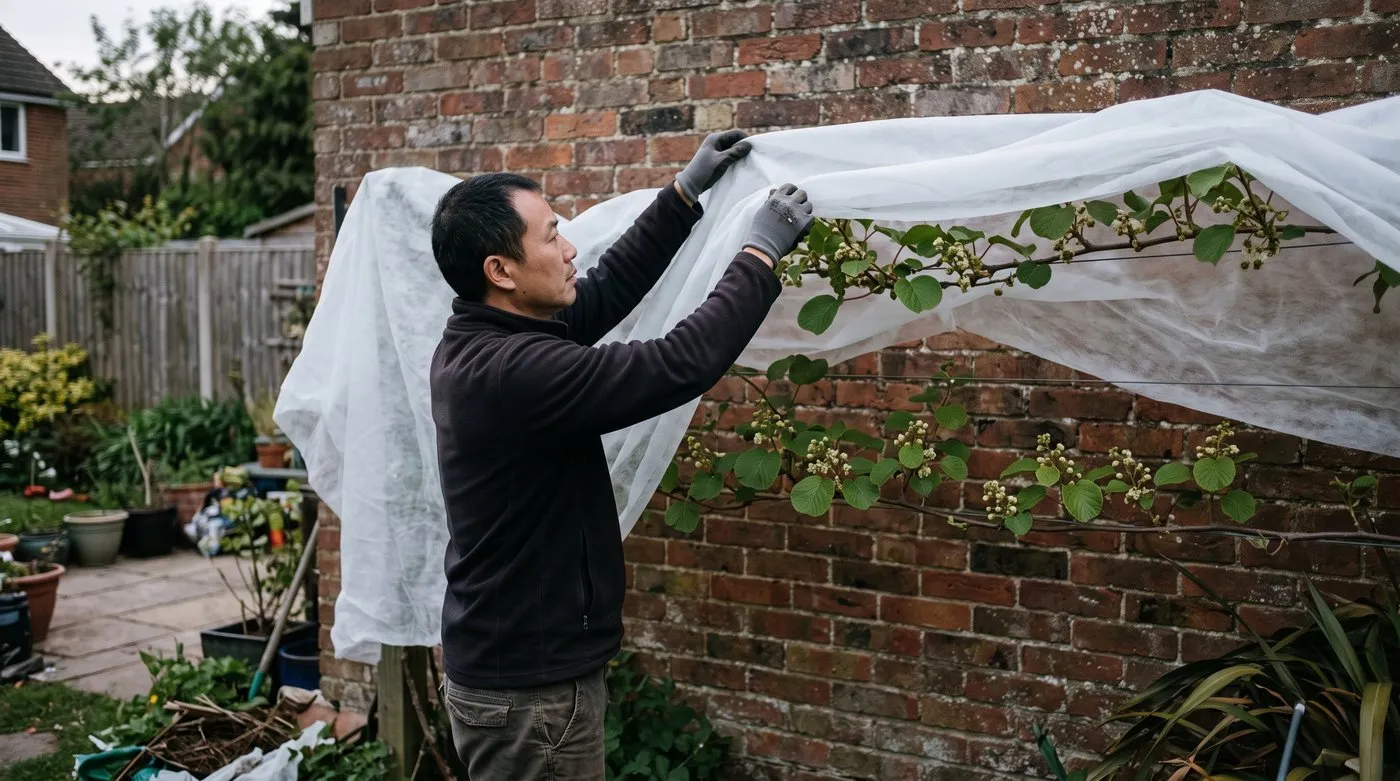
Fleece goes on when frost is forecast and comes off in the morning so bees can reach the flowers. One cold night in May can cost you the crop.
How to prune a kiwi vine
Kiwi vines can put on 3-4 metres of new growth in a season. Left alone, the leaves shade out the fruit. Prune twice a year: in summer to calm it down and in winter to set up next year’s fruit.
Summer pruning (July-August)
Summer pruning sends the vine’s energy into ripening fruit rather than more leaves. Cut each fruiting side shoot back to 5-7 leaves past the last fruit. Remove non-fruiting shoots that shade the fruit, and anything growing into or straight out from the wall.
Keep the male vine tidy too. It needs less pruning, as it carries no fruit.
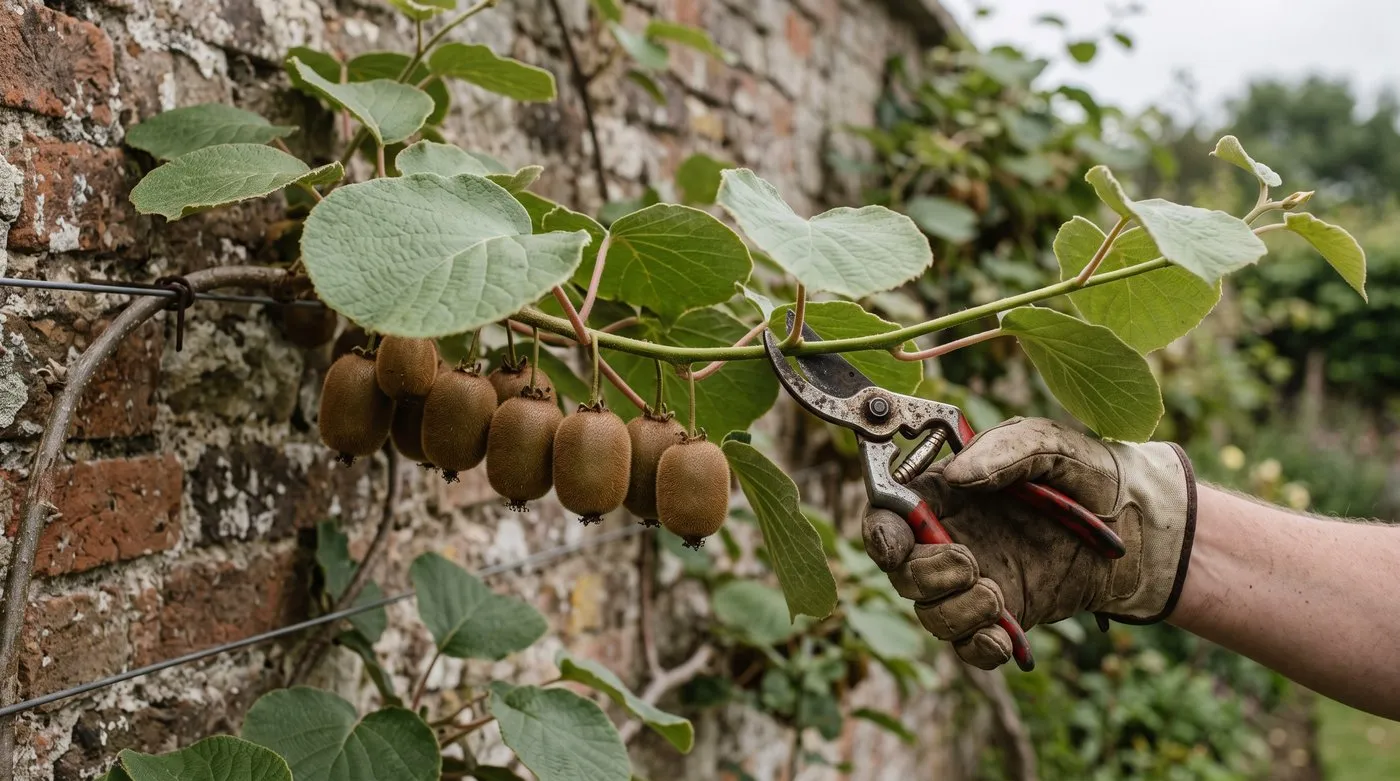
Cut fruiting side shoots back to 5-7 leaves past the last fruit. It sends the vine’s energy into ripening rather than more leaves.
Winter pruning (December-February)
Cut each summer-pruned side shoot back to 2-3 buds from its main arm. Those buds make next year’s fruiting shoots. Remove dead, damaged or crossing shoots, and thin any crowded spots.
Kiwi vines bleed sap if you prune too late, so finish by the end of February. New to pruning? Our pruning guide covers the basics for all trained fruit.
How to harvest and store kiwi fruit
 Pick fuzzy kiwis in October before the first hard frost, then ripen them indoors.
Pick fuzzy kiwis in October or November, before the first hard frost. Our summers aren’t long enough for them to ripen fully on the vine. Instead, pick them firm and ripen them indoors.
When to pick
Fuzzy kiwis are ready when the seeds inside have turned black, even though the fruit is still firm. Cut one open to check first. Snip each fruit off with secateurs, leaving a short stalk. A hard frost damages fruit on the vine, so watch the forecast from late September.
Kiwi berries ripen earlier, from late August into September. They’re ready when the skin colour deepens and they come away easily with a gentle twist.
Ripening and storage
Spread fuzzy kiwis out in a single layer at room temperature until they give a little when pressed. To speed things up, pop them in a paper bag with a banana or apple. Once ripe, they keep for a week or two in the fridge.
Kiwi berries don’t keep long. Eat them soft and ripe within a few days. If you pick them while still firm, leave them at room temperature for a few days to soften first.
A grown-up vine can give you more than you can eat. Spare fruit makes lovely jam and chutney, or freeze it for smoothies.
Patience: the first years without fruit
The hardest part of growing kiwi is the wait. Named fuzzy kiwi vines usually take 3-5 years to fruit. Kiwi berries are often a bit quicker. Plants grown from seed take much longer, and you won’t know if they’re male or female until they flower.
Use the waiting years to build a strong framework. A well-trained vine with good arms crops far better than one left to sprawl. Water well through summer, feed with a high-potash feed from May to August, and prune as above.
Plenty of fruit asks for some patience. Grape vines and fig trees also take a few years to crop. The reward is a vine that keeps going for decades.
Common problems and solutions
Flowers but no fruit
Usually it’s missing pollination. Check you have both a male and a female (unless it’s a self-fertile kind). Cold, wet weather while it flowers also keeps bees away. You can help by dabbing a soft brush on male flowers and then on female flowers.
Frost-damaged flowers
Brown, wilted flowers after a May frost mean no crop that year, sadly. All you can do is protect it better next spring. Keep fleece ready from early May.
Vigorous growth but no flowers
Young vines often grow like mad without flowering. That’s normal. If an older vine still hasn’t flowered, it may be a seedling male, or it may be getting too much nitrogen. Switch to a high-potash feed.
Yellowing leaves
On chalky soil, leaves can go yellow between the veins. That’s a shortage of iron, because chalky soil locks it up. Water on sequestered (chelated) iron in spring, and mulch each year with ericaceous compost.
Kiwis have few pests here. Cats are sometimes drawn to young plants, a bit like catnip, so protect new vines with wire netting until they’re established. Like other fast-growing climbers, kiwis need regular attention in their first few years to keep them in check.
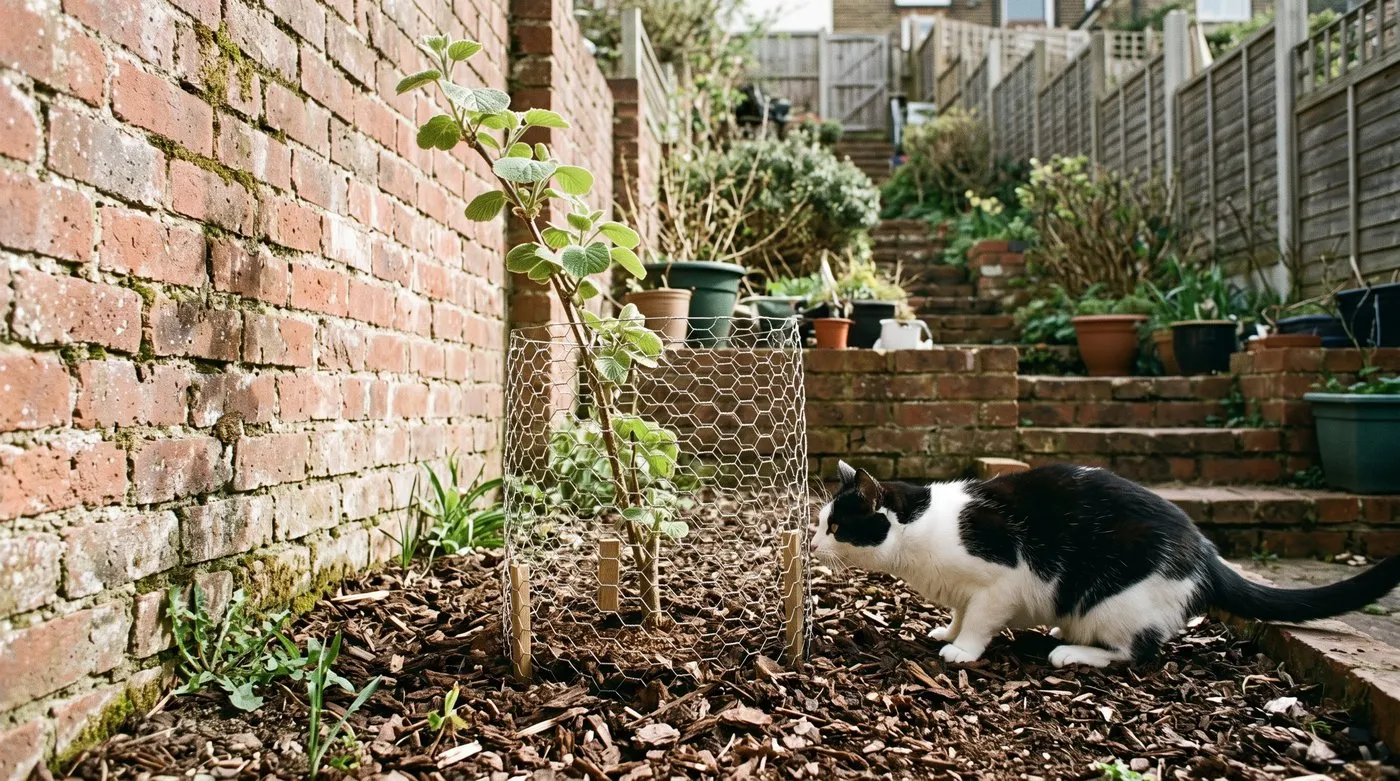
Cats can be drawn to young kiwi plants, a bit like catnip. A ring of wire netting keeps them off until the vine is established.
Month-by-month kiwi growing calendar
| Month | What to do |
|---|---|
| January-February | Winter prune side shoots to 2-3 buds. Order new plants |
| March | Plant new vines. Mulch established plants with compost |
| April | Tie in new shoots. Give a general feed |
| May | Watch for frost while it flowers and fleece on cold nights. Start watering |
| June | Flowers open and bees get to work. Water deeply in dry spells |
| July-August | Summer prune side shoots to 5-7 leaves past the fruit. Water and feed |
| September | Pick kiwi berries when they colour up and come away easily |
| October | Pick fuzzy kiwis before the first hard frost and ripen indoors |
| November | Plant new bare-root vines. Mulch around the base |
| December | Winter prune once the leaves have dropped. Check wires and supports |
Frequently asked questions
Can you grow kiwi fruit outdoors in the UK?
Yes, in a warm, sheltered spot. Fuzzy kiwi crops best against a sunny south-facing wall in southern England. Hardy kiwi berries are tougher and fruit across a wider area. The vines cope with winter cold, but new shoots and flowers are easily hit by late spring frost.
Do I need two kiwi plants to get fruit?
Usually yes, most kiwis need a male and a female. The male and female flowers grow on separate plants, and one male can pollinate several females nearby. Jenny and the kiwi berry Issai fruit on their own, though a male nearby may help. Always buy named plants that say whether they’re male or female.
How long does it take for a kiwi vine to fruit?
Usually three to five years after planting. Named plants from a nursery fruit sooner than ones grown from seed. Bigger crops follow once the vine has built a good framework on its wall, wires or pergola. Kiwi berries often start a little earlier than fuzzy kiwis.
When should I harvest kiwi fruit in the UK?
Pick fuzzy kiwis in October or November, before a hard frost. In the UK they rarely ripen fully on the vine. Pick them while firm, once the seeds inside have turned black. Ripen them indoors at room temperature until they give a little when pressed. A bag with an apple or banana speeds things up.
What is the best kiwi variety for UK gardens?
Jenny is a popular pick because it fruits on its own. One vine gives you medium-sized fuzzy kiwis with good flavour. For kiwi berries, Issai is the usual choice. It also fruits on its own and gives smooth, grape-sized fruit you eat whole.
How do I protect kiwi flowers from frost?
Cover the vine with fleece on frosty nights during flowering. Kiwi flowers and new shoots are easily killed by late spring frost. Take the fleece off by day so bees can reach the flowers. A south-facing wall gives a bit of extra warmth, so in frosty gardens grow kiwis against a warm house wall.
How do I prune a kiwi vine?
Prune twice a year, in summer and winter. In summer, shorten fruiting side shoots to a few leaves past the last fruit. In winter, cut those side shoots back to a couple of buds from the main framework. Take out dead, crossing or crowded shoots. Kiwis grow fast and soon tangle without pruning.
Can I grow kiwi fruit in a greenhouse?
Yes, but kiwi vines soon outgrow most greenhouses. A better plan is to plant the vine outside and train the stems in through a vent or gap. The roots get the rain, and the flowers and fruit get extra warmth and frost cover. In cooler areas, fuzzy kiwis tend to crop more reliably under glass.
Our team produces practical UK gardening guidance from source research, contributor records and established horticultural practice. Editorial standards are overseen by Matt W.


