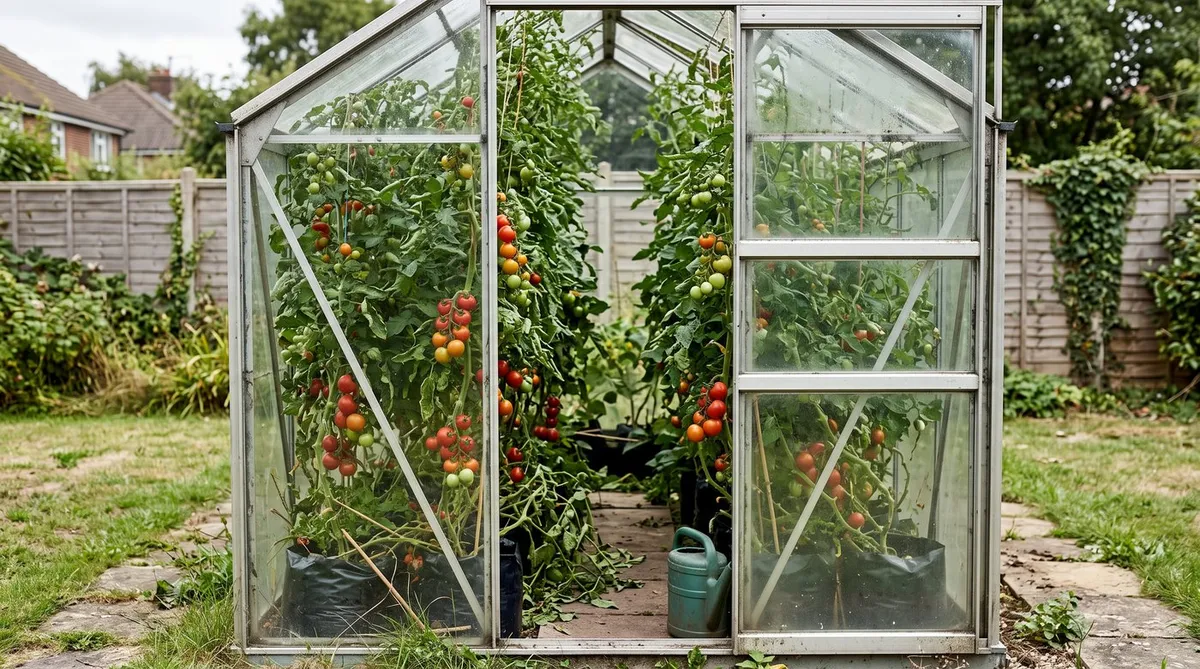
Key takeaways
- Sow in mid to late April in a propagator at 20-25C, not earlier
- Sweetheart F1 is the most forgiving variety for a UK greenhouse
- Hand-pollinate in the morning and do several female flowers on the same day
- Train vines up strings and cradle each fruit in a net sling
- Four fruits per plant gives sweeter melons than a crowd of small ones
- Pick when the stalk end smells sweet and cracks appear round the stalk
A melon you’ve grown yourself, picked warm from the greenhouse on an August afternoon, is a very different thing from a cold one out of a supermarket chiller. The smell alone is worth the effort. And the effort isn’t huge. Melons need warmth, a bit of help with pollination and some string. That’s most of it.
If you already grow cucumbers in your greenhouse, you’re halfway there. Melons are trained in much the same way. They just like it a few degrees warmer and need a little more help setting fruit.
Why do melons need a greenhouse in the UK?
Because they need steady warmth to set fruit and build up sugar, and a British summer outdoors rarely provides it. Grown outside, most melons end up small, hard and pale inside by the time the weather turns.
Glass changes that. A greenhouse holds the day’s heat and keeps nights milder. During cold snaps in late May, or once September nights start to bite, a small heater can keep things ticking along. Our greenhouse heating guide runs through the options.
A greenhouse roof also keeps rain off the leaves. Melons are prone to mildew and mould when their foliage stays damp, so dry leaves count for a lot.
You don’t need much space. A standard 8x6ft greenhouse fits two or three melon plants, with room left for other heat lovers like sweet peppers and aubergines. Just make sure you can let the heat out on sunny days. Good ventilation matters as much as warmth.
Best melon varieties for UK greenhouses
 Sowing melon seeds on their edge in individual pots in a heated propagator.
Choose varieties bred for short, cool summers. Cantaloupe and Charentais types are the ones that do best under British glass. Big watermelons are a different story and really struggle here.
| Variety | Type | Flavour | Ease | Good for |
|---|---|---|---|---|
| Sweetheart F1 | Cantaloupe | Sweet, aromatic | Easy | Beginners |
| Emir F1 | Cantaloupe | Rich, honeyed | Easy | Flavour, disease resistance |
| Ogen | Small melon | Intense, spicy-sweet | Medium | Small greenhouses, early fruit |
| Alvaro F1 | Charentais | Sweet, juicy | Medium | Warm greenhouses |
| Edonis F1 | Charentais | Very sweet, perfumed | Easy | Average summers |
For a first go, pick Sweetheart F1. It puts up with cooler nights better than most and sets fruit without much fuss. By August the whole greenhouse smells of it.
Ogen is an old favourite with small, round fruits about the size of a grapefruit. They’re packed with flavour and ripen early, which makes Ogen a sensible choice if your greenhouse has no heating at all.
When and how to sow melon seeds
Sow in mid to late April. It’s tempting to start in March, but early seedlings sit in poor light for weeks, go thin and leggy, and get overtaken by April sowings anyway.
Sowing method
Fill 9cm pots with seed compost and push one seed into each, on its edge, about 2cm deep. Sowing on edge stops water pooling on the flat seed and rotting it. Water lightly and keep the pots at 20-25C in a propagator. Our guide to sowing seeds indoors has more tips if you’re new to heated propagators.
Seedlings normally pop up within a week. In a cool room they’re slow and uneven, so if nothing has happened after a fortnight, the pot is probably too cold. As soon as they’re up, give them the brightest spot you have while still keeping them warm.
Potting on
Move seedlings into 12cm pots of multipurpose compost once they have two or three true leaves. Hold them by a leaf rather than the stem. Melon stems are brittle and snap easily, and a snapped stem means starting again. Keep the compost just moist.
Key dates for UK melon growing
| Stage | When |
|---|---|
| Sow seeds in a heated propagator | Mid to late April |
| Pot on to 12cm pots | Early to mid May |
| Plant in the greenhouse | Late May to early June |
| Hand pollinate | Mid June to mid July |
| First melons | August |
| Main harvest | Mid August to mid September |
| Clear old plants | Late September |
Planting melons in the greenhouse
Plant out once the greenhouse stays reliably warm at night. In most of England that’s late May or early June. In Scotland and the far north, a heater makes it much easier to plant on time.
Soil preparation
Melons are greedy. A couple of weeks before planting, dig plenty of well-rotted manure or garden compost into the greenhouse border. Grow bags work fine too, with two plants to a standard bag. A few handfuls of perlite mixed in helps drainage.
Here’s the bit people skip: plant each melon on a small mound, about the size of an upturned mixing bowl. Water then runs away from the stem rather than sitting round it, and a permanently wet stem base is how melons rot. Space plants 45-60cm apart and water them in well, around the mound rather than on top.
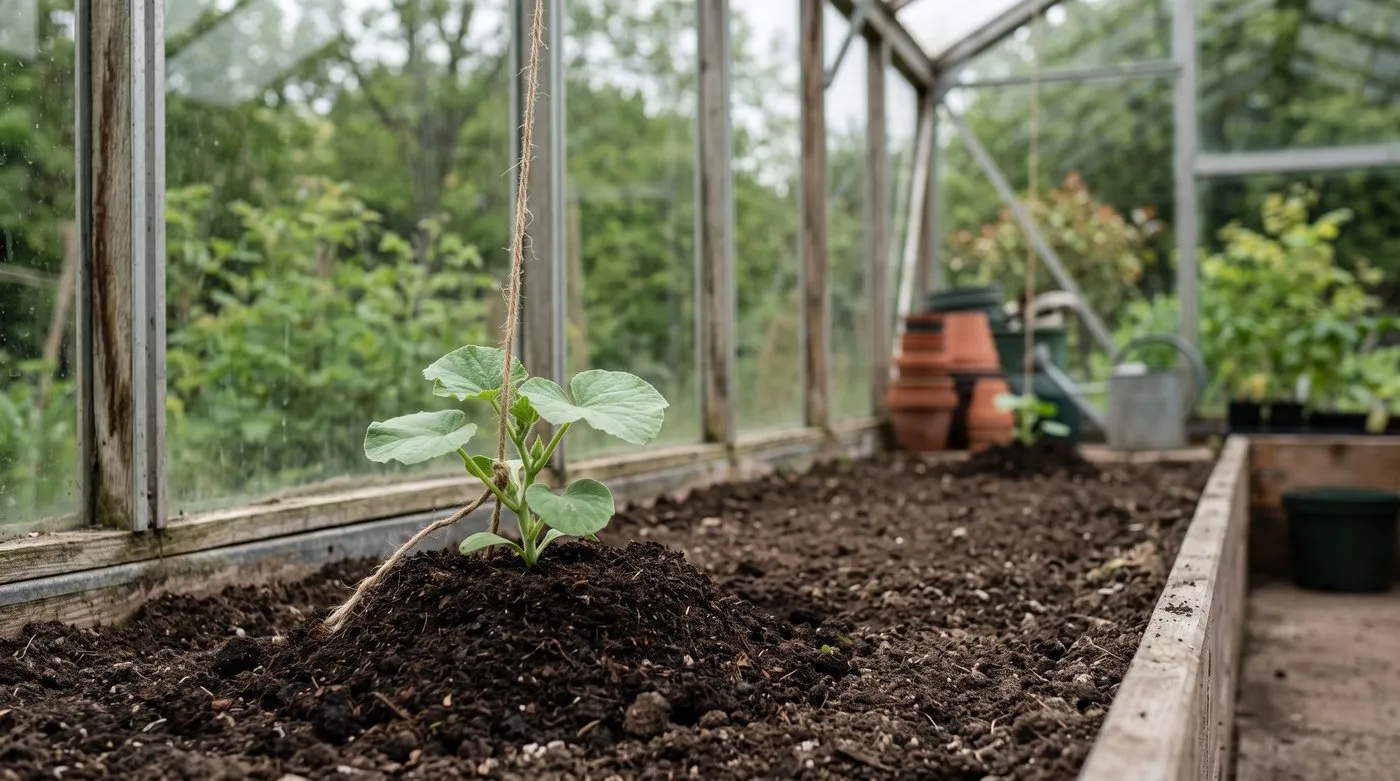
A small mound keeps water away from the stem, which can rot if it sits wet. Space plants 45-60cm apart.
Keeping the right temperature
What melons enjoy:
- Days: warm, around 25-30C
- Nights: ideally 18C or a touch more
- Too hot: open the vents once it climbs past 30C
In a cold spell they simply stop growing. In a scorching greenhouse the flowers fall off. A min-max thermometer is the most useful thing you can buy for this, as it tells you what the nights have really been like. On blazing days, shade netting or a coat of shading paint on the glass takes the edge off.
Training melon vines in a greenhouse
 Melon vines trained up strings, with the young fruit cradled in net slings.
Grow melons up strings rather than letting them sprawl across the floor. It saves a huge amount of space and keeps the fruit clean and dry. If you’ve trained greenhouse cucumbers, the idea is the same.
How to train them
- Fix a wire or bar across the greenhouse at roughly head height
- Tie a length of soft garden string from the wire down to the base of each plant
- As the main stem grows, wind it gently round the string
- Pinch out the tip when it reaches the wire
- Let four or five strong side shoots develop
- Pinch out each side shoot after five or six leaves, which encourages the fruiting shoots
- Once a fruit has set, stop that shoot two leaves beyond it
Supporting the fruit
Don’t skip this. A ripening melon is far too heavy for the vine to carry on its own. When a fruit reaches tennis-ball size, cradle it in a net sling tied to the wire or the greenhouse frame. Old net curtain, a bit of fruit netting or even a pair of tights will do. Without one, the fruit can tear itself off or snap the vine.
Keep four fruits per plant and pinch off the rest while they’re still marble-sized. It feels harsh, but fewer melons means each one gets more sugar.
Hand pollination for greenhouse melons
Hand pollinating is the job that makes or breaks the crop. Bees rarely wander into a greenhouse, and an unpollinated female flower just withers and drops.
Spotting male and female flowers
Male flowers sit on thin stalks and have a plain yellow centre dusted with pollen. Female flowers have a tiny round melon sitting just behind the petals, so they’re easy to spot once you’ve seen one. The males usually turn up first, and the females follow about a week later.
How to do it
Do it in the morning, when the pollen is fresh and the flowers are fully open. There are two easy ways:
-
Use a male flower: pick an open male flower, pull off its petals and dab the pollen-covered centre into each open female flower. One male can do several females.
-
Use a brush: twirl a small, soft paintbrush in a male flower, then brush the pollen into the females.
Try to pollinate three or four female flowers on the same morning. If one fruit sets a week ahead of the others, the plant tends to put everything into that first melon and abandons the rest. Doing them together gives you a matching set.
Within a few days the little melon behind a successful flower starts to swell. If it yellows and drops instead, just have another go with the next batch of flowers.
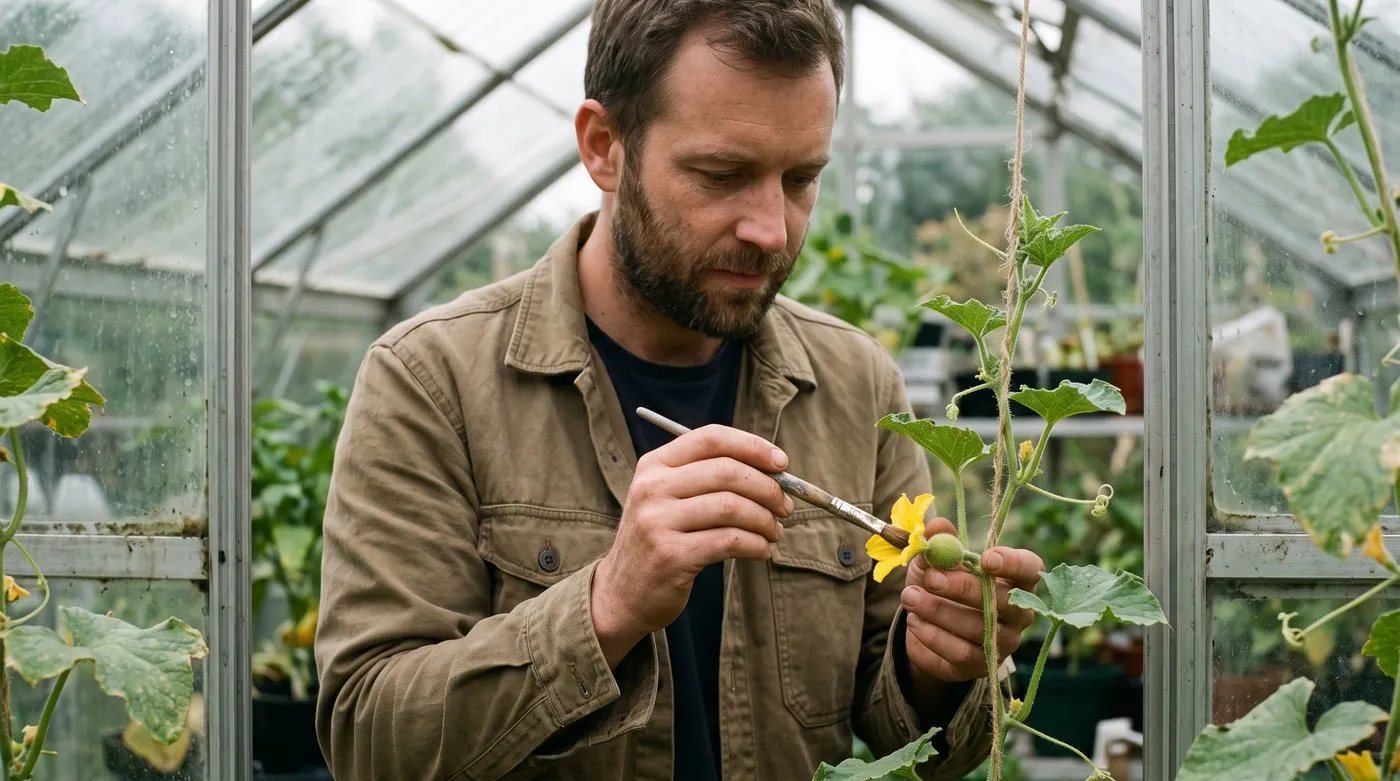
Pollinate in the morning when the pollen is fresh. Within a few days, the tiny melon behind a pollinated flower starts to swell.
Feeding and watering greenhouse melons
Watering
Water at the base and keep the leaves dry, as damp foliage invites mildew. Pour it around the mound, not straight onto the stem.
- Young plants: keep the compost moist but never soggy
- Plants with swelling fruit: water every day in warm weather, and grow bags may need it twice a day in July
- Ripening fruit: cut back a little, which helps concentrate the sweetness
Feeding
Start with tomato feed once the first fruits have set and are clearly swelling, and give it weekly at the strength on the bottle. Feeding earlier mostly gives you leaves at the expense of flowers.
| Stage | Feed |
|---|---|
| Seedling to fruit set | Nothing |
| Fruit set until ripening | Tomato feed weekly |
| Last week or so before picking | Stop feeding and ease off watering |
Melons belong to the same family as pumpkins and squash, and they’re fed in a similar way, just a bit more gently.
How to tell when a melon is ripe
 A ripe cantaloupe with golden, netted skin. The sweet smell at the stalk end is the best sign it’s ready.
Trust your nose. Put your face close to the stalk end and sniff. A ripe melon smells sweet and perfumed there. If you smell nothing, it isn’t ready, however good it looks.
Other signs it’s ready
- Colour: cantaloupes change from green to golden, and the raised netting on the skin becomes more obvious.
- Cracks at the stalk: a ring of fine cracks appears where the stalk meets the fruit.
- A little give: press gently near the stalk end. Ripe melons give slightly. If it’s rock hard, leave it.
- Weight: it should feel heavy for its size.
Pick in the morning while the fruit is still cool, cutting the stalk with secateurs and leaving a short stub on. Eat ripe melons within a few days, or keep them in the fridge a little longer. An unripe melon won’t ripen in the fridge, so leave those on the plant.
Common problems with greenhouse melons
Poor fruit set
Nearly always pollination. Get in there every morning while the plants are flowering and pollinate by hand. Cold nights can make the flowers drop as well, so add a bit of heat during chilly spells.
Powdery mildew
White, dusty patches on the leaves, usually from late summer. Ventilate well, water the base only, and pick off the worst leaves. The RHS powdery mildew guide has more on spotting and dealing with it. Emir F1 and Edonis F1 have some resistance.
Stem rot at soil level
The stem goes soft and brown at the base and the whole plant collapses, often just as the fruit is swelling. It comes from planting too deep or letting water sit around the stem. Plant on a mound and water round it, never onto it.
Small or tasteless fruit
Thin to four fruits per plant. Feed weekly with tomato feed once fruit has set, keep the nights as warm as you can and ease off the watering as the fruit ripens. If flavour has disappointed you before, try Emir F1 or Ogen next year.
Red spider mite
Tiny mites that thrive in a hot, dry greenhouse. The leaves look pale and finely speckled, and bad attacks bring fine webbing. Damping down the greenhouse floor on hot days helps keep them away. A predatory mite, Phytoseiulus persimilis, is a good natural control under glass. Our greenhouse pest control guide covers other common pests too.
Month-by-month melon growing calendar
| Month | What to do |
|---|---|
| March | Order seeds. Clean the greenhouse glass. Get compost and grow bags ready. |
| April | Sow seeds mid to late month in a heated propagator. |
| May | Pot on. Plant into the greenhouse late in the month. Start training. |
| June | Train vines up strings. Hand pollinate once female flowers appear. |
| July | Keep pollinating. Put fruit in net slings. Start weekly feeding. |
| August | Main harvest. Sniff the stalk end daily. |
| September | Pick the last fruit. Clear plants by the end of the month. |
| October | Clean the greenhouse and order next year’s seeds. |
Our greenhouse growing calendar shows what else you can grow alongside your melons.
Once you’ve got the hang of warmth, pollination and strings, melons become one of the best things in the greenhouse. Fancy another project under glass? Try grape vines next.
Frequently asked questions
Can you grow melons in a greenhouse in the UK?
Yes, and a greenhouse is easily the best place for them here. Melons want warm days and nights that stay mild, ideally around 18C. Varieties such as Sweetheart F1 and Emir F1 cope with cooler British summers and ripen under glass in August and September.
When should I sow melon seeds in the UK?
Mid to late April. Push one seed on its edge into a 9cm pot and keep it at 20-25C in a propagator or on a warm windowsill. Shoots normally appear within a week. Earlier sowings rarely do better, because the seedlings go weak in the poor spring light.
Do melons need hand pollination in a greenhouse?
Yes, if you want a reliable crop. Bees rarely find their way inside. Pick an open male flower, pull off its petals and dab the pollen into the middle of each female flower. Do it in the morning and try to pollinate three or four females on the same day.
How many melons will one plant produce?
Four is a good number to aim for. Pinch off any extra baby fruits when they’re marble-sized. Four well-fed melons will taste far better than eight small, watery ones.
How do I know when a melon is ripe?
Smell the stalk end. A ripe melon smells sweet and perfumed there. Cantaloupe types also form small cracks round the stalk and turn from green to golden. The fruit feels heavy for its size and gives slightly when pressed near the stalk.
What temperature do greenhouse melons need?
Warm days and nights of around 18C suit them best. Growth stalls in cold spells, while a baking greenhouse makes the flowers drop. Open the vents on hot days and hang a min-max thermometer so you know what the nights are really doing.
Why are my greenhouse melons small and tasteless?
Too many fruits, cold nights or uneven watering are the usual culprits. Thin to four fruits, keep nights as warm as you can and water steadily. Once the fruit has set, feed weekly with tomato feed, then ease off the water as it ripens.
Our team produces practical UK gardening guidance from source research, contributor records and established horticultural practice. Editorial standards are overseen by Matt W.