Key takeaways
- Blanch most vegetables for 1-4 minutes before freezing to keep their colour, flavour and crunch
- Freeze things on a tray first so they stay loose and easy to pour
- Most frozen fruit and veg is best eaten within 8-12 months
- Freeze peas the day you pick them for the sweetest taste
- Lettuce, cucumber and radishes don't freeze well, so eat them fresh
- Label every bag with what's in it and the date
A freezer is a gardener’s best friend in a summer glut. When the runner beans crop faster than you can eat them and the pea harvest comes all at once, freezing saves that just-picked taste for winter.
The secret is blanching, a quick dip in boiling water before freezing. Raw veg slowly loses its colour, flavour and crunch even in the freezer, and blanching stops that. Below you’ll find blanching times for common UK crops, the tray trick for fruit, storage times and how to defrost safely.
Blanching: how to do it
Blanching means a short dip in boiling water, then straight into iced water. It’s the most important step for freezing vegetables. Skip it and they fade, taste flat and go mushy within a few months.
How to blanch vegetables
- Bring a big pan of water to a rolling boil. Use plenty of water so it comes back to the boil quickly.
- Wash, trim and cut the veg to the size you’ll want to cook later.
- Drop the veg into the water and start timing when it comes back to the boil.
- Blanch for the time in the table below. Too short a dip is worse than none, so use a timer.
- Lift the veg out with a slotted spoon or sieve.
- Plunge it straight into a bowl of iced water. Cool it for about as long as you blanched it.
- Drain well and pat dry with a clean tea towel.
- Bag it up and freeze straight away.

Runner beans being blanched, with a colander and a bowl of iced water ready for cooling.
Blanching times for UK garden vegetables
Times are for normal-sized pieces. Add 30-60 seconds for bigger chunks.
| Vegetable | How to prepare | Blanch for | Good to know |
|---|---|---|---|
| Runner beans | Slice into 2-3cm pieces | 2 minutes | Freeze really well |
| French beans | Top, tail, leave whole | 2 minutes | Do small batches |
| Broad beans | Shell | 3 minutes | Slip the skins off afterwards |
| Peas | Shell | 1 minute | Freeze the day you pick them |
| Sweetcorn | Strip kernels off the cob | 4 minutes | Whole cobs need 6-8 minutes |
| Broccoli | 3cm florets | 3 minutes | Soak in salty water first to shift any bugs |
| Brussels sprouts | Trim, halve big ones | 3-4 minutes | 3 for small, 4 for medium |
| Cauliflower | 3cm florets | 3 minutes | A spoon of lemon juice keeps it white |
| Spinach | Remove thick stems | 1-2 minutes | Squeeze out the water after cooling |
| Kale | Strip and tear leaves | 2 minutes | Do small batches |
| Courgettes | Slice 1cm thick | 1 minute | Softer after, best for cooking |
| Carrots | Slice, dice or leave baby ones whole | 3-4 minutes | 3 sliced, 4 whole baby |
| Parsnips | Peel and dice | 2 minutes | Roast from frozen |
| Beetroot | Cook fully, then slice | No blanching | Cook until tender, cool, freeze |
| Turnips and swede | Peel and dice | 2 minutes | Or cook and mash first |
| Leeks | Slice into rings | 2 minutes | Great for soups |
| Onions | Peel and chop | No blanching | Freeze raw |
| Peppers and chillies | Deseed and slice | No blanching | Freeze raw on a tray |
| Asparagus | Trim woody ends | 2-3 minutes | 2 thin, 3 thick |
| Tomatoes | Whole, halved or pureed | No blanching | Skins slip off after thawing |
Peas are sweetest frozen within a couple of hours of picking, as they start turning starchy soon after. It’s the reason home-frozen peas often beat shop-bought fresh ones.
Open-tray freezing: the trick for everything
Open-tray freezing means freezing things spread out on a tray before you bag them. It stops everything welding into one solid lump.
How to open-tray freeze
- Line a baking tray with baking paper.
- Spread the produce in a single layer, pieces not touching.
- Freeze uncovered for a few hours until solid.
- Tip the frozen pieces into a labelled freezer bag.
- Squeeze out the air and seal.
You end up with a bag of loose pieces, so you can pour out exactly what you need.

Raspberries, blackcurrants and chopped mint spread out on a tray, ready to freeze.
What to open-tray freeze
- All berries: raspberries, blueberries, strawberries (halved), blackberries, gooseberries and currants
- Blanched peas, broad beans and sweetcorn
- Sliced courgettes, peppers and chillies
- Herbs: chop them, pack into ice cube trays, top up with water and freeze
Freezing fruit: dry pack or syrup pack
Fruit doesn’t need blanching. It does go softer when it thaws, so pick the method that suits how you’ll use it.
Dry pack
Freeze the fruit on a tray, then bag it. It’s the quickest way and perfect for smoothies, crumbles, baking and jam making.
Best for: raspberries, blueberries, blackberries, gooseberries, currants and rhubarb cut into chunks.
Syrup pack
Cover the fruit in cold sugar syrup in a tub. The syrup keeps its colour and shape better, so it’s nicer for eating after thawing.
Syrup: stir 400g sugar into 1 litre of cold water until it dissolves, then chill it.
- Pack the fruit into tubs, leaving a 2cm gap at the top.
- Pour over the cold syrup until the fruit is covered.
- Lay a scrunched-up piece of baking paper on top to keep the fruit under.
- Seal, label and freeze.
Best for: plums, peaches, apricots, pears and apple slices. Add a spoonful of lemon juice for apples to stop them browning.
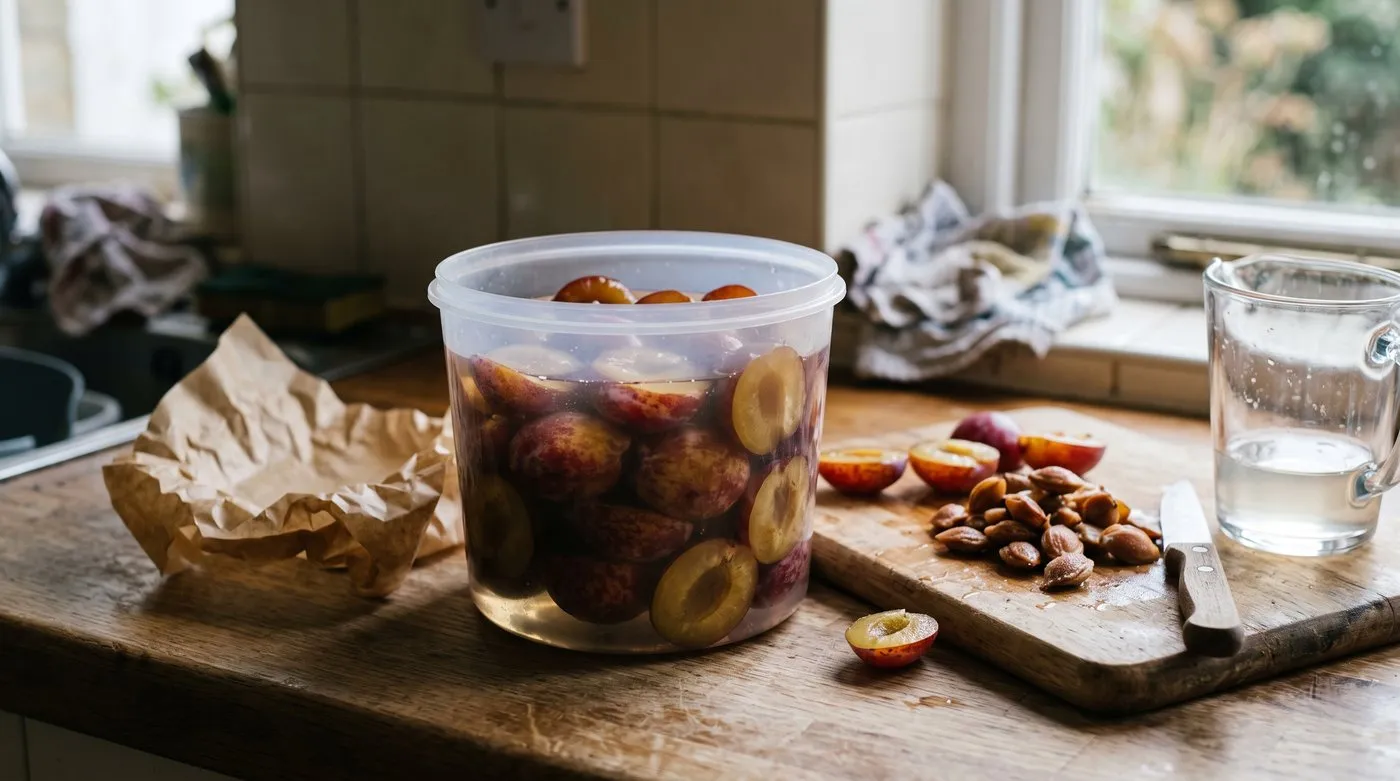
Plums keep their colour and shape much better in syrup. A scrunched piece of baking paper on top stops the fruit bobbing up and browning.
Which method for which fruit
| Fruit | Best method | Best used within | Tip |
|---|---|---|---|
| Raspberries | Dry pack | 12 months | Handle gently |
| Strawberries | Either | 8 months | Go soft, so use for cooking or smoothies |
| Blueberries | Dry pack | 12 months | Freeze whole |
| Blackberries | Dry pack | 12 months | Tray freeze to stop crushing |
| Gooseberries | Either | 12 months | Top and tail first |
| Plums | Syrup | 10 months | Halve and stone |
| Apples | Syrup | 10 months | Peel, core, slice, add lemon |
| Pears | Syrup | 8 months | Brown fast, so syrup is a must |
| Rhubarb | Dry pack | 12 months | No need to peel |
| Red and blackcurrants | Dry pack | 12 months | Strip from the stalks first |
What freezes well and what doesn’t
Most crops freeze happily, but watery salad crops turn to mush.
Freezes well
- Peas, almost as good as fresh if frozen quickly
- Runner and French beans, when blanched
- Broad beans, best with the skins slipped off
- Sweetcorn kernels
- Broccoli and cauliflower, for cooked dishes
- Spinach and kale, squeezed dry
- All berries
- Tomatoes, whole or pureed for sauces and soups
- Herbs, in ice cube trays
- Chillies, raw
Doesn’t freeze well
- Lettuce and salad leaves go slimy.
- Cucumber turns watery and see-through.
- Radishes lose all their crunch.
- Celery goes limp, so only use it in cooking.
- Raw potatoes turn grainy. Cooked mash or blanched chips are fine.
- Raw courgettes go soggy, so blanch first and use them in cooking. Other crops are better preserved in other ways.
How long does frozen produce keep?
Food stays safe at -18C, but it slowly loses flavour and texture. For the best taste, use it within these times.
| Produce | Best used within |
|---|---|
| Peas, French beans, broad beans, sweetcorn | 12 months |
| Broccoli, cauliflower, carrots | 12 months |
| Runner beans | 10 months |
| Spinach and kale | 8 months |
| Courgettes | 6 months |
| Tomatoes | 10-12 months |
| Raspberries, blueberries, blackberries, rhubarb | 12 months |
| Strawberries | 8 months |
| Apples and plums in syrup | 10 months |
| Herb cubes | 6 months |
| Chillies | 12 months |
Thin bags, a freezer that warms up and down, and lots of door-opening all shorten these times.
Labelling and using the oldest first
After a few months, every bag of green beans looks the same. Label everything, or you’ll keep eating this year’s crop and find last year’s at the bottom.
What to write on the bag
- What it is (“runner beans, sliced”, not just “beans”)
- Date frozen
- How much (weight or portions)
A permanent marker works on freezer bags. Use masking tape on tubs.

Labelled bags of peas, beans and courgettes. A date on each makes it easy to use the oldest first.
First in, first out
Keep the oldest bags at the top or front, and put new ones underneath or behind. Baskets in a chest freezer help keep fruit, veg and herbs apart. A simple list taped to the lid, crossed off as you go, saves a lot of waste.
Best containers for freezing
Freezer bags
Thick freezer bags suit most produce. They’re cheap and freeze flat to save space. Squeeze out all the air before sealing, or suck the last of it out with a straw. Thin sandwich bags let air in and cause freezer burn.
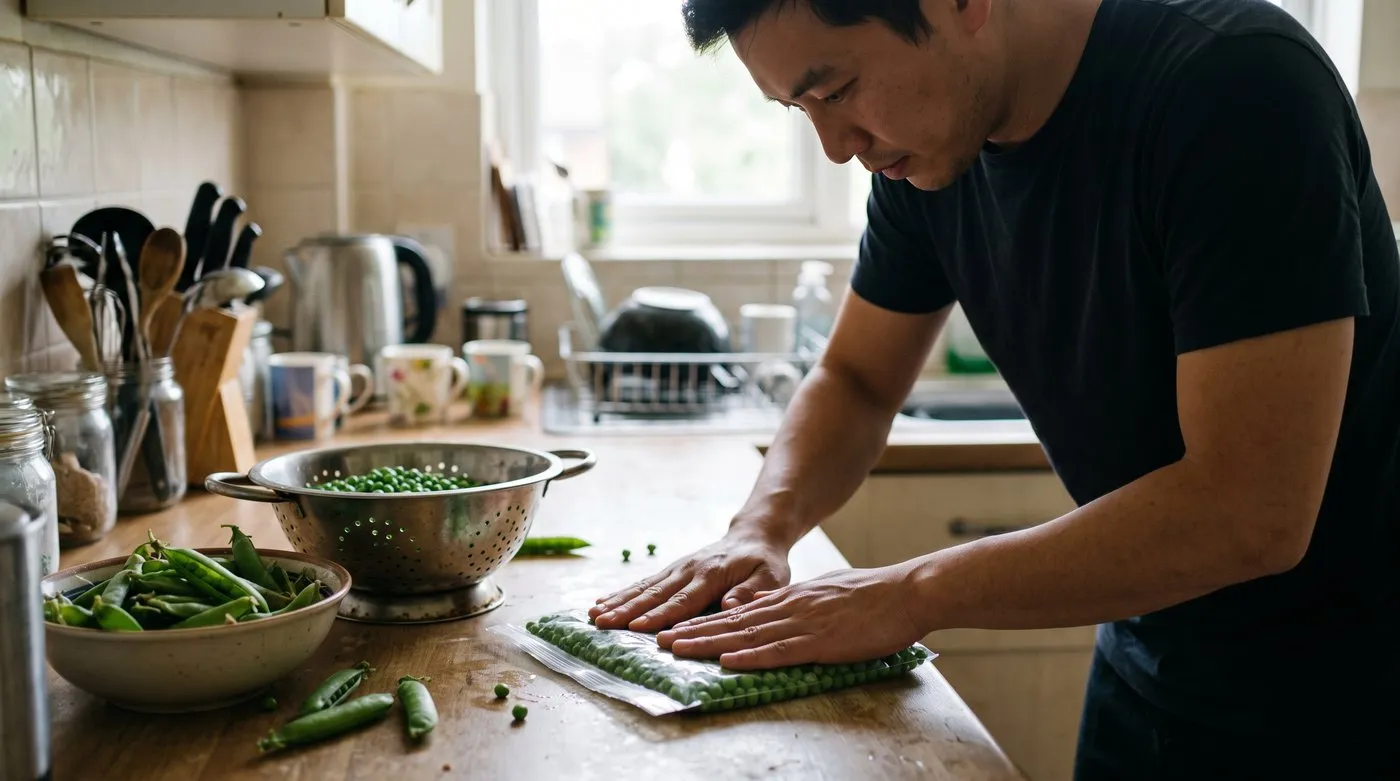
Press bags flat to push out every pocket of air before you seal them. Flat bags also stack neatly and freeze faster.
Tubs
Plastic freezer tubs with tight lids suit soups, purees, fruit in syrup and anything easily squashed. Leave a 2cm gap at the top, as liquids expand when they freeze.
Vacuum-sealed bags
A vacuum sealer sucks out all the air before sealing. It gives the best protection against freezer burn and is worth it if you freeze a lot each year.
Ice cube trays
Perfect for herbs, pesto, tomato paste and stock. Freeze, pop out the cubes and bag them. Each cube is a ready-made portion.
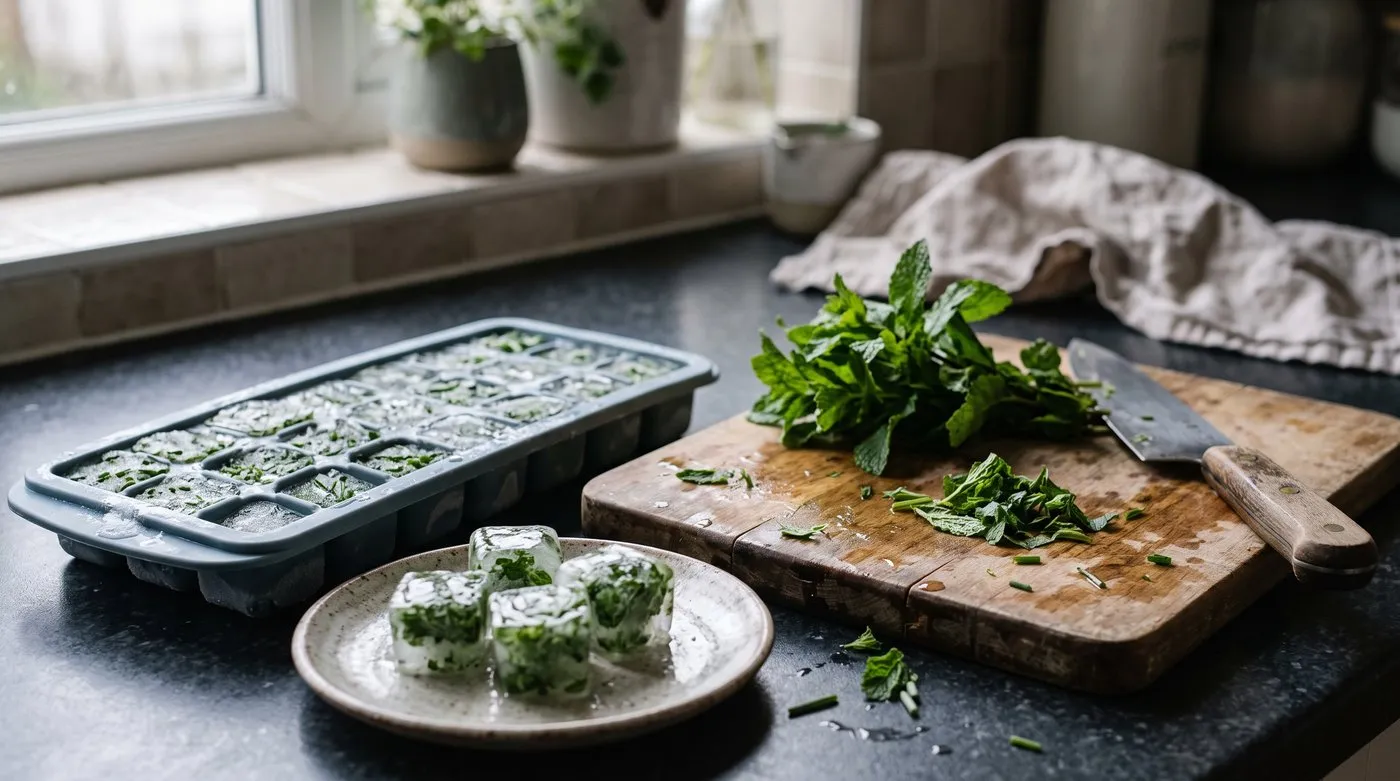
Chopped herbs frozen in water make handy ready-made portions. Drop a cube straight into soups, sauces and stews.
Defrosting safely
Vegetables: cook from frozen
Most frozen veg goes straight from the freezer into the pan. Boil for a few minutes, or add it to stir-fries, stews and roasting tins.
Thaw spinach and kale in a colander first and squeeze out the water. Thaw tomatoes if you want to peel them, as the skins slip off easily.
Fruit: thaw in the fridge
Thaw fruit slowly in the fridge, for a few hours or overnight. Quick thawing makes it more watery. For smoothies and baking, use it straight from frozen.
Food safety basics
- Don’t leave food out at room temperature to thaw for more than 2 hours.
- Thaw in the fridge, in cold water changed every 30 minutes, or on the microwave defrost setting.
- Cook thawed food within 24 hours.
- Only refreeze food that was thawed in the fridge and is still cold.
Our easy recipes for home-grown vegetables have plenty of ideas for using your frozen crops.
Seasonal freezing calendar
Have bags and tubs ready before each harvest peak.
| Month | What to freeze | How |
|---|---|---|
| May | Asparagus, spring greens | Blanch, then tray freeze |
| June | Strawberries, gooseberries, broad beans, peas | Tray freeze fruit, blanch veg |
| July | Raspberries, blueberries, French beans, courgettes | Tray freeze fruit, blanch veg |
| August | Runner beans, sweetcorn, tomatoes, blackberries, plums | Blanch beans and corn, tomatoes whole, berries on a tray, plums in syrup |
| September | Apples, pears, broccoli, spinach, kale | Apples and pears in syrup, blanch greens |
| October | Squash puree, chillies, late beans, beetroot | Cook and puree squash, chillies raw, blanch beans, cook beetroot first |
| November | Leeks, parsnips, Brussels sprouts | Blanch all |
Our vegetable planting calendar and monthly harvest guide help you plan growing and freezing together.
Common mistakes when freezing garden produce
Skipping the blanching
Unblanched veg looks fine going in but fades, tastes flat and goes mushy within a few months. A few minutes of blanching makes a big difference.
Freezing too slowly
Slow freezing makes big ice crystals, which leave food soggy. Spread things out on a tray, and don’t fill the freezer with lots of new food at once. If your freezer has a fast-freeze setting, use it for big batches.
Leaving air in the bags
Trapped air causes freezer burn. Press bags flat to push the air out before sealing. If you can feel squishy air pockets, try again.
Freezing tired produce
Freezing won’t improve anything. Limp carrots, bruised fruit and wilted leaves come out just as sad. Pick in the cool of the morning and freeze the same day.
Losing track of what’s in there
Unlabelled bags turn your freezer into a lucky dip. Label and date everything, and keep a list on the lid.
Now you’ve got freezing sorted, read our guide on other ways to preserve fruit and vegetables for pickling, bottling and drying.
Frequently asked questions
Do I need to blanch vegetables before freezing?
Yes, for most vegetables. A quick dip in boiling water stops them losing colour, flavour and crunch in the freezer. Then cool them straight away in iced water. Onions, peppers and chillies are fine frozen raw.
How long can you freeze garden vegetables?
Most are at their best for 8-12 months. Peas, beans and sweetcorn keep well for a year. Courgettes and spinach are best used within 6-8 months. After that they’re still safe, but the taste and texture slowly fade.
What is the best way to freeze soft fruit?
Spread the berries on a lined tray and freeze them. Once they’re solid, tip them into a labelled bag. That way they stay loose and you can pour out just what you need. For apples and pears, which go brown, use a sugar syrup instead.
Which vegetables should not be frozen?
Lettuce, cucumber, radishes, celery and raw potatoes. They’re full of water and turn mushy or slimy when they thaw. Eat them fresh, or use other ways to preserve them.
Should I defrost frozen vegetables before cooking?
No, cook most of them straight from frozen. Tip them into boiling water, a stir-fry or a roasting tin. They only take a few minutes. Spinach and kale are the exceptions, so thaw them and squeeze them dry first.
What containers are best for freezing garden produce?
Thick freezer bags are the handiest choice. Squeeze out the air before you seal them. Use tubs with tight lids for soups, purees and fruit in syrup. A vacuum sealer gives the best protection if you freeze a lot. Thin sandwich bags let in air quickly.
Can I refreeze vegetables after defrosting?
Only if they were thawed in the fridge and are still cold. Even then, they get softer each time. Freeze in small portions so you only take out what you need for one meal.
How do I prevent freezer burn?
Keep air away from the food. Squeeze the air out of bags, wrap things snugly and use thick freezer bags. Keep the freezer at a steady -18C. Freezer burn isn’t harmful, but it leaves dry, pale patches that taste stale.
Our team produces practical UK gardening guidance from source research, contributor records and established horticultural practice. Editorial standards are overseen by Matt W.