
Key takeaways
- Plant bare-root crowns from November to March, in sun or part shade and rich soil
- Don't pick in the first year, so the crown can build its strength
- Pull stems with a twist rather than cutting, and stop picking by the end of June
- Cover a crown in January for tender, early pink stems
- Divide old crowns every 5-6 years to keep them cropping well
- The leaves are poisonous, so only eat the stems
Rhubarb is one of the easiest crops you can grow. Plant a crown in a corner of the garden and it’ll give you stems every spring for years. It shrugs off cold and wet, copes with some shade, and needs very little looking after. Think crumbles, jams and a freezer full of fruit.
What are the best rhubarb varieties for UK gardens?
Grow an early variety and a main-season one, and you’ll be picking from early spring to the end of June.
Early varieties
- Timperley Early: the earliest for outdoor growing, with slim green and red stems from late March. Good for forcing and great for colder gardens.
- Champagne: bright crimson stems with a lovely sweet flavour. Ready from mid-April, and keeps its colour when cooked.
Mainstay varieties
- Victoria: the classic. Thick, green stems flushed red at the base, and big crops. A great choice for beginners.
- Stockbridge Arrow: a Yorkshire variety with deep red, sweet stems. Good for forcing. You may need a specialist nursery.
- Raspberry Red: red all the way up and sweeter than Victoria, so you need less sugar. Compact, so good for small gardens.
Rhubarb variety comparison
| Variety | Picking | Stem colour | Flavour | Good for |
|---|---|---|---|---|
| Timperley Early | March to June | Green and red | Tangy | The earliest outdoor stems |
| Champagne | April to June | Deep crimson | Sweet | Flavour and colour |
| Victoria | April to June | Green and red | Classic tart | Big crops, beginners |
| Stockbridge Arrow | April to June | Deep red | Rich, sweet | Forcing |
| Raspberry Red | Late April to June | Bright red | Sweet | Small gardens |
Tip: Green stems can taste just as good as red ones once cooked. Choose on flavour and vigour, not just looks.
When and how to plant rhubarb crowns
Planting time
Plant bare-root crowns from November to March, while they’re dormant. November and December are best, as the roots settle into cool, moist soil before spring.
March is fine too, but water regularly through the first spring and summer.
Pot-grown rhubarb can go in at any time, but bare-root crowns are cheaper and settle in well.
Choosing the right position
Rhubarb grows in full sun or part shade. Full sun gives the biggest crop, but part shade is fine. Avoid deep shade under trees, where the stems go thin.
It likes rich soil that holds moisture but drains well. Soggy winter soil rots the crown. On heavy clay, improve drainage first, and see our guide to improving clay soil. Raised beds work well too.
Dig in two or three buckets of well-rotted manure or compost. Rhubarb is a hungry plant that stays put for years, so good soil now pays off. Our composting guide shows you how to make your own.
How to plant
- Dig a hole about 30cm wide and 30cm deep
- Fork manure or compost into the bottom
- Set the crown so the buds sit just below the surface, no deeper than 2.5cm
- Fill in with soil mixed with more compost
- Firm gently and water well
- Space crowns about 90cm apart
Don’t plant too deep, as a buried crown can rot.
After planting, add a mulch of manure, compost or bark to keep moisture in and weeds down. Keep it slightly back from the buds.
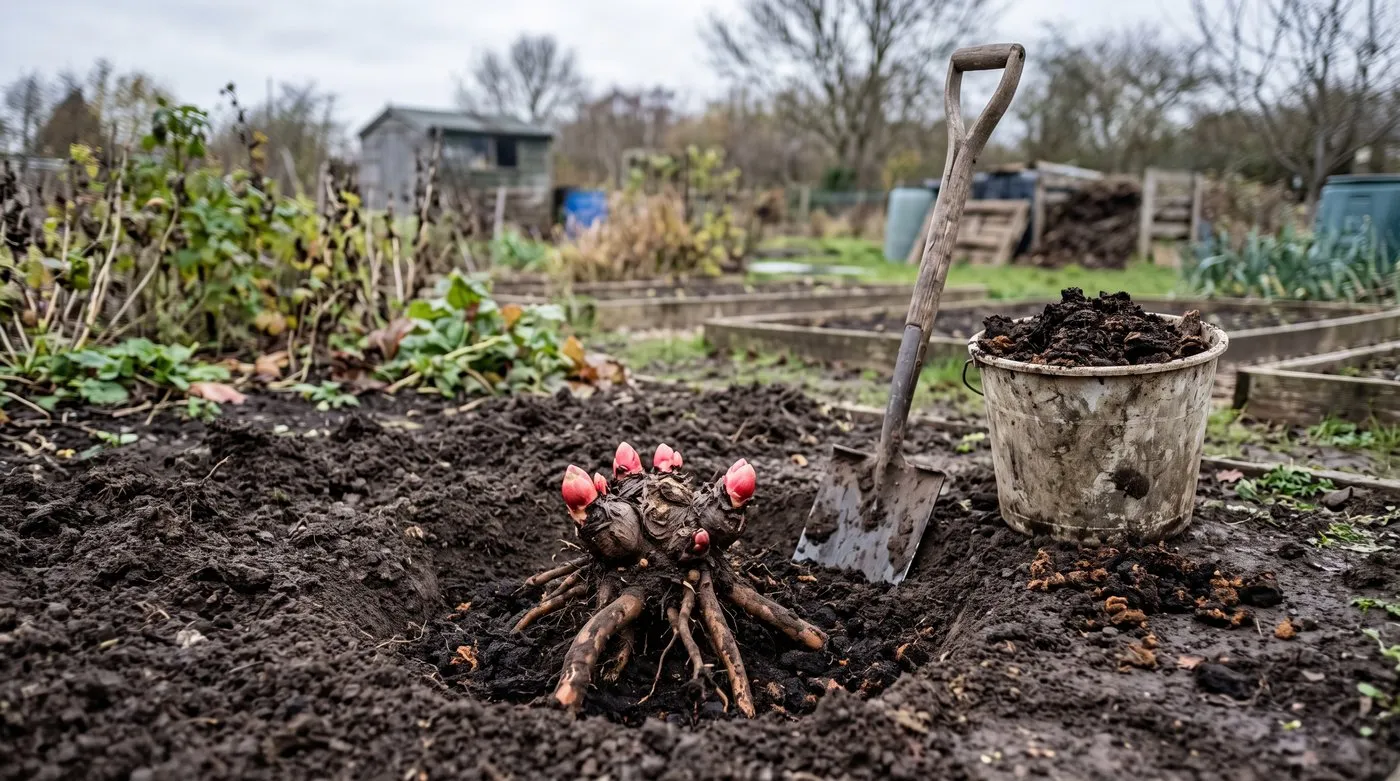
Set the crown so the buds sit just below the surface, no deeper than 2.5cm. A buried crown can rot in wet winter soil.
Should I harvest rhubarb in the first year?
No. This is the golden rule. Leave it alone in the first year so the crown can build strong roots.
In year two, take just 3-4 stems per plant, choosing the thickest.
From year three, pick freely from April until the end of June. Then let the leaves grow on to feed the roots for next year.
How do I harvest rhubarb stems?
Pulling, not cutting
Pull stems, don’t cut them. Hold the stem near the base and pull with a firm twist. It comes away cleanly. Cutting leaves a stump that can rot.
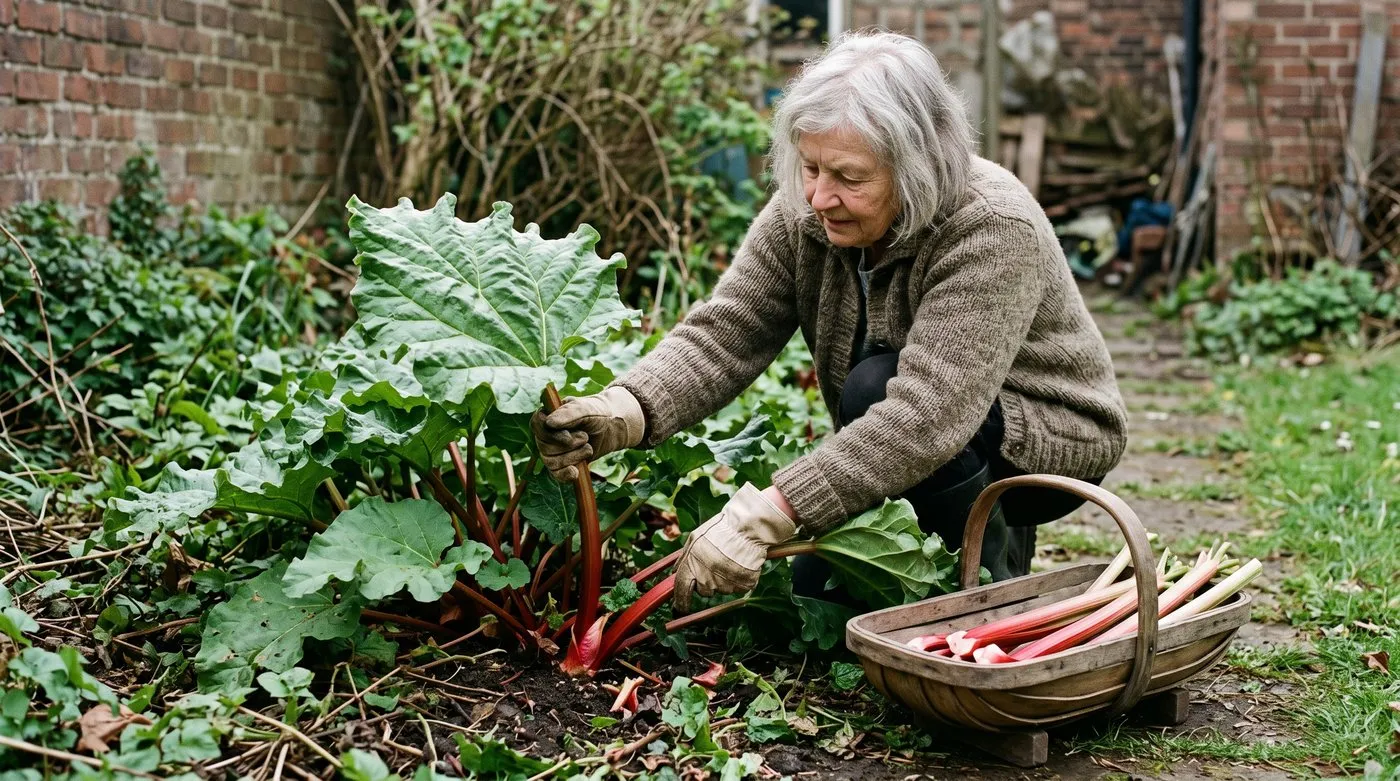
Hold the stem near the base and pull with a firm twist rather than cutting. Then trim off the leaf straight away, as rhubarb leaves are poisonous.
When to stop harvesting
Stop picking at the end of June, or mid-July at the latest. The leaves need the rest of the summer to feed the roots for next year.
Never take more than about a third of the stems at once.
What to do with the leaves
Cut the leaves off as soon as you pick. Rhubarb leaves are poisonous, so never eat them or feed them to animals. The stems are safe.
Pop the leaves on the compost heap, where they break down safely.
How do I force rhubarb for early stems?
Forcing gives you tender, pale pink stems a few weeks earlier than normal. They’re sweeter and more delicate too. You simply keep the crown in the dark, so the stems grow long and pale reaching for light.
When to start forcing
Cover the crown in January or early February, before any leaves show. Use a strong plant that’s been in the ground for at least three years.
What to use
- An upturned dustbin or big bucket: cheap and easy. Block any holes so no light gets in.
- A terracotta rhubarb forcer: the traditional choice, with a lid so you can peek. It looks lovely too.
- A big cardboard box lined with black plastic: a short-term option. Weigh it down with bricks.
It must be completely dark inside. Any light turns the stems green and tough.
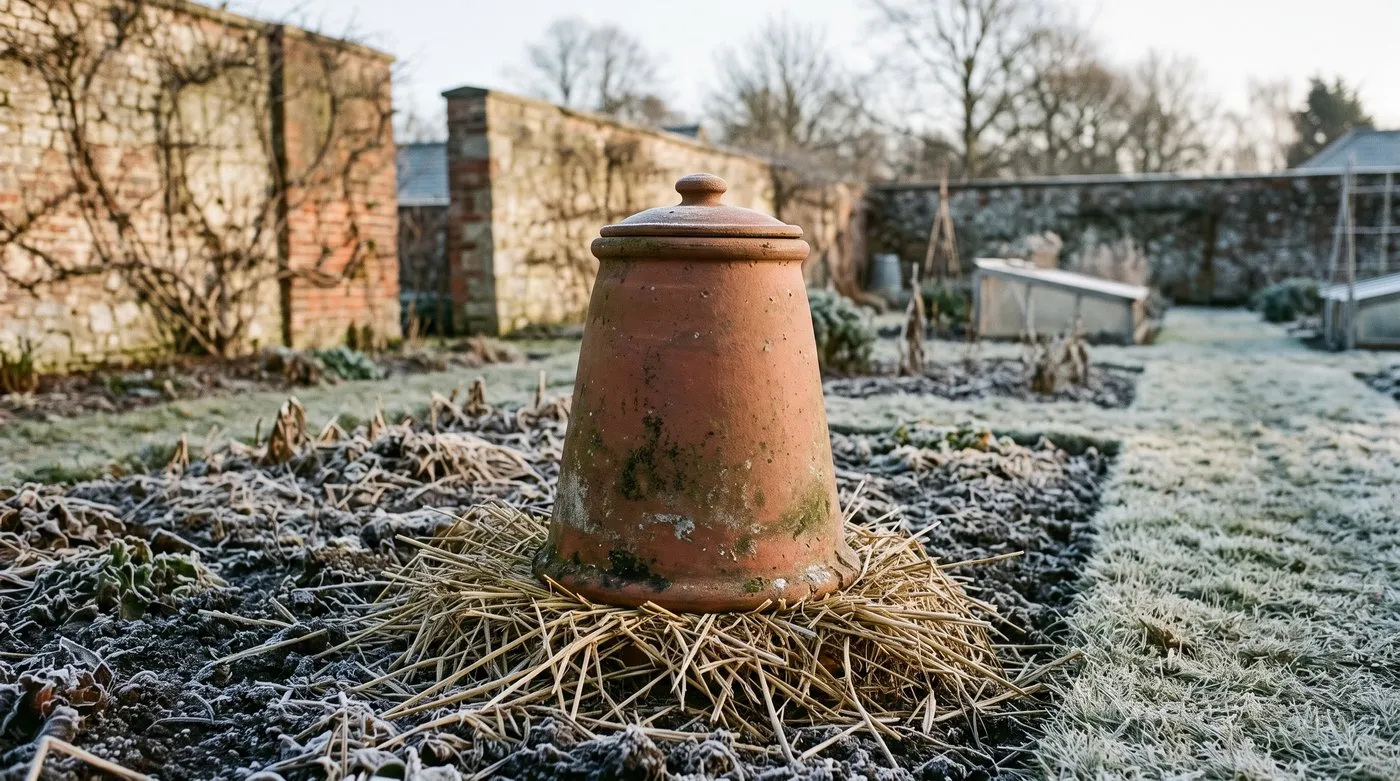
Any cover works as long as it’s completely dark inside. Even a little light turns forced stems green and tough.
How forcing works
- In late autumn, mulch around the crown with straw or manure
- In January, put the cover over the crown
- Have a peek after about 4 weeks
- Pick the stems when they’re 25-30cm tall, usually after 5-6 weeks
Forced stems are pale pink with small, crinkly yellow leaves. They snap cleanly and taste sweet.
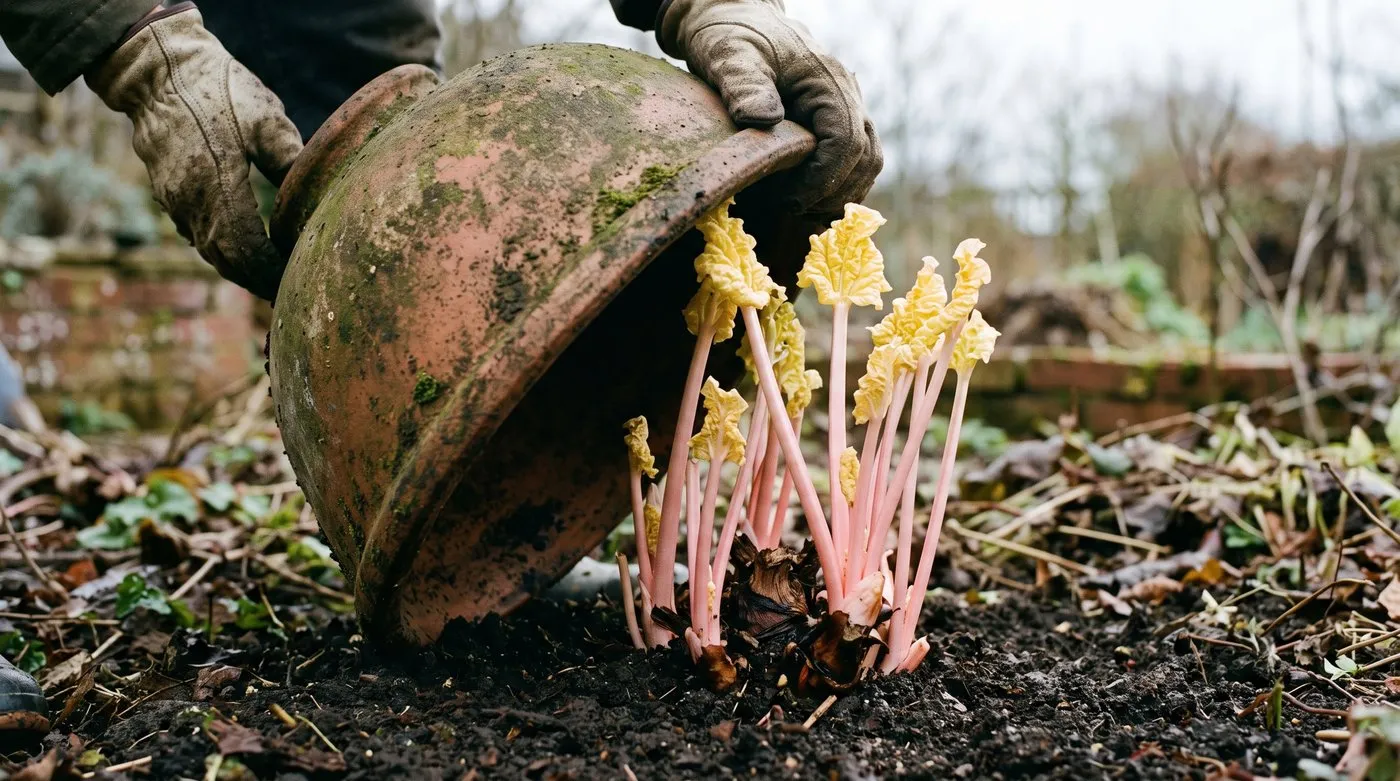
Forced stems come up pale pink with little yellow leaves, sweeter and more tender than outdoor ones. Let that crown rest for at least a year afterwards.
Resting after forcing
Let a forced crown rest for at least a year. Forcing uses up its stored energy. Grow it normally for a year, or two if it looks weak.
For forced rhubarb every year, grow three crowns and take turns.
How do I divide rhubarb crowns?
Old crowns get crowded, and the middle goes woody with thin stems. Dividing every 5-6 years keeps them young and productive.
When to divide
Divide between November and February, while the plant is dormant. Don’t wait until spring growth starts.
Division method
- Lift the whole crown with a fork
- Shake off the soil so you can see the buds
- Split it into pieces with a sharp spade, each with at least one strong bud and some root
- Throw away the old, woody middle
- Replant the pieces straight away in soil with added manure
- Water well and mulch
A big crown can give you several new plants. Share the spares with friends and neighbours.
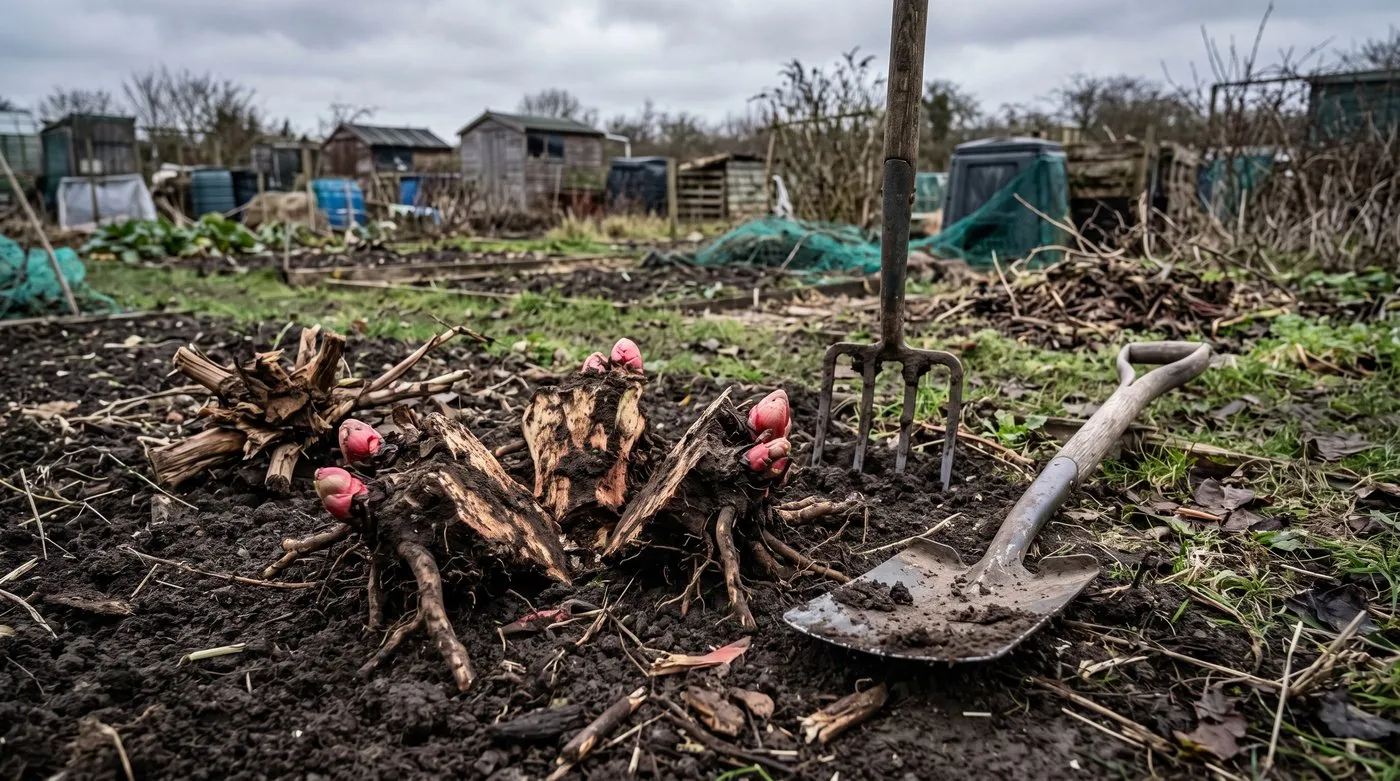
Each piece needs at least one strong bud and some root. Throw away the woody middle and replant the young pieces in well-manured soil.
Why does my rhubarb produce flower stalks?
Sometimes rhubarb sends up a thick stalk with creamy flowers. It’s more common in:
- Old, crowded crowns that need dividing
- Stressed plants, in dry or poor soil
- Some varieties that flower more readily
Cut flower stalks off at the base as soon as you see them. Flowering takes energy away from the stems you want to eat.
The stems are still fine to eat. Feed, water and divide if needed, and the problem usually stops.
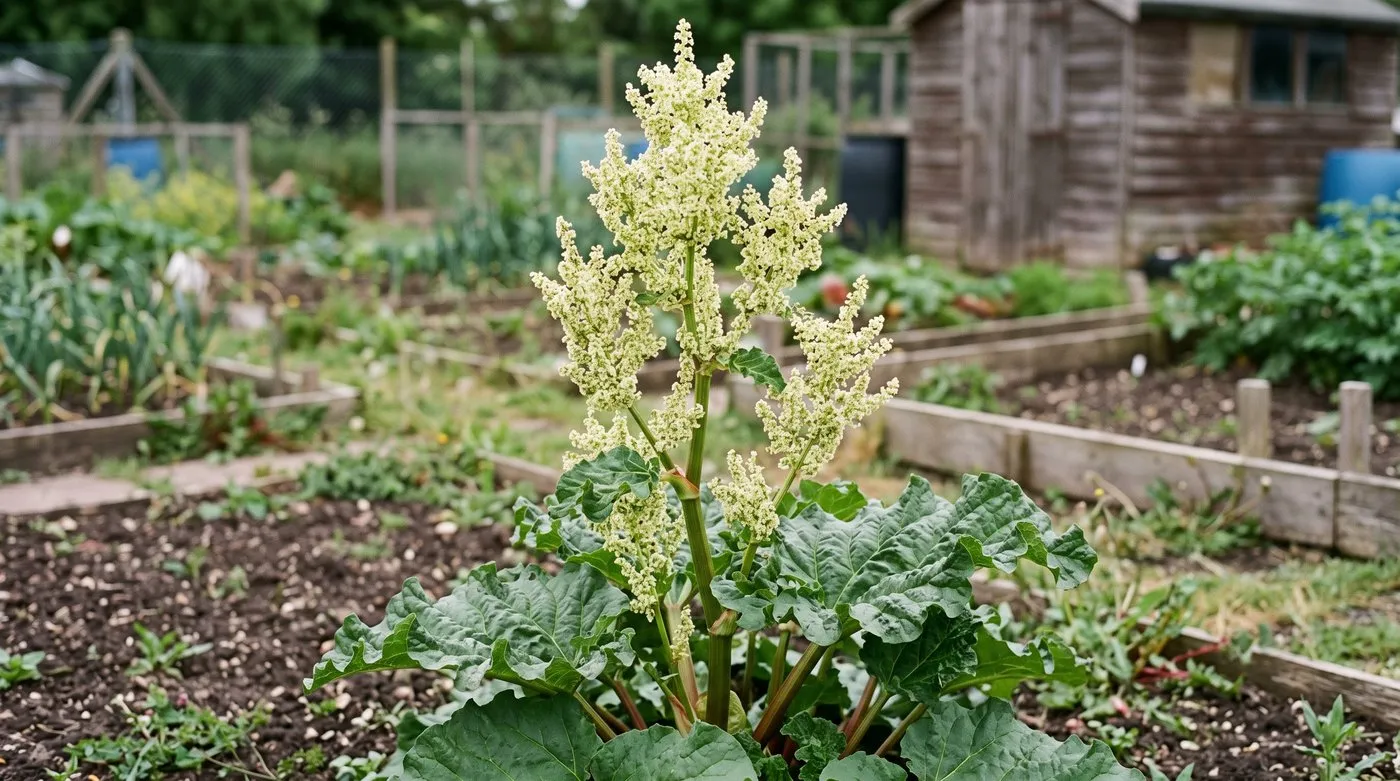
Cut flower stalks off at the base as soon as you see them. The stems are still fine to eat, and dividing an old crown usually stops it.
What should I feed rhubarb?
Rhubarb is hungry. Without feeding, the stems get thinner each year.
Annual feeding routine
- February: Spread a thick mulch of well-rotted manure or compost around the crown.
- April: Scatter a general fertiliser such as Growmore around the crown, at the rate on the pack, and water it in.
- July: Add another mulch of compost after the last picking.
Avoid high-nitrogen feeds late in the year.
Tip: If you only feed once, make it the winter manure mulch. It makes the biggest difference.
Month-by-month rhubarb growing calendar
| Month | What to do |
|---|---|
| January | Cover crowns for forcing. Order bare-root crowns |
| February | Plant crowns. Mulch with manure. Check forced rhubarb |
| March | Last month for planting. Pick forced stems. Early outdoor stems start |
| April | Main picking begins. Feed. Remove flower stalks |
| May | Keep picking. Water in dry spells. Weed |
| June | Last month of picking. Stop by the end of June |
| July | No picking. Water in drought. Mulch with compost |
| August | Leaves are feeding the roots. Leave it be |
| September | Growth slows and leaves start to yellow |
| October | Clear dead leaves. Get spots ready for new crowns |
| November | Plant new crowns. Divide old ones. Mulch with straw |
| December | Dormant. Plan which crown to force |
Can I grow rhubarb in a container?
Yes, though you’ll get a smaller crop. Use a big pot, at least 50cm across and 50cm deep, as rhubarb has large roots.
Fill it with multipurpose compost mixed with some well-rotted manure. Plant one crown with the buds just below the surface. Water regularly, as pots dry out fast.
Feed with liquid tomato feed every two weeks from April to June. Refresh the top layer of compost each autumn. Pot-grown crowns need dividing or replanting after 3-4 years.
Raspberry Red is a good compact choice. Victoria can outgrow a pot quickly.
Five common mistakes when growing rhubarb
Picking in the first year. New crowns need a season to settle. Wait until year two for a light pick, and year three for a full one.
Cutting instead of pulling. A cut leaves a stump that can rot. Pull with a twist instead.
Planting too deep. The buds should sit at or just below the surface.
Not feeding. Rhubarb uses the same patch of soil for years. A thick manure mulch each February keeps the stems thick.
Picking too late. Stop by the end of June. The leaves left on the plant are charging its batteries for next year.
Rhubarb pests and diseases
Rhubarb is wonderfully trouble-free. Most plants go years without any problems.
Crown rot
The most serious problem. The crown goes soft and brown, and the stems collapse. It mostly happens in soggy soil or through wounds. Make sure the soil drains well, take care when weeding, and pull rather than cut. Dig up and bin affected crowns, and plant new rhubarb somewhere else.
Honey fungus
Rhubarb can be hit by honey fungus, which attacks the roots. Look for poor growth, yellow leaves and white fungal sheets under the crown’s skin. There’s no cure, so dig out the plant and as much root as you can. The RHS honey fungus guidance explains more.
Slugs and snails
Slugs love the tender new shoots in spring. Beer traps and wildlife-friendly slug pellets help. The stems soon toughen up and slugs lose interest.
Growing rhubarb alongside other crops
Rhubarb gets big, so give it about 90cm all round. It’s happiest at the end of a bed, along a fence, or in a permanent corner with asparagus and horseradish. Our UK vegetable planting calendar helps you fit it into your plans.
Keep it out of beds where you rotate crops each year. A spot where it won’t be disturbed is ideal.
In summer, the big leaves give shade. You can grow lettuce under the edges, where it stays cooler and slower to bolt.
Rhubarb is a garden investment worth making
Few crops give so much for so little effort. Plant a crown this winter and it’ll crop for years. It just wants a yearly mulch of manure and a bit of patience in the first year. Forced stems in early spring are the first fresh harvest of the year, and the outdoor crop keeps you in crumbles until summer. When it eventually tires, divide it and start again.
Now you’ve got rhubarb sorted, have a look at our UK vegetable planting calendar to see what else to grow through the year.
Frequently asked questions
When should I plant rhubarb in the UK?
Plant bare-root crowns from November to March, while they’re dormant. The roots settle in before spring. Pot-grown plants can go in at any time if you keep them watered. Choose a sunny spot with rich soil that drains well.
Can I harvest rhubarb in the first year?
No, leave it alone in the first year. The crown needs a season to build its roots. Take just a few stems in year two, then pick normally from year three. Always leave some stems on each plant.
How do I force rhubarb for early stems?
Cover a dormant crown in January with something that blocks all light. An upturned bin, a bucket or a terracotta forcer all work. The stems grow pale pink and tender, ready in about 4-6 weeks. Let that crown rest for a year afterwards.
Why is my rhubarb producing thin stems?
Usually the crown is old, crowded or hungry. Lift and divide it in winter, keeping pieces with a strong bud each. Replant into soil with plenty of manure. Mulch every winter, and don’t over-pick.
Are rhubarb leaves poisonous?
Yes, so never eat them or give them to animals. Cut the leaves off as you pick and put them on the compost heap, where they break down safely. The stems are fine to eat, usually cooked with sugar.
Should I remove flower stalks from rhubarb?
Yes, cut them off at the base as soon as you see them. Flowering takes energy away from the stems. It’s more common in old, dry or hungry plants, so feed and water well. The stems are still fine to eat.
How long does a rhubarb plant last?
Ten years or more with a little care. Dividing it every five years or so keeps it going strong. Some old allotment crowns have cropped for decades. Feed it with manure each winter and don’t pick too much.
Our team produces practical UK gardening guidance from source research, contributor records and established horticultural practice. Editorial standards are overseen by Matt W.


