Key takeaways
- Get ready in October, before the first frost arrives
- Wrap borderline plants loosely in fleece, never in plastic
- A cold frame keeps pelargoniums and fuchsias going with no heating at all
- A greenhouse heater set to about 2C keeps tender plants frost-free
- Lift dahlias after the first frost and store the tubers cool and barely damp
- Water stored plants sparingly, because wet does more harm than cold
Overwintering is how you keep tender favourites going from one summer to the next. A bit of fleece, a cold frame and a cool garage can save plants you’d otherwise have to buy again in spring.
Here’s every practical method, from wrapping pots in fleece to storing dahlia tubers in the shed. For other seasonal jobs, see our winter gardening jobs checklist and autumn gardening guide.

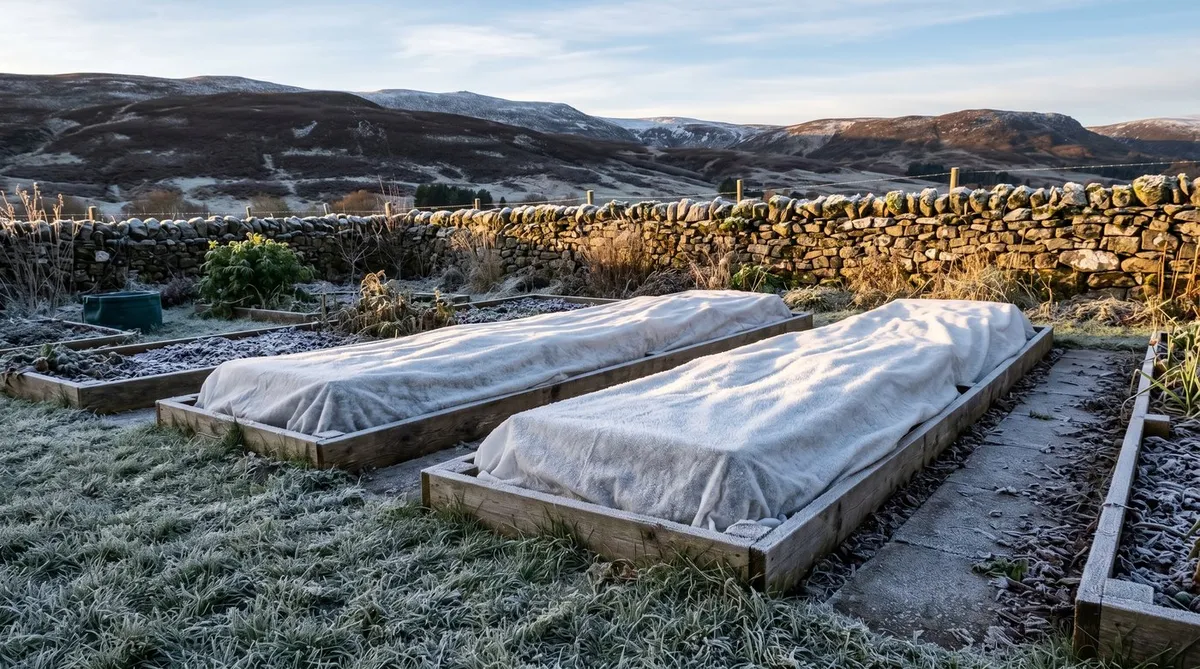
Fleece-wrapped pots and a cold frame give tender plants two layers of shelter through winter.
What does overwintering mean for UK gardeners?
It just means helping plants that can’t cope with a British winter on their own. The RHS gives every plant a hardiness rating from H1 to H7, and you’ll often find it on the label. The lower the number, the more help it needs.
Where you live makes a big difference too. A sheltered Cornish garden barely sees frost, while the Scottish Highlands get bitterly cold. Your own garden’s sheltered corners and frost pockets matter as much as the region.
| How tough | RHS rating | Where it can winter | Examples |
|---|---|---|---|
| Tender | H1 to H2 | Indoors or a heated greenhouse | Houseplants, pelargoniums, tender fuchsias |
| Half-hardy | H3 | Under cover, or wrapped in a sheltered spot | Dahlias, cannas, tender salvias |
| Mostly hardy | H4 | Outside in most gardens, mulched in cold areas | Penstemons, many agapanthus |
| Fully hardy | H5 to H7 | Outside anywhere | Roses, hostas, apple trees |
When should you start overwintering plants?
Start getting ready in late September and have everything sorted by mid to late October. Don’t wait to see frost damage, because by then the harm is done.
Roughly when to start:
- Southern England: frosts usually start late October or early November. Get going by early October.
- Midlands and Wales: frosts usually start mid to late October. Start at the beginning of October.
- Northern England and Scotland: frosts can arrive in early October. Start in late September.
For planting ideas through winter, see what to plant in November and what to plant in December.
How to overwinter plants with horticultural fleece
Fleece is the cheapest, easiest place to start. Two layers keep off more frost than one.

Two loose layers of fleece round the pot and crown keep the frost off.
Which plants to fleece
Fleece borderline plants that stay outside. Good ones to wrap:
- Agapanthus in pots: wrap the pot and mulch the crown
- Olive trees in pots: fleece the top and wrap the pot in bubble wrap
- Tree ferns: tuck straw into the crown and wrap the trunk in fleece
- Cordylines: gather the leaves up, tie them loosely and wrap the bundle
- Hardy bananas (Musa basjoo): cut back, pile straw round the stump and cover with fleece
How to wrap properly
Keep it loose. Tight wrapping holds damp against the stems, and that rot does more damage than frost.
- Water the plant well the day before. Dry roots freeze faster.
- Push three canes into the pot or soil round the plant.
- Drape two layers of fleece over the canes, leaving an air gap.
- Tie it with garden string and leave the bottom open so water drains.
- On mild, dry days, take the fleece off to let some air in.
Fleece breaks down in sunlight, so start each autumn with a fresh roll.
How to use a cold frame for overwintering
A cold frame is a little glass box that keeps rain and frost off without any heating. It’s brilliant for tender plants and is often overlooked.

A simple cold frame keeps pelargoniums and fuchsias going all winter with no heating bills.
Best plants for cold frame overwintering
- Pelargoniums: cut back to 10cm, take off most leaves, water monthly
- Tender fuchsias: cut to 15cm, let them go dormant, keep barely moist
- Rooted cuttings: late-summer cuttings of tender perennials do well
- Alpines: they’re fine with cold but hate wet, and the frame keeps rain off
- Autumn-sown hardy annuals: sweet peas, cornflowers and larkspur in modules
Cold frame management through winter
Open the lid on any mild day. A closed frame gets damp inside, and that brings grey mould. Fresh air matters more than warmth.
On very cold nights, throw an old piece of carpet or bubble wrap over the lid and take it off in the morning.
Put the frame against a south-facing wall to catch the winter sun. Standing it on bricks helps it drain. For more ideas, see our cold frame gardening guide.
How to overwinter plants in a greenhouse
Even an unheated greenhouse keeps off light frosts. Add a small heater and you can keep it frost-free all winter.

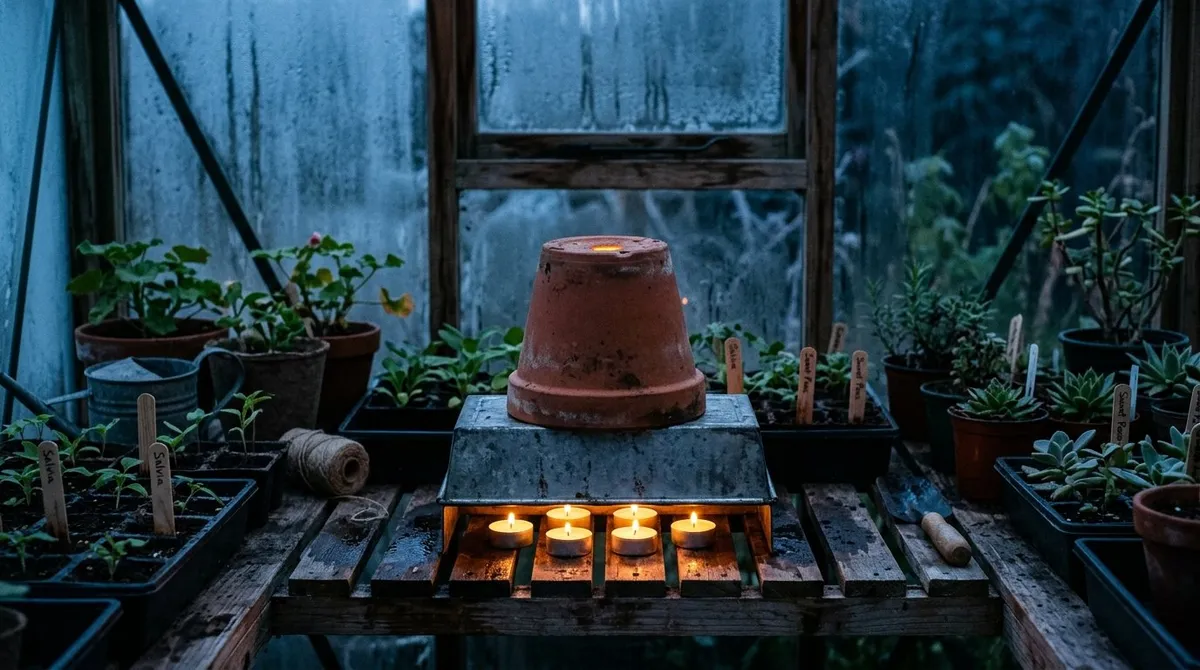
A heater with a thermostat set to about 2C keeps a whole greenhouse of tender plants frost-free.
Greenhouse insulation
Line the glass with bubble wrap before winter. It keeps heat in and cuts your heating bill. Fix it on with clips, not tape, and leave the roof vents clear so you can still open them.
Our greenhouse insulation guide goes through it step by step.
Greenhouse heating options
| Heater | Good for | Watch out for |
|---|---|---|
| Electric fan heater with thermostat | Easy, accurate control, no fumes | Needs a safe mains supply |
| Paraffin heater | No electricity needed | Makes it damp inside, so ventilate |
| Electric tube heater | Low, gentle, even heat | Slow to warm a big greenhouse |
| Heat mat | Warming seed trays and cuttings | Warms the roots, not the air |
Set the thermostat to about 2C to keep the frost out. Citrus and brugmansia are happier at about 5C, but that costs more to run.
What to overwinter in a greenhouse
- Citrus trees: bring them in before the first frost, keep above 5C, water sparingly
- Tender salvias: cut back to 15cm, keep frost-free, water less
- Pelargoniums: keep on the staging with little water and plenty of fresh air
- Plug plants and cuttings: diascia, osteospermum and verbena
- Dahlia tubers in trays: keep on the lower staging and check monthly for rot
For keeping the air fresh through winter, read our greenhouse ventilation and humidity guide.
How to overwinter dahlias in the UK
Dahlias are the plant most often lost over winter. The tubers can cope with cold if they’re dry, but they rot in cold, wet soil.
To lift or not to lift
In most gardens, lift them. You might get away with leaving them in light, free-draining soil in a mild area, like Devon, Cornwall or coastal Wales, under a thick mulch. Heavy clay holds water round the tubers and kills more dahlias than frost.
How to lift and store dahlia tubers
- Wait until the first frost blackens the leaves. Cut the stems to 15cm.
- Dig carefully round the clump and lift the whole thing.
- Shake off the loose soil, or hose it off if it’s sticky clay.
- Stand the tubers upside down for a week so water drains from the hollow stems.
- Trim off any damaged or rotten bits.
- Store them in trays of barely damp vermiculite, compost or sand at about 5C.
- Check them every month and throw out any that go soft.
A frost-free garage, shed or cold spare room is ideal. Avoid anywhere that freezes or stays above 10C. To grow them from scratch, see our dahlia growing guide.
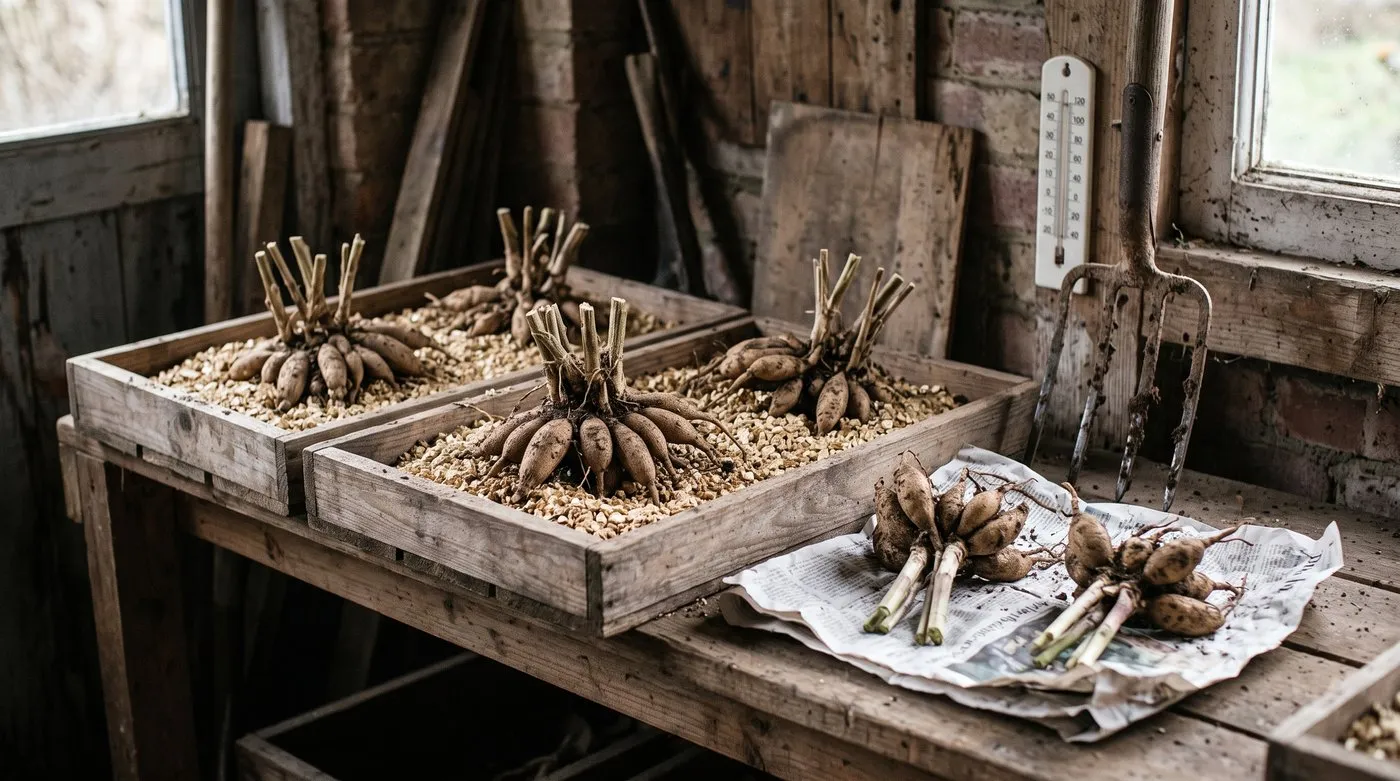
Stand the tubers upside down for a week to drain, then store them in barely damp vermiculite at about 5C. Check them monthly for soft ones.
How to overwinter cannas and other tender bulbs
Several summer bulbs need lifting and storing too.
| Bulb or tuber | Lift | Store at | Store in | Replant |
|---|---|---|---|---|
| Dahlia | After first frost | About 5C | Damp vermiculite | April to May |
| Canna | After first frost | 7-10C | Damp compost | April |
| Gladioli | October | 5-10C | Dry, in paper bags | March to April |
| Begonia | After first frost | 5-7C | Dry compost | March |
| Eucomis | November | About 5C | Dry sand | April |
Cannas are the fussiest. Don’t let the roots dry out completely. Store them in barely moist compost somewhere frost-free, check every fortnight and mist lightly if it’s bone dry. The same goes for overwintering ginger lily rhizomes, which also hate a bone-dry winter.
Gladioli are the easiest. Lift the corms, snap off the old shrivelled one underneath, dry them for two weeks and store in labelled paper bags somewhere cool. The scented Acidanthera, or Abyssinian gladiolus, is stored the same way.
How to overwinter plants indoors
Indoors works well for a few tender plants, rooted cuttings and houseplants that spent summer outside.
Best indoor overwintering spots
- Cool spare bedroom (8-12C): great for dormant pelargoniums and fuchsias
- Bright windowsill (above 10C): suits citrus, curry leaf plants, tender herbs and cuttings
- Unheated porch or conservatory: good for nearly hardy plants that just need to stay dry
- Heated utility room: too warm and dark for most, so only for a short stay
The acclimatisation rule
Bring plants in gradually. Going straight from a cold patio to a warm living room makes leaves drop. Give them a week in a cool room first. Do the reverse in spring, and harden off seedlings before they go back out.
Cut watering by at least half. Indoors, more plants die from too much water than from cold. Only water when the top 3cm of compost is dry.
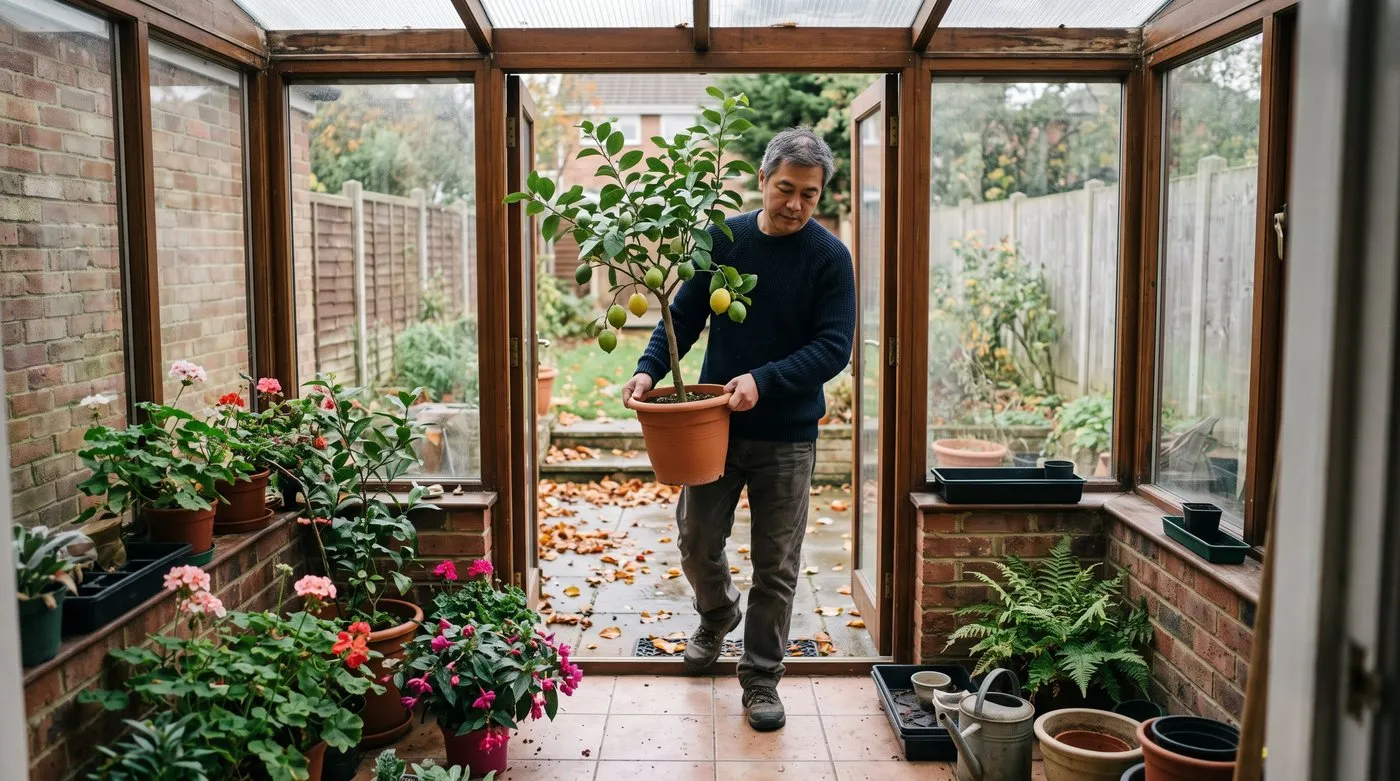
Give plants a week somewhere cool before a warm room, or the leaves may drop. Water only when the top 3cm of compost is dry.
Which plants survive UK winters without protection?
Plenty of plants need no help at all, which saves you time and worry.
Tough plants that stay out all winter:
- Native trees and shrubs like oak, birch, hawthorn and hazel
- Hardy perennials: hostas, hardy geraniums, asters, sedums, echinacea
- Hardy bulbs: daffodils, snowdrops, crocus, alliums, bluebells
- Roses: see our rose growing guide
- Hardy fuchsias such as ‘Riccartonii’ and ‘Mrs Popple’
- Most ornamental grasses: see our ornamental grasses guide
Nearly hardy plants that only need help in cold areas:
- Penstemons: mulch the crown in northern gardens
- Japanese anemones: fine in most gardens, mulch them on exposed sites
- Hardy agapanthus like ‘Headbourne Hybrids’: protect them in pots, they’re usually fine in the ground
Month-by-month overwintering calendar
| Month | Jobs |
|---|---|
| September | Take cuttings of tender plants as a backup. Buy fleece and bubble wrap. |
| October | Lift dahlias, cannas and gladioli after the first frost. Wrap borderline plants. Bring citrus inside. |
| November | Line the greenhouse with bubble wrap and set up the heater. Close cold frames on frosty nights. |
| December | Check stored tubers. Open the greenhouse on mild days. Water sparingly. |
| January | Keep an eye on the heater and wrapping. Throw out any rotting bulbs. |
| February | Order summer bulbs. Check dahlias for early shoots. |
| March | Move pelargoniums somewhere brighter and water a little more. |
| April | Start hardening off overwintered plants. Pot up dahlia tubers that are sprouting. |
For more month-by-month ideas, see our spring gardening jobs guide and the greenhouse growing calendar.
Common overwintering mistakes
Wrapping too late. Once you see frost damage, it’s done. Wrap before the first frost is forecast.
Overwatering in storage. Dormant plants hardly drink. A monthly check and a light mist is plenty. Soggy compost causes rot faster than any frost.
Forgetting to open up. A shut greenhouse or cold frame heats up fast on a sunny winter day. That wakes plants too early, and the next frost kills the soft new growth. Open the vents on mild days.
Using the wrong wrap. Plastic sheeting and bin bags trap damp and rot stems. Use fleece on the plant itself. Keep bubble wrap for greenhouse glass and the outside of pots.
No backup cuttings. Take cuttings of tender plants in August and September and root them in a cold frame or on a windowsill. If the parent plant doesn’t make it, you’ve still got a young one. See our plant propagation guide for how.
Frequently asked questions
When should I start overwintering plants in the UK?
Start in October, before the first hard frost. In the south, frosts usually arrive in late October or early November. In the north and Scotland, get going by mid-October. Keep an eye on the forecast and have fleece ready.
Can I leave dahlias in the ground over winter?
Sometimes, in mild gardens with free-draining soil. Cover them with a thick mulch if you try it. In most gardens, especially on heavy clay or further north, lifting them is safer. Wet soil kills more dahlias than frost does.
What temperature kills tender plants in the UK?
It depends how tender they are. Truly tender plants, like pelargoniums, suffer once it freezes. Half-hardy plants can cope with a few degrees of frost for a short time. Check a plant’s RHS hardiness rating on its label to see how much protection it needs.
Is horticultural fleece better than bubble wrap for overwintering?
Yes, fleece is better for wrapping plants because it breathes. Bubble wrap traps damp and can make stems and leaves rot. Use bubble wrap to line greenhouse glass, cold frames and the outside of pots instead.
Do I need to heat a greenhouse to overwinter plants?
Not always. An unheated greenhouse keeps off light frosts. For tender plants like citrus and pelargoniums, a small heater with a thermostat set to about 2C keeps the frost out.
How do I overwinter pelargoniums in the UK?
Cut them back to about 10cm in October and take off most of the leaves. Keep them somewhere frost-free, like a greenhouse, cold frame or cool spare room. Water once a month at most. They look dead by January but bounce back in spring.
Which plants need overwintering in the UK?
Tender plants that can’t take much frost. Common ones are dahlias, cannas, gladioli, pelargoniums, tender fuchsias, agapanthus in pots, citrus, olive trees in pots, bananas and tender salvias. Fully hardy plants are fine outside all winter.
Our team produces practical UK gardening guidance from source research, contributor records and established horticultural practice. Editorial standards are overseen by Matt W.