
Key takeaways
- The rootstock, not the variety, decides how big a fruit tree grows
- M27 and M9 make small apple trees that crop young but need a stake for life
- MM106 is a popular all-rounder for a free-standing apple tree of 3.5-5m
- Pears grow on quince, plums on Pixy or St Julien A, cherries on Gisela 5 or Colt
- Use a more vigorous rootstock on poor soil and a dwarfing one on rich soil
- Keep the graft union 5-10cm above the soil so the variety never roots
The rootstock decides how big your fruit tree will grow and how soon it starts cropping. It’s the root system your chosen variety is grafted onto, and it matters more for size than the variety does. The same ‘Cox’ apple can be a small pot tree on one rootstock and a tree taller than a house on another.
This guide explains what the codes on the label mean and helps you match a rootstock to your space and soil. For planting and aftercare, see our guide on how to grow fruit trees.
What is a fruit tree rootstock?
A rootstock is the bottom part of a grafted fruit tree: the roots and the base of the trunk. The fruiting variety, called the scion, is grafted on top. Where the two meet you’ll see a swollen kink low on the trunk, the graft union.
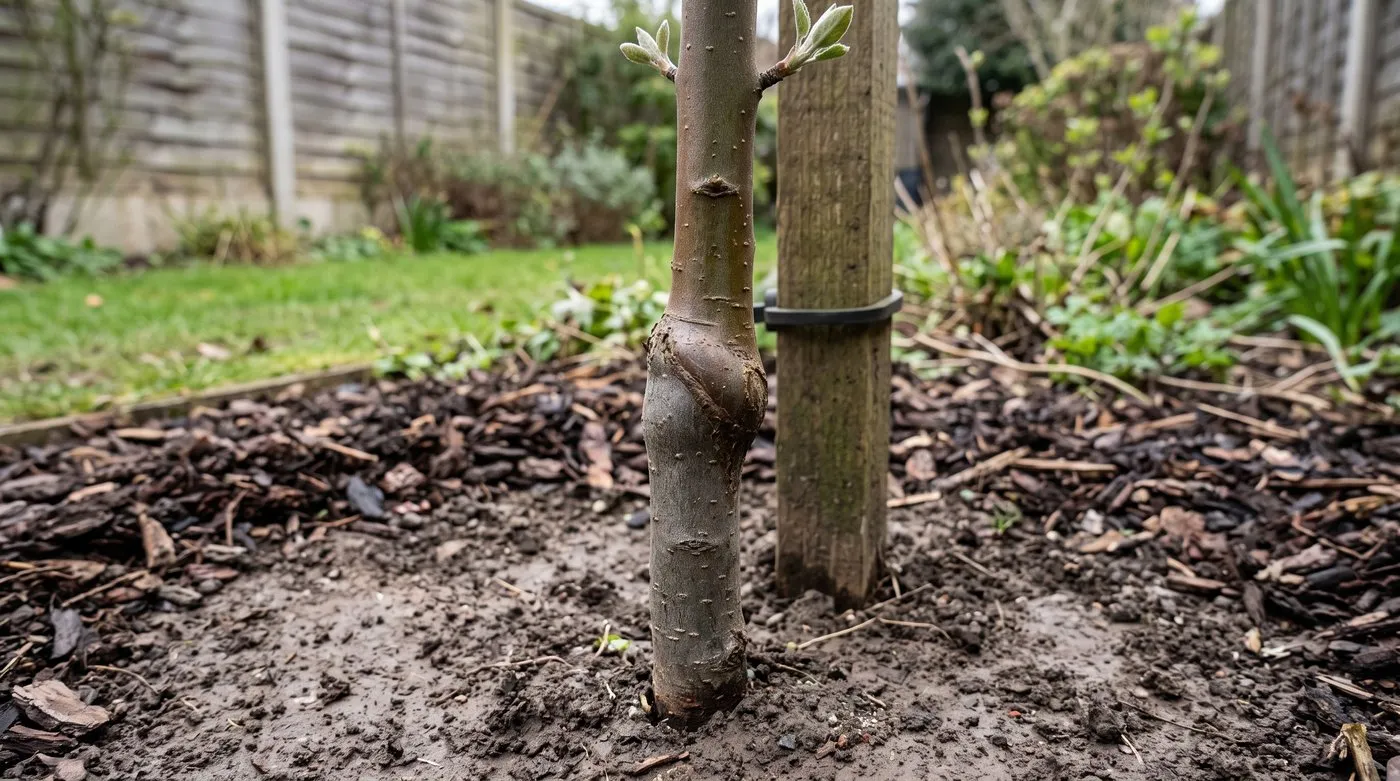
That swollen kink is the graft union. Keep it well above the soil and the rootstock keeps the tree the size you chose.
Almost every fruit tree you buy is made this way, because most varieties don’t come true from seed. The rootstock controls three useful things:
- Final size, and so how far apart you plant
- How soon the tree crops, as dwarfing roots tend to bring trees into fruit younger
- What soil it copes with, as vigorous roots forage better in poor ground
Apple rootstocks carry M or MM codes from the East Malling research station in Kent. The number is just a reference, not a size. That’s why M27 is tiny and M25 is huge.
Apple rootstocks from smallest to largest
Apples have the widest choice, from a patio tree to a big orchard standard. Heights are rough guides, as soil, variety and pruning all play a part.
| Rootstock | Size | Rough height | Staking | Best for |
|---|---|---|---|---|
| M27 | Very dwarfing | 1.5-2m | For life | Pots, stepovers, tiny gardens |
| M9 | Dwarfing | 2-3m | For life | Small gardens, cordons, rows of small trees |
| M26 | Semi-dwarfing | 2.5-3.5m | Several years, longer if exposed | Small gardens, cordons, espaliers |
| MM106 | Semi-vigorous | 3.5-5m | First few years | Bush trees in average gardens |
| MM111 | Vigorous | 4.5-6m | First few years | Bigger gardens, poor or dry soil |
| M25 | Very vigorous | 5m or more | First few years | Traditional orchard standards in grass |
M27 is the smallest. Its weak roots can’t anchor the tree or search far for water, so it needs a permanent stake, rich soil and a clear circle free of weeds and grass. Think of it as a container plant in the ground.
M9 crops young and heavily for its size, but it also needs a stake for life. M26 is a notch bigger and good for trained forms. MM106 is the easy-going middle choice for a free-standing tree. MM111 and M25 are for big spaces and traditional orchards, and they take longer to start cropping.
M9 and MM106 trees often grow rough lumps near the base of the trunk. These are usually harmless, as our guide to apple burr knots explains. For variety choice and care, read our guide on how to grow apple trees.

The same apple variety on five rootstocks. The heights are rough guides, but the jump from M27 to M25 is real.
Pear rootstocks: why pears grow on quince
Garden pears are usually grafted onto quince, a close relative. Quince roots keep the tree smaller and bring it into fruit much sooner than pear seedling roots.
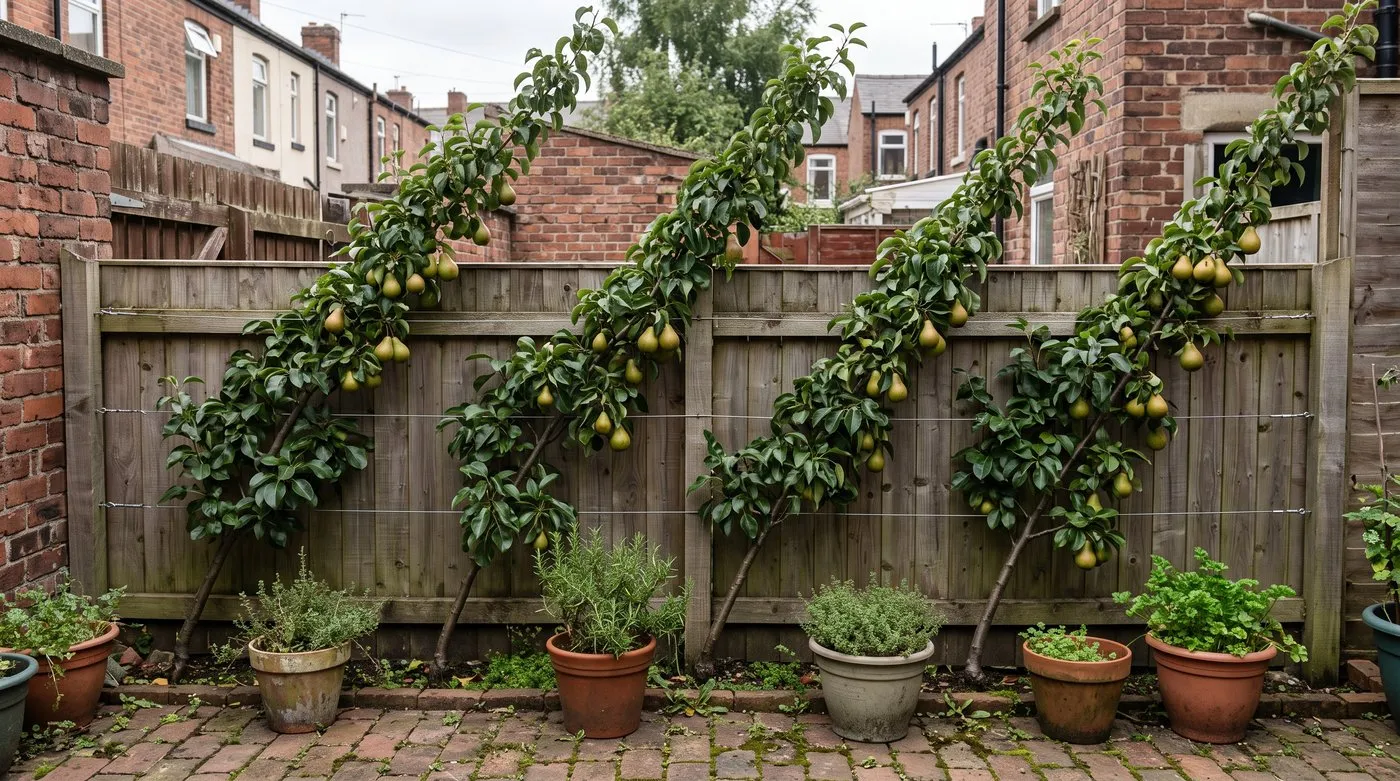
Pears on Quince C stay compact enough to train as cordons, so even a courtyard can fit a few varieties.
Quince C is the more dwarfing choice, making a tree of roughly 2.5-3.5m. It suits cordons, espaliers and small gardens, but needs good soil. Quince A gives a slightly bigger tree of roughly 3-4.5m and copes better with ordinary ground. It’s the usual pick for a free-standing pear.
A few pears, including Williams’ Bon Chrétien, don’t join well with quince. Nurseries fix this with an interstem: a short piece of a compatible pear, such as ‘Beurré Hardy’, grafted between the two. If you’re buying one of these varieties, ask the nursery whether it has been double-worked like this. Our guide on how to grow pear trees covers varieties and pollination partners.
Plum, gage and damson rootstocks
Plums, gages and damsons share the same rootstocks. The choice is smaller than for apples but still covers most gardens.
| Rootstock | Size | Rough height | Best for |
|---|---|---|---|
| Pixy | Dwarfing | 2.5-3m | Small gardens, pots, fans |
| VVA-1 | Dwarfing | 2.5-3m | Small gardens |
| St Julien A | Semi-vigorous | 3.5-4.5m | Bush trees and wall fans |
| Myrobalan B | Vigorous | 4.5-6m | Large gardens and poor soil |
Pixy keeps a tree small but needs decent soil and watering in dry spells. St Julien A is the rootstock most garden plums are sold on. It makes a sensible-sized tree, trains well as a fan and copes with a range of soils. Myrobalan B is best saved for big gardens and orchards. See our guide on how to grow plum trees for the best varieties to put on them.

A plum fan on a sunny wall. St Julien A gives just enough vigour to fill the wall without taking over.
Cherry rootstocks: Gisela 5 and Colt
Gisela 5 is the cherry rootstock to ask for in most gardens. It keeps a tree to about 2.5-3m, so you can actually throw a net over it before the blackbirds strip the fruit.
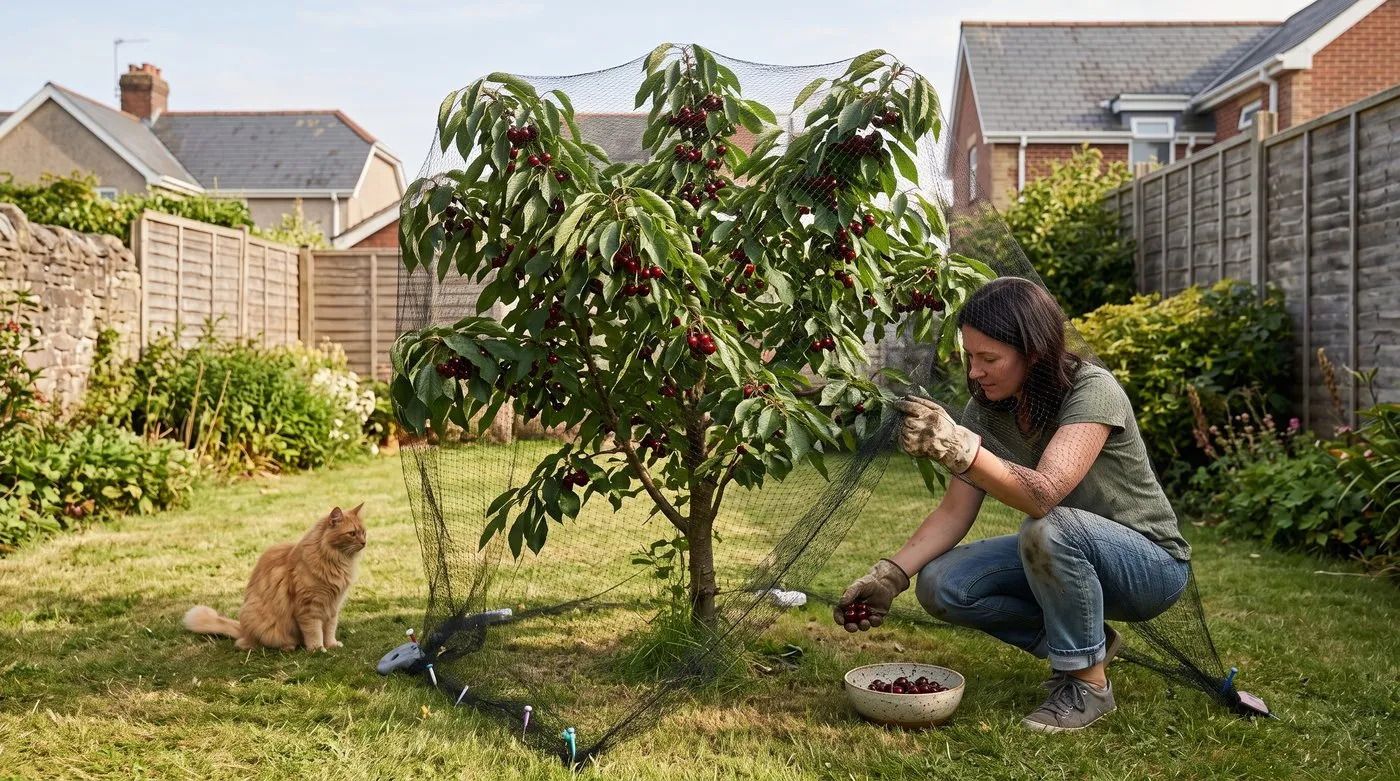
A cherry on Gisela 5 stays small enough to net, so the blackbirds don’t get the crop before you do.
Old cherry trees grew on wild cherry seedlings and became giants, far too big to net. Gisela 5 changed that. It needs good soil and a stake while young, and it starts cropping within a few years.
Colt is semi-vigorous and makes a larger tree of roughly 4-6m. It copes with a wider range of soils than Gisela 5, so it suits a bigger garden. Our guide on how to grow cherry trees covers pollination, netting and pruning.
How to choose the right rootstock for your garden
Start with your space and soil, then find the variety you want on that rootstock. The classic mistake is falling for a variety and taking whatever rootstock comes with it.
Space first. A courtyard or patio pot suits M27, Pixy or Gisela 5. An average suburban garden suits M9, M26, Quince C or St Julien A. A bigger lawn has room for MM106, Quince A or Colt. Save MM111, M25 and Myrobalan B for orchards and paddocks.
Then soil. This one surprises people. Choose a more vigorous rootstock for poor, thin or dry soil and a more dwarfing one for rich ground. A dwarf stock on poor soil just sulks. A vigorous stock on rich soil grows lots of leaf and is slow to fruit.
Then shape. Cordons and espaliers need restrictive rootstocks such as M9, M26 or Quince C. A free-standing bush suits MM106 or St Julien A. Our guide to dwarf fruit trees for small gardens has ideas for the tightest plots.

Lay a cane across the hole before you backfill. The graft union should sit clearly above it, at least a hand’s width above the soil.
When to plant and look after trees on each rootstock
Plant bare-root trees from November to March, when they’re dormant. The timing is the same for every rootstock. What changes is the staking and how much watering they need.
| Month | Task |
|---|---|
| September to October | Order bare-root trees, naming the rootstock you want. Clear a 1m circle of grass and weeds |
| November to March | Plant bare-root trees in mild spells, never into frozen or waterlogged soil. Stake at planting |
| March to April | Plant container-grown trees. Check ties on staked trees |
| May to August | Water dwarf-rootstock trees in dry spells. Keep the circle around them weed-free |
Dwarf rootstocks such as M27, M9, Pixy and Gisela 5 need the most care in summer. Their small root systems can’t reach far for water. A tree on M25 looks after itself once it’s settled.

Small trees on dwarfing rootstock, each tied to a stake. You can fit several varieties in the space of one big tree.
Common rootstock mistakes
- Choosing the variety first. Pick the rootstock for your space, then look for your favourite variety on it.
- Burying the graft union. If the variety roots above the union, the tree loses its size control. Keep the union 5-10cm above the soil, and don’t pile mulch or soil against it.
- No stake on M9 or M27. These trees never anchor themselves. They lean and can blow over when heavy with fruit.
- A dwarf rootstock on poor soil. It will barely grow. Use a stronger rootstock, or improve the soil and water well.
- Expecting pruning to shrink a big tree. Hard pruning a vigorous tree makes it grow back harder. Pruning shapes a tree, but the rootstock sets its size.
The rootstock is the one thing you can’t change after planting, so it’s worth getting right. You’ll find more fruit guides in our growing section.
Can you graft your own variety onto a rootstock?
Yes. You can buy rootstocks on their own from specialist fruit nurseries and graft your chosen variety onto them. It’s a lovely way to grow an old family apple on exactly the size of root you want.
The usual method is a whip-and-tongue graft in early spring, using a dormant shoot of your variety cut in winter. Matching cuts are bound tightly together and the union heals over the summer.
Now you know which rootstock to ask for, read our step-by-step guide on how to graft fruit trees to make your own.
Frequently asked questions
What is the most dwarfing apple rootstock in the UK?
M27 is the most dwarfing apple rootstock you can usually buy. It keeps a tree to about 1.5-2m and crops within two or three years. It needs a stake for life and rich, weed-free soil. Use it for pots, stepovers and the tiniest gardens.
What rootstock should I choose for a small garden?
M9 or M26 suits most small gardens. M9 makes a tree of about 2-3m and needs a stake for life. M26 grows a little bigger and trains well as a cordon or espalier. Both start cropping young.
Which apple rootstock is best for a normal garden tree?
MM106 is the usual choice for a free-standing bush. It makes a tree of about 3.5-5m, copes with average soil and only needs a stake for the first few years. Many nurseries offer it as their standard option.
Why does the graft union have to stay above the soil?
A buried graft union lets the variety grow its own roots. Once that happens, the rootstock no longer controls the size and the tree grows much bigger. Plant so the union sits 5-10cm above the soil and keep it that way.
What rootstock do pears grow on?
Garden pears are usually grafted onto quince. Quince C makes the smaller tree and Quince A a slightly larger one. A few varieties, such as Williams’ Bon Chrétien, don’t join well with quince, so nurseries graft a short piece of a compatible pear in between.
Can I keep a tree small by pruning instead of using a dwarf rootstock?
Not really, because hard pruning makes a vigorous tree grow back harder. Cutting a tree on M25 hard each winter gives lots of leafy shoots and fewer fruit. Choose the right rootstock when you buy, then prune to shape.
Our team produces practical UK gardening guidance from source research, contributor records and established horticultural practice. Editorial standards are overseen by Matt W.


