
Key takeaways
- Plant bare-root pear trees from November to March in a sheltered, sunny spot
- Quince C rootstock suits small gardens, and Quince A gives a bigger tree
- Conference is the easiest UK pear and can crop without a partner
- Pears flower before apples, so protect the blossom from late frosts
- Pick pears while still firm and ripen them indoors
- Thin heavy crops in summer for bigger fruit and steadier crops each year
Pear trees are some of the longest-lived, most rewarding fruit trees you can grow. A tree on a dwarfing rootstock fits a modest garden and can keep cropping for decades. Pears like the UK climate, though they flower earlier than apple trees and need more shelter from late frosts.
Getting the rootstock, variety and spot right is most of the battle. A pear trained flat against a sunny wall is a classic British sight. The wall keeps the blossom warmer on frosty nights and helps the fruit ripen. Here’s everything you need, from planting to the trick of picking pears at the right moment.
Which rootstock should I choose for a pear tree?
Choose Quince C for small gardens and trained trees, or Quince A for a bigger free-standing tree. The rootstock is the root part of the tree, and it sets how big the tree grows and how soon it fruits.
Quince C (small)
Quince C is the most popular rootstock for garden pears. Trees grow to about 2.5-3m tall. It suits most UK gardens and is the best choice for trees trained flat against a wall or fence. The roots are small for the crop, so keep the tree staked for life.
Quince A (medium)
Quince A gives a bigger tree, around 3-4.5m tall, and takes a little longer to start fruiting. It suits an open spot where you have room for a free-standing tree. It copes better with poorer soil and gives bigger crops. Stake it for the first few years.
Seedling rootstock (full size)
Seedling rootstock gives a full-size orchard tree of 6-10m and takes many years to fruit. It’s too big for most gardens, so only choose it if you’re planting a traditional orchard.
Rootstocks side by side
| Rootstock | Size | Starts fruiting | Staking | Good for |
|---|---|---|---|---|
| Quince C | Small, 2.5-3m | Soonest | For life | Small gardens, trained trees |
| Quince A | Medium, 3-4.5m | A little later | First few years | Medium gardens, free-standing trees |
| Seedling | Large, 6-10m | Many years | First few years | Orchards, big plots |
Gardener’s tip: If your soil is shallow, chalky or very light, choose Quince A over Quince C. Its stronger roots cope better with tough conditions.
What are the best pear varieties for UK gardens?
Most pears need a partner that flowers at the same time, so check the pollination group when you buy. Plant two varieties from the same or a neighbouring group. A pear tree in a neighbour’s garden can do the job too.
Conference (Group 3)

Conference pears, the UK’s favourite and the easiest to grow.
Conference is the UK’s most popular pear and the best choice for beginners. It can set fruit without a partner. The long, green pears with russet patches are picked in late September or October. Sweet and juicy, and happy as a free-standing tree or trained against a wall.
Concorde (Group 3)
Concorde is a cross between Conference and Doyenne du Comice. It’s reliable like Conference, with some of Comice’s finer flavour. It grows compactly, so it suits smaller gardens. It can crop alone but does better with Conference nearby. The fruit is ready to eat from October to November.
Williams’ Bon Chretien (Group 3)
Williams’ is the classic English pear, rich and aromatic. It’s ready in September, before Conference. The skin turns from yellow-green to golden as it ripens. It needs a partner. On Quince A it makes a handsome free-standing tree.
Doyenne du Comice (Group 4)
Comice is often called the best-tasting dessert pear, with buttery, melting flesh. It ripens in November. It needs more warmth and shelter than Conference, plus a partner, so it’s happiest trained against a warm wall.
Beth (Group 3)
Beth is a compact variety for small gardens. Its sweet, pale yellow pears are ready in early to mid-September, one of the earliest. It needs a partner such as Conference. Its neat shape makes it perfect for small garden fruit growing.
Invincible
Invincible (also sold as Delwinor) is sold as self-fertile, so it can crop on its own. Suppliers say it can flower again if frost hits the first blossom, which makes it worth a try in colder gardens. The fruit is ready in October.
Varieties side by side
| Variety | Group | Crops alone? | Pick | Flavour | Good for |
|---|---|---|---|---|---|
| Conference | 3 | Yes, partly | October | Sweet, juicy | Beginners |
| Concorde | 3 | Yes, partly | October | Sweet, smooth | Small gardens |
| Williams’ Bon Chretien | 3 | No | September | Rich, aromatic | Flavour |
| Doyenne du Comice | 4 | No | November | Buttery, melting | The finest dessert pear |
| Beth | 3 | No | September | Sweet, light | Small gardens, early crop |
| Invincible | Not needed | Yes | October | Sweet, mild | Colder gardens, easy growing |
Gardener’s tip: Conference and Concorde make a great pair. Both are in Group 3, both can crop alone, and together they give bigger crops.
How to plant a pear tree
Picking the right spot
Pears need a warm, sheltered spot even more than apples. Their blossom opens earlier, often in April, when late frosts can still strike. One frosty night in a frost pocket can wipe out a year’s crop. Avoid low spots where cold air settles.
South or west-facing walls are the best spots for trained pears. The wall gives off warmth at night, which helps protect the blossom. Training pears as espaliers or fans against a wall is a lovely old British tradition.
In the open, pick a spot in full sun, sheltered from north and east winds, with soil that drains well. Pears cope with most soils but hate sitting wet.
Planting bare-root trees
Plant bare-root trees from November to March while they’re dormant. November and December are best. Bare-root trees cost less than potted ones and settle in well.
Dig a hole 60-90cm across, wide enough to spread the roots out. Keep the graft union (the knobbly join near the base of the trunk) about 10cm above the soil. If you bury it, the top part can make its own roots and the tree grows far bigger than planned.
Fill in with the soil you dug out mixed with some garden compost. Don’t add fertiliser to the hole. Firm gently and water well. Knock in a short stake at 45 degrees on the windy side and fix it with a tree tie.
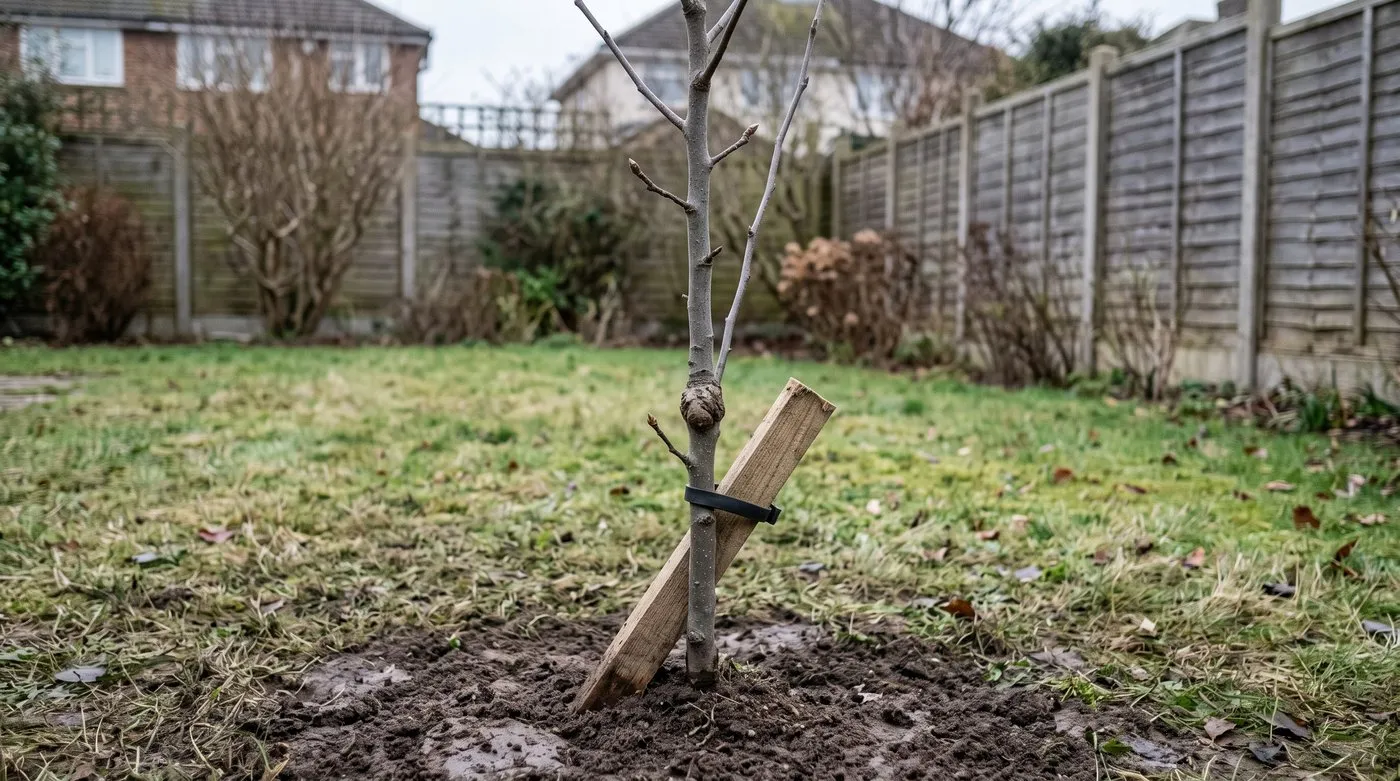
Keep the knobbly graft union about 10cm above the soil. Bury it and the tree can root from the top and grow far bigger than planned.
Spacing
| Tree shape | Spacing | Rootstock |
|---|---|---|
| Free-standing bush | 3-4m apart | Quince A |
| Espalier (flat on a wall) | 3.5-4.5m apart | Quince C or A |
| Cordon (single stem at 45 degrees) | 75cm apart | Quince C |
| Fan | 3.5-4m apart | Quince C or A |
How to prune pear trees
Prune free-standing trees in winter and trained trees in late summer. Pruning keeps trees fruiting well and lets air in, which helps keep disease away.
Winter pruning (free-standing trees)
Prune between November and February while the tree is dormant. Remove dead, diseased and crossing branches, and open up the centre to light and air. Cut back to an outward-facing bud or a main branch. Aim for a goblet shape with an open middle.
For the first few years, shape young trees by choosing four or five well-spaced main branches. Remove any that compete or spoil the shape. After that, pruning is lighter: thin out crowded growth and keep the short fruiting stems, called spurs.
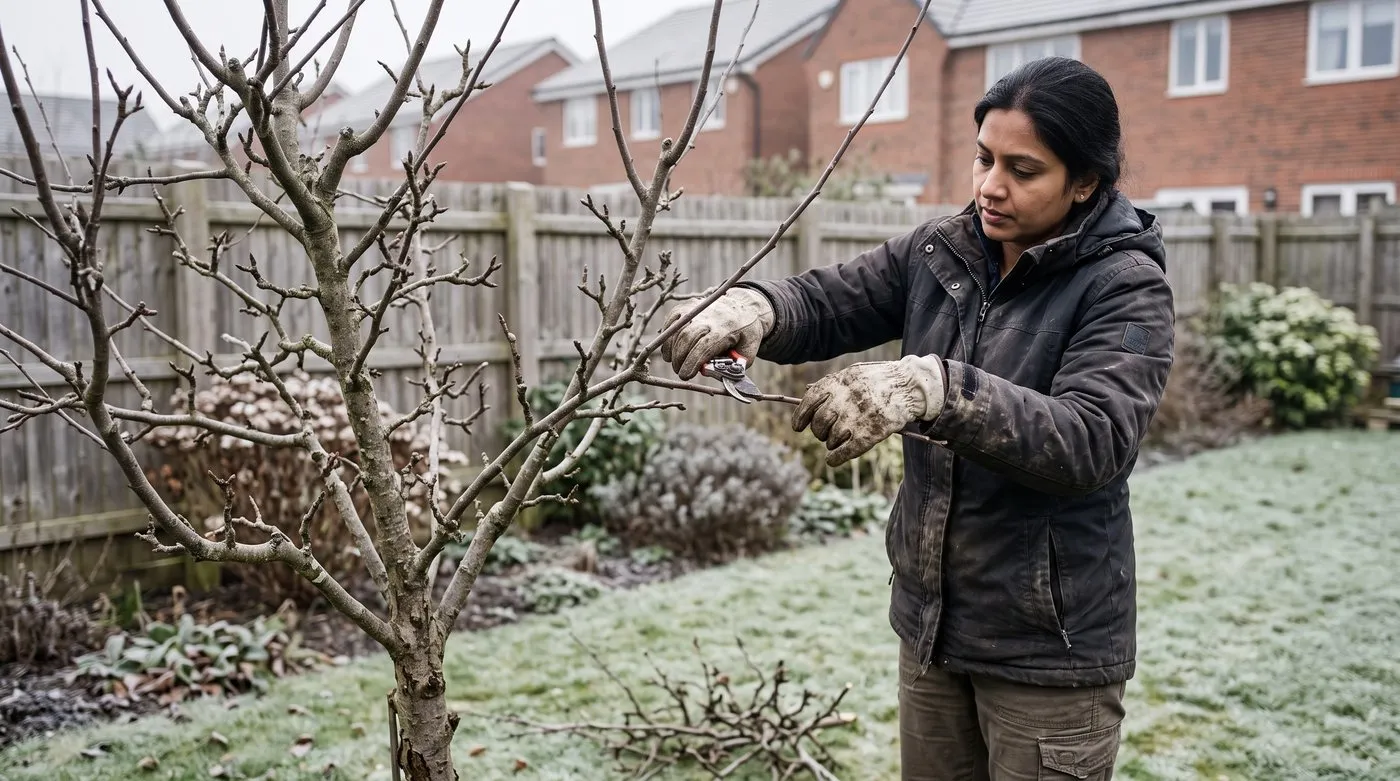
Cut back to an outward-facing bud and keep the middle open to light and air. Leave the short knobbly spurs, as that’s where the fruit comes from.
Summer pruning (trained trees)
Cordons, espaliers and fans are pruned in late July or August. Cut new side shoots back to three leaves above the basal cluster (the little rosette of leaves at the base of each shoot). Cut any shoots growing from last year’s pruned stems back to one leaf above the cluster.
Over time the spurs get crowded. Thin them in winter, removing the weakest. Our guide to training fruit trees shows how to train espaliers and cordons step by step.
Gardener’s tip: Use sharp bypass secateurs for stems up to 2cm thick and a pruning saw for anything bigger. Blunt tools leave ragged cuts that let disease in.

A pear espalier on a warm brick wall. Pears take to formal training beautifully.
How pear pollination groups work
Most pears need a partner variety that flowers at the same time. This is the step new growers most often miss. Without a partner, you get blossom but no fruit.

Pear blossom in April. It opens before apple blossom, so keep an eye out for frost.
Pears are sorted into pollination groups 1 to 4 by when they flower. Group 1 flowers first and Group 4 last. Plant two varieties from the same group, or neighbouring groups. The closer the trees, the easier it is for bees to carry pollen between them.
Conference, Concorde and Invincible can crop on their own. Even so, they usually crop better with a partner.
A few older varieties, such as Merton Pride, can’t pollinate other trees. If you grow one, you’ll need two other varieties nearby that can pollinate it and each other. Sticking with Conference, Concorde and Beth, all Group 3, keeps it simple.
Why is my pear tree not producing fruit?
If your tree flowers but doesn’t fruit, the cause is usually pollination or frost. If it doesn’t flower at all, it may be too young, over-pruned or short of sun.
Run through these in order:
- No partner: most pears need another variety in the same or a neighbouring group nearby.
- Frosted blossom: a frost in April kills the flowers, often leaving them black in the middle.
- Wet, windy spring: bees stay home in cold, wet weather, so the blossom isn’t pollinated.
- Age: trees on Quince C usually start cropping after three or four years.
- Too much winter pruning: cutting off the fruiting spurs leaves only leafy growth.
- On-off cropping: a huge crop one year can be followed by almost nothing the next.
Month-by-month pear tree calendar
| Month | What to do |
|---|---|
| January | Winter prune free-standing trees. Check stakes and ties. Order bare-root trees |
| February | Keep planting bare-root trees. Mulch around the base with compost |
| March | Last month for bare-root planting. Watch for early blossom on sunny walls |
| April | Blossom opens. Cover with fleece on frosty nights. Don’t spray while it’s in flower |
| May | Tiny fruits form. Water new trees in dry spells |
| June | The tree drops some fruitlets naturally. Water young trees in dry spells |
| July | Thin heavy crops. Water in dry weather |
| August | Summer prune cordons and espaliers. Williams’ may be ready late in the month |
| September | Pick Beth and Williams’, then early Conference, while still firm |
| October | Pick Conference, Concorde, Comice and Invincible. Store somewhere cool, dark and airy |
| November | Plant new bare-root trees. Clear fallen leaves to cut down on scab |
| December | Carry on winter pruning. Plan any new trees |
How to pick and store pears
Pears don’t ripen well on the tree. This is the big difference from apples. Left on the branch, they go gritty and mushy in the middle while still looking firm outside. If stored fruit tastes odd, our guide to why apples and pears taste bitter or off can help you work out why.
When to pick

Pick pears while they’re still firm. They ripen best off the tree.
Pick pears when they’re full-sized but still firm. Cup a pear in your hand and lift it gently with a little twist. If it comes away easily, it’s ready. If you have to tug, give it another week. Early varieties like Williams’ and Beth are usually ready from late August to early September. Conference and Concorde come in late September to October. With early varieties, tasting one is the best test.
Ripening indoors
Early varieties soften within about a week of picking. Later ones like Comice and Conference can be kept somewhere cool first, then brought into a warm room for a few days to finish. Press gently near the stalk. When it gives a little, it’s ready to eat.
Storing pears for longer
Don’t wrap pears. Lay them in a single layer, not touching, on slatted trays somewhere cool, dark and airy, like a garage or shed. Conference keeps for several weeks like this. Check them weekly and take out any going soft or brown. Our harvest planning guide helps you fit pears in with your other autumn crops.
Gardener’s tip: Never keep pears in a sealed plastic bag. Ripening fruit gives off a gas that makes the others ripen and rot faster, so they need air around them.
Pear tree pests and diseases
Pear trees are usually healthy in UK gardens, but a few problems crop up. Spotting them early and keeping things tidy stops most of them getting serious.
Pear midge
Pear midge is the most common pest. Tiny orange grubs feed inside young fruits in May and June, so the fruits turn black and drop. Pick up and bin fallen fruitlets before the grubs can crawl into the soil. Our guide to pear midge control sets out what to do through the year.
Pear leaf blister mite
Pear leaf blister mite causes yellow or pink blisters on spring leaves that turn brown or black by summer. It looks alarming but rarely harms the tree or the crop. You usually don’t need to do anything.
What causes orange spots on pear leaves?
Bright orange spots on pear leaves in summer are almost always pear rust. It’s a fungus that moves between pears and junipers. Bad outbreaks look dramatic but rarely do much harm.
The spots appear from late spring and swell over summer. By late summer, brown warty lumps form on the underside. The fungus spends winter on junipers, not pears, so clearing fallen leaves doesn’t help much. Pick off the worst leaves if only a few are affected. Our guide to pear rust explains when it’s worth doing more.
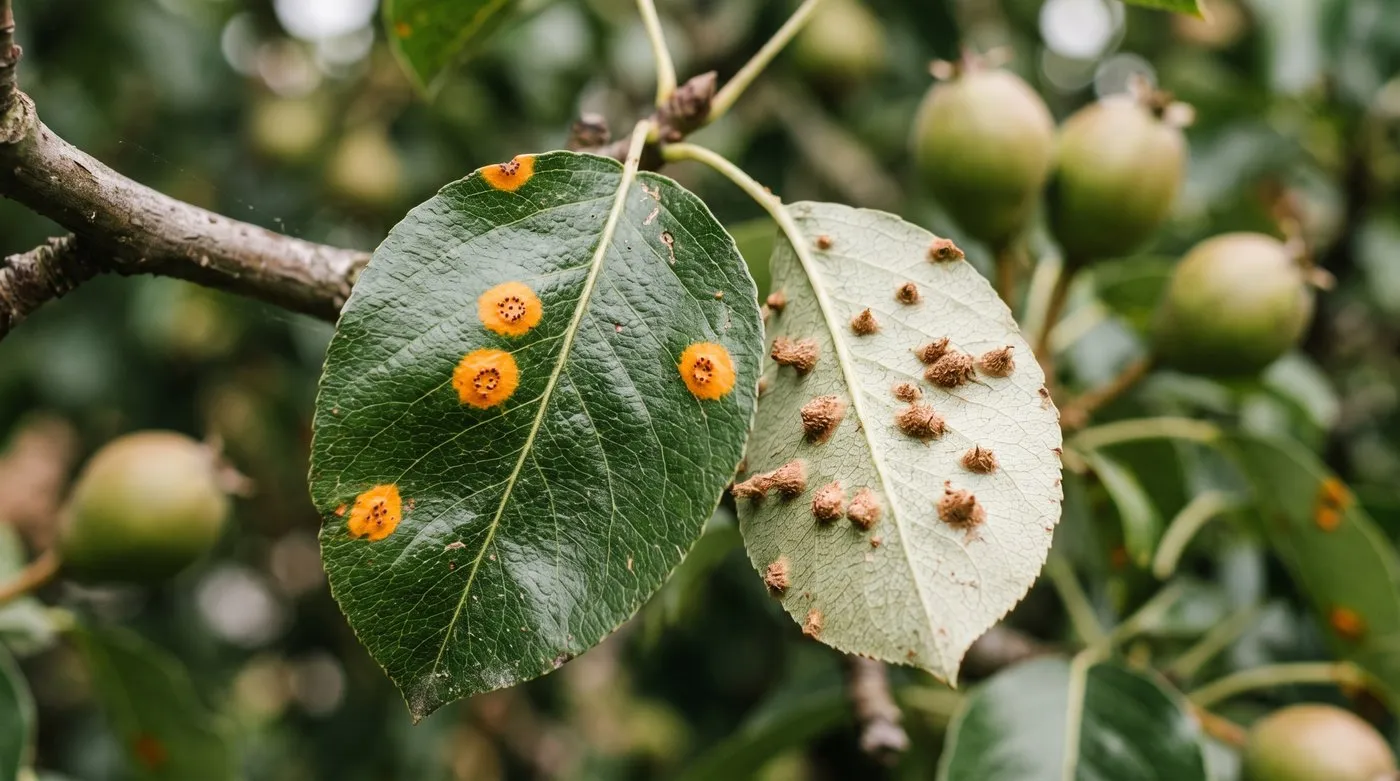
Bright orange spots like these are pear rust. It looks dramatic but rarely harms the tree, so picking off the worst leaves is usually enough.
Codling moth
Codling moth grubs tunnel into fruit in summer, leaving a hole near the base of the fruit and brown mess inside. Hang pheromone traps in mid-May to see if they’re about. Our guide to codling moth control works just as well for pears.
Pear scab
Pear scab gives dark, rough patches on fruit and olive-green spots on leaves. It’s worse in wet years. Rake up fallen leaves in autumn, as the fungus survives winter on them, and prune to keep the tree open. The RHS pear scab page has photos to help you spot it.
Fire blight
Fire blight is a bacterial disease that makes shoots and branches turn brown, as if scorched. It’s no longer notifiable in mainland Britain, and there’s no spray for it. Cut out affected shoots about 30cm below the damage, or 60cm on bigger branches. Clean your tools between cuts.
Brown rot
Brown rot causes soft brown patches on fruit with rings of mould. Remove affected fruit straight away, including any shrivelled fruit left on the tree over winter.
Five common mistakes when growing pear trees
Planting in a frost pocket. Pear blossom is easily killed by frost. Avoid low spots where cold air settles. Plant against a sunny wall, or throw fleece over the tree on frosty April nights.
Forgetting about pollination. Planting one tree that needs a partner and expecting fruit is the classic beginner mistake. Check the pollination group before you buy. If you only have room for one, choose Conference or Invincible.
Burying the graft union. If the graft ends up below the soil, the tree can grow its own roots and get much bigger than planned. Keep it 10cm above the surface.
Leaving pears to ripen on the tree. They go gritty and brown in the middle. Pick them while still firm and ripen them indoors.
Not thinning heavy crops. A huge crop one year can mean very little the next. After the tree drops its extra fruitlets in June, thin to two fruits per cluster on free-standing trees and one on trained trees.
Why a pear tree is worth the wait
A pear tree will outlive most other plants in your garden. Trained pears on walls look better every year. Pears sit nicely alongside apple trees, plum trees and cherry trees, giving you fruit from summer into winter.
Now you’ve got pears sorted, read our guide on growing plum trees in the UK for another lovely fruit for British gardens.
Pears can crop heavily one year and lightly the next, so learn how to stop biennial bearing.
Frequently asked questions
When is the best time to plant a pear tree in the UK?
Plant bare-root trees from November to March. The tree is dormant then, so its roots settle in before spring. November and December are ideal, as the soil is usually moist. Potted trees can go in at any time, but bare-root trees are cheaper and settle in quickly.
Do I need two pear trees for pollination?
Usually, yes. Most pears need a partner variety that flowers at the same time. Conference is the main exception, as it can fruit on its own. Even Conference crops better with a partner such as Concorde or Beth.
How long before a pear tree produces fruit?
Usually three to four years on Quince C rootstock. Quince A takes a year or so longer, and full-size orchard trees take much longer. Buying a two or three-year-old tree shortens the wait.
Why are my pears hard and gritty?
They were probably left on the tree too long. Pick pears while still firm, when they come away with a gentle twist. Then ripen them indoors at room temperature for about a week. Pears left on the branch go gritty and mushy in the middle.
Can I grow a pear tree in a pot?
Yes, choose a tree on Quince C rootstock. Use a pot at least 45cm wide and deep, filled with John Innes No 3. Water regularly and give a balanced feed in spring. You’ll get a smaller crop than from a tree in the ground, but it’s great for a patio.
What is the best pear tree for a small garden?
Concorde on Quince C rootstock is a great choice. It stays compact, crops well on its own, holds an RHS Award of Garden Merit and gives sweet pears from October. Train it flat against a wall to save even more room. Beth on Quince C is another good pick.
How do I prune a pear tree?
Prune free-standing trees in winter while they’re dormant. Remove dead, diseased and crossing branches and open up the centre. Prune trained trees like espaliers in late July, cutting new side shoots back to three leaves above the cluster at their base.
How long do pear trees live?
A long time, often cropping for many decades. Full-size orchard trees live longest and grow very large. Garden trees on quince rootstock are smaller but still crop for decades with a yearly prune and mulch.
Our team produces practical UK gardening guidance from source research, contributor records and established horticultural practice. Editorial standards are overseen by Matt W.


