Key takeaways
- Propagate between April and July, when plants grow fastest
- Always cut just below a node, the little bump where a leaf joins the stem
- Pothos, tradescantia and philodendron root in water in two or three weeks
- Splitting a clump is the most reliable method of all
- Rooting powder is optional, but handy for slow plants like rubber plants
- Rooting cuttings of named varieties for your own home is fine
One pothos cutting in a glass of water costs nothing. A spider plant in the kitchen throws out a dozen babies every summer, each one ready to pot up. Propagating turns one plant into many, and it’s one of the most satisfying things you can do with houseplants.
It’s easy once you know where to cut, what cuttings like, and which method suits which plant. Here’s how to do it in a UK home.
When is the best time to propagate houseplants
April to July is best, while plants are growing strongly. Get the timing right and cuttings root quickly. Get it wrong and they can sit for weeks and then rot.
April to July is the sweet spot. Plants are making soft, lively stems that root fast, and longer, warmer days help.
August and September still work for most methods, though rooting may be a bit slower.
October to March is the hardest time. Plants are resting, the days are short and cuttings rot more easily in cool, damp air. They can still root, just slowly. Splitting a really overgrown plant is fine at any time of year if you have to.
Warmth helps a lot. Cuttings root best at around 20-25C. A heated room is fine in winter, but a windowsill that gets cold at night usually isn’t.
How to propagate houseplants from stem cuttings
Stem cuttings work for most houseplants, from trailing plants to big leafy ones.
Step 1: Pick a healthy stem. Choose one that’s growing well, has no pests and has at least two or three leaves. Skip weak, leggy or old woody stems.
Step 2: Make the cut. Take a piece 10-15cm long, cutting just below a node with clean, sharp scissors. The node is the little bump where a leaf joins the stem. Roots grow from nodes, so a cutting without one won’t root.
Step 3: Strip the lower leaves. Take the leaves off the bottom half. Any leaves sitting in water or compost will rot. Leave two or three at the top.
Step 4: Dip in rooting powder (optional). Dip the cut end in rooting powder and tap off the extra. Easy plants don’t need it, but it helps the trickier ones. Our guide to plant propagation methods has more on this.
Step 5: Root in water or compost. Stand the cutting in a clean glass of water with the node under water, or push it 3-4cm into damp cutting compost. Both work, and there’s more on each below.
Step 6: Keep it warm and bright. Put it somewhere bright but out of direct sun, ideally around 20-25C. Hot sun dries cuttings out before they can root.
Step 7: Wait and watch. Roots usually appear in two to four weeks. In water you can watch them grow. In compost, give it a gentle tug after three weeks. If it resists, it has roots.
Pothos and tradescantia cuttings rooting in water. The roots grow from the nodes in two or three weeks.
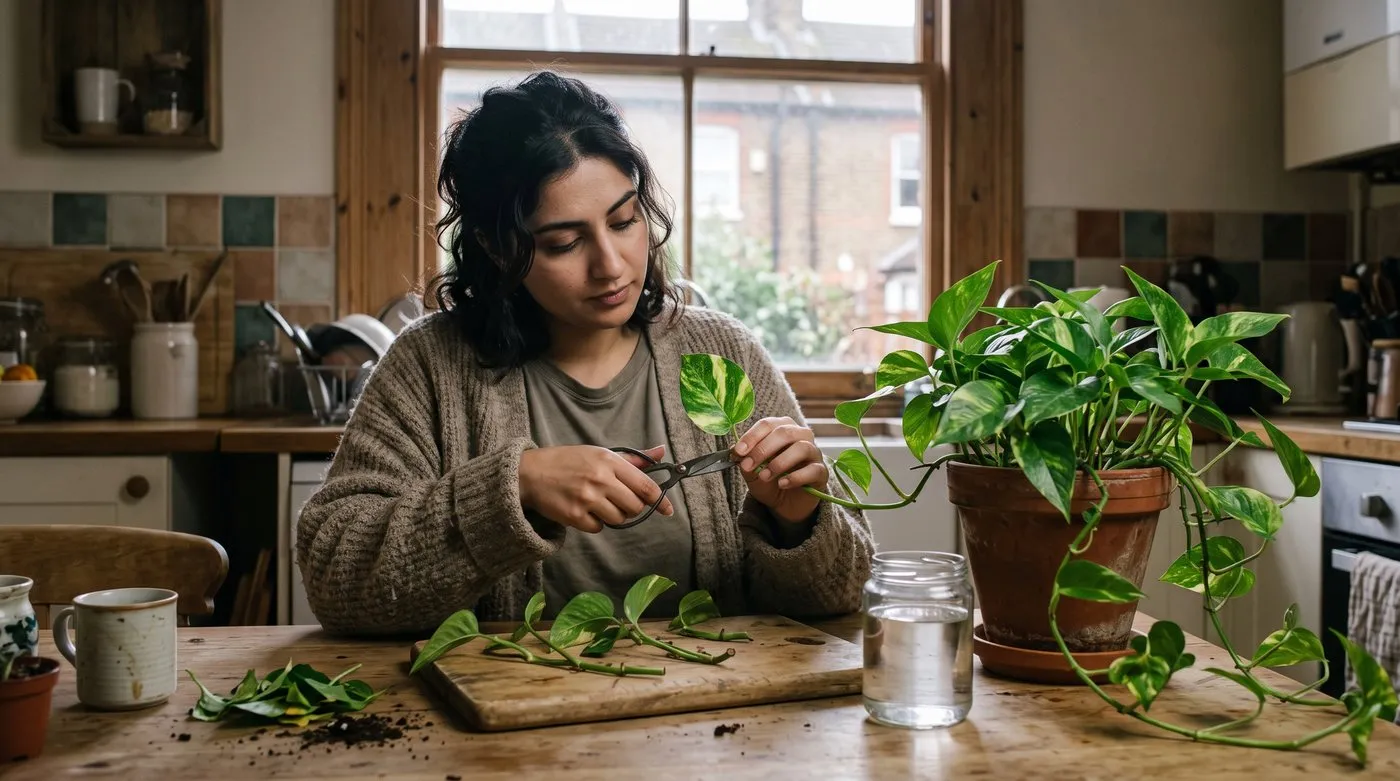
Every cutting needs a node, the little bump where a leaf joins the stem. Roots can only grow from there, so cut just below one.
Water propagation vs soil propagation
Water is easiest for beginners. Compost gives stronger roots and skips a step later. Both work for most houseplants.
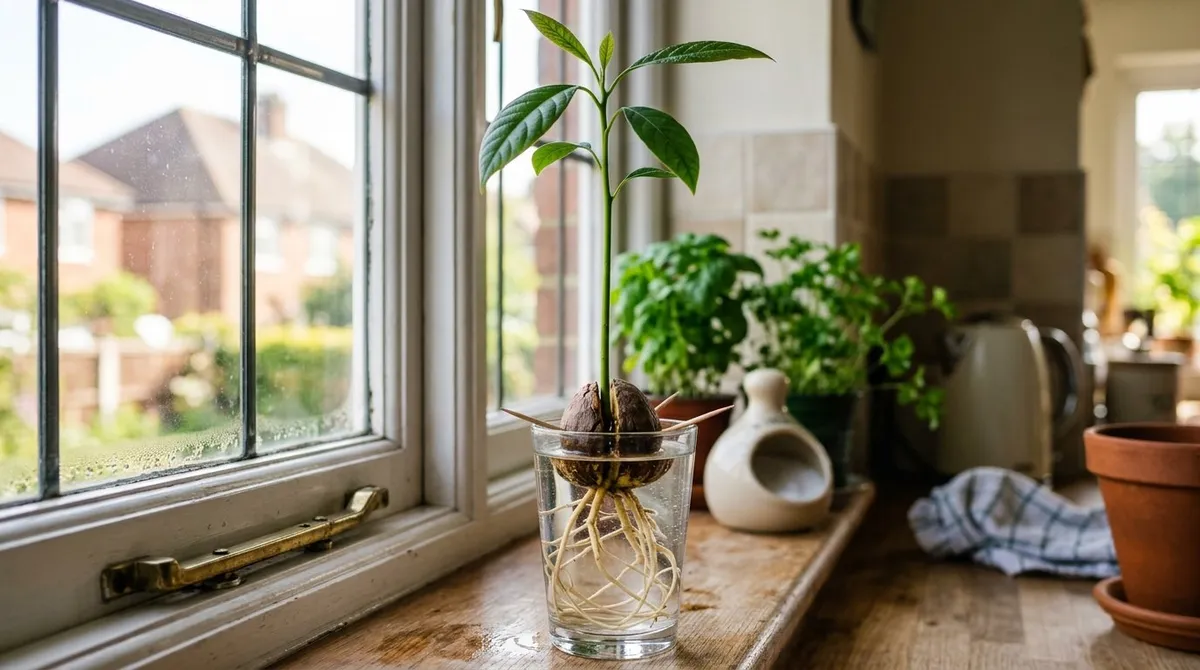
Water is lovely for beginners because you can see the roots growing and spot rot early. Use a clean glass of room-temperature water. Keep the node under water and all the leaves above it. Change the water every 3-4 days.
Roots grown in water are a bit different from roots grown in soil. They’re thinner and more delicate, so the plant has to adjust when you pot it up. Move cuttings into compost when the roots are 3-5cm long. Leave it much longer and they find the switch harder.
Compost skips that switch. The roots are used to soil from day one, so the plant settles in faster.
Use half perlite and half peat-free multipurpose compost, as the RHS suggests for houseplant cuttings. It holds some water but drains well. Push the cutting in 3-4cm deep, firm it gently and water lightly. Pop a clear plastic bag over it, or use a propagator, to keep the air humid.
The catch with compost is that you can’t see what’s happening. Look for new leaves or try the tug test. It’s also easier to rot a cutting if the compost is too wet.
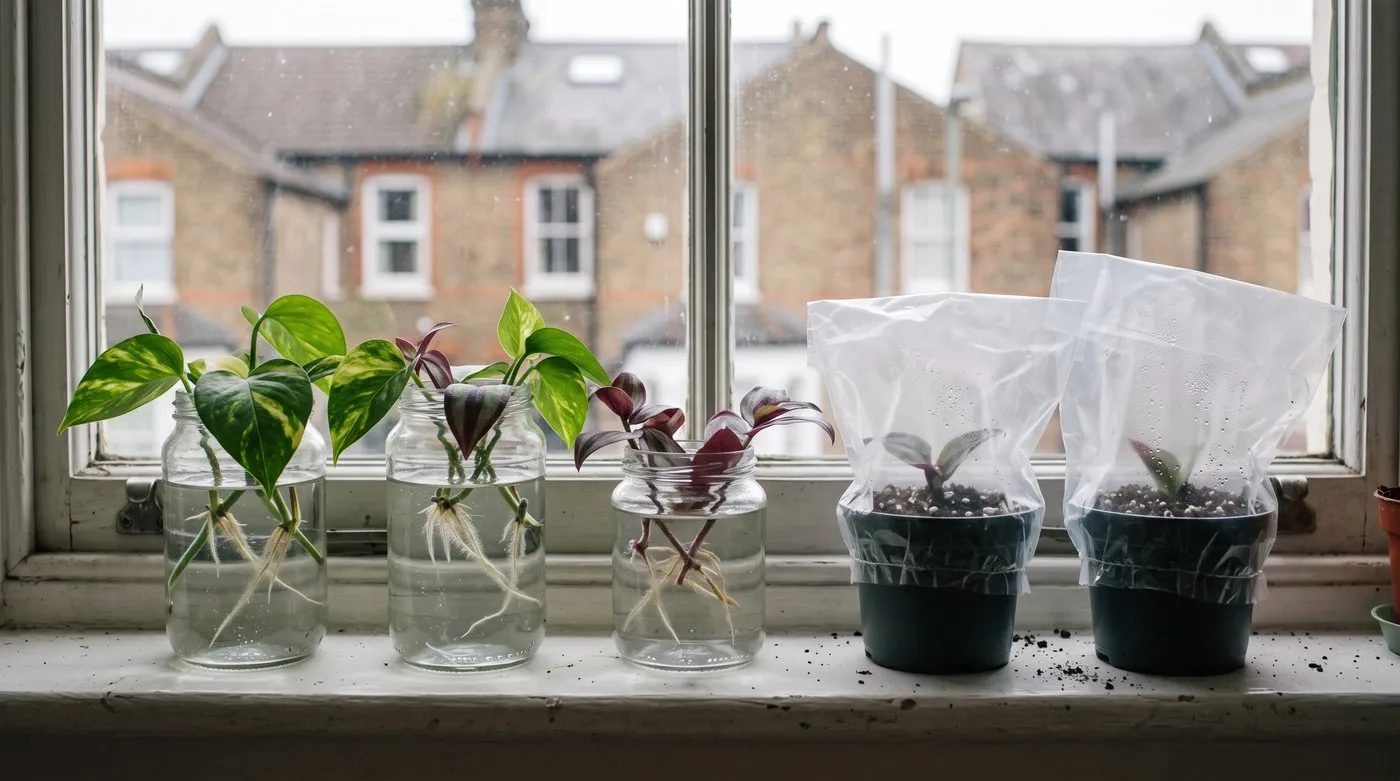
Pot up water-rooted cuttings when the roots reach 3-5cm. Leave them much longer and they struggle to switch to compost.
What can you use instead of perlite for cuttings?
Horticultural grit or fine gravel works well instead. Mix it about half and half with peat-free compost, just as you would perlite.
Grit is heavier, so it keeps tall cuttings like monstera or rubber plant steady. It holds a little less air, so water a bit less often. Vermiculite is good for African violet leaves, as it stays damp. Don’t use garden soil, which packs down hard in pots and can bring in pests.
| Water | Compost | |
|---|---|---|
| How easy | Easiest for beginners | Needs a little more care |
| See the roots? | Yes | No |
| Settling in later | Has to adjust to soil | No adjusting needed |
| Roots | Thinner, more delicate | Stronger |
| Risk of rot | Easy to spot early | Higher if too wet |
| Best for | Pothos, philodendron, tradescantia | Rubber plant, fiddle leaf fig, hoya |
How to propagate by leaf cuttings
Some houseplants can grow a whole new plant from one leaf. It’s a bit like magic: the leaf grows roots, then a tiny new plant pops up at its base.
Succulents are the classic example. Twist a healthy leaf off the stem rather than cutting it, so the base stays whole. Lay it on top of dry cactus compost. Don’t bury it or water it. After 3-5 days the end dries over. Then mist it very lightly every few days. Roots and a tiny rosette appear in four to eight weeks. Our guide to succulent care covers the right compost. A Christmas cactus roots the same way from two or three stem segments twisted off in spring.
African violets grow from a leaf pushed into compost. Cut a healthy leaf with 3-4cm of stalk. Push the stalk into damp vermiculite or perlite at an angle and cover with a clear bag. Baby plants appear at the base in six to ten weeks.
Begonias with big leaves can be cut into pieces, each with a main vein. Lay them vein-side down on damp compost and pin them flat with bent wire if they curl. New plants grow from the veins in six to eight weeks.
Snake plant leaves can be cut into 7-10cm sections and pushed upright into damp, gritty compost. Mark the bottom of each piece so you plant it the right way up. Roots and shoots appear in four to eight weeks. Varieties with yellow edges lose them when grown from leaf cuttings, so split those instead.
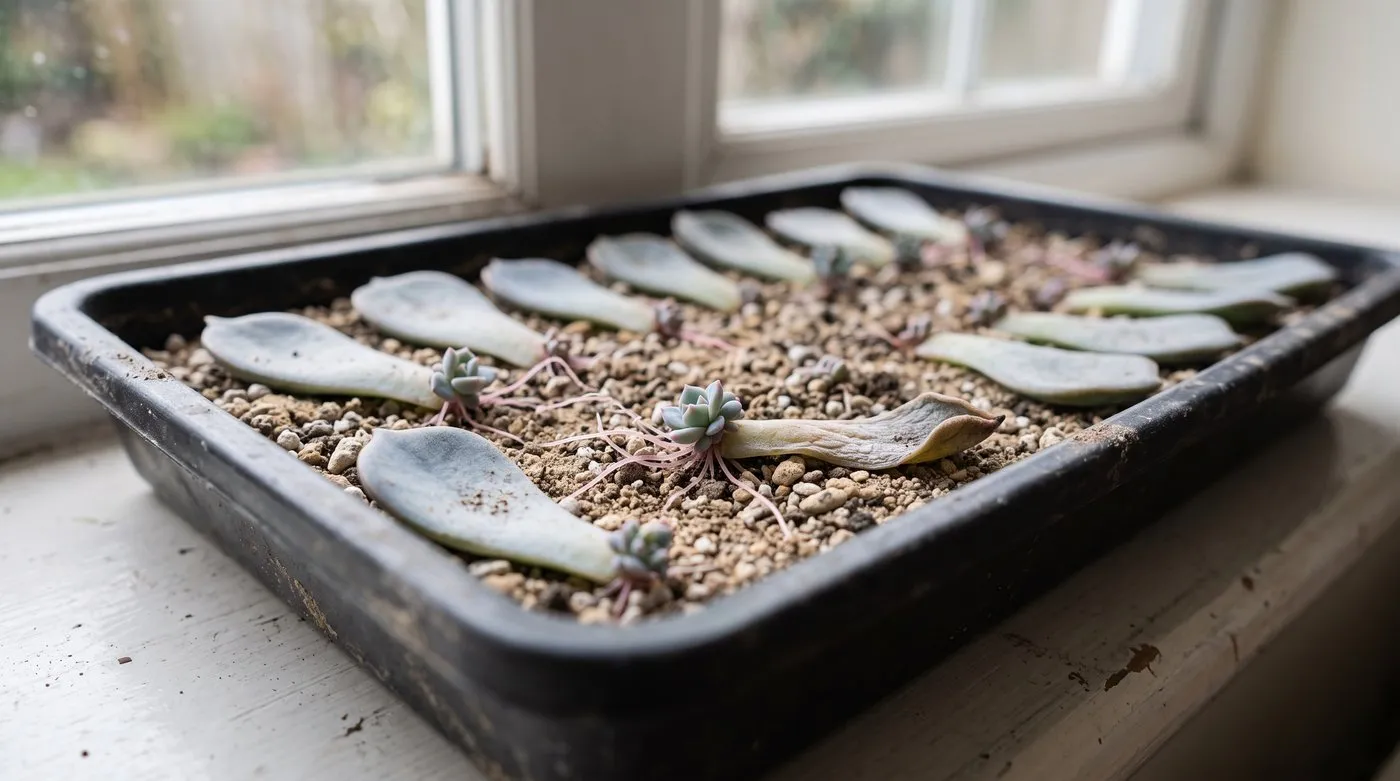
Lay succulent leaves on top of the compost rather than burying them. Wait a few days for the ends to dry, then mist very lightly.
How to propagate by division
Splitting a plant is the easiest, most reliable method. It works for any houseplant that grows as a clump of stems, and it rarely fails because each piece already has roots.
Step 1: Water the plant. Give it a good drink the day before. Damp roots come apart more easily.
Step 2: Take it out of the pot. Lay the pot on its side and slide the plant out. You may need to cut the pot off a big plant.
Step 3: Split the clump. Gently pull it apart into two to four pieces, each with at least three or four stems and some good roots. If the roots are tight, cut through with a clean knife. Losing a few roots is fine, especially in spring.
Step 4: Pot each piece. Plant each one in its own pot of fresh compost. Match the pot to the size of the roots, as a small piece doesn’t need a big pot.
Step 5: Water and settle. Water lightly and keep them in bright, indirect light for a week. New growth means they’ve settled in.
Peace lily, calathea, Boston fern, asparagus fern, Chinese money plant and most clumpy beginner houseplants split easily. Do it every two or three years when they outgrow their pots.
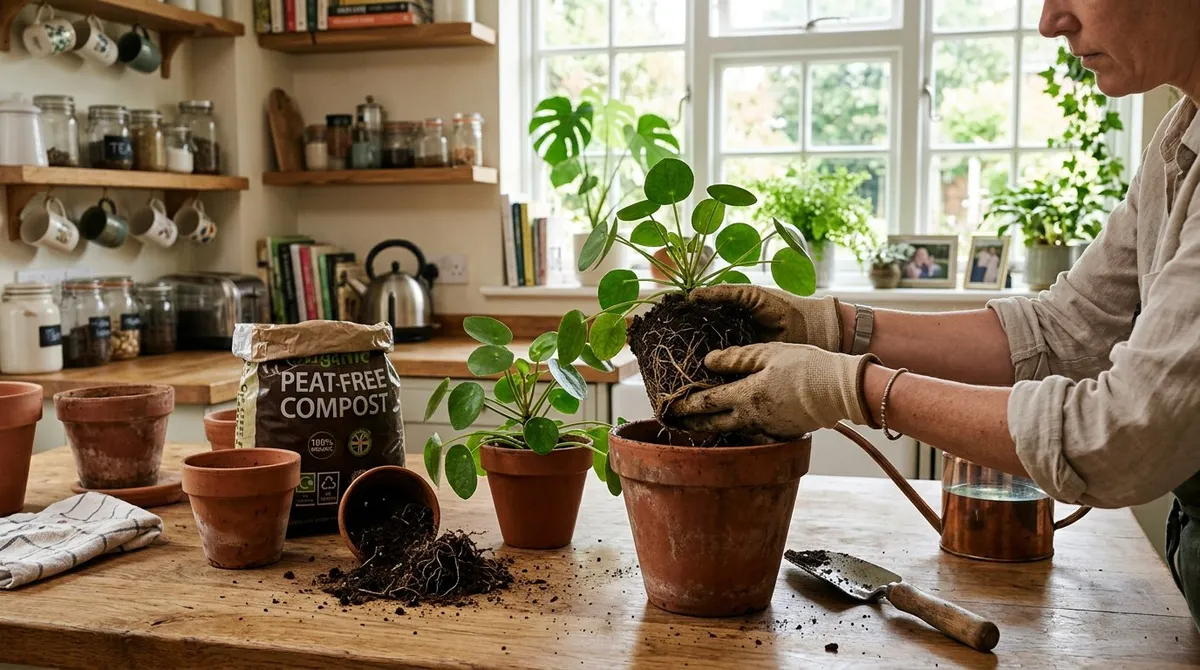
A peace lily split into three. Each piece has its own stems, leaves and roots.
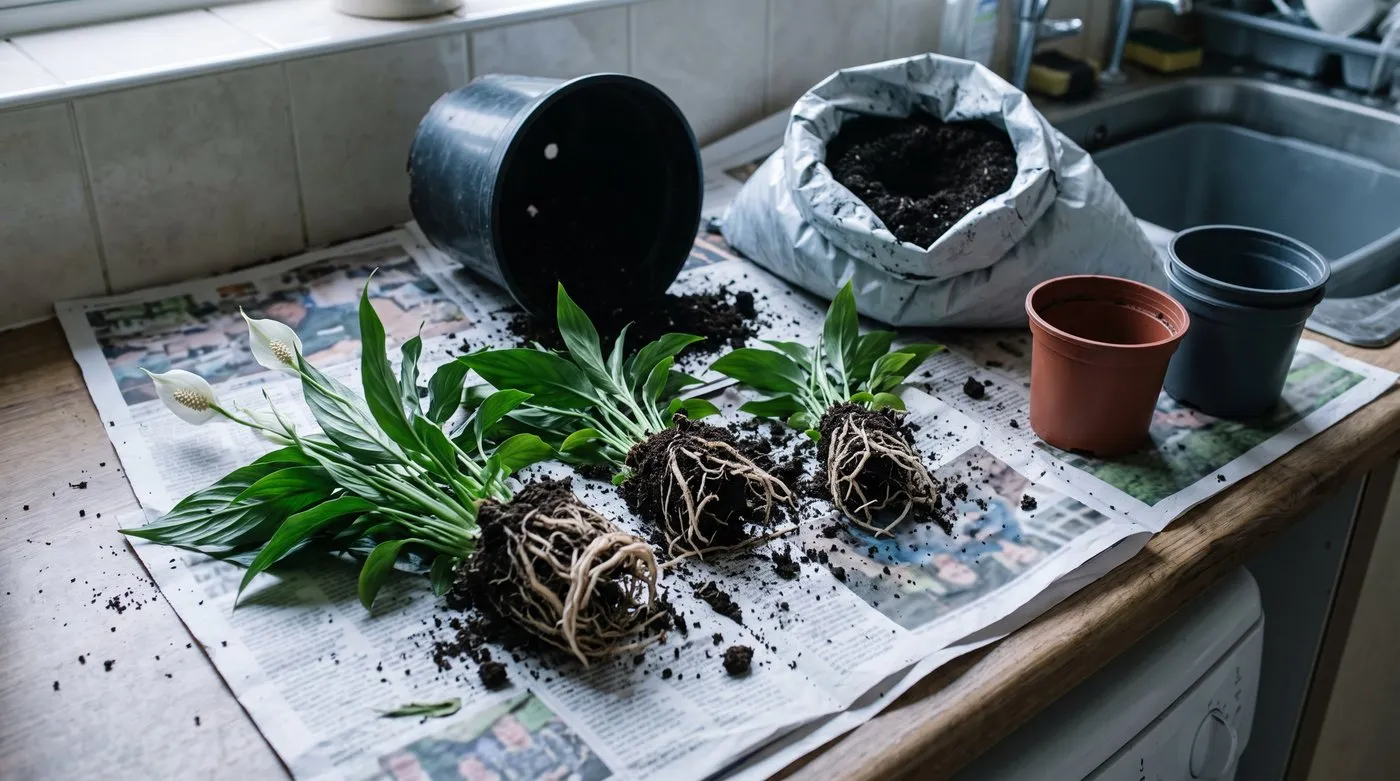
Give the plant a good drink the day before you split it. Damp roots pull apart far more easily, and each piece settles in faster.
How to propagate from offsets and pups
Some houseplants make mini copies of themselves at the base or on long stems. These babies, called offsets or pups, are exact copies of the parent and come with their own roots.
Spider plant babies dangle on long stems and grow little roots while still attached. Snip one off and pot it into damp compost. Or pin it into a small pot next to the parent while still attached, then snip it free once rooted. That almost never fails.
Aloe vera pups pop up round the base. Wait until one is at least 7-10cm tall with three or four leaves. Take the plant out of its pot and cut the pup away with a clean knife, keeping as many roots as you can. Pot it in gritty cactus compost and wait two or three days before watering.
Bromeliad pups appear at the base after the plant has flowered. The parent slowly dies afterwards. Wait until each pup is about a third the size of the parent, then cut it off and pot it up.
Chinese money plant (Pilea peperomioides) sends up babies from the soil and along the stem. Separate soil babies once they’re 5-7cm tall by cutting the root that joins them. Pot into normal compost and go easy on the water until they settle.
Haworthia and echeveria make babies round their base. Split them off when you repot in spring and put each one in its own small pot of gritty compost.
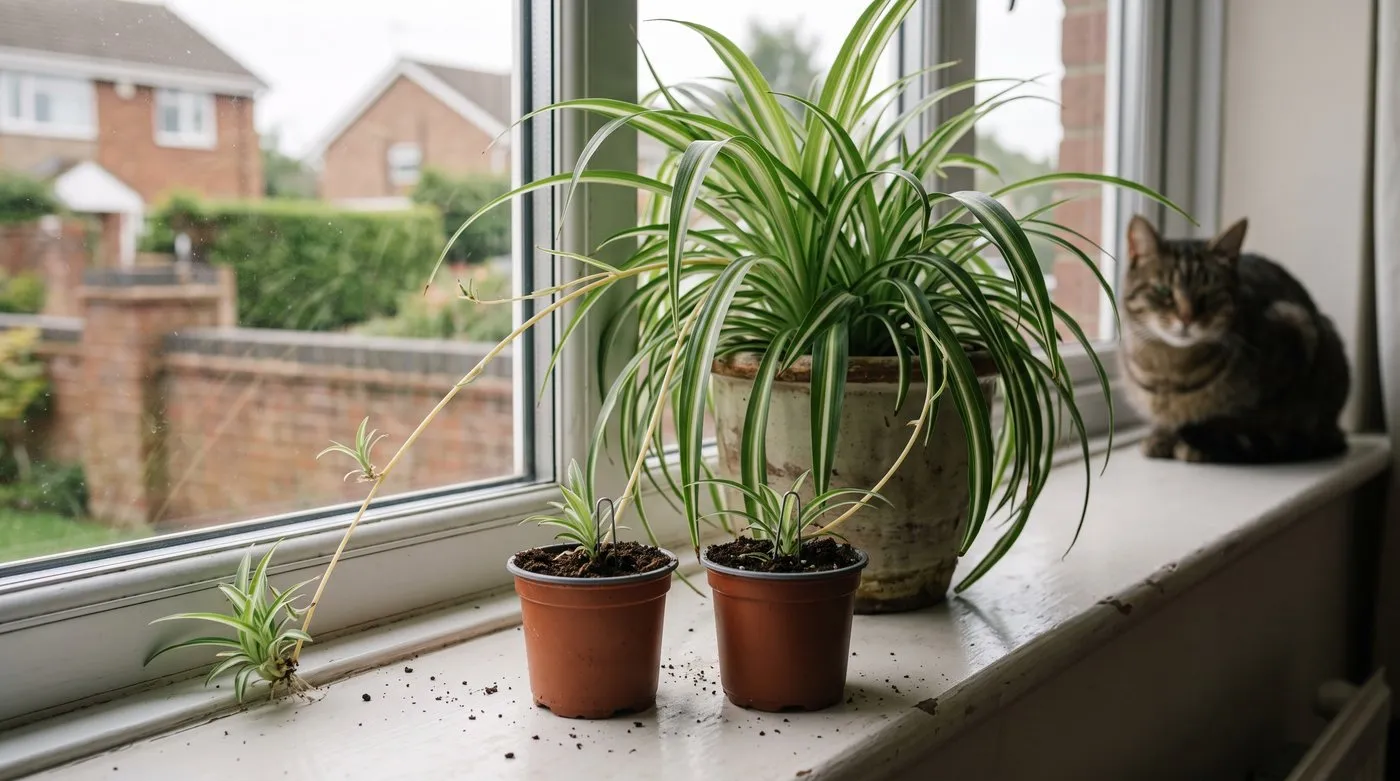
Pinning a spider plant baby into its own pot while it’s still attached almost never fails. Snip the runner once it has rooted.
How to propagate by layering indoors
Layering is the safest method of all. The stem stays attached to the parent and keeps being fed while it grows roots. Once it has roots, you cut it free.
Simple layering suits trailing and climbing plants. Put a small pot of damp compost next to the parent. Pin a bit of stem onto the compost with a bent paper clip or a small stone. A tiny nick under the stem where it touches the compost helps roots form. Keep it damp. Roots form in four to eight weeks, then snip it free.
Air layering is for tall, woody plants that have got too leggy. Make a 3cm upward cut a third of the way into the stem and wedge it open with a bit of cocktail stick. Wrap a ball of damp sphagnum moss round the cut, cover it with cling film and tape both ends. Roots grow into the moss over six to twelve weeks. Once you can see them, cut the stem below the roots and pot it up.
This works well for rubber plants, fiddle leaf figs, dracaenas and monstera. It’s a great way to shorten a leggy plant and get a new one at the same time. Our guide to garden propagation techniques covers layering outdoors.
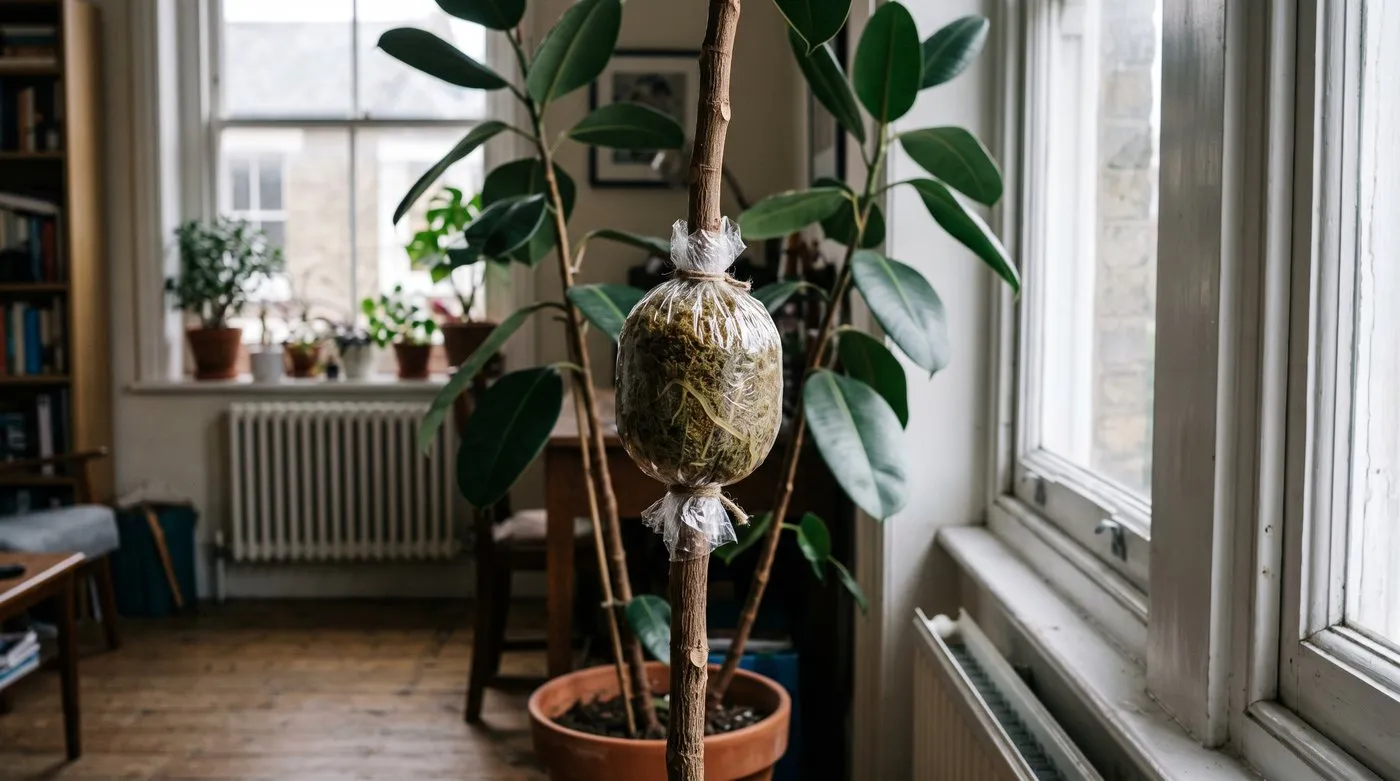
Air layering keeps the stem attached and fed while roots grow into the moss. Once you can see them through the film, cut below the roots and pot up.
Can you propagate a leggy houseplant?
Yes, and leggy plants make great cuttings, because long stems have plenty of nodes. Cut the stretched stems back in spring and root the tips in water or compost.
Trailing plants like pothos, tradescantia and string of hearts can be cut into several 10-15cm pieces, each with a node. Once rooted, pop them back into the parent’s pot to fill out the bare top. The parent usually sprouts again below the cuts.
For upright plants with a bare trunk, like rubber plants and dracaenas, air layer them at the height you want. Legginess usually means not enough light, so move the parent and the new plants closer to a bright window.
Equipment for propagating houseplants
You don’t need anything fancy. Most of it is already in your house.
Clean, sharp scissors or secateurs. The most important tool. A clean cut heals faster. Wipe the blades with rubbing alcohol or boiling water between plants.
Clean glass jars. For rooting in water. Clear glass lets you watch the roots.
Cutting compost. Half perlite and half peat-free multipurpose compost. Ready-made seed and cutting compost works too.
Rooting powder. Optional, but handy for trickier plants. Dip, tap off the extra, and plant.
Small pots (7-9cm). Small pots suit new cuttings. A big pot holds too much wet compost round tiny roots. Move up a size once the plant is growing well.
Clear plastic bags or a propagator. A bag keeps the air humid so leaves don’t wilt. Take it off for half an hour a day to stop mould. A heated propagator helps but isn’t essential. Want even more free plants? Learning to save seeds is another cheap way to do it.
Houseplant propagation comparison table
Here’s the best method, how easy it is and how long it takes for 14 popular houseplants.
| Plant | Best method | How easy | Time to root | Best time |
|---|---|---|---|---|
| Pothos | Stem cutting in water | Very easy | 2-3 weeks | April to July |
| Spider plant | Babies on runners | Very easy | 1-2 weeks | Spring to summer |
| Tradescantia | Stem cutting in water | Very easy | 1-2 weeks | April to July |
| Monstera | Stem cutting in compost | Easy | 3-4 weeks | May to July |
| Snake plant | Splitting or leaf cutting | Easy | 4-8 weeks (leaf) | April to June |
| Peace lily | Splitting | Easy | Straight away | March to May |
| Rubber plant | Air layering | Medium | 6-10 weeks | May to July |
| Fiddle leaf fig | Air layering | Medium | 8-12 weeks | May to July |
| Philodendron | Stem cutting in water | Easy | 2-3 weeks | April to July |
| Echeveria | Leaf cutting | Easy | 4-8 weeks | April to August |
| African violet | Leaf cutting | Medium | 6-10 weeks | April to June |
| Hoya | Stem cutting in compost | Medium | 4-8 weeks | May to July |
| Chinese money plant | Babies | Very easy | 2-3 weeks | Spring to summer |
| Aloe vera | Pups | Easy | 2-4 weeks | April to July |
Common propagation mistakes and how to avoid them
Most failures come down to a handful of easy-to-fix slips.
Cutting in the wrong place. Roots grow from nodes, so a cutting from a bare bit of stem won’t root. Always cut just below a node, the bump or ring where a leaf joins.
Too many leaves. A cutting with lots of big leaves loses water faster than it can drink, and wilts. Leave just two or three. On big-leaved plants like monstera, you can cut leaves in half across.
Dirty tools. Germs on blades get straight into the cut. Wipe them between plants and use a clean jar.
Not changing the water. Stale water goes cloudy and smelly, and the cutting rots from the bottom. Change it every 3-4 days with room-temperature tap water.
Too much sun. Without roots, cuttings can’t replace the water they lose. Keep them in bright, indirect light. A north or east-facing windowsill is ideal in summer.
Soggy compost. Too much water drowns new roots. Squeeze a handful: if water runs out, it’s too wet. Add more perlite.
Leaving water roots too long. Long, tangled water roots struggle in compost. Pot up when roots are 3-5cm long, and keep the compost damp for the first two weeks.
Using a poorly plant. A cutting from a pest-ridden or sickly plant brings its problems with it. Always take cuttings from healthy plants.
Left: healthy white roots on a pothos cutting. Right: a rotted cutting with a brown, mushy base from stale water.
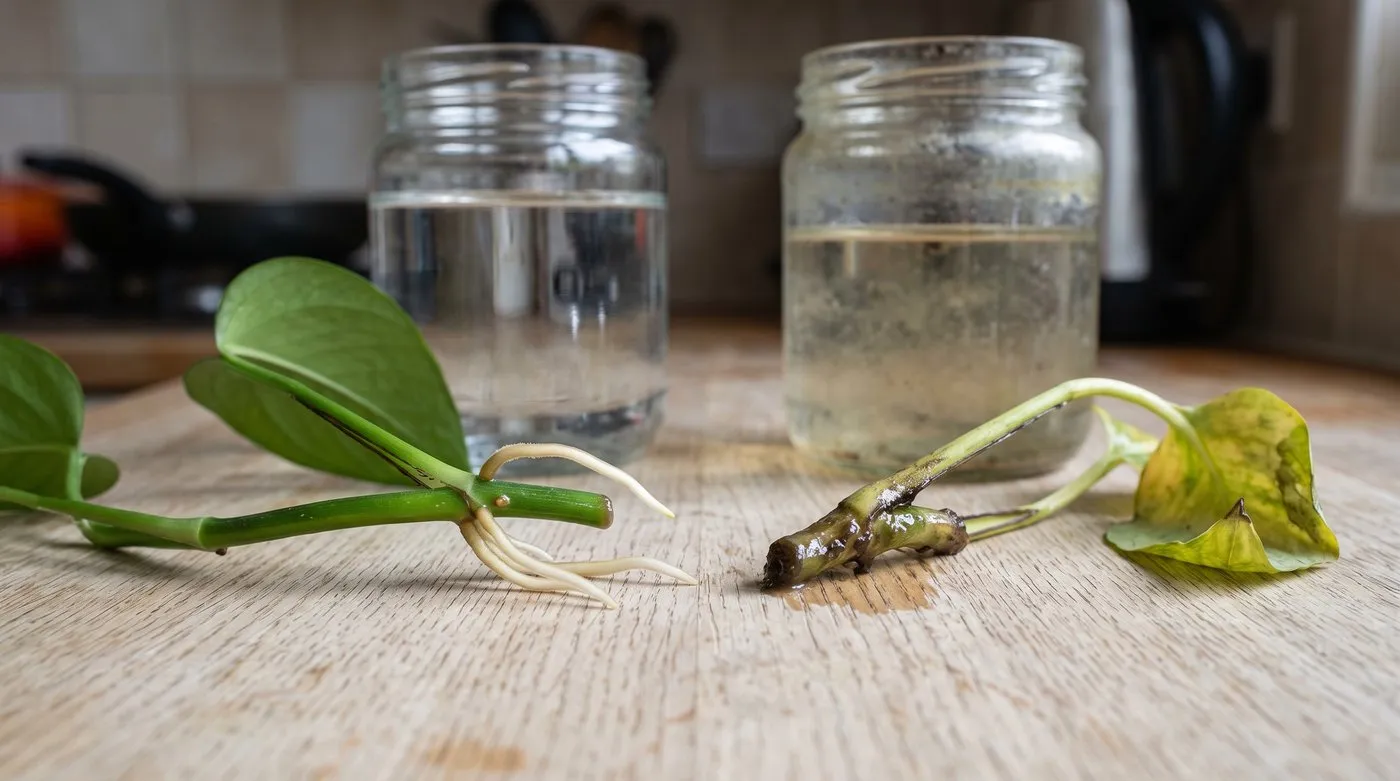
Stale water is the usual reason cuttings rot. Change it every 3-4 days and keep every leaf above the waterline.
Is it legal to propagate patented houseplant varieties?
Yes, for your own use. Lots of named varieties are protected by plant breeders’ rights, often shown as “PBR” on the label. You can still root cuttings for your own home or give spares to friends for free. Selling plants of a protected variety, at a car boot, online or at a plant sale, needs the breeder’s permission. Old favourites like spider plants and plain green pothos usually aren’t protected.
How to care for newly rooted cuttings
New plants need a small pot, steady moisture, bright indirect light and no feed for the first month or so. Their roots are still tiny.
Pot size. Start in a small 7-9cm pot. A big pot holds lots of wet compost that tiny roots can’t use, and they rot.
Watering. Keep the compost lightly damp for the first two or three weeks. Don’t let it dry out. Once new leaves appear, water as you would for that plant normally.
Light. Bright, indirect light, with no direct sun for the first two or three weeks.
Feeding. Wait four to six weeks before feeding. Fresh compost has enough food, and feed can scorch tiny roots.
Humidity. Young plants like humid air. Group them together or stand them on a tray of wet pebbles. A light misting is fine for leafy cuttings (not succulents) until they settle.
Patience. New plants can look like they’re doing nothing for weeks. The roots are busy underneath. Don’t overwater out of worry and don’t keep moving them. If your spot is a bit dim, our guide to low-light houseplants can help.
Once your new plants outgrow their pots, read our guide on how to repot houseplants.
Frequently asked questions
What is the easiest houseplant to propagate?
Pothos is the easiest of the lot. Snip a stem below a node, pop it in water, and roots appear in two or three weeks. Spider plants are just as easy, as their babies already have little roots. Tradescantia roots in water in no time too.
Can you propagate houseplants in winter?
You can, but it’s much harder. Most houseplants grow slowly from November to February, and windowsills get chilly at night. Cuttings root slowly and are more likely to rot. Wait until April if you can.
Why are my cuttings rotting in water?
Usually stale water or leaves sitting under the water. Leaves below the waterline rot and spread it to the stem. Change the water every 3-4 days, strip off the lower leaves and use a clean jar. If it keeps happening, try rooting in damp perlite instead.
Do I need rooting hormone for houseplant cuttings?
Not for the easy ones. Pothos, tradescantia, spider plants and philodendrons root happily without it. For slower plants like rubber plants, fiddle leaf figs and hoyas, a dip in rooting powder can help. Powder is the easiest kind to use.
How long do houseplant cuttings take to root?
Most take two to four weeks in spring and summer. Pothos and tradescantia can show roots in about 10 days. Rubber plants take four to eight weeks, and so do succulent leaves. Air layering takes six to twelve weeks.
Should I propagate in water or soil?
Either works for most houseplants. Water is great for beginners because you can watch the roots grow. Compost gives stronger roots that don’t need to adjust later. Always use dry, gritty compost for succulents and cacti, as they rot in water.
Can I propagate a houseplant from a single leaf?
Only some plants grow from a single leaf. Succulents like echeveria and sedum do, and so do African violets and begonias. Snake plant leaves can be cut into sections too. Most others need a piece of stem with at least one node.
Our team produces practical UK gardening guidance from source research, contributor records and established horticultural practice. Editorial standards are overseen by Matt W.