Key takeaways
- An east or west-facing windowsill gives the bright, gentle light it likes
- Dry air from central heating makes it drop needles, so mist it or use a pebble tray
- Water when the top 2-3cm of compost feels dry, and never leave it standing in water
- It isn't a true fern but a cousin of the asparagus you eat
- The berries are harmful to pets and children, and the sap can irritate skin
- Divide crowded plants in spring to get more for free
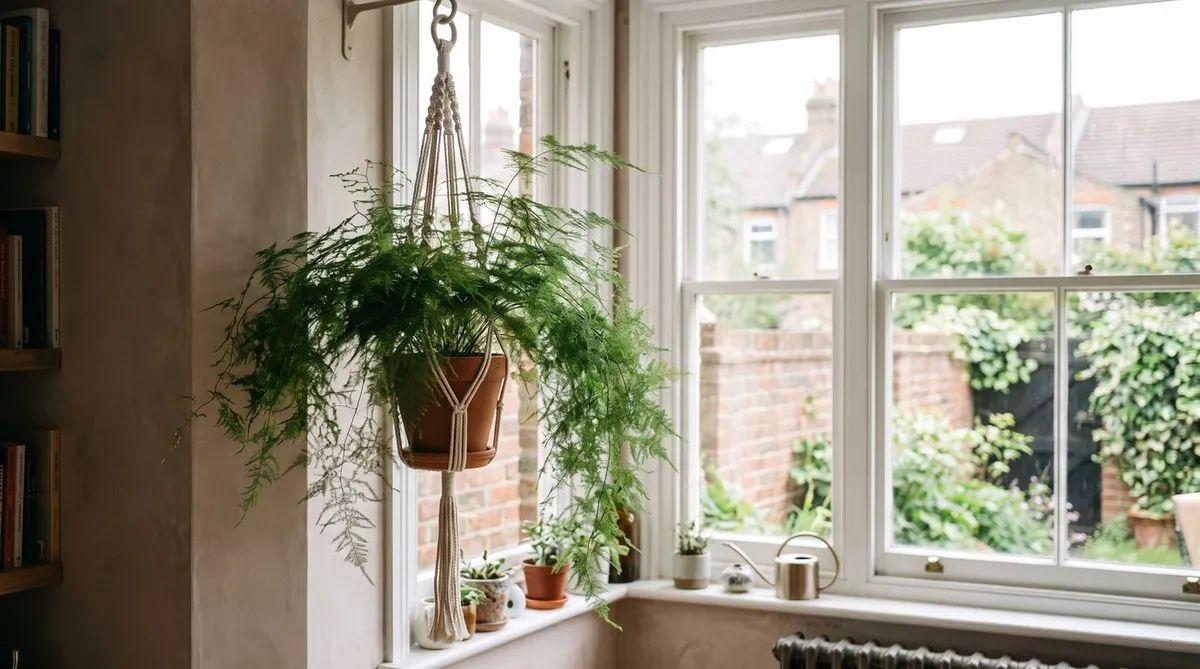
The asparagus fern is a lovely, soft and feathery houseplant that trails beautifully from shelves and hanging baskets. Despite the name, it isn’t a fern at all. It’s a cousin of the asparagus you might grow in the veg patch.
Give it bright light without hot sun, keep the air around it moist, and it’ll reward you with clouds of fresh green growth. One thing to know up front: the berries are harmful to cats, dogs and children.
Tip: A tired, half-bare asparagus fern often bounces back once it’s moved somewhere bright and humid, like a bathroom windowsill, and misted regularly.
What does asparagus fern need?
Bright light without hot sun, a warm room and moist air. It isn’t hard to grow, but its needs are a little different from many popular indoor plants.
| What it needs | In practice |
|---|---|
| Light | Bright but no hot direct sun, so an east or west window is ideal |
| Warmth | A normal heated room. Keep it away from cold draughts and frost |
| Moist air | Mist, use a pebble tray or grow it in a bright bathroom |
| Compost | Ordinary houseplant compost with some perlite |
| Pets and children | Berries harmful if eaten. Sap can irritate skin |
Keep it away from pets and small children. Eating the red berries can cause vomiting, diarrhoea and tummy pain, and handling the stems a lot can irritate skin. If you have pets, have a look at our guide to plants toxic to cats before deciding where it goes. The RHS entry for Asparagus setaceus also notes it can irritate skin and the fruit is harmful if eaten.

Those fine, feathery layers are what make asparagus fern so pretty.
Which asparagus fern should you choose?
Pick A. setaceus for trailing, ‘Sprengeri’ for a tough arching plant, or ‘Myers’ for upright plumes. These are the three you’ll see most in garden centres, and they all need the same care.
| Type | Common name | Shape | Size indoors | How easy |
|---|---|---|---|---|
| A. setaceus (plumosus) | Lace fern | Climbing or trailing | Trails up to about 2m | Easy |
| A. densiflorus ‘Sprengeri’ | Sprengeri fern | Arching | 60-90cm across | Easy |
| A. densiflorus ‘Myers’ | Foxtail fern | Upright plumes | About 60cm tall | Medium |
A. setaceus has the finest, softest leaves, in flat, cloud-like layers. It’s perfect trailing from a high shelf or a hanging basket. Florists love the cut stems for bouquets.
‘Sprengeri’ is the toughest of the three. Its arching stems have longer, coarser needles and cope better with drier air. It has small white flowers in summer, then red berries. A great pick for beginners.
‘Myers’, the foxtail fern, grows in upright, bottlebrush-like plumes. It looks smart on a table or windowsill where a trailing plant would get in the way. It likes slightly more light than the others.

Left to right: A. setaceus with fine trailing fronds, Sprengeri with arching stems, and Myers foxtail fern with upright plumes.
Where to put asparagus fern in a UK home
It wants bright light but not hot midday sun. In the wild it grows in dappled shade, and a sunny south-facing window in summer can scorch it in days.
East or west-facing windowsills are ideal. East windows give soft morning sun. West windows give warm afternoon light without the midday blast.
North-facing windows are usually too dark, especially in winter. If that’s all you have, a grow light helps. Unlike a low light houseplant such as a ZZ plant, asparagus fern won’t cope with deep shade. It soon goes leggy and bare.
How to water asparagus fern
Water when the top 2-3cm of compost is dry, and never leave it standing in water. It stores water in chunky roots, so it copes with a short dry spell. It still likes compost that stays lightly moist, not wet.
Do the finger test. Push a finger into the compost. If it’s dry at your fingertip, water well until it runs out of the bottom. Tip away what’s left in the saucer after half an hour. Soggy roots are the most common way to lose one.
In summer that’s roughly once a week, and in winter every couple of weeks. Always check first rather than going by the calendar. Use room-temperature water rather than icy water from the tap. Rainwater is ideal.
How to keep the air moist
Use a pebble tray, group it with other plants, mist it, or grow it in a bright bathroom. Dry air is where most people go wrong with this plant. Central heating makes rooms very dry from autumn to spring, and the needles dry out and drop, leaving bare stems.
Four easy fixes:
- Misting. Spray the leaves with a fine mister each morning. It helps, but only if you keep it up.
- Pebble tray. Fill a tray with pebbles and add water to just below the tops. Stand the pot on the pebbles. As the water dries off, it moistens the air around the plant.
- Grouping. Cluster it with other plants. Together they keep the air around them moister.
- Bathroom. A bathroom with natural light is naturally steamy, and asparagus ferns love it.
A cheap hygrometer, a little gadget that shows how damp the air is, takes out the guesswork.
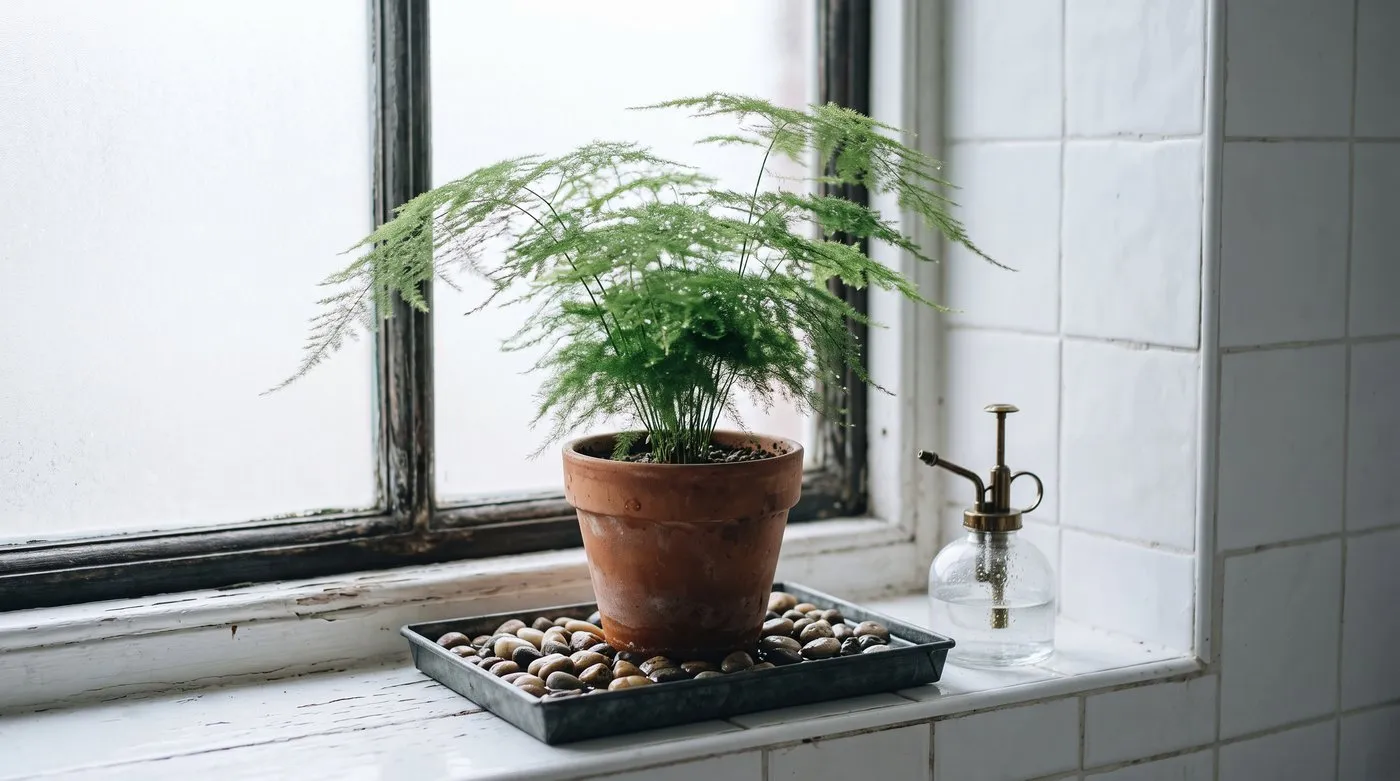
A bright bathroom and a pebble tray make asparagus fern very happy. Moist air is the cure for those dropping needles.
How to feed and repot asparagus fern
Feed every two weeks from April to September with a balanced liquid houseplant feed at half strength. It doesn’t need much, and too much feed can burn the fine roots. Stop feeding from October to March.
Repot every two or three years in spring. Its chunky roots fill pots fast, push the compost up and can even crack plastic pots. Move it into a pot one size bigger, using houseplant compost mixed with some perlite. Our guide on how to repot houseplants walks you through it.
Does asparagus fern like being root-bound?
It’s happy a little snug, but not crammed. A pot packed solid with roots dries out fast and the plant stops growing.
Repot when you see:
- Roots and pale, chunky tubers pushing the compost up over the rim
- Roots growing out of the drainage holes
- Water running straight through without soaking in
- A plastic pot bulging or splitting
To keep it the same size, divide it rather than moving it into a bigger pot. Trim off any soft or dead tubers while you’re at it.
Wear gloves when repotting. Older stems carry small, sharp thorns that are easy to miss.
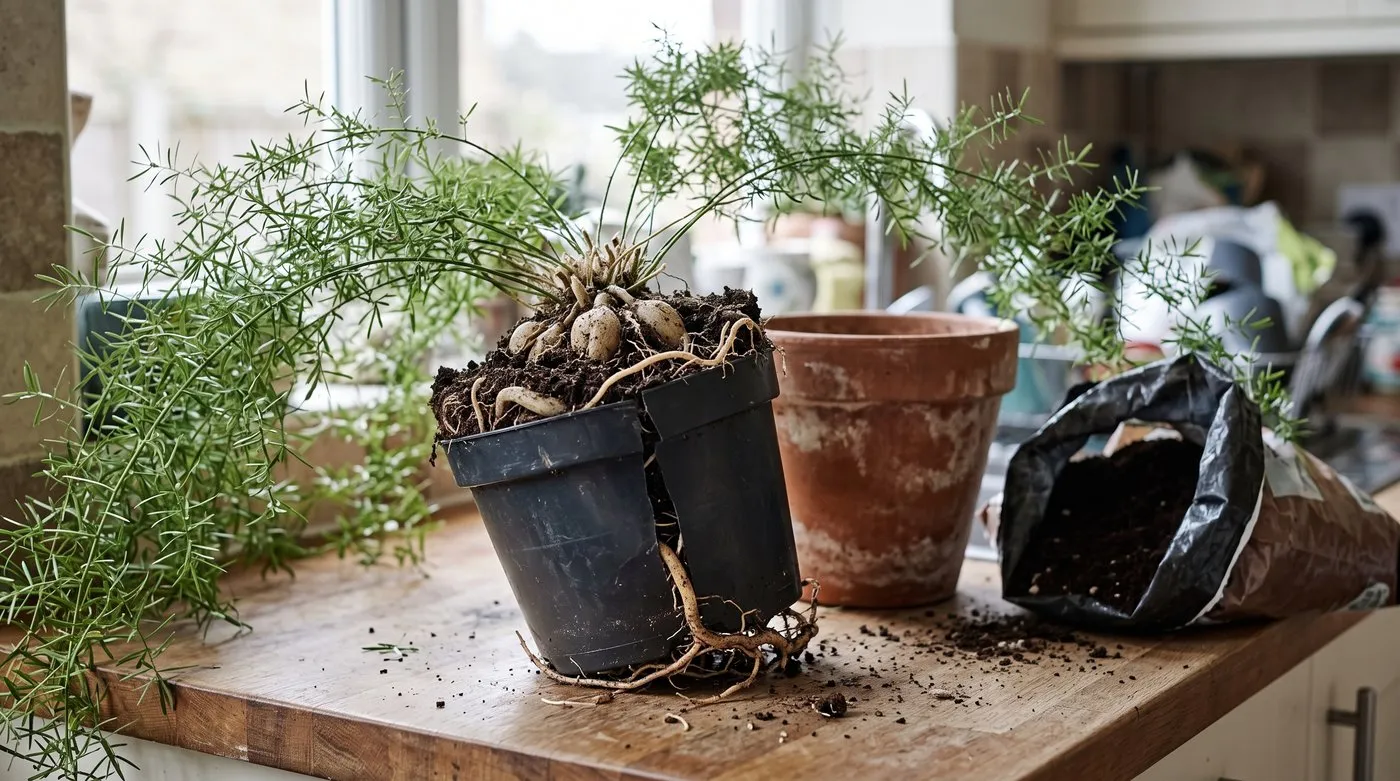
Tubers pushing the compost up and a bulging pot mean it’s time to move up a size, or divide it if you want to keep it the same size.
How to propagate asparagus fern
Dividing it in spring is the easiest way. Tip the plant out of its pot and cut the root mass into pieces with a clean, sharp knife. Make sure each piece has three or four stems and a good cluster of chunky roots. Pot each one into fresh compost and water well.

Dividing an asparagus fern in spring. Each piece needs a few stems and some chunky roots.
You can grow it from the seeds inside the berries, but it’s slow and hit-and-miss. Soak the seeds in warm water overnight, sow them 1cm deep in moist compost and keep them somewhere warm. They can take over a month to come up. Division is much quicker. Our guide to how to propagate houseplants covers both ways.
Quick reminder: if your plant has berries and you have children or pets, pick them off.
Fixing common asparagus fern problems
Most problems come down to light, dry air or watering.
| Problem | Likely cause | Fix |
|---|---|---|
| Yellowing | Too much direct sun or too much water | Move out of direct sun. Check the pot drains |
| Dropping needles | Dry air | Mist daily, use a pebble tray, or move to a bathroom |
| Leggy, bare stems | Not enough light | Move somewhere brighter. Cut bare stems to the base |
| Brown, crispy tips | Too dry, or too much feed | Water more often. Flush the compost with plain water |
Yellowing is often misread. People think it needs more light and move it into the sun, which makes it worse. Asparagus fern yellows from too much sun, not too little. Move it back from the window or add a net curtain.
Dropping needles are why people think this plant is fussy. It isn’t, it just hates the dry air central heating creates. Sort out the air and the needle drop soon stops.
How do you revive a dying asparagus fern?
Cut every stem back to the compost and let it regrow from the roots. Those chunky roots store enough energy to send up fresh shoots.
First, check the roots. Tip the plant out and squeeze a few tubers. Firm, pale ones mean it’s alive. Soft, brown, smelly ones are rotten, so cut them off and repot the healthy pieces in fresh compost.
After cutting back, keep the compost barely moist and put it in bright light, out of hot sun. Don’t feed until new shoots appear. In spring and summer, fresh growth usually shows within a few weeks. Winter recovery is slower.
What pests attack asparagus fern?
Red spider mite, scale insects and mealybugs are the main ones. All three love warm, dry, centrally heated rooms.
- Red spider mite: fine webbing and pale, speckled leaves that drop. Give the plant a shower, raise the moisture in the air and keep it away from other houseplants.
- Scale insects: small brown bumps on the stems, often with sticky stuff below. Wipe them off with a damp cloth or cotton bud.
- Mealybugs: white, fluffy clusters where needles meet stems. Pick them off with a damp cotton bud.
Check your plant every couple of weeks in winter. The RHS houseplant growing guide has more on red spider mite and other common houseplant problems.
Month-by-month asparagus fern care
| Month | Job | Details |
|---|---|---|
| January | Keep the air moist | Heating at its peak, so mist daily |
| February | Look for pests | Scale and spider mite like warm, dry air |
| March | Tidy up | Cut dead or bare stems to the base |
| April | Start feeding and repot if needed | Half-strength feed every two weeks. Divide crowded plants |
| May | Water more | About once a week as it warms up |
| June | Pop it outside (optional) | Sheltered shade only, never direct sun |
| July | Watch for berries | Pick them off if you have pets or children |
| August | Keep feeding and watering | Check it hasn’t outgrown its pot |
| September | Bring it in | Before the nights turn cold |
| October | Water less | Every couple of weeks. Stop feeding |
| November | Mist more | Heating dries the air, so mist daily |
| December | Rest | No feed, little water, bright light |
In Scotland and northern England, bring plants back inside by late August, as nights cool down sooner.
Frequently asked questions
Is asparagus fern toxic to cats?
Yes, it’s harmful to cats. Eating the berries can cause vomiting, diarrhoea and tummy pain. Touching the stems often can also irritate skin, in pets and people. Keep the plant on a high shelf or in a room your cat can’t get into. If your cat chews any of it, call your vet straight away.
Why is my asparagus fern turning yellow?
Usually it’s getting too much direct sun. A south-facing window in summer can scorch it. Move it to an east or west-facing spot. Too much water can also turn it yellow, so check the compost isn’t soggy and the pot drains freely.
How often should I water an asparagus fern?
When the top 2-3cm of compost feels dry. That’s roughly once a week in summer and every couple of weeks in winter. Its chunky roots store water, so it copes with a short dry spell better than with soggy compost. Always tip away water left in the saucer.
Can asparagus fern grow outside in the UK?
Not all year round, as frost kills it. You can stand the pot outside in a sheltered, shady spot from June to September. Bring it back in before the nights turn cold in autumn.
How do I stop my asparagus fern dropping needles?
Raise the moisture in the air around it. Central heating makes rooms very dry in winter, and that’s what makes it drop needles. Mist the leaves daily, stand the pot on a tray of wet pebbles, or group it with other plants. A bright bathroom is another great spot.
Is asparagus fern a real fern?
No, it just looks like one. It’s a cousin of the asparagus you eat. True ferns spread by spores, while asparagus fern has flowers and berries. The name comes from its soft, feathery, fern-like leaves.
Should I prune my asparagus fern?
Yes, give it a tidy in early spring. Cut dead, yellow or bare stems right down to the base before new growth starts. Fresh shoots soon come up from the middle. Wear gloves, as older stems hide small thorns.
Our team produces practical UK gardening guidance from source research, contributor records and established horticultural practice. Editorial standards are overseen by Matt W.


