
Key takeaways
- Bright light out of direct sun gives the most flowers, and shade keeps it alive but with few blooms
- Keep it between 12C and 24C, away from radiators and cold draughts
- Brown tips usually mean dry air, too much water or hard tap water
- White flowers fade to green after a few months, which is normal, so just cut them off
- Feed every few weeks from April to October, then stop for winter
- It's poisonous to cats, dogs and children if chewed, so keep it out of reach
The peace lily is one of the most forgiving house plants for UK homes. Most of its problems come from dry central heating, hard tap water and dark winter days. Get those right and you’ll dodge most yellow leaves, brown tips and years without flowers.
What light does a peace lily need?
Bright light out of direct sun gives the most flowers, but peace lilies cope with shadier spots too. The RHS peace lily guide suggests a spot near a window, out of direct summer sun. In deep shade it grows slowly and rarely flowers. Its showier cousin with red flowers needs a bit more light, and our anthurium care guide explains the differences.
An east-facing window is the best spot all year round. It gets gentle morning sun without the midday heat of south-facing glass. North-facing rooms are fine for leaves, but expect fewer flowers, especially from October to March.
| Spot in a UK home | How a peace lily gets on |
|---|---|
| South-facing sill in summer | Too bright, leaves may scorch |
| East or west-facing sill | Good light, flowers well |
| North-facing sill | Healthy leaves, fewer flowers |
| Middle of a room | Slow growth, few or no flowers |
Strong midday sun through a south-facing window can scorch the leaves, leaving pale or brown patches. If that’s your only room, stand the plant back from the glass or behind a net curtain. For more plants that cope with dim rooms, see our guide to low-light houseplants.

A peace lily in full bloom. The white “petal” is really a hood that wraps around the central spike.
What a peace lily likes in a UK home
Steady warmth, a bit of humidity and compost that stays lightly moist but drains well. Here’s a quick guide.
| What | What it likes | What it hates |
|---|---|---|
| Temperature | 12-24C | Cold draughts, hot radiators |
| Air | Slightly humid | Dry, centrally heated air |
| Compost | Top dries a little between drinks | Standing water in the saucer |
| Water | Rainwater or filtered water | Hard tap water month after month |
| Potting mix | Peat-free multipurpose with perlite | Heavy compost that stays wet |
Winter brings two problems. Windowsills get much colder at night than the rest of the room, especially behind closed curtains. And central heating dries the air. A bit of thought about where you put the plant fixes both.
How to water a peace lily in hard water areas
Use rainwater or filtered water if you can, and flush the compost now and then. Much of the south and east of England has hard water. Scotland, Wales and the north-west mostly have soft water.
In hard water areas, minerals slowly build up in the compost. You’ll spot a white crust on the surface and crispy brown leaf tips.
Three easy fixes:
Filtered water. A jug filter takes out some of the hardness. Let it warm to room temperature before you use it.
Rainwater. Rainwater is naturally soft. A water butt, or even a bucket left out in the rain, gives you plenty for a few house plants. Orchids love it too.
A good flush. Every month or two in spring and summer, pour plenty of water through the compost and let it drain right away. This washes out the build-up.
Always use water at room temperature. Icy water straight from the tap in winter can chill the roots.
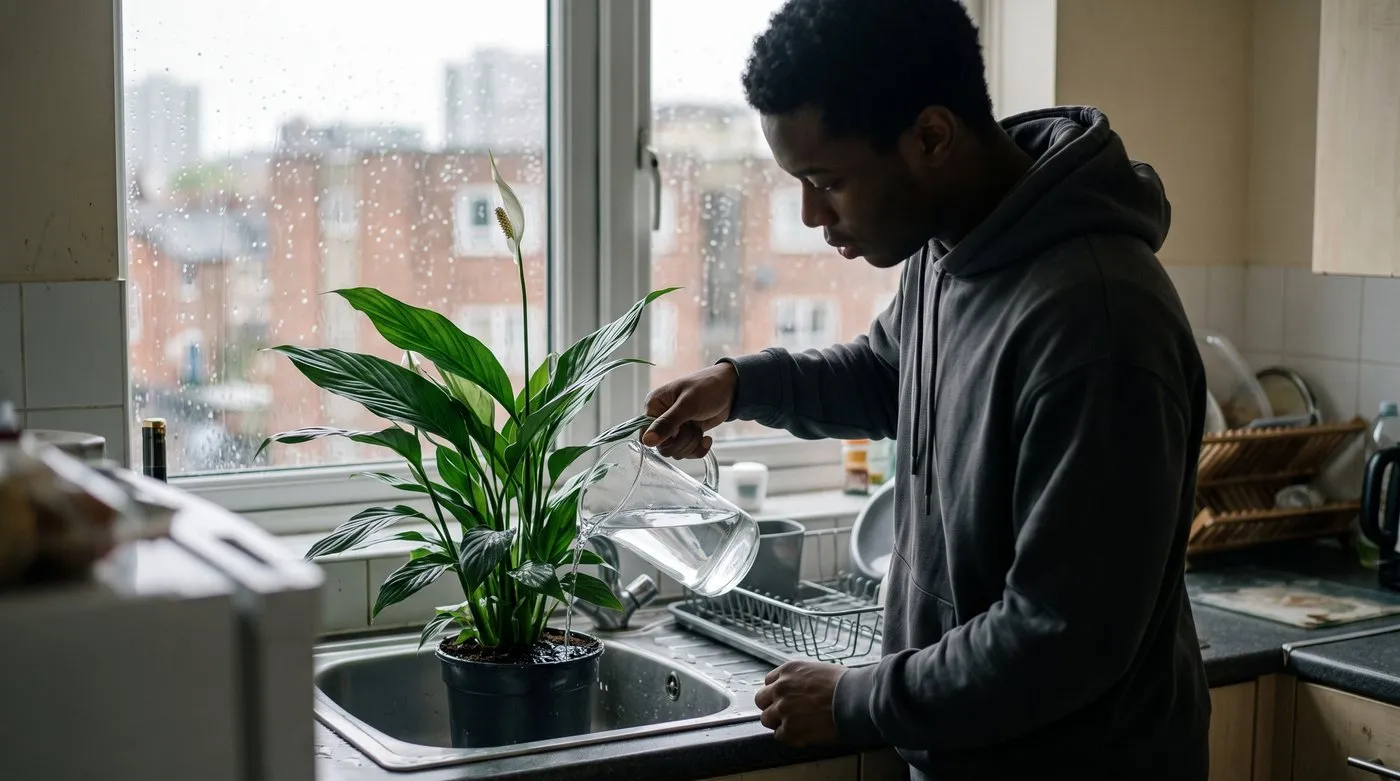
Every month or two, run plenty of water through the compost and let it drain away. It washes out the mineral build-up that hard tap water leaves behind.
How to raise humidity for peace lilies in winter
Stand the pot on a tray of damp gravel and keep it away from radiators. Central heating dries the air, worst of all in mid-winter. Dry air is the most common cause of brown leaf tips.
Misting helps for a short while, but in a warm room it soon wears off. Pair it with something that lasts longer.
Pebble tray. Fill a tray wider than the pot with gravel or clay pebbles. Add water to just below the top, so the pot sits above the water. Top it up often.
Group your plants. Plants clustered together keep the air around them a little moister. If you keep bathroom plants, a peace lily looks great with ferns and calatheas.
Choose the room. Kitchens and bathrooms are usually more humid than bedrooms and lounges. A bathroom with a window is often the best spot of all. For drier rooms, our guide to bedroom plants has some tougher choices.

Peace lilies grouped on a bright bathroom windowsill, soaking up the steam from the shower.
When and how to feed a peace lily
Give a general liquid house plant feed every few weeks from April to October. Peace lilies aren’t greedy, and too much feed can brown the leaf edges, just like hard water.
Stop feeding from November to March. The plant barely grows in the dark winter months and can’t use it.
Always water first, then feed. Feed poured onto dry compost can harm the fine roots.
Peace lily care month by month
This assumes a heated UK home with the plant on an east or north-facing windowsill. Always feel the compost before you water rather than going by the calendar alone.
| Month | Watering | Feeding | Jobs |
|---|---|---|---|
| January | Lightly, when the top is dry | None | Check for cold draughts. Use a pebble tray. |
| February | Lightly, when the top is dry | None | Watch for soggy compost. |
| March | A bit more as growth starts | None | Move closer to the window if it’s slow. Repot if packed with roots. |
| April | When the top is dry | Start, every few weeks | Look out for new flowers. |
| May | When the top is dry | Every few weeks | Water more as rooms warm up. |
| June | Often weekly or more | Every few weeks | Main flowering time. Cut off old flowers at the base. |
| July | Often weekly or more | Every few weeks | Flush the compost if a white crust appears. |
| August | Often weekly or more | Every few weeks | Divide if it has outgrown its pot. |
| September | When the top is dry | Every few weeks | Water less as days shorten. |
| October | Less often | Last feed | Move away from cold, draughty windows. |
| November | Lightly | None | Heating’s on, so start the humidity tricks. |
| December | Lightly | None | Darkest month. Keep it out of draughts. |
How to repot a peace lily
Repot in spring, and only when the pot is packed with roots. Peace lilies like being a little snug, so this is usually every few years.
Go up just a few centimetres in pot size. A pot that’s too big holds too much water and the roots rot. Use peat-free multipurpose compost with perlite mixed in, roughly three parts compost to one part perlite. Our repotting guide walks you through it.
Afterwards, water lightly and keep the plant out of direct sun for a couple of weeks. Hold off feeding for a few weeks, as fresh compost has food in it.

Repot in spring and go up just one pot size so the compost doesn’t stay soggy.
Fixing peace lily problems
Most problems come down to water, light or temperature. Change one thing at a time, then give it a couple of weeks.
| What you see | Likely cause | What to do |
|---|---|---|
| Brown crispy tips | Dry air, hard water or too much water | Use a pebble tray and rainwater or filtered water. |
| Yellow lower leaves | Too much water, or old leaves dying off | Let the top of the compost dry between drinks. Check the roots. |
| Drooping, compost wet | Roots rotting in soggy compost | Take it out, trim black or mushy roots, repot in fresh compost with perlite. |
| Drooping, compost dry | Thirsty | Give it a good drink. It usually perks up within hours. |
| No flowers | Not enough light | Move it somewhere brighter but out of direct sun. Feed from April to October. |
| Brown scorched patches | Direct sun | Move it back from a sunny window or use a net curtain. |
| Blackened leaf edges | Cold | Move it away from draughty windows, especially at night. |
| White crust on compost | Hard water build-up | Scrape it off, flush the compost and change your water. |
| White fluffy bugs in leaf joints | Mealybug | Wipe off with a damp cotton bud. Use an approved house plant insecticide if needed. |
| Sticky leaves with small green bugs | Aphids | Rinse off in the shower or sink. Keep it away from other plants. |
Why are my peace lily flowers turning green?
It’s normal for older flowers to turn green. Each white flower lasts a few months, then slowly fades to green. That’s just the flower finishing, not a sign of disease.
Some young flowers also open greenish and whiten as they go. Once a flower turns green or brown, cut its stalk off at the base, close to the compost. This keeps the plant tidy. Wear gloves, as the sap can irritate skin. If no new flowers follow, it probably needs more light.
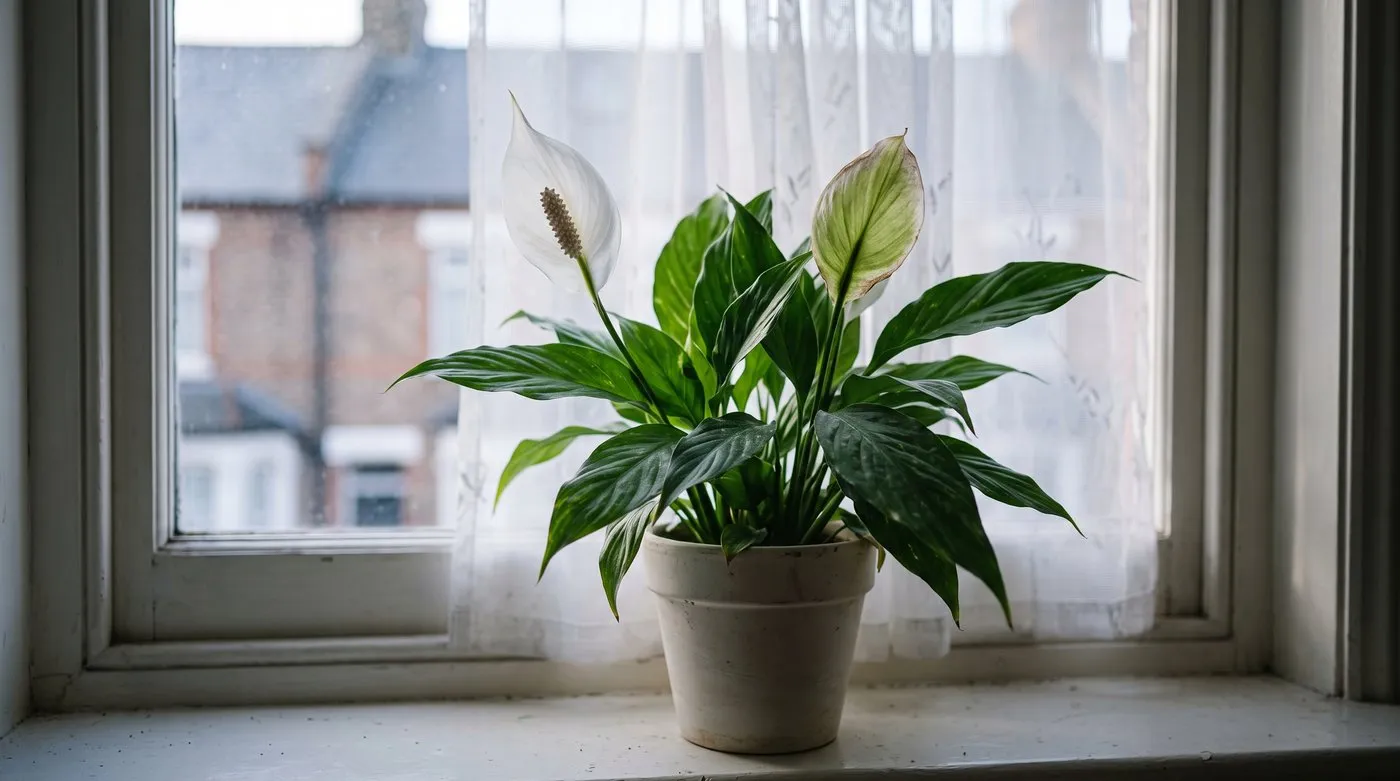
A flower turning green is just an old one finishing, not a sign of disease. Once it goes green or brown, cut its stalk off at the base.
Should you cut brown leaves off a peace lily?
Yes. Cut leaves that are mostly brown or yellow off at the base of the stalk. They won’t recover, and the plant looks better without them. Use clean, sharp scissors and wear gloves.
For leaves with just brown tips, trim the dead bit off, following the leaf’s natural shape. Leave a thin line of brown so you don’t cut into healthy leaf. Trimming hides the damage but doesn’t fix it. Check the air, your water and how often you water, or the new leaves will brown too.
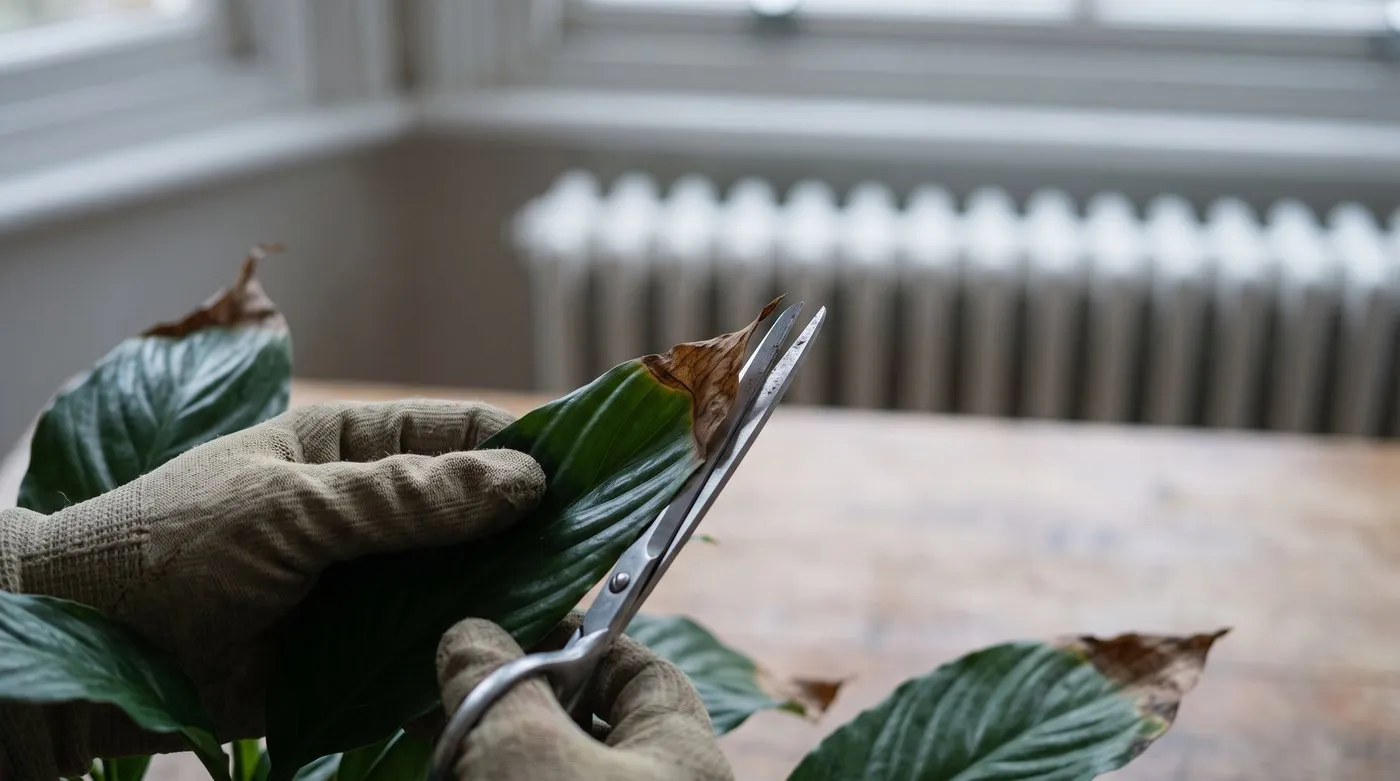
Follow the leaf’s own pointed shape and leave a thin line of brown. Trimming tidies things up, but check the air and your water or new tips will brown too.
How to propagate a peace lily
Split it into smaller plants. Peace lilies don’t grow from cuttings. A mature plant forms several clumps, each with its own roots, and you can pull these apart.
Do it in spring, when you repot. Ease the plant out of its pot and gently tease the clumps apart by hand. Each piece needs several leaves and a good bunch of roots. Pot each one into a pot just big enough for its roots, using the same compost and perlite mix. Water lightly and keep it warm and out of direct sun while it settles. Our propagation guide covers other house plants too.
Don’t make the pieces too small. Bits with only a couple of leaves have few roots and often fail.
Can a peace lily go outside in the UK summer?
Usually not. It likes at least 12C, and UK nights often drop below that, even in summer. Wind, heavy rain and direct sun can also damage the soft leaves.
If you’d like to give it a summer holiday, choose a sheltered, shady spot during a settled warm spell. Bring it in before the nights cool, and check under the leaves for pests first. For most homes, a bright room out of direct sun is the safer bet all year.
Is a peace lily safe around pets and children?
No. All parts are poisonous to cats, dogs and people if chewed. Tiny crystals in the plant cause burning pain, swelling and drooling straight away. Serious poisoning is rare because the pain usually stops animals and children after one bite.
If a pet chews one, call your vet, especially if swelling or drooling carries on.
If you have pets or small children, our best indoor plants guide has some safer choices, such as spider plants, Boston ferns and calatheas.
Do peace lilies clean the air?
A little, but opening a window does far more. Peace lilies do take in some pollution, but in a normal room the effect is small. Enjoy them for their glossy leaves and white flowers, and keep the room aired.
For more plants that are happy in the same conditions, see our guide to the best low-light houseplants for UK homes.
Frequently asked questions
How often should I water a peace lily?
Water when the top 2-3cm of compost feels dry. That’s often about once a week in summer and less in winter. Peace lilies droop when thirsty and usually perk up within hours of a drink. Too much water is the bigger danger, as soggy compost rots the roots.
Why are the tips of my peace lily leaves turning brown?
Dry air from central heating is the usual cause. Too much water and hard tap water can also brown the tips. Use rainwater or filtered water if you can, stand the pot on a tray of damp gravel, and keep it away from radiators.
Why is my peace lily not flowering?
Not enough light is the usual reason. Move it to a bright spot near a window but out of direct summer sun. An east-facing window often works well. Feeding from April to October helps too, and young plants may need a little time before they flower.
Are peace lilies toxic to cats and dogs?
Yes, all parts are poisonous if chewed. They cause mouth pain, drooling and swelling. Serious poisoning is rare because the pain usually stops a pet eating more. Keep the plant out of reach and call your vet if your pet has chewed it and seems unwell.
Can I put a peace lily in a bathroom?
Yes, a bathroom with a window suits it nicely. The steam from showers helps stop brown leaf tips. A bathroom with no window is too dark unless you add a grow light.
Do peace lilies purify indoor air?
A little, but not enough to replace an open window. They do take in some pollution, but a real room holds far more air than one plant can clean. Enjoy it for its looks and keep the room aired.
Should I use tap water for my peace lily?
It’s usually fine in soft water areas. That includes Scotland, Wales and much of northern England. In hard water areas, especially the south and east of England, use rainwater or filtered water when you can.
Our team produces practical UK gardening guidance from source research, contributor records and established horticultural practice. Editorial standards are overseen by Matt W.


