Key takeaways
- A knot garden is a pattern of low hedges that seem to weave over and under, best seen from above
- Start with a flat, sunny 3m square, ideally below a window
- Box blight and box tree moth make box a gamble, so Ilex crenata and euonymus are safer choices
- Mark the pattern with a 1m string grid and dry sand before planting
- Plant about five small plants per metre and expect the ribbons to join in two or three years
- Clip two or three times a year, from early June to mid-September
A knot garden is a pattern of low clipped hedges that seem to weave over and under each other, like threads in a knot. It was a Tudor favourite, laid out below windows so it could be admired from above. With the right plants and a bit of string and sand, you can make one in a weekend.
This guide covers picking a pattern and site, choosing plants now that box is risky, marking out, planting and clipping. For clipped shapes beyond knots, the topiary guide for beginners is a good next read.
What is a knot garden?
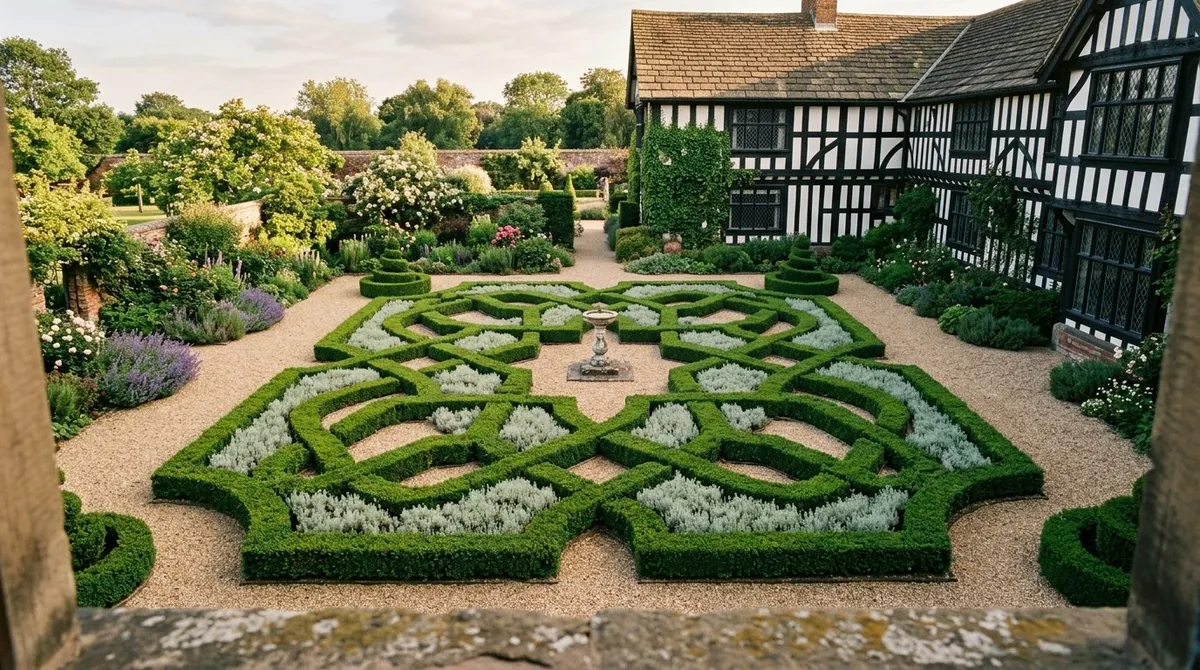
A knot garden is a formal bed of low clipped hedges in an interlacing pattern, designed to be seen from above. Where two hedges cross, one appears to pass over the other.
The name comes from the knotwork of Tudor embroidery and plaster ceilings. Knots were popular in England in Tudor and early Stuart times. Thomas Hill printed ready-made knot patterns in one of the first popular English gardening books, in 1563.
You can see fine recreated knots at Little Moreton Hall in Cheshire, Hampton Court Palace and Helmingham Hall in Suffolk. Visit one before drawing your own. Photos flatten a knot, but seen from above the weave suddenly makes sense.
Open knot or closed knot: which to choose?
Choose an open knot for your first go. Gravel between the hedges is far easier to look after than packed planting.
- An open knot leaves the spaces between hedges unplanted and fills them with coloured gravel, crushed brick or bark. The pattern stays clear all year, and weeding takes minutes.
- A closed knot fills each space with herbs, bedding or bulbs. It looks generous in summer, but the infill competes with the hedges for light and water.
The weave is what makes a true knot. Plant each ribbon in a different foliage colour, such as dark green and silver. Then, where two cross, clip the top ribbon a few centimetres higher than the other.
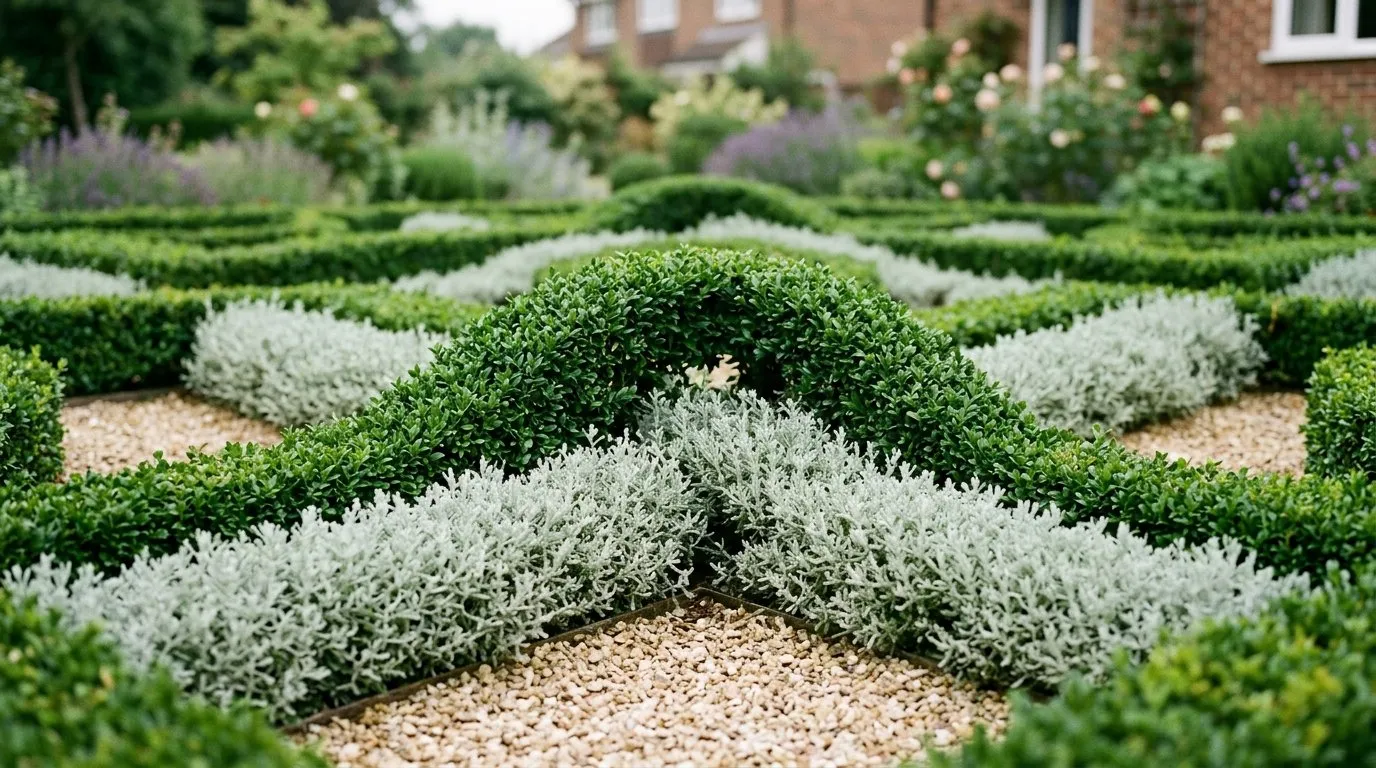
The crossing is the whole trick. The green ribbon is clipped higher than the silver one, so it seems to weave over it.
Start with a simple pattern rather than inventing one:
| Pattern | Difficulty | Foliage colours | Good first knot? |
|---|---|---|---|
| Quartered square with a central circle | Easy | 1-2 | Yes |
| Two-ribbon interlace | Moderate | 2 | Yes |
| Celtic-style threaded knot | Hard | 2-3 | No |
| Initials or an emblem | Hard | 2 | No |
What size and site does a knot garden need?
A 3m square is a good first knot. It’s big enough for a real interlace, yet small enough to clip in an hour or so. Much smaller and the pattern gets cramped once the hedges reach full width.
The site matters more than the pattern:
- Level ground. Even a gentle slope shows as a dip in the hedge lines. Level the ground before planting.
- Full sun. Knot plants want six hours of sun or more. Shade brings gaps, disease and leggy growth.
- Seen from above. Put it below an upstairs window, a raised terrace or the top of some steps.
- Free-draining soil. Lavender and santolina die in wet winter soil, and Ilex crenata dislikes waterlogging too.
A front garden suits a knot surprisingly well. The upstairs windows give the view from above, and the pattern holds its shape all winter. For more formal touches, see the guide to classic English garden elements.
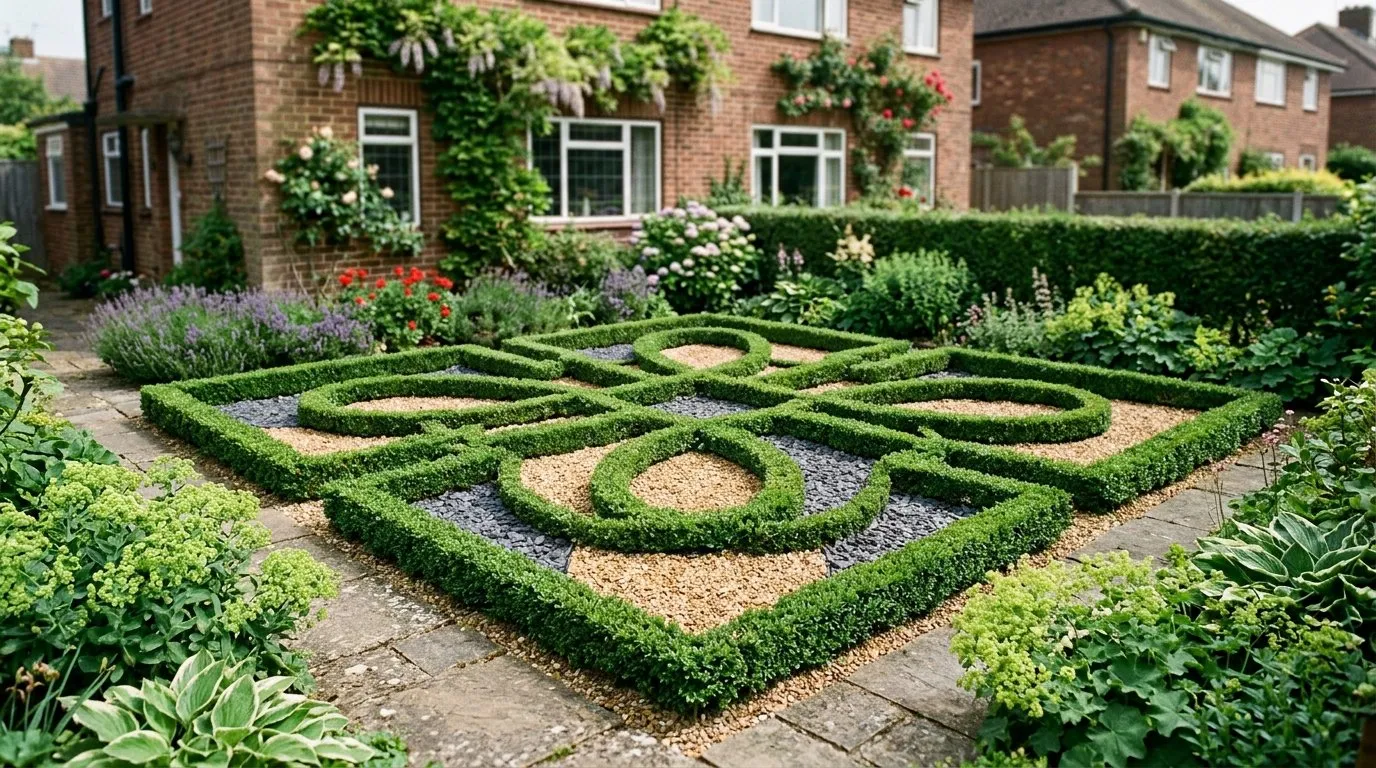
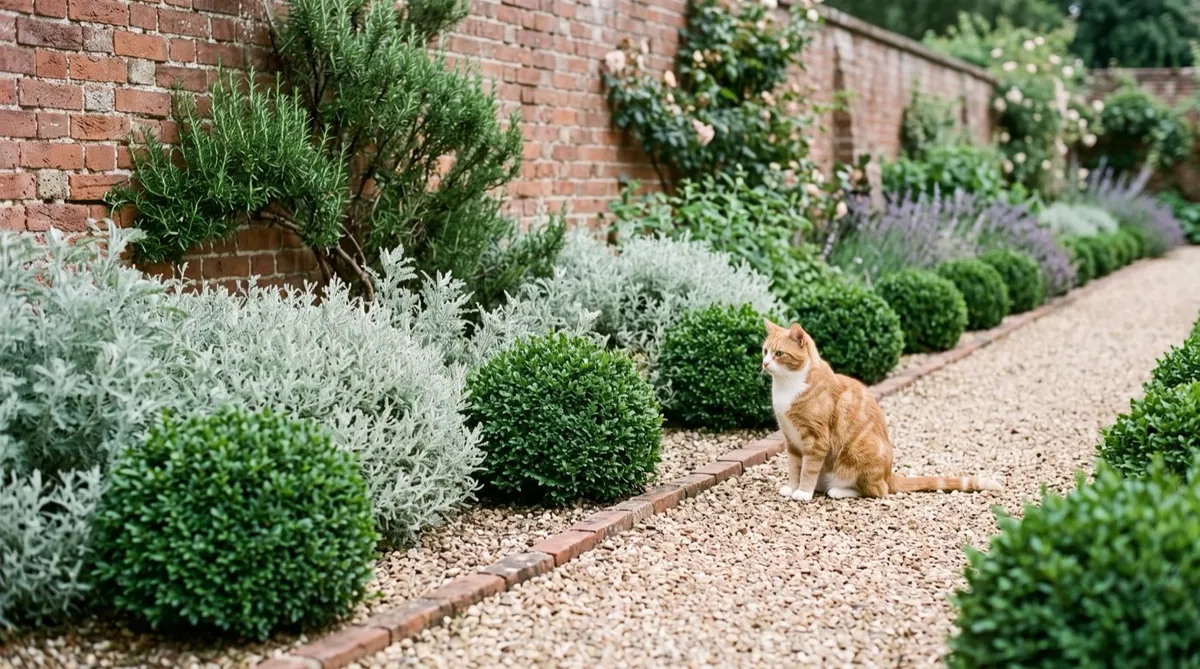
An open knot in a front garden. Two colours of gravel do half the work, and the bedroom window gives the view from above.
Which plants are best for a knot garden?
Ilex crenata and Euonymus ‘Jean Hugues’ are the safest choices for a new knot. Dwarf box edged every historic knot, but box blight and box tree moth now make it a gamble in most areas. The RHS box blight page explains the disease, and the guide to why box hedges die covers diagnosis and rescue. If you already have healthy box, keep it and check it often.
| Plant | Foliage | Plant about | Per metre |
|---|---|---|---|
| Dwarf box (Buxus ‘Suffruticosa’) | Deep green | 15cm apart | 6-7 |
| Ilex crenata | Dark green, box-like | 20cm apart | 5 |
| Euonymus japonicus ‘Jean Hugues’ | Glossy mid-green | 20cm apart | 5 |
| Wall germander (Teucrium chamaedrys) | Glossy green, pink flowers | 20cm apart | 5 |
| Lavender ‘Hidcote’ | Silver-grey | 30cm apart | 3-4 |
| Cotton lavender (Santolina chamaecyparissus) | Bright silver | 30cm apart | 3 |
Ilex crenata, the Japanese holly, is the best box lookalike. Its small dark leaves and twiggy habit pass for box at a couple of metres, and it clips into sharp lines. It wants reasonably moist soil and struggles on thin, dry chalk.
Euonymus ‘Jean Hugues’ is the tough choice. It fills in quickly, copes with poor soil and usually costs less. The leaves are a little bigger and glossier than box. The guide to growing euonymus covers its care.
Wall germander is a traditional knot plant with pink summer flowers that bees love. You’ll lose most of the flowers if you clip for crisp lines.
Lavender and santolina give the silver ribbons that make a weave easy to read. Both are shorter-lived and get woody with age, so replace plants when they open up.
How to mark out a knot garden pattern
Mark out a 1m string grid, then draw the pattern in dry sand before you plant anything. Tudor gardeners used lines and sand too, and nothing beats it.
- Clear and level the ground. Remove weeds and roots, then rake it flat.
- Draw the pattern on graph paper first, with each square equal to 1m.
- Peg a string grid at 1m spacing across the bed, matching your drawing.
- Pour dry sand from a bottle along each line of the pattern, square by square.
- Step back and look, ideally from the window. Adjust any wobbly curves before planting.
For a 3m square with a border and a simple two-ribbon weave, you’ll need roughly 20m of hedging. At five plants per metre, that’s about 100 plants. Buy a few spares and plant them in a corner. If one dies in the first year, you can swap in a plant of the same size.
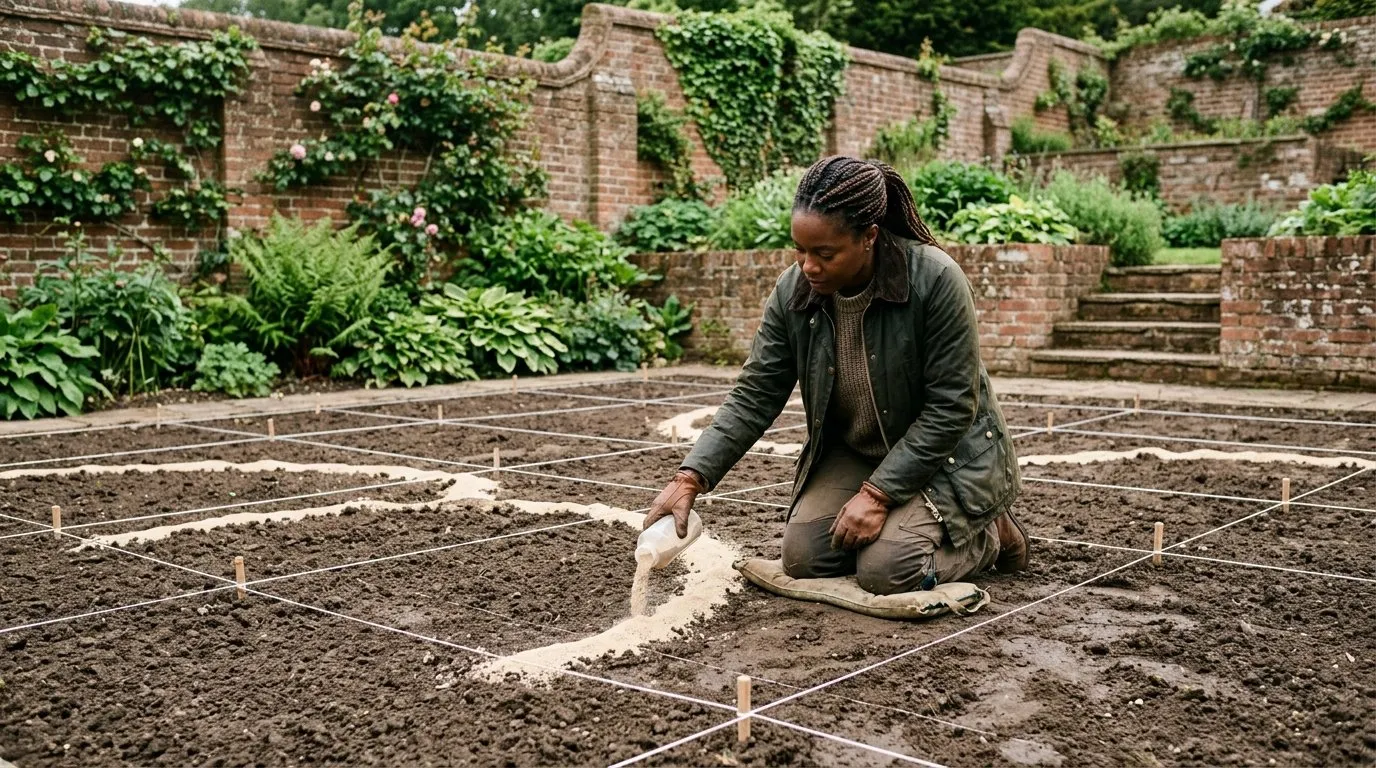
String grid first, sand lines second, spade last. An hour of marking out saves years of looking at a wonky ribbon.
Planting your knot garden
Plant in autumn or early spring, when the soil is moist and workable. Small plants in 9cm pots are cheaper and settle in quickly.
Plant along the sand lines at the spacing in the table, firming each one in. Water well and keep watering through the first two summers in dry spells. Mulch between plants to keep weeds down.
Young plants look very sparse at first. Hold your nerve, as the gaps close by the end of the second summer. Clip lightly in the first year, just to encourage bushy growth.
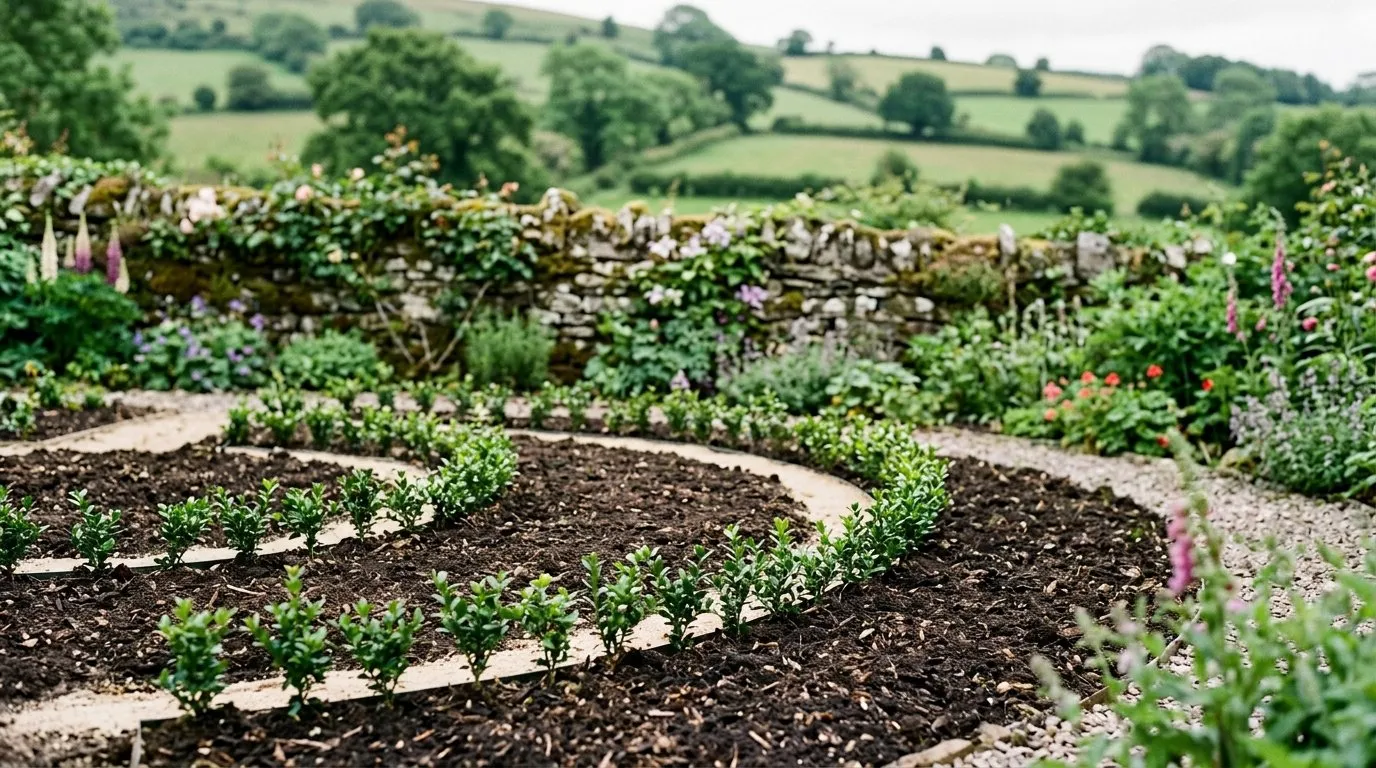
Freshly planted ribbons look thin for a season or two. Small plants knit into a solid line faster than you’d expect.
What to put inside the knot
Gravel is the easiest infill, herbs the most traditional, and bedding the most colourful. Pick one approach per knot. Mixing all three looks muddled from above.
- Gravel in one or two colours keeps the pattern sharp all year.
- Herbs such as thyme, chives and marjoram make a closed knot useful as well as pretty. The guide to creating a herb garden has more ideas.
- Bulbs and bedding give two displays a year: tulips in spring, then compact bedding until autumn.
A centrepiece anchors the design. A sundial, a clipped holly ball or a standard bay all work. Set it dead centre and check it from the window before fixing it down.
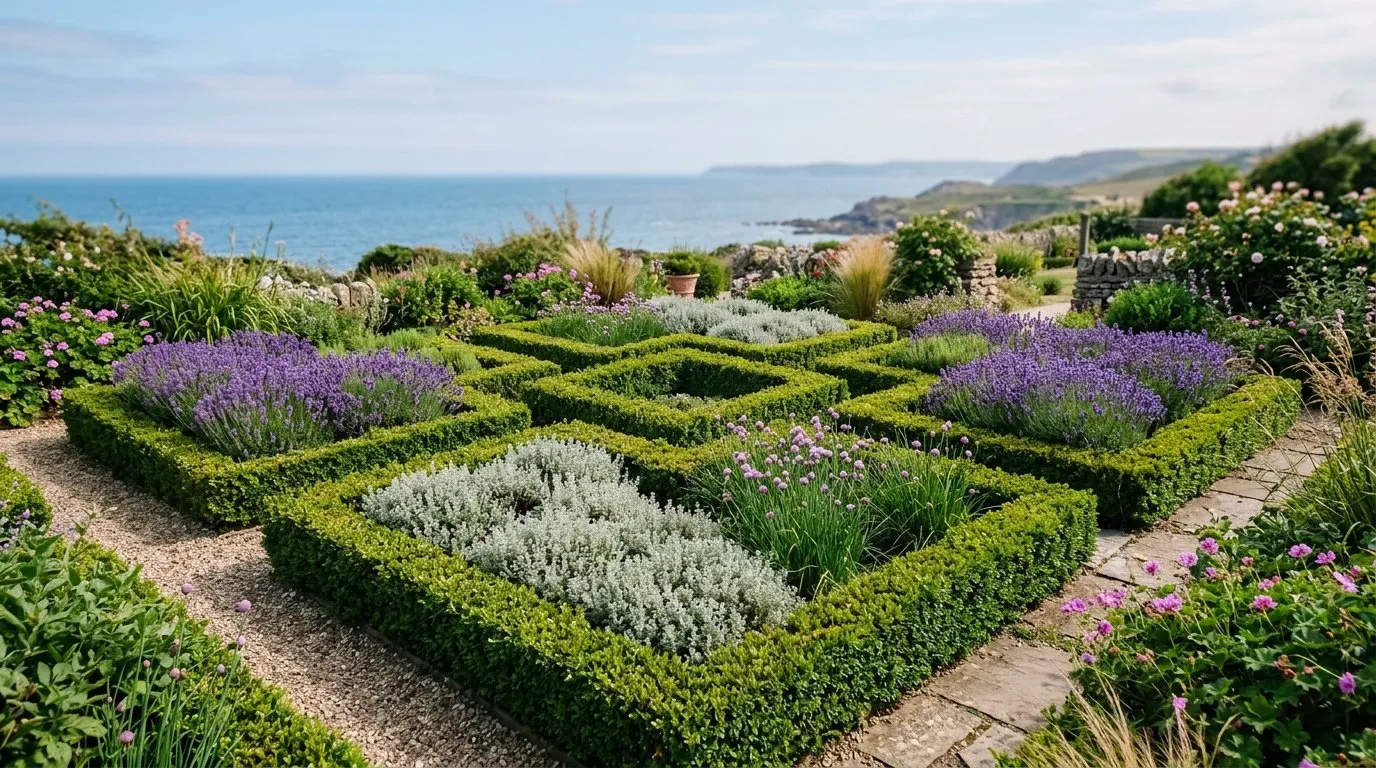
A closed knot used as a herb bed. The hedging frames the herbs, and the herbs soften the hedging.
When to clip a knot garden
Clip an established knot two or three times a year, starting in early June and finishing by mid-September. Little and often beats one hard cut. Each pass takes off just a few centimetres of soft growth and keeps ribbons about 20-25cm wide.
| Month | Knot garden job |
|---|---|
| March to April | Cut santolina back hard. Tidy winter damage. Light euonymus trim in late April |
| Early June | Main cut for every ribbon. Re-cut crossings so the top ribbon stands proud |
| July | Second trim for fast growers. Clip germander once its flowers fade |
| Late August | Trim lavender after flowering, staying just above the old wood |
| September | Final tidy cut, finished by mid-month so new growth can harden |
| October to November | Plant new knots, top up gravel, clean and oil your shears |
Check for nesting birds before any cut from March to August. Even a low hedge can hide a nest, and disturbing an active one is an offence.
Use hand shears at the crossings and save a powered trimmer for long, straight runs. A string line along the top keeps the cut level. Avoid clipping in frost, drought or hot sun, which leaves brown, scorched tips. The guide on how to trim topiary covers technique and blade care, and how to prune lavender covers the silver ribbons.
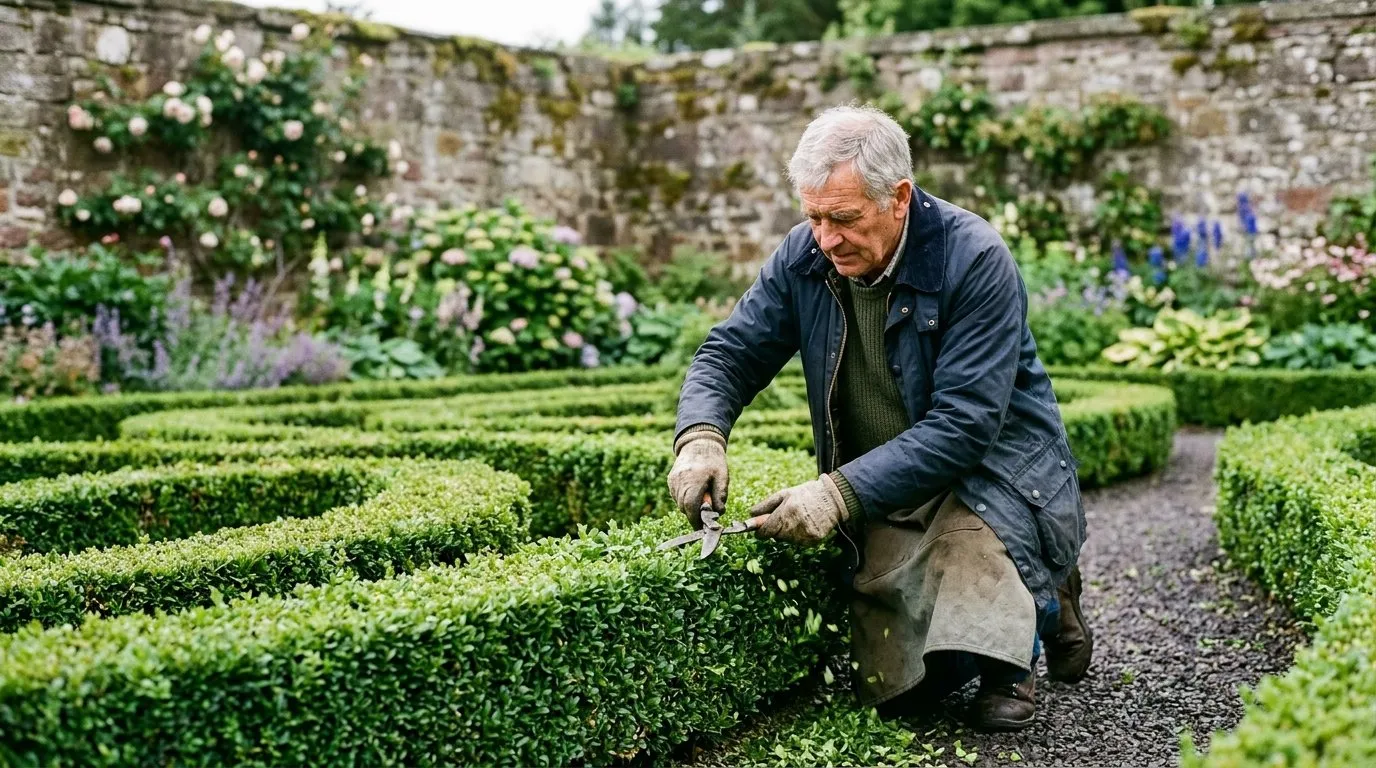
Hand shears at the crossings, a trimmer on the straights. The June cut sets the shape for the whole year.
Common knot garden mistakes
Choosing a shady or sloping site. Gaps and wonky lines follow. Pick level ground in full sun.
A pattern that’s too complicated. Fiddly designs are hard to plant and clip. Start with a simple square or two-ribbon weave.
Planting box without a plan for blight. Use Ilex crenata or euonymus unless you’re ready to keep a close eye on box.
One hard clip a year. Lines go fuzzy and gaps appear. Clip little and often.
Nowhere to see it from. At ground level a knot just looks like low hedges. Put it below a window or raised spot.

A knot earns its keep in January, when frost picks out every line you clipped in summer.
Frequently asked questions
What is the difference between a knot garden and a parterre?
A knot’s hedges seem to interlace, while a parterre’s sit in separate shapes. Knots are small and Tudor in spirit, with ribbons that appear to weave over and under at each crossing. Parterres came later from France, cover bigger areas and use scrolled beds edged with hedging. If the ribbons never cross, it’s a parterre.
Can you still plant box in a knot garden?
You can, but box blight and box tree moth make it a gamble. Both hit closely clipped dwarf box hard. If you want box, choose an open, airy site, water at the roots only and check often for caterpillars. Most new knots now use Ilex crenata or euonymus instead.
How much does a knot garden cost to make?
Mostly the cost of around 100 small hedging plants for a 3m square. Gravel, membrane, sand and string add a little more. Euonymus is usually cheaper than Ilex crenata. Buying small 9cm pots keeps costs down, and they catch up quickly.
How long does a knot garden take to establish?
Two to three growing seasons for the ribbons to join up. Plants set about 20cm apart usually touch by the end of the second year. Water through the first two summers and clip lightly until the ribbons meet. After that, you’re just keeping the pattern sharp.
What is the best plant for a knot garden?
Ilex crenata is the closest box lookalike for new UK knots. Its small dark leaves and dense habit look like box from a couple of metres away, without box blight. Euonymus ‘Jean Hugues’ is tougher on poor soil. For silver ribbons, use santolina or lavender ‘Hidcote’.
How do you keep a knot garden pattern crisp?
Clip little and often, using string lines as a guide. Two or three light cuts a year keep a far sharper line than one hard cut. Keep ribbons about 20-25cm wide. At crossings, clip the top ribbon a few centimetres higher so it looks like it passes over.
Ready to choose your hedging? Compare eight options in the guide to box hedge alternatives, or browse more garden design ideas.
Our team produces practical UK gardening guidance from source research, contributor records and established horticultural practice. Editorial standards are overseen by Matt W.