Key takeaways
- A square plot feels small because you can see all four fences at a glance
- Laying paving and beds on a 45-degree diagonal gives the longest possible view
- A circle inside the square hides the corners and removes straight edges
- A screen or tree two-thirds of the way down stops you seeing the back fence
- Make borders at least 1m deep so you can plant in three layers
- Mark the new layout in sand and live with it before you lay any paving
Small square garden design has one big problem to solve. A square plot laid out square looks smaller than it is. Every path runs parallel to a fence and stops dead at it, and you can take in all four boundaries in a single glance.
The good news is that the fixes are about layout, not money. Turn the design on the diagonal, hide part of the garden and plant deep borders. This guide focuses on square plots. For general tips on any small space, see our guide to small garden design ideas.
Why a square garden looks smaller than it is
Your eye judges space by the longest clear view it can find. In a square garden with a rectangular lawn, that view is just one side of the plot.
Three things make it worse:
- You can see all four fences at once, so your brain sizes up the space instantly.
- A rectangular lawn and patio repeat the shape of the boundaries.
- Narrow borders all round draw a hard frame around the plot.
Because you see everything at once, nothing tempts you to explore. Bigger gardens feel bigger partly because you can’t see them all from the back door. Every idea below either lengthens the view, interrupts it or makes the boundary harder to spot.
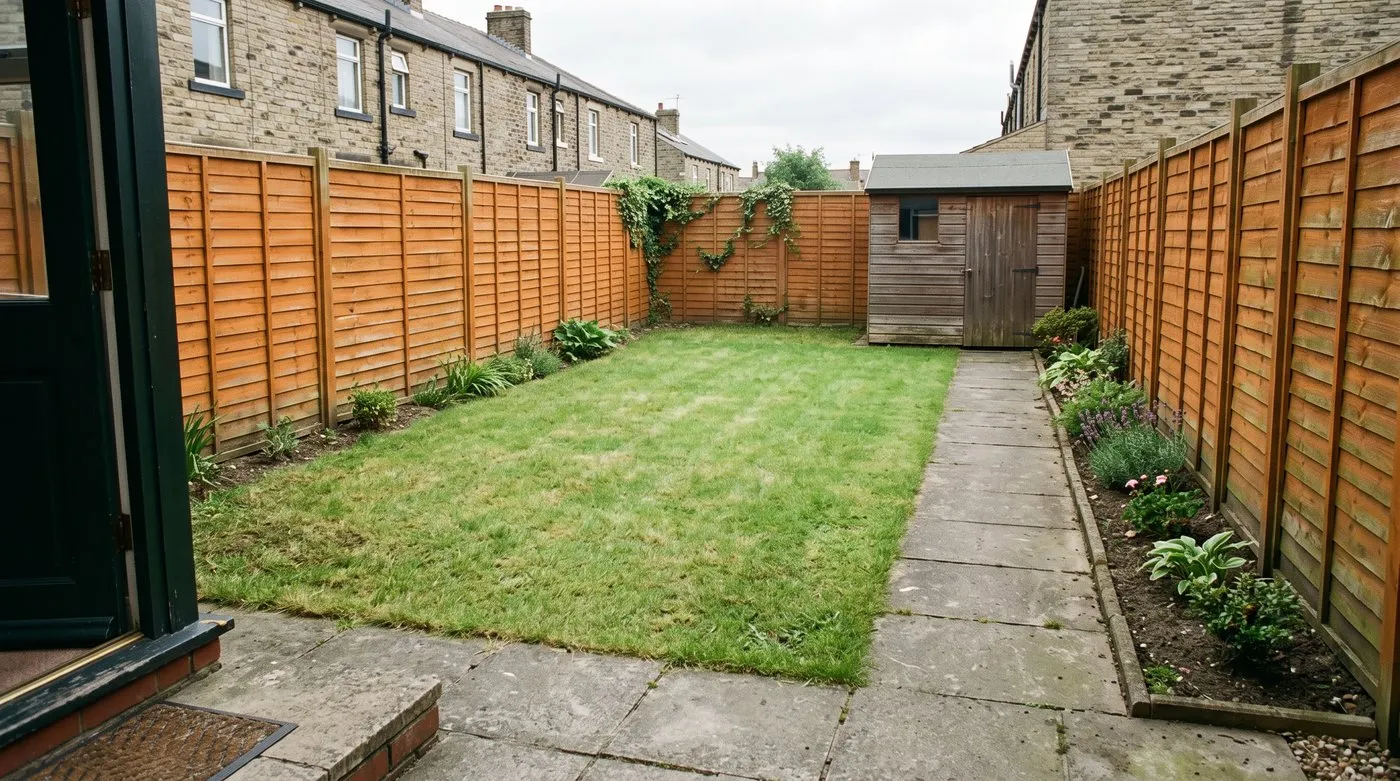
The classic layout: a rectangular lawn, a straight path and thin borders. Every view ends square against a fence.
Turn the layout 45 degrees
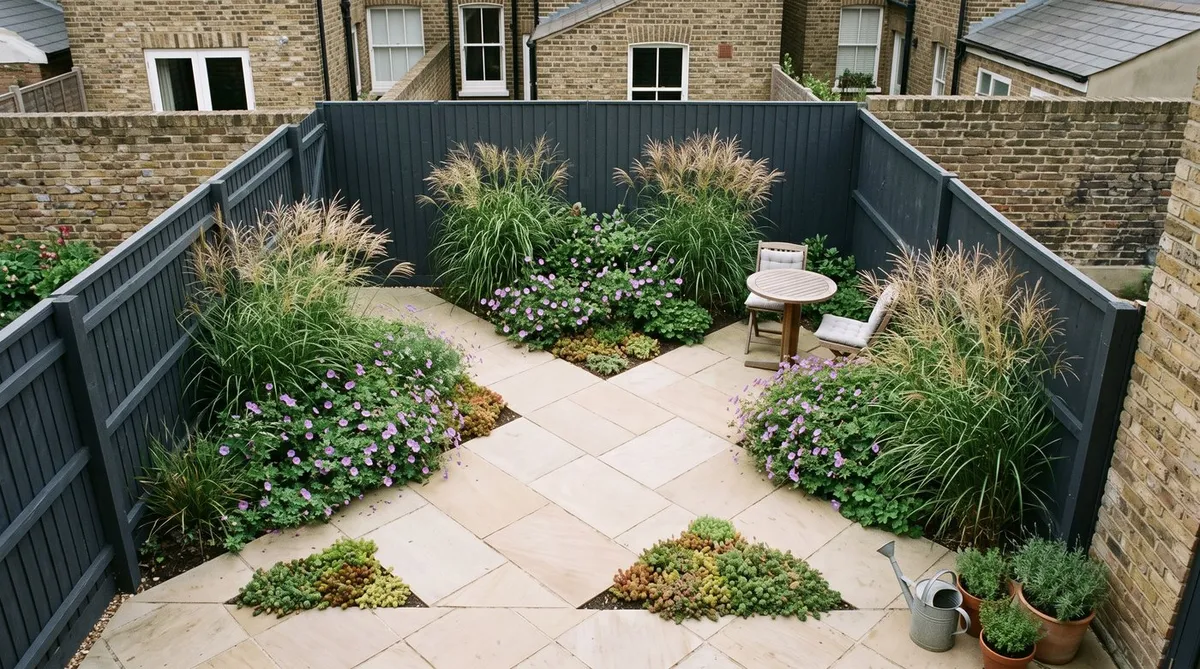
Turning the whole layout on the diagonal is the strongest single move in a square garden. The diagonal is the longest straight line in a square, roughly 1.4 times the length of a side.
| Plot size | Length of a side | Corner to corner |
|---|---|---|
| 5m by 5m | 5m | About 7m |
| 6m by 6m | 6m | About 8.5m |
| 7m by 7m | 7m | About 9.9m |
| 8m by 8m | 8m | About 11.3m |
The diagonal also creates four triangular corner beds. Triangles taper, and a tapering bed seems to recede into the distance. Two of the corners are usually deep enough for a small tree.
How to set it out: Run a string from one corner of the plot to the opposite corner. Line up everything with it: paving joints, path edges, bed edges and decking boards.
Commit fully. A diagonal path across square-laid paving just looks like a mistake. Diagonal paving needs more cutting at the edges, so order extra slabs. Our guide to making a small garden look bigger covers other tricks that work alongside it.
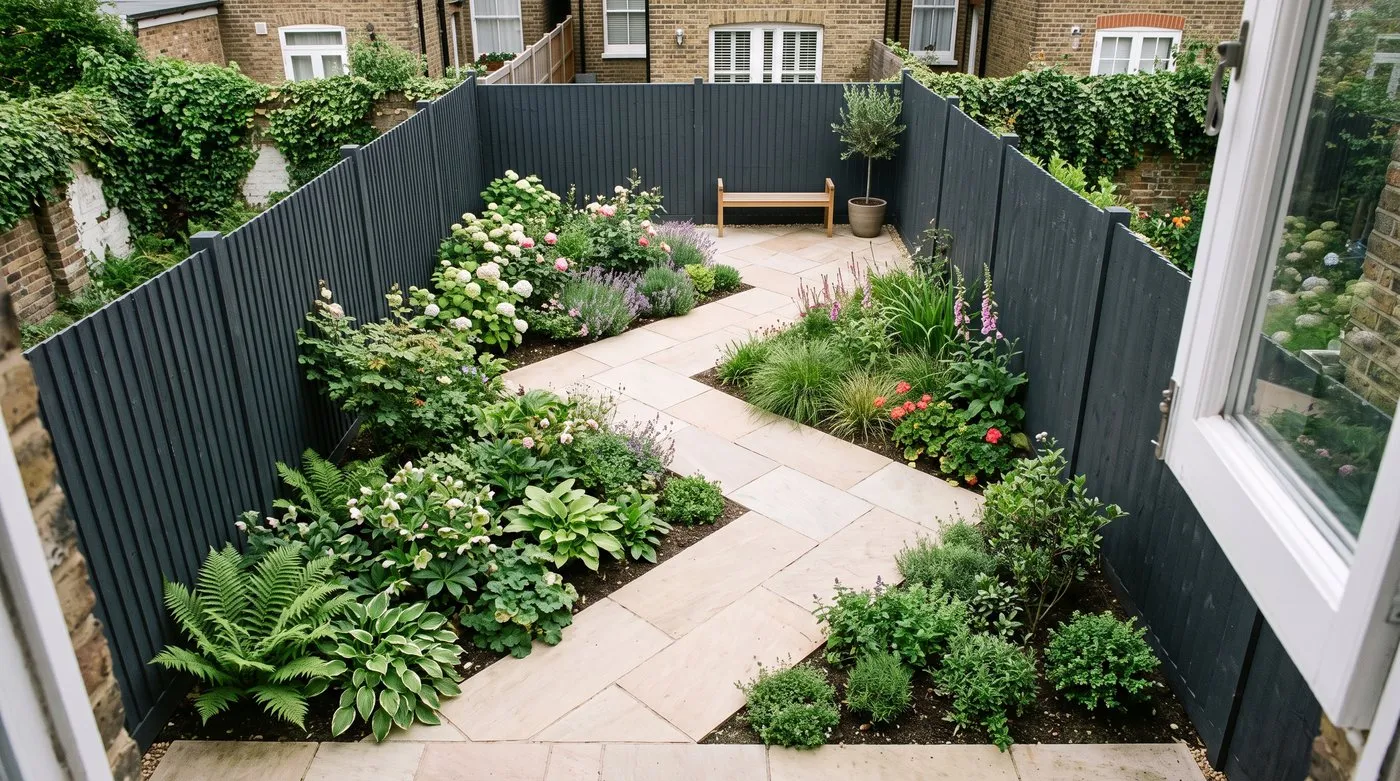
Paving joints, bed edges and the path all run corner to corner. That’s what makes the layout look deliberate.
Other layouts that suit a square plot
The diagonal isn’t the only answer. Here’s how the main options compare.
| Layout | Effort to build | Best for |
|---|---|---|
| Full 45-degree diagonal | Moderate, lots of cuts | Any square of 5m or more |
| Circular lawn or patio | Moderate | Softening a boxy plot |
| Two overlapping circles | Harder | Larger squares split into two zones |
| Rule-of-thirds layout | Easy | Tight budgets |
| Diagonal path only | Easy | Rented gardens and quick fixes |
Circles: A circle has no straight edges, so your eye has nothing to measure the fences against. It also turns the four corners into planting pockets. A circle a little smaller than the plot leaves a strip of border all the way round. Our guide to circular lawn ideas explains how to mark one out and edge it.
Rule of thirds: Divide each side into three and put key features on those lines, not in the middle. In a 6m square, that means 2m and 4m in. Put a tree at one point and a seat at the opposite one for a relaxed, off-centre feel with no new paving at all.
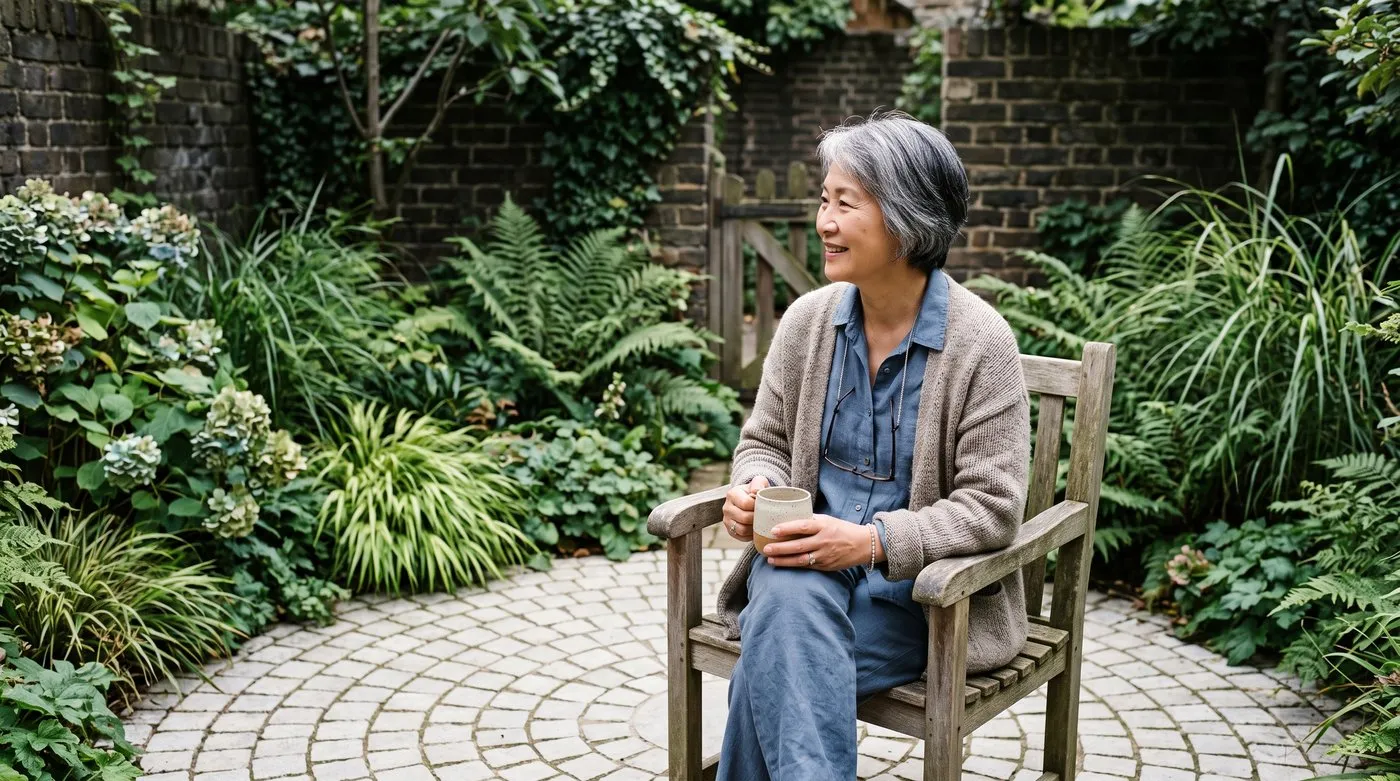
Sitting inside a circle, there’s no straight edge in view to compare with the fences.
Hide part of the garden on purpose
It sounds odd, but hiding part of a small garden makes it feel bigger. If you can’t see the back corner, your brain assumes there’s more there.
Place a screen about two-thirds of the way down the garden, a little off-centre. It could be a slatted panel, a multi-stem tree, a clump of tall grasses or a pair of large pots. Leave a clear route past it, so it invites you round rather than walling you off.
Aim for something roughly head height. Too low and you see straight over it. Much taller and it starts to feel like another fence. Our guide to privacy design for overlooked gardens has more screen ideas.
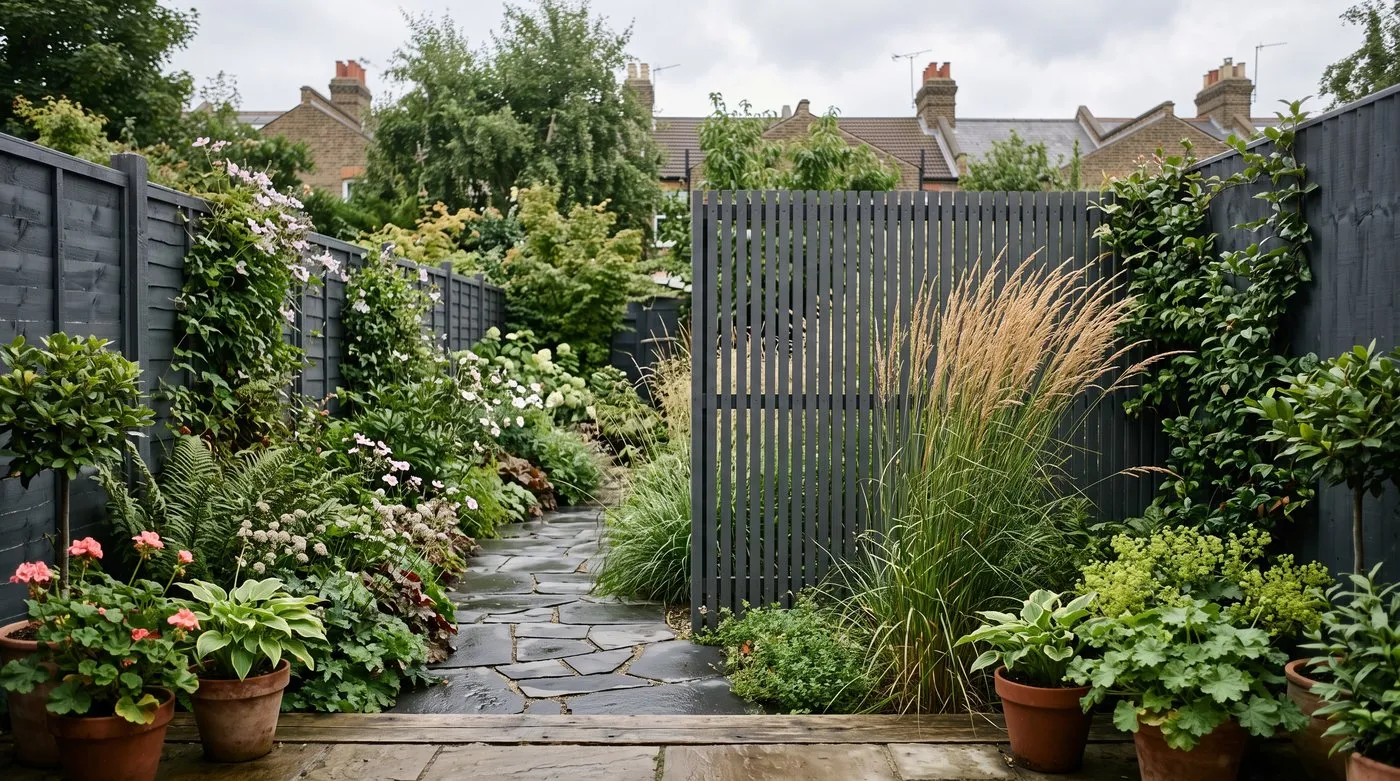
A screen two-thirds of the way down, with a path round it. You can’t see the back fence, so the garden feels longer.
Deep borders and dark fences
Most small gardens give themselves away at the edges. An orange fence with a skinny border in front of it shows exactly where the garden ends.
Make borders deeper. At least 1m, and 1.5m is better. That gives room for three layers: tall plants at the back, medium ones in the middle and low ones at the front. With three layers you only glimpse the fence through leaves. Yes, you lose some lawn, but deep planting beats a bigger patch of grass.
Paint the fence dark. Black, charcoal or deep green fades into the background behind plants. Paint it before you plant.
Mirrors can help if you angle them slightly and half-hide the edges behind foliage, so they look like a gap rather than a mirror. Keep them out of strong midday sun, and fix bird stickers or place them where birds won’t fly into them.
Changing levels
A step up or down splits one space into two, which makes the garden feel less like a single box. A sunken seating area or a raised deck both work.
Keep steps a sensible, even height so nobody trips. Before you dig down for a sunken area, check the drainage. Dig a test hole and fill it with water after rain. If it sits there for a day, the sunken area will flood in winter and needs proper drainage. For anything more than a low step, get advice from a landscaper.
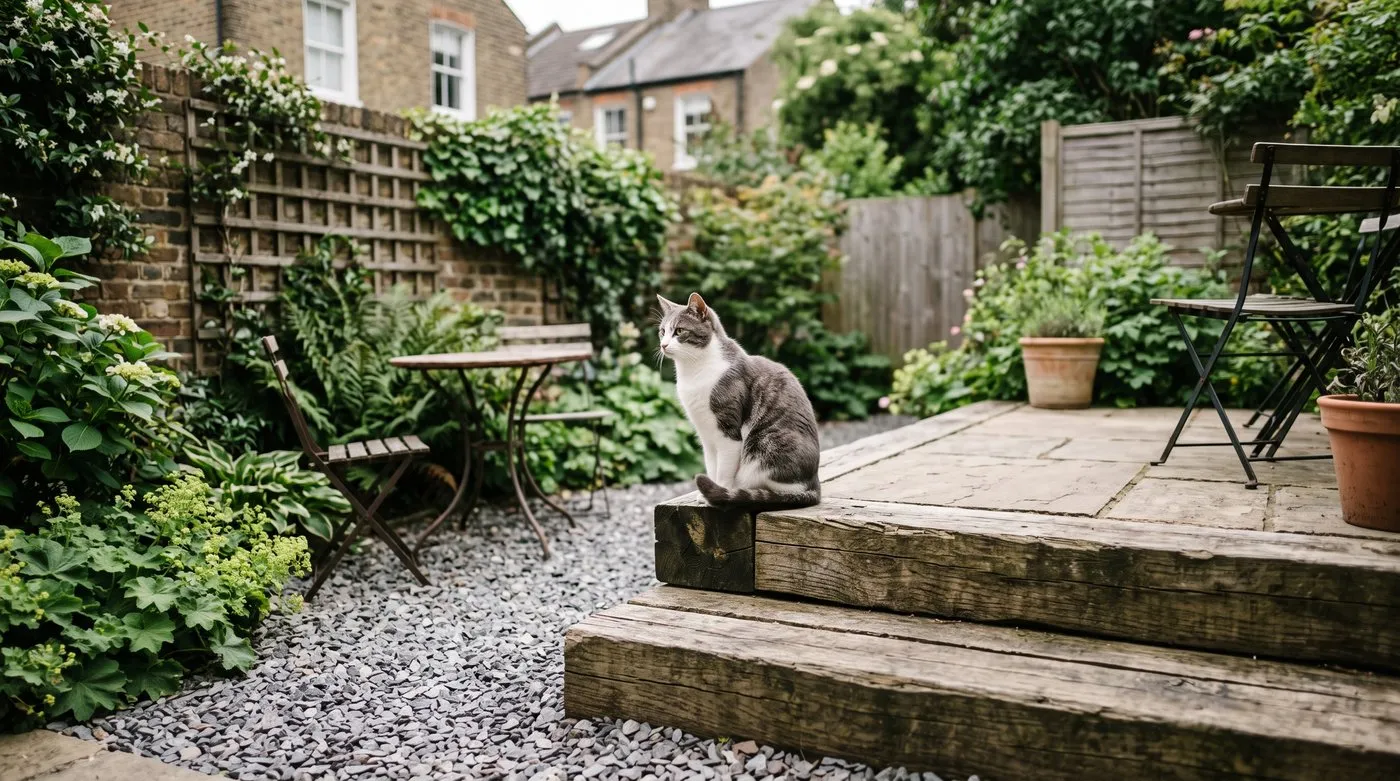
Two wide sleeper steps split the garden into a gravel seating area and a terrace. The cat has already picked its favourite spot.
Multi-stem trees for height without bulk
Small gardens need height, but the wrong tree steals more space than it gives.
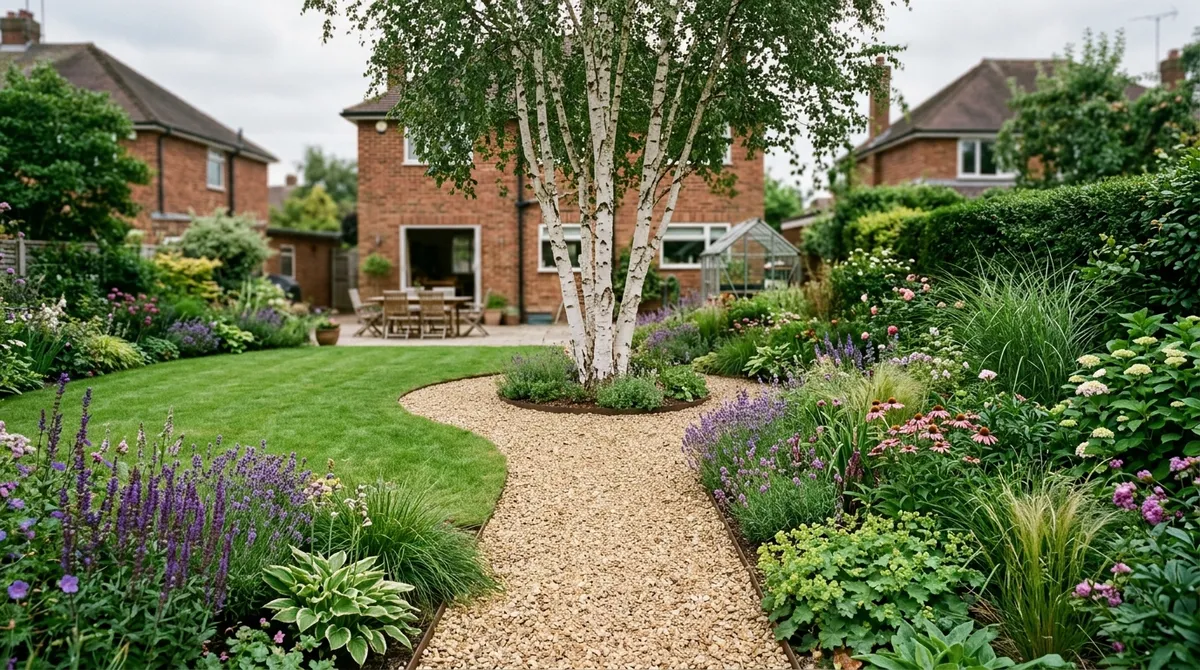
A standard tree has one clear trunk and a crown on top. In a small garden that crown often sits right at eye level and blocks the view. A multi-stem tree branches from near the ground into several slim stems. You can see between them, so the tree adds height without closing the garden in.
Good choices include:
- Amelanchier lamarckii: white blossom in April, berries for birds and red autumn leaves. Copes with clay.
- Betula utilis var. jacquemontii: white bark for winter and a light canopy.
- Acer griseum (paperbark maple): slow growing, with peeling cinnamon bark.
- Cercis siliquastrum (Judas tree): pink flowers straight on the bare stems in late spring.
Plant at least 1.5m from a boundary, and keep trees well away from house walls, especially on clay. See our guide to the best trees for small gardens for more choices.
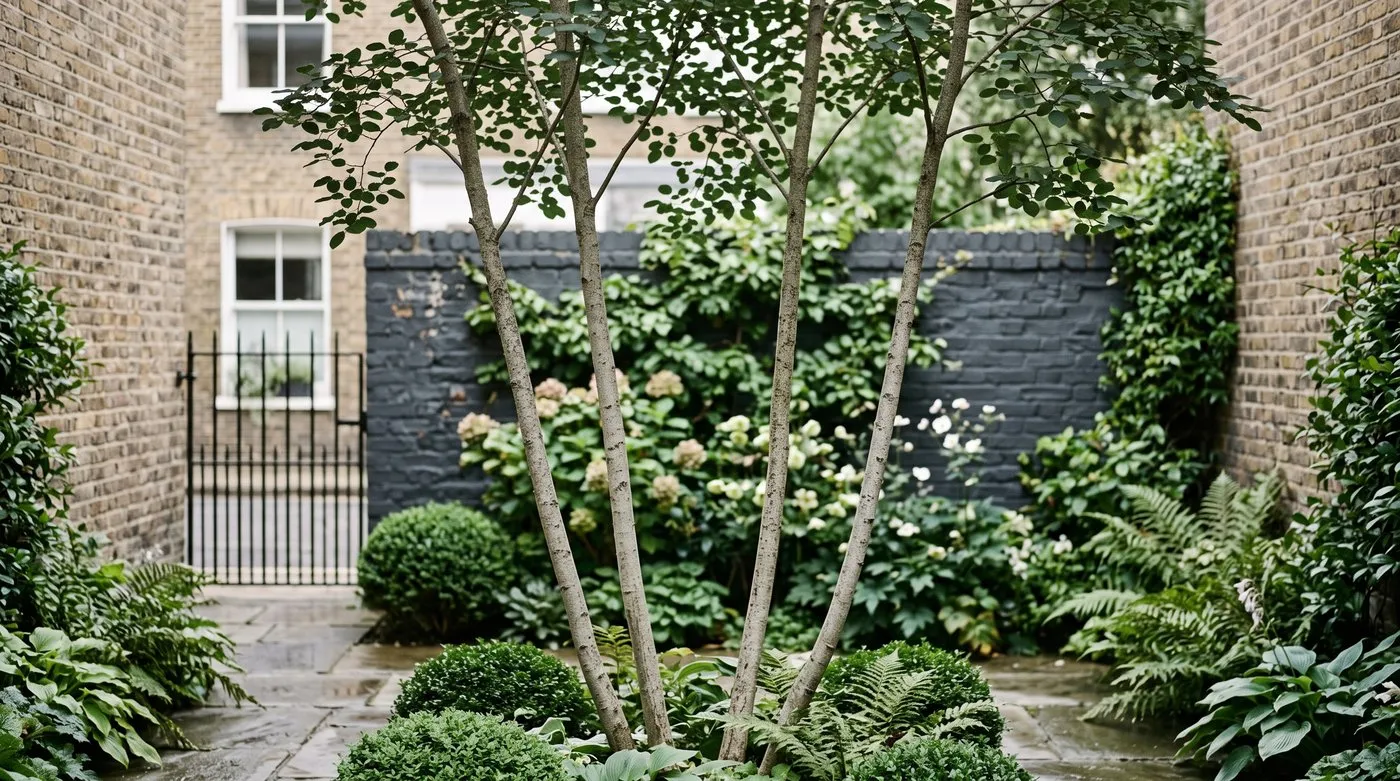
Several slim stems give height, but you can still see the planting behind. A single trunk with a dense head would close the space in.
Worked example: a 6m by 6m terrace garden
Here’s how it comes together in the most common UK small square.
- The diagonal path runs from the back door corner to the opposite corner, about 8.5m long and around 90cm wide, in the same paving as the terrace.
- The terrace is a triangle at the house end, big enough for a small round table and four chairs.
- The far corner is a smaller triangle with a bench and a large pot. It gives you a reason to walk down the path.
- Two triangular beds fill the side corners, each at least 1.5m deep at the widest point, planted in three layers.
- A multi-stem amelanchier sits about two-thirds of the way along the path, a little to one side. It hides the bench from the back door.
- The fences are painted charcoal, with star jasmine on trellis on the sunniest side.
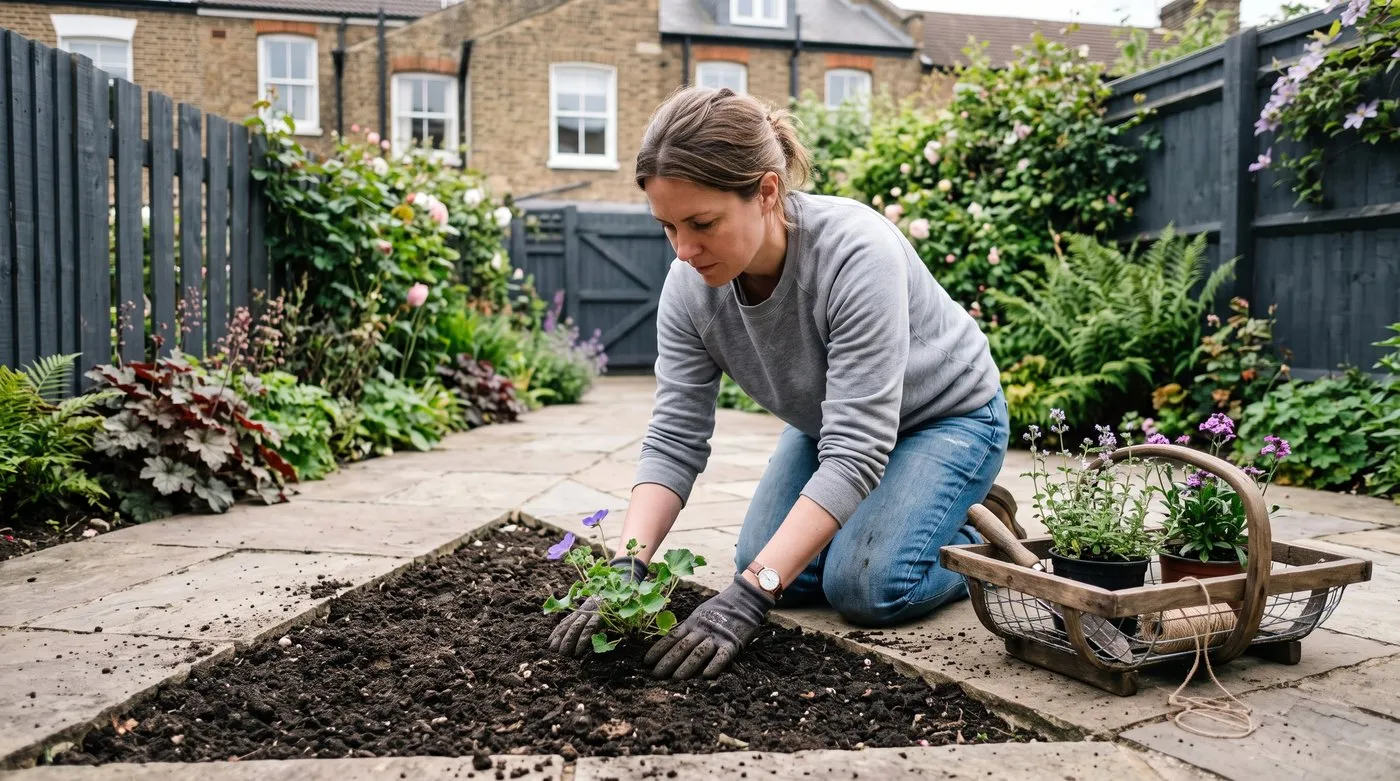
Planting up a triangular corner bed. The taper helps the bed look like it’s stretching away from you.
Plan the layout before anything else
Most square gardens stay as “lawn with a border” because nobody questions the layout. The lawn came with the house, and every later job works around it.
So decide the shape first, before choosing a single plant. Mark the diagonal or circle on the ground with sand or a hose, then live with it for a couple of weeks. Walk it, sit in it and look at it from the house. Moving a sand line costs nothing. Moving paving costs a lot.
If you want to keep the lawn for now, a diagonal path alone captures much of the effect.
Common mistakes in small square gardens
- Half-committing to the diagonal. One diagonal path across square paving looks like an error. Line everything up.
- Keeping thin borders. A narrow strip along the fence frames the plot. Make borders at least 1m deep.
- Putting the focal point in the middle. A tree or pot dead centre splits the garden in half and confirms the square. Put it off to one side.
- Flat mirrors at eye level. They just reflect you back. Angle them and hide the edges with plants.
- Skipping the drainage check. A sunken area on wet clay can turn into a pond every winter.
Frequently asked questions
How do you make a small square garden look bigger?
Lay the main path and paving on the diagonal. The view then runs corner to corner, which is the longest line in a square. Add a screen part-way down and deep, layered borders so you can’t see the back fence in one glance.
Why does a diagonal garden layout work?
The diagonal is the longest straight line in a square. A 6m square is about 8.5m from corner to corner. Lining up paths, paving and beds along it gives your eye the longest journey and creates triangular corner beds.
Should a small square garden have a circular lawn?
It’s one of the best options for a square plot. A circle has no straight edges to compare with the fences. It also pushes the corners into planting, which softens the whole space.
What colour should I paint a fence in a small garden?
Dark colours such as black, charcoal or deep green work best. Dark fences fade into the background, especially behind plants. Bright orange-brown stain does the opposite and makes the boundary stand out.
What is the best tree for a small square garden?
A multi-stem tree such as Amelanchier lamarckii is ideal. Several thin stems give height while you can still see through them. A single trunk with a dense crown tends to block the view at eye level.
How deep should borders be in a small garden?
At least 1m deep, and 1.5m is even better. That gives room for tall, medium and low plants in layers. A narrow strip along the fence just highlights the boundary.
Got a different shape of plot? Read our guide on how to design a long thin garden, or browse more garden design ideas.
Our team produces practical UK gardening guidance from source research, contributor records and established horticultural practice. Editorial standards are overseen by Matt W.