Key takeaways
- UK permitted development allows boundary fences and screens up to 2m high without planning permission
- Pleached trees raise a clipped screen to roughly 3.5 to 4m, above a standard 1.8m fence
- Screen only the key sightlines, not the whole boundary, to keep the garden feeling open
- Layer screening at three heights: around 1m, 2m, and an overhead canopy at 2.4m or more
- A pergola or multi-stem tree creates a borrowed ceiling that blocks views from upper windows
- A focal point and the sound of moving water pull attention inward and make a space feel private
Being overlooked changes how a garden feels. You notice the upstairs windows, the gap in the fence, the neighbour at their kitchen sink. So you stop using the space. Privacy design for an overlooked garden is the fix, and it is far more than planting one tall hedge along the boundary.
Start with the sightlines, not the boundary
Most people screen the wrong thing. They ring the whole boundary with 1.8m fence and trellis, spend a fortune, and still feel watched from above. The garden ends up boxed in yet not actually private.
Begin instead by sitting where you most want to relax. Put a chair on the patio, sit down, and look around slowly. Note every point where someone can see you: a bedroom window, a landing window, a gap between fences, the neighbour’s decking. These are your key sightlines. There are usually only three or four that matter.
Now screen those, and only those. A single well-placed panel or tree that blocks one bedroom window does more than 10 metres of extra fencing. This is strategic screening, and it keeps the garden feeling open rather than walled in. You remove the feeling of being watched without losing light, air, or the sense of space.
Gardener’s tip: Take a photo from your seat, then ask someone to stand at each overlooking window while you check the view. Mark the real sightlines with bamboo canes before you buy a single plant or panel.
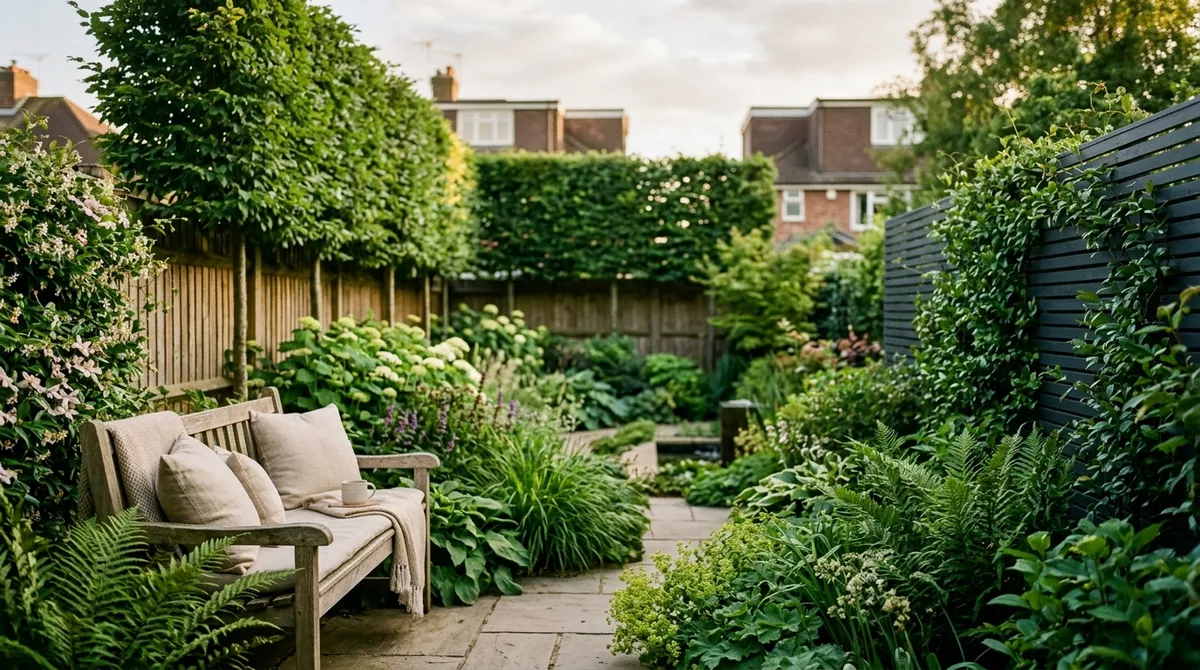
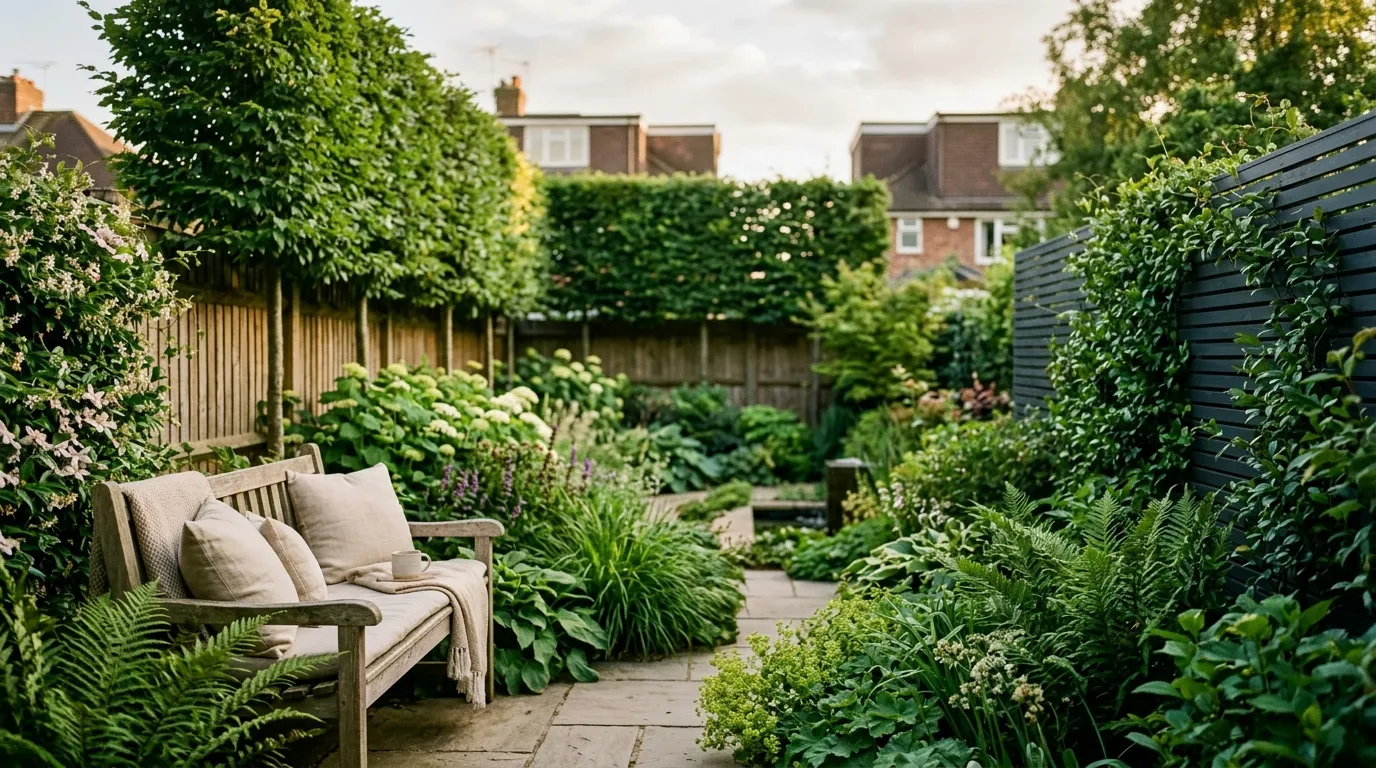 A cocooned seating area screened by pleached hornbeam, a slatted panel and climbers. The neighbours’ windows are softened, not walled out.
Layer screening at three heights
A single tall barrier reads as a wall. Layered screening reads as a garden. The difference is depth, and depth is what makes privacy feel natural rather than defensive.
Work in three layers. The low layer, up to around 1m, is shrubs, grasses and perennials that screen ground-level views and soften the base of taller planting. The mid layer, roughly 1 to 2m, is your fence, trellis, slatted panels and shrubs that block direct eye-level sightlines from neighbouring gardens. The high layer, 2m and above, is trees, pleached stems and pergola beams that deal with first-floor windows.
Stagger the layers in plan as well as height. Set a small tree a metre in front of the fence, with shrubs in front of that, so the eye reads several planes of green rather than one flat line. This is how a 5m-deep border can feel like a private woodland edge.
The borrowed ceiling for upper-window overlooking
A taller fence does nothing about an upstairs window. Upper windows look down at an angle, over the top of any boundary you are allowed to build. The answer is to add a ceiling, not a higher wall.
We call this the borrowed ceiling. It is any overhead structure that breaks the downward sightline above your seating area. A timber pergola is the classic solution. Build it directly over the patio, then grow wisteria, a grapevine or a rose across the top for a living roof in summer. Even bare beams fracture the view enough to take the edge off being watched.
A multi-stem tree does the same job with a softer feel. Plant it so the canopy spreads over the seating area at 2.4 to 3m, and the leaves filter the view from above. Amelanchier and birch are ideal. For instant cover on a sunny terrace, a large cantilever parasol or a sail shade works as a movable ceiling.
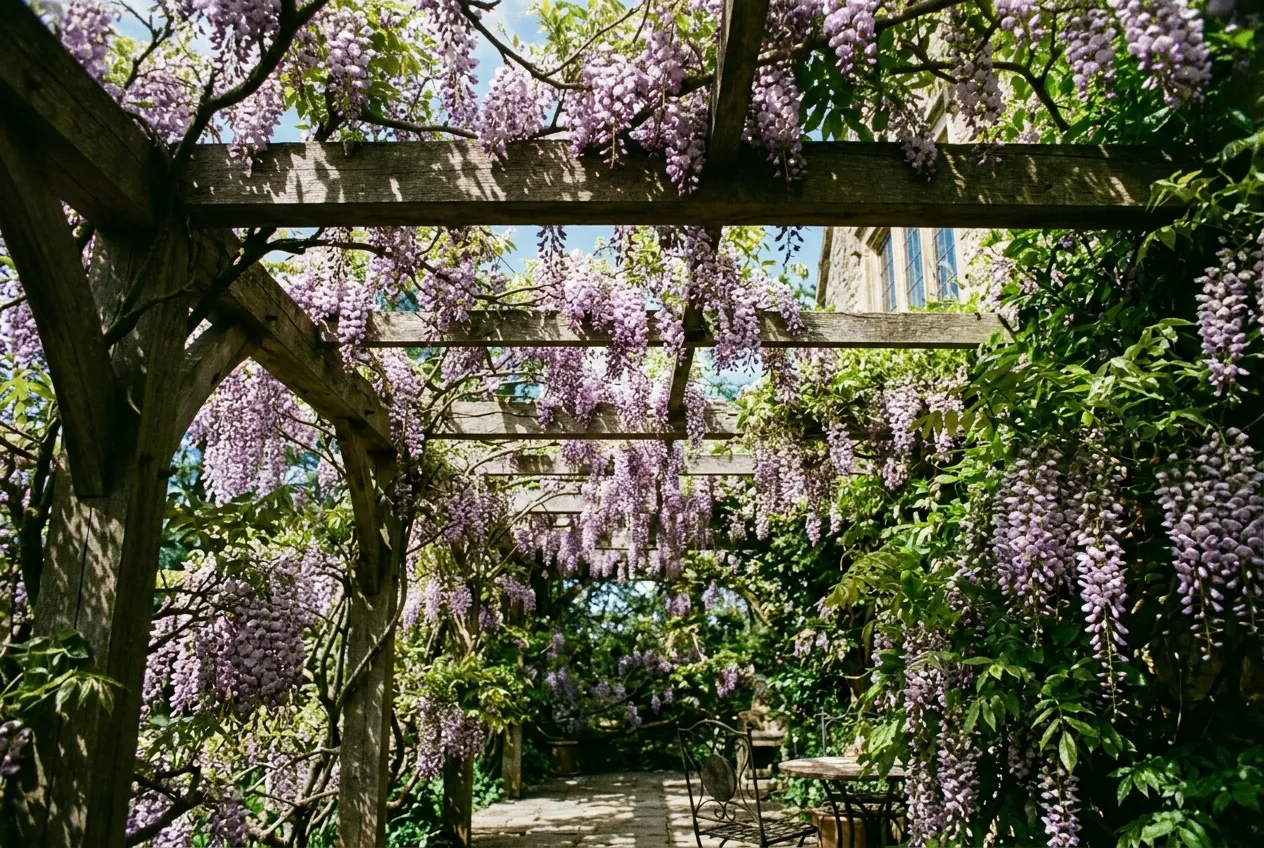 A pergola clothed in wisteria gives a borrowed ceiling. It blocks the downward view from first-floor windows that no fence can reach.
Pleached trees for a raised screen
Pleached trees are the designer’s favourite for an overlooked plot. A pleached tree is trained flat, with its branches tied to a frame so the foliage forms a neat panel on a clear stem. The effect is a hedge on stilts: a clipped green screen that floats above your existing fence.
This is exactly what you want for first-floor overlooking. A standard pleached tree carries its foliage panel from around 1.8m up to 3.5 or 4m, so it sits right where a bedroom window looks down. It blocks that view while taking up barely 60cm of ground depth. A row of three or four screens a whole boundary without the bulk of a full hedge.
Plant pleached trees about 1.2 to 1.5m apart so the panels knit together. Clip once or twice a year, in midsummer and again in early autumn, to keep the shape crisp. Keep them well watered for the first two seasons while the roots establish. Hornbeam is the classic pleaching species; our hornbeam hedge guide covers why it handles clay and cold sites so well.
| Pleached species | Evergreen | Mature screen height | Notes |
|---|---|---|---|
| Hornbeam (Carpinus betulus) | Semi (holds brown leaves) | 3.5 to 4m | Tough, tolerates clay and exposure, classic choice |
| Photinia ‘Red Robin’ | Evergreen | 3 to 4m | Year-round cover, red new growth, fast |
| Pyrus ‘Chanticleer’ | Deciduous | 4 to 5m | Narrow, white blossom, good autumn colour |
| Amelanchier lamarckii | Deciduous | 3.5 to 4.5m | Blossom, berries, light shade, wildlife value |
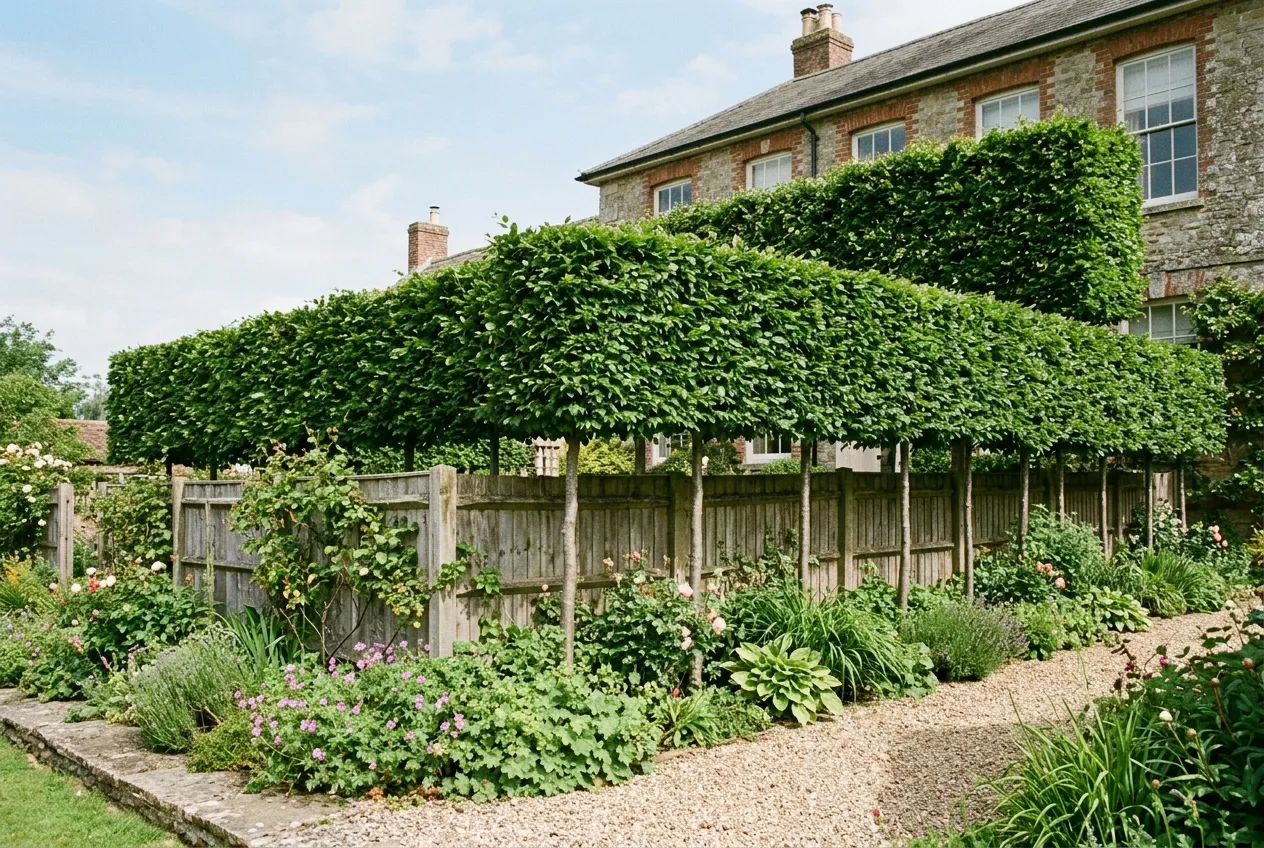 Pleached hornbeam forms a hedge on stilts. The clipped panel screens first-floor windows while using barely 60cm of ground.
Green walls, trellis and climbers
Where ground space is tight, screen vertically. A clad wall or fence takes up almost no room and turns a hard boundary into a sheet of green. This is the cheapest fast privacy you can build.
Fix sturdy trellis above a fence to gain legal height, or fit horizontal wires 30cm apart held 5cm off the wall on vine eyes. Then plant climbers to cover it. For evergreen, year-round screening, star jasmine (Trachelospermum jasminoides) is hard to beat. It climbs 4 to 6m, holds glossy leaves through winter, and carries scented white flowers in summer. Clematis armandii gives fast evergreen cover with early scented bloom.
On a shady, north or east-facing wall, climbing hydrangea (Hydrangea anomala subsp. petiolaris) is the reliable choice. It is slow for the first two years, then clothes a wall in lacy white flowers and clings without support. Our guide to the best plants for shade covers more options for the darker corners every overlooked garden seems to have.
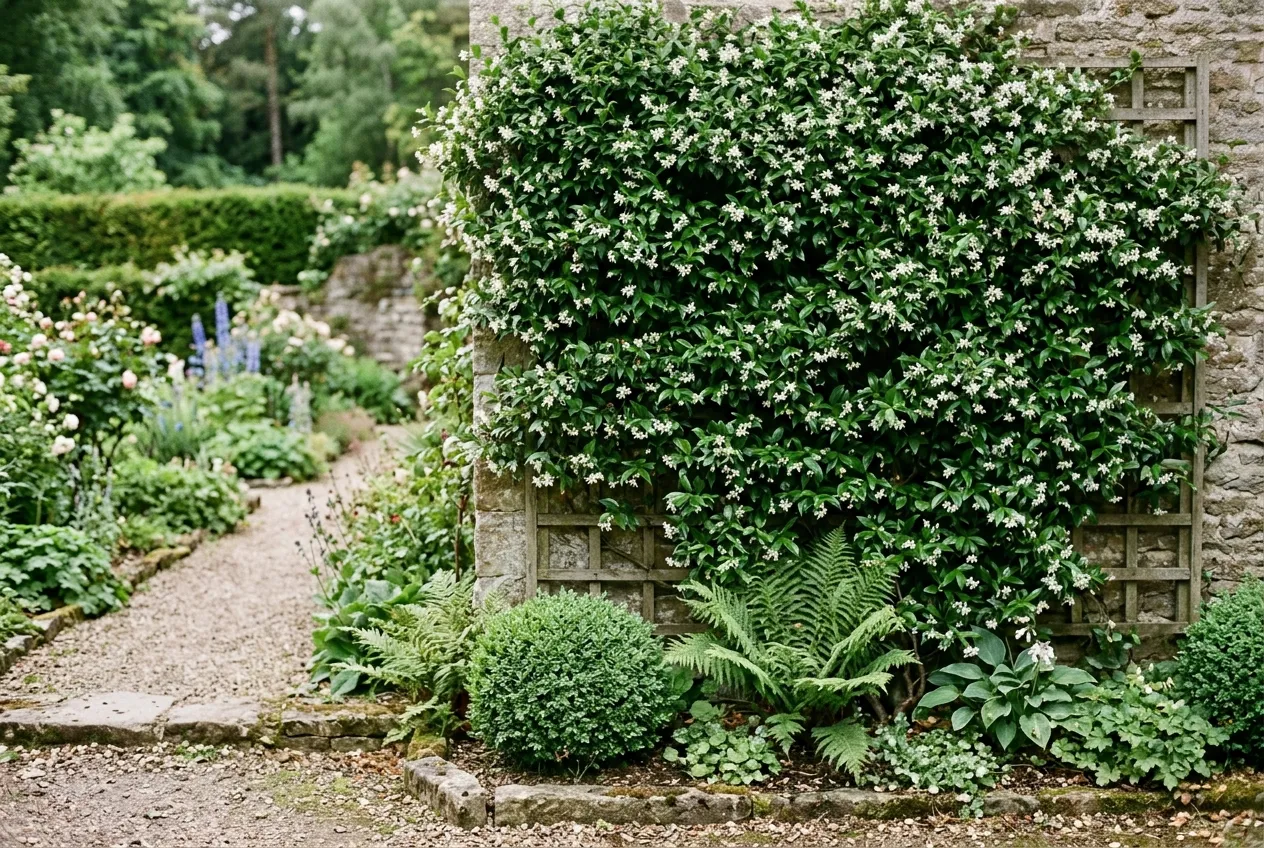 A trellis panel clothed in star jasmine turns a bare wall into a green screen. Evergreen climbers hold cover through winter.
Slatted screens and modern panels
For a clean, contemporary look, slatted screens beat solid fencing. Horizontal hardwood or composite slats with small gaps between them filter the view rather than block it dead. You read greenery and light through the gaps, so the boundary feels lighter while still breaking the sightline.
Slatted panels suit the strategic approach perfectly. Set a single 1.8m panel exactly where one neighbour’s window looks in, leave the rest of the boundary low, and you screen the problem without enclosing the whole plot. Painted a dark grey or charcoal, the slats recede and the planting in front of them stands out.
Use them as room dividers too. A free-standing slatted screen can carve a private seating nook out of an open garden, giving a back to a bench or hiding a patio from the kitchen door. Plant in front of the screen, never behind, so the greenery softens the timber. Tall grasses such as Calamagrostis ‘Karl Foerster’ or a multi-stem shrub work well against the horizontal lines.
Warning: Slatted screens act like sails in wind. Set posts in concrete at least 600mm deep, use 100mm posts for anything over 1.8m, and check your boundary structures stay within the 2m permitted height.
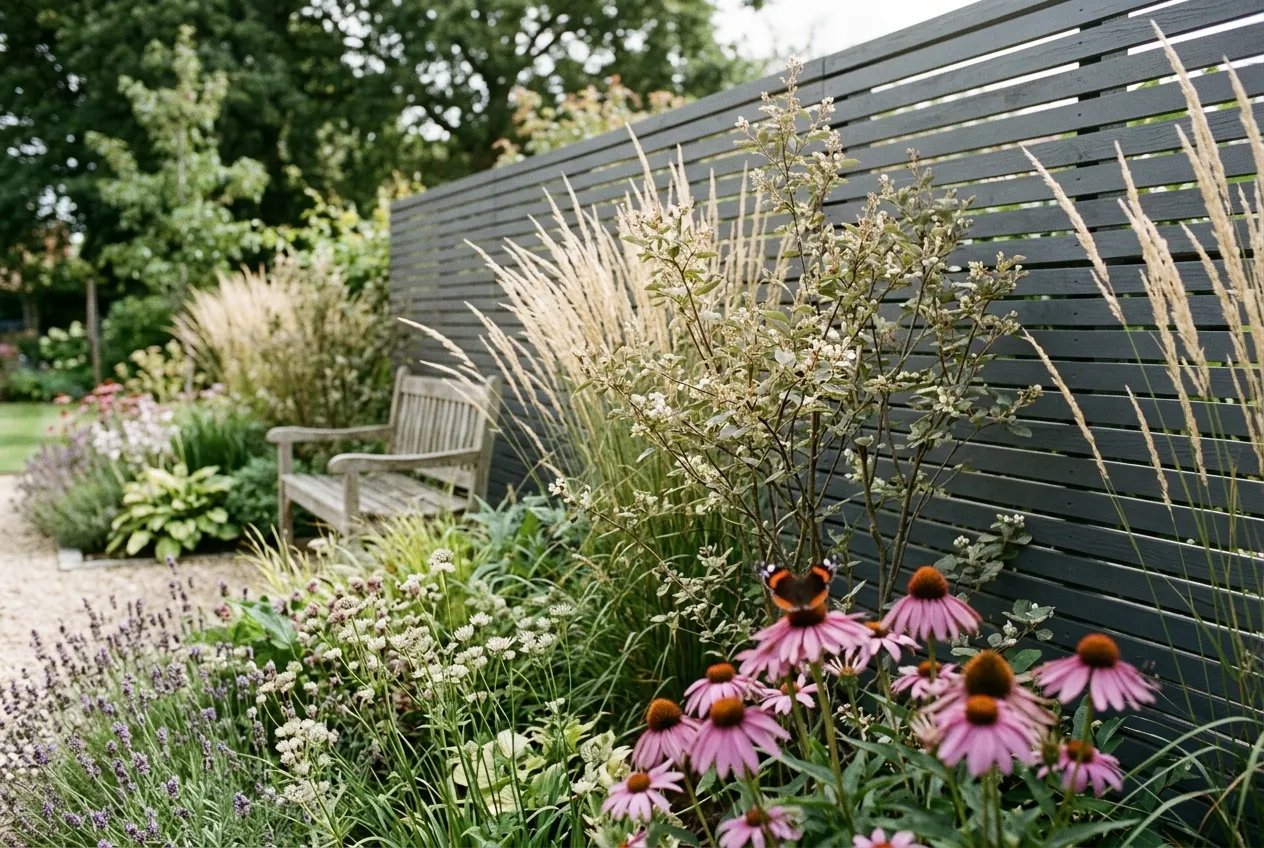 A slatted hardwood screen filters the view rather than blocking it dead. Grasses planted in front soften the horizontal lines.
False perspective and drawing the eye inward
Privacy is partly real and partly a trick of attention. If the eye is busy inside the garden, it stops travelling up to the neighbours’ windows. Good design uses false perspective and strong internal focus to do this work.
Draw the eye down and in. A path that narrows as it goes, or planting that gets finer and paler towards the back, makes a short garden feel deeper and pulls your gaze along the ground rather than up to the skyline. A change of level, even a single shallow step down to a sunken seating area, instantly feels more sheltered and contained.
Lighting extends the effect after dark. Uplight a multi-stem tree or graze light across a textured screen, and the lit garden becomes a glowing room while the houses beyond drop into black.
A focal point and the sound of water
The most underrated privacy tool makes no visual barrier at all. It is sound. Moving water masks noise from neighbours and traffic, and a garden you cannot quite hear into feels private even where it is only part screened.
A simple water feature in a corner does two jobs at once. The sound covers conversation and the gurgle pulls attention inward, away from the boundary. A weathered steel sphere fountain suits this beautifully, its rusted surface and film of moving water giving a quiet focal point that reads as sculpture. The Corten Steel Sphere Water Feature 60cm sits well among ferns and grasses in a shaded private corner, where the warm rust tone glows against the green.
Pair the water with a place to sit and the corner becomes a destination. A solid stone seat tucked into screening planting feels grounded and permanent in a way a folding chair never does. The Rustic Straight Grey Granite Garden Bench settles into a planted nook and weathers in over the years, anchoring the most sheltered spot in the garden.
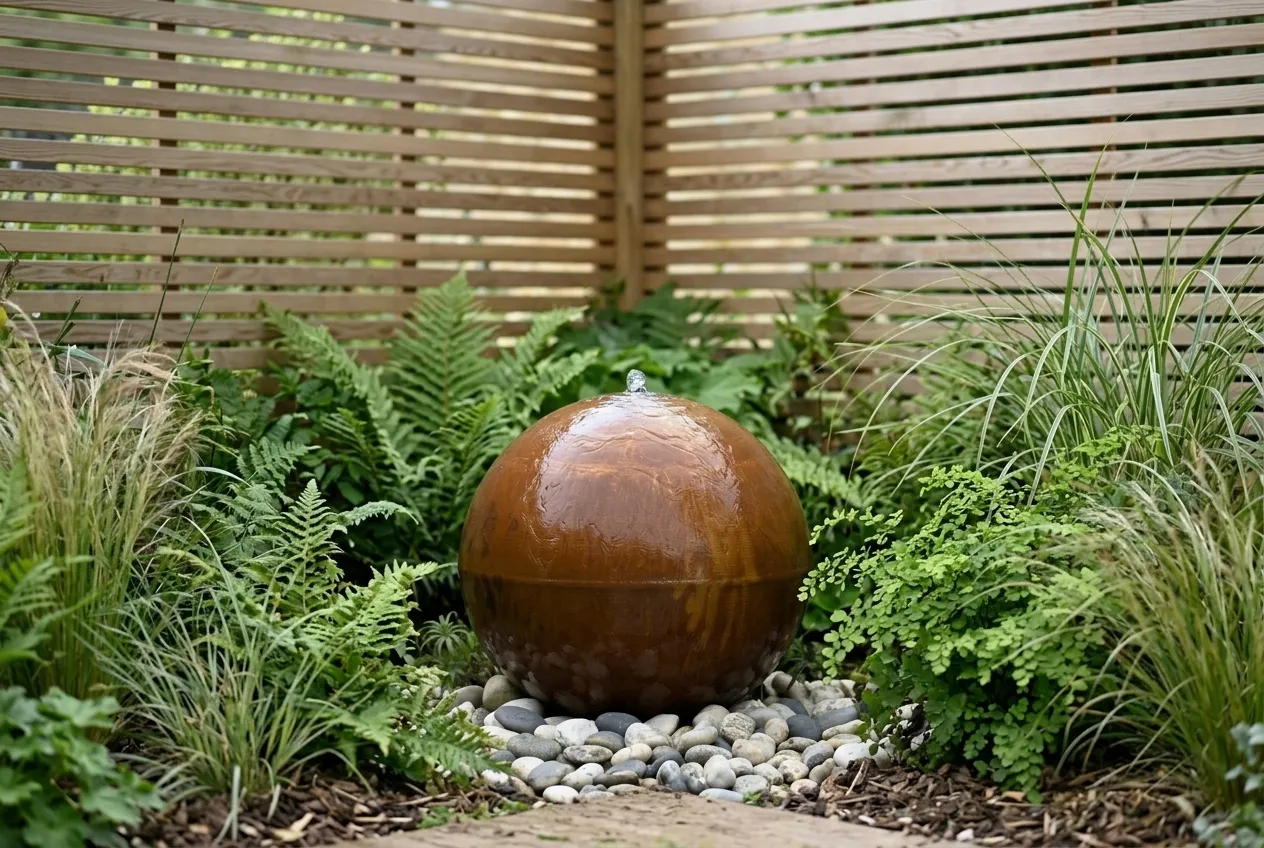 The Corten Steel Sphere Water Feature in a shaded corner. Moving water masks neighbour noise and draws the eye down into the garden.
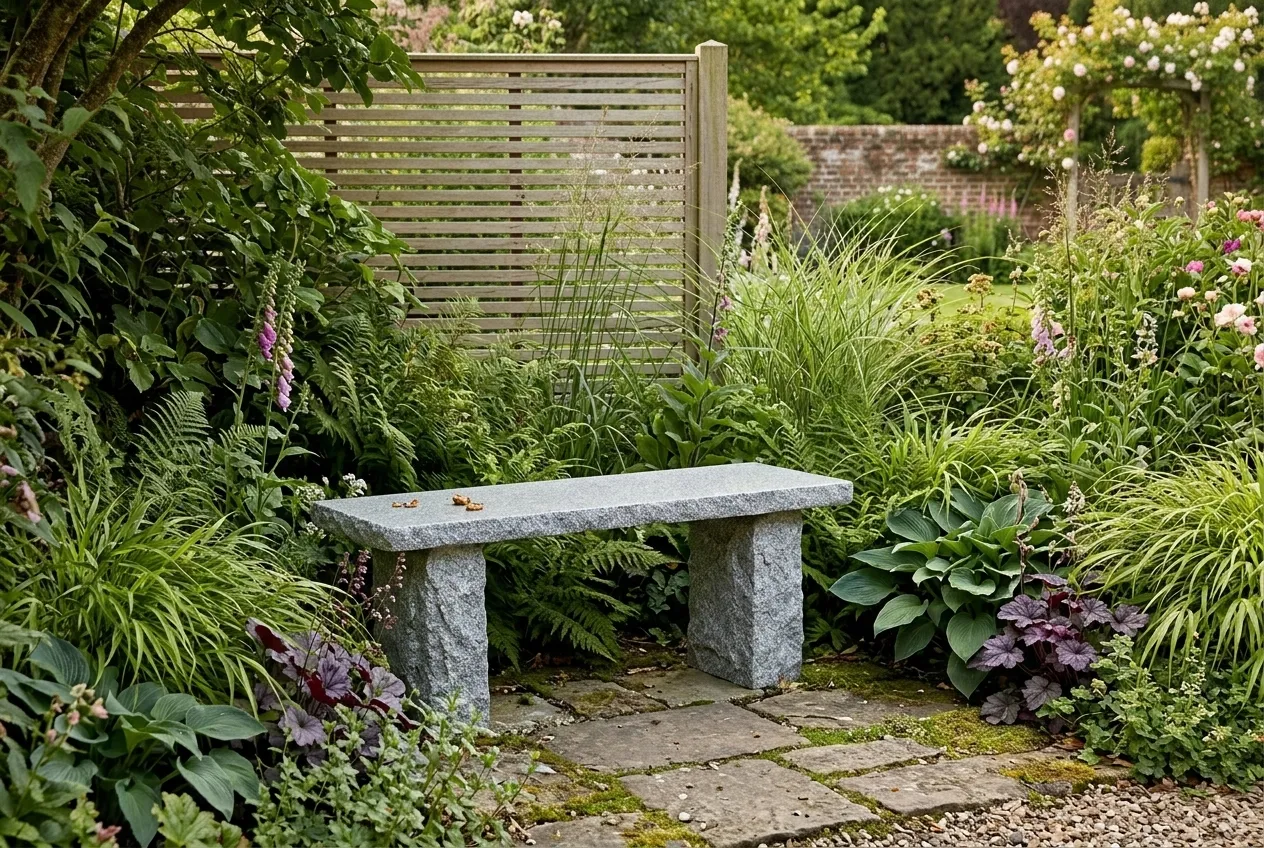 A rustic granite bench tucked into screening planting gives the private corner a permanent, grounded seat.
The 2m boundary rule and what you can build
Before you build anything tall, know the rules. Under permitted development in England and Wales, you can put up a fence, wall or screen up to 2m high without planning permission. Next to a road or footpath used by vehicles, the limit drops to 1m.
That 2m figure is the total height of the structure, trellis included. A 1.8m fence with 300mm of trellis on top is over the limit and technically needs permission. In practice many neighbours never object, but it pays to check before you invest.
Planting is treated differently. Trees and hedges have no height limit under planning rules. However, the High Hedges part of the Anti-social Behaviour Act 2003 lets a neighbour complain to the council about an evergreen or semi-evergreen hedge over 2m that blocks their light. This is why a row of deciduous pleached trees, which are not a hedge in law, is often the safest route to height.
Warning: Always check your property deeds before building or planting on a boundary. Restrictive covenants on new-build estates often cap fence heights or ban anything above a set line. Boundary disputes are slow and costly, so a quick chat with the neighbour first is worth it.
Where to screen first, step by step
Tackle an overlooked garden in order, not all at once. This stages the cost and stops you over-screening.
- Map the sightlines. Sit in your main seating spot and mark every overlooking window and gap with canes.
- Fix the overhead view. Deal with upper windows first, since they ruin the sense of privacy most. Build a pergola or plant a canopy tree over the seat.
- Block the key eye-level views. Add a slatted panel, pleached tree or trellis screen at each marked sightline. Leave the rest of the boundary as it is.
- Layer and soften. Plant in front of every hard screen at low and mid height to give depth and disguise the structure.
- Anchor the space. Add a focal point, water sound and a permanent seat so the eye stays inside the garden.
Follow that order and you spend money where it counts. Most overlooked gardens need far less screening than the owner first assumes once the key sightlines are handled.
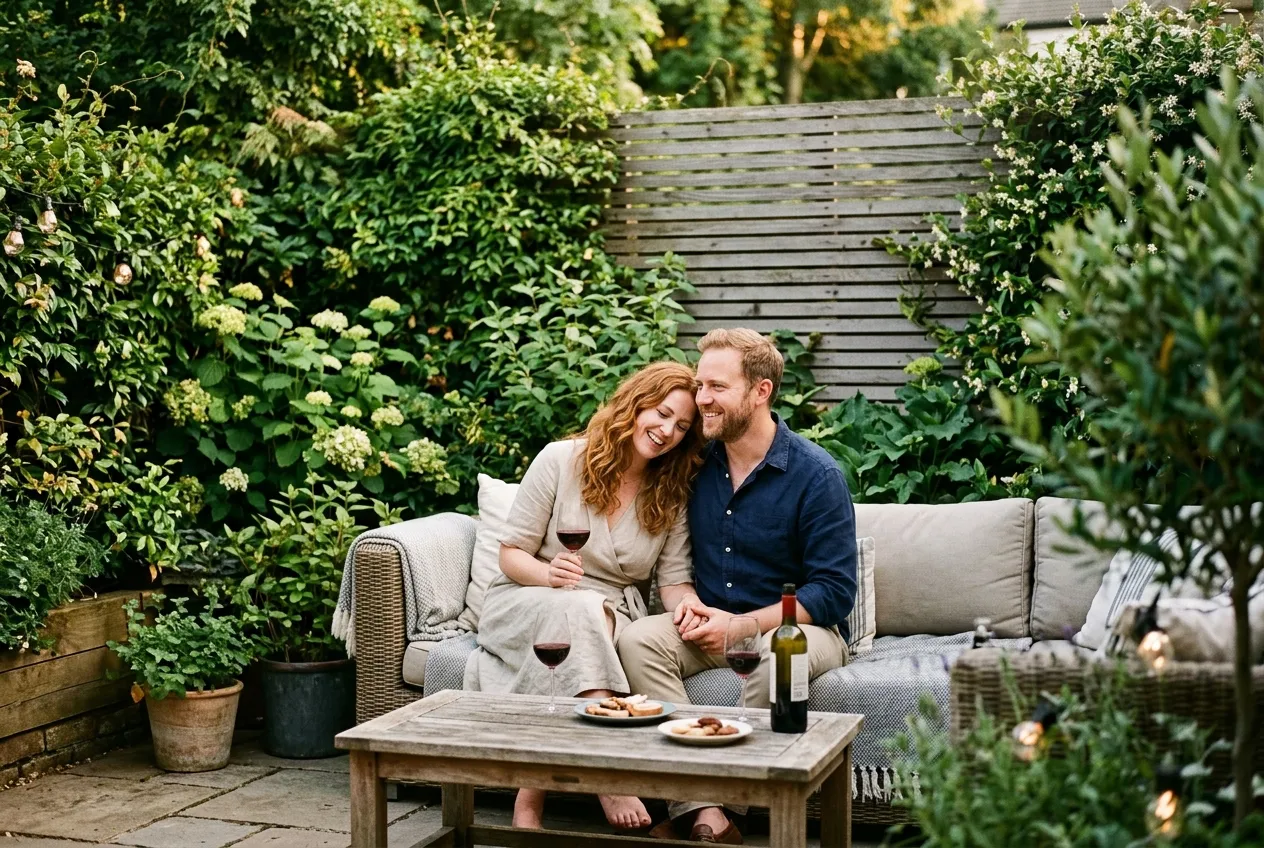 Once the key sightlines are screened and a ceiling is in place, an overlooked patio becomes a private outdoor room.
Common mistakes
Screening the whole boundary
The most common error is ringing the entire plot with tall fence and trellis. It is expensive, it casts shade, and it makes the garden feel like a box. Screen only the sightlines that matter and leave the rest open. The garden stays bright and feels larger.
Forgetting the overhead view
A taller fence does nothing about an upstairs window. People spend hundreds raising the boundary, then sit beneath a clear view from above. Always add a ceiling, a pergola, a canopy tree or a parasol, over the seating area where overlooking is worst.
Choosing fast growers that never stop
Leylandii and bamboo give quick cover, then become a lifelong battle. Leylandii hits 1m a year and shades the whole plot. Running bamboo invades borders and neighbours’ gardens. Choose pleached trees or a clipped evergreen that holds at a sensible height instead.
Planting a single flat line
One straight hedge or fence reads as a wall and emphasises how small the garden is. Stagger planting in depth, with a tree in front of the fence and shrubs in front of that. Layered planes feel private and natural.
Ignoring the rules and the neighbours
Building over 2m without permission, or planting a tall evergreen hedge that blocks a neighbour’s light, invites trouble. Check permitted development limits, read your deeds for covenants, and talk to the neighbour before you start. It saves money and goodwill.
Frequently asked questions
How can I make my garden private from neighbours’ upper windows?
Add an overhead layer, not just a taller fence. Upper windows look down at an angle, so a high boundary alone does little. A pergola, a parasol or the canopy of a multi-stem tree breaks the downward sightline over your seat. Position the canopy directly above where you sit, then add climbers for summer cover.
What is the best tree for privacy in a small garden?
Multi-stem Amelanchier lamarckii is one of the best for small gardens. It reaches 4 to 6m slowly, casts only light shade, and gives spring blossom, autumn colour and berries for birds. For a formal clipped screen choose pleached hornbeam. For a narrow space, upright Pyrus ‘Chanticleer’ takes very little ground room.
How high can a garden fence or screen be in the UK?
Up to 2m high without planning permission under permitted development. Next to a road the limit drops to 1m, and trellis counts towards the total. Trees and hedges have no planning height limit, but the Anti-social Behaviour Act covers evergreen hedges over 2m if a neighbour complains. Check your deeds for covenants first.
Are pleached trees good for privacy?
Yes, pleached trees are one of the most effective privacy solutions. They carry a clipped panel of foliage on a clear stem, raising screening to around 3.5 to 4m while using little ground. This blocks first-floor windows without the bulk of a full hedge. Hornbeam, evergreen Photinia and Pyrus are the usual choices.
What evergreen climbers screen a garden quickly?
Star jasmine and evergreen clematis give fast, year-round cover. Trachelospermum jasminoides climbs 4 to 6m and holds its leaves through winter with scented summer flowers. Clematis armandii grows quickly with early scented bloom. On a shady wall, climbing hydrangea works well once established. Train all of them on wires or trellis held off the wall.
How do I block being overlooked without a huge hedge?
Screen only the key sightlines rather than the whole boundary. Sit in your seating spot and note exactly which windows look in. Place a slatted panel, a single tree or a trellis screen to break just those views. This keeps the garden feeling open while removing the sense of being watched from one or two points.
Does a water feature really make a garden feel more private?
Yes, moving water masks noise and pulls attention inward. The sound of a fountain or sphere covers conversation and traffic, so a space feels enclosed even when it is only part screened. Paired with a strong focal point, water draws the eye down into the garden rather than up towards the neighbouring windows.
Our team produces practical UK gardening guidance from source research, contributor records and established horticultural practice. Editorial standards are overseen by Matt W.