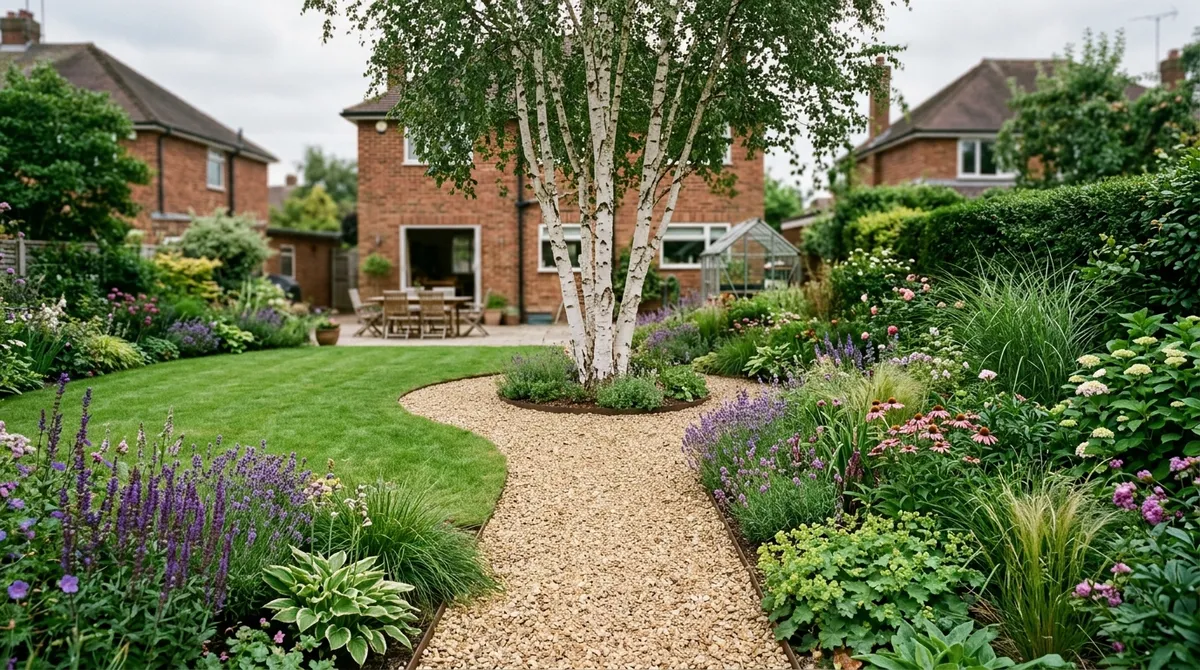
Key takeaways
- Five simple ideas: proportion, unity, rhythm, focal points and balance
- Split the garden roughly into thirds: hard surfaces, lawn and planting
- Make borders at least 1.5m deep so you can plant in three layers
- Repeat plants in groups of 3, 5 or 7 for a calm, joined-up look
- Pick at least two plants that look good in each season
Good garden design isn’t a secret art. Whether you have a tiny courtyard or a big plot, the same few ideas apply. Get them right and a jumble of plants turns into a garden that looks good and works well.
The five simple ideas behind good garden design
Every good garden uses five ideas: proportion, unity, rhythm, focal points and balance. Once you know them, you’ll spot them everywhere.
Proportion means features suit the size of the space. A deep border looks right in a long garden, but a big water feature swamps a small courtyard.
Unity ties things together. If your patio is York stone, use it again for edging or stepping stones. If your house is red brick, use matching brick for raised beds. Stick to about three materials. Too many and it starts to look busy.
Rhythm comes from repeating plants along a line. Lavender planted at regular gaps along a path does it. So does swapping between upright grasses and rounded geraniums. Plant in groups of 3, 5 or 7 for the best effect.
Focal points catch the eye and anchor the design. Have one main one you can see from the kitchen or living room window, like a small tree, a pot, a sculpture or a bench. Smaller ones where paths meet help draw people through the garden.
Balance spreads the visual weight. Formal balance mirrors one side against the other. Informal balance pairs different things of similar weight, like a big shrub on one side and three smaller plants on the other. Informal balance suits most British gardens.
As you develop your layout, explore Warley Place ideas for paths and garden rooms.
 Repeated groups of salvia and catmint give this border a lovely rhythm, with low clipped hedging for shape.
How to use the rule of thirds in your layout
The rule of thirds is the handiest planning trick there is. Imagine a noughts and crosses grid over your plan. Put your main features where the lines cross, about a third of the way in from the edges.
So in a 9m x 6m garden, a tree might sit 3m from the back and 2m from one side. It looks far more natural than right in the middle.
You can split the space in thirds too. In a typical back garden, aim for roughly:
- One third hard surfaces (patio, paths, decking)
- One third lawn or ground cover
- One third borders and beds
How deep should your borders be?
Narrow borders are the most common design mistake. A 60cm strip only fits one row of plants, and it looks a bit mean.
Aim for at least 1.5m. That gives you three layers:
- Back: tall perennials, shrubs and climbers on supports
- Middle: medium perennials and small shrubs
- Front: edging plants and ground cover
For a mixed border, go deeper if you can. That leaves room for shrub roses, tall grasses like Miscanthus and bulbs tucked between.
| Border depth | Rows of plants | Good for |
|---|---|---|
| 60cm | 1 | Edging, along narrow paths |
| 1m | 2 | Small gardens, raised beds |
| 1.5m | 3 | Most borders |
| 2m or more | 3-4 | Big mixed borders with shrubs |

A hose is a handy way to try out a border edge before you cut. Push it out to at least 1.5m and you’ll have room for three layers of planting.
An easy planting plan for beginners
Think in three layers: evergreen backbone, seasonal stars and ground cover. It works in any garden and gives you something to look at all year.
Layer 1: Evergreen backbone (about a quarter of your plants). These hold the garden’s shape in winter. Yew makes a great hedge or screen. Pittosporum ‘Tom Thumb’ has lovely dark foliage. Sarcococca suits shade and smells wonderful in winter. Place these first.
Layer 2: Seasonal stars (about half). These change through the year. Pick at least two for each season. Spring: tulips and Brunnera. Summer: Geranium ‘Rozanne’ and Salvia nemorosa. Autumn: sedum and Japanese anemones. Winter: hellebores and Cornus ‘Midwinter Fire’.
Layer 3: Ground cover (the rest). These smother weeds and knit everything together. Geranium macrorrhizum, bugle (Ajuga) for shade and lady’s mantle (Alchemilla mollis) for sun or part shade are all easy.
 A small garden split into patio, lawn and planting, with a focal point at the far end pulling your eye through.
How to use colour in your garden
Colour is where most beginners wobble. The easy fix: pick one colour scheme and repeat it through the garden.
There are three simple ways to go:
Harmonious colours sit next to each other on the colour wheel. Blues, purples and pinks feel cool and calm. Try Agapanthus, Salvia ‘Caradonna’ and Astrantia ‘Roma’ in a sunny spot for flowers through summer.
Contrasting colours sit opposite each other, like orange and blue or purple and yellow. They add energy. Blue catmint with orange Crocosmia ‘Lucifer’ is a real head-turner. Use contrasts where you want people to look, like by the gate or a seat.
One-colour schemes use shades of a single colour. The white garden at Sissinghurst is the famous one. It’s the easiest to get right because nothing can clash. Try Hydrangea ‘Annabelle’, white Agapanthus, Rosa ‘Iceberg’ and Leucanthemum ‘Becky’.
| Colour scheme | Feel | Plants to try |
|---|---|---|
| Cool (blue, purple, pink) | Calm and spacious | Agapanthus, Salvia, Astrantia |
| Hot (red, orange, yellow) | Lively and bold | Crocosmia, Helenium, Rudbeckia |
| White and green | Elegant and restful | Hydrangea, Rosa ‘Iceberg’, Astilbe |
| Pastel mix | Soft and romantic | Roses, Penstemon, Verbascum |
 Hot and cool colours side by side. Warm oranges seem to jump forward, while cool blues sit back and add depth.
How to keep the garden looking good all year
A garden that only shines in summer looks bare for months. Choose at least two plants that peak in each season.
Winter (December to February): Shape matters most now. Evergreen hedges, the shiny bark of Prunus serrula and the fiery stems of Cornus ‘Midwinter Fire’ carry the garden. Witch hazel (Hamamelis) gives scented flowers in January, and hellebores follow. Grasses like Calamagrostis ‘Karl Foerster’ keep their golden stems. Gardens open through the National Garden Scheme are great for winter ideas.
Spring (March to May): Bulbs fill the gap before perennials get going. Crocus in March, tulips in April, Camassia in May. Brunnera ‘Jack Frost’ gives silver leaves and blue flowers under shrubs.
Summer (June to August): The big show. Geranium ‘Rozanne’ flowers for months, Salvia ‘Caradonna’ gives purple spikes, and Echinacea carries August. Repeat-flowering roses keep going with deadheading.
Autumn (September to November): Sedum turns from pink to rust, Japanese anemones flower on, acers turn red and grasses like Miscanthus catch the low sun.
| Season | Shape | Flowers | Bulbs and extras |
|---|---|---|---|
| Winter | Yew, holly | Witch hazel, hellebores | Snowdrops, winter aconite |
| Spring | Evergreen backdrop | Brunnera, Pulmonaria | Crocus, tulips, Camassia |
| Summer | Clipped evergreen balls | Geranium, Salvia, roses | Allium, Agapanthus |
| Autumn | Evergreen framework | Sedum, Japanese anemone | Colchicum, Nerine |
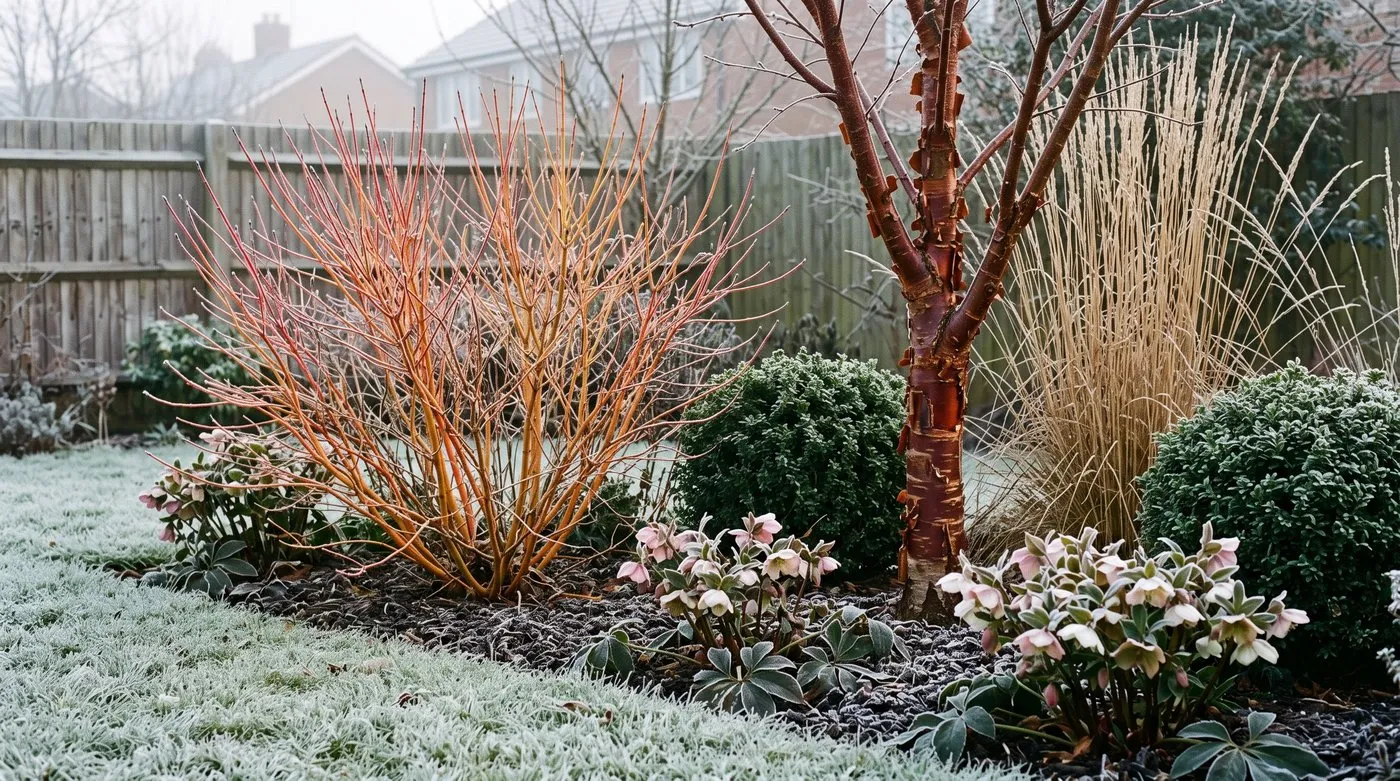
In winter, shape and stems do the work. Evergreens, coloured dogwood, shiny bark and grasses left standing keep the garden looking furnished until spring.
Patios, raised beds and fences
Paths, patios and walls are the bones of the garden. They last for years and cost the most, so plan them first.
Patios are best where they catch the afternoon and evening sun, often a west or south-west spot. Allow about 3m x 3m for a table for four, and a bit more for six. Porcelain paving is easy to keep clean. Natural stone has a softer, classic look.
Raised beds add height and help on heavy clay. About 30-45cm high suits flowers, and a little higher is comfy for vegetables. Railway sleepers or brick both work well.
Fences frame the garden. Paint a fence dark grey or black and your plants will really stand out, while pale fences pull the eye to the boundary. On the street side, a hornbeam hedge gives a softer edge. See our front garden ideas for more.
What a garden makeover costs
Costs vary a lot with size, materials and how much you do yourself. As a rule:
- Hard landscaping (paving, decking, walls) is usually the biggest spend.
- Planting costs much less, especially if you plant it yourself.
- A designer’s plan is an extra, but can save costly mistakes on a bigger job.
Ways to save: buy perennials in the autumn sales, use bare-root shrubs and hedging in winter, and do the planting yourself. Get a few local quotes for any paving or building work.
Common garden design mistakes
Mistake 1: Planting without a plan. Buying plants on a whim and finding a spot later gives you a plant collection, not a garden. Even a rough sketch helps. Mark where things go before you dig.
Mistake 2: Borders too narrow. A thin strip along the fence wastes a lovely planting chance. Push borders out to 1.5m. You’ll lose a bit of lawn and gain a much better display.
Mistake 3: Forgetting winter. Summer-only gardens look bare from November to March. Make about a quarter of your planting evergreen. Add winter shrubs like Viburnum bodnantense ‘Dawn’ and red-stemmed Cornus alba ‘Sibirica’.
Mistake 4: One of everything. Forty different plants, one of each, has no rhythm. Choose fewer kinds and buy more of each. Five each of six plants looks far better than one each of thirty.
Mistake 5: Forgetting the view from indoors. You look at your garden from the house more than you sit in it. Stand at the kitchen window and plan from there. Put your best winter plants where you’ll see them from the warmest room.
Gardening in pots? The same ideas work on a smaller scale with a container-based approach.
Garden design calendar
| Month | What to do |
|---|---|
| January | Take photos from every window. Note the bare spots. |
| February | Draw your plot to scale. Mark sun, shade and what’s already there. |
| March | Finish your plan. Plant bare-root hedging before the season ends. |
| April | Start on paths, patios and raised beds. |
| May | Plant evergreens first, then put up climbers on supports. |
| June | Add summer perennials in groups of 3, 5 or 7. |
| July | Check your colour combinations. Photograph what works. |
| August | Plan autumn planting and order spring bulbs. |
| September | Plant bulbs. Move or split perennials that didn’t do well. |
| October | Plant shrubs and trees while the soil is still warm. |
| November | Look back over the year. Plant bare-root roses and trees. |
| December | Look for plants to fill gaps. Our cottage garden planting plans are full of ideas. |
Frequently asked questions
What are the basic principles of garden design?
Proportion, unity, rhythm, focal points and balance. Proportion means features suit the size of the garden. Unity comes from repeating materials and colours. Rhythm comes from repeating plant groups. Focal points catch the eye, and balance spreads the visual weight so neither side feels heavy.
How do I plan a garden layout from scratch?
Measure your plot and draw it to scale on squared paper. Mark north so you know where the sun falls. Split the space roughly into thirds for patio, lawn and planting. Put the patio where it gets afternoon sun, make borders at least 1.5m deep, and add a focal point you can see from the house.
What is the rule of thirds in garden design?
Imagine a noughts and crosses grid over your garden. Put your main features where the lines cross, about a third of the way in from an edge. It looks more natural than plonking things in the middle.
How deep should a garden border be?
At least 1.5m deep for three layers of planting. That gives room for tall plants at the back, medium ones in the middle and low edging plants at the front. Go deeper if you have space, as plants get more room and the border looks fuller.
How much does it cost to redesign a garden in the UK?
It depends on size, materials and how much you do yourself. Hard landscaping like paving and decking is usually the biggest cost, and planting the smaller one. Get a few local quotes, and save by planting yourself and buying bare-root plants in winter.
What plants give year-round interest in the UK?
Evergreens give the garden shape all year. Yew and holly hold their shape in winter. Witch hazel, hellebores and Viburnum bodnantense flower in the cold months. Add tulips and Brunnera for spring, geraniums, salvias and catmint for summer, and sedums, acers and grasses for autumn.
Should I design my garden in a formal or informal style?
Choose the style that suits your house and how much time you have. Formal gardens use straight lines, clipped hedges and mirror-image planting, and suit period houses. Informal gardens use curved borders and relaxed planting, and suit most homes. Plenty of gardens mix the two.
Our team produces practical UK gardening guidance from source research, contributor records and established horticultural practice. Editorial standards are overseen by Matt W.