Key takeaways
- Plan a sequence of seasonal interest rather than a single display.
- Set out the border and its access before choosing plants.
- Keep a simple notebook of plant names, positions and observations.
- Use a restrained plant palette that fits the available space.
- Review changes without treating the first plan as permanent.
Begin your garden plan with the space available, a sequence of seasonal interest and a manageable choice of plants. Warley Place’s surviving plants and changed grounds offer useful starting points for that planning.
Essex Wildlife Trust describes a former Edwardian garden that volunteers restored without recreating its original form. That distinction is the starting point here.
For a smaller garden, the useful questions concern seasonal interest, clear spaces and manageable plant choices. What should happen next after the first flowers? Which plants deserve room?
These five lessons are Garden UK’s interpretation, not Ellen Willmott’s documented gardening method. They connect the surviving site with decisions you can make at home. Our garden design guides can help you develop the details.
What survives at Ellen Willmott’s Warley Place
Warley Place is a nature reserve with surviving plants and evidence of its earlier gardens. It is not a preserved version of Willmott’s original scheme.
Essex Wildlife Trust describes the 25-acre, 10-hectare site as the location of her house and once-famous Edwardian gardens. Willmott remodelled the gardens and introduced a large assortment of plants from around the world. Some still survive.
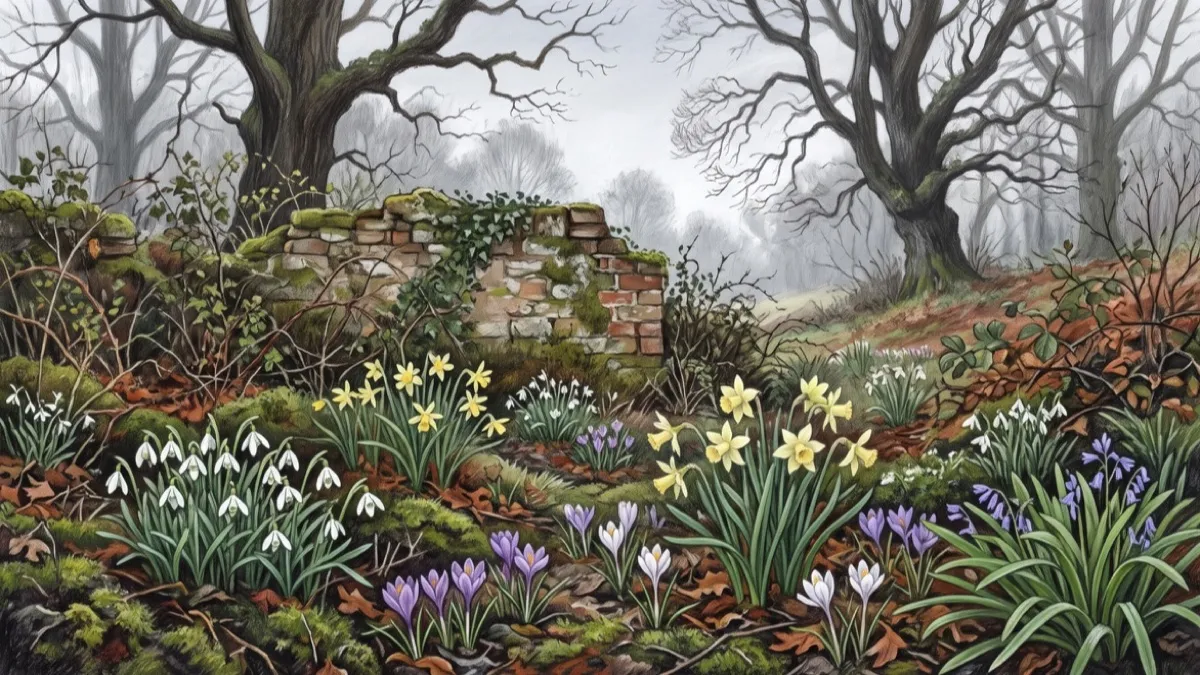
The Trust names magnolias, camellia, winter aconites, anemones, foxgloves, ferns and huge sweet chestnuts. Its spring sequence includes snowdrops, daffodils, crocuses and bluebells.
Building remnants, hidden cellars, water holes and decaying walls are historical evidence and reasons for visitor care. They are not design details to copy.
Willmott’s influence also extended beyond this site. The RHS history records her advice before Hanbury’s 1903 gift of Oakwood to the society.
Warley Place lesson 1: plant for succession
Plan what follows each display before adding more plants for the same moment. A border plan needs a sequence, not simply a shopping list.
The Trust’s spring list provides a useful starting point: snowdrops, daffodils, crocuses and bluebells. Treat that as a sequence to observe, rather than a calendar promise for every garden.
Each plant needs a place on your plan and an expected period of interest, checked against the plants you choose and the conditions you have.
Then ask what remains when the flowers finish, leaving room for the other planting instead of filling every gap immediately.
For planting dates, use our guide to when to plant spring bulbs.
A useful first step is to choose fewer bulb groups and give each a clear position. You can add another group after observing the first season.
The aim is to understand the sequence before expanding it. A photograph at each change will be more useful than a vague memory of spring.
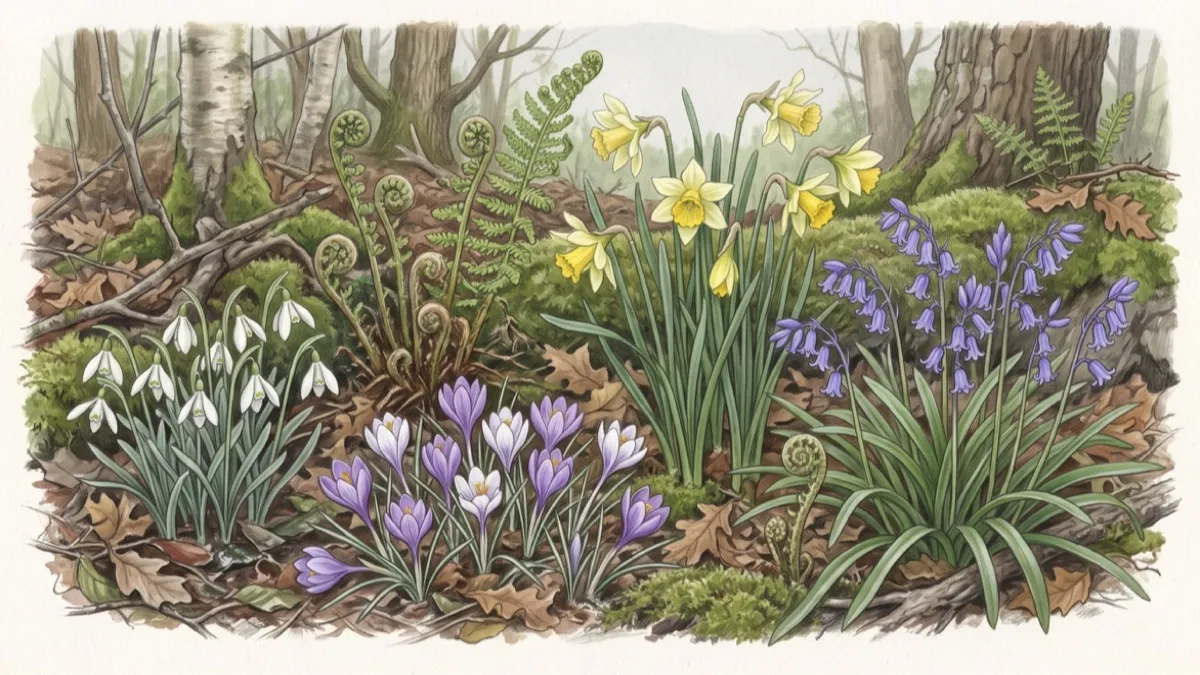
Editorial illustration: a generic bulb succession study, not Warley Place or a record of its planting layout.
Warley Place lesson 2: make structure clear
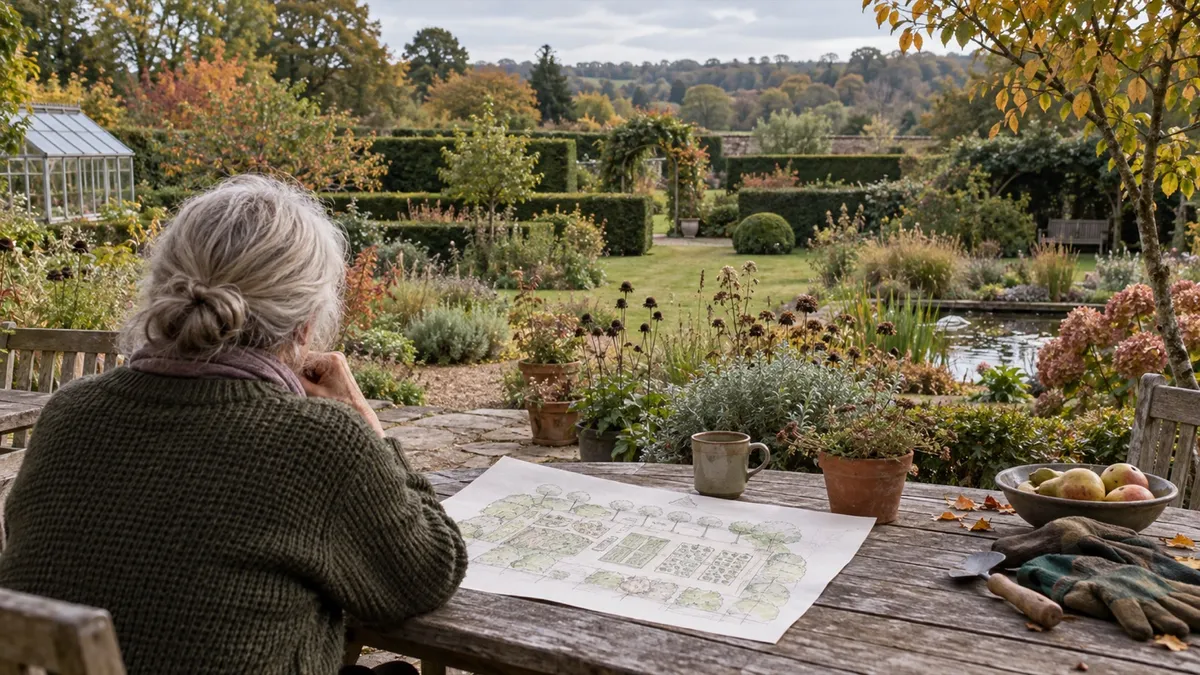
Draw the usable space before choosing the plants, marking the border edges and the route you need for access.
Warley Place contains evidence of a garden that changed substantially. That history prompts a practical question: can you still understand your own plan without its plant labels?
For a small garden, a measured outline is a useful beginning, with doors, existing access and the space you need to reach the border marked clearly.
Deciding where the planting ends gives you a boundary to work within as you consider individual plant choices.
Our garden design principles for beginners can help you organise those decisions.
A simple outline also gives you somewhere to stop. An appealing plant does not automatically justify extending the border.
Keep the historical distinction clear. Surviving walls and cellars tell us about Warley Place’s past; they are not instructions for a new garden.
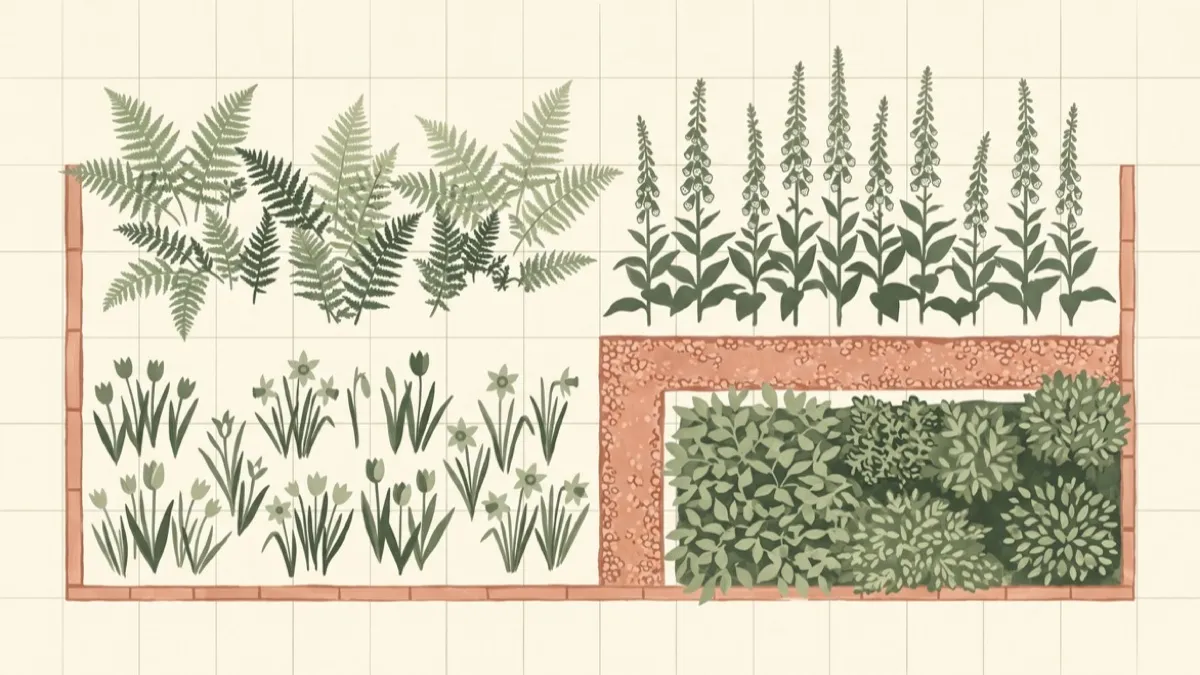
Editorial illustration: a generic garden layout, not Warley Place or a reconstruction of its gardens.
Lesson 3: keep a simple plant notebook
A record of what you plant, where it goes and what you observe gives your next decision something firmer than memory.
The Trust records that some plants introduced by Willmott still survive. It does not establish the notebook method suggested here.
For your own garden, give each plant group a short reference that appears on your sketch and beside the plant’s name in your notebook.
The purchase or planting date is useful if you know it; unknown details can stay blank rather than being guessed.
During the year, note the first flowers you observe and any gaps you want to reconsider. Keep observations separate from proposed changes.
For example, an empty patch is an observation. Buying another plant is only one possible response.
A photograph from the same position can accompany each review of the border, with notes short enough that you will actually return to them.
Before buying, read the previous entry. You may already have a plant that needs moving rather than replacing.
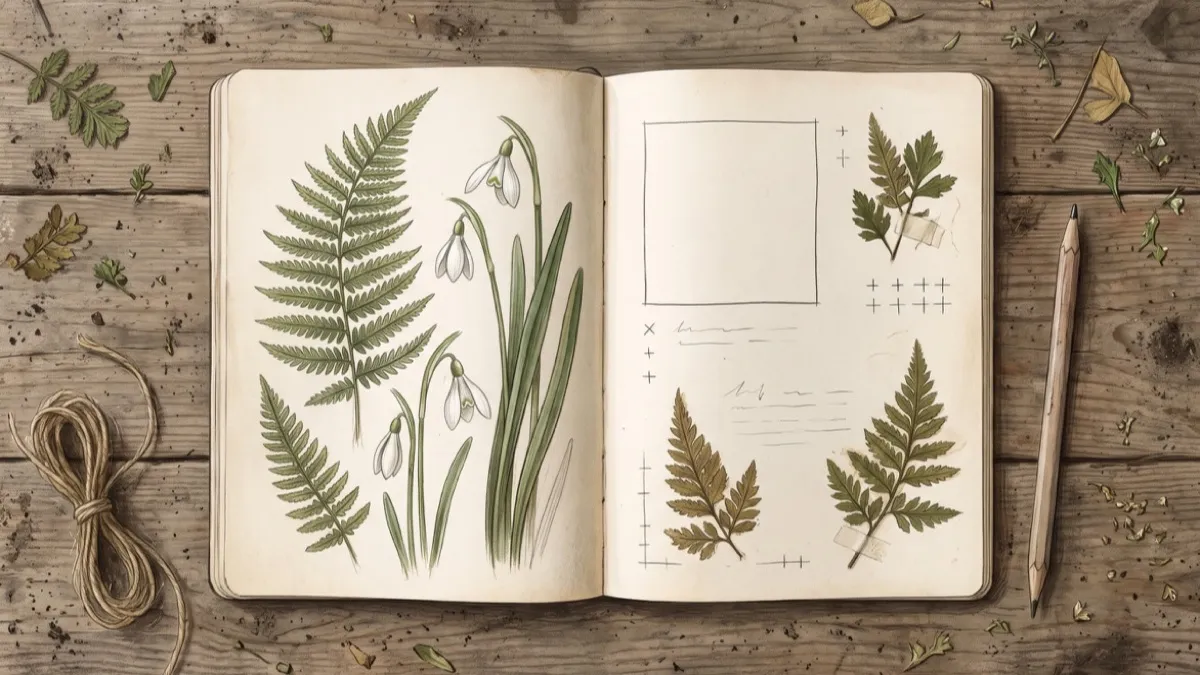
Editorial illustration: a generic gardener’s notebook, not Ellen Willmott’s notebook or a document from Warley Place.
Lesson 4: restrain the small-garden palette
A limited palette lets you choose plants for the space you have, rather than copying the breadth of a large collection.
Willmott introduced plants from around the world at Warley Place. A small border does not need to reproduce that collecting ambition.
The following 3m x 4m border is Garden UK’s example. It is not a reconstruction of Warley Place.
The outline is 4,000mm wide and 3,000mm deep. These four zones total 12 square metres.
| Zone | Dimensions | Example planting | Starter quantity |
|---|---|---|---|
| Back strip | 4,000mm x 1,000mm | Ferns | 3 plants |
| Middle strip | 4,000mm x 1,000mm | Foxgloves | 5 plants |
| Front left | 2,000mm x 1,000mm | Daffodils | 15 bulbs |
| Front right | 2,000mm x 1,000mm | Snowdrops | 30 bulbs |
These quantities are a starting sketch, not universal spacing instructions. Choose suitable species or cultivars after checking light, soil and mature spread.
Quantities may need adjusting if your selected plants require different spacing, while access belongs outside the planted rectangle.
The bulb groups give the plan a spring starting point. The remaining choices keep the palette limited without requiring every plant named at Warley Place.
Before ordering, write the final choices beside the sketch, leaving any unsuitable position unresolved until you have checked it.
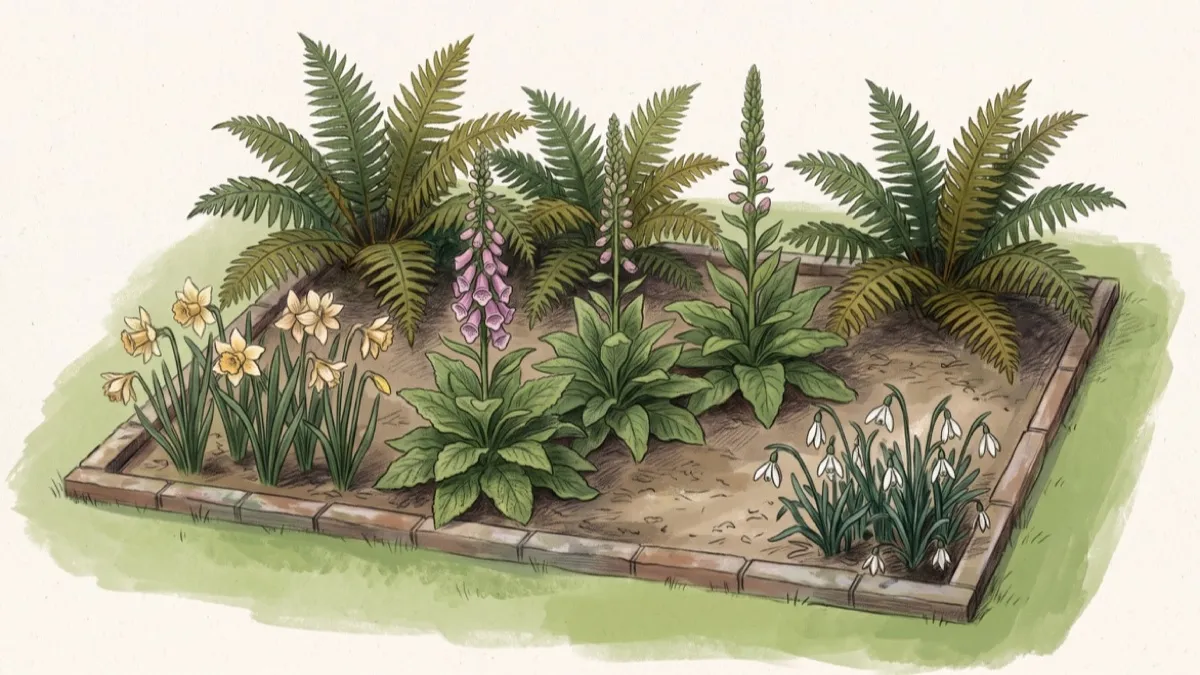
Editorial illustration: Garden UK’s example border, not Warley Place or a reconstruction of its historic planting.
Warley Place lesson 5: allow the garden to change
Reviewing the garden as it develops gives you room to keep useful decisions and reconsider the rest, without treating the first plan as permanent.
The Trust says volunteers restored Warley Place after neglect, but not in its original form. The surviving site therefore needs to be understood as a changed place.
For your garden, separate planned changes from simple observations. A note of what has spread, disappeared or become difficult to manage gives you a starting point for deciding what to do.
You do not need to preserve every original choice. Equally, an unfamiliar change does not automatically need correcting.
If wildlife is part of your plan, our guide to creating a wildlife garden gives you another planning reference.
The purpose of the space can guide your decision: does the change support it? Record your answer before altering the planting.
Common mistakes to avoid
Copying a plant list without checking the space is an easy mistake. Use the names as research prompts, then check the individual plants.
Buying for one flowering period leaves the rest of the plan unresolved. Sketching the next stage helps you consider what follows before adding another plant.
Treating every gap as a buying instruction can also make the plan harder to read. Your notebook is a useful first reference.
Historical hazards are not decorative details to copy. At Warley Place, building remnants and hidden hazards require visitor care.
Keep folklore separate from evidence. An entertaining story is not a reliable planting instruction.
Frequently asked questions
What is Warley Place today?
Warley Place is a nature reserve on Ellen Willmott’s former house and garden site. Essex Wildlife Trust describes it as 25 acres, or 10 hectares. Volunteers restored the neglected site without recreating its original form.
When is the best time to visit Warley Place?
Essex Wildlife Trust describes February to June as the best visiting period. Its spring plant list includes snowdrops, daffodils, crocuses and bluebells. Building remnants and hidden hazards are reasons to follow visitor safety guidance.
Did Ellen Willmott influence RHS Wisley’s history?
Yes, she advised Sir Thomas Hanbury before his 1903 gift to the RHS. The RHS records that he bought Oakwood at Wisley and the adjoining farm. Following Willmott’s advice, he gifted Oakwood to the society.
Is the ‘Miss Willmott’s Ghost’ seed story true?
It should not be used as evidence of Willmott’s gardening methods.
Can a small garden use these Warley Place lessons?
Yes, these practical ideas can guide a small-garden plan. The 3m x 4m example is Garden UK’s design exercise, not a reconstruction of Warley Place. Check individual plant requirements before buying.
Measure your space, then use our mixed-border planning guide to turn the sketch into a planting plan.
Our team produces practical UK gardening guidance from source research, contributor records and established horticultural practice. Editorial standards are overseen by Matt W.